A Sonnet of Two Letters

It happens to us alone, but it happens to so many it’s a trope we share. It goes like this: you have one of those bad dreams. Something terrible has gone wrong — and you, inside the dream, feeling it is real, try to fix it — but you can’t because the other people in the dream are oblivious to the terrible and are acting stubbornly in odd, irrational ways. While dreaming you’re trapped in this desperately unsolvable situation only you can clearly see and try to act rationally on, running in place, thinking in circles.

I had one of those dreams this week: felt so real, so heart-wrenching. Then the dawn comes, and you realize that experience was a dream — oh, that’s why you couldn’t fix it, that’s why everyone else in the dream was acting so wrongly!

OK, exiting satire mode, but let’s stay strange.

Early this Fall I was cleaning out something: a box, a drawer, a binder, a little used bag, I can’t remember exactly what. But in it was a clutch of papers. I glanced at the pages and recognized it was a mix of things: some works-in-progress looking for first reads from the old group of poets I used to meet with every month, and some initial drafts of a longer, multipart poem I was writing as my mother was going through her last hospitalization, the one from which she would ask to return to the home I grew up in with my father and sisters in order that she could die there. I set those sheets of paper aside.*  I figured I’d look them over later, maybe digitally scan them, or put them in my filing cabinet. At that later I’d also look to see if there were any drafts in the small stack that were unfinished pieces I could revisit.

Now here it is, we’re November and I finally got around to that sort-out. One of the pages was a college-ruled notebook sheet with a complete intermittent draft of an irregular (American) sonnet. What was this? While I remember well working on the longer poem around my mother’s last illness 20-some years ago, I had no memory of working on this sonnet. Complete blank. Moreover, the sonnet seemed to speak of someone’s story that I didn’t recognize as mine — nor anyone else’s I could recall either.** With the time-interval between discovery of the papers and my finally going over them, I can’t even be sure if this sonnet was found among the stuff from the time of my mother’s death or not. Trying to determine why I didn’t remember it, I wondered if it was even older. I recalled that scholars date Emily Dickinson manuscripts by looking at the changes in her handwriting over time, so I tried that assay. Looked to me more like my 20th century handwriting, so the poem could be older. Still, it was my handwriting, testifying I, however unremembering, wrote this poem — and “What was it about?” That intrigued me. The poem asks the reader to work obliquely, details are supplied but not all the details, something that can tantalize.

A Sonnet of Two Letters

The gardening stake metaphor used in the final section reminds the 2024-me of Robert Frosts “Pea Brush,”  a poem I didn’t know when the me I was back then wrote it

.

Why did the voice in the poem not mail their first letter? What was it about the recipient’s husband that was germane to that decision? Was there an affair or appearance of one? Clearer to me was the latter part, the stuff of the second letter, a recalling of youthful aspirations and a friend who by what they said helped make them more substantial than pretensions. What an interesting yoking, I thought. The imperfect, the not said, or the thing whose saying we keep hidden — combined with the things that were said that help us realize our lives.

As you might tell from the previous paragraph, I was experiencing this poem just as I would the general run of Parlando Project poems, ones written by others in a project which has as one of its mottos “Other People’s Stories.” Its mystery and ambiguity captivated me, and so I set about making it into a Parlando song.

I did a revision of the initial handwritten draft I had found and worked on combining it with the music you’ll hear with it below this week. The music today is played as a conventional LP-era rock ensemble: there’s the usual quartet: bass, drums, chordal and “lead” guitar. Added to that are two keyboards, piano and Hammond organ. You can hear the result with the audio player gadget you should see just below. No gadget? Wake up, this highlighted link opens a new tab with its own audio player.

.

*Two of those poets have since died, I re-handled those pages, ones they’d typed in and handed to me years ago, and thought tenderly of them. My part of the household is due for an austere “death cleaning,” the tossing of those things an old man keeps to extend something of the life of that-and-those who’ve passed on. I have no grave illness, but the keeper now must consider that they will pass on and that there’s no real keeping.

**I did write from personas in my writing life regularly, a bit more so in prose than poetry. I was likely imagining the “short-story” plot that I then went about expressing in the sonnet.

Nature Can Do No More Blues: Combining mysteries with bottleneck slide guitar

I thought I was done with my Emily Dickinson series. I had started to think of what poets would be next, and….

Emily came back.  Not the mystical psychedelic Dickinson. Not the weird indie-folk Dickinson. Oh, still mysterious, still a trickster — but she asked not for unusual harmonies or strange timbres this time. She wanted to Rock!

Well, if you’ve been in a mode lately of working with acoustic guitar, and you want to transition to Rock, then there’s no better way to start than Blues. I grabbed my bottleneck slide and my resonator guitar* and it was time to get down with some rough ‘n’ ready Delta Blues — at least the way I play them.

I didn’t learn how to play slide from some Papa Legba at the crossroads, nor by grizzled tutelage from an in-the-tradition player. I was an Iowa teenager when a white college kid from Minnesota pulled out a severed wine bottle top from his jean-jacket pocket and proceeded to show the results of the guitar lessons he’d had in Minneapolis.**   I recall his technique was not pristine, but the sound including the incidental noises of the slide grinding into the strings and occasionally slapping onto the fretboard entranced me.***  Five years later I finally decided to try to figure out how to play guitar, by myself, living in a little rented travel trailer, and unable to afford any lessons.

We know Emily Dickinson played piano. Did she have lessons her family could have afforded her? Did a family member teach her? I don’t know if we know what kind of music she played, but it may have been hymns and popular parlor pieces that were sold as sheet music. Did the Celtic immigrants in Amherst leak any of their music to her? Was Black American music in her ken, and if so what variety? All mysteries, but it’s unlikely she had any idea of Blues music, because as best as can be determined, it didn’t exist yet. Sometime around the time her poetic writing was tailing off, it seems that Black Americans began mixing the musics they heard around them in North America with the music that survived the slave ships, and lullabies, and work-a-day chants of work-gangs or field laborers. Most were newly freed from enslavement. Commercial entertainment was a newly opened field for them as musicians and as audiences. In this new situation they had a new story to tell.

Extracted as musicological theory, Blues can be expressed in a lot of ways, but my appreciation says it’s an attitude as much or more than a scale, timbre, or harmonic framework. What attitude? The Blues isn’t “the Blues” as Western European derived Americans knew it. It’s not melancholia or simply depression. It’s not elevated Romantic despair. Sad, bad, and difficult things happen in a Blues song, but that’s not the main point: the main points are that the singer is still here, can tell you about it, and has maybe figured out something about what has led to this situation that they’ll share with you.

So, here’s what Emily Dickinson did that was Blues-like. Like the Blues, Dickinson is going to use humor and incongruity to describe her experience. If death is a fact of human existence, she’s going to write its Yelp review telling you about it. She’s going to tell her tales using coded language at times, so as to not rile up those who think she shouldn’t have the thoughts she has — and besides, coded language gives one the paradoxical freedom to choose the strongest, sharpest words.

Now the poem I took today is from late in Dickinson’s life, and it’s more puzzling than many of her often puzzling poems. “Nature can do no more” strikes me as an Autumn poem. Here’s all it is, as she wrote it down:

Nature can do no more
She has fulfilled her Dyes
Whatever Flower fail to come
Of other Summer days
Her crescent reimburse
If other Summers be
Nature’s imposing negative
Nulls opportunity —

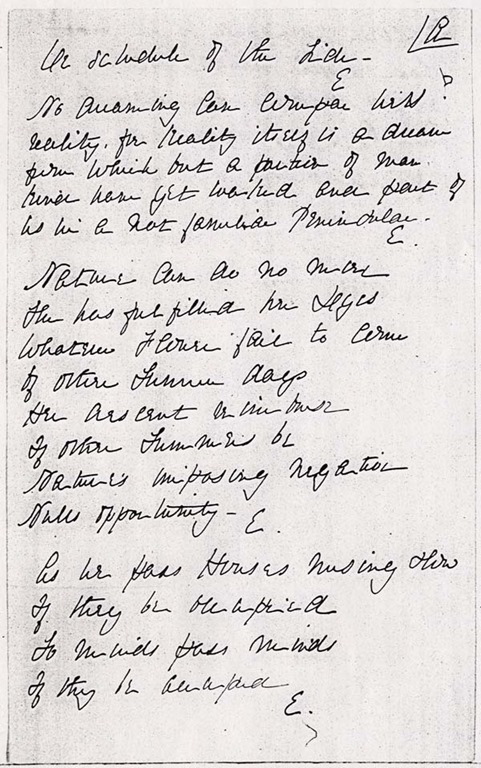
Nature can do no more in Manuscript

Dickinson’s “Nature can do no more” in manuscript. Above the poem she wrote: No dreaming can compare with reality, for reality itself is a dream from which but a portion of mankind have yet worked and part of us in a not familiar Peninsula.“

This poem expresses itself strangely. “Fulfilled her Dyes?” Floral blooming colors? Autumn leaves? Punning “dies?” The transcribers think she scribed “crescent” but it might be “descent” — but what’s accounts receivable here? “Negative Nulls opportunity?” As the Pythagorean math-lyricist Billy Preston put it “Nothing from nothing leaves nothing.” Or it just clearing the field for new growth? I saw a short presentation on Dickinson poetry this week where the presenter compared Dickinson to Joyce’s tangled Modernist word-play mode. This poem would be an exhibit for that.

But this struck me as Blues-like too. You see, following up on my mid-century, Upper Mississippi white-blues-kid introduction to this old acoustic Blues style, I wanted to hear more of this music performed by its originators, and you did that listening to LPs re-recorded off of worn, made-cheap, second-hand-store shellac 78s, cut fast in any handy room with a single approximated microphone. It’s a powerful sound, but it’s not a pristine and clear sound. And the singers, even if I was in the room — maybe because I was in the room, a white guy like almost all the recordists — aren’t always going to speak out. They’re asking to be heard by other Afro-American listeners perhaps, so their patois and accents aren’t lightened or toned down.

To this day, after years of listening, after much more study of Afro-American history and language, after generations of audio restoration advancements, there aren’t 100% agreed upon transcriptions of lyrics sung and said on all those early 20th century records (and their meaningful context) — “crescent” or “descent” isn’t the half of it.

So mysterious Emily Dickinson, meet Geeshie Wiley.****  What’s “Eagles on the half dollar” have to do with commerce and sex, was it “bolted meal” and flour or flowers?  I was ready to combine the mysteries here — and yes Emily Dickinson, rock a little.

I might have performed Dickinson’s exact words for this piece, but I wanted them to fit into a common Blues music form, and so I was already prepared to modify them. I decided to make words that were more my extrapolation of what I feel she might be saying as she views the null of winter coming on with the knowledge of the cyclical phase of the seasons meaning another summer follows. I tried to mumble the words a bit as I sang them to give it the air of those old slide-guitar Blues records. Here’s what I sang:

Nature can do no more, she has fulfilled her Dyes
Flowers that failed to bloom left for other summer days

The crescent moon decrees, other Summers yet to be
Colors’ slow cremation — nulls for opportunity

Yes, there’s a spoken aside in the middle of the song. I’m not printing that, because the spirit of the old 78s says you have to try to figure it out. You can hear my performance of this “after a poem by Emily Dickinson” song with the audio player you should see below. No player seen? You don’t have to jump the Katy looking for it, you can use this highlighted link that will open a new tab with its own audio player.

.

*The, neck and the body’s outline shape is like a regular acoustic guitar, but the top and interior are replaced with a 10-inch metal speaker cone. This cone is driven to vibrate by the bridge holding the guitar’s strings producing a louder piercing tone that has a directness and can’t-ignore-it volume that Blues players liked.

**The kid’s name was Don Williams, an all-to-common name. If he’s still alive he’d be in his 70s. I’d love to meet him again if only to tell him that for all his pretentions and mine he imprinted my approach to the guitar.

***This is not how everyone plays slide guitar, even Blues slide. Precise touch and technique can produce music with tight intonation that avoids all these artifacts. I just like hearing those artifacts. I love recording piano with key or pedal noise or even a bit of a squeaking bench too.

****I often fear I’m too long-winded when a feeling starts me up. But I’m nothing like what recordings like Geeshie Wiley’s can do to folks whom the muse has touched. Here’s two of them (warning: long form writing)  Daphne A. Brooks. John Jeremiah Sullivan.

Christina Rossetti’s May

Here’s a piece using a Christina Rossetti poem “May,”  that’s both simple and spare and mysterious and broad. Early in this project I presented several of Rossetti’s poems, most of which were new to me, because her short, lyrical poems delighted me with their avoidance of the cruft her English Victorian contemporaries often fall into. Nothing’s universally wrong with elaborate poems, but to my tastes, sparer poems can offer us guidance to pay attention, real attention,  to what remains.

Here’s the text of her short poem. The stuff in curly brackets are variations I found in a short search through versions online.

I cannot tell you how it was; {,}
But this I know: it came to pass
Upon a bright and sunny {breezy} day
When May was young: ah, pleasant May!
As yet the poppies were not born
Between the blades of tender corn;
The last egg {eggs} had not hatched as yet,
Nor any bird forgone its mate.

I cannot tell you what it was; {,}
But this I know: it did but pass.
It passed away with sunny May,
Like {With} all sweet things it passed away,
And left me old, and cold, and grey.

These variations are from tiny to small. A semicolon or a comma? Can anyone make any difference from that? “Sunny” or “breezy?” I prefer sunny, breezy is more active, since this is a poem that works its magic by giving us a still moment, and then showing us it’s not. And if sunny, then “sunny” is nicely repeated in the 11th line, when this short poem begins to refrain with itself. “Egg” or “Eggs?” Close call there. Egg lets us see a singular egg (it’s usually easier to invoke a single thing vividly rather than a multitude), but “eggs” make the point that this is an entire reproductive process. “Like” or “With?” I like “like.” “With” followed by that “all” has a sense of this being an immediate entirety. “Like” allows us to hear the poet say some thing, part of an indefinite series of loss or leaving, has gone away. Again, the power of the singular. Do we know what that thing is? The poem decides not to tell us.* How does that choice rank against the power of the singular? If it’s not named it could be anything,  the ultimate multitude of possibilities. Here choices for singular things in this short poem become more important, because it then sets off this missing piece of information about what has gone away in contrast to the specific things named around it.

Wait, that’s not a springtime bird guarding its nest in the lilacs!

.

Do you notice one more variation in the poem’s structure? Hint: how many lines? One, two, three, four…Oh, 13 lines. This works like a sonnet, it even has a turn, a volta, after 8 lines, as in one highly common sonnet format; but the final section is 5, not 6 lines.

It’s too certain a variation not to think that Rossetti decided to make a little meta point that other poets or sonnet fanciers alone will catch. “Yeah, something’s gone and left—there’s no damn 14th line!”

I can’t tell you why the variations in the exact text of this poem. I presume that someone, or Rossetti herself, did a light revision before some level of republication. Which is the latest? Which did Rossetti herself prefer? My scholarship is such tonight that I simply don’t know.

But I did worse. Just today, after I had finished recording the performance that you’ll be able to hear below, I noticed I’d made an error, a variation myself. The copy of the text I was working from had dropped the 13th and final line.

I could simply redo the performance, but it’s become difficult to record acoustic instruments over the past year for this project. Though it blunts the meta-point of the 13-line sonnet, I tell myself there’s power in my unintentional change. “Left me old, and cold, and gray,” the 13th line I inadvertently left out, tells us more about that mysterious thing that has “passed away” with May. My slip-up retains some additional mystery.

The player gadget will appear below for some of you to hear my performance of Christina Rossetti’s trimmed-down sonnet, accidentally trimmed again. If you don’t see the player, you can use this highlighted hyperlink, which will open a new tab and play the song.

.

*Here’s another short write up about this poem, which summarizes some of the guesses about what has passed away. Some love gone sour is one guess, and what with the spring birth specifics in the first 8 lines, perhaps some opportunity to have a child would be another. My accidental deletion of the last line, with its emotional damage curtly listed, adds an element of “All things must pass” to the loss, the possibility of a more Buddhist outlook to a change that’s part of the illusion of possession.

A Mien to Move a Queen

Ready to go on a roundabout trip with today’s blog post? Keep your hands inside the car, we’re going somewhere back to here on another wild-mouse ride.

A couple of things the foot-square vinyl LPs of my youth afforded us: liner notes to help guide us in appreciation of the grooves within, and more commonly as The Sixties progressed, lyric sheets.

Not every record had those lyric sheets. Some artists opposed them on principle—Bob Dylan was one—though to a large degree the reason we got them was due to that hold-out, Mr. Dylan. Dylan revolutionized song lyrics. Before Bob Dylan, no one wrote songs with lyrics like he did.*  After Dylan, a lot of everyones tried their hand at it. In the 21st century when we hear or see lyrics that use an accretion of rapidly changing metaphors and a kaleidoscope of dark-cylinder mental outlooks, we no longer notice that they are Dylanesque. It’s just a mode that songwriters can draw from the common.

Would that have happened if Dylan hadn’t happened? Possibly. And plausibly, only similarly, but distinctly different. Would Richard Farina (sans motorcycle accident) or Leonard Cohen have won a Nobel prize for reshaping a word form?

One argument that it would have still happened was the psychedelic phase of pop music that followed Dylan’s revolution. There, later in The Sixties, opaque and strange lyrics got another push, one that was largely ascribed to intoxicating chemicals which produced visual sequalae and baroque mental turns. Now of course the intoxicated or drug altered poet was already a thing in literary poetry, and the sober cold-water-army songwriter was likely a minority long before “The Sixties.” But Dylan had punctured the membrane that separated those two crowds, and so we got the Canyons of Your Mind school of songwriting too.

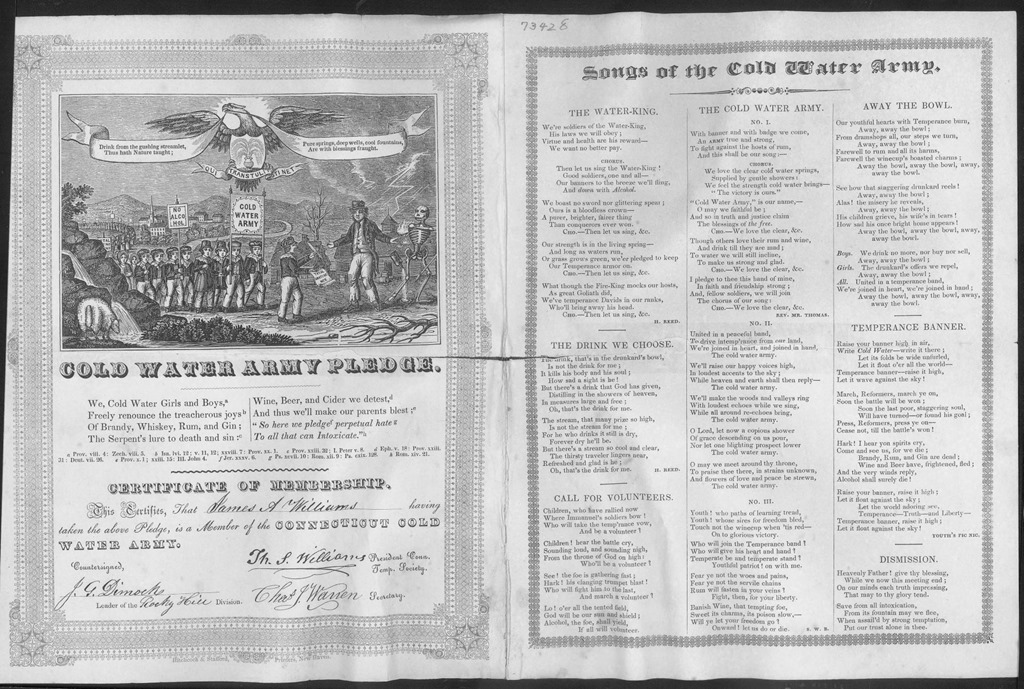
Cold Water Army

19th century straight-edge punks on dihydrogen monoxide, usually also anti-slavery and pro-women’s rights too. Comes with a lyric sheet!

Some of it was good, some of it bad—but then we might see lyric sheets to the wind like these:

Oh where are you now
Pussy willow that smiled on this leaf?
When I was alone
You promised the stone
From your heart….
Brandish her wand
With a feathery tongue

Or

A mien to move a queen
Half child—half heroine
An Orleans in the eye
That puts its manner by
For humbler company
When none are near
Even a tear
Its frequent visitor

Or

If you were a bird and lived very high
You leaned on the wind as the breeze came by
Say to the wind as it took you away
“That’s where I wanted to go today”

And

Bedouin tribes ascending
From the egg into the flower
Alpha information sending
States within the heaven shower
From disciples, the unending
Subtleties of river power

The chorus sings: “OK Boomer,” and you can ascribe all of these to chemical traces, wonder about their authors consequent mental damage, or coldly appreciate them as word music, but I’ll come at you from a minority report: the trip’s in your head, not in the drug. I gave up stuff you can smoke (mostly nicotine) around the time I passed the trustworthy border age of 30. I never spun the pill roulette wheel. Needles are for records or loose buttons.

Next stop for the psychedelic bus is some credit for those lyrics above. The first is from Syd Barrett’s post-Pink Floyd song “Dark Globe.”  The second is the beginning of an arresting if mysterious poem by Emily Dickinson. The third is by children’s writer, humorist, and WWI vet A. A. Milne quoted by songwriter Paul Kantner to begin the Jefferson Airplane’s “Ballad of You and Me and Pooneil.”  And the fourth is the start of “Slip Inside this House”  from the 13th Floor Elevators’ Tommy Hall and Roky Erickson.

A little day glo paint or patchouli and Emily Dickinson fits right in when she writes in this mode I think, even if she’s a century too soon, “The Eighteen-The-Sixties.” When I ran into that first stanza of her 1861 poem known by it’s first line “A Mien to Move a Queen”  earlier this month, I was immediately captured by its strange mystery, so much so that I worked out the music you hear today without even knowing that the poem was longer than that one stanza, and I was so entranced by it that the piece you hear today uses only the first and last parts of her poem because I think the middle parts break the mood that first stanza gave me. Want to see the entire poem? The link is here.

The omitted middle section seems playful to me—even as the British would say, twee, but I am of course editing a genius here. I still like my selection as I hope it adds some weight to the whimsey. What was Dickinson on about in this poem? Even living with it for a few days, I’m not entirely sure. The opening stanza is often read as connecting to Joan of Arc. Some read the poem as Emily reflecting on herself and constructing her own persona, and the middle section I omitted gives some evidence of that. Beside it’s general mysteriousness, there are to my mind two pieces of particular heightened sensitivity or even hallucinogenic imagery: the “Orleans in the Eye” line and the sensuous and heard quiet of the “Like Let of Snow” image.

So, we started with musty cardboard squares and moved through two steps of an era of wilder and wilder metaphors sung to music, and finished with Emily Dickinson, sewing 1861 fascicles by whale oil light while listening to Syd Barrett or A. A. Milne feedback on her record player long into the night. In between songs, the needle stops shimmying and she can hear the sound of snow moving across snow outside, filling, and not, summer’s empty room.

The player to hear my musical performance of a selection from Emily Dickinson’s “A Mien to Move a Queen”  is below. Thanks for reading and listening!


*Yes there are examples that made it into popular or semi-popular music pre-Dylan. Modernist poetry had already done all of these things earlier in the century, and  in addition, a big part of what Dylan used in creating his work were the un-acknowledged Modernists who created the Afro-American blues. None of that disproves the point that Bob Dylan showed that you could do that sort of thing in a proximate way that led to a revolution in the possibilities of song lyrics.

A Certain Slant of Light

The Parlando Project combines various words (usually poetry) with music as varied as I can make it. When I planned the Parlando Project I did not intend to post detailed examinations of the poems’ meanings.

After all, I thought, listening to music is a sensuous experience, and poetry, as it is musical speech, also has its impact when hearing it, independent of any final meaning one could extract from it. Of course, assuming the poetry is in one’s own language, it’s nearly impossible to escape meaning if one allows oneself to listen at all. Some words and phrases will mean something, even on first hearing, even with the most confusing and difficult poetry.

In the end, we may experience a difficult or elusive poem as if it was a set of flat-pack furniture, or a jigsaw puzzle, or as one of those plastic model kits that I bought and glued together in my youth. But in those cases, a wordless black and white sheet with numbers and pointed arrows inside the carton tells you this is to be assembled as a dresser or end table, and the puzzle or model kit has the beautiful color picture on the box top that tells you the pieces’ assembled meaning.

With a poem like Emily Dickinson’s “There’s a Certain Slant of Light”  there is no picture of it complete, there are no assembly instructions. If you try to put it together, you may feel there are pieces missing.

The pieces, though, are beautiful, even left unconnected, even if we don’t know what the whole is to be. Slanted light on a winter’s afternoon with a heft like music. Shadows holding their breath. Heavenly hurt without a scar.

The Emily DIckinson Internal Difference

See Emily play?

There’s no harm in going to the bottom of this post and using the player to hear my performance of “There’s A Certain Slant of Light”  without reading the rest of this. There will be no test. There’s no correct answer. You never need to put down your pencil and close your test booklet. Dickinson didn’t write about what she intended with this poem, and intelligent readers have differed in what they found there. Some found an end-table, others a fine art painting, others a plastic 1940 Ford sedan built one of three ways. Some listeners will just enjoy the pieces. There’s a little piano motif I play in it: A, B, C, E ascending and then back to A again. What does that mean? It’s an arpeggiated A minor (add 9) chord, or it’s just a series of notes that sound “meaningful” in sequence without knowing the harmony.

AMT 1940 Ford 3 in 1 model car kit

It could look like this after you put it together

Here’s that player to hear my performance of Emily Dickinson’s “A Certain Slant of Light.” No assembly required.