I’m going to present a pair of poems which are more related to Armistice Day, the former name for the holiday now called Veteran’s Day in the U. S. Here’s the first one.
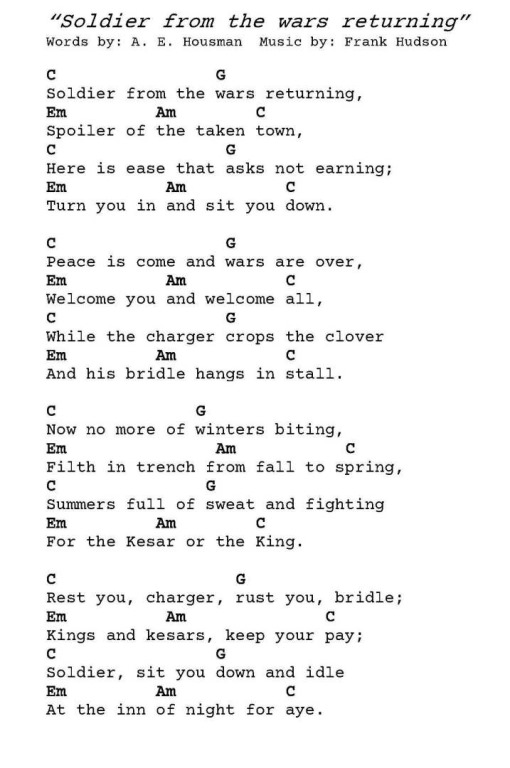
Earlier this month I was confessing to Lesley Wheeler that I haven’t read much of English poet A. E. Housman, a poet who I believe retains more readership in the UK than here in the States. Well, no matter how little I know of him, his poetry has qualities that attracts musical composers like myself.
Here’s a chord sheet for today’s song. I recorded this with a capo on the 2nd fret, sounding in the key of D
.
This poem, which may not have had a title as I saw it with just the first line in quotes, is clearly a poem for Armistice Day and its veterans, first published a few years after the end of WWI. I don’t find it a complicated poem, but that doesn’t hurt it when one seeks to be comprehensible in an immediate performance such as I gave it. It’s hope, contemporary with Housman and his listeners when he wrote his words, that “wars are over,” now has sort of cruel quaintness, but it was an earnest statement then. Here’s a link to Housman’s words, and then below this is an audio player gadget to hear my performance of the song I made from them.
No audio player? Clicking on this highlighted link will open a new tab with its own audio player in that case.
Allow me to be more internal than I usually am when presenting these pieces. Today’s piece uses my own words (we do that rarely here) and it’s here today for a peculiar reason — and peculiar is something I enjoy indulging in.
Early this autumn I was looking for a musical piece that represented the season, and I recalled this poem of mine that I had written music for. When? I probably wrote the poem early this century, and from a file I found, I was able to determine I wrote the music in 2007. Sometime after writing the music, I recorded what I recall was a pretty good version of it, likely with Dave Moore playing keys.
“Maybe I made this one of the early Parlando Project pieces” I thought. At the beginning of this Project as I was figuring out how to compose and record our combinations of original music with literary poetry, I had used several recordings of that vintage. Having some already completed pieces gave me time to get a handle on other tasks while getting this thing going.
But, what, I didn’t know? Well, I’ve put up over 700 publicly accessible pieces in this Project’s lifetime since 2016 — and that doesn’t count the ones that just didn’t work or didn’t fit the concept. One might like to think I keep my eye on every sparrow — but with that amount of catalog, it’s not fully accessible in my head. So, I looked. Here. For my own work.
Nope. I hadn’t presented it. It might not have made the cut because I wrote the words, and the Parlando Project is about other people’s words. Where else might it be? I looked in my somewhat disorganized collection of sessions and finished non-public pieces. Nope, not found there either.
My solution then was to re-record it. Recording time has been hard to come by lately, but I remembered this poem-which-became-song as being effective, so I tried to have it ready when I could open my microphone and record.
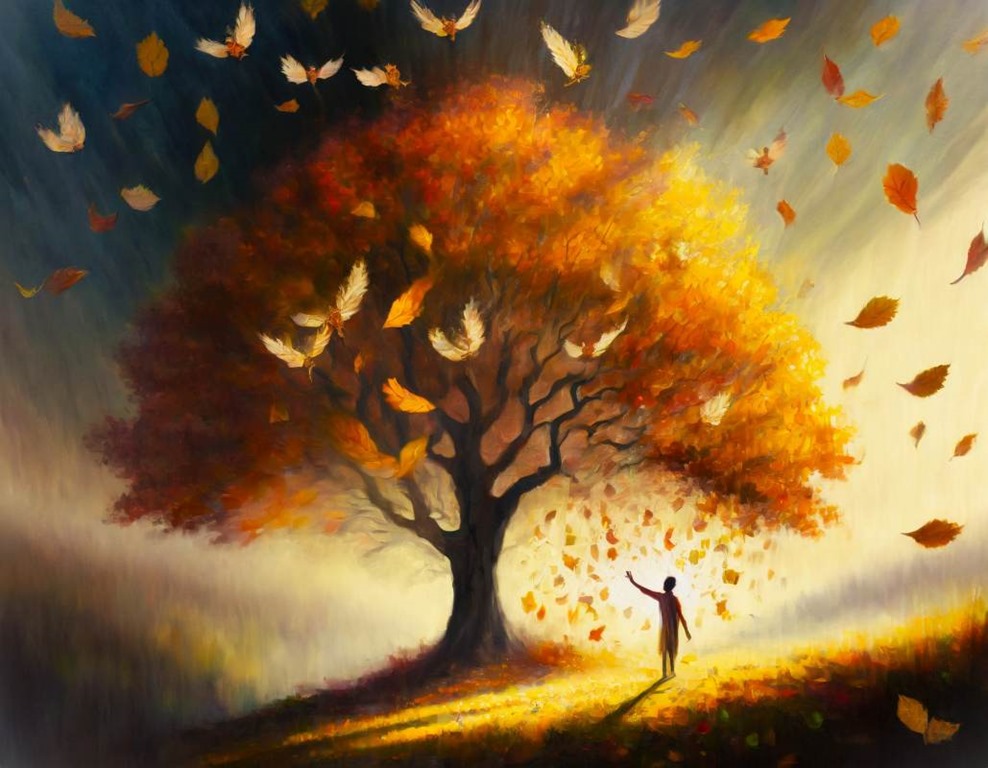
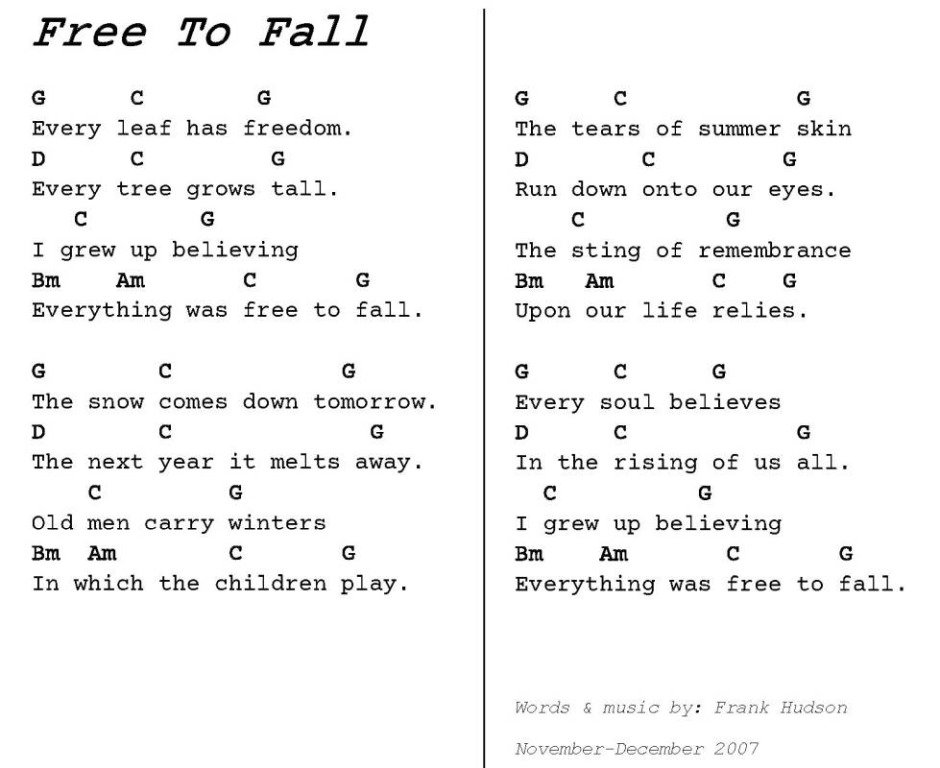
The piece is called “Free To Fall.” As I wrote at the start of this inward story, I said I remembered it as being an interesting variation on the poetic perennial of autumn. In the first verse I already hit the falling leaves motif (can that one be escaped?) and I think the “every tree grows tall” was me referencing the British folk song “The Trees They Do Grow High.” I continued to try to bring some longstanding tropes into this brief song: my own restatement of François Villon’s “Mais où sont les neiges d’antan*” starts off the second verse. I think the lines “Old men carry winters/in which the children play” are my own, but like my memory of where I put this song’s older recording, who knows if I just don’t recall some inspiration or reference.
The third verse’s reversion to summer memories and grief may be influenced by what I consider to be one of the great autumn songs, one found in every fakebook: Joseph Kosma/Jacques Prévert/Johnny Mercer’s “Autumn Leaves.**” That song too begins with falling leaves, but references a summer lover now gone. Having lost my late wife in August might have made sure I made that step back in memory in the song.
“Everything is free to fall”
.
The originality of this compressed catalog of autumn thought comes in the refrained pair of lines “I grew up believing/everything was free to fall.” What was my intent there? I’m not sure if I’m articulate enough to do as brief a job as the poet me did in writing the poem. Yes, I knew many readers/listeners would think of things like free will and predestination, shibboleths of theology — but in the lines’ first statement I wanted the connotation that autumn’s falling leaves are freed from their work in photosynthesis and now can flutter and drift. The fourth verse refrain may (or may not) put this in a different context. Is this a compressed statement of “free will,” the doctrine that humankind has the choice of choosing good or evil, which also carries a connected thought that this is what makes good, good, not just an inherent trait? I was likely aware of that when I wrote it, but in performing it this fall I took another plausible memory: that there are those who believe in an afterlife, or a rising or rebirth of the souls of the dead, but that the song’s singer believes that however temporary or final autumn’s dying off is, that there’s a freeing element in it, like that leaf that has been loosed at the start. That’s a bittersweet freedom I wanted to convey.
Here’s a chord sheet so that other singers can extend or improve my performance
.
This poem/song works for me. Maybe it has some worth to you. In summary, the way I think it works is from the ability of compressed verse and song to collect things in a small memorable chunk of words, a portable experience. I’m glad I remembered this 16-year-old song and that I was able to record a new version to share with you. You can hear it with the audio player gadget below if you see that. No gadget? Some ways of viewing this blog won’t show them, but this highlighted link will open a new tab with its own audio player.
.
*“Where are the snows of yesteryear” is the concluding line of his “Ballade des dames du temps jadis” published in 1533. Yup, those snows are definitely gone.
**One of the abandoned Parlando Project songs you won’t hear came from my idea to do a fresh translation of Surrealist-associated poet/lyricist Prévert’s French “Autumn Leaves” lyrics. I got a hold of those lyrics in French, and found that Johnny Mercer’s English lyrics are a freer, looser sort of translation. Prévert’s lyric is longer and more miserable, while Mercer’s cuts right to the nub of the situation without wasted elaboration. I found there was nothing I could do with Prévert’s French that would even approach the recasting that Mercer had already done.
You may wonder if our Halloween Series has continued past Halloween — but in pedantic fact,* the calendar date referred to in this poem’s title is November 2nd. Halloween has no particular religious element for most these days in the US, but originally it was All-Saints’ Day Eve (saints=hallowed people), the day before that observation.
That Halloween was for spooky, eerie, and likely non-Christian things was kind of a “get that all out of your system before the day for all saints comes around” proposition. So, if All-Saints’ day is on November 1st, what is this next-up All Souls’ Day? It’s a day for all the dead souls who aren’t saints — that is to say, for most of us. The ubiquitousness of the total of all those who’ve ever lived, minus those few that were saints, is a likely cause for this holiday to fall into obscurity. It’s the Participation Medal of the holy calendar.
Similarly, the author of today’s text, Hortense Flexner, is not a famous poet, though she spent her entire life working in the field of literature and education. For some reason, probably the effectiveness of the poem and its continued relevance, this single poem out of her life has survived her to be passed around the Internet and in publications as a Halloween poem.** She subtitled it “1917” on publication, no doubt in reference to the suffering and casualties of WWI — but it’s since needed no dated subtitle. I’m risking little to suggest few read it now as a historical document of situations more than a century old.
Once more I present a chord sheet so that other singers can spread the singing of this.
.
Today, to anyone her words reach in times of fresh suffering and a glass separation between those comfortable and those afflicted with new death, “All Souls’ Night” requires no further instructions from me. I’ll just say there’s an audio player gadget to hear it below, and if you don’t see that, I supply this highlighted link that will open a new window with an audio player in it.
.
*I have family members who were Protestant ministers. I’ve had friends who had at least passing familiarity with the Catholic religious calendar — but I’m evidence in that I knew Halloween in its devout practices of costumes and candy, and vaguely its religious connection to All-Saint’s Day, but nothing at all about All Souls Day.
**Although this poem is the last in my Halloween Series this year to get a blog post, a previous post here presenting “All Souls’ Night” has gotten steady visits throughout the past few weeks.
Having done over 700 audio pieces in the more than 7 years of the Parlando Project, I take pride in the variety of the original musical settings I’ve supplied for them. Oh, there are more than a few of the performances over the years that embarrass me: stuff were my problematic vocals don’t deserve parole, or arrangements where I can’t now tell how I ever thought they worked, or those where it would have been better if I’d had access to better musicians than my overdubbing, but many of them still sound good to me.
None sounds better than this one as we near the end of my Halloween Series presenting some of the listener favorites from those 700-plus pieces. “A Winter’s Tale” sets a should-be-better known poem by D. H. Lawrence. For some of you that poem’s climate is going to seem premature — and you may even wonder why it fits a Halloween theme. I assure you in Minnesota, in the northern parts of North America, this poem is not out of season. We’ve had no snow yet, but my morning bike ride was –5 Celsius. And tomorrow? Those thin polyester costumes sold at stores for trick or treating are not right for many a Minnesota Halloween. And any creativity in making one’s own costume is suppressed by the eventual need for an overcoat which will cover it. And what of Lawrence’s poem — here’s a link to the text of the poem — what’s Halloween about it?
A long way between houses just for some candy.
.
Well, it’s quite mysterious. This is the third time I’ve presented it, and I’m still not sure what the specifics of the described wintery mystery are. At times it seems like a breakup or strained love poem. Other times it seems like a hunting poem, metaphorical or not. It may have some connection I’ve not fathomed to Shakespeare’s play concerned with virulent mistrust. If it’s a hunt, I can’t even say who the speaker/singer and the hunted are. One or the other may even be Winter itself. That mystery and the air of danger are enough to make it a Halloween poem, and after my musical work, a Halloween song.
You can hear it with the audio player gadget you should see below. No player to be seen? This highlighted link is a backup that will open a new window with its own audio player.
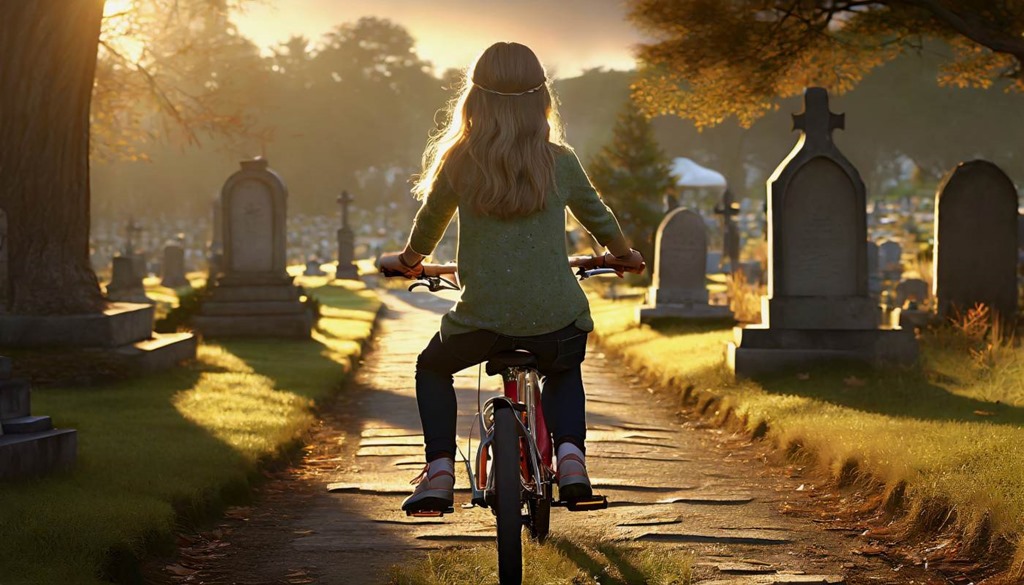
Nine days ago I started this Halloween Series with my sung adaptation of a graveyard poem by Robert Frost. Now we’re nearing the end of the series, and today I’m going to present another graveyard poem that sits with my sense of Halloween, Ethna McKiernan’s “Stones.”
I also promised in the beginning of the series that I would say why I’ve decided to make an extra effort to note Halloween. Decades ago, I met a young man (we were both young then) who had many interests, John Brower. The immediate bond: we both loved unusual music, not just strange or adventurous Rock that one could find in many a large record store back then, but harder to find Modernist orchestral music, and the even harder to find musics from other cultures around the globe. John also had a strong interest, much stronger than mine, in fantasy and horror genre fiction and film. What links those two groupings? For one thing, they were outsider-ish things then. If you want direct evidence of this mysterious connection you only need to investigate the trope of using the musics of the first of John’s interests with the movies and TV shows within his second one. The first signals the second: dread, tension, and the unknown. Scary movie, unknown planet, unsettled minds, eldritch times and places, it was a good chance that the less tonal string sections, the theremins and early electronica, the gongs or tuned percussion, the swooping vibratos and strange timbres of otherwise unheard avant-garde or exotic musics would emerge in the soundtrack. In the obverse, can anyone think of a well-known happy or loving scene similarly soundtracked with odd music? I can’t.*
But that doesn’t explain John. He gathered about him an eclectic mix of folks interested in these things, many of whom would be loners by inclination or classification. And every Halloween he would take them into the dark autumn north woods to his family’s cabin for a celebration of the holiday of the things less -heard than feared, we all in this group lit by the light of frightening movies until deep into the night.**
John grew up, continued to be engaged in many things, keeping those core interests and working to foster them. Then he died suddenly, while still young by the way I’d measure lifetimes from my current age.
There so much more to his story, and I’m sure parts I don’t really know, but within the briefness I prefer for these posts I want to say that I learned things from John and his enthusiasms, and in the scattered pre-Internet age he was a rare ear interested in some of the things that I spent my time thinking about and seeking out. Two decades after his death, I still will hear a piece of music, see a movie referred to, or encounter a piece of dark fantasy, and I’ll think of John, remembering some of what he thought of it, or I’ll be occasioned to consider what he might say about it today,
John had this spirit of Halloween, the old spirit of the things we repress and shush-up the rest of the year. Now, long after his death, and the death of others who so graciously tolerated and helped inform my interests in music and poetry, I have this personal graveyard in my head that I’m tending. As the Blues Poet Bo Diddley sang, I find “I’ve got a tombstone hand and a graveyard mind…”
One of the most striking and effecting poems in my Halloween Series, Ethna McKiernan’s Stones. If you want more, and I’m thinking some of you will, buy her book, linked below.
..
Which brings me to today’s poem I set to music. Regular readers may recall Ethna McKiernan from earlier posts. She was part of a small poet’s group alternate Parlando voice Dave Moore and I were part of — and unlike Dave or I, she published her poetry regularly both locally and via her connection with Ireland.*** She died nearly two years ago now, but in my head she has a mind’s gravestone like my late wife, like John Brower, like Ethna’s friend and poet compatriot Kevin FitzPatrick.
Poets, musicians — we play in our heads all the time. We look back at inscribed dates inside there, and compose in that dark using beats and sounds strung over time. Those beats come to rests, those sounds fade to silence. When I set Ethna’s poem “Stones” to music I chose to refrain a line from her beautiful poem so that it won’t end before you pay attention to it: “I am watching over all of you.” In Ethna’s poem that line is hauntingly unclear by design. We the living are charged with watching over our personal graveyards. We hope, transparently and by wisps of sight, that their residents are also watching over us.
Happy, yes, Happy Halloween that we knew them. The audio player to hear me trying to do justice to Ethna McKiernan’s poem “Stones” with my own music and performance is below. No player on your screen? This highlighted link will open a new tab which will supply you with an audio player.
.
*While the avant-garde or the exotic was only used for terror and unrest, for some reason the foundational composer of western classical music, Johan Sebastian Bach was the other go-to music for frightening undercurrents. Why? As young children, did filmmakers sit under towering pipe organ tubes fearing that wolves would appear out of that forest, or that teetering from low notes, that they would fall over and crush them?
**John was one of the first folks I knew with a home VCR, and even as video rental stores started to emerge he proudly purchased movies he admired, just has he collected esoteric avant-garde records, and small-press books. Neither of these things were inexpensive to his income level then, but he considered this his form of patronage of artists and their art.
There’s much commerce between fantasy and fable — and William Blake, as literal as he may have drawn the angels of his visions, was one such trafficker. In this poem a metamorphical form of pomology creates out of anger a beautiful, attractive, and cursed fruit, so I thought this poem suitable for our Halloween Series.
One question asks for an answer in Blake’s poem: what makes the poison apple grown from wrath, fear, and tears “bright” and “shining,” and eventually so irresistible to the poem’s enemy?
Many readings concentrate on the poem’s singer, the one who instead of forgiving as he had done with a friend, grows their anger, sorrow, and fright into the Poison Tree. But let’s consider the other party, their enemy. Let’s look at the song from their view.
The emotions that grow the Poison Tree are often stronger than the more positive emotions like trust, love, and mere happiness — and the alloys of these negative emotions can be made into purer metals. Thus the human reaction, however unacknowledged, to envy the tactics of our enemies. Oh, what great evil they use, how powerful that is, how greatly we’ve been hurt by it — so, shouldn’t we be allowed at least some of the fruits of that tree? No, not all the root and trunk of that evil —for we are not like our enemies, — we are just owed a little of that power, maybe one apple?
The poison apple “shines” because it seethes with the power of hatred. It’s “bright” because the dark fruit becomes reflective the moment we reach to pick it. A convex apple is a strange mirror. We see ourselves magnified, we see our enemies too, we see wrath distorting us.
Blake’s fable in that reading says then: do not plant that poison tree from the injustice done to you, as the poem’s singer does, for the fruit will be impossible for your enemy to resist. “Oh, that’s not so bad,” you may first think, “the foe ‘is outstretched beneath the tree” as the poem ends. But beyond the poem’s ending there’s another refrain: the foes survivors have wrath, fears, and tears — and a seed poison apple for another tree.
One thing I admired about Blake was his multiple skills, out of which he created the poetry, the book design, and the artwork for his Songs of Innocence and Experience. Indie!
.
My performance of Blake’s “A Poison Tree” is full of the sound of an American invention most often used by British bands of the late Sixties and early Seventies, the Mellotron. The Mellotron was supposed to be a home or light theater/salon entrainment device. It had tape recordings of instruments, including recorded sections of orchestral strings and woodwinds, one recording for each note to be triggered by a keyboard. When it was discovered by rock bands they found they could saturate their recordings in these orchestral textures. Because the articulations of the taped instruments were “canned” not freshly played, the result was a little ersatz — but eventually this was embraced and the output of the polite Mellotron was sometimes patched through overdriven amplifiers like an electric guitar might be. That’s part of the sound in the LYL Band performance of “The Poison Tree” that you can hear with the audio player gadget below. No player? This highlighted link is an alternate way to hear it, as it will open a tab with its own audio player.
Continuing our Halloween Series featuring some of our listener’s favorite fantasy and supernatural pieces from the seven years of the Parlando Project we get to today’s short Emily Brontë poem “Spellbound.” Once more we have an eerie situation with withheld information that adds to the mystery while paradoxically compelling our attention.
Before beginning the Parlando Project I was only aware that Emily Brontë had written poetry, holding that fact as having no other consequence. I’m not even sure what drew me into her poetry — memory fades — but it may have been finding out that another Emily, Emily Dickinson, read it. Brontë’s poetry, which preceded her famous novel Wuthering Heights, was at least partially extracted from a series of writings she and her young siblings created within a set of fantasy worlds — and though this short discussion of Emily and Anne Brontë’s imagined world of Gondal doesn’t list this poem as being part of that universe, “Spellbound’s” setting doesn’t sound out of place from the northern, winter island in their Gondal.
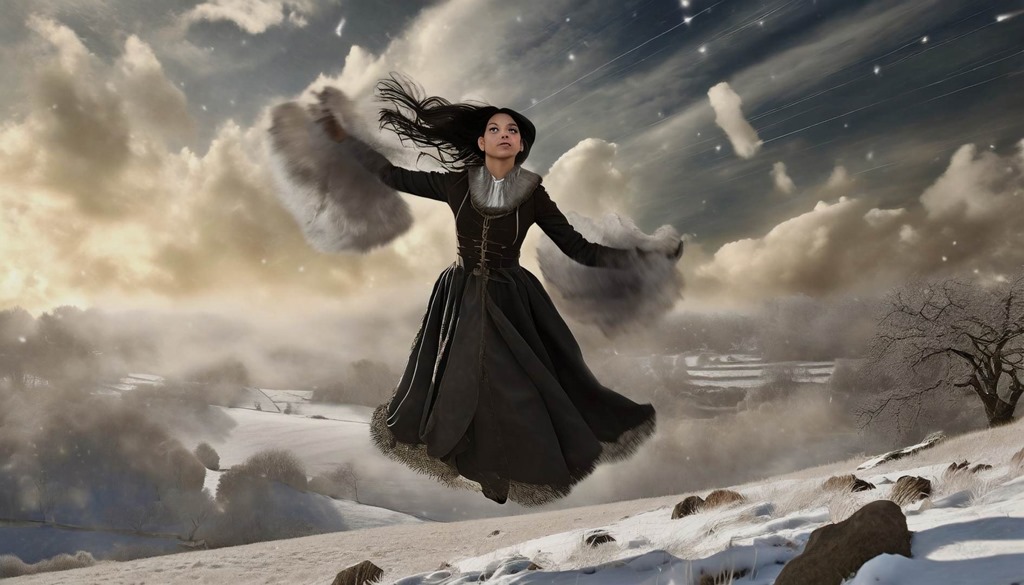
Nor out of place in the northern U.S. where I live, where the wind and weather is casting us to cold with predictions of snow and ice within the next 24 hours. When I first presented this poem three years ago,* I was intrigued by the prepositional position that the poem’s speaker seems to be in. In the poem they say that clouds are above them and the wintery wastes are below. It could be that Brontë was only envisioning a highlands or hillside perspective, but my mind’s eye had the spellbound speaker suspended, frozen in mid-air. Perhaps again, my imagination overtook me in that detail, but then I’m glad for Brontë’s imagination which created this chilling and enchanting poem that let me picture that.
Another illustration created by enchanting Adobe’s Firefly with an incantation. Firefly claims that it doesn’t use uncompensated artists work in its AI model.
.
I rather like the music I came up with for this one. Maybe you will too. An audio player is below for many of you so you can hear the performance of it, but some ways of reading this blog will suppress that page element, and so I also offer this alternative: a highlighted link that will open its own audio player gadget.
.
*If you follow this link to my original presentation of “Spellbound” you can see the lyrics as part of a chord sheet in case you would like to perform this song yourself.
Judging from the numbers of its inclusions in Internet lists of spooky poems, Walter de la Mare’s “The Listeners” comes to mind to more than just me when people are asked to think of Halloween poems. Yet it has no monsters, no sudden scares, no wicked battles, no fully-described supernatural events.
It creates its strange effect in this strange way: it gives us lots of details which may seem inessential, and next to nothing of its central situation. The plot is simple: a man travels to a building on horseback. He knocks at the building’s door. No one answers. He leaves. As an elevator pitch summary, it has little to call us in or disturb us. Why does it leave us with a wondering chill? It’s those details. Here’s a link to the poem.
First off, there’s a supporting character in the poem which seems to have only one for sure, the Traveller. That character: his horse. We meet the horse right at the start, noticing that it is unconcerned and grazing as the Traveller opens with his door-knocking announcement of arrival.
We’re also told it’s night. Only slightly unusual, in that one generally doesn’t schedule appointments at night. The Traveller knocks again. We’re told the building has a turret. Castle or fortress, or just a decorated Victorian era house? We know by this it’s not a small hut or cabin. The listeners that are spoken of soon are something of some means.
Our two characters: the Traveller, and the horse he rode in on. One thinks it’s very important to be there, the other couldn’t care less.
.
We’re told the Traveller has grey eyes. What an odd detail! We’re not filling out his driver’s license after all. Grey is a quite rare eye color in de la Mare’s Great Britain or Western Europe. Does the poem mean to suggest the Traveller is coming from a far distance?
Is there anyone inside the house? The poem mentions “phantom listeners” and these listeners are in the title. “Phantom” says they aren’t in the house at present in the way the Traveller and the horse are outside the door. We learn that the house has a hall, reinforcing by detail that the building isn’t small. The Traveller senses these whatevers, their “strangeness.” How are they strange? Nothing is said — but our second character, the horse, remains only interested in grazing.
The Traveller is insistent, pounding louder, shouting the intriguing line “Tell them I came…that I kept my word.” This is the plot’s climax, we don’t know what duty brought the Traveller there, perhaps from a long way off. Of course, we wonder what the bargain is, what the promise was. Is our wonder stirred by not knowing? Mine always is.
Another detail: we’re told the Traveller is “the one man left awake.” How are we to take that statement? That the “phantom listeners” are asleep and can’t be awakened? Or should we take it more catastrophically: that the “phantom listeners” aren’t human, never were, and that the Traveller is the last man at all, anywhere, awake? I never considered this latter reading until typing this tonight —perhaps I’m over-reading — but if so, is the Traveller coming to ask them to lift that spell, the only man still with agency to plead?
I love the final quatrain of this poem. Our horse returns, and the listeners, we’re told, can hear the creak of the leather from its saddle stirrup — a lovely detail, and a quieter sound compared to the pounding and shouting that has preceded it. Finally this sound: the evocation of the horseshoes ringing on hard stone inside a world of otherwise silence. The horse may be unconcerned by the silence, perhaps even the lack of any other awake people is not of any matter to it.
My music for this features the electric 12-string guitar, an instrument that I love. You can hear me perform Walter de la Mare’s “The Listeners” with the audio player below. If you can’t see that player, no need to knock louder, use this highlighted link which will open a new tab with its own audio player. Thank you for being The Listeners for this Project!
Yesterday in our Halloween Series I mused on the appearance of ghosts in a garden with Millay’s blithe apparition. As I present today’s musical piece adapted from literary poetry, Thomas Hardy’s “The Shadow on the Stone,” let me start by asking questions. Many others will follow.
Do you want to see a ghost? Is that wanting part of what makes it appear?
Hardy’s poem is poised in that first question. As I have performed it as a song with music that I wrote for it, I should wonder if the words are clear enough in themselves to tell us what the situation is. Looking at the text of Hardy’s poem, I think it’s mostly self-sufficient in that regard, though some mystery (possibly useful mystery) remains if nothing else is explained.
When I first presented this in 2021, I went into the biographical specifics that engendered this poem, but for today let me just say that the “she” that the ghost is supposed to be is Hardy’s dead wife who was completely estranged from him before her death. Nothing in the poem spells that out, nothing tells us that when living she had grown to find Hardy completely unsuitable. Well nothing, save for a line that we can hear as modern idiom that Hardy may have intended only as a brief metaphor: “Her behind me throwing her shade.”
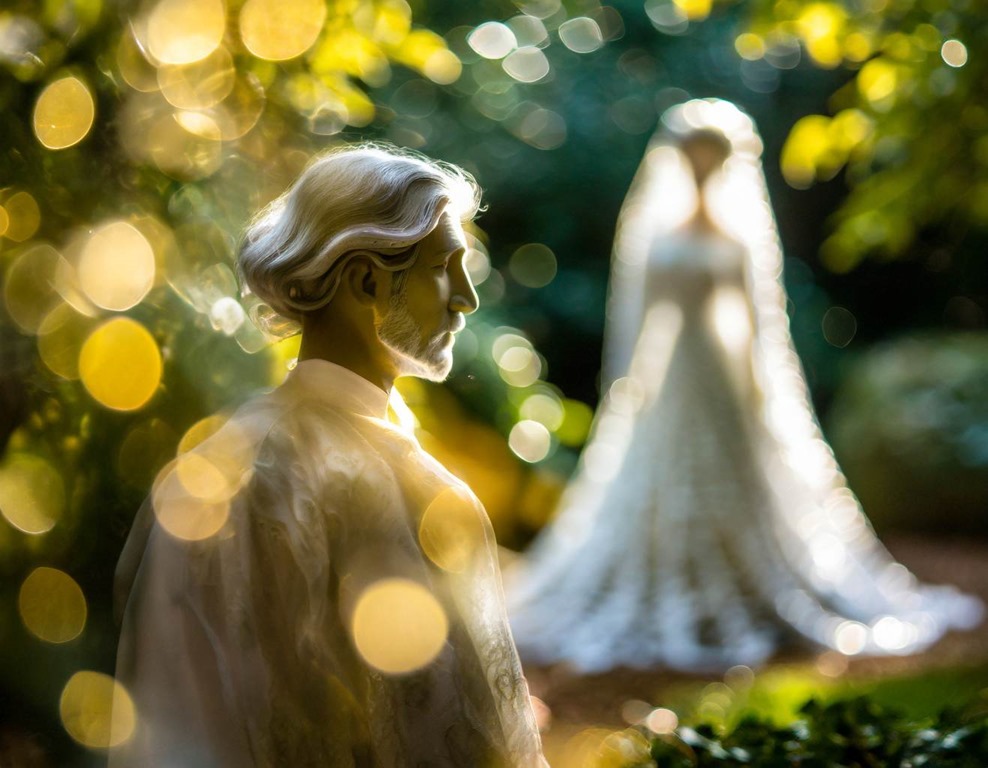
Ghost from a machine: illustration from Adobe Firefly, the AI engine that proclaims it doesn’t use uncompensated artists work.
.
Such a complex ghost, or a wish for a ghost, this is!
Does Hardy want to see the ghost? Does Hardy fear to see the ghost? Can either of them speak? Are either of them changed from what they once were? Is he haunted by her, or haunted from her? All the answers are all the answers here. The curly shape of the question mark the shifting curve of an ghost manifesting.
Spontaneously when doing the vocals for this piece I decided to throw in some more answers at the end of my song in the form of “inline epigraphs” that Hardy didn’t include with his poem, but this performer did.
You can hear my performance of Thomas Hardy’s “The Shadow on the Stone” with the audio player gadget below. You don’t see a player? This highlighted link will make one appear in a new tab.
Last time in our Halloween Series, an A. E. Housman poem combined with music had death on a knife edge. Placed at the end of the growing year in northern places, Halloween comes at a time in a yearly cycle that suggests death. Note: that statement includes the word “cycle.” Humans have memory, and song, and eventually writing, so we know the turning round — the end of the growing comes before the white none of winter and before the regreening of spring.
Should it be so with death, that full nothing? Some hope and believe that so, though we can have no memory of that. But even one life has many turnings, places we pass through and leave. Today’s piece ends by portraying that we open and close gates of memory, gates that are no longer there.
Edna St. Vincent Millay wrote this poem of a non-threatening ghost. It’s an earlier work, and some see the ghost as a wisp of her not-long-departed girlhood. I’ll add that the choice of having the ghost appear in a garden speaks to the placement of Halloween in a harvest/leaving time of the year. Gardens have needs: nutritious soil, water, sun, and care. Perhaps they need ghosts from time to time as well?
“She paused—then opened and passed through a gate that once was there.”
.
The music I composed and played for Millay’s “The Little Ghost” shows South Asian influences, what with harmonium, tambura, and my vibrato note electric guitar playing. You can hear that combination of words and music with the audio player below. No player to be seen? This highlighted link is an alternative, it’ll open a new tab with its own audio player.





 Frank Hudson