This sonnet is one of William Wordsworth’s most well-known short poems. As can be the case with commonly known poems, I can’t remember when I first read or heard it, and so it might seem like it’s always existed, that it’s just there, ordinary in its presence. I’ve been thinking today that the poem’s familiarity hides some strangeness. Let’s look at some of that.
For National Poetry Month this year I’ve been examining poems included in a pair of 1920’s anthologies for children: The Girls and The Boys Book of Verse. Let’s start by examining context for this poem appearing there. This is not a poem of childhood experience.* “The World Is Too Much With Us” starts off speaking in an adult’s voice of the weariness of “getting and spending.” I’d say that inside the pair of anthologies I’ve been looking at this month, this is more intended as a poem a parent would read to their child. Other poems in these books live and report from the world of imagination, a splendid world, which though it may also not be physically “with us” as children, exists in the same way as the thoughts and emotions of the actual world do.
Chords in case you’d like to sing this poem yourself. Another form of participation: As the two 1920s poetry anthologies were gendered, I’m asking my audience to guess if each poem I present this month was in the boys or girls volume. Answer below.
.
Do we ever think of Wordsworth’s opening phrase as odd: “The world is too much with us?” Volumes and volumes of poetry are filled with nature poetry telling, seeing, hearing, approaching tasting or smelling, the world. We expect poetry to give us that world-muchness. We’ll get to nature eventually in the second quatrain — though it may not be the nature we’d expect — but this is an example of a leading phrase that should shock or intrigue us: “What do you mean WW? I’m so busy with my adulthood I hardly see the world beyond nearsighted bills and paycheck!” Perhaps familiarity keeps us from feeling any shock at the opening.
There’s an odd idiom to finish off that first line: “late and soon.” Was this a common phrase in Wordsworth’s time, or is it just a make-rhyme? While its variation “sooner or later” is something that everyone still says, in this exact saying it seems to be making the present moment a wider aperture: saying that recently and in my next future this is the way things are — though it’s also expressing the deadlines that press our getting and spending, all that ASAP and overdue.
In reading poetry I’m immediately attracted by the musical impetus prosody brings to the words, but another part of my mind should (eventually, after the word-music has struck me first) trace the actuality of the images. The poem’s second quatrain brings the nature images, one almost conventional, the following one, extraordinary. This poem is so commonplace with us that we think little of this quatrain. “This sea that bares her bosom to the moon” may be an all-to-conventional readymade now, but Wordsworth wants us to see there an offer of vulnerability; and with the other well-worn trope of the moon’s tides, a sense that we will, even if we are “out of tune,” resonate with the pulls of nature. And then the unusual image: this nature is not a slow, predictable rising of a consonant chord. If we think we remember this poem, do we forget the “winds that will be howling at all hours” that are now enclosed inside the petals of “sleeping flowers.” This is Wordsworth’s Blakean heaven in a wildflower. I cannot say what the poem’s composer’s conscious intent was — but as a deep image, the flowers containing the plant’s reproductive features could illuminate that desire and sexuality are a riveting but unreined nature.**
And within the later specific context of this poem appearing in an anthology that might be bought by parents to read to young children, this remarkable — yet little remarked on — image may speak to the howling winds of parenthood.
So, the world of human commerce is too much with us — but nature too may be too much with us — it may rack us beyond our control. Do we overlook that Wordsworth says for everything we are out of tune, something he writes after a quatrain on the commercial world of work and a quatrain on nature.
The sestet that concludes Wordsworth’s sonnet to my reading is not a grand summation or synthesis, some glorious wish. I read it as saying some rickety, obsolete, altogether false mythology might seem a preferable refuge from this world — its nature and its business. Proteus and Triton there are not the speaker exalting in neo-paganism. They are “outworn,” and a thing that the poem can only see as plausibly not as bad as the elongated moment the poem has presented. In such a fancy — if bound between covers, the imagination of a childhood book of Greek myths that our anthologists might also offer — we could have powers and a way to shape the world that elude the poem. Over on a bookshelf near me is such a book from my wife’s childhood. In childhood, our imaginations, our fancies, are our superpowers. Us obsolete children, outworn, cannot call on those powers and inveigh them with this world.
I hope I brought out some of those inferences with my musical performance in a poem that is perhaps too well-known to be known today. It was rewarding to take out my nylon-string guitar to record it, the kind of guitar I started on in my 20s. You can hear my performance of “The World Is Too Much With Us” with the audio player below. No audio player? Is it inside a sleeping flower? No, some ways of reading this blog hide it. This highlighted link will open a new tab with its own audio player.
The answers to your gender quiz game today. “The World Is Too Much With Us” appears in both the girls and the boys 1920s anthologies. Relax busy adults, no one loses points today. “I Wandered Lonely as a Cloud” is also in both books.
I keep meaning to write some things in general about the two anthologies aimed at children I’m featuring during this U.S. National Poetry Month: “A Girls Book of Verse” (1922) and “A Boys Book of Verse” (1923). NPM implies an American focus in its name — and these 1920s anthologies were published by an American publisher (Frederick A Stokes) with American editors (Mary Gould Davis & Helen Dean Fish) and they remained in print until at least the WWII years.
Long-time readers here will know that I have an affinity for the first quarter of the 20th century as a literary era. It’s the time of Modernism’s emergence and triumph in the arts, and English language literary poetry was transformed largely by a group of Americans: Ezra Pound, Carl Sandburg, Langston Hughes, T. S. Eliot, Robert Frost, H. D., William Carlos Williams, Amy Lowell et al.
How much of this is reflected in our two 1920’s anthologies?
Close to zero, zilch, nada, nothing,
There’s a single poem by Amy Lowell, “A Little Garden,” a metered and rhymed poem that barely reflects her influence on a branch of Imagism, that indispensable early Modernist poetic movement. There is one Modernist with several poems included in the two anthologies — an American not in the above list, one that I’ll reveal later this month — but most of you won’t know that poet’s name.
This is not because the anthologists wanted to include only older poems from before America was in the game. Most of those published postdate America’s Whitman/Dickinson/Longfellow and the “Fireside poets” poetic emergence. Many of the poems are from the young 20th century or the final years of the old century. OK, let’s quantify how many poems by U. S. poets are in this set of English language poetry from just about a century ago.*
I did a quick and dirty count of American’s poems in these two anthologies’ tables of contents. Remember, Americans are making these two books, and while they might have been sold overseas, I suspect American parents, libraries, and children were the intended audience. Are they going to be flying the red, white and blue from the library ramparts? Cheering the home team?
Apologies for the cursory numbers to follow. Even if I’m reasonably knowledgeable about poets of this era, there are a lot of unknown authors in these two books 237 poems. Stopping to search Pamela Tennant, Jean Ingelow, Cecil Roberts, Alice Meynell, and Young E. Allison, and the like would have delayed this post.**
Here’s the rough count: 42 poems with known U.S. authors. 150 written by known non-U. S. authors (almost all British Isles residents). The poems by unknowns (which still included those in the footnote below when I did the tally) counted as 42. Given the over 3-1 breakdown in the knowns, and the revealed makeup of the short sample of the unknowns, I expect the unknowns would break similar to the knowns.
So, there you have it: about a hundred years ago — within our parents’ and grandparents’ childhoods for many readers of this post — they easily could have gotten the idea that poetry was still largely a British thing. I was surprised at this lopsidedness. I’d also say that before reading through the anthologies this year I expected at least a smattering of the Modernists, though I’m not surprised by the overwhelming rhymed/syllabic metric poetry .
And then I remembered how poetry was taught to me as an American student. Modernism was acknowledged, though things seemed to stop at Frost and Yeats. The art started with Chaucer and Beowulf, quickly moved to the Tudor poets, and spend a fair amount of time on the 19th century worthies that were included in these 1920s books.
However de-emphasized poetry may be in today’s America, I doubt we’d see such a disproportionate mix now. But before I end off today, I’ll reiterate what I wrote last time: I’m not that much of a literary nationalist, and so I’ll leave you with two non-American authors from this gendered pair of books of verse for children, two poems that speak of longing for their home nations. Both were written when the poets were no longer living in their birth countries, intensifying their poetic expressions. As I’m doing throughout this series, I’m asking you to guess if the poems appeared in the girls or boys book of verse.
The first is one of the most famous and best-loved poems to appear in the pair of books: William Butler Yeats “The Lake Isle of Innisfree.” I was at a poetry reading here in America this past Thursday night, and not just one, but two of the reading poets said that one of their own poems was inspired by this poem of Yeats. It’s such an Irish poem that it’s printed on the Irish passport. Yet the poem was written in London, by a man whose father had moved his family to England when the poet was only two. I performed this as part of this Project in 2019, and you can hear it here with this audio player — or if you don’t see the player, with this link.
Can you guess if it’s in the girls or boys book?
The second one, is by Robert Browning, who’d eloped off to Italy with his poetic life-partner Elizabeth Barrett Browning. He called his poem “Home Thoughts from Abroad” and I recast it for singing and call my version “In England Now.” My aim in my recasting was to make the dislocation from an ideal England seem less a matter of geography and more a matter of time and change. You can hear that version with the next audio player gadget, or with this link.
Was this floral longing poem in the girls or boys book?***
.
Here at NPM2024 Field the British side has shown up to face the Modernist American 9. The Brits advantages: fine woolens, bats that could also be used in a pizza oven. Americans? Plenty of sharp Latin-American players, closer, more aerodynamic beard trims. Read the post for the score.
.
*In case you’re wondering, I think the only translations from a non-English poet are a pair of William Cullen Bryant translations of Homer, and a KJV Song of Songs excerpt.
**Anyone who knows me, knows that just typing this excuse makes me want to indeed do a web search for at least this quintet. I did. Results: only Allison is an American.
***Yeats’ poem of his bee-loud Mojo Dojo Casa Dream House was the leadoff poem in the “Girls Book of Verse.” Browning’s poem of an April unaware for those who simply live in it was in both the boys and the girls volumes. So, if you’re keeping score, you guessed this second one correctly.
The Parlando Project’s thing: taking a literary poem and combining it with a piece of music isn’t a new thing. If poetry exists in every language, poetry combined with music exists in every language too, and such casual melding typically pre-dates the culture’s written poetry. We have just kept on doing it as a practical and immediate art.
This is National Poetry Month here in the U. S., but I don’t think I’m overly nationalist in the words I use here. Still, just as poetry and music go together, national and ethnic pride often takes poetry and song onto itself. W. H. Auden notably stated that “poetry makes nothing happen” but if we examine it the other way around, it’s unlikely that any great movement for change or nationhood ever has had no poetry and song associated with it.
As a poem “The Minstrel Boy” was first published in 1813 as part of the author’s collection titled Irish Melodies, and its central image is a harp carried by a “warrior bard.” It’s therefore apt that Moore combined it with music forthwith, using what he named as a traditional Irish tune.* Harps and lyres etc. are an extraordinarily large family of instruments, but Moore seems clearly to be writing of Ireland, where the Celtic harp has become a national symbol. At the time of its writing, Ireland was still under the long-standing, often cruel and exploitative, rule of England. Classmates of Moore had recently died in one of the periodic Irish rebellions.
The song also became popular in America, though I’m not certain how rapidly it took root here — but in the year of its publication America was at war with Britain for the second time after its revolution. And by later in the 19th century, the song had currency among Irish-American immigrants.
Ironically, Moore received a British diplomatic post to Bermuda, and in 1803 he not only visited the United States but met President Thomas Jefferson. The tale I read online says the two did not hit it off, and that Moore was not impressed with American chattel slavery. **
Since those times the song (or sometimes just the tune associated with it) has been closely associated with the armed forces, police, and firefighters — folks whose sense of professional duty includes risk of death. I find that ironic too, for the song’s minstrel boy is the definition of an untrained irregular, possibly underage, untrained (he has to borrow a weapon), and more of a singer-songwriter than a SEAL Team professional. *** This is one of those cases where tradition overwhelms close reading.
I’m performing this song as part of my NPM series looking at poems from a pair of 1920’s anthologies of verse for children: The Girls Book of Verse andThe Boys Book of Verse, and “The Minstrel Boy” appears in one of this gendered pair of books. In each instance this month I’ve asked you to guess which one: Boys or Girls. Today’s poem is a free square in that game, as one would easily guess this military service theme would be in the boy’s book — as it is. Indeed, The Boys Book of Verse has an entire section, Songs of Peace and War dealing with poems about battles and military service. The editors, both women, would have had recent experience of WWI, and whatever their feeling about warfare, they must have felt that subject was something their readers or purchasers would want included for the boys.
I stop to think here — as I do as I consider the entirety of this pair of “the last Twenties” books — that the first audience for these books would go on to experience a much greater and deadlier world war.
I’m likely not one of the best singers to have sung this well-loved song, but I performed it with a full rough’n’ready rock-band arrangement as best as I could peel off in this month’s accelerated schedule. My inspiration for singing this song? A similarly not-ready-for-the-most skilled-singer-contest one, Joe Strummer, who also recorded this song. You can hear me tear through those chords asunder with the audio player you should see below. If no audio player sullies your screen, it’s because some ways of reading this blog won’t show it. This highlighted link is your alternative — it will open a new tab with an audio player.
.
*The tune Moore selected, named as “The Moreen,” was said to be a traditional tune. Wikipedia says that no one has independently found a source of this tune from before its pairing with “The Minstrel Boy’’ — so it could be that it would have disappeared forever if Moore hadn’t tapped it for his poem about a doomed harper. That adds an air of mystery to the song, doesn’t it.
**The stirring final line stating the harpers fight was against slavery does and doesn’t require an explanation. Servitude in general, even government duties and tributes required from monarchs or tyrants, was often rhetorically called out as slavery, while American chattel slavery was totalitarian: humans — and with added cruelty, any families of those enslaved — owned in perpetuity like animals without rights of any kind. I read that this song was sung by both sides of the American Civil War — the “slavery” on one side rhetorical, the slavery on the other total and abject. When I started this post talking about the widespread tradition of nationalist poetry and song, take note: a corollary from Auden’s dictum may be that poetry and song prove nothing.
***This might be a fair poetic description of the Irish rebels that the teenage Moore knew, those who died in an ineffective rebellion. The long fight for Irish independence seems to have had an outsized portion of “warrior bards,” folks with less military experience and tactical acumen than literary and musical bona fides.
Social media likes controversy, so it’s no surprise that two things have recently mingled there in provocative assertion: poet Mary Oliver and the dread “middlebrow” epithet.* It’s not a long bridge between the two: Oliver’s poems are put forward as all too middlebrow in this charge, and middlebrow is a sign of significant lack of ambition or achievement. I’m not a fan of the term “middlebrow,” for a hierarchy is implied and I don’t care for hierarchies much — but to speak of this I should define middlebrow poetry. A definition that works for me is: poems that remind us of something we already sorta-kinda know, but maybe couldn’t quite put into words. These poems are usually immediately understandable on first reading by a significantly literate reader.
Why’s this bad or lacking? If this is a singular mode it rules out poems that tell us multivalent things, or mysterious things that require more thought to comprehend, thought perhaps taken in stages. It rules out shocking, utterly surprising poems. And such poetry doesn’t feed our playful desire to puzzle-solve with clues we are proud to have acquired.**
My view? I think various modes of poetry (even differing modes of reading the same poem) have diverse values, and I’m more than OK with that. Poetry’s eye should be the insect’s compound eye, containing a hundred, a thousand, ommatidia. And so, if it was up to me, the best cultures wouldn’t be restricted to, or rewarding of, one poetic mode. This may be a visceral thing with me: I get bored with all one type of thing quickly. Building towers of hierarchies might be fun, and illustrative of what one can stably hold long enough to build such a tower, but in the end, the domain one will look out on will have a lot of scenery that isn’t in your tower. In the right mood, I can get pleasure out of looking at the commonplace apprehension poem and a “difficult” avant-garde one — and in the wrong mood on my part, or insufficient achievement in the poet, not a touch of pleasure in either mode. And beyond all this meaning and metaphor, there’s the oldest part of poetry, the part even young children understand, that poetry also has abstract pleasures like music has — poetry is the instrument on which the meaning plays.
A great many of the poems in our pair of 1920s children’s poetry anthologies are as middlebrow as any Mary Oliver poem brought up on charges in this controversy. This shouldn’t surprise us. A modern children’s anthologist looking to duplicate the task of those in the previous decade called The Twenties would, I think, do likewise. Some of those pressures would be commercial: what will sell to parents, libraries, teachers. Some would be practical: these children aren’t yet bored with the lessons of the world — those lessons are new and useful building-blocks for their youthful towers — and maybe a lesson of my old age (and a lesson of Mary Oliver) is that I shouldn’t have been bored with the lessons of the world either.
I think too of what happened as the first childhood readers of these poems in the 1920s progressed into the economic distress of the Great Depression, the rise of nationalist dictators, the Second World War, and the Damoclean Cold War. All through the middle of their lives how much time would they have for poetry that offered them the highbrow pleasure of gnostic meaning, of shocking new combinations and collisions?
The answer is: some would find the time, some went on and made their own verses in those modes — and many others would not. Some kept food on the table, kept bolts tightened on airplanes, tended the sick, kept fuel in NATO tanks facing east. Some had their yet young lives ended sans poetic envoi. Others desired, birthed, and raised my generation.
Highbrow, middlebrow, it is neither sophistication nor no-nonsense populism to forget either part of that cohort.
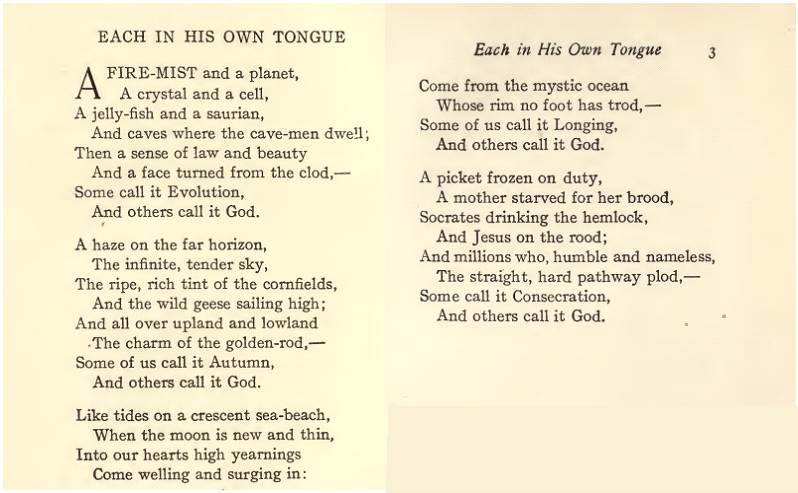
On to today’s poem, an example of a poem that earnestly intends to be a lesson: “Each in His Own Tongue” by William Herbert Carruth. Look! Mary-Oliver-approved wild geese make their appearance in it, decades too early! I also offer this month’s puzzle challenge: the pair of 1920’s anthologies I’m drawing from were gendered: one for boys, one for girls. So as with each post this month, you’re asked to guess in which volume did the poem appear. Answer lower down.
Here’s today’s poem as it appeared as the title poem in a book-length poetry collection by Carruth.. Marginalia picked up in the scan of a copy of that poetry collection. Wonder who Ina Coolbrith is? Here’s a link.
.
The brief Wikipedia stub for Carruth tells me he was “president of the Pacific Coast Conference of the Unitarian Church.” One of my preacher relatives once said of an Unitarian school he’d attended “The only time anyone would speak of ‘God’ is when someone stubbed their toe.” I read this morning a brief poetic knot of a summary of Oliver’s earnest lessons delivered by A. M. Juster who wrote that he’s “Not a big fan or a big detractor of Mary Oliver” but then sums up his impressions of her work by saying “I also think her spirit wanted to write religious poetry, but her mind wouldn’t let her.” Each in their own tongue I’d say, ungendering Carruth. Carruth wrote “His,” and his poem appeared in the Boys Book of Verse. You can hear my musical performance with the audio player gadget below. No gadget to be seen? This highlighted link is a backup which will open a new tab with an audio player.
*This last factor is less-often laid out as I just did, perhaps because it doesn’t seem serious when complex poetry is discussed. But let’s admit it: great portions of humanity loves puzzles and challenges in which they feel rewarded if they can progress farther than some other human.
For National Poetry Month this year we’ve been looking a poems that were selected in 1922 and 1923 for a pair of gendered poetry anthologies: The Girls Book of Verse and The Boys Book of Verse. Today’s poem is another reasonably well-known selection, John Masefield’s “Sea Fever.”
I’ll not have much to write about the poem itself, it speaks so straightforwardly. I will say that I always thought of it as a poem by an older poet, and an archaic one at that in that it speaks of ocean-going sailing ships. Turns out, I read this poem with misapprehensions. Reading briefly about the poem, I found it was published by a poet only in their mid-twenties, and though the long-lived Masefield’s life overlapped mine — he was still England’s Poet Laureate during my schooldays in the United States — he indeed worked on windjammers.
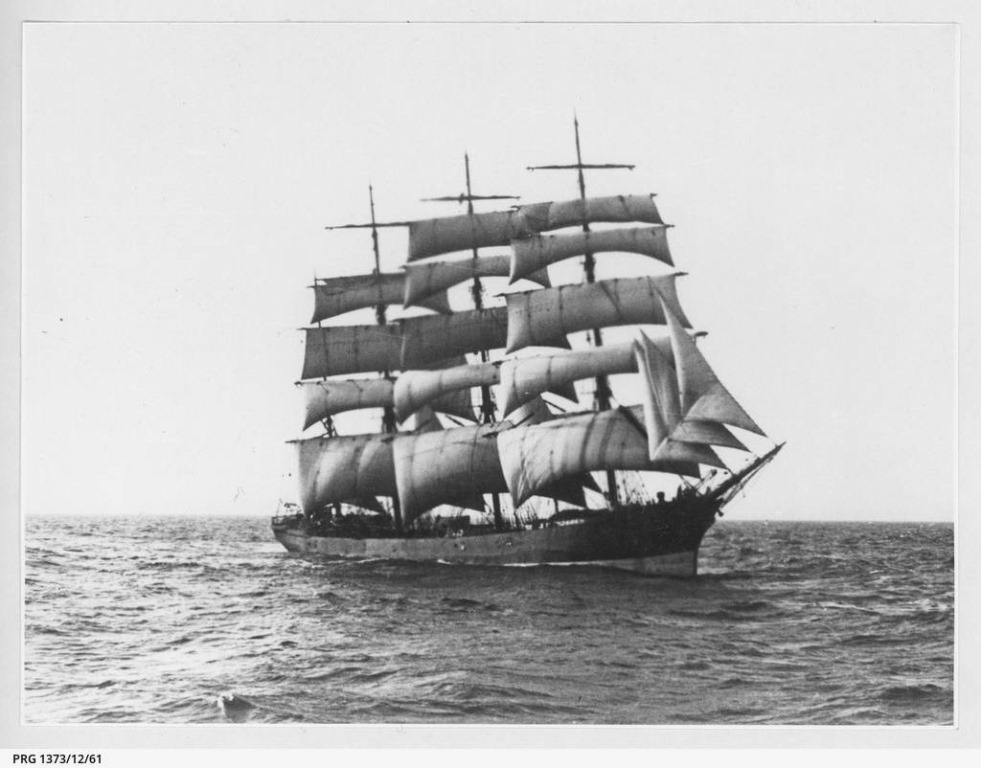
The young Masefield sailed on the cargo ship Gilcruix at the end the 1800s, and yet the ship looks like it could have been from the beginning the 1800s.
.
These two 1920’s poetry anthologies clearly wanted to encourage reading for the children that would grow to become the fabled Greatest Generation of the Great Depression, WWII, and the Cold War. Ironically, Wikipedia says Masefield was unhappy in school and shipped out to a life at sea “to break his addiction to reading, of which his aunt thought little.”
Masefield worked at sea and in America* for the next decade. The seagoing did not cure his reading addiction,** he continued to read on shipboard and eventually began to write himself.
While “Sea Fever” is more in the mode of poetic memoir than our poem last time by Emily Dickinson — it’s a nice bit of parallelism that Dickinson imagined books as a replacement for sailing far away, and Masefield imagined he could sail far away as a replacement for books!
As with our other poems from this pair of gendered anthologies this month, I’m going to ask you to guess if this was in the boys or the girls poetry anthology — answer below.
Here at the Parlando Project we take words, usually literary poetry written by various poets, and set them to original music in different styles. Not for the first time, this is a poem that already has a fairly well-known “art song” setting: one by John Ireland. Ireland made a lovely song, and not an overly elaborate one melodically for that sort of thing — but it’s beyond the limits of my vocal talent. So, the setting I created and performed with just my cruder voice and acoustic guitar is what you can hear below. I don’t know if you will be able to hear the canvas slap or the wind through the rigging in this version, but I was trying for that and a hearty song feeling in this one. There’s a graphical audio player to hear it below, but if that player is not visible, this highlighted link is your backup. It will open a new tab with its own audio player. Was this song of manly company on the high seas in the girls or boys book? It was in the girl’s volume.
.
*In between voyages, Masefield worked in a factory in Yonkers New York, something I did in my early 20s too. I may not have shared his nautical adventures, nor will I ever become the poet laureate of anyplace, but that tiny little happenstance made me feel kinship with Masefield 70 years apart.
**More of what is likely only coincidence: when Lou Reed’s protagonist in his song “Heroin” escapes into his drug addiction he likens it to a wish that he’d “Sailed the darkened seas on a great big clipper ship sailing from this land here to that.” If Reed had started his other song of that era “I must go down to Lexington 125, to the call of the running tide” we’d have an actual connection to go on.
For National Poetry Month I’ve set out on a feature where I’m examining the poems in a pair of poetry anthologies directed at children which were published roughly a century ago: The Girls Book of Verse and The Boys Book of Verse. Each collected around a hundred poems in a variety of styles, sub-categorized in broad subject areas the anthologists thought reflected childhood moods and interests.
That child audience became our ancestors. The early readers of the first edition would have been the oft-praised Greatest Generation which grew up in the Great Depression and served in the titanic national struggles of WWII and the Cold War. It’s likely that childhood has changed since then, but did these books in any way equip the young minds for the panorama of their future?
One of the pair of anthologies used this well-known poem by Emily Dickinson as a lead-off poem placed even before the table of contents. How many libraries had, maybe still have, this poem on the wall of their children’s section? I can’t say, but I recall seeing it in more than one in my post-WWII childhood.
Some of the words, if laid plain on the page, might risk being obscure to a 1920 or 2020’s child. Dickinson and the anthologists seemingly had little fear of that. A frigate is a class of fast war ship. Do children still have youthful romance with sea-ships? Born in a landlocked Midwestern state, I did — reading of and knowing all the classifications of ships, famous naval battles, famous captains, that sort of thing. Modern youthful D&D fantasists of the earth-like realms seem kind of land-bound to me, perhaps because Tolkien seems to have left his sea-faring tales to the long unpublished Silmarillion. Current SciFi readers might still have all the trappings of sea-battles recast in airless space, but that is less the exact particulars of historic ships.
Coursers too is not a word in most modern children’s vocabularies, and I have my doubts for a 1920s child. It’s a term for a fast-pursuing horse, and by extension those that ride them. With frigates just preceding it, I always heard and misremembered the word here as corsairs, a term for pirates or privateers, and it’s possible Dickinson thought she was punning there.
Dickinson’s second stanza makes reference to funds, and by extension class, in its metaphor. Rather than the appeal to straightaway imagination in the more remembered first stanza, here she makes the case that it doesn’t take much money to read. Dickinson’s family seems to have been roughly middle class, despite some challenges in her family’s finances during her childhood. Extensive world travel might have been outside their means or attitudes, but books wouldn’t have been. Oddly though, she says the “poorest” can have this book-led adventure. Does she simply not know of that level of poverty, or is this just “poetic license?”
I’m grateful to my parents and librarians for extending limited means to afford books as a child. My mother, an avid reader, knew how to use library extension services to order nearly any book, and I can still recall my joy when she’d open a substantial cardboard box from a letter-placed order which would include several books picked by some far-off librarian to be about sailing and historic sea battles for me to read. My father would let me ride in the empty well of his bread truck to be let off at the county seat which had a beautiful and bountiful library for me to wander in.
Here’s a standing question for this month’s pieces from the two gendered anthologies: do you think it was the for boys or for girls book that lead off with this Dickinson poem? Answer below.
A note about how today’s musical setting of Dickinson’s poem came about. At around 10 PM, which ought to be bed-thinking time, I was still thinking about more recording opportunity to bank musical pieces for this Project. Like last-time’s Blake piper, today’s poem’s book-with-far-flung-words seems to invoke not only poetry, but this Project itself — so I thought I should do this one sooner rather than later. My wife, who’s sometimes bothered trying to sleep if I strum an unplugged electric guitar in the next room was out house-sitting for a friend. I need a tune! I grabbed an old plastic acoustic guitar with a large crack in its top that I bought in a second-hand shop decades ago and now keep out in the dry, wood-cracking-weather of my home office. The chord progression I settled on was simple. My melody, like many of mine, is doomed to be served by my voice, and so is utilitarian. After finding that music in the nighttime, I decided to record a short demo then and there. It was after midnight. I rigged up some way to record the cracked plastic guitar — a brittle and unappealing pickup as there’s no room for a mic on its body like I would use in my studio space — and set one down.
Simple guitar chord sheet in case you’d like to sing this song yourself.
.
The next morning I listened to the demo and thought it aspired to be presentable. To disguise the crinkly sound of the guitar I did my best to sweeten it with EQ and reverb — but more elaborately, I composed one of my simple string trio parts to further cover the guitar sound up. You can hear that night sound Tolless-Traverse with the audio player below. No player? This highlighted link is a backup way, as it opens a new tab with its own audio player. Was our poem, written by a woman hunting on fast, pursuing ships in her imagination, in the girls or the boys verse anthology? It was the boy’s book.
From my Parlando outlook, this is a fine choice to start off a look at our twin girls and boys 1920’s poetry anthologies for National Poetry Month. Today it’s a poem by William Blake, a poet still known and rated today, and a poem that includes a child and praise for music inside of it. It’ll make a natural beginning I figured.
After I made that decision, I started to notice a couple of things. The poem began to seem stranger than it somewhat straightforward first reading might suggest. The odd thing I noticed first was the amount of insistent repetition in it. Lyric poetry, and even more so poetry meant to be sung. will often refrain lines, repeat entire verses or sections — look at many a modern charting pop song and you’ll see hooks as repetitious as today’s poem — but it still struck me as odd. The child continues to ask for song. The piper plays it. Immediately, the child asks for the song again. Parents experienced with young children may relate here — insert your own bête noire kids-song ear worm and insatiable toddler — those requests can be cute and dulling at the same time. Blake’s child is laughing at the time of the first request, weeping at the second, Why? Best guess: because the song is over, and they must hear it again. But then the child asks for a third song — perhaps the same one, perhaps not — and they are asking for it without the piper playing the pipe. Since most pipes are wind instruments it’s likely the piper in the poem hasn’t been singing the first two times.*
Combining the child’s responses after the first two requests which the piper has immediately fulfilled (laughing, weeping) the child “wept with joy” after the third go-round.
The picture I get here is joy in repetition, and woe at ending. The child makes one more request: the piper should cease the singing and write this music down. The piper MacGyvers up a pen and ink and gets to scoring.
Simple guitar chords on the chord sheet this time.
.
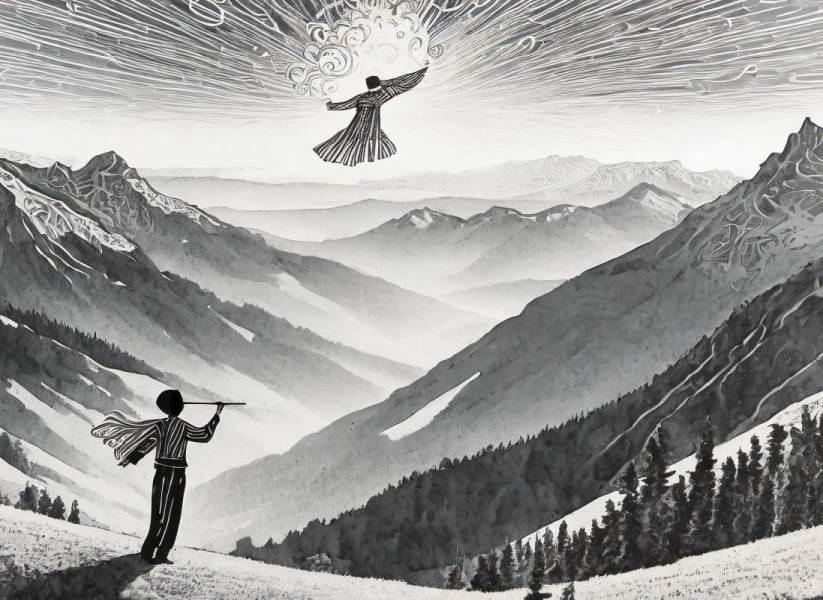
Then we’re told the child vanishes. This shouldn’t surprise us. If we were paying attention, this child appeared to the piper “on a cloud.” This child wasn’t a flesh and blood child — wasn’t one of the potential readers or listeners to the anthology’s contents — it’s a spiritual emanation of childhood.
OK, that’s a little weird, but Blake was a self-confessed visionary, and literary inspiration stories can be peculiar. Just another day at the poetic office for Blake. And as the piper makes his own pen and ink, I thought of one of the things that I found most inspirational in Blake’s life: that despite literary poverty he mastered the means of creating his own poetry, art, and engraved books.
Just after completing my musical version of this, another area of concern came to me. Just how strange did this seem to the children in the 1920s or to their parents who might read this to them if they were younger children?
I was a young child in post-WWII America, and in my time and place, I would have been puzzled. About the only piper I’d have any reference to was The Pied Piper, a page-bound storybook character. Yes, various kinds of musical pipes were extant then, as there would have been in the 1920s, but nothing I would expect in my time to see being played in wild valleys. Blake’s poem was over a century old when the 1920s anthology was made— maybe late 18th century England had itinerant rural pipers?
As they grew up, the child reader, then or now, would likely understand this is fantasy, even if exactly what Blake was getting at with his fable might be missed. Its value would remain as a set of word-music that speaks to the joy found in music and the arts.
Is anyone trying to guess if this was in the girls’ or boys’ anthology? Male author. The cloud/child is male, the piper is not gendered. Is joy in music a gender role thing? Not really.
Wilderness cumulous-carried spirit children are not a reliable compositional prompt.
.
It’s from the introductory section of the “for girls” book. My music is a simple folk music setting: acoustic guitar and bass, and eventually an Irish tin-whistle for piping. The tin-whistle is a played VI.** Two other instruments make a subtle entry in this recording. There’s a quiet electric piano in the piece, played and mixed so low it almost sounds like an overtone of the guitar, and another VI of a small obscure 1940s keyboard instrument, the Solovox that comes in for the next-to-last verse.
The Solovox was an FDR-era monophonic analog keyboard synthesizer, with glowing tubes and a wood-veneer case like a large table radio of the time. I used it for two reasons. If this song floats in fairy-tale time with children appearing and disappearing out of clouds, I thought the piper’s sound could change from the tin whistle to something more mid-20th century as a marker of how the children the anthologies were written for grew and changed. But also, I’ve seen, even briefly played, a particular real Solovox. The mother of alternative voice and keyboard player in this Project Dave Moore had one, and when he was young his mother would play piano and deftly slip one hand over to play melody lines on a Solovox. Dave now has his mother’s example of this old instrument, and has had it fixed so it plays, though with some glitches.
To hear “Piping Down the Valley’s Wild” you can use the graphical audio player you should see below. Player vanished? This highlighted link will open a new tab with an audio player. I plan more poems, adapted musical pieces, and observations from The Girls/The Boys Book of Verse coming up soon.
.
*There are methods to do that, where a singer alternates using their breath to sound the instrument and to sing lines of song. And there are bagpipes and the like where the wind comes from a bellows. But the child has asked the piper to drop their pipe and sing, so it stands to reason this is a request for the piper to sing a song with words after playing instrumentally for two renditions. The song then progresses from melody, to sung words, to finally written words — a plausible metaphor for the writing of a poem.
**I explained VI/Virtual Instrument technology last time, but in short it’s playable software that tries to contain all the sounds an actual instrument makes, often by capturing all conceivable notes and many articulations of those notes with a microphone it makers placed on the real instrument.
Earlier this Spring I had an idea for a Parlando Project feature for this year’s National Poetry Month. It was based on something I read in the blog “My Life 100 Years Ago,*” as blogger Mary Grace McGeehan turned some of her attention to children’s literature. As those interests crossed over for her, I learned there were a paired set of poetry anthologies from a century ago, one first published in 1922, The Girl’s Book of Verse, and the other the following year, The Boy’s Book of Verse.
A reason I’m drawn to poetry is that poets often examine and see things many others would miss. I read of those two titles and was intrigued. Lots of things to examine. One, the books are gendered — unsurprisingly, they only saw to market two volumes then — and being published in the early 1920s they might say a lot about how the anthologists viewed childhood and gender roles at the time that Modernism was starting to become a substantial part of literature in America. And for those targeted boys and girls (and their parents) the world was changing in areas well beyond poetry, music, and the arts. Adult women had just been given the right to vote, and there was increasing belief in expanding women’s roles. Fathers had in some cases returned from America’s first extra-continental wars.**
And there was another reason, I had recently come to see appealing elements in some of Robert Louis Stevenson’s poetry aimed at children as I revisited it. It’s long been a cultural commonplace that Mark Twain and Lewis Carroll are children’s books with layers of understanding, not just fantastical adventures. And in our present culture a great deal of our marketplace is taken up by young-adult books and genres that often have roots in youthful reading: Fantasy and Speculative Fiction for example.
So, what if we step back a century and see what’s there? I found a number of interesting poems in the two books, and my plan was to step up the posting tempo of this blog to at least double time. There’d be writing on what I observed in the books, and the Parlando Project’s combining of literary poetry with original music in various ways and styles would top that off. I started stockpiling some compositions, even recorded initial tracks for a couple. I was realistically readying myself for more activity here than usual to celebrate NPM 2024.
I didn’t know this would be the poster for this year when I started out. Seems appropriate for my plan.
.
Great plan.
Great plan, meet life.
I’d already figured what would be the first two pieces of this series. Monday I was going to complete recording the music I had set for the first one. My old-man energy didn’t hold out, and mid-morning recording expectations turned more into an early afternoon plan. Monday afternoon, I grabbed my music to go record, and..
The music stayed on the table. More family distress came home. I haven’t found a way to write about this that feels appropriate to me — and I’ve felt so blessed the past eight years of this Project to have so much time to do the extensive work it entails that I don’t want to be disproportionate in measuring my little change of plans this week against the reasons for distress. Today’s concluding summary: this is an introduction of my original intent, and a public statement that I still have hope for some variation of the plan still coming off for this April Poetry Month here.
My appreciated long-time readers will know to wait — and new visitors: there’s a lot here for those interested in poetry and the various ways it can be combined with music. You might want to search for a poem or poet and see if we’ve already presented it. Over 700 pieces, there’s a lot here — but it’s all over but the footnotes today — and those footnotes are something else this blog picked up from Mary Grace.
.
*Her blog started out with a pledge to only read material from 1918, but it has transitioned to an occasional look through stuff that was contemporary a century ago. Lots of considerations of what women in this dynamic time were presented with, often through magazines of the day. This stuff fascinates me. It’s the mundane and commercial mirror to the era when a lot of the poetry I’ve presented was created.
**How about other historically significant issues in this last decade that called itself The Twenties? Social inequality was certainly on some adults’ minds then, but that generally goes unreflected in these middle-class oriented poetry anthologies. I may take a second scan, but the issues of America’s racial caste system are largely ignored, though there is a bizarre Longfellow poem I hope to at least mention in the series (even if I might never figure out how I could perform it). Another thing to think about as we consider these century-old books: the children’s audience here would be inside that Greatest Generation who experienced the Great Depression, the global rise of nationalistic fascism, and eventually an even greater world war and its aftermath. Is there anything here in these poetry books which the authors suggested their mothers should be handing them that helped them through that?
A three-part post today — let’s see how short I can keep it, though we’re going to go far. Read on and we’ll leap from an important artistic movement whose poetry is forgotten, to the case of the odd filtering out of a woman artist from that movement, to some notes about translation and musical composition — and in the end to a remarkable trick, an April Fools’ joke of a sort I played on myself unconsciously.
Canons
It’s weird sometimes trying to figure out whose work gets remembered. It’s too much to ask for there to be some fair-minded, objective, and well-informed process of experts weighing the canon as our caissons go rolling along. Instead, quality and salience is supposed to just emerge. Emerge from what? Taken, via circular reasoning, from that memory. This sort of works, though how we know how well it’s working is hard to explain, as it may not consider those we aren’t as a culture considering. Canons have always changed — it’s ahistorical to say they haven’t, and when did we agree that history stops?
Dada poets are under-considered — or if they are, it’s as a conceptual statement more than a considered poetry. Visual arts will always include a Dada piece when discussing Modernism, literary arts are much less certain to. Dada’s evolution into Surrealism makes it almost easier to leave out Dada poetry. Dada poetry can be seen as the rough demonstration, the provocation that initiates a disruption.
My idea of presenting a Dada piece today comes out of an idea as question I had: “What can I do for April Fools’ Day?” Dada can be seen as an April Fools’ Joke. How so? Let me invent a manifesto of Dada that no Dadaist is likely to earnestly write as it violates the concept of Dada:
Much of what we’ve been given as meaningful can be seen in the human predicament as useless, maybe even harmful. Yet, we’re constantly being fooled with the trappings of power and precedent. Arbitrary examples of meaning, truth, and rules, dressed in the right costumes, framed in the expected way, keep us susceptible. So let us show how the trick is played and laugh at its absurdity.
Art Movement — and also the structure of an April Fools’ Joke.
Therefore, Dada presented poetry — a literary form we believe must be meaningful because it’s beautiful — that was random, perverse, taking the forms and frames of meaning while eschewing that meaning. Surrealism later posited meaning — or perhaps more exactly, the experience of art including poetry — as being above and beyond logical, conventional rationalizations, but the way was cleared by Dada’s withering can(n)on-fire that made merciless sport of the idea of hierarchical poetic meaning.
Still, we’re more comfortable with the idea of looking at the urinal/fountain or bicycle handlebars above a bike seat and seeing a worthwhile experience than we are looking at a series of chaotic words uttered incongruously as poetry. The first is a gentle poke in the ribs, it can easily elicit a pleasurable “See that?” The second worries us more, how should we take this? And the connection of denotative meaning (even an elusive one) that we rely on to carry us through an assemblage of words, is it indispensable? Is reader/listener boredom a legitimate artistic response, or one we’ll long endure?
The questions in some Dada poetry are valuable. The answers, not always so.
Emmy Hennings, forgotten because she was a Dadaist and because she wasn’t a Dadaist
Earlier this week I set myself a task to look at some Dada poetry to see what I could present here. I came upon a handful of poems by a name I believed I’d never seen: Emmy Hennings. I’ve retrospectively rechecked a couple of books I’ve read on Dada/Surrealism and I found my memory faulty. Hennings’ name was mentioned, but the context of those mentions didn’t make her seem anything like a key player. She was the partner and wife of Hugo Ball, a big macher in Dada, and consigned as a peripheral helper/muse/hanger-on. She did perform (from the very first Cabaret Voltaire performance!) but she was often characterized as a “music hall performer,” the kind of conventional entertainment that wasn’t what Dada was about. The supposition was put forward by the avant-garde that she was an interloper tempting Ball and the Cabaret away from real Dada into some kind of bourgeois, conventional performance career.
On further examination, there’s a case that she’s been underestimated.
Just kids. 1913, three years before the Cabaret Voltaire, but Emmy looks to me here like this could have been taken in 1975.
.
Looking over her poetry in a handful of human translations and quickie machine translations from her native German, I was immediately drawn in. It showed that essential Dada tactic as stated many years later by American Dada composer Frank Zappa: “Anything Anytime Anyplace For No Reason At All.” It also contained German Expressionist poverty-stricken darkness — and yes too, an element of erotic romanticism, though in the context that element was being set in place against the rest, implying criticism of it. Downrating her including music hall and folk song in her Cabaret Voltaire performances would seem to leave-out the case for Hennings consciously creating a Dada collage. If you put disparate things together as part of Zappa’s AAAFNRAA, those elements will talk to each other when viewed as one thing.
Here’s a secret factor most artists remain loath to admit: the random, or even the most carefully constructed miss-matches, can generate meaningful perception in the human mind. Yet Hennings didn’t write unalloyed gibberish, though outlandish collisions were allowed. She sometimes writes in a manner I recognize from later Surrealism — although from a woman’s mind and experience, a vantage point the Surrealists were loath to admit into their boy’s clubhouse.
Reading more about Hennings, I could see a rich collage of biographic and aesthetic components to her art.* I tried to sum that up to my wife by describing my emerging conception of Hennings as “A WWI sort-of Nick Cave: dark outlook, opiate addiction but hard working, catholic mysticism encrusted, mixed with elements of power-observing romantic eroticism.”
I already had a rough performance mix of the musical composition used for today’s piece before any of these Dada and April Fools’ ideas. I composed it using four new “virtual instruments”** that were newly available to me: a viola da gamba, a hardanger fiddle, a singing voice, and something that called itself a dulcimer.
I love bowed strings, and the somewhat rare and archaic viola da gamba is one that has long interested me, an interest that was sustained by once having a co-worker who played the instrument. The VI is a bit harsher sounding than hers (she used period correct gut strings and a softer bowing attack) but I used it to play the low-end lines in today’s piece.
The hardanger fiddle is a Norwegian folk-variation that uses sympathetic drone strings to add persistent, powerful overtones to the those actually fingered on the fretboard. A musical hero of mine, guitarist Steve Tibbetts once recorded an entire album featuring the instrument. My honest summary: I love drone, I love Tibbetts, my wife would testify I must love Norwegian-Americans, but I found it hard to take the sound of the hardanger for the length of an album — my reaction is similar to how some people experience bagpipe music. I also like sour tunings and harmony, but still that was my reaction. Dada being my goal, I went against sweetness however, and there’s a brief hardanger section in the middle of the piece.
By far the predominant sound in today’s music is from the VI that calls itself a dulcimer. I play the American mountain dulcimer a little bit. It’s a gentle diatonic scale instrument associated with American British Isles immigrants who settled in rural Appalachia, usually played by women as a quiet solo accompaniment for singing. This VI’s sound is nothing like anything I’ve played on mountain dulcimer. A demonstrator for the company that sells the VI says it sounds more like a lute. I’d expand that to say any of the oud variations or maybe even a mandolin family instrument. I treated its sound with a lot of reverb, so it’s more Coleridge’s opium dream Abyssinian maid dulcimer than some rustic American in a lone cabin.
The last thing I added to what was an otherwise vocal-less piece at this point: a high, keening VI voice. The human singing voice is something that VIs don’t yet allow easy access to. Perhaps eventually the ability for an easily available VI to sing all the components in human sung language will emerge, but for now what they do quickest is singing vowel-rich syllables. This VI went beyond the usual Oohs and Aahs with what sounded like nonsense words in no certain language. I hadn’t made the connection yet, but nonsense words are another part of Dada.***
So, on completion of the realized composition I surprised myself — I had what I then saw as a Dada piece without starting out with any such intent. That led me to seek out Dada poetry, and then to find and translate Emmy Hennings’ poetry to meld with my music.
“Singing at Dusk” is one of the few Hennings poems that has English translations I could find, but I made my own fresh translation. I followed a priority that guides my translations: determine what the images are in the original language and construct a contemporary English language way to convey those images. Since that is my primary goal, I will take liberties with the original’s sentence structure and wording. At times (and this happens here in this translation) I’ll even change the matter of the image in search of vividness. This latter choice is a historical fault, and I feel conflicted about it, but as I continue to translate, I catch other more renowned translators, resorting to it. Because I wanted a compelling sound to match up with the rather insistent music it was to mesh with, I also (uncharacteristically for my translations) decided to impose a rhyme scheme along with some other sound elements for this translation, which further caused me to depart from Hennings’ original. That kind of mutation to serve a form or rhyme scheme is another thing I catch other translators doing. Due to these choices, the result is partway between an earnest attempt a poetic translation and an “after a poem by” variation.
This version is a looser translation aimed for the needs of today’s performance
.
If it’s Dada, how much of this matters? It could, maybe should, be nonsense syllables, a random whatever. However, I didn’t find Hennings’ poem in the original German to be nonsense. Dedicated to her husband, Hugo Ball, it strikes me in German — and perhaps even more so in my looser translation — as a critical look at romance and marriage/partnership from a woman’s standpoint. Another element I bring out in my translation is the immigrant/exile experience. The originating Dadaists were from various countries, holed up in Switzerland, with a World War raging around them. They were writing work in German and French and a smattering of other languages, when those languages were being spoken in opposing trenches. National rootlessness was endemic in Dadaism, both as a choice and a fate.
Here’s the promised final observation: those keening nonsense words I generated from a VI played on my little plastic keyboard resolve at the end to something that I suddenly realized sounded very much like a woman singing “Jawohl.” What! They were just vocalese syllables, abstract sounds when I chose them — and they remained so for the dozens of times I’d listened to those passages, played even before I chose a German language poet to translate. Was that a trick of the ear? Here it was, the night-time, I was going to bed after a long day working on this piece. I was listening to this singing at dusk, and inside my earbuds I hear this voice loudly singing the German word for the certain and absolute “Yes.”
Will you have my experience with this musical piece? I can’t say, but you can hear it with the audio player below. No player? This highlighted link will open a new tab with its own audio player.
.
*Like some other Dadaists, she was a hyphenate: she wrote poetry, prose, sang, danced, made and performed with puppets, painted.
**A virtual instrument (VI) is a playable instrument made up of multiple samples (most often taken from a microphone in a recording studio placed on the “real thing”) of the various notes, ranges, and articulations of an actual instrument. One plays the VI by using a controller (a keyboard or perhaps a guitar with a MIDI pickup) that controls the notes played, or by scoring the music and selecting how that score should be played. This is a much more atomized use of sampling than the other kind of sampling that uses recorded snippets (often several bars long) of already recorded music afterward triggered to create musical beds and motifs in modern hip hop/rap music. The latter is another use of collage: thank Dada again.
Obviously, the tactile experience and idiosyncratic techniques of the real instrument cannot be brought over, but the results are increasingly convincing, at least to casual listeners. For composers without grant patronage or large exploitable friend networks, it’s a godsend. Even when the exact sound of a musician and acoustic instrument in the room isn’t produced, a musical something can be.
***The most famous Dada poem in any form known to modern English speakers is the Talking Heads song “I Zimbra.” When he presented it during his American Utopia theater piece, composer David Byrne explained that he adapted the vaguely foreign-sounding lyrics from a Dada nonsense-word poem by Hugo Ball, the partner of today’s poet Hennings.
Perhaps we should remind ourselves in this pre-AI age that every poem, any poem, is written by another human being. I did the math with the years, and this is a poem published and likely written about a hundred years ago by a 40-something Midwestern American.
I’m decades past that age, as was Donald Hall when Hall gave us his law that states that most poets, even prize-winning ones, will be forgotten 40 years after they die. This may sound callous, but that process is likely necessary. How many poets can we hold as a culture, as a reader? Dozens? Certainly more. Hundreds? Whatever, there’s a limit. The poet who wrote today’s piece? Who would we give up in the pantheon to let him in?
I came upon the poet who wrote today’s poem, Edwin Ford Piper, by reading a striking poem he wrote of the closing American wilderness that I’ve already presented earlier this year. I know little about him as a person.* I almost worry to find out more, since human beings are full of all kinds of faults, deleterious opinions, vanities, and misapprehension. Did he write this poem in this time of the year, in the Spring? Who can say. Writers are full of memories, and imagination that can redress any cold or baren place, but it feels like he did. The poem’s trope of Spring’s reincarnation of driving/seeking life paired with the Christian holiday of Easter is far from unique — but the poem’s not, in feeling, much of a Sunday-dress observance — it’s luxuriously pantheistic. “Whispering Often” was written in a past era we still call Modernism, published in a journal that put forward many of the great English Language Modernist poets, Chicago’s Poetry Magazine, and it was included in Poetry’s founder’s anthology shortly afterward that had Modern American Poetry imprinted on its end-boards — but I can’t call it an example of Modernism.
If you can un-embarrass yourself, you could sing this Spring poem too.
.
It’s not end-rhymed. It does sing on the page, despite having a meter that I can’t easily chart out. There’s a familiar iambic rise to many of the phrases, but I don’t think I can call it blank verse, a form that Piper used elsewhere. Oh, but does this rite of Spring want to sing! The title says whispering, so maybe the poet is abashed at the voice that is called forth. Not a lot of today’s poetry sings like this. Instead, we’re more often interested in a poem showing us a particular apprehension the poet has uncovered, an apprehension we are to recognize and share. We are want to pause and recognize the matter of typical 21st century poems, like a friend speaking with us. A wise friend perhaps, a little better with language than we normally are — but still, we wouldn’t want them to break out into a song over shared teacups or beer glasses. How gauche that’d be!
And so, I think of this poem now, as Spring is rebeginning here in my Midwest, as the Abrahamic religions are celebrating holidays of freedom, rebirth, and revelation — but more so as the northern half of earth is celebrating something that Abraham could have seen in a place outside Ur. In this case, a man in his 40s, a Midwestern American like myself, stopped and wrote this down.
What an odd act! If he paused to think about it, he would know that by all odds this poem will be soon forgotten. Yes, Piper was a professor of literature, but he was an adult, someone who knows the comings and goings, the correct way to behave, the agreed worth of this and that. Yet the poem will appear as something as outrageous as an unbidden public song, one with a crush of erotic desire for life. Religion can shape and seek to make that solemn — and perhaps such a transformation teaches wisdom, brings thoughtful ethics to our roots and melting eddies — but that Spring is older than wisdom.
It’s enough to make a grown man break out into song after all.
So I did. Earlier this month I hurriedly sang a bunch of pieces I had written that I feared wouldn’t have time to shape and improve into full arrangements in an interrupted life. Long-time listeners will know my voice isn’t going to be polite, though maybe it should be. You can hear that quick, short, performance with the graphical audio player below. No player? You don’t have to rush past, you can use this alternative highlighted link that will open a new tab with its own audio player.
.
*It’s not certain, but there’s a fair chance that later this year I will make another trip to pay respects to one of my poetic heroes, Carl Sandburg, and on the way tarry awhile to see if I can learn more about Edwin Ford Piper.








 Frank Hudson