The achievement of Emily Dickinson’s poetry is unusual, but the poem I set to music and perform today stands out even amid the rest of her work. This uniqueness has led to varied interpretations of what the poem is getting at: sometimes esoteric readings of the poem’s matter, written by folks plausibly smarter and more knowledgeable about Dickinson than I.
And so, if I was stopped before approaching this poem to make a song from it, I would have replied with a vague recall of what I’ve read: that it’s about something singularly, perhaps secretly, important about Dickinson herself — a striking, summary image of a rage or force she felt. Well, maybe it is. I’m not proposing that I have any authority to change any charge this poem has given you. I’ve often found myself ignorant or obtuse. Still, I found a rather different poem than I expected as I tried to arrange how I’d express the poem while singing it.
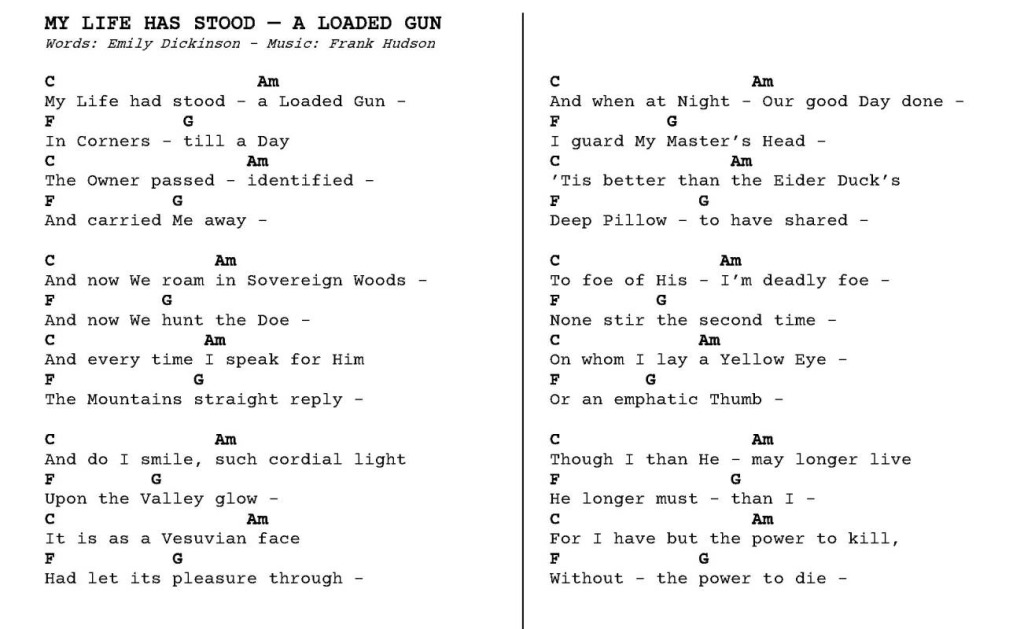
Here’s a chord sheet for today’s song. One intent in providing this is a hope others will sing it, perhaps better than I can.
.
The poem I read anew had Dickinson’s poetic voice playing a dramatic role, and the play is a tragedy whose protagonist is a sentient non-animal object, a gun. The gun’s relationship to humans, or particularly to its owner, is subservient and not rage-filled. It self-portrays itself as if it was a loyal dog: happy that it’s been selected like a pup from the pound, happy with a woodland walk in the company of its owner, proud of its sharp echoing bark. The stanza-scene where the gun is snozzled up to its owner’s pillow in bed, as if a sleeping pet, would make the most ardent gun-enthusiast contentedly smile.
Some readings have over-weighed the “stood” in the first line, as a Chekhovian gun frozen in the first act — all unrealized potential violence, a symbol of a quiet hurt or rage.
But then the turn, the volta. In the penultimate stanza the gun’s self-portrayal takes on another aspect: it’s like a gangland capo here, a deadly enforcer. Is it proud of its efficacy and efficiency in killing that it recounts? There’s no clear moralizing, but there is a contrast between that stanza and the sleeping master and gun. They will stir, and awake, while any foe the gun has shot will not “stir the second time.” The final stanza will tip our speaker-gun’s judgement on this.
Am I not diving deep enough into the wreck here? Am I stuck on the surface symbolism and not cognizant of the deeper meaning of what is being symbolized about Emily Dickinson, the middle-class, likely non-violent, non-weapon-toting woman? Could be, but as a singer of subjective quality, as a poor strutting player in this tragedy of the loyal gun, I might be able to convey that deeper stuff by playing the images well.
What was Dickinson’s self-knowledge of what she’s doing here? Was she the gun any more than Shakespeare was Macbeth or that Bob Dylan secretly sees himself as an Early Roman King? Deception and hidden meanings are a Dickinsonian trope, and the final verse clearly intends to be a hermetic riddle. I solve the riddle by thinking that the gun muses that as a non-living durable object it could outlive its human owner — but that in a better, wished-for world, the master would destroy it.
You can hear my performance of “My Life has stood — a Loaded Gun” with the graphical audio player below. No player seen? There’s one more bullet in your chamber — this highlighted link will open a new tab with its own audio player.
Is there a name for a poetic form made of two quatrains? Emily Dickinson wrote a good number of these 8-liners — brief, but a bit longer than one-stanza forms such as the haiku or the cinquain. One advantage of short forms is that they are easy to hold in memory, allowing them to be shaped and revised while one’s hands are busy with other daily tasks. We know Dickinson sometimes jotted down short pieces on household paper scraps, but maybe even those had earlier drafts before she could grab a pencil.
What can she put in such a container?
This one implies a short narrative. Someone (we’ll just say Dickinson for simplicity’s sake) is waiting at her house for something to arrive. She’s ready to tie on her bonnet (her outdoor hat) and on the waited arrival she’ll be going outside her home. In the second quatrain she says she’s awaiting “his…step.” The something is revealed as a male someone. Where are they going? Dickinson writes of a “journey to the Day.” Is this an odd way to say she expects a day-long journey? Perhaps, but she did capitalize “Day” as if it’s a particular concept rather than a 24-hour interval, and the poem ends with mention of a similarly capitalized “Dark.” Dickinson was fond of circular intervals standing for a lifetime, with a day’s sunset or nightfall standing for death. I suspect that’s what she’s getting at here.
I was captured by this poem, given my musical interests, by its citing of singing in each stanza. Examined carefully, the first line says something distinctive. “I sing to use the Waiting.” What a striking statement to a musician — or to music’s sister art poetry and poets. Life is time, that’s its waiting. What counts its meter and shapes the air in-between? I think of composer Frank Zappa’s quote “Without music to decorate it, time is just a bunch of boring production deadlines or dates by which bills must be paid.” Poets and musicians sing to use that waiting.
In the ending sentence Dickinson says both she and the awaited are singing to “Keep the Dark away.” Does music — does poetry — hold off, or prevent, death? Well, it may not be that death=dark exactly. Dark may be the unknowable aspect of death, the frightening nature of the threshold we cannot see beyond.
A thought occurred to me as I was living with this poem over the past couple of days: it would seem to pair well with — as a prequel of sorts — to one of Emily Dickinson’s most famous poems: “Because I could not stop for Death.” In “I sing to use the Waiting” she’s awaiting that other poem’s he, Death, to bring around a carriage for her. If that’s so, we might expect that on the ensuing carriage ride the two, Death and Emily, are singing as they ride past the playground and the cemetery toward eternity.
I’m OK with all the night-time transparent carriage traffic, but I wish they’d stop singing so loud. Still from The Phantom Carriage (1921)
.
I had immediate ideas for the musical sounds for today’s Dickinson poem setting, which helped me get a rapid start of the process of composing and tracking it. I was aiming for mysterious, but when I went to mix the various tracks it began to sound odder than I had thought it would be. I explored different options at that point, but in the end I decided there was no going back from strange. I should more often remind listeners here that I go exploring a lot of different musical ideas, so don’t take any one piece you hear here as representative of what you might hear in the next piece, or the one after that.
You can hear my musical performance of Dickinson’s “I sing to use the Waiting” with the audio player gadget below. Awaiting a gadget that never shows up? This highlighted link is an alternative.
Next week I’m going to be attending a number of events online that are part of the Emily Dickinson Museum’s annual “Tell It Slant” festival.* While I’m not sure how this will change my production schedule for new pieces here, I’m hoping to present a series of Emily Dickinson musical settings before September ends.
The first of these pieces is Dickinson’s “The Day undressed Herself” — and what a charming poem it is. As my reading of Dickinson has expanded, I’ve become aware that some Dickinson poems are so compressed and abstract that extracting a clear meaning is very difficult, but despite this poem’s use of an un-introduced conceit throughout, it’s clearly a poem depicting a sunset. If something of a riddle, the subject is one most readers will “get” easily.
But poetry isn’t just plot and foreground. I don’t mean to replace the direct evidence of hearing the words sung in my performance, but the sounds here are so lovely, and the poet here is clearly choosing words for sound, starting right off with the fabric swish of the poem’s first line and continuing in the 1st verse with the now antique word “Dimities” (which are undergarments.) And Dickinson’s metaphoric details aren’t just sounds, they set this sunset, this emblem world and its cosmic time, in an intimate female universe.
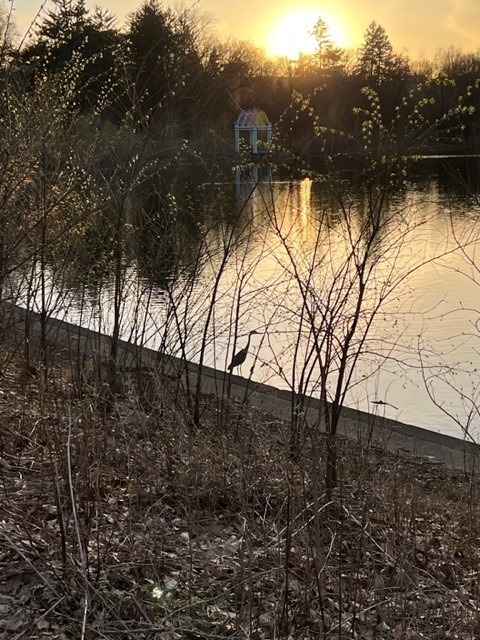
The window next to me as I write this faces west too, but it’s only an urban alley. Here’s a sunset a few blocks east, the heron doesn’t seem to know they’re in a city.
.
It starts with a woman undressing, where in art a long tradition of erotic gaze comes with that choice. If that’s so here, it’s a deep and unstated undercurrent. Is she just readying for bed, for dreams perhaps? Or something else? By accounts, Dickinson wrote often at night. I don’t know if she wrote after a change into her bedclothes or not, but this possibility: the sunset’s heralding of an opening to the looser dress of imagination may be in Dickinson’s mind.
The 2nd stanza expands from Earth’s sunset, to let us know, as scientifically educated Dickinson did, that the Sun is but a single star — and if I read her right, that stars are being born daily in the universe.
Another trope that comes with the sunset: day’s end meaning life’s end. The poem’s 3rd verse indicates this is considered and taken as a side issue of this sunset — sunset’s ars longa isn’t so concerned with that — and as it happened, Dickinson’s night-scribed poetry became more than a lifetime-lived. In some mythologies, the sky gods are male —in this one, our western, setting sun is a “Lady of the Occident,” female.
The final stanza starts with a line: “Her Candle so expire” which if considered more fully isn’t just sunset extinguishing the last light before bed. My ear may be over-pun-sensitive, but I hear the rhyming word “fire” in “expire,” and once more the cosmologist is saying in that line that stars themselves have lifetimes.
Someone has been sailing on frigate-books in the closing two lines. I’m surprised at her knowledge of the truck in a sailing ship’s rigging, a ball where the halyard’s pass. It’s an unusual word, no-doubt chosen to consonante with Bosporus, the water separating Europe and Asia next to Constantinople/Istanbul. The dome in the final line is then the Hagia Sophia (“holy wisdom”) church in that city. And the final words, “Window Pane.” What’s this definitive, capitalized pane of glass? Dickinson’s bedroom faced west, her little writing table at a western window.
Here’s a rough chord-sheet of today’s musical Dickinson.
.
I wanted to do something featuring a lush sounding steel-string acoustic guitar for this one. With luck I was able to just squeeze in the final take you can hear below as my studio space time so expire. You can hear that performance with the audio player gadget below. No player seen? This highlighted link is an alternative that will open a new tab with its own audio player.
.
*This Festival features a multi-day round-robin reading of all of Dickinson’s 1789 poems, and each time I go through that experience I’m reminded that it is as impossible to comprehend all of Dickinson’s poetry as to remember all the stars in the night sky. Each time through, “new poems” seem to have been inserted — which are in reality ones I had heard in previous years but wasn’t ready to feel until now. Just sitting through a small portion of the readers’ reading — an hour or even a half-hour — can change your appreciation of what Dickinson offers. Busy people might want to choose only one of the reading sessions that has a convenient time for them, and maybe do some hand mending, cooking, or housework as the variety of readers speak the poems in turn. Let the poems that you are ready to feel come to you in your household, as their author composed them in hers.
There are also a variety of programs discussing other aspects on this year’s schedule. It’s all free to attend, but you should sign up at this link.
If we think of poetry as more than a barren art, we might think of things we read in poems as things that occurred to another person, somewhere, sometime. Oh it may be a mistake to automatically read poems as memoir — invention has always been one of those occurrences — but the more universal the poem’s account, the more we may think: this decorated thing I’m reading came from the senses of someone feeling an experience.
If we do that, we can think today that somewhere in China, sometime in the 8th century, an adventurer turned poet in middle-age awoke at night. What kind of bed, what kind of bedroom? The poem tells us nothing posh, despite its brevity: the poet’s expectation in the shining he sees around his bed is that it’s frost. It might be a lean-to, or even a bedroll on some improvised pallet out in the open. At best it might be an unheated room.
But still he’s awakened to something shining. He soon re-adjusts. No, this brightness that has occurred is moonlight not the frost of a more northern climate. Commentaries I read on classic Chinese poetry note that “bright” is something of a favorite poetic ideogram in those poems. A good symbol for immanence and essence? That light from the now open eyes of our poet must be seen. Oh, it’s the moonlight, likely a full moon on a clear night, he figures out. But that realization says something about near and far. The moon is more than 200,000 miles away. Yes, the moonlight is near, he could touch it but feel nothing.
What can he touch? He can put his head back down on the bed and think, perhaps to think himself into dreams of his home. Feel that now with him as the side of face and scalp touch back down. How far, that home? Moon far?
The 8th century poet who wrote this, Li Bai (also known as Li Po), was an itinerant for much of his life. Choice? Consequences of other choices? Exile? The traditions seem to indicate a mixture of all that.
This is a well-known poem in Chinese, taught as an early lesson in poetry to children like Sandburg’s “Fog.” In my translation I did something I don’t normally do: imposing an English meter & some rhyme.
.
Now another man, in another bed. I can tell you with more exactness where and when: September 18th, 1970 comes in within a night in London, England. The man has been out to nightclubs, “sitting in,” playing music with others, something that consistently energizes him. For much of his life music has possessed him like that. He’s been blessed or cursed with the compulsion to make it. It’s just a couple days past the harvest moon in this room, the moon as far away as Li Bai’s moon.
He’s with a woman whose role is somewhere between girlfriend and convenient stranger, but this is not strange to him. He barely knew his mother, his father’s time was taken with drink, low wages, and a skin color that marked him as an outsider, and so he could rarely care for him. This had often been. As a child, taken in by other women, neighbors, and relations — and as he left home, others in the various valences between girlfriends and strangers.
Do non-performers understand how hard it can be to transition to sleep after the active interaction of live performance? Performers likely have tried it all: sex, boring TV, cannabis, food, and even more alcohol than they drank to take the edge off self-consciousness before performing — enough to move them from the level of self- to un-consciousness. And yes indeed, other drugs.
This man had moved from at least some of the above to the other drugs: his companion’s sleeping pills. A foreign formulary, they were much stronger than he anticipated.
September 18th, 1970, Jimi Hendrix, the man in London, quiet night thoughts. Did he awaken in that night as Li Bai did in his poem? Accounts differ from that London night. Let me think that at least his consciousness tried to return — in his head the sparkling currents like the magnetic waves when electric guitar strings are strummed. Did he think of home as the great Chinese poet did? If so, what would be home? Did he think of America? He was doubly American in a fierce way: some of his ancestors had been kidnapped and sold to enslavement there, and some of his ancestors had had their before-it-was-named-America taken too, a trail of tears. Did he think of his parents, even more so because of their relative absence in his life? Others who had episodically cared for him? He might have. Maybe too his night thoughts were of music, of songs. We can still hear him sing about dreaming on recordings, so he could have dreamt of singing a new and elusive verse. Did he open his mouth to say it, and there was nothing? No air. No breathing. No life.
You can hear my performance of Li Bai’s “Quiet Night Thoughts” (for Jimi Hendrix) with the audio player below. See just a pool of moonlight at the end here, no audio player? This bright link will open a new tab with its own audio player.
I sometimes think I’m working against gathering a larger audience for this.
Twice in the past month or so I’ve had an opportunity to speak in passing with poets about what I do with the Parlando Project. I’ve got my elevator pitch carved out: “I combine poetry, usually literary poetry not intended to be performed, with original music in different styles.” Both poets came back with this replying question: “What kind of music?”
Maybe I should start hitting that word “different” with hard emphasis — but Midwesterners know that kind of spoken underline could be parsed in our regional argot as cloaked disparagement. If I was to say:
“I’ve written a piece for a string quartet in which the instruments are placed on the floor and filled with nuts and seed. A herd of squirrels is then unboxed and will proceed to chew through strings and tonewood for the course of the musical evening.“
The Midwesterner is bound to reply “Oh, that sounds different.”
For Friday the 13th: presenting the unexpected, not gnawful, just “different,” the Squirrel String Quartet.
.
Now, I believe both of those poets this past month are perceptive, I read it in their admirable poetry. If they miss the word “different” it’s because many people have strong feelings about the music they care about.* Long before reaching the age of those poets most listeners have strong affinities for some music and equally strong dislikes for the sounds that they don’t wish to put in their ears. The idea of combining poetry with music is attractive, but what kind of music is an unavoidable point in describing the Parlando Project, and I can’t encapsulate that. Elevator pitch? If I tried, I’d be out of breath and walking up flights of stairs. To both poets I was reduced to trying to start my response with “That’s my problem: it varies.”
Readership of the blog posts here continues to increase through the years, while listenership to the audio pieces has been for the last half of this Project’s life flat to somewhat lower. This bothers me, and I have theories, but one that seems particularly plausible is that the variety itself turns off listeners. One day acoustic guitar folk-scare strumming, the next day some kind of synthesizer sound, a garage-rock quality electric combo, something like Jazz, small orchestral ensembles, Blues slide-guitar, or alt tunings in a matrix somewhere between John Fahey, Joni Mitchell, and Sonic Youth. And then on the third day, a combination of one or more of the above.**
How well do I (who much of the time needs to play or score all the parts) present that variety? I think my own judgement approximate, but it goes like this: on good days I think I do it well enough, on bad days I feel embarrassed by the faults in execution and conception I hear. So, my limitations are a factor here, but even if I was a master of all these forms, I think the problem would remain. In this theory it takes only one or two “bad fit” musical pieces for a new listener’s taste to judge the work has no value, and no further listening occurs.
What will I do about this? I don’t know. I can’t help the eclecticism — it’s been in me since my youth*** and I don’t think I want to try to scrub it out.
Today’s musical piece comes from that “We’re a garage band, We come from Garageland” mode — looser still in that like most of the LYL Band pieces presented here over the years it’s spontaneous, not the execution of parts each instrument is supposed to play. As keyboardist Dave Moore says at the end, the words are “a personal experience story,” an exception in the Other People’s Stories texts the Parlando Project finds, experiences, and presents. Just over a year ago a storm with 60 mph winds and golf-ball sized hail struck Minneapolis. Overall, it caused 1.1 billion dollars in damages. On my roof, my shingles were totaled (the classic hail-storm result), windows were shattered, and there were plenty of cracks in the siding from the wind-driven hail. As “Heaven and Hail” tells it, it took months, well into the winter, for overwhelmed builder crews to get all the home damage repairs completed in my neighborhood.
Last year at this time work started on fixing the damage at my place. One experience amid the hammers, ladders, and supply pallets: hearing one of the crew’s boomboxes playing a record of garage rock classics all sung in Spanish. Another Rosetta Stone moment, like reading those cereal boxes in French.
To hear this short account of the storm and aftermath you can use the audio player gadget below. No player? This highlighted link is an alternative that will open a new tab with its own audio player.
.
*Neither asked me —and few people ask me — “What kind of poetry?” With non-poets, I ascribe that to the lesser interest in poetry as an art and therefore a lack of strong likes and dislikes.
**This leaves out the subjective qualities of my voice, something which I recognize is of overwhelming importance to most listeners.
***”Top Forty” rock’n’roll radio was extraordinarily broad in “The Sixties™” and I was listening to the classical music station and a country-western station along with that format. Hootenanny was on TV, folkie music was part of church camp. Other than the occasional cross-over hit I’d hear on the radio, the Jazz waited a bit to creep in late in my youth. Eventually the smart programmers figured out that a pop music station that played a “button pusher” record would cause the listener to switch to a competitor. I’m the odd-duck that when I hear a record I don’t like, right after one I do like, I want to hear the third and maybe fourth or fifth record played, particularly if any of the small sample (liked or not-liked) is something I don’t think I’ve heard before.
We’re going to travel to one of the best short poems that late 19th century American poet Richard Hovey ever wrote, a strange poem about approaching death, a place far or near, with no trusty mileposts. As I like to do, we’re going in a round-about way. Let’s start with a blue lake.
I can remember what a wonder it was. My father and his youngest brother loved to fish on lakes, and in search of ever more pure sport-fishing beyond the sky-blue waters of northern Minnesota, they took to traveling up further into Ontario Canada. I was maybe 10 or 11, still at an age when I was open to whatever my parents led me toward. We stayed at a family-owned fishing lodge at the end of a gravel road outside of Reddit. A few small, well-kept cabins, a couple of outhouses, and a lake-dock — which was all the two brothers needed, as the day was mostly spent out fishing.
As I said, I was accepting of this. I gamely came along, earnestly operating a rod and reel, waiting, sensing for any piscatorial tugs on the line, listening to the two men occasionally talking about what fishing tactics were most promising. My youngest uncle, maybe 18 or 19, had been about my age when their father died, and my father now served as his younger brother’s father-figure. I was unaware then that more than lures and casting targets was in their talk.
I was never bored. I had a vast imagination when young, and could sit quietly daydreaming stories and ideas in my head for hours. I suspect a good poet would have been more observing of the boundless nature around me; and while I watched and listened to my dad and uncle some, they were too commonplace for me to treasure.
Instead, here is what I recall being fascinated by: I was in another country, Canada, subject to its laws, and a Queen, a governmental oddity that seemed a little out of time to me. A gallon wasn’t even the same gallon there, nor a dollar exactly a dollar! The lodge owning family and everyone we met in Canada spoke English of course, but since my imaginative and book-minded mind lived in words, I was amazed that all the groceries we picked up in Kenora on our way up had bilingual labels including French.
I was as if I had found the Rosetta stone all by myself. As a native Iowan, I already had a passing place-name experience with French from my state’s then 160 year past life as a French possession, but here in Canada a box of Wheaties or a carton of milk could be held inside other words. So, later in high school and in my truncated college studies, I selected French as my foreign language.
I was terrible at it as a school subject. I did OK (not outstanding) in basic vocabulary. I was passable in recalling the tenses and such. I accepted the arbitrary gendering of nouns. But my mouth stumbled entirely in the speaking of French, so obtusely bad at speaking it that I strongly suspect it is something in my neurological wiring. That I persisted with French as I entered college was at least in part because I was learning that French poetry had been so interactive with English language poetry, particularly in the formation of Modernism.*
After my formal education ended, I continued translating French poetry, not by any right of fluency, as I’ve confessed above, but because I wanted to bask in the secret sauce that helped form Modernism.
Richard Hovey seems to have been greatly enamored of what was modern French poetry to him. His published work includes translations of Verlaine, Maeterlinck, and Mallarmé. While going through his published work this summer I came upon this sonnet “Au Seuil,” in French, dated as having been written in 1898. When I translated it, I found this graceful consideration of dying and some possible judgement and afterlife which I present to you in English today. As an old person, dying no longer requires any heroic situation, acute illness, or grandiose gothic stance to make such consideration apt for me. It’s a matter of petty logistics now.**
The poem as published posthumously in a collection by the Vagabondia co-author titled “To the End of the Trail.”
My translation, presented here as a chord sheet for the musical performance you can hear below. In performance I refrained the final line of the sonnet as shown here.
.
Was today’s poem written by an old man, or a young man staring down a deadly disease? No, Hovey was 34 years old, likely in vigorous health. Still, in less than two years he’d be dead, dying during a routine operation for something as unromantic as a varicocele. One can only wonder how he would have coped with the upcoming English poetic Modernism that would be sparked in part by French writers he admired.
Though subject to my language limitations, today’s poem to song turned out to be a relatively straightforward and faithful translation — with one exception. My usual poetry translation tactic is to primarily find the images in the poem and work at carrying them over vividly to English. I strive to have a non-creaky, natural syntax and word choice in the target language, and to make from that a poem in modern English word-music rather than trying to mimic the prosody of the poem’s native language. What was that one exception? In the poem’s 13th line, “ Qui nous benira de ses grands yeux bleus,” there’s an image I think.*** It could be that Hovey intends a witty little aside about a Nordic male god-in-heaven sitting on a throne of judgement, the cliché being then his point. As I worked on this line I wanted the possibility, however unexpected and wishful, of something universally marvelous. I dropped the andromorphic gendered pronoun as more than unnecessary, and then perhaps unconsciously recalling the poetry of the first-nations name for my current home-state of Minnesota, made the apprehending eyes more than humanly large.****
You can hear my musical performance of what is now an English language poem with the audio player gadget below. No player seen? This highlighted link is the alternative, and it’ll open a new tab with its own audio player.
*Oddly it wasn’t Spanish poetry. In England we can assign this to not forgiving the Armada and all that — but large portions of the United States had been Spanish possessions after all. And while Canada’s French is spoken regionally, Spanish is the predominate language across our equally large southern border and in the American commonwealth of Puerto Rico.
**For example: when I replaced two bicycles stolen early this summer, ones I’d ridden for 20 and 40 years, I wondered at the return-on-investment of spending like-amounts in current market prices to replace them. My favorite old-person’s joke is that when someone offers me a lifetime guarantee, I ask if there’s a better offer.
***Literal: “Who will bless us with his big blue eyes.”
****Lakota compound word for the place of sky-reflecting-waters. And there I have returned to that boat with my father and his youngest brother, as Hovey wrote in a different language: “we know this hidden way/as one knows the ghost of a dead friend.”
I enjoy the part of this Project that gives me cause to examine the lesser-known and forgotten poets and poems. Even the most famous literary poetry principally exists in quiet books, but give me a book now largely unread and my interest is perked.
Today’s poem is by Richard Hovey, one of the co-authors of a remarkable yet forgotten three-book series that began with Songs from Vagabondia published in 1894. Who was Hovey?
He was the son of a Civil War general* who privately published his first book of poems in 1880 when he was a teenager. He attended Dartmouth College, graduated with honors in 1885, and was highly active in literary activities there, coming to write what remains the official school song. After college he seems to have considered various paths. He studied for a while in New York’s General Theological Seminary, taught briefly at Barnard College and Columbia University. In 1887 he met his Vagabondia co-author Bliss Carman, and true to their eventual series title, they spent some time tramping around New England. Hovey wrote that he decided to dedicate himself to writing on New Year’s Day of 1889 while viewing a solar eclipse, which seems somewhat magical for an epiphany, but yes, there was an eclipse on that date. In 1891 he began publishing a planned lengthy series of verse plays based on King Arthur’s court, and he seemed to have traveled to Europe around this time where he met writer Maurice Maeterlinck and took on the job of translating Maeterlinck’s work into English. Hovey was also enamored with the French Symbolist poets and did English translations of their work.
Let me set the literary stage for this young poet as he began his career: Verlaine, Rimbaud, and Mallarmé were still alive. So was Walt Whitman. So was Mark Twain. The first and just-posthumous volume of Emily Dickinson’s poetry was still in process. Ezra Pound was a toddler in Idaho. While Hovey was a college student, Oscar Wilde toured America giving lectures on Aestheticism.** Hovey and Carman, with their on-the-road poems of beauty and poetry, of wit over dour seriousness, seemed to have resonated.
I learned one other possibly salient fact about the time Hovey and Carman were putting together the first Vagabondia book. In 1893 there was a sudden economic depression in the United States. Vagabonds were not always free-thinking college boys yet to establish their literary careers. Was there a sub-rosa political/economic point at the start of this series? There’s little I’ve found in the Vagabondia books that tip me to Hovey’s political stance, if he had formulated one.
I chose Hovey’s poem “Isabel” from Songs from Vagabondia partly because it was short and naturally suggested being set to music on first read. Given that I was also trying to get a grasp on Hovey’s life, I wondered who this Isabel might be. I didn’t find out. There’s no Arthurian Isabel, and I haven’t found any prominent Isabel characters in the works of Hovey’s literary heroes. I believe it was a somewhat common name in this era.***
Despite Vagabondia’s praise for male comradeship, I’m not (as yet) catching any homoerotic overtones there. Where eros does appear, it seems directed at women. The only romantic relationship I know for Hovey was a married woman who he had a child with and later married after her divorce. If you want to wonder at Hovey’s sexuality from afar, clouded in a sexually repressed time and with the small amount of information, I can only offer this tidbit: his lover and eventual wife was said to be “old enough to be his mother.”
Indeed, after all this search for biographic info, today’s poem might seem a tad insignificant. As a short love poem “Isabel” reminds me of Robert Herrick more than any of Hovey’s contemporaries, and she might be only a device to let Hovey write that sort of poem. In straightlaced society I suppose the poem’s breast-pillow line could have seemed 1894-era hot stuff, but I’m immune to that level of “I’m so naughty” eroticism — likely why Swinburne (also still alive in Hovey’s time) always seems laughable to me.
But Aestheticism holds that a poem doesn’t have to have great wisdom or weight as long as it’s beautiful, so I spent more than my usual amount of time with this 6-line poem’s music to justify asking for your attention to it. “Isabel” uses some of my favorite odd chords and flavors, and you can hear it with the audio player below. No player? This highlighted link will open a new tab with its own audio player.
.
*Father Charles Hovey was the President of what is now Illinois State University in its early days, and organized the 33rd Illinois Regiment (known as “the Teacher’s Regiment”) at the outbreak of the American Civil War, serving the Union as a Brigadier General.
***I wondered about writers with that name Hovey could have read. The only hit in that search was the marvelous early 19th century folk poet, folk singer, and tavern keeper Isabel Pagan. Pagan’s poem “Ca’ the Ewes to the Knowes” was popularly set to music by Robert Burns, a poet who Bliss Carman extolled earlier in this series. I did read that Hovey either knew or took classes with Francis Child, of the famous Child Ballads collection. That the Vagabondia series calls itself “Songs” is evidence that folk song, at least of the literary variety, is one its elements.
Does the summer feel like it’s gone by like a dream, one of those dreams where the ungainly night-plot finds its own winding path? I started this summer with a May Day suggestion to remember to write of our workday labors, and then too, I presented back then a cover song marking my teenager’s last childhood summer. And now it’s Labor Day weekend, and I’m going to present a poem that is the antithesis of paid labor, another poem from the 1894 Songs of Vagabondia book by Bliss Carman and Richard Hovey. We’ve already heard from Carman this month, now let’s sample some Hovey.
Richard Hovey is another of those pre-Modernist era poets who wrote in the final years of the 19th century. Because his work falls before the Modernist revolution and the ascension of American poets to a preeminent place in English language literature there’s lesser interest in it, but with a figure like him I think of a bright young man living in an age that felt stirrings of desire to form its own poetic styles.
His Songs of Vagabondia struck a carefree chord in its time. Tennyson, Longfellow, or Robert Browning would have presented a very serious life that should be attended to. The Vagabondia poems, with intent, fail the Sandburg Test I’ve proposed to assay poetry collections. If my beginning-of-Summer cover song asked the listener to indulge in “That Summer Feeling,” these poems concur. There’s no Winter and barely an Autumn there. No work or studies either. Instead, we have flirtations and libations, the comradeship of likeminded friends, and here the open road and heart are spent without anything much in one’s purse or paycheck.
For this Hovey poem from Songs From Vagabondia I chose to create a denser piece of music, a presumptuous rock band ensemble with two drumsets, electric bass, piano, two electric guitars, along with string synth and wind instrument parts. For a Labor Day holiday song about an aimless trip down a Maine river, I spent quite a few hours working to form this into shape. I’m not sure I produced the perfect arrangement after all that, but I enjoyed the process.
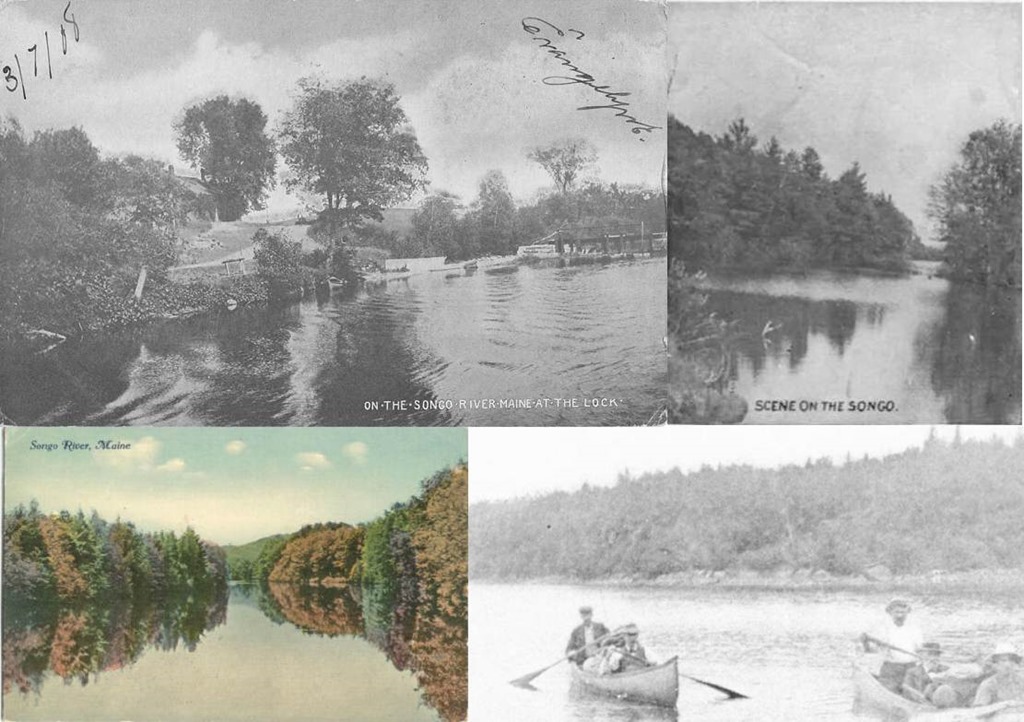
These Songo river photos look like they could have been taken within a decade or so of Hovey’s poem. Looks bucolic in these, but others show passenger steamboats (one named for Maine’s poet Longfellow) plied the river too.
.
The Songo in Hovey’s poem is a short river in Maine, but the Songo connects a large lake and some other bodies of water — and though I don’t think the poem mentions it, it had then (and still has!) a hand operated set of locks and a swing-away draw bridge constructed in 1830.* Hovey’s poem makes this river sound rural and solitary, but having never been to Maine, much less the Maine of the late 19th century, I can’t say how busy it actually would be. The poem’s voice says someone is using oars for propulsion, so even if this is an aimless pleasure trip, there’s work involved just as there was in my recording the song I made of the poem. At the end of the poem there appears to be someone else in the boat, as the poem’s voice cries out “Kiss me” unexpectedly. Who is the other there? Could this be a Hendrixian excused kiss of the sky-blue-water-sky? Maybe, but a lover would be the likely (if unprepared for) guess. The unprepared suddenness of this ask seems dream-plot strange to me.
In my performance I turned the poem’s remarks about the experience being dreamlike into something of a refrain to further emphasize that element for someone who might hear this once as I perform it. I also removed one short stanza from the poem’s original text in the interest of shorter performance length. You can hear the full band performance of “Down the Songo” with the graphical audio player you should see below. No player? This highlighted link is an alternative that will open a new tab with its own audio player.
.
*This short modern video shows the continued remarkable operation of the manual lock and drawbridge. Yes, these are hand-cranked mechanisms! So, Sandburg Test met with this post, there are necessary folks working a job on this river, even if unmentioned in Hovey’s poem.
So, what else did our two young late-19th century North Americans Bliss Carman and Richard Hovey put in their 1894 Songs from Vagabondia book? How about this one: a SF prose poem adrift in wine and the universe?
I’ve already mentioned that Hovey’s poetry is easy to link to the French language poets* that were a strong influence on English language Modernism that was just over the horizon in 1894, but perhaps pioneering Canadian poet Carman had obtained a copy of Rimbaud’s Illuminations when it was issued just a few years before the pair’s Vagabondia book. The form of the prose poem was still fairly novel, but this experiment in that form adds another, fantastic, element too.
The first time I read “The Mote” I thought it the story of a short slightly tipsy conversation between two young men in a bar. For young men with loosened tongues to talk of the universe, its unfathomable scope and mysterious connections, is a comic commonplace after all.
As the mote flies into the wine cup of one of the young tavern drinkers and the conversation starts, it’s easy to overlook the way Carman set the scene: the pair entering the tavern are of “august bearing, seraph tall.” Are Rudy Gobert and Karl Anthony-Towns having a post-game libation? “Seraph” isn’t the most common form of an esoteric word, “seraphim,” but it’s a name for the highest order of angels.
If one reads it again, taking that seraph literally rather than figuratively, then the mote which is called “Earth” isn’t a parable, but the plaything of two indolent angels! This ambiguity seems cleverly designed-in by Carman.
You can hear me perform Bliss Carman’s “The Mote” with the audio player below. The guitar part was played with my Squier Jazzmaster, an affordable rendition of a once unsuccessful Fender electric guitar design. One of the knocks against the Jazzmaster was that it had too much open string-length between the tailpiece and the bridge, a fault that could generate extraneous noises when one uses the vibrato bar. Some modern players see this and figure: “Feature, not a bug!” So, in that manner, some of what I recorded here has me intentionally playing the outside noises that a Jazzmaster can make.
If you don’t see the audio player gadget, I provide this highlighted link that will open a new tab with its own audio player.
.
*Here’s an odd thing: the 19th century French poets that were stretching the subject matter, outlook, and prosody in advance of their contemporaries in England took influences from American poets like Whitman and Poe. Carman and Hovey wouldn’t have needed to go across the ocean to France to read those Americans — but still, there’s a field of echoes going on in this pre-Modernist era. There’s another cosmic joke here too: Brits may have needed to hear some American-originated poetic ideas spoken in French before they could recognize their value!
When we last left off pioneering Canadian poet Bliss Carman he was audaciously publishing a collection of 100 lyrics by Sappho. If you read that post you find that such a substantial book of Sappho required Carman to largely imagine what the ancient Greek poet wrote, since much of what survives of her poetry are fragments, often but a line or two.
One could shelve that effort next to Ouija board transcriptions, among literary frauds, or within the loose bounds of historical fiction. Still, the “Sappho” poems he published have their attractions. And there’s a greater reason to look at Carman’s work: he was writing these things in the generation between 1890 to 1915 before English language poetic Modernism fully emerged with new models and freedoms for poetry. Some younger poets then suspected that Victorian 19th century poetry was overdue to be superseded. In England, William Morris and the Pre-Raphaelites had done what segments of young poets, musicians, and artists sometimes choose to do: they rejected their current and parent’s generation and looked to older models of their arts for different forms of expression.
Imitating the ancient Greeks in English was one such idea. Carman went further by treating his recreations as translations, but he may have gotten away with it when English translations of Sappho were still a bit thin on the ground. Other early Modernist poets writing in English like H. D. and Edgar Lee Masters produced original works that echoed the tone and methods of Greek lyric poetry.
Those Sappho lyrics weren’t Carman’s breakthrough however. That happened in 1894 when he and American poet Richard Hovey* published Songs of Vagabondia, the first of a series of co-written poetry collections that sought to break the Victorian mold. For a mid-20th century person like me, I sensed a rhyme in the appeal of these books as I read through them. Is it too easy for me to see them as the late 19th century equivalents to On The Road and beatnik bohemia?
How so? Though the Vagabondia poems have variety in subject and tone, they extol carpe diem, wine, women, and song, along with non-itinerary wandering. Sensuality and beauty are self-rewarding. Respectability, career, and money are for others.
This song is fun to sing, so let me share the fun with a simple chord-sheet to encourage you to try it.
.
Carman’s “The Two Bobbies” speaks to this literary and cultural moment. He jauntily compares the English Victorian worthy Robert Browning with the 18th century Scottish poet Robert Burns. Silent on its now age-beiged page, Carman’s poem was just begging to be made into a song, so this week I came up with a simple setting for acoustic guitar and my voice of subjective quality. You can hear me hold forth with it using the audio player gadget below. No audio player? This link is a backup that will open a new tab with its own audio player.
.
*And what of Vagabondia’s co-author Richard Hovey? I have plans to present some of his work here soon. Rather than looking to the ancient Greeks or to 18th century British poets, Hovey was steeped in another motherload of Modernist-influential poetry: certain French poets of the second-half of the 19th century.




 Frank Hudson