The Story of Dave Moore and Fine Art

This month, I’m going to start a series here featuring the words and music of Dave Moore. This is different—and not—because long-time listeners will have heard Dave’s voice and words here from the beginning, but this time I’m going to expose a little more of Dave’s range of work. If you’ve come here expecting our usual eclectic mix of poetry from various eras with music, don’t worry, we’re not abandoning that (and there’s lots here, just look at the archives on the right), I’m just taking some time to present something different, and “something different” has been my aim since the start.

I’m going to try to put Dave’s stuff in context, at least the way I’ve seen it. I’ve known Dave for 50 years. He was writing poetry before I met him, and he’ll write things for the page to this day, but he became a songwriter and he has had a long-running one-panel comic for decades too. I’ll start by talking about the songs.

A little over 40 years ago Dave’s words were used for the lyrics of a third of the songs on one of the pioneering Twin Cities punk/new-wave/indie records: 1978’s Fine Art’s Fine Art.  Dave didn’t perform with the band, and as far as I know, he didn’t have any direct input on the music the band created for the songs. Fine Art existed from just before their only LP was recorded until around 1983.

That you haven’t heard of Fine Art is likely derived from several reasons. The biggest one is that they, unlike some later Twin Cities’ Indie bands, never made it nationally, but I remain puzzled as to how they have disappeared from the memories, books, and posts of those who have sought to cover the local Minnesota-based heroes that made and made up the late 1970s scene that produced The Replacements, Husker Du, and Soul Asylum, and even to some degree Prince, a scene that was then the platform under an even later generation of Twin Cities connected indies like Babes in Toyland, The Hold Steady, or the Jayhawks. Like other cities who experienced the eruption of indie bands in the late 70s and early 80s, the Twin Cities has its own selection of “They were so good and original, how come they never made it as national acts?” bands. The Suicide Commandos, The Suburbs*, and The Wallets were unforgettable to most who saw them locally, but their national/international profiles never really existed, and are now, like our weather will be soon, below zero. Fine Art, who have a good case to being seminal to the scene, who staked their own distinctive sound within it, are forgotten even locally, and that pains and puzzles me.

So, if you make it through this post, you’ll know more about the band Fine Art than anything you’ll be able to find in a book or on the web. In talking about why they didn’t make it into history, I’m going to try to sneak in why you should care about what they did.

OK, what were the problems and obstacles that explain why you haven’t heard of Fine Art, even though they helped break the ground for a significant Indie rock scene?

Their name, Fine Art, can be understood unironically. Their leader**, Colin Mansfield was a highly experimental guitarist, and his compositional ideas were not punk pure nor entirely pop accessible. A sizeable portion of the Twin Cities scene followed the early 80’s movement to make hardcore music which was intense not only in its volume and velocity, but in the kind of loose authenticity that later was called grunge.***   “Art rock” was another of the labels hung on “Progressive Rock,” and that was the enemy to this segment. Fine Art, particularly in it’s early days, could be just as much (or even more) a focused frenzy as, for example, Husker Du,**** but that band had a non-sequitur, non-significant name, and Fine Art’s name on a concert handbill may have suggested the wrong thing to some of the market.

They were song-oriented. Despite the continuing connoisseur appreciation for Grant Hart, Paul Westerberg, and Bob Mould as songwriters, the early TC live indie music scene then was not conducive to them. PAs, live board ops, and venues tended to make all the bands vocals unintelligible. On record, the songs come through, but Fine Art issued too few recordings: essentially one self-titled LP of an early version of the band before they were fully formed, and one EP, Scan,  that better represents the middle of the band’s life. I’m unaware of any other Minnesota band with the breadth and quality of material from this early ‘80s era which left so little recorded legacy—but then that proves my point I guess, how would I know if such other bands existed?

Fine Arrt 1980 Liz-Terri-Carol-Colin with period dancer

The Fine Art lineup in 1980 fronted by Terri Paul and Kay Maxwell, Colin Mansfield on the far right. Also visible is Liz, their bass player that year which gave the band a 50/50 male/female split.

Live shows. The power of Fine Art in a live show could be substantial, perhaps most intensely on a small stage in a small room, but despite having exceptional singers/front-women over the band’s lifetime, they didn’t always come over on the First Avenue mainstage, the largest venue to present indie acts by the early ‘80s. Their contemporary local heroes The Suburbs (who like Fine Art never limited themselves to hardcore punk-rock moves) would in this era have one of the most dynamic high-energy live shows I’ve ever seen. Last night I watched Sammy Hagar on TV relating what he thought the wisest words legendary concert promoter Bill Graham had imparted to him: “It isn’t the audience’s job to win you over, you have to win them over.” Sammy Hagar, then as now, wouldn’t be a cool re-teller of an always controversial promotor’s bromide, but Fine Art in all it’s incarnations, had a cool stage demeanor, putting out the best music they could devise without a smarmy sales pitch, but also never explicitly pulling the audience into their vision. This stance works more often after you’ve become famous, or (paradoxically) after you’ve become famous for not catering to audiences in an overt way, but it’s the more difficult shot to make, and Fine Art didn’t make its shot.

I was going to write even more dancing-architecture about Fine Art on stage when I discovered that there is available a good quality film of them just past the midlife of the band, performing at the famous 7th Street Entry small room in Minneapolis. This was a good lineup for the band musically, and the performance is about as open and inviting as any I recall seeing. The short film misses some of my favorite numbers, any 45 minute film would, and in particular it includes none of the songs that best showed singer Kay Maxwell’s more exploratory vocal work. But, apropos of my point above, this is about as open and warm as they got, even in a small club. Guitarist Colin Mansfield even smiles. On stage. While the camera is on him.*****

Fine Art in 1981 perform a set in First Ave’s small 7th Street Entry room. As per usual, I think Dave Moore may have written about a third of the lyrics in the songs here.

They didn’t tour. I can’t say for sure why they didn’t. Any bootstrap band has to commit to a “get in the van” leap even for an Indie tour. This means no income other than chancy part-of-the-door proceeds and increased costs even if only for gas and repairs. Hometown relationships will be sacrificed. And the logistics for a six-person band with two women are a much greater challenge than for say a three person trio male-bonding road trip. Realistically, if they had toured, would out-of-state audiences have reacted differently than Twin Cities ones? In some markets I think it’s possible, but far from assured.

Front women. Throughout almost the entire run of the band’s life it used dual female lead singers. This was unusual in this era, locally and nationally, but more so in Minnesota indie circles before the mid-‘80s. Gender mix at indie shows in this era from my memory showed a higher male attendance, and the tastemakers were almost entirely male. Early versions of the band paired Kay Maxwell with Terri Paul until Terri Paul left to marry Suburbs’ principal Chan Poling. Maxwell then was joined at the front of the stage by violinist/vocalist Jennifer Holt, who in turn left to form Tete Noires, another needs-to-be-remembered-more Twin Cities band that prefigured the Riot Grrl idea of the later ‘80s. In theory, you could expect CIS sex-appeal to be a marketplace-trumps-art plus, but remember Fine Art wasn’t a band that wanted to explicitly ingratiate itself with audiences, and the band’s songs almost never featured conventional or playful boy-girl romance or sexual come-ons. In fact, most Fine Art songs throughout the life of the band took a distinctly cool look at relationships and their frictions with individual autonomy, something that pop and rock music didn’t allow female singers to do much in the 70s.****** In this skeptical and examining regard, they were doing in the small Minnesota scene what some post-punk bands in England and the US coasts were doing, but it’s likely that Fine Art was developing this attitude independently. My guess is, that to the extent the young men of the Brent Kavanaugh generation heard the lyrics at a gig, or absorbed the stance portrayed by the singers on stage in a non-literary way, Fine Art wasn’t going to be their new favorite band. Would it be better if they listened? I certainly think so.
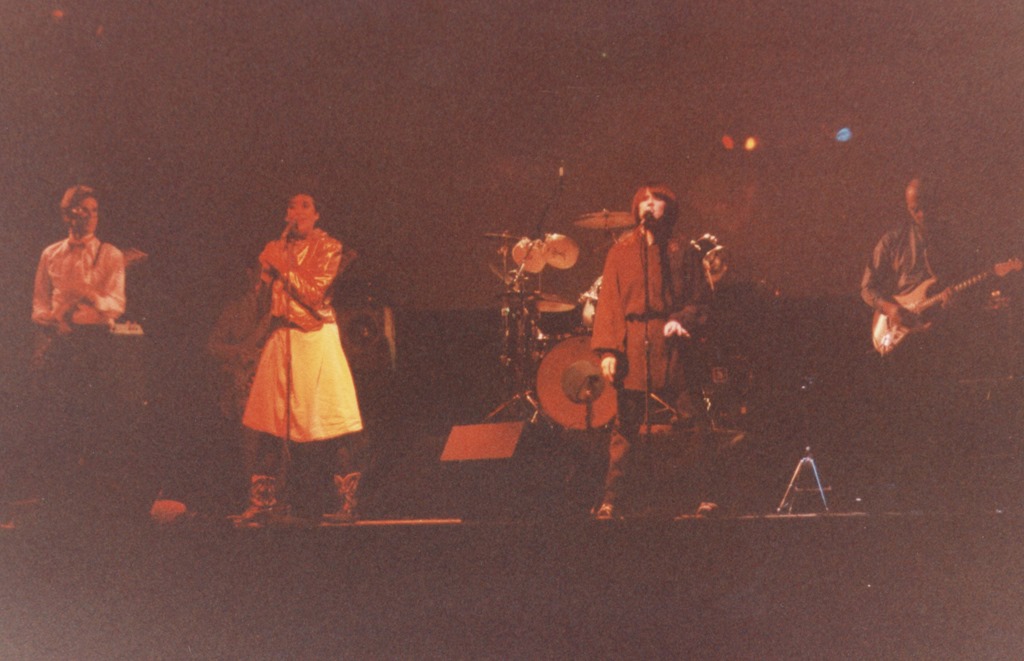
Fine Art on stage at the First Ave Mainroom early 1980s

Fine Art circa 1982 on the First Avenue mainstage:  Ken Carlson, Jennifer Holt, Kay Maxwell, and Colin Mansfield

Today as I think through these things I wonder what would have happened if I was rich and possessed a time machine, could I use cubic money and hindsight to change things? Could I have tried to break them as a recording act without local scene cred? No assurance in that. Try to move them to New York and ace out Blondie, but end up as The Shirts instead? Move to Athens Georgia and try to be the B52s, but end up as Pylon? I suspect the best fantasy bet would have been to move them to England, an even more imaginary gambit, but it was a scene more capable of breaking unusual bands because the extensive network of critics and music press there competed relentlessly to find unusual bands to champion.

OK, we’ve left Dave Moore for awhile here, so let’s circle back. Fine Art had women frontmen who handled the vocals. That means that Dave’s lyrics first were sung by women. A song like “Nailed,”  performed by Fine Art on their LP and regularly in concert afterward, is ostensibly a vampire blues that might have been the text from an issue of Tales From the Crypt,  takes on a different cast sung when sung by two women in harmony. Lines like “I gave you my body, and you took it too. Always thought you’d give it back—shows how much I knew” change in that context.

Here’s Dave Moore’s lyric “Nailed”  performed not by Fine Art, but by the LYL Band. Colin Mansfield wrote the music here, and we only approximated it. I’m doing the lead vocal, though Dave peeks through on backing vocals. If you watched the Fine Art/7th Street Entry video you may be able to put together a mental construct of what the “real thing” sounded like on a good night. Let me assure you, it was even better than what you are imagining.

——————————————

Because what’s more punk-rock than footnotes

——————————————

*The Suburbs are perhaps the most similar Twin Cities band to Fine Art in style. Their principal Chan Poling brought a broad outside musical background into his band as did Fine Art’s Colin Mansfield. And at their best, each band’s rhythm section was solid, and their approach to songwriting eclectic and unafraid of oddness. The Suburbs had the more dynamic live show though, even on a large stage, and the conventional all-male lineup presented a show that could be enjoyed without further thought by the plastic beverage cup waving male club goer. My impression was that the Suburbs were soon a very consistent live draw for any venue hosting them, and Fine Art never was that. Of course, all that talent and appeal didn’t mean that even The Suburbs made it past local hero standing.

A survivor band version of The Suburbs still exists, and Poling (who performs with them) has gone on to a successful career in music that continues to today.

**I don’t know exactly how the band was organized, but Colin Mansfield, along with his then wife Kay Maxwell and outstanding rhythm guitarist, the late Ken Carlson were the three members who participated in every version of the band, and though music and lyrics were contributed not only by Dave Moore but as well by the rest of the band, I always got the impression that Colin was the organizer and collator of that process. I’ve lost the thread with Colin over the years, but he transitioned to in the box electronic music later on, and unlike the Fine Art material, that later work is available.

***As a marker for this aesthetic, I’ll note that Soul Asylum first performed under the band name Loud Fast Rules. The Replacements, whose IP holders should see about the availability from Blackglama of the phrase “What becomes a legend most,” were able to gain attention as the ultimate in anti-showbiz casualness, where a sloppy show meant that they really meant it.

****Colin Mansfield from Fine Art produced Husker Du’s first demos and their initial single, which sounds less like later Husker Du and more like Fine Art. After Husker Du broke up, Colin and Du bassist Greg Norton formed a short-lived trio Grey Area.

*****In my experience Colin Mansfield was a pleasant, understated and helpful man, as well as quite a musician. I once suggested, from my position on being less than any of those things, that it might help if he looked more animated and moved by the music on stage, and he asked back if there wouldn’t be some visual value in all that sound coming out a still and undemonstrative musician. We both were probably right, but he was right from a position of greater talent and achievement.

******Here for example are some of the other songs from that LP issued at the band’s beginnings in 1978, and remember all vocally performed by women: “Don’t Tell Me That,” “Too Much Pride,” “I’ve Got to Protect Myself,” Rapist,”  and “Speak My Language.”  Ken Carlson wrote the first three, Andy Schirmer wrote the third, and only the last was written by one of the vocalists, Terri Paul. It’s an odd dynamic isn’t it? Songs of self-assertion, anger, skepticism toward love relationships as a system, sometimes inward turning pain, written largely by men to be sung from the viewpoint and voice of two women. I don’t know if this was planned, my suspicion is that was something of an accidental combination which the band allowed to happen and then grew to embrace. I never asked. I don’t even know if any of the band men thought of themselves as feminist, and it wouldn’t shock me if any of the women in the band would have stories where the men failed to show feminist understanding. Human beings, they’re like that.

The Temple of Summer

I spent Saturday riding my bicycle on the Mesabi Trail and visiting Hibbing, the Minnesota Iron Range hometown where Bob Dylan grew up non-ferrous.

To the visitor, the landscape there has a strangeness. Since the late 19th Century, open pit iron mining has been the industry of the region. An open pit mine is not the kind of underground tunneling and mole-dark pick-axe work you might visualize when you hear the word “mine.” Instead it is the removal of cubic miles of earth with explosives and huge shovels, work my wife describes as “making your own Grand Canyon.” The iron gives exposed rock and dirt a Martian red hue, and this colossal earthwork of generations of open pit mines has added extra hills, ridges, gorges, and small lakes. Though trees and brush eventually regrow and give these acts of men something of the appearance of nature, some hills retain the terraces where the trucks drove, giant Northern ziggurats or Mayan temples, now sprouted with pines—the Hanging Gardens of Bob Dylan.

postcard mesabi iron range

“Making your own Grand Canyon”


Since Bob Dylan grew up here, the strangeness of this landscape may not have impressed him in his youth, but an adulthood away might have eventually revealed its uniqueness. It is a singular place on a Labor Day weekend where one can see the mark of daily labor sculpted in a giant tableau.

How many of us can say the same for our labors? Children are raised, daily cares are met, that meeting makes a decision, a sick person is comforted and will live another couple of decades, the number of widgets on the planet increases infinitesimally, a project that will impact things for a few years is completed. In contrast, in the land around Hibbing, Virginia, and Mountain Iron, vistas are forever altered to mark a work life.

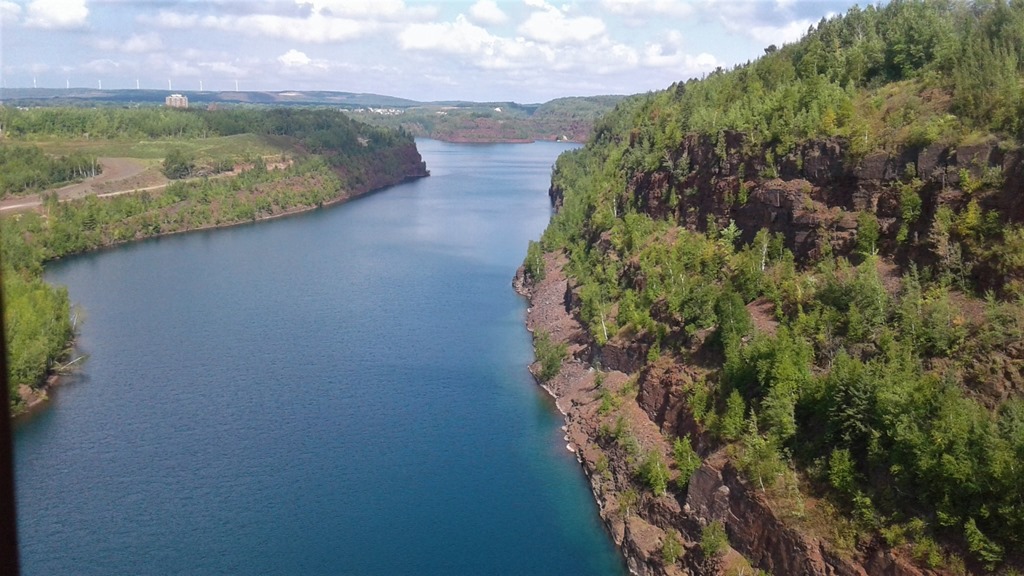
Virginia MN Bridge view

A view from the highest bridge in Minnesota spanning part of a no longer active open pit mine now filled with water outside the town of Virginia. The landscape you are viewing is man-made, not a natural feature.


An artist’s work, for all the literary pretentions to immortality, is at least as ephemeral as other work. The work is finished, and the earth has not changed its face. The work is read, seen, heard by its handful, and it melds at best into a memory in some part of those.

So, punch a clock or not, these are the same jobs, the same work. The poem, the performance, the painting, no less, no more, the product effort of applied human energy as any other work.

Occasionally, someone gets to be a Bob Dylan, and the vistas change. Leonard Cohen said that giving Bob Dylan a Nobel Prize is like pinning a medal on Mount Everest for being the highest mountain. I stood next to my bike on the state’s highest bridge spanning a man-made gorge and thought, maybe somehow, even subconsciously, this landscape gave Bob the idea.

Iron Range Truck

“Cruising down the highway in a Greyhound bus/All kinds of children they was hollerin’ at us…”


Today’s audio piece will not remind you of the Bard of Hibbing, as it is a fuzzy epitaph using Mellotron instead of giant earth-moving trucks to get its rocks off me. Here’s wishing all Parlando Project listeners a lanquid fall into the fluffiest possible snowbank. As you exit the Temple of Summer, listening to the music using the player below, I remind you that the Parlando Project appreciates your attention, but still needs listeners and readers. If you can, let others know what we’re doing here, and if you’re new to us, you may want to check out our archives with 250 other audio pieces combining various words with original music.

A Visit from the Angels

Back more than 200 years ago, poet, painter, engraver and mystic William Blake was reported to be conversing with angels in English trees. Last episode we had William Carlos Williams celebrating celebrity scientist Einstein in a blooming New Jersey night early in the 20th Century. Today we have Dave Moore in his backyard garden in Minnesota in our present century.

Blake Angels on spiral

William Blake illustration of Dave’s Minneapolis garden night, sort of.

Is this poetry, song, or story-telling? It might be a little bit of all of them, but then labels are just sticky paper. Let me refrain this time from talking so much about the piece, but I encourage you to just listen to the LYL Band and Dave Moore tell the story. Use the player gadget below to hear it, or this highlighted hyperlink.

Anglers

Next weekend is the Minnesota sport fishing opener. Today’s piece, “Anglers”  is appropriate for that—but to that opener I’ll bring 8th Century Irish monks, a strange airship cosmology, a Nobel prize winner, and tenderly, a pair of brothers.

I wrote the words for “Anglers”  combining two things, one biographic and one literary, mixed with some phrases that occurred to me.

The biographic? My grandfather died when my father was a young man, shortly after I was born. My father had four brothers and a sister, and the youngest of his brothers was only a few years older than I was. My grandfather never lived long enough to teach him much, and so my father helped teach his youngest brother some things their father did not live long enough to do. One of those things was sport fishing. As my young uncle grew up, he and my dad became fishermen of the most avid kind.

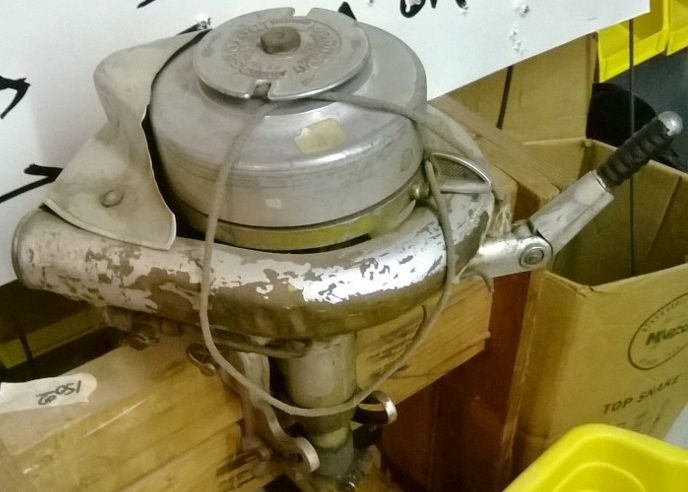
Over the next fifty years, the two men fished many places in Minnesota, but most memorably for me, in Canada. Not just on the border lakes like Lake of the Woods, but halfway up Ontario to lakes above the little town of Redditt. Their base there was a rustic fishing lodge: log cabins, outhouses, small aluminum rental rowboats to which they’d attach a 1930s Johnson Sea-Horse outboard their father had bought decades ago onto their flat stern. Their routine: out with the dawn, fish until noon, pull in some inlet, fry up some fish for shore lunch, then fish again until late solstice dark. The poem I wrote doesn’t mention it but I was with them as a child on some of these trips, though fishing was not something I kept up with as I grew up and went East. The two brothers though continued their angling until my father before his death became too frail and sickened with senility to continue.

Johnson SeaHorse outboard motor

“Uncoiling the Sea-Horse.” My grandfather’s Johnson Sea-Horse outboard used by his sons


That’s the biographic. The phrases? I often write, at least in part, in my mind’s ear. Sometimes it’s entire first drafts of shorter poems that are composed there, other times it’s only beginnings or endings, or even phrases that somehow seem to mean to be in a poem. I’ve told myself an advantage of writing this way is that poetry often works best if it’s memorable speech, so composing this way pre-tests things by holding them in memory and seeing if they adhere.

As I get older it’s harder for me to memorize works in process, and this piece had only phrases and parts of the beginning and end stanzas in my head before I started my first paper draft. One of the phrases was the idea of the sport fisherman, the angler, being at right angles to the surface of a lake. Another was a phrase which occurred to me, “lattices of fishes,” which I simply loved the sound of, but it also seemed like unto the vertical angle from the surface of the anglers in their boat.

It was that angle word-play that brought in the literary. The anglers point up and down in their angle from the surface. What do they point to? And lattices, obviously there’s another level under the water-surface plane.

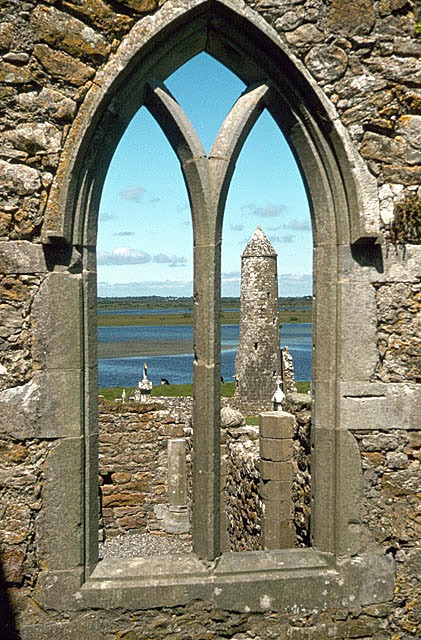
The literary? Seamus Heaney, the Irish poet, wrote a poem I much admired about a story from the medieval Irish annals. The story was some monks at Clonmacnoise in 749 A. D. observed an airship snagged on the tower of their monastery and a crewman of that airship who climbed down from it to free his ship.

Clonmacnoise tower

Clonmacnoise tower. Don’t snag your anchor on the weeds or rocks.


In combining the two, I created a cosmology where the air breathing anglers on the surface of a lake are like angels, or the crewman of that medieval airship, to the barely comprehending fish who are brought across to the airy world. And that echoed the idea I had developed in my head from the anglers pointing up 90 degrees from the surface of the lake in their boat. They are pointing to the heavens, a place we can no better understand than the fish can know about the world of our air-breathing.

And there you are, that’s the entire poem’s metaphoric magic-trick revealed. Yet that isn’t the poem, much less this audio piece that presents it. I still had to work on the language through several drafts, and I may work on it more after this presentation—but the poem and the audio piece is more than its images or its ideas, because a poem and a musical composition are both machines that think with sound.

So, listen to “Anglers”  using the player below. And please, let others know what we’re doing here. I would so much appreciate that.

Tom Rapp has died

Isn’t it odd how you know, and yet don’t know things, even in this world of instant communications and webs world-wide. Yesterday I started work on a new Parlando Project piece, and this morning I returned from a brisk ride to breakfast on a cool sunny April day to write about this piece whose words were written by Sara Teasdale.

I would have said that I was introduced to Teasdale from an LP record by one of my musical influences, Tom Rapp. I figured I’d link to something about him…

…and there I learned, that he had died more than two months ago.

So, I’ll link to this, his performance, Parlando Project-like, of Shakespeare’s song “Full Fathom Five”  from The Tempest combined with Teasdale’s “I Shall Not Care.”

Even though that’s an example of the Parlando Project principle: “Other Peoples’ Stories,” that is to say, it is words Rapp didn’t write, it conveys something of the impact Tom Rapp can have if one is open and receptive to his presentation. He didn’t need  to use Teasdale’s words or Shakespeare’s, because Rapp is one of the best singer-songwriters you likely don’t know about.

Let me not inflict too much biography on you. Rapp is another child of the Midwest, born on the Dakota plains, raised some in Minnesota. While still a grade-schooler, he bested a teenager from Hibbing— kid named Bobby Zimmerman —in a talent contest in Minnesota. That Zimmerman kid moved to New York and changed his name to Dylan. Rapp ended up in Florida in the middle 1960s and formed a band with other kids in his high school. He named the band from a phrase from the Sermon on the Mount:  Pearls Before Swine. Their first LP from 1967, with a cover taken from Hieronymus Bosch painting was the only one with any appreciable sales, and Rapp issued a handful of albums afterward to ever declining audiences. Why?

As you’ve heard me proclaim here “All artists fail.” Even the most successful, have multitudes remaining who couldn’t care less what they have done; and unique ones do not get any advantage. Rapp wrote fewer songs about romantic love, and his best songs did not offer any easy comforting. And he’s as far from get-down, party until you forget as any musician who ever lived. Rapp is a writer of look, and then look deeper, and remember.

Unique can mean mostly that the audience is not shouting for more like him or her. Yet, I’m sure there are in this troubled world a great many who could find solace, as I did, in Tom Rapp.

You can be the 82nd person to listen to this since 2014.


When I found that link to the LP cut of the song he made from Shakespeare and Teasdale on YouTube, I saw that it had exactly 80 views since it was uploaded four years ago. Let that sink in for a minute. 80 views. The clumsiest unboxing video for some appliance will easily garner more. There have been a few successful “songwriters you should have heard” stories this century, where decades-old work becomes better known—Nick Drake or Rodriquez come to mind—but to succeed in finding an audience, such things require luck, and we’ll only allow a few to win when we re-spin Fortuna’s wheel. Pearls before swine indeed.

Feb. 22nd 2019: Thinking about Tom Rapp again today for no particular reason. Here’s a link to an excellent late 20th century run down of his story by Gene Weingarten.

Dear March

We had a real Minnesota whip-saw this week, the aftermath of a 15-inch snowstorm as the week began and a day in the 50s as it ends.

Much digging out of cars, and wheels doing the whistle-spin on the ice beneath for three days. It’s been a long winter, but Sometimes It Snows in April  as Prince once sang.

Today, when it reached the lower 50s, people were out in shorts and T-shirts, with snow still covering yards, with the low rubble of white ruined walls still on the streets where cars had once been imprisoned. This is how Minnesotan’s celebrate unbelievable spring.

Now this Saturday brings the anniversary of Prince’s death, which was as unbelievable as Spring. I was looking for another poem to combine with music, and I reminded myself I hadn’t done an Emily Dickinson poem yet this April, and there can be no full celebration of U. S. National Poetry Month without Dickinson. As I looked, I came upon this poem, and it seemed right.

“Dear March”  has one of Dickinson’s bold apostrophes, but instead of death or some other imponderable, it’s Spring that gets to be portrayed as the caller, one who gets welcomed at the door with old-school manners. There’s delightful wit in this: the March winds portrayed as being out of breath, it must have walked the long way to get here! “I got your letter, and the birds.” But being Dickinson, she will add her slant. Just past halfway she bemoans the colorless landscape of winter that she’s been left with, as if it would be her job to color it in: “There was no purple suitable/you took it all with you.”

“There was no purple suitable, you took it all with you.”

I think again of Prince, and I think this is the poem to do.

The poem continues, and we can now understand that the wit has an undercurrent. Someone else is knocking. It’s April, more visitors—or are they both suitors? “I will not be pursued!” Dickinson is now ambivalent to more Spring, to more young man’s fancies. She’s not answering the door “He stayed away a year”—well so did March. The poem ends in ambivalence. She should doubt the constancy of these Spring suitors even with the flirting, the flattery and the gifts they bring, but then there’s joy in blaming them for their absence now that they have returned.

Prince in the studio

Prince: performer, songwriter, impresario, but I’ll think of him as the patron saint of studio rats

,

I don’t want to stretch things too far here, but there are a couple of similarities in Dickinson and Prince. Both known for wearing one color (white and purple). Both enigmatic to the public (“The Myth” and “The Glyph”) and increasingly reclusive. And both were capable of being prolific and artistically self-sufficient, though this is not as rare for poets as it is for musicians and songwriters who could (as Prince did) write and record all the parts. In the end, they are both American originals, not copies of anyone before or since.

To hear my performance of Emily Dickinson’s “Dear March”  use the player below. And let folks know about what we’re doing here, combining various words (mostly poetry) with original music in different ways. It’s #NPM2018, and you can dance to it.


Snow Storm on a Blank Page

Longtime readers will know that one of the principles for the Parlando Project is “Other People’s Stories.” I partly do this out of a contrarian streak, as the Internet is full of folks telling their own stories. Yet, obviously, I do not take my path due to a condemnation of personal stories. After all, without other’s stories, I would not have the ones I present and react to here.

I believe something additional happens in my process of presenting my encounters with other people’s stories. You, the valued readers and listeners here, add a third part to this. Do you see, what I see, as I am looking at, speaking someone else’s silent words; while you remain off to the side, with your ears at each side of your own mind and memory, your eyes parallel to your own mouth? No, you will see something slightly different.

Yet, this morning, let me violate my self-imposed principle, and write, as if this were a conventional blog, about myself.

I awoke today after a week that finally found promised 50 degree Fahrenheit temperatures to an utter snowstorm that had itself awakened from a night sky that fitfully dreamed rain, sleet, hail, and freezing rain. The wind outside had someplace to go in a hurry.

I am an Amateur of Velocipeaes by Leonara Carrington

Leonara Carrington dreams of bicycles with oversize tires

As a contrarian, I dressed and took to my marvelous Minnesota invention, the fat bike fitted with 4 inch wide studded and knobbed tires. A morning with few moving, yet full of noise. Snow crunching under the tires, wind restating its case more insistently over again, the typewriter of snow against my goggles.

Parked at the curbs, even the most fearsome cars were growing a white carapace, their windshield wipers stretched out, insect arms, quivering in the wind.

Windsheld wipers stretched out insect arms

“Insect arms, quivering in the wind”  wipers left out to keep them from being encased in ice

To be an old man on a bicycle is to know gratitude. Does a fierce April snowstorm tell a story? Perhaps it does. Is it beautiful, or a false and comfortable frightening that leaves others inside, deciding that internal pleasures are best this morning. But I wished to hear its story today, to see it. As I rode, the wind said yes and no in its one direction. The snow said music is frozen yet moving. The whiteness says color can only exist if you make it.

In the middle of the week I had driven two friends to the airport. They saw this sign “If you see something, say something.” I thought, isn’t that the fourth Imagist rule, one unstated by F. S. Flint and Ezra Pound? Yes, you must honor the thing and your reaction to it, using no word just because you believe you must use that word, and remember you are making music, not marching. But the first rule, which I understand now in the multitude of a blizzard: if you see something, say something.

Shattered Visage

The place of short epigramic poetry in our culture, and just a touch of Percy Bysshe Shelley, combine in today’s piece.

When people seek to stop the expansion of poetry in definition or in practice they will aim and fire at certain targets. If you look closely and slowly, you may see the bullet holes with their worn, rusting lips frozen in mid-kiss.

“Song lyrics? When you see them on the page, you can surely tell they aren’t poetry. And what about advertising jingles then?”

I’ll reply that it’s true that we don’t know if Sappho was a copywriter for hire, or worked independently—and frankly, the advertising jingle has passed into disuse anyway. One benefit of aging is that one can remember lost, golden ages when the rustic bards of old sang along the roads.

I speak of course of that mid-20th Century, Midwestern American Greek Anthology presented by Burma Shave. We know only the fragments of their work that scribes have preserved in illuminated HTML, but did these jingles really harm mid-20th Century poetry much?

I think not.

Here was the scheme: an insurgent company that made shaving cream in Minneapolis Minnesota took to the idea of a series of small signs, enjambed with the broken lines of an epigramic poem, signed-off at the last sign with the company’s logo: its name in white flowing script. Cars sauntered on narrower roads in those days, roads that went farther between cities that had yet to leak out suburbs and housing projects. Car radios were an option not ticked off by every frugal buyer, and the boredom on the two-lane was an advertiser’s opportunity. Huge billboards, the epics of the roadside, might have pressed the budget of the Burma Shave company, but those little signs in series were another matter. Poetry, then as now, is a bargain.

Burma_Shave_Signs_by_highway

Poetry in motion, Burma Shave signs in use, circa 1940.


And to us, the naïve backseat riders with no tablets or Gameboys, we could hope then the horizon might give us that initial red sign and line of verse, followed by their episodic reveal, their enforced caesurae.

Perhaps the poems imagery or significance did not equal Elizabeth Bishop or Wallace Stevens, but the experience—yes!—was exactly what poetry should deliver. It comes on us, with expectation, but unpredictably. It reveals itself, in time marked with intervals that tell us it is indeed time. And in the end, it pleases us in a way that the passage of a mere Pioneer Seed Corn placard or another end-of-lane mailbox cannot.

Its motives may not have been artistically pure, but we didn’t care.

Commercial motives are as fragile as Olympian ones. Around 1960, Burma Shave was sold, and the brand discontinued. The placement of new signs stopped, and only in places where no one cared to groom the roadside did they remain to gradual ruin.

Years later I would move to Minneapolis, and eventually I would fall in with some folks who created a literary magazine that wanted to celebrate the inescapable, unpretentious—yes, sometimes commercial—main drag down Phaeton’s east-west path of the city. They called the magazine “The Lake Street Review.”  Down that street I would often bike or drive past a nondescript building, just before the freight-railroad tracks, just before the shopping-and-buying mall built were Minneapolis-Moline once built tractors. When it was built, this building had been a church, but as the area became industrial in the early 20th Century, the building became, for awhile, the headquarters, the factory, the Parnassus of Burma Shave.

Save the (Burma) Shave

The ex-Burma Shave building on Lake Street as it appeared in the 21st Century


I don’t know if any of us knew that. I only found out as they planned to tear it down, which they did. As the workman did a workman’s job, in the midst of the ditch of lathe and beams, a red sign with cursive white letters was found at the end: “Burma Shave.”

Weckage of Burma Shave Building

“on the pedestal, these words appear…” After the Burma Shave building was torn down.


Musically, the LYL Band performed “Shattered Visage”  a couple of years ago, but I share it now after this week’s presentation of Shelley’s “Ozymandias.”  As I said Monday, I read “Ozymandias”  without bringing out the pathos in the the impermanence of human achievements, choosing instead to emphasize time’s judgement on tyrants, but in “Shattered Visage”  my parody turns to the former. One other link to “Ozymandias:”  remember Horace Smith, the second-place sonneteer who also wrote an “Ozymandias?”  He entered into literary circles with a spoof he authored along with his brother, where they imitated all the most famous poets and orators of their time, including Lord Byron, who supplied an admiring blurb when the collection was published.

To listen to “Shattered Visage,”  use the player below.


My Feet

Today’s piece uses words from a more modern poem from a Minnesota poet: Renée Robbins. I met Renée after this piece was written, but I recall going with her to a very nice soirée celebrating the publication of this collection of poems by Minnesota poets, including her “My Feet”,  40 years ago.

A Coloring Book of Poetry for Adults

A good attempt at a broad-view of 70s Minnesota poets, including Renée.
Oddly, I can’t find the credit for the cover artist. Anyone know?


This was the 1970s, and from our age or our ages, an optimistic time to be a poet in Minnesota. Running down a list of names, I’ll slight anyone I leave off out of concerns of length and focus, but locally it was still the age of Robert Bly, John Berryman, and James Wright. Minnesota literature, at that time, seemed to have placed poetry at least equal to the novel or memoir.

I had come recently from New York and had reconnected with Dave Moore who had finished college. I was writing furiously, filled with a Twenty-Something desire to set on the page all the patterns I could see in our still forming lives. Renée had taken a shorter trip, going to college first in Duluth and then in Marshall Minnesota where she studied with Phil Dacey.

There is a longer story here, full, like most life stories, with twists that seem meaningful to us—even if not invested with the same importance by fatebut let’s return to poets, and the 1970s, and Minnesota.

Renee Robbins 1970s

Renée Robbins, later the 1970s


Note that truncated list I gave of the exciting characters, the names of poets that would be in someway connected to Minnesota in that time. No women. I find that odd. No similar list of the most notable contemporary poets in the United States made the middle ‘70s would be so gender singular. Is this an accident, a side-effect of the stubborn impact of Robert Bly locally, a reflection of a lingering patriarchy, or just a reflection of my own framing as I look backwards? It could be all of them I suppose. Established names or not, woman’s voices were coming forward.

Renée and I fell in love. Eventually we married. Eventually she got sick and died shortly after the turn of the century. As I said, these twists in the stories we hold as ours seem meaningful to us. Perhaps it’s a meaning like a deep poem, one with a deep image, one that doesn’t stand for anything other than itself, one that can bend light around it, leaving the densest shadow, as life still glitters around it, with a strange margin where they meet.

Robbins’ “My Feet”  may not be that kind of deep poem, but as I tried to argue here recently, poetry is richer and less constrained when we feel we can use it for more than the deepest things. And Robbins’ choices in “My Feet”  implicitly make that argument I think. Ozymandias may have two vast and trunkless legs of stone and those meaningful sands mocking them, but the rest of us have only our tired dogs, like to those Renée can apprehend with her characteristic artistic focus on close looking. Her time on the farming plains of Southwest Minnesota may have given her a new landscape to appreciate those feet.

To hear my music and performance of Renée Robbins’ “My Feet,”  use the player below.

Garden Elegy (for Grant Hart)

Sometimes the things we present here come together quickly. For example, some of the LYL Band pieces heard here are first takes where the musicians are reacting to the words spontaneously the best we can. Other pieces ask to spend a little time underground to think, like seeds think.

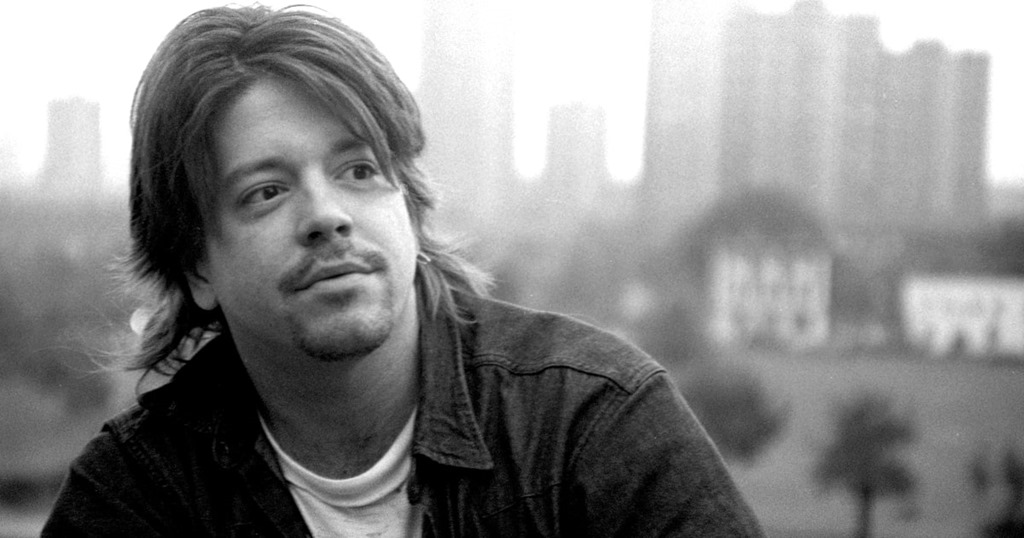
Today’s piece is one of those later ones. Nearly two months ago Grant Hart, a founding member of Hüsker Dü, a Minnesota indie rock group that achieved some fame before breaking up in the late 1980s, died. After Hüsker Dü broke up, Hart had continued working in music and visual art, some of it quite striking, none of it as well-known as it should have been. We are used to stories of a young person whose indie band is on the rise, there is less notice for those artists whose work continues past middle-age. After all, even when there are new levels to the work, there may be no apparent market. While thinking of him, I noticed, strangely, for the first time, that Grant’s name was, in effect, a two-word prayer.

younger Grant Hart

Young musicians, young artists, need will and lot of work to get a chance to succeed.
But at a certain age, they will need even more of that will to continue to make art.

.

Around the same time, I was talking with Dave Moore (who you’ve heard here, vocally, keyboardely, and composerly) about his household’s garden bounty coming to an end.

These two thoughts combined into the words for today’s piece back in September. And early last month I wrote the music—so this piece has existed, on paper, for a month. I performed it on acoustic guitar for a handful of people in a living room in October. It seemed to work. So why haven’t you heard it yet?

I really wanted to get the performance right. And this month I attempted that, getting as close as this recording. I wanted it to be good, but I didn’t want it to be polished either.

Garden Elegy

Here are the words to “Garden Elegy (for Grant Hart)”

.

The LYL Band began roughly the same time as Hüsker Dü. We even shared a producer of our first recordings back in the day (Colin Mansfield). But we were much different. We were a band of poets and artists, closer to the Fugs or Billy Bragg than the Who or the Jam. And I was then, as now, not a consistent and confident performer and a problematic singer. That was my problem as a band-member back then. As passionate as I could be in my writing, I couldn’t find the heart to focus that passion on stage, to the detriment of the band.

So, it didn’t take just the two months the song was in process, it took some decades to get close to what this song requires. When you listen to “Garden Elegy (for Grant Hart)”   you’ll hear me going for it as best I can, trying to focus passion. About halfway through you’ll hear the body of the guitar bang into the amplifier.

And that’s my prayer for artists today, perhaps your prayer too: that we may be granted heart.

Here’s the song:

.

Did you not see a player gadget above? Here’s another way to hear it, with this highlighted hyperlink that will open a player in a new tab window.