A Birthday, Vampires, and The Greatest Original Music Band Minneapolis Ever Forgot.

If Halloween is about shadows, ghosts, the dead and un-dead etc etc, it comes in the month I celebrate the birthday of my friend, the living Dave Moore, an occasional alternate voice here at the Parlando Project. Dave’s a poet, songwriter, cartoonist, and my longtime musical partner in the LYL Band. Back in the 1970s his lyrics were frequently used by “The Greatest Original Music Band Minneapolis Ever Forgot,” Fine Art.

I wrote about Dave and Fine Art a few years back. TL:DNR summary: Fine Art were a Rock band that emerged in 1978, issuing a self-produced, self-titled, vinyl LP, and then performing often in what few Twin Cities locations that were open to the handful of original music bands.* “Punk” was still the sticky label used for young bands that performed non-conformist new material then, but it was not a homogeneous scene of Ramones and Sex Pistols cadre three-chord-shouting-in-leather-jackets-and-frayed-cotton.**  Television, Patti Smith, Pere Ubu, Talking Heads — all these were formative bands in the Seventies, present at the beginning. Yet, oddly enough, labels like New Wave, and Post-Punk were generated to try to describe those that didn’t follow the stance of regimented simplicity for concentrated force and/or skill-set necessity. Fine Art were one of those from that non-traditional tradition.

As the famous Minneapolis First Ave club moved to presenting young original music bands, Fine Art played there regularly in the early Eighties, both in the small side-room the 7th Street Entry and in the big main room. When someone reprints a poster of that fabled club’s scheduled acts from that era to highlight Husker Du, The Replacements, Soul Asylum, or even Prince, you’ll often see the Fine Art band name playing the week before or after.

When this era is covered in overview, even by locals who want to concentrate on “the scene” not just the national acts that emerged, Fine Art barely makes the footnotes. That’s not exceptional, history-is-written-by-the-winners and all that. But here’s the thing: Fine Art’s material was all original (they never performed a cover), and it was very very good. The band two guitarists were excellent: Ken Carlson’s driving chordal center on rhythm guitar and Colin Mansfield the genius lead guitarist who could do song hooks or Free Jazz, sometimes in the same song. The two women lead singers format was unusual then as now, and the original pair Kay (Carol) Maxwell and Terry Paul, and later Kay and Jennifer Holt were effective. But it’s the songs, those constructions that were passing sounds on a club stage and remain only on the barely surviving and out-of-print records that shock me to revisit. They’re still  unconventional — and as such, they still sound fresh 40 years later. Dave’s lyrics are part of that, even if he wasn’t the only lyricist in the band.

Vampires. Coffins. Fear of being suffocated. A song with a Dave Moore lyric from Fine Art’s LP issued at the start of the band’s existence in 1978.

.

Fine Art didn’t survive past the Eighties, but the LYL Band still gets together. You still can hear songs Dave wrote and ones he contributes to here sometimes. I do my best trying to be musically adventurous to support Dave’s words.

In one’s youth you are told you should think of the future.

Generally, you don’t.

In one’s old age you are said to think too much of the past. I generally don’t. A smaller future is the treasure I consider, the treasure I want to spend. Playing with and knowing Dave is part of the treasure.

.

*I think this surprises some younger indie musicians or fans today. In the Twin Cities in the Seventies, if you wanted to play in public in a band you were expected to perform songs people knew, which meant cover songs. If you wanted to buck that trend, there were in 1978 maybe 2-3 places that would let you try it. When you hear of The Replacements doing one of their live piss-take cover song tangents, there’s likely just a bit of residual anger at that constraint behind it.

**In retrospect, many assume an amoeba, fish, surfacing amphibian, stooped monkey, biped man with club picture of how indie evolved from punk. But the earliest CBGBs bands were a very mixed lot. The Ramones stood out  because of their fast, faster, and fastest strumming rock minimalism in that scene. And Ur-source band The Velvet Underground mixed simple and complex, pop ambition and alienation noise with abandon. New Wave and Post-Punk existed from the beginning — or before the beginning. Fine Art may have produced fewer hard core adjacent songs as the band evolved, but they were always composing fresh, heterodox musical concepts.

At the Threshold: marvels with French on sky-blue waters

We’re going to travel to one of the best short poems that late 19th century American poet Richard Hovey ever wrote, a strange poem about approaching death, a place far or near, with no trusty mileposts. As I like to do, we’re going in a round-about way. Let’s start with a blue lake.

I can remember what a wonder it was. My father and his youngest brother loved to fish on lakes, and in search of ever more pure sport-fishing beyond the sky-blue waters of northern Minnesota, they took to traveling up further into Ontario Canada. I was maybe 10 or 11, still at an age when I was open to whatever my parents led me toward. We stayed at a family-owned fishing lodge at the end of a gravel road outside of Reddit. A few small, well-kept cabins, a couple of outhouses, and a lake-dock — which was all the two brothers needed, as the day was mostly spent out fishing.

As I said, I was accepting of this. I gamely came along, earnestly operating a rod and reel, waiting, sensing for any piscatorial tugs on the line, listening to the two men occasionally talking about what fishing tactics were most promising. My youngest uncle, maybe 18 or 19, had been about my age when their father died, and my father now served as his younger brother’s father-figure. I was unaware then that more than lures and casting targets was in their talk.

I was never bored. I had a vast imagination when young, and could sit quietly daydreaming stories and ideas in my head for hours. I suspect a good poet would have been more observing of the boundless nature around me; and while I watched and listened to my dad and uncle some, they were too commonplace for me to treasure.

Instead, here is what I recall being fascinated by: I was in another country, Canada, subject to its laws, and a Queen, a governmental oddity that seemed a little out of time to me. A gallon wasn’t even the same gallon there, nor a dollar exactly a dollar! The lodge owning family and everyone we met in Canada spoke English of course, but since my imaginative and book-minded mind lived in words, I was amazed that all the groceries we picked up in Kenora on our way up had bilingual labels including French.

I was as if I had found the Rosetta stone all by myself. As a native Iowan, I already had a passing place-name experience with French from my state’s then 160 year past life as a French possession, but here in Canada a box of Wheaties or a carton of milk could be held inside other words. So, later in high school and in my truncated college studies, I selected French as my foreign language.

I was terrible at it as a school subject. I did OK (not outstanding) in basic vocabulary. I was passable in recalling the tenses and such. I accepted the arbitrary gendering of nouns. But my mouth stumbled entirely in the speaking of French, so obtusely bad at speaking it that I strongly suspect it is something in my neurological wiring. That I persisted with French as I entered college was at least in part because I was learning that French poetry had been so interactive with English language poetry, particularly in the formation of Modernism.*

After my formal education ended, I continued translating French poetry, not by any right of fluency, as I’ve confessed above, but because I wanted to bask in the secret sauce that helped form Modernism.

Richard Hovey seems to have been greatly enamored of what was modern French poetry to him. His published work includes translations of Verlaine, Maeterlinck, and Mallarmé. While going through his published work this summer I came upon this sonnet “Au Seuil,”  in French, dated as having been written in 1898. When I translated it, I found this graceful consideration of dying and some possible judgement and afterlife which I present to you in English today. As an old person, dying no longer requires any heroic situation, acute illness, or grandiose gothic stance to make such consideration apt for me. It’s a matter of petty logistics now.**

At the Threshold as published in French

The poem as published posthumously in a collection by the Vagabondia co-author titled “To the End of the Trail.”

At the Threshold

My translation, presented here as a chord sheet for the musical performance you can hear below. In performance I refrained the final line of the sonnet as shown here.

.

Was today’s poem written by an old man, or a young man staring down a deadly disease? No, Hovey was 34 years old, likely in vigorous health. Still, in less than two years he’d be dead, dying during a routine operation for something as unromantic as a varicocele. One can only wonder how he would have coped with the upcoming English poetic Modernism that would be sparked in part by French writers he admired.

Though subject to my language limitations, today’s poem to song turned out to be a relatively straightforward and faithful translation — with one exception. My usual poetry translation tactic is to primarily find the images in the poem and work at carrying them over vividly to English. I strive to have a non-creaky, natural syntax and word choice in the target language, and to make from that a poem in modern English word-music rather than trying to mimic the prosody of the poem’s native language. What was that one exception? In the poem’s 13th line, “ Qui nous benira de ses grands yeux bleus,” there’s an image I think.***  It could be that Hovey intends a witty little aside about a Nordic male god-in-heaven sitting on a throne of judgement, the cliché being then his point. As I worked on this line I wanted the possibility, however unexpected and wishful, of something universally marvelous. I dropped the andromorphic gendered pronoun as more than unnecessary, and then perhaps unconsciously recalling the poetry of the first-nations name for my current home-state of Minnesota, made the apprehending eyes more than humanly large.****

You can hear my musical performance of what is now an English language poem with the audio player gadget below. No player seen?  This highlighted link is the alternative, and it’ll open a new tab with its own audio player.

*Oddly it wasn’t Spanish poetry. In England we can assign this to not forgiving the Armada and all that — but large portions of the United States had been Spanish possessions after all. And while Canada’s French is spoken regionally, Spanish is the predominate language across our equally large southern border and in the American commonwealth of Puerto Rico.

**For example: when I replaced two bicycles stolen early this summer, ones I’d ridden for 20 and 40 years, I wondered at the return-on-investment of spending like-amounts in current market prices to replace them. My favorite old-person’s joke is that when someone offers me a lifetime guarantee, I ask if there’s a better offer.

***Literal: “Who will bless us with his big blue eyes.”

****Lakota compound word for the place of sky-reflecting-waters. And there I have returned to that boat with my father and his youngest brother, as Hovey wrote in a different language: “we know this hidden way/as one knows the ghost of a dead friend.”

Lambing (Night-Born Lambs)

Over the years I’ve presented a fair number of poems by authors well-known for their prose work — James Joyce, Thomas Hardy, Emily Brontë, D. H. Lawrence, and so on — but as I prepared today’s set of words for performance I thought of something I told its author, poet Kevin FitzPatrick, more than once: “If I came upon the matter of this poem, I’d probably choose to make it into a short story instead of a poem.”

That may sound like a harsh judgement. When I said this once, Kevin’s friend Ethna McKiernan once torted back at me sharply “It’s a narrative poem!”

Yes, I know that form. I may be personally more invested in the lyric poem’s momentary compression, but narrative is a perfectly valid approach. And if you look carefully at how Kevin writes, he subtly weaves into his work touches that are poetic extensions to efficient prose storytelling. I tried to explain to Ethna that I had a second part to my statement about Kevin’s poems like “Lambing,”  “…but you make it work when you make that your choice.”

This poem’s background is implied in small details within it, and Kevin FitzPatrick’s last collection strung together a series of poems portraying this part of his biography: in later middle-age Kevin’s life-partner Tina decided she wanted to run a small but diversified farm, and each weekend, Kevin would leave from his office job in the Twin Cities to this rural farm across the border in Wisconsin. Kevin was thoroughly a city boy, so many of the poems let us use his unaccustomed eyes to pay attention to the rural culture and tasks of this farm. One trait the poems often touch on: the web of interdependence and cooperation between the community of farmers and country dwellers around Tina’s farm. In “Lambing”  we meet Jim and Rose, neighbors and the former owners of Tina’s farm who are called to bring their knowledge to the incidents of the poem.

Kevin worked hard at keeping his narratives tight yet clear. Parlando alternate voice Dave Moore and I would give him notes, which Kevin was always gracious in receiving, and his solutions (not always ours) to problems we might note nearly always improved the poems.*  Unlike more elusive and allusive poetry I won’t have to act the village explainer to assist new readers to understand what’s going on in “Lambing.”

Instead, I’d like to point out that this isn’t just prose with more line-breaks. While not exactly a Robert-Frost-style blank verse poem, the Iambs with the lambs** put subtle music to this story. The sound of lines like “Their lantern lit up the shelter late” would in a lyric poem call attention to their sound, so don’t let the flow of the story overlook them if you want to pay attention to how this poem might work its way. And while not a compressed Imagist poem, the small details speak to that kind of poetic impact: Rose’s green dress shoes, the just-born lamb “like something discarded,” the nursing lambkin’s tail twirling like a gauge’s needle gone wacky.

Lambing illustration

Unintended in FitzPatrick’s spring-set poem, but this time of year I think manger/crèche.

.

Kevin FitzPatrick’s final collection, titled Still Living in Town,  contains more poems about his farm experience, and other things as well. It’s a fine, fine book, and its poems are as carefully straightforward as today’s example. Here’s a link to more information on his poetry and a place to buy this book.

I performed Kevin’s “Lambing”  today with a piano, drums, and keyboard bass musical backing. At the end of the poem performance there’s a short, less than two-minute, purely instrumental piece for synthesizer and arco bass which I call “Night-Born Lambs”  that was inspired by the experience of working on the performance of this poem, and from thoughts of Kevin. You can hear this pairing with the audio player gadget you should see below. What if you don’t see that player?  This highlighted link is a backup, and it will open a new tab with its own audio player.

.

*I forget who said it, but I always remember this rule-of-thumb: when someone points out an issue with a draft you submit for notes: “They are usually correct in seeing something is a problem, but that doesn’t mean that their suggested solutions are also correct.”

**Type-nerd note: depending on what typeface you read this with, that sentence could seem a puzzling typographic tautology.

A Winter’s Tale: A cold mystery for Halloween

Having done over 700 audio pieces in the more than 7 years of the Parlando Project, I take pride in the variety of the original musical settings I’ve supplied for them. Oh, there are more than a few of the performances over the years that embarrass me: stuff were my problematic vocals don’t deserve parole, or arrangements where I can’t now tell how I ever thought they worked, or those where it would have been better if I’d had access to better musicians than my overdubbing, but many of them still sound good to me.

None sounds better than this one as we near the end of my Halloween Series presenting some of the listener favorites from those 700-plus pieces. “A Winter’s Tale”  sets a should-be-better known poem by D. H. Lawrence. For some of you that poem’s climate is going to seem premature — and you may even wonder why it fits a Halloween theme. I assure you in Minnesota, in the northern parts of North America, this poem is not out of season. We’ve had no snow yet, but my morning bike ride was –5 Celsius. And tomorrow? Those thin polyester costumes sold at stores for trick or treating are not right for many a Minnesota Halloween. And any creativity in making one’s own costume is suppressed by the eventual need for an overcoat which will cover it. And what of Lawrence’s poem — here’s a link to the text of the poem — what’s Halloween about it?

Winters Tale 1080

A long way between houses just for some candy.

.

Well, it’s quite mysterious. This is the third time I’ve presented it, and I’m still not sure what the specifics of the described wintery mystery are. At times it seems like a breakup or strained love poem. Other times it seems like a hunting poem, metaphorical or not. It may have some connection I’ve not fathomed to Shakespeare’s play concerned with virulent mistrust. If it’s a hunt, I can’t even say who the speaker/singer and the hunted are. One or the other may even be Winter itself. That mystery and the air of danger are enough to make it a Halloween poem, and after my musical work, a Halloween song.

You can hear it with the audio player gadget you should see below. No player to be seen? This highlighted link is a backup that will open a new window with its own audio player.

.

“Stones,” rolling slowly and backwards

Nine days ago I started this Halloween Series with my sung adaptation of a graveyard poem by Robert Frost. Now we’re nearing the end of the series, and today I’m going to present another graveyard poem that sits with my sense of Halloween, Ethna McKiernan’s “Stones.”

I also promised in the beginning of the series that I would say why I’ve decided to make an extra effort to note Halloween. Decades ago, I met a young man (we were both young then) who had many interests, John Brower. The immediate bond: we both loved unusual music, not just strange or adventurous Rock that one could find in many a large record store back then, but harder to find Modernist orchestral music, and the even harder to find musics from other cultures around the globe. John also had a strong interest, much stronger than mine, in fantasy and horror genre fiction and film. What links those two groupings? For one thing, they were outsider-ish things then. If you want direct evidence of this mysterious connection you only need to investigate the trope of using the musics of the first of John’s interests with the movies and TV shows within his second one. The first signals the second: dread, tension, and the unknown. Scary movie, unknown planet, unsettled minds, eldritch times and places, it was a good chance that the less tonal string sections, the theremins and early electronica, the gongs or tuned percussion, the swooping vibratos and strange timbres of otherwise unheard avant-garde or exotic musics would emerge in the soundtrack. In the obverse, can anyone think of a well-known happy or loving scene similarly soundtracked with odd music? I can’t.*

But that doesn’t explain John. He gathered about him an eclectic mix of folks interested in these things, many of whom would be loners by inclination or classification. And every Halloween he would take them into the dark autumn north woods to his family’s cabin for a celebration of the holiday of the things less -heard than feared, we all in this group lit by the light of frightening movies until deep into the night.**

John grew up, continued to be engaged in many things, keeping those core interests and working to foster them. Then he died suddenly, while still young by the way I’d measure lifetimes from my current age.

There so much more to his story, and I’m sure parts I don’t really know, but within the briefness I prefer for these posts I want to say that I learned things from John and his enthusiasms, and in the scattered pre-Internet age he was a rare ear interested in some of the things that I spent my time thinking about and seeking out. Two decades after his death, I still will hear a piece of music, see a movie referred to, or encounter a piece of dark fantasy, and I’ll think of John, remembering some of what he thought of it, or I’ll be occasioned to consider what he might say about it today,

John had this spirit of Halloween, the old spirit of the things we repress and shush-up the rest of the year. Now, long after his death, and the death of others who so graciously tolerated and helped inform my interests in music and poetry, I have this personal graveyard in my head that I’m tending. As the Blues Poet Bo Diddley sang, I find “I’ve got a tombstone hand and a graveyard mind…”

Stones Illustration 800

One of the most striking and effecting poems in my Halloween Series, Ethna McKiernan’s Stones. If you want more, and I’m thinking some of you will, buy her book, linked below.

..

Which brings me to today’s poem I set to music. Regular readers may recall Ethna McKiernan from earlier posts. She was part of a small poet’s group alternate Parlando voice Dave Moore and I were part of — and unlike Dave or I, she published her poetry regularly both locally and via her connection with Ireland.***  She died nearly two years ago now, but in my head she has a mind’s gravestone like my late wife, like John Brower, like Ethna’s friend and poet compatriot Kevin FitzPatrick.

Poets, musicians — we play in our heads all the time. We look back at inscribed dates inside there, and compose in that dark using beats and sounds strung over time. Those beats come to rests, those sounds fade to silence. When I set Ethna’s poem “Stones”  to music I chose to refrain a line from her beautiful poem so that it won’t end before you pay attention to it: “I am watching over all of you.” In Ethna’s poem that line is hauntingly unclear by design. We the living are charged with watching over our personal graveyards. We hope, transparently and by wisps of sight, that their residents are also watching over us.

Happy, yes, Happy Halloween that we knew them. The audio player to hear me trying to do justice to Ethna McKiernan’s poem “Stones”  with my own music and performance is below. No player on your screen? This highlighted link will open a new tab which will supply you with an audio player.

.

*While the avant-garde or the exotic was only used for terror and unrest, for some reason the foundational composer of western classical music, Johan Sebastian Bach was the other go-to music for frightening undercurrents. Why? As young children, did filmmakers sit under towering pipe organ tubes fearing that wolves would appear out of that forest, or that teetering from low notes, that they would fall over and crush them?

**John was one of the first folks I knew with a home VCR, and even as video rental stores started to emerge he proudly purchased movies he admired, just has he collected esoteric avant-garde records, and small-press books. Neither of these things were inexpensive to his income level then, but he considered this his form of patronage of artists and their art.

***As she was dying, Ethna finished her final new and collected book, and it’s very very good. You can order Light Rolling Slowly Backwards  from your local bookstore or from the publisher at this link.

Quiet Sanctuary

I have trouble at poetry readings.  Oh, I enjoy them, but they tend to spark off ideas and associations* in my mind. When I come back from those jumps in my consciousness the poet reading in front of me may have gone off to the next poem — and I feel like I have been delinquent in my duty as an audience.

A couple of months ago at the poetry reading series I try to attend regularly,** a poet was introducing a poem, and somewhere in between that poem’s introductory material and the poem itself this connection, this metaphor, occurred strongly to me. I don’t now recall what it was the poet reading said. Was it something about an acoustic guitar? Possibly. Something about a church? Maybe. That I can’t remember says something about the utter rapidity and completeness of my leaving that room and into the germ of this poem.

Quiet Sanctuary

Here’s the poem presented as a chord-sheet with the guitar chords I used to accompany it.

.

I saw immediately the churches of my parents’ and grandparents’ generation, small Midwestern US churches. Usually wooden and white with a steeple’s neck outside, and inside largely one room, the sanctuary within the single story, filled with dark brown wooden pew benches. A basement below, small children’s bible class spaces and a kitchen that smelled of brewing coffee, the sanctum of wives, mothers, and grandmothers of the congregation after weddings, funerals, baptisms.

South Marion church

The particular church most in my memory is decades gone, but this nearby one will serve as an example.

.

When one thinks of churches, I suppose some think of grand spaces, cathedrals or those more modern large urban churches built to approach that scale and presumption. Weighty stone buildings, as unresonate as tombstones, intricate carvings and décor. Grand halls, chambers, perhaps a pipe organ, for they are the pipe organs of buildings, elaborate and encyclopedic, overwhelming anything human that would manipulate it.

The modesty of those small-town Midwest churches, the woodiness of them, has its own glory. And so it seemed natural to connect them to a instrument that is somewhat of a point of origin to me musically, the acoustic guitar.

I don’t know how well this little poem will communicate that to those who do not share my experiences with those buildings. I accept that a poem can’t be everything. There’s one detail in my poem that might not make sense or image to some readers: the attendance list. In my recall, it was common for these churches to have a board that toted up the attendance for the last service. I’m not sure that sign’s entire purpose. To remind those in the sanctuary that they were part of a continuance? Could be. The small continuances are what these churches contained.

You can hear my musical performance of “Quiet Sanctuary”  with the audio player gadget you might see below. No player to be seen? I offer this highlighted link as fall-back then. The link will open a new tab with its own audio player.

.

*It occurs to me that I rarely have ideas as such so much as I have associations, things that seem to recall other things or suggest other things yet to be connected. It’s possible to write poetry without the poems containing metaphor, that kind of association, but most poets don’t. That trait may be why I’m drawn to poetry.

**That reading series, held the second Thursday of the month in St. Paul Minnesota, is the Midstream Reading Series. I know some of my readers are from the Twin Cities area. I find this event worthwhile, and you might too. Though I’m often inarticulate in person, I would try to say hello if you were to greet me there. Next reading is this coming Thursday, October 12th.

Wabasha and 5th, 1949

Tomorrow is Thanksgiving in the United States, a harvest festival with elements of a more general event for gratitude. Those who wish to emphasize the gratitude aspect will often decry that Thanksgiving has become too connected with the Christmas shopping season. Their criticism would be: how inappropriate that a day to count our blessings is the day to launch a month of acquisitions and striving for more to give or get.

Earlier in this frankly troubling week for my family, with losses, stresses, and dissatisfactions, I happened upon a photograph from Twitter user Gary Hornseth, who specializes in archived photos and scans from my region. As I glanced at it, I first noticed that it was a very nice urban nightscape shot. The photographer, either freelance or working on a newspaper’s staff, was able to get a long exposure and the right amount of what painters call chiaroscuro to make the high-vantage-point monochrome shot eye-catching. The archivist’s note didn’t tell us who the photographer was, but they say its source was the November 23rd 1949 edition of the St. Paul Pioneer Press newspaper.

Wabasha and 5th 1949

I don’t know who the photographer of this midcentury downtown St. Paul shot was. Fine work.

.

But then the next thing intrigued me. Hold it, I know that section of St. Paul Minnesota. I worked for 20 years just a couple of blocks away from that corner later in the 20th century. There — that must be the church spire next door to where my coworkers and I worked for a radio network. Back then, from the 4th floor or the roof of my workplace, nearly the same viewpoint on the night was on offer. The streetcar that runs down Wabasha in the old photo? That would be ancestral to the light rail that eventually ran down the street by my work. I looked closer to see what else I could find in the photo. Oh look, there are Christmas decorations spanning the street. Many cities and towns used to string them between light poles for the season, and there they were, like a Minnesota Bedford Falls, arrayed across Wabasha. I checked a calendar. Just as today’s 23rd of November, the day this photo appeared was the eve of Thanksgiving.

And finally, I saw the one thing that drew me furthest into that picture. At the left margin of the photo, silhouetted in a lit window on the 4th floor of an office building, is the single human figure in the shot. Not enough detail to say who they are, just their unmistakable human form. A cleaning person, night watchman, midnight-oil-burning worker, or business owner? Could it even be a writer such as myself? Because they are not so blurred in the photo’s long exposure, we know they were standing still, looking out for a good moment. To look out at the night on a settlement of people, especially from a high vantage point, is to have a thought, or the experience of something that may be more encompassing than an ordinary thought. Here then, as I would have seen decades later, are people and their creations, their government, their religions, their workplaces, their schools, their hospitals, their arts, their businesses. All of them have someplace to be or someplace to be lost from, something to celebrate or something that does not fit them. The gap in time from 1949 to now, is something like a lifetime of moving through those states, even on one corner in St. Paul Minnesota. To someone my age, that doesn’t seem that long.

In conclusion, that’s the real and balanced Thanksgiving, the one of all of us satisfied or unsatisfied, grieving or gathering, living in justice or injustice, may observe.

I wrote today’s piece you can listen to below after viewing that photo. It started somewhat prose-poem-like, which I revised more toward prose. It’s a couple minutes longer than most of our Parlando Project pieces and I didn’t have much time to put together a performance of it, so I decided to go word-jazz, working as spontaneously as a one-man band could do so. I quickly ran through the piano part, worked with percussion samples to get a drum track that worked (easily the longest task), and then played the fretless bass part. The spoken word story recording was one pass, not perfect, but close enough considering the time I could devote to this. You can hear it with the player gadget below, and where that gadget isn’t displayed, with this backup highlighted link.

.

My November Guest

Back in 1916 American Poet Robert Frost published this short poem about what we’d today call Seasonal Affective Disorder (SAD). SAD is that syndrome where the increased darkness and other autumn changes set off depression in some individuals. Like many early Frost poems, it’s a beautiful, graceful poem with effective yet unaffected rhyme and meter — but when I saw it early today in a Twitter post by Cian McCarthy I was struck at the unusual way Frost treated this account of seasonal depression.

“My November Guest”  is set in the time of year we’re experiencing in my part of Minnesota this week. We’ve had two days of dark rain, even thunderstorms, the rain falling unbroken through the bald branches of the trees. It was around 60 degrees F. when I awoke this morning. I rode my bicycle to breakfast at a café wearing shorts as I might in spring, but when I rode past a small pond on my route I noted per the Keats of memory that “The sedge has withered from the lake/And no birds sing.” I returned home and spent an hour or so reading on our porch, but the forecast says it’ll be 26 F by midnight. Snow and ice will be falling north of us over the evening. “Robert Frost” is certainly the correct name for a poet to describe this.

Within the poem’s 20 lines Frost recounts a conversation between the poem’s narrator (we’ll say it’s Frost for simplicities sake as I paraphrase the poem) and his “Sorrow” (the poem’s name for depression.) Most of the conversation are points sorrow (simultaneously personified as external nature) is making to Frost. Sorrow/nature is stating that these dark days could be seen as beautiful. Frost says he is listening to this, feels what his sorrow is telling him has worth. The poem continues: the absent bird song, no colorful leaves on the trees, the cold mist — is it the dullness of grey or the burnish of silver? “You can’t see this as beautiful” nature concludes.

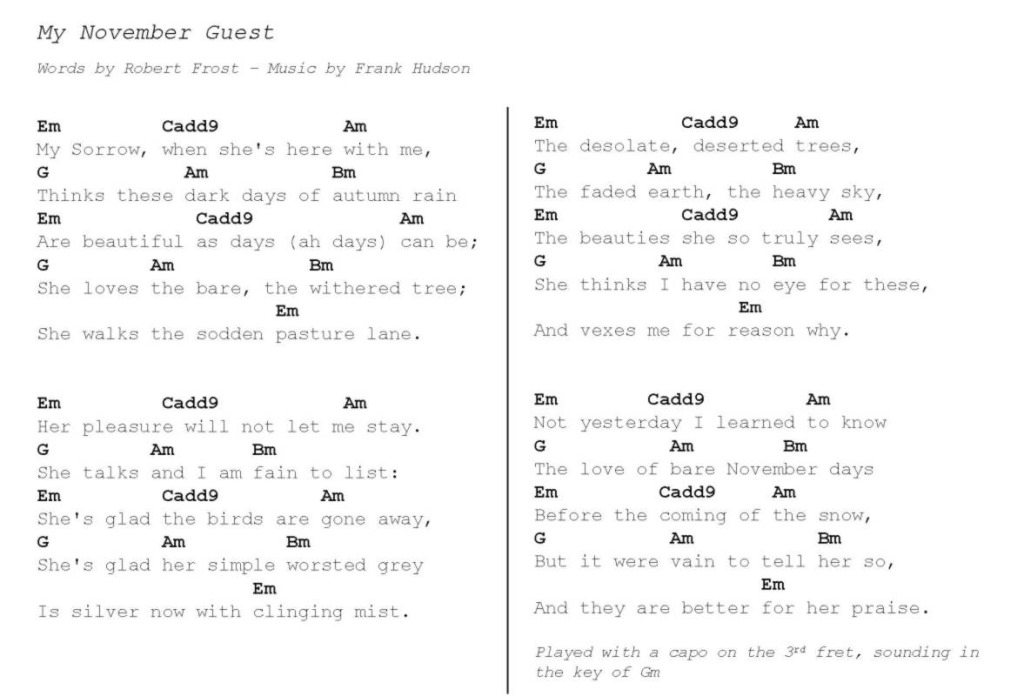
My November Guest

Here is the song I produced from Frost’s poem in songsheet format. I present these in hope that better singers than I might perform them.

.

Frost’s last stanza is his part of the conversation. “Yes, I know how to read the book of nature — or at least the calendar. I wasn’t born yesterday.” His day, the poem’s day, like my day today, may have been dark and damp, but it wasn’t yet the winter that is coming over the walls of the calendar’s date-boxes soon. I know I’ll miss sitting on the porch, biking without mitts, streets only wet not packed with snow or ice. The early and long November darkness may overwhelm us, set off mad clocks inside us, but that’s only dark, only hidden. Or so we tell ourselves and light our LUX lamps. Frost says it’d be vanity to tell his sorrow and this nature this, his mere knowledge, for nature knows the is  of this that surpasses knowledge.

Today’s music is a simple arrangement: me singing with acoustic guitar, as I quickly spent the middle of the day setting Frost’s poem to music and then recording it efficiently in my studio space before I need to hide my microphones from HVAC noises there. You can hear it with a player gadget where you can see that, or with this backup highlighted link for those who can’t.

.

Yellow Air (Heat)

Are you new here? If so, this is what the Parlando Project does: we take words (other people’s, mostly poetry) and combine them with a variety of music we compose, create, and perform. I find this fun, and I also find that even more than reading another person’s poem — even reading it aloud — performing it illuminates corners inside the text that I might otherwise overlook, so I write here about that experience. Then when you listen to the pieces you get to hear the poem in this new context to freshen your appreciation of poems you know, or to allow you an entry into a poem previously unknown to you.

Most of the time I’m faithful to the texts I use to create these pieces. Oh, I might take a part of a poem and make it a refrain/chorus, or I may select some tasty phrases from a prose paragraph so that expresses something more sharply, as if it was a poem — but my usual idea here is to honor some poet or their poem no matter how famous or little-known it is.

John Gould Fletcher is shelved in that little-known section these days, even though he was associated with writers and movements that are still studied, still read (at least by those interested in early 20th century American Modernist poetry.) I wanted to look at some of his work because I read that one of those associations was with those pioneering Modernists who took to calling themselves Imagists. Imagism was often that 2:40 punk-rock single of a hundred years ago. Instead of spendthrift merely decorative language, rhyme, and imagery, the Imagist poem wanted to get right down to it: direct treatment of something observable, not some ideal distilled from abstract thoughts imagined or philosophically proposed. No extra points would be scored for extra words. Rhyme, while not forbidden, was also not the main point. If rhyme led to extra words, those unneeded ones, it was worth discarding.

The musicality of poetry wasn’t thrown out, but like Modernist music, Modernist verse wasn’t interested in the old formal beats so much.

Best as I can tell from my early readings, Fletcher’s personal interpretation of Modernism and Imagism was not the same as others. He didn’t write much in hyper-short forms, while many of his fellow Modernists published whole collections, or sections in collections, made of sub-20-line poems. At least at first glance, Fletcher cared more for sound and less for freshness and concreteness in his imagery than others.

This Project likes shorter pieces, even more so now because my time and opportunities to compose and record are less than in the Project’s early years. In reading through a couple of Fletcher’s collections from a hundred years ago, I did come upon this short poem that was part of one of those roman-numeral separated sequences like other Modernists used. “Heat”  seemed an attempt at the short Imagist poem to me. Here’s how “Heat”  goes:

As if the sun had trodden down the sky,
Until no more it holds living air, but only humid vapour.
Heat pressing upon earth with irresistible langour.
Turns all the solid forest into half-liquid smudge.

The heavy clouds like cargo-boats strain slowly against its current;
And the flickering of the haze is like the thunder of ten thousand paddles
Against the heavy wall of the horizon, pale-blue and utterly windless.
Whereon the sun hangs motionless, a brassy disc of flame.

Short as it is, it’s a little wordy and formal in its manner of speech compared to other Imagists, but a palpable feeling is evoked in the description. I could have performed “Heat”  as it is above — but then a week ago tonight, I was sitting on my front porch after a summer thunderstorm when the entire outdoors started to take on an intense yellow cast.*

Yellow Sky the Picture 2

It was hard to get a modern digital picture of last Tuesday evening’s sky with a phone. The smartphone kept correcting the heavy yellow and darkening cast to that sky, and as I looked at the photo preview on the phone I wondered why my phone wouldn’t believe me as it showed things brighter and blue. I resorted to using a much less smart device with a lesser digital camera to get this.

.

I decided then and there to use Fletcher’s poem to remark on that experience. This recasting went through a few drafts and produced this reuse of some of Fletcher’s words in a different poem:

Yellow Air song PRINT VERSION

Here’s “Yellow Air” with chords in case you want to sing it yourself.

.

What did I change? I wanted my own yellow air in a hot, humid summer experience to be portrayed. Though I retained many of Fletcher’s original words and phrases, my variation is present tense and uses a much less literary/formal sentence structure. Mine’s 61 words — Fletchers, 80. The clouds as ships image is borderline cliché and Fletcher’s “cargo-boats” wasn’t specific enough to fight that, so I substituted my own upper-Midwest image: the 18th century indigenous cargo-boats of our region, the voyageur canoe — still reflected even today by those who use their modern canoes to carry themselves and gear into the Boundary Waters for camping. I wanted a more definitive ending too, and so ended my “After…” poem with the sun portrayed as a ruling strong-man who doesn’t care that the sky is yellow and the heat and humidity oppressive.

What I kept, or even tried to bring out was Fletcher’s word-music. Rhymes near and perfect were increased in number and paused on, and I tried to make this variation more easily singable than Fletcher’s more prolix lines.

You can hear the resulting song with the player gadget below, or if that won’t show up in your way of viewing this blog, with this backup highlighted link.

.

*The Twin Cities Weather Service explained last week’s yellow sky cast this way: “Behind thunderstorms in the evening, high clouds remain. The setting sun emits light that is bent with longer wavelengths. While the blue (shorter) wavelengths are scattered out, the yellow-orange-red part of the spectrum remain, thus producing the sky we’re seeing tonight.”

It’s been hard to complete new work recently, so “Anglers” for Minnesota’s Sport Fishing Opener day.

The world of this poem is scribed with the understanding that when you’re on a lake’s surface you are at the boundary level of two worlds. Like unto angels in Medieval drawings, those fishing are pulling the fish from the aqueous world into the sky world, and I often felt I could sense the hooked fish’s wonder and distress. “Who are these scale-less giants unconcerned by gaseous air?” This poem is called “Anglers.”

Meanwhile, back in Chicago, the Yip Abides blog and rmichaelroman caught this wall painting in 2009. Whimsey aside, the very fish the anglers are seeking to catch in Minnesota today are spending their day trying to catch other fish.

.

It’s unsaid in the poem, but I was in the boat described. I didn’t put myself there because I wanted to focus the reader’s attention on the two brothers and yes, on the fish. There are other undercurrents that I think I kept out of the poem, and someday should make at least one other fishing boat poem. If any in this blogs’ diverse readership reads this before or after getting in a boat and wetting a line, net, or spear, the poem asks you to consider this if you like to think on the water and not just chum with talk: you are frighteningly miraculous.*  Don’t let it give you a big head or anything. There are angler forces without skin on another level above our surface.

My grandfather’s actual Johnson Seahorse outboard motor mentioned in the poem

.

I recall that the more published and noticed members of my little writer’s group Kevin FitzPatrick and Ethna McKiernan were not particularly satisfied as readers/listeners of this poem in an earlier version, and I may have made a couple of changes based on that in the version you can hear today. I think they may have been puzzled or unimpressed** by the pun at the heart of the title: that on the flat surface of the lake, the “anglers” are the highest upward length of a right-angle to the water surface, the sharpest break vertical the fish would ever experience. And then there’s the even more obscure eye-rhyme-ish pun of anglers and angels. Neither of them cared much for puns, while Dave Moore and I indulged generously, enough to wrinkle the other half of the group’s noses.

Now Kevin and Ethna have been, like the fish, also pulled through the surface, and today there’s a church-based memorial service for Ethna which I don’t think I will be attending, though I’m glad to have attended a poetry-centered one for her earlier this year, and I’m planning to attend the poet-focused one for Kevin later this May.  In lieu of today’s service attendance, and out of guilt from my absence, I’ll say that if their skin-less existence is in wonder and distress, that my thoughts go with them, and in my dim watery existence here I ask us on all our levels to turn our circle-eyes toward wonder.

And I know too there are practical voices in the fishing opener today. “That’s what I get for getting into a fishing boat with a poet. Such high-flown thoughts! Damnit. I’m trying to get a worm on this rig’s hook. We feed worms to fish, and then well, we feed worms.”

If you’d like to hear my performance of my own poem “Anglers”  there’s an audio player gadget below this for many of you, and for those who can’t see that, this highlighted link  will open an audio player  for it in a new tab. My music for this uses what I often call my “punk rock orchestration.” I use very simple orchestral instrument colors both because I lack the knowledge/skill to do more complex ones and because I think there’s a direct charm remaining and being featured by stripping that sound down.

.

*Ah, footnotes, the sinker-weighed lures bobbling along near the bottom! No, I’m not out fishing today, or most any days in this part of my life, though I think about my hours of fishing as a young person. I always considered the fish though, a little to a lot. One thing’s simple though: every poet wants to be miraculous.

**When a poem or poet doesn’t “hook” us, these two feelings can be cause and effect in either order.