I sometimes think I’m working against gathering a larger audience for this.
Twice in the past month or so I’ve had an opportunity to speak in passing with poets about what I do with the Parlando Project. I’ve got my elevator pitch carved out: “I combine poetry, usually literary poetry not intended to be performed, with original music in different styles.” Both poets came back with this replying question: “What kind of music?”
Maybe I should start hitting that word “different” with hard emphasis — but Midwesterners know that kind of spoken underline could be parsed in our regional argot as cloaked disparagement. If I was to say:
“I’ve written a piece for a string quartet in which the instruments are placed on the floor and filled with nuts and seed. A herd of squirrels is then unboxed and will proceed to chew through strings and tonewood for the course of the musical evening.“
The Midwesterner is bound to reply “Oh, that sounds different.”
For Friday the 13th: presenting the unexpected, not gnawful, just “different,” the Squirrel String Quartet.
.
Now, I believe both of those poets this past month are perceptive, I read it in their admirable poetry. If they miss the word “different” it’s because many people have strong feelings about the music they care about.* Long before reaching the age of those poets most listeners have strong affinities for some music and equally strong dislikes for the sounds that they don’t wish to put in their ears. The idea of combining poetry with music is attractive, but what kind of music is an unavoidable point in describing the Parlando Project, and I can’t encapsulate that. Elevator pitch? If I tried, I’d be out of breath and walking up flights of stairs. To both poets I was reduced to trying to start my response with “That’s my problem: it varies.”
Readership of the blog posts here continues to increase through the years, while listenership to the audio pieces has been for the last half of this Project’s life flat to somewhat lower. This bothers me, and I have theories, but one that seems particularly plausible is that the variety itself turns off listeners. One day acoustic guitar folk-scare strumming, the next day some kind of synthesizer sound, a garage-rock quality electric combo, something like Jazz, small orchestral ensembles, Blues slide-guitar, or alt tunings in a matrix somewhere between John Fahey, Joni Mitchell, and Sonic Youth. And then on the third day, a combination of one or more of the above.**
How well do I (who much of the time needs to play or score all the parts) present that variety? I think my own judgement approximate, but it goes like this: on good days I think I do it well enough, on bad days I feel embarrassed by the faults in execution and conception I hear. So, my limitations are a factor here, but even if I was a master of all these forms, I think the problem would remain. In this theory it takes only one or two “bad fit” musical pieces for a new listener’s taste to judge the work has no value, and no further listening occurs.
What will I do about this? I don’t know. I can’t help the eclecticism — it’s been in me since my youth*** and I don’t think I want to try to scrub it out.
Today’s musical piece comes from that “We’re a garage band, We come from Garageland” mode — looser still in that like most of the LYL Band pieces presented here over the years it’s spontaneous, not the execution of parts each instrument is supposed to play. As keyboardist Dave Moore says at the end, the words are “a personal experience story,” an exception in the Other People’s Stories texts the Parlando Project finds, experiences, and presents. Just over a year ago a storm with 60 mph winds and golf-ball sized hail struck Minneapolis. Overall, it caused 1.1 billion dollars in damages. On my roof, my shingles were totaled (the classic hail-storm result), windows were shattered, and there were plenty of cracks in the siding from the wind-driven hail. As “Heaven and Hail” tells it, it took months, well into the winter, for overwhelmed builder crews to get all the home damage repairs completed in my neighborhood.
Last year at this time work started on fixing the damage at my place. One experience amid the hammers, ladders, and supply pallets: hearing one of the crew’s boomboxes playing a record of garage rock classics all sung in Spanish. Another Rosetta Stone moment, like reading those cereal boxes in French.
To hear this short account of the storm and aftermath you can use the audio player gadget below. No player? This highlighted link is an alternative that will open a new tab with its own audio player.
.
*Neither asked me —and few people ask me — “What kind of poetry?” With non-poets, I ascribe that to the lesser interest in poetry as an art and therefore a lack of strong likes and dislikes.
**This leaves out the subjective qualities of my voice, something which I recognize is of overwhelming importance to most listeners.
***”Top Forty” rock’n’roll radio was extraordinarily broad in “The Sixties™” and I was listening to the classical music station and a country-western station along with that format. Hootenanny was on TV, folkie music was part of church camp. Other than the occasional cross-over hit I’d hear on the radio, the Jazz waited a bit to creep in late in my youth. Eventually the smart programmers figured out that a pop music station that played a “button pusher” record would cause the listener to switch to a competitor. I’m the odd-duck that when I hear a record I don’t like, right after one I do like, I want to hear the third and maybe fourth or fifth record played, particularly if any of the small sample (liked or not-liked) is something I don’t think I’ve heard before.
I think there’s a misapprehension of Carl Sandburg’s poetry: that it’s simple, prosy work: that it says what it says, hearty single-minded messages with some decorative metaphor. Tastes differ, and mine may not be a guide to anyone else, but I sometimes don’t find him so. As I continue trying different things during the summer with this multipart personal story, I’ll return to our regular stuff at the end today with an example of Sandburg mysterioso.
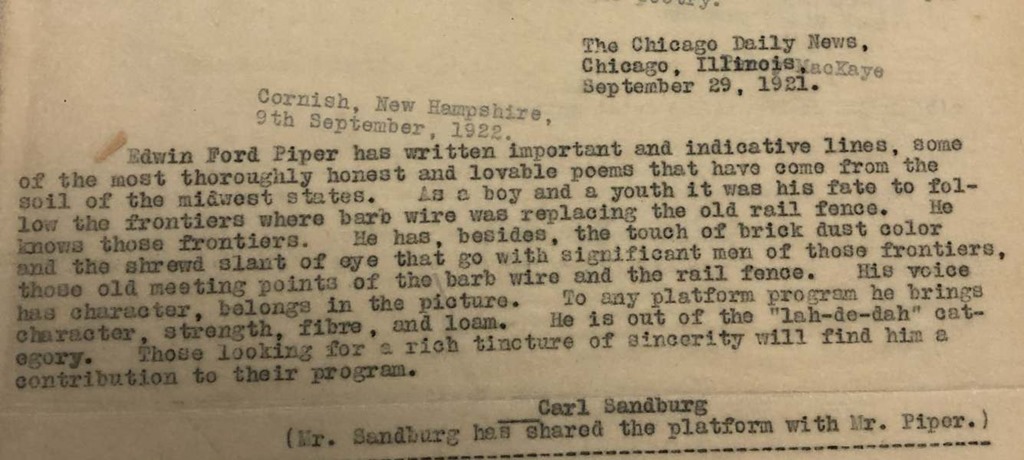
The finale of my June trip to Iowa City to see what I could find out about an even more under-considered Midwestern 20th century poet, Edwin Ford Piper, was planned to be a visit to Galesburg Illinois, a small city just east across the Mississippi river where Sandburg was born. Piper and Sandburg compare easily. Both born in the American Midwest a couple of decades after the Civil War, both part of early 20th Century literary movements we no longer take as much notice of. Both were attracted to a broad swath of memorized vernacular music that would be called “Folk Music.” They knew each other, even shared stage programs. Sandburg’s 1927 music collection The American Songbag established what American folk music would be for my mid-century generation,* and from examining Piper’s papers I could see his definition paralleled Sandburg’s. Piper was one of the contributors to American Songbag.**
Poet Sandburg blurbing poet Edwin Ford Piper. I also saw a note from Sandburg thanking Piper for songs used in Songbag, but don’t have a picture of that.
.
We arrived at Galesburg early for the 1 P.M.-opening of the Sandburg birthplace site. We wandered the wondering-what-it’ll-become-in-the-21st-century business district with its building facades still showing a variety of past decades abandoned styles left to fade, and browsed a charming small bookstore there. We were going to have an early lunch somewhere, and decided to just get sandwiches and go eat them in the small area behind the birthplace on benches by the Remembrance Rock there.
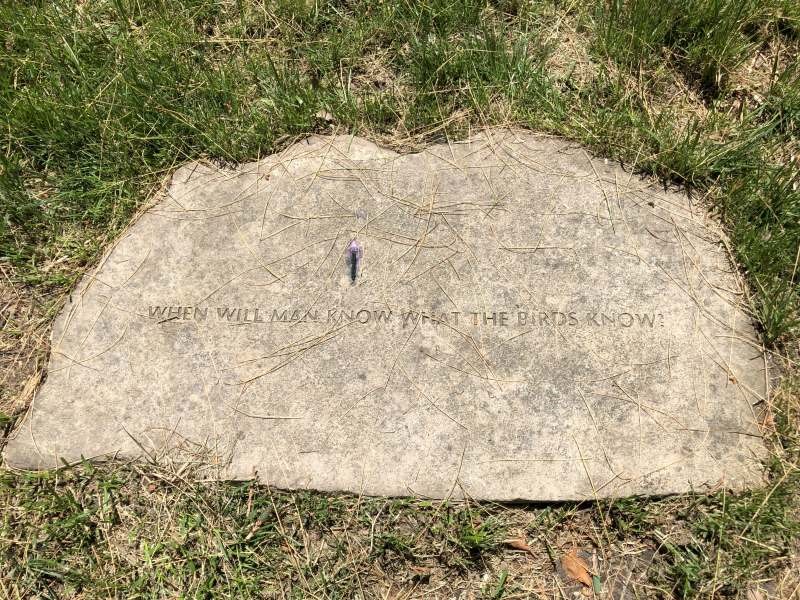
The rock is an unremarkable bolder, utterly plain and unshaped as a design choice.*** Sandburg and his beloved wife and partner’s ashes are buried under it. The lawn it sits on behind the house is circled by bushes and a few trees, and rather than any sense of a park, it reminded me of the backyard of the house where I grew up in Iowa. One thing the photos I have seen of the rock didn’t show: a ring of irregular, small, flat, stones that circle it, each engraved with a line from a Sandburg poem. If one wished, one could ceremoniously walk from flat grounded rock to rock stepping with your foot-soles on his words, which it seemed to me to be what one of Sandburg’s models Whitman has commanded — and so I did. There’s a nice bust of Sandburg on a stand there too, but to my sense of the place, walking his words was more meaningful. I’d told my wife that Sandburg’s father was a railroad blacksmith, and she figured that the neighborhood might have been handy for rail workers. After our lunch, she took a little stroll while I waited, and she came back to report that just over a rise a block away was the railroad line.
…but then all the birds know is to poop on poetry-engraved rocks, same as any other.
.
One of the site’s staff members arrived ahead of opening time to do a little yard work, and when that time arrived, he changed tasks to welcoming and serving as a guide for about 30 older folks in an adult learning program who arrived from Peoria in two small busses. Beside the birthplace (our host preferred to not call it a house, but a railroad worker’s hut) there was another small, somewhat rundown house next door that served as the site’s offices and a small room of memorabilia backed with an illustrated wall timeline of Sandburg’s life. Behind the two houses was a garage that has been turned into a cozy theater space where they host musical acts in homage to that part of Sandburg’s heritage.
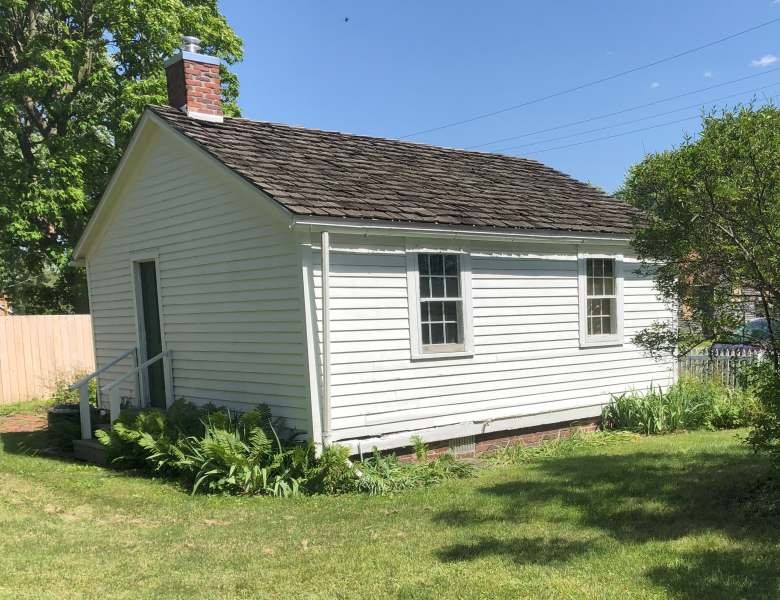
My wife and I plus the 30 others overwhelmed the birthplace site’s capacity. Resourcefully the staff divided the group into two, and after watching a short video on Sandburg our half got to walk through the birthplace hut or house. If you are familiar with the modern tiny house movement, the floorplan and the maximal utilization of it would strike a resonance. Outhouse, no plumbing or running water, it’s decorated in late 19th century Swedish immigrant homey style, but a couple, a young child, and a baby would have been a tight fit, much less our troop of visitors. I recall visiting a reconstructed Lincoln birthplace cabin as a child, and though the Sandburg birthplace is wood-frame construction, not a log cabin, the square footage and amenities might have struck Lincoln biographer Sandburg as similar.
Sandburg’s birthplace: house, hut, cabin. This side shows the smallness best I think.
.
Perhaps because of the touring group’s visit, there was a special performance by a singer-guitarist whose name I didn’t catch, who did a short re-creation of Sandburg singing and talking about his life. I enjoyed that effort. Before leaving, I asked one of the leaders of the visiting group, an old professor, who had some years on your old guy reporter here, what Sandburg biography he’d recommend. He cited Penelope Niven’s bio, and I bought it at the site’s store.
No one hides the fact Carl Sandburg might not have much direct memory of the birthplace as his family moved to another Galesburg house while he was only a toddler**** But the link to his parents and the choice of it for a burial place (which was I believe his doing) speaks to the meaning to him. Unlike the larger house and goat farm where Sandburg spent his post-WWII life until he died that is a National Parks Service site, the birthplace is run by the State of Illinois and some local spirit and volunteerism. Sandburg retained throughout his life a fondness for Galesburg, never hid his roots there, and Galesburg was also the place where he attended college after his stint in the Army, though he never completed a degree.
Which brings me to today’s new musical piece, a setting of a Sandburg poem about someone who apparently left town wiping the dust off their shoes at the city limits. In his collections Sandburg called the poem “Gone,” but the main character’s name sticks in some memories, so it also gets called by the first line, or by the character’s name that appears in that line: “Everybody loved Chick Lorimer in our town.” Here’s a link to the text of the poem.
I promised mystery in this one. There are things left out, and various implications some of which complicate, some of which conflict, are left open. Can we even take that opening statement at face value? Not now, certainly not in 1916 could it be said that we all love “a wild girl” with a dream “she wants.” Some might, many would not. Wildness and dream-holding create envy, often a lot of it.
Is Chick Lorimer someone that everyone in town has marked as special, marked for greater things — someone so preeminent in their youth where that envy would be tamped down? If so, why the sudden leaving, with no one knowing where or why? Does a recognized prodigy, much loved, leave a place without saying goodbye? That would be a rare story.
Perhaps the “everyone” is a casual overstatement, referring only to a small group of friends who shared ideas? Later the poem seems to refer to larger numbers however.
Is she not actually loved by much of the town, and “loved” in a narrow, sexual, sense by many men? The “Dancer, singer, and laughing passionate lover” line could give testimony to that thought. That line is followed by two specific but puzzling lines, and their very specificity says we should pay attention to them. “Were there ten men or a hundred hunting Chick?” “Hunting” is a word choice, though we do say we hunt for the lost all the time without thinking of hunting as in wild game. Why the specific range, “ten or a hundred?” If this noteworthy young person is gone, no other info, that’s a missing person. Have they come to harm, are they being hunted for something they’re suspected of doing wrong? Why can’t they say, between 10 and 100 for the number of hunters? This hunt seems secretive from that wide range: 10 might be a small matter, 100 a greater one — but even 100 would be small if this is a universally beloved light of a town, unless it’s a very small town. It seems significant that the poem’s speaker can’t give a better estimate. And that’s followed by another stat: “five men or fifty with aching hearts.” The numbers are still widely separated, but they’re also halved from the number of hunters.
To perform this, I felt I had to have some plot in mind as I sang it. In my mind, Chick is a free-spirited libertine, and to a large degree that “loved” means no-strings sex. Chick likely left because she wanted something more, or because the disapproval of her “loving” everybody was getting intolerable. The maybe just five “aching heart” men thought they were, or could be, her significant partner.*****
How bohemian was poet Sandburg’s experience early in the 20th century? When he first moved to Chicago he lived in what was in effect a free-thinkers commune run by a strange guy, Parker Sercombe. From my reading, “Free Love” was just as much a topic in bohemian culture in the early 1900s as it was in the 1960s.
But maybe I’m wrong, and maybe your reading is different. It could be that Chick is like “Chuck” Sandburg (the name he used then) wanting to see the world, wanting to follow their dream. Sandburg had bicycled around Illinois, rode trains legally and illegally to other parts of the US, and he’d already been to Puerto Rico in the Army by the time he wrote this. Chick could be his anima. Sandburg never felt entirely alienated from his hometown or family however. He came back through town, wrote letters to his family, and so on. And if you want to see his beginnings and his decided final place to remember him, one goes to Galesburg.
To hear my performance of “Gone” AKA “Chick Lorimer” you can use the audio player below. Do you feel nobody knows where the audio player has gone? This highlighted link will open a new tab with its own audio player.
.
*If you never cared about the post WWII folk revival for whatever reason, I will point out that Rock’n’Roll became self-aware artistic and literary-flavored “Rock Music” in the later 60s because folk revival musicians transferred their backgrounds into bands with electric instruments after The Beatles, electric Blues bands, and “Dylan goes electric” emerged to take over college and post-graduate audiences in the US. Over in the UK, the folk revival to Rock pipeline was supplied by “Skiffle” — an American jug-band folk revival style that swept UK youth in the 50s, merging with a peculiar British Trad Jazz revival that often featured the Blues element of pre-WWII Jazz.
**Piper’s wife, in her own papers collection at the University of Iowa library, claims that Piper’s contributions were greater than Sandburg credits in Songbag. Possible, I suppose, though the nature of Piper’s song collecting revealed by my examination of his papers shows a collaborative effort with collectors sharing with each other freely. Piper’s unpublished collection, like Sandburg’s published one, wasn’t done with a sense of ownership of songs.
****The family didn’t get sudden wealth, it supplemented the railroad wages by renting out rooms in the succeeding houses, and the children worked to add to the family income as they grew older.
*****For a fuller story fleshed out from the short poem’s details, there’s this 50 minute early 1960s TV episode from the Route 66 series which uses the poem idea as its central motif and title, with the leading man reciting Sandburg’s poem 2/3 of the way in. This linked version has hokey colorization of the series fine B&W photography, but it is easily viewable.
Perhaps we should remind ourselves in this pre-AI age that every poem, any poem, is written by another human being. I did the math with the years, and this is a poem published and likely written about a hundred years ago by a 40-something Midwestern American.
I’m decades past that age, as was Donald Hall when Hall gave us his law that states that most poets, even prize-winning ones, will be forgotten 40 years after they die. This may sound callous, but that process is likely necessary. How many poets can we hold as a culture, as a reader? Dozens? Certainly more. Hundreds? Whatever, there’s a limit. The poet who wrote today’s piece? Who would we give up in the pantheon to let him in?
I came upon the poet who wrote today’s poem, Edwin Ford Piper, by reading a striking poem he wrote of the closing American wilderness that I’ve already presented earlier this year. I know little about him as a person.* I almost worry to find out more, since human beings are full of all kinds of faults, deleterious opinions, vanities, and misapprehension. Did he write this poem in this time of the year, in the Spring? Who can say. Writers are full of memories, and imagination that can redress any cold or baren place, but it feels like he did. The poem’s trope of Spring’s reincarnation of driving/seeking life paired with the Christian holiday of Easter is far from unique — but the poem’s not, in feeling, much of a Sunday-dress observance — it’s luxuriously pantheistic. “Whispering Often” was written in a past era we still call Modernism, published in a journal that put forward many of the great English Language Modernist poets, Chicago’s Poetry Magazine, and it was included in Poetry’s founder’s anthology shortly afterward that had Modern American Poetry imprinted on its end-boards — but I can’t call it an example of Modernism.
If you can un-embarrass yourself, you could sing this Spring poem too.
.
It’s not end-rhymed. It does sing on the page, despite having a meter that I can’t easily chart out. There’s a familiar iambic rise to many of the phrases, but I don’t think I can call it blank verse, a form that Piper used elsewhere. Oh, but does this rite of Spring want to sing! The title says whispering, so maybe the poet is abashed at the voice that is called forth. Not a lot of today’s poetry sings like this. Instead, we’re more often interested in a poem showing us a particular apprehension the poet has uncovered, an apprehension we are to recognize and share. We are want to pause and recognize the matter of typical 21st century poems, like a friend speaking with us. A wise friend perhaps, a little better with language than we normally are — but still, we wouldn’t want them to break out into a song over shared teacups or beer glasses. How gauche that’d be!
And so, I think of this poem now, as Spring is rebeginning here in my Midwest, as the Abrahamic religions are celebrating holidays of freedom, rebirth, and revelation — but more so as the northern half of earth is celebrating something that Abraham could have seen in a place outside Ur. In this case, a man in his 40s, a Midwestern American like myself, stopped and wrote this down.
What an odd act! If he paused to think about it, he would know that by all odds this poem will be soon forgotten. Yes, Piper was a professor of literature, but he was an adult, someone who knows the comings and goings, the correct way to behave, the agreed worth of this and that. Yet the poem will appear as something as outrageous as an unbidden public song, one with a crush of erotic desire for life. Religion can shape and seek to make that solemn — and perhaps such a transformation teaches wisdom, brings thoughtful ethics to our roots and melting eddies — but that Spring is older than wisdom.
It’s enough to make a grown man break out into song after all.
So I did. Earlier this month I hurriedly sang a bunch of pieces I had written that I feared wouldn’t have time to shape and improve into full arrangements in an interrupted life. Long-time listeners will know my voice isn’t going to be polite, though maybe it should be. You can hear that quick, short, performance with the graphical audio player below. No player? You don’t have to rush past, you can use this alternative highlighted link that will open a new tab with its own audio player.
.
*It’s not certain, but there’s a fair chance that later this year I will make another trip to pay respects to one of my poetic heroes, Carl Sandburg, and on the way tarry awhile to see if I can learn more about Edwin Ford Piper.
Nothing excites me more while doing this project than coming across a little-known poet that I had never heard of. Some of these poets have perhaps a single poem worthy of interest; others, whole bodies of work which have slipped off the page, fallen to the floor, and have then been lost in the cracks.
Just how interesting is Edwin Ford Piper? I don’t know yet — and that’s fascinating! I’ve picked up a few things about him. He grew up during the closing act of the American frontier in the vicinity of the small town of Auburn Nebraska near where Nebraska’s southeastern border meets up with Missouri and Iowa. Despite a typical rural childhood of his era, with schooltime being “Sometimes two months a year, sometimes none,” he largely educated himself as a child by reading, graduated from the University of Nebraska, and he then became a long-time college professor of English Literature at the University of Iowa until he died in 1939.*
But here’s what’s intriguing me so far: unlike a great many of his contemporaries, it appears he takes as his subject the local culture of the Midwest in his time, including the ordinary working-class and underclass. At least at first glance he’s a Modernist of a sort. Some of the first poems I’ve read look like a melding of Sandburg** and a Midwestern, not New England, Frost — but with his own vision and sound.
I’ve been long-winded lately trying to share as much as I’ve been able to find out about another lesser-known Midwestern poet of this time, Fenton Johnson. So, let me rest your eyes from the historical matters of Piper so far, and share a performance of the first poem of his I came across: “The Last Antelope.”
In its deep cross-species empathy the poem reminds me of Kenneth Rexroth, who’s a generation later. Piper tells its story using some Modernist tactics, including abrupt time-shifts and changes in point of view, always chasing the most vivid perspective. It’s in an unfussy iambic pentameter, but like Frost, the language and word-music seem so natural you don’t hear the pentameter, just feel the rhythm without noting it. If you’d like to read the poem along with my performance of it available below, you can find the text of it here.
Like Fenton Johnson, there’s not a lot of pictures of Piper to be found online. How little-known is Piper? Not even a stub Wikipedia page!
.
A few pieces of detail about the pronghorn antelope that might serve as background for this poem: it’s the fastest land animal in North America (55 mph top speed!), and unlike some other speedsters world-wide, it can keep up significant speed over a long time and distance. The method of hunting implied in Piper’s poem is similar to what Indigenous tribes used, but with guns improving on bow and arrow: large groups of hunters driving the antelope into a natural or constructed dead-end pen where it can’t use its speed to escape.
Why did it become extinct in the Iowa/Nebraska area in Piper’s childhood era? He concisely notes the reasons in the midst of the chase the poem takes us on: they are skittish prairie creatures who want the lookouts of high ground and long free spaces to run. Early attempts to conserve them in fenced ranges failed, they refused to thrive where they couldn’t run. Barb-wire, a famous marker of the closing of the American frontier, was particularly dangerous: the pronghorn generally don’t leap over fences, they prefer to kneel and crawl under them. The barb-wire then tore at them, their crown of thorns.
Simple music for this closing of the frontier story — just acoustic guitar — but I hope I can tell well the story Edwin Ford Piper wrote. You can hear it with the audio player below this. No player? This highlighted link is an alternative way to get an audio player for it.
.
*Coincidences: for a few years late in the 20th century the University of Iowa’s Iowa Poetry Prize was named the Edwin Ford Piper Poetry Award, but for whatever reason, this name was abandoned. While it had this name, Missouri-to-Minnesota poet Phil Dacey, who I treasure for his early kind words and influence to me, won that prize.
**Like Sandburg (actually “with,” as he submitted collected songs to Sandburg’s landmark American Songbag that helped kick off the American Folksong Revival) Piper was known to break into song when reciting poetry. He got called “The Singing Professor” for this, and that makes him a natural Parlando Project interest.
I have trouble at poetry readings. Oh, I enjoy them, but they tend to spark off ideas and associations* in my mind. When I come back from those jumps in my consciousness the poet reading in front of me may have gone off to the next poem — and I feel like I have been delinquent in my duty as an audience.
A couple of months ago at the poetry reading series I try to attend regularly,** a poet was introducing a poem, and somewhere in between that poem’s introductory material and the poem itself this connection, this metaphor, occurred strongly to me. I don’t now recall what it was the poet reading said. Was it something about an acoustic guitar? Possibly. Something about a church? Maybe. That I can’t remember says something about the utter rapidity and completeness of my leaving that room and into the germ of this poem.
Here’s the poem presented as a chord-sheet with the guitar chords I used to accompany it.
.
I saw immediately the churches of my parents’ and grandparents’ generation, small Midwestern US churches. Usually wooden and white with a steeple’s neck outside, and inside largely one room, the sanctuary within the single story, filled with dark brown wooden pew benches. A basement below, small children’s bible class spaces and a kitchen that smelled of brewing coffee, the sanctum of wives, mothers, and grandmothers of the congregation after weddings, funerals, baptisms.
The particular church most in my memory is decades gone, but this nearby one will serve as an example.
.
When one thinks of churches, I suppose some think of grand spaces, cathedrals or those more modern large urban churches built to approach that scale and presumption. Weighty stone buildings, as unresonate as tombstones, intricate carvings and décor. Grand halls, chambers, perhaps a pipe organ, for they are the pipe organs of buildings, elaborate and encyclopedic, overwhelming anything human that would manipulate it.
The modesty of those small-town Midwest churches, the woodiness of them, has its own glory. And so it seemed natural to connect them to a instrument that is somewhat of a point of origin to me musically, the acoustic guitar.
I don’t know how well this little poem will communicate that to those who do not share my experiences with those buildings. I accept that a poem can’t be everything. There’s one detail in my poem that might not make sense or image to some readers: the attendance list. In my recall, it was common for these churches to have a board that toted up the attendance for the last service. I’m not sure that sign’s entire purpose. To remind those in the sanctuary that they were part of a continuance? Could be. The small continuances are what these churches contained.
You can hear my musical performance of “Quiet Sanctuary” with the audio player gadget you might see below. No player to be seen? I offer this highlighted link as fall-back then. The link will open a new tab with its own audio player.
.
*It occurs to me that I rarely have ideas as such so much as I have associations, things that seem to recall other things or suggest other things yet to be connected. It’s possible to write poetry without the poems containing metaphor, that kind of association, but most poets don’t. That trait may be why I’m drawn to poetry.
**That reading series, held the second Thursday of the month in St. Paul Minnesota, is the Midstream Reading Series. I know some of my readers are from the Twin Cities area. I find this event worthwhile, and you might too. Though I’m often inarticulate in person, I would try to say hello if you were to greet me there. Next reading is this coming Thursday, October 12th.
A break in the influences as memoir series here, that theme that I’ve fallen into doing for National Poetry Month? Maybe. I’m going to present a new performance of a Carl Sandburg poem — but before that I’m going to talk about another writer, Rod Serling. Serling wrote a variety of things, but he’s best known for creating and hosting, often presenting his own scripts, the mid-century TV show The Twilight Zone.
I’m doubtful young people watch the old gray half-hour Twilight Zone episodes anymore, though they are still available in various ways — but people younger than me certainly did, and to some degree still do. That generation between today’s youth and my old age has sought to revive it under its original title or in spirit, and they still talk between themselves about the original episodes and their hard to reproduce sensibility. I remember being in a creative writing class back in The Seventies, with folks maybe five years younger than me, and I was surprised at how often they might refer to some TZ episode instead of a Greek myth or some piece of literary poetry. SF/Fantasy fandom has grown a hundredfold since, it’s the backbone of popular narrative culture now. The SF/Fantasy memory-hole village that was Twilight Zone’s once, has become a crowded inner-ring suburb, neither new-hot nor charmingly old-fashioned.
One episode of that series, one that came early in the show’s 156 episode run from 1959 to 1964, appears on some of the middle-generation’s “best of” lists, though I think there’s a strangeness that it does. Titled “Walking Distance” it’s tied very clearly to Serling’s own Greatest Generation memories, not as much to my generation who might have watched it on its first run, and I’d expect not-at-all to those younger than me. To summarize the plot without spoilers I’ll say the story is that an overworked and worried 1960 advertising man ends up walking in the countryside and enters his old hometown, the allegorically named “Homewood,” where he grew up before he left for New York City. He finds it not the present town in 1960, but the town of the 1920s.Given the number of time-fantasy stories written since then, not that unique a setup.*
Well, is a poem about a poet hearing a bird sing, or mourning a dead intimate, or finding themselves awash in desire all that unique? “Walking Distance” works, if it works, on performance and from the strength of the slightly wordy** but emotionally resonant script. A feeling of nostalgia — more than that, the feeling of wanting to be able to walk one’s childhood places in dimensions more palpable than memory is something easy to evoke in us. Serling’s script wants to draw a bit more than just all the feels in this situation — but let’s face it, all the feels, the range of edges soft and sharp of them, is the powerful engine here. That engine is strong and universal enough that I can feel the lost 1920s that Serling evokes, even if I never lived them.
Which brings me to Carl Sandburg and today’s poem for performance, “Band Concert.” Published in 1918, it presents itself in a poetic collection of contemporary portraits of American places and people that Sandburg has observed in his travels. The night of the band concert in this poem — while in Nebraska instead of upstate New York — is closely contemporary to Serling’s Homewood. Poet Sandburg is roughly 40, so while the scene in his poem is set in the now, the poem views the kids half his age re-enacting things that are already past for our storyteller.
If one knows the history of American music, Sandburg can be decoded as knowing that the Nebraska city is a few decades behind Chicago or New York. The band seems to be playing rags, the craze of the turn of the century, not of 1918. A small-town kid who had long left for the biggest cities in America, Sandburg can compare the giggles of the kids to the “Livery Stable Blues,” a landmark early Jazz recording where white musicians produced outrageous instrumental sounds imitating farm animals. “Livery Stable Blues” was released in 1917, and Sandburg was an early Jazz-bug — but he’s not knocking the Nebraskans for their music. He’s celebrating it, and them. And after all, cowboy rags and Negro*** rags, would be in the repertoire of Carl Sandburg the folk musician who would be including a set of guitar-accompanied songs in his poetry readings.
Homewood’s park and our 1960 visitor, dressed much as script writer & host Serling would be. Town square park and bandstand from my grandmother’s town. Bandstands in towns were common enough in my Midwest, so I forgot this elegant one, but I did remember the alligator.
.
In time-space, I’ve never visited Serling’s Homewood, nor the Nebraska place Sandburg is reporting from. Those are my grandparents’ times. In my own midcentury I’ve been to their outskirts close enough to see the band pavilion in the park or square, the full summer dresses, farm boys when that was a common occupation rather than employees of feed lots, and I’ve walked the sidewalks past the lattice shadows decorating porches. I can translate some from their writing. Serling, Sandburg, my grandparents, they know “more of the story.” Which is us — time, space, placental barriers away.
You can hear me perform Carl Sandburg’s “Band Concert” with a rock quintet which has no tubas nor cornets in this concert. Audio player gadget below, alternative link here for those who don’t see a graphical gadget.
.
*Twilight Zone itself did another well-loved episode later with a very similar setup: “Next Stop Willoughby.”
**As if poets have standing to complain about the use of words to portray things, rather than filming a chase, fight scenes, or calling in a CGI render farm.
***Those who go to the original text linked here will note that Sandburg uses the n-word in this poem as he does elsewhere in his early poetry. I’ve “translated” it. Sandburg also uses the general range of derogatory ethnic names of an era where “white” by the conventions of today wasn’t then a monolithic block, but instead was segmented into many othered creatures to be devalued with rude names and determinatory stereotypes. I’m not a Sandburg expert, nor am I the one to rule on what’s racist and what’s documentary, but what I’ve read of Sandburg says to me that he was intentionally anti-racist.
Our Halloween series continues with the voice, music, and words of Dave Moore today as I present his piece “Sam and the Ghosts.” And as bonus autumn content, this one takes place in a garden just past harvest time.
I haven’t kept a garden in decades, but Dave and long-time friend of this blog Paul Deaton do. They remind me that at about this latitude north, October is the time to have removed the final products and to prepare the bed for the interval until spring planting time returns.
I may not have done this for decades, but this process goes back — way back. Folks were planting crops in the Midwest long before colonization. The mound builders here, like the earthworks and standing-stone raisers in the British Isles, fed themselves on the invention of agriculture. So in that way, every garden — that small geographical gesture — is a memorial. William Blake said the rebellious angels of art must need to drive their plows over the bones of the dead. I don’t think he was speaking of colonization or commerce when making that point, but his maxim is true reportage anyway. Whether we are speaking of poetry or music or tomatoes, were we plant has likely been tilled before by dead people. Isn’t it proper then that we should honor them before we make our gestures in the soil?
The song sheet Dave handed me the day we recorded this song a few years back.
.
In Dave’s poem which he made song, Sam* has forgotten this. Some ghosts remind him. In his poem they are ghosts of settlers. Outside of the poem, they are people created by Bob Dylan.** Those definite levels in history are not the beginning, not the end. Who knows who ran the land from where the settlers’ family left to come to America? Then we do know who lived the land, and were so harshly displaced before the settlers’ opportunity. Who knows, maybe Hollis Brown’s farm is no longer farmland now after some other money has changed hands. How many songwriters are tilling Bob Dylan’s land?
Every seed you plant came from somewhere before you plant it. Every land has ancestors. Every garden is, or should be, a memorial. Winter will bury our gardens, turn our blank pages to blank pages again, and we wait and expect for spring.
The ancestors expect for spring too. We are that spring. The gaps of expecting are where the ghosts live.
To hear the LYL Band perform with Dave Moore singing his song “Sam and the Ghosts” you can use the graphical player below if you see it. No player? This highlighted link is your alternative.
.
*Neither Dave nor I can resist a pun. For extra Halloween-relevance points, Dave has named his gardener “Sam Hane.”
Today let’s examine the place of hands and humor in poetry and music. Let’s start with hands, before we turn to the subject of humor and a poem about farming.*
You just heard alternate Parlando Project voice Dave Moore last time here, but besides letting you get a break from my vocals, Dave has played keyboards with me since the late 1970s as the core of The LYL Band. That’s a long piece of work, particularly in that I’ve needed him more than he’s needed me with this. Here are the basics of that: I’m a poor rhythm guitarist. I like to add color and decoration whether the song is fast and loud or quiet and moody. Groove, beat, a solid march of chords to carry you along? Not in my wheelhouse. The LYL Band has had other guitarists over the years to handle some of that, but most of the time it’s been down to Dave for the chords and groove. Back in the earliest days of recording us, when four tracks were a fresh luxury, I’d put Dave’s keys on the same track as a drum machine, sure that he’d be solid as the machine.
Now we’ve both got some mileage on our hands, and Dave has encountered some issues with both of his arms and hands. He tells me that the fingers just won’t do what he asks them to do some of the time. He’s become more like me now as a musician: able to do some things, some days, within limits. My own hands have had problems too, which currently are no worse, and many days a little better. Oddly, writing and composing can let my hands weaken. To wrangle a guitar as I often like to takes not just flexibility but also finger strength which is best approached by regular use with a gentle uptake, not a two-hour live session where I need them to work right off after weeks of musing on poetry and tapping out a sonnet. I’ve been trying to carve out more time to “just play” in order to keep my digits loose and strong.
So, when Dave and I got together this month to honor our friends who’ve recently died, I assessed that my hands were ready to rumble by current standards; but Dave, while game, wasn’t sure. During the session, he did all right, even if he wasn’t nearly as strong as he was in our little band for years.
Now on to humor. Kevin FitzPatrick was a poet we got together to honor. We both knew him for decades, and Kevin even played a little blues harmonica with us a few times in the early days. One thing that Kevin’s poetry often used was his dry sense of humor. If his poems “had other people in them” the interaction between those characters was often humorous. Humor is like that, isn’t it? With poetry one can easily fill a chapbook with solitary musings, singing philosophies, and hermit’s prayers, but humor generally requires other people, our rubs, our missed and kissed connections.
Kevin’s final collection Still Living in Town has several characters, but the central ones were his own persona, a city-living office employee and his life partner, Tina, a woman who had decided she wanted the rural life — and not a Walden cabin in the woods, but a farm growing a variety of produce and sheep.** Kevin was in his 60s, but he was a big fit guy (he boxed and taught martial arts in his youth) and however urban his life had been, his character pitched in with the farm labor.
Kevin’s farm poems are and aren’t like Robert Frost’s to compare them to a famous example. That Kevin could approach a blank verse feel in some poems would connect them — but Frost, urban-born and professionally an itinerant teacher, liked to cast his persona in his farming poems as knowledgeable and in place with farming, while Kevin portrayed himself with beginner’s mind on the farm. Given that fewer living readers have any connection with farm work, Still Living in Town invites us into that milieu wonderfully.
The poem of Kevin’s I used for today’s piece is looser metrically, but while it’s set in like weather to this current March (wheeling rain and snow and thaw) it most wants us to hear a little story about the two characters, the labor of farming, and yes, the humor in hands and their stubbornness.
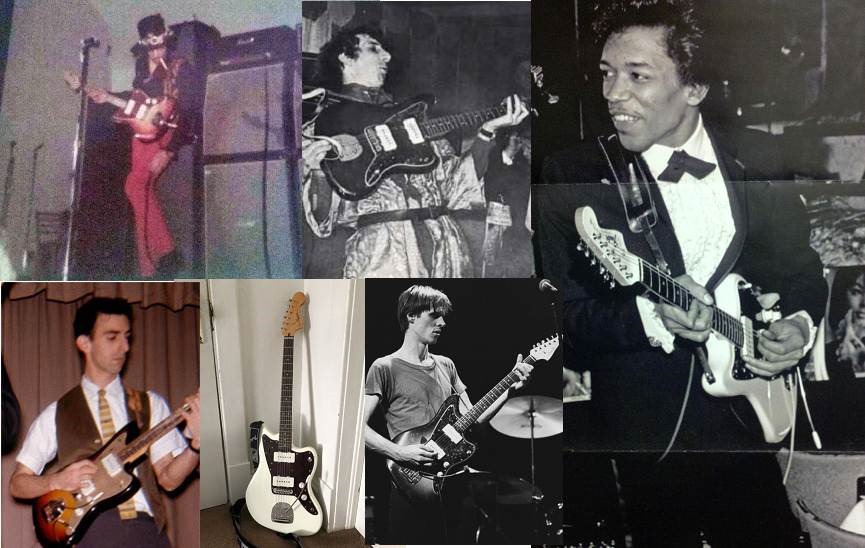
Jazzmasters! From the upper left: Jimi Hendrix without a Strat; Pete Townsend about to decrease the supply of used guitars; some guy named Jimmy James (wonder what became of him?); Frank Zappa, who didn’t say “The Jazzmaster isn’t dead, it just smells funny;” my Jazzmaster painted the homeopathic color Sonic Blue; Tom Verlaine, vanguard of the alternative nation which latched onto the bargain unwanted Jazzmaster in the 1970s.
.
A few notes on the music. I sometimes create the drum tracks for my compositions before the live session begins. And since I’m usually needed in the guitarist role, I sometimes lay down the bass parts with those tracks ahead of time too. That’s how this piece was. On the day of the session, I sang and played the wailing lead guitar*** and recorded the reading of Kevin’s words live with Dave playing a baaing/buzzing synth part live. Dave’s part, subject to his current hands, didn’t fulfill all the groove chop I thought the piece needed. So I added a second guitar part doing my best at rhythm guitar on my Telecaster, but a lot of the final groove you hear is an electric piano part that I laid down trying to imitate my friend and partner Dave’s playing as I recall it from the past.
By now I hope you’re ready to hear the musical story of Kevin FitzPatrick’s farm poem “Coyotes.” The player gadget is below for many of you. Don’t see that? This highlighted link is provided as an alternative so you can hear it that way too.
.
*I have to repeat this one, which I read in a comment thread this month regarding the upcoming Hollywood Oscar awards event: “The only Oscars I care about are Peterson and Wilde.” In the context of Dave Moore, even the young Dave wasn’t likely to stand toe to toe (finger to finger?) with Oscar Peterson on piano. On the other hand, I’ll hop on top of Oscar Wilde’s tea table in my slush-muddy Minnesota shoes and declare Dave’s poetic wit with Wilde’s.
**Other reoccurring characters weave in and out in the farm poems too — and while four-legged, the couple’s farm dog, the incongruous poodle named Katie, makes a cameo appearance in this one and others.
***The lead guitar part is played on a Jazzmaster, a famous failure in Fender’s otherwise wildly successful line of mid-century electric guitars. A couple of decades into its Edsel-hood of “what were they thinking” failure, unwanted used Jazzmasters became an affordable choice pragmatically chosen by some punk and alternative musicians. Even so, few think of a Jazzmaster for this kind of wailing lead guitar with a bit of funk flavor. As long as one is able to address the Jazzmaster’s bridge design issues, it can do that sort of thing.
In discussing last May how much fun it is to perform Bob Dylan songs I mentioned that when Dave Moore and I get together to play we often throw in a Bob Dylan song along with our own music. Last month* we finally got together after a long break due to Covid-19 and other infirmities, and as per that tradition the next to last song we played was a Dylan number.
Dave has been extraordinarily prolific with songs over the past few years, so it’s most often I who bring the Dylan to the table. Hipster-wannabe that I am, I often like to cast a wide net for the less-covered or celebrated Dylan songs. This time it was “Went to See the Gypsy” off of Dylan’s little-remembered New Morning LP of 1970.
At the time it came out New Morning seemed important, as Dylan had stumbled badly with his previous record Self-Portrait. Self-Portrait seemed to many a lackadaisical record about being lackadaisical, and those many weren’t having that in the turbulent and searching summer of 1970. Think about this: that LP was released almost exactly a month after nine college students were shot and four died on a Midwest college campus. Of those four dead, two were protesting what seemed a widening war in Southeast Asia and two were somewhat distant onlookers between classes. A few days later two more students were killed at Jackson State in the South. The average youthful Dylan fan was less likely to be interested in tunes about all the tired horses in the sun at that moment.
So, less than six months later this other Dylan album, New Morning, came out. In retrospect it wasn’t really a return of the fiery prophet of Sixties Dylan, but a lot of rock critics had made their bones considering that earlier Dylan style and made the best of what they had in it. One song, and one song only, could be parsed as if it was in that style “Day of the Locusts,” a protest tune about getting an (honorary) degree from an Ivy League university while that year’s crop of “17 Year Cicadas” chirped their Dada chorus. Maybe some college students dug that one.
With the passage of time, New Morning’s necessity to rehabilitate the great songwriter’s reputation has lost its utility. Dylan has had at least two greater “return to greatness” moments since then, easily supplanting the importance of New Morning. And of course the measure of the artist over such a long and important career makes bumps in the road disappear in the trailing dust. Though little thought of now, New Morning is what it may have been intended to be, a much better record of relaxing with the mundane and interrogating it.
“Went to See the Gypsy” is about nothing happening, a topic that many of the fraught students of 1970 would eventually need to come to grips with, and maybe it fits this second summer of Covid-19 too. The singer goes to meet the undefined titular “gypsy,” who maybe only figuratively that (the word derives from a now considered pejorative term for the Romany ethnic group). I think that character title is used to convey someone exotic and transitory. There may also be a suggestion that the gypsy could be a fortune teller, as many songs that Dylan would have known would have made explicit. The meeting is a big nothing. The two have a nighttime greeting in a hotel room (transitory housing), and then the singer has to go to the hotel’s lobby to make a call. Modern people, sit down in a circle around the fire, and let the old ones speak of this: in those days you couldn’t text anyone if you were running late or you had to get some info or agreement, you were required to go to a place where there where iron-clad telephones chained to a wall that took coins to accomplish that.
In the lobby an attractive girl (“dancing,” intimation of transient movement) begins to do a hype man spiel about the gypsy. How much time passes? We don’t know. Does the singer try to make time with the girl or vice-versa? The song doesn’t say. It only says that dawn is approaching (often the signal to end a song or poem) and the singer returns to the gypsy’s door, which is open and the “gypsy is gone.” The door being open is a telling detail, as it indicates that this wasn’t some planned leaving. The gypsy rushed out or was rushed out by someone. The singer returns to the lobby, the dancing girl is gone. Was she part of some planned distraction? We don’t know. The song ends with the singer instead “watching that sun come rising from that little Minnesota town.”
Now this song all could have happened in a little Minnesota town. One thing that many non-Minnesotans think about Dylan’s home in the Iron Range was that it must’ve been some ethnic Northern European monoculture, which it wasn’t in the least. Personally, I’ve always thought this final scene is a poetic jump cut, and that Dylan’s final sunrise is times and miles away from the events before in the song, but that’s just me.
In summary, a song about things just happening that keep things from happening. Your fortune won’t get told, nor will the mysterious guru tell you what to do, you won’t get to go through the mirror, and a pretty girl may have her own agenda.
Here’s today cover version of Bob Dylan’s “Went to See the Gypsy” Alas, there’s a couple of typos in the captions that flash by. I blame working too late.
.
Musically this is me on electric guitar with Dave playing some soft reed organ sounds at first. After those tracks were laid down live, I decided it’d been too long since I had done a full orchestral arrangement, and so after the fact I did just that and had the orchestra instruments come in partway in the song to represent the potential big something that hovers out of reach over this non-event story. I know dawns in little Midwestern towns, far from the chance of Las Vegas, gurus, or those who can tell one’s fortune. There you make your songs and self, yourself.
I should be back shortly with the song we did right after this one, a Dave Moore original.
Just last month I was writing here about how alternate Parlando voice Dave Moore and I used to perform pieces live and unrehearsed. Infirmities, personal matters, and a little thing called the Covid-19 epidemic meant we haven’t been able to do that for 18 months — but today we did that again.
Rusty? Yes. We’ve always been rough and ready, which means we persevered today because we love our common attempts at spontaneous performance, even though your ears will be spared most of them. Personally, I’m overjoyed to hear Dave’s keyboards mixing in with my guitars again. Perfect or imperfect is another, subsidiary, matter.
Here’s the very first piece we performed today, using for a text one of the sonnets I’ve written this year about infirmities. My sonnet, “Until Memory is Only Forgotten,” tells about an older woman with Alzheimer’s disease which has removed, and is removing, many of the layers of her memory, and who is traveling from the Memory Care Unit where she is presently living to visit siblings back in the farming community where she grew up.
Pictures of the Gone World. The young woman who raised blue ribbon dairy cows.
.
Long time readers here will know this Project normally features us presenting and performing texts by other authors, but since summer tends to bring in a smaller audience, I may be using more of our own texts when I can find time to present work here this season.
I chose to tell this woman’s story without following a time-line, because as with memory (even a degraded one) the scenes aren’t linear. Dave and I repeat some motifs in our playing, just as the subject of the poem sees different crops in the fields and can only see corn and speak again to her daughter-driver of that crop; yet in unmarred memory she recalls her Jersey dairy cows like the other Memory Care Unit resident who can still tout his Holsteins. Structurally this is a free-verse sonnet, though I think the old patterns of iambic pentameter remain rustling distantly in the fields.
Here’s the sonnet used as the text for today’s audio piece.
.
The player gadget to hear The LYL Band performance of “Until Memory is Only Forgotten” will appear below for some of you. If you don’t see it, you haven’t forgotten, you’re just reading this in a mode or reader that won’t show such things. That’s OK, this highlighted hyperlink will also play the performance.





 Frank Hudson