Here’s the final piece of this two-parter, and the place where I take off that hair shirt for a while and present a review of John Darnielle’s new book This Year, 365 Songs Annotated.
I largely owe my appreciation of singer-songwriter John Darnielle to my daughter, who found solace in his earlier recordings as she moved through adolescence. One 2005 song, the one that gives its title to a new book by Darnielle, features a 17-year-old speaker refraining: “I am gonna make it through this year if it kills me.” It resonated more than a decade later with another 17-year-old. What a good thing for a song to do.
I knew Darnielle’s work from a couple of songs recorded under his long-running project name “The Mountain Goats,” most notably the mysterious anthem “Jaipur.” My daughter gifted me his All Hail West Texas album one Bandcamp Friday a year or so ago. My immediate thoughts on Darnielle were that he was a good song lyricist. Like the late poet-associate of mine Kevin Fitzpatrick, his work is full of “other people,” and those people are often working class or lost-soul types who make themselves known as if in overheard declarations in his songs. Writing in Boomer classic-rock consumer-guide style “he’s like…” comparisons are misleading in Darnielle’s case. Saying he’s lyrically a mix of Randy Newman, Bruce Springsteen, Ray Davies, and John Prine is a bad assay, because he’s like all of them at once or in sequence, and he is his own man too. Still, the range of characters is an important strength. A lot of poetry, and a lot of indie songwriting too, is a singular solipsistic narrative, and Darnielle’s of the songwriting school that avoids this.
More than a collection of song lyrics (though they’re good lyrics)
.
Yet, This Year is largely the story inside one person, a memoir in a different form: a book of days where he writes somewhat sequentially, but not by strict intent or always, about how 365 songs came about, what he thinks he was trying to express, and what his life was like as he wrote and recorded them. The entries can be quite short, a couple of hundred words typically, though a few extend for a few pages. The lyrics to each day’s song are included with each entry, which is helpful for any reader who’s not familiar with his work. I’m half-way through reading it straight through, but the book can also be read an entry at a time, as sort of daily thought-starter. I’m somewhere between a hardcore fan and someone that doesn’t know any of Darnielle’s work, and I’ve sought out some of the songs after reading of them in the book.
Things I’ve learned? It was not apparent to me beforehand, but he’s a poet who converted to songwriting, and many of his early songs had preexisted as page poems that he wasn’t planning to sing. Reading his lyrics silent on the page in this book demonstrates a literary poet’s craft in his writing, but my finding this out in memoir is a testimony to their lack of crusty poetese. Poets as well as songwriters would benefit from exposing themselves to Darnielle’s lyrical tactics, and he talks effectively about them in this book. I also learned that he spent formative years in his songwriting’s development living in a small town in Iowa, the kind of place I grew up in, in roughly the same part of the state, though I’m more than a generation older than him.
Another part of his story, which unreels through the day entries each devoted to a single song from his now large catalog of original songs, is that he began recording and making these songs public using meager equipment. He so far mentions almost nothing about the particulars of his instruments which are likely unremarkable and inexpensive, and a considerable part of his early career recordings – including the original versions of some of his best-loved songs – were recorded on a boom-box cassette tape machine at home. I resonated with that, having spent around 20 years using such cassette tape along with low-budget equipment. A late 20th century indie-music and fanzine samizdat network allowed Darnielle a slow-burn career doing that, around the time that my own nerve to share my work had faded. He recounts in the book, that royalties from the tapes sometimes paid part of the $170 a month rent,* but he had a day job in a lower-paid nursing field, again something I rhymed with in my cassette years.
The short entries in the book also tell a story of Darnielle’s religious journey, which began as a Catholic youth and has had elements of return, though I’m midjourney on that arc so far in the book.
These similarities paradoxically bring up the personal gap which makes reading his book so meaningful to me now. From what I’ve read so far, Darnielle apparently retained confidence in his own work through these long-beginnings, low-rent, lo-fi years, and even if there are dark nights of the soul in coming parts of his book, he displays that now as he discusses the work in retrospect. I had, and still have, substantial gaps in being able to carry that in public during my cassette years. Having days of private levels of self-confidence in some of my musical work is not an effective dose to properly present it to others, and my doing so “blind” without that confidence led me to some painful comedy of misreadings of likely interest. Those two things (managing self-doubt, being able to present one’s work effectively to others) interact. Darnielle may have been more personally engaging, or just more persistent in his networking. Elements of luck might have been significant (with me, they were in my “day job.”) Thinking of this difference as I read Darnielle’s book, it’s (too) easy for me to think, “Well, it must have been easier for him, his work was so darn good.” He’s a better vocalist and performer than I am (no-biggie, almost everybody is), and though I’m not sure how far apart we are in “on a good day” guitarist skills, his song lyrics are teaching me new tactics even after decades of my doing this on the page and with guitar.
In the first part of this pair of posts I sincerely worried about my work and hubris when I put it up against the skillset and history of Jazz. Despite those differences in how we’ve used our parable of the talents, I find reading Darnielle’s book heartening so far. You don’t have to be a songwriter, if you are any kind of writer – and likely if you are an artist of any kind – spending time with this book may be helpful.
Here’s an early song of mine, recorded on primitive equipment before the nearing 900 songs of the Parlando Project had started counting off, but consistent with its principles, a setting of John Keats’ “In the Drear Nighted December.” Audio player gadget should be below, but if not, this highlighted link will open a new tab with its own audio player.
.
*For any younger folks reading this, the $170 a month rent (for a house!) must seem a dormouse fantasy. For younger musicians, the idea that royalties from indie recordings might contribute in any substantial way to making rent must seem equally fantastic.
The experience of the fourth performance in this July series was unlike the previous three. Those reading along may recall that each of the first three I’ve written about this month left me with its own distinct feeling of disconnect, of ways that I had not been able to reach an audience. I could’ve taken the performer’s side in this failure to connect — there is a long and necessary tradition of confounding audience expectations after all — but emotionally I couldn’t live with that unreservedly. Given that the core of the LYL Band was a band of poets not reliable professional musicians, and those poets were reflexive non-conformists singing songs that held up to examination or ridicule civic and cultural matters, I should have expected that outcome.* Intellectually, I understood this, but emotionally, it bothered me, particularly after the U of M concert I wrote of last time.
Society picks a few non-conformists, perhaps ones bound with redeeming qualities or compelling evolutionary necessities, and is fine dispensing with the rest.** If it didn’t do this mostly, well, the non-conformists wouldn’t be non-conformists would they? The LYL Band in this metaphor is the platypus.
But as I said, today’s performance is different. Somewhere in the mid-1980s a couple of nurses at the hospital I worked at had an idea: they wanted to put on a Prom to remediate memories of less-than-accepting Proms from their high-school years. What a great idea! They set a date and went about decorating a house’s basement with festooned crepe paper and colored light bulbs, plastic flowers, and some cardboard gilding, just as small school gyms had been transformed in teenage midcentury America. One of the nurses knew I had a band, would we be the rockin’ dance combo for this event?*** Sure, we’d do it — if we could find a drummer.
If nothing else, the perceived (by me) failure of the U of M concert from last time cemented in my mind that playing electric instruments without a backbeat couldn’t sustain the illusion that we were a Rock band. Someone knew a drummer. He agreed. We rehearsed with him a single time, and Dave and I selected from our repertoire songs that might be fit for dancers.
When the night of the Alternative Prom arrived, we set up in the house’s basement. We had no PA as such for vocals at this time, so I used a small Radio Shack mixer connected to my home stereo for the vocals, with no provision for monitors. I even set up one mic for any members of the audience that wanted to sing backing vocals.
The Prom attendees arrived. Some had scrounged old formal wear from second-hand stores, and even accessorized with corsages, while others were in come-as-you-are casual dress. Some came with their we’ve-achieved-adulthood-now partners, others just themselves. Given the nurse-origin of the event, women were in the majority. How many in the audience? Again, memory can’t count, but the basement was soon quite full, just enough room to dance, maybe 30-35 people? I really can’t be sure. I think there was some food and drink, but I don’t recall the particulars as my mind was keyed up for the performance.
Our little trio began to play about 10 p.m., myself with my electric guitar, Dave with his Farfisa combo organ with grey bass-register left-hand keys, and our for-the-night-drummer at his kit.
Dancing broke out, and continued through our roughly 60 minute set which concluded with a cover of Wilson Pickett’s garage-rock classic “In the Midnight Hour.” I don’t know what experiences any of my readers who play instruments have had, but let me say that if you ever get a chance to play for a dancing audience, I highly recommend it. I believe that music (and to a degree, its sibling art poetry too) are meant to move bodies. While I have never been a very good “rhythm guitarist,” here in a trio I had to fill that space however shambolically I could. It helped that the drummer was good, and fully-invested in “more cowbell,” and Dave’s left hand on the organ grey keys filled in well for no bass player.
I’d considered what should be our encore if the performance worked, and my idea was to lean on my still patent Patti-Smith-inspired vocal improvisation skills. The planned framework would be the ultimate chestnut of its era “Louie Louie,” a three-chord song that I would connect with whatever songs came into my head by converting them to fit “Louie Louie’s” three-chord-trick cadence.
Dave started the encore, his voice hoarse from singing without the benefit of vocal monitors that night. “Louie Louie” soon slid into Dave’s song “Sugar Rush.” As the guitar breaks and audience sing-alongs carried us forward toward midnight, I merged in other songs: “Like a Rolling Stone.” “La Bomba.” “The Star-Spangled Banner.” “Fortunate Son,” and finally, tiny snippets of the Velvet Underground’s “Pale Blue Eyes” and “Sweet Jane.”
The performance was over. Art is hard to measure, harder yet when it’s rough-edged, imperfect, and improbable; but it may have been the single best LYL Band performance, despite (or because) of its unconcern for sophistication. The recording is crude too, and the vocals suffer from the lack of monitors and strained voices. The funk of the sweaty basement, the joy of the dancers remediating their teen-age years, the surrounds of dance steps and emotions: none-of-than can make it directly onto audio tape. But Rock’n’Roll isn’t a juried competition. On any one night, with any one audience, it’s a shared mood of ecstatic feelings, and no level of skill and fidelity sans those feelings can’t maintain it.
I can’t find any pictures from the Alternative Prom, but for visuals I put in a bunch of LYL ‘80s posters and pictures from other gigs, including the U of M concert I wrote about last time. One level of our non-conformity: we tried and succeeded in not dressing for the part of a punk band.
.
*If only in a footnote, I feel a need to note the death of Tom Lehrer this week. He really made an impression on me, and Lehrer’s presentation was, like the early LYL band, centered on the idea of gleefully rubbishing many cultural standards and pieties. I even tried to work in a punked-up version of his “We’ll All Go Together When We Go,” as our answer to “99 Luftballons.”.
If the Fugs, that other band of poets, were arguably the first punk rock group, I suspect any acerbic singer-songwriter from my generation had listened to Lehrer’s LPs. Here’s one odd thing I noted in the reaction to his death, and the inevitable short pieces on his career: I have yet to see a conservative weigh in with their view. No tut-tutting from the religious cultural nationalists on Lehrer’s satire tearing down the church and militaristic state. No remarks on his musical asides to sexual laissez faire oppressing or not-oppressing in the proper ways. No public-health consequences drawn from his 1953 ode to “The Old Dope Peddler” recorded when Lou Reed hadn’t turned 12 years old. Somewhere there may have been some “he’d be cancelled today” edge-lord free-to-be-fascist Lehrer elegy, but the respectable conservatives are leaving the field to the crickets. My theory: there’s an audience result that isn’t “enemy list” notoriety, but is more at “never heard of him” where Lehrer resided for 75 years or so.
**Frank Zappa, who understood a scientist’s cool examination of such things, had this quote: “Without deviation from the norm, progress is not possible.”
***Let me do a capsule American Rock history lesson here. During the 1960s and into the early ‘70s the nation was full of small musical combos made up of young semi-professional musicians. They had different models: some wanted to be the Ventures, or Booker T and the MGs, others The Beatles, or Animals, The Young Rascals, The Rolling Stones, Paul Revere and the Raiders, Mitch Ryder and the Detroit Wheels, or the Yardbirds. By later in this era many of these combos took on psychedelic trappings and had converted to ballroom and movie-house stage ambitions, but for a few years before, these “garage rock” band’s gigs would be bars, under-21 not-bars or teen-clubs, and youthful social functions such as high-school dances and proms.
One of the things about writing this series surrounding a scrapbook connected with a 1930-‘50s Afro-American Jazz combo is to observe the risk of writing here as an old white guy in the 21st century about a bunch of young Black Chicago musicians and what I might suppose about their lives. The Cats and the Fiddle in the scrapbook took their shot in the world of art and entertainment, but they’re not famous guys. They lived their lives, as I’ve lived mine, as you likely will live yours, with few persisting details or indelible marks. Perhaps I’m overly fixated with looking for those marks.
In today’s piece I’m going to look at the house where that scrapbook was found. It still exists: 3132 Park Ave South in Minneapolis. I’ve looked to see what I could find out about that inanimate place and the people who passed through it. I hoped any details might help me figure out who collated and left that scrapbook. I found what preceded the scrapbook’s discovery sustained my interest.
Back in the first part of the series I recounted that I lived there briefly in 1976 while helping a friend whose words, voice, and keyboard playing has appeared here over the years, Dave Moore. Dave and his then wife had purchased the somewhat rundown house at an attractive price for their planned little family and their small business. I helped a bit with their work in fixing it up and getting the business going.
The house had character, and this young couple, my friends, hoped to honor part of it by making it look a little more like it did in the house’s youthful years at the beginning of the century, looking for clues in old style books and in the “bones” of the house. Similarly, today’s post is going to start as far back as I can find information.
As Minneapolis started to grow as an upper-Midwest business hub, Park Avenue was a broad, tree-lined boulevard that ran north-south through the middle of the city from the southern neighborhoods to the rail depot and centers of government, business, and milling which were fast being established in Minneapolis’ downtown. Park Avenue became a prime site for the commerce titans to build their mansions. In the mid-70s you could still sort of squint and image that era: the trees were still there, elder elm branches arched much of the way over the wide street, and a handful of the mansions still remained.*
3132 was not one of the mansions. In 1902 it was built by an A. E. Rydlum (or Rydlun) who was a builder, and it was complete and offered for sale in the Spring of 1903 by Thorpe Brothers, who were an active real estate sales firm in this era of rapid growth and building of new housing in Minneapolis. Here’s how Thorpe listed it:
For Sale-Modern house, ten rooms, hardwood finish throughout; full basement, nickel open plumbing, hot water heating plant, sideboard, china closet, mantels, bookcase. Location 3132 Park Av; easy terms; will be sold soon.”
The next notice of the house I found was a birth announcement later that year. A Mr. and Mrs A. J. MacDougall were listed as living there in that announcement. Next year, 1903, they place an ad seeking “a nurse girl, 12 to 15 years old” for service at 3132. In 1904 they place another, similar, ad: “A nurse girl from 14 to 16 years old for 3-year-old boy.”
When I was working on the house, an attic servant’s quarters and separate stairway were part of the house. There was still a bell in the pantry off the kitchen that had a ringer button on the floor of the dining room. How many servants eventually lived there? How long did a 12 or 14 year old childcare worker likely stay an employee? The McDougall child had a theater birthday party at the downtown Orpheum Theater in 1908. The original Minneapolis Orpheum was a 1500 seat, ornate vaudeville house that had been built in 1904.
A recent Streetview picture of 3132 Park Ave S, servants quarters behind the three dormered windows at top.
.
I pictured a somewhat prosperous young family, that kind that the house seemed to be built for in this location. So, I thought Mr. MacDougall, the first owner of a fine large house with its attic servant’s quarters, was perhaps a middle-manager, a businessman, or the like. Then earlier this year I began to look at the city directories that are available from the Minnesota Historical Society. It might be helpful to my generation to say that these Directories were like the phone books of their time, a combination Yellow and White Pages of a city’s residents, businesses, and organizations — but younger readers will find that obsolete image useless. So let me reset: they were large books issued yearly, or near so, listing alphabetically by name the head of each household in a city, followed sometimes by the name of their spouse, sometimes by the name of their company or employer, and almost always by a general classification of their job.
No one is just their job, but as a shortcut to figuring out, however roughly, where someone and their family was in the class structure, city directories are a data source for everyday people in the past. Here’s what a series of annual Minneapolis city directories say about our MacDougall (whose first name was Allan or Allen — the first spelling used in earlier entries, and then the other):
1903 not in the directory. Likely the directory’s data predates his moving into 3132 Park
1904 he’s listed as “miller” living at our 3132 Park Ave. house
1905 his occupation is “lab,” short for laborer, living at 3132
1906 the “lab” adds that he works at “Washburn C” — Washburn Crosby was a large milling firm in Minneapolis that is now the corporation General Mills
1907 laborer again, no mention of what company, still living at 3132 Park
1908 job now changed to “foreman,” continues living at 3132 Park
1909 looks like he, still a foreman, (and likely his family, though none of these listings mentions his wife) now live at 3436 Columbus Ave, about three blocks away
This scant info tells me little and makes me wonder. Does a miller or an ordinary laborer afford this large new house — much less, live-in help, and theater birthday parties for his kid? Does the later classification as foreman tell us he wasn’t just a line worker? Was there a blip in the market that caused Thorpe to sell under normal market prices, or would they possibly rent an unsold house? Mortgage terms were shorter then, but moving a young family from a fine house in a great location after only 5 years could mean it turned out to be only aspirationally affordable to MacDougall.
The next residents appear in 1910 from the records I’ve found. A Mr. and Mrs. Peter W. Campbell — leaving a gap, 1909 is unaccounted for. The 1910 city directory lists him living at 3132 Park, and his daughter Elizabeth is married at the home that year. The newspaper account lists 25 guests at the wedding. The house I later knew had a big dining room and parlor joinable by opening a large set of pocket doors. I imagined that many guests, the bride and groom, the officiant. It’d be a cozy affair, but they’d probably all fit.
Peter Campbell is confirmed to be living at 3132 Park in the 1910 directory, but there’s no Peter Campbell in the 1911 Minneapolis directory at all, and he’s a boarder elsewhere in the city in 1912. These listings don’t list his job. This short-term occupancy for someone that doesn’t seem clearly homeowner class testifies against his ownership.
In 1910, during the same summer as the Campbell wedding, 3132 Park is listed for sale again: “”Elegant 8 room all modern home, fine lot, reduced price $6,250.” The house isn’t yet a decade old. It’s a fine upper middle class home in a desirable location in a growing city, and in this time servants-wanted ads were placed, and then placed again, curious residents arrive and leave. If this was a Stephen King novel, I could see the haunted story potential, but I don’t really know the story, just these little points.
I can’t say when the house sold but by 1913 we have yet another servants wanted ad, “girl for general housework.” This ad is likely announcing the family that would be the home’s longest occupants, The McLeods: husband John, wife Elizabeth. I note there have been three Scottish names in the house’s history: MacDougall, Campbell, McLeod. John McLeod was certainly Scottish, born on the Island of Lewis, a very northwestern part of the Outer Hebrides. McLeod was said to have built several grain elevators in North Dakota, but his job now in Minneapolis’ downtown was as an “independent grain trader.”** The McLeod’s were a middle-aged couple when they lived there, and Mrs. McLeod was an active clubwoman, holding regular meetings for the Columbian Club and her Presbyterian church at 3132. In 1921 the Columbian Club agenda was a talk on “Greece, the Reign of Pericles, the Glory of Phidias.” Rather than thinking of cursed winds crying “Heathcliff” around 3132 Park, the next 21 years record the kind of stable middle-class life the house’s builders might have expected.
In 1934 Mrs. McLeod dies. Then five years later, in April 1939. this headline appears in the local paper “Trader Collapses at Grain Exchange.” John McLeod was 77, still apparently working as a grain trader. He died the next day in an oxygen tent at the Swedish Hospital in South Minneapolis.
This more-or-less ends the upper middle-class phase of the fine house on 3132 Park. In May 1941 it’s listed for sale as a “very livable home” and “interior in excellent condition….must be sold to close an estate.” I think of all the hardwood trim, doors, built-ins — much of which Dave and I were chemically stripping of layers of paint in 1976. It was likely still pristine then, and still echoing with talk of Phidias and perhaps John McLeod’s mumbles about the Non-Partisan League’s pressures on his trading margins.
Two years past McLeod’s death to settle an estate? You got me on that, but there are indications that the Great Depression isn’t the best time to be selling a big house. The house is listed again in August and September of ’41, this time in the for rental ads. Rent? $50.
Yet in 1942 someone else is having social club meetings at 3132 Park: a Mrs. Jewell Bliss is holding a meeting there for the Juline Burr Tent, DUV to be followed by a social hour and cards. DUV is probably Daughters of Union Veterans and Mrs. Juline Gales Burr (who died in 1906) was a Minneapolis resident and the first state president of the Minnesota Grand Army of the Republic (another Union Civil War veterans organization). Also that year a luncheon for “past president of D. of H.” hosted by Jewell again. D of H is likely “Degree of Honor” a Catholic female fraternal benefit society.
Yet the house on 3132 remains in a murky state in 1942 as I look for mentions. I’ve found records for Jewell Bliss, who was married to a Norland (who went by Noel) Eldred Bliss. Since city directories are alphabetical by head of household (often husband) I looked for Noel Bliss. Throughout the entire US WWII years he lived on Penn Ave North, not Park Ave, and Jewell is listed as his wife, same address in 1942, ’44, and ’45 in the city directory. Noel’s occupation is listed as “beverages” and his business address seems to be 2501 Marshall in Minneapolis.*** Bliss was in the news in 1936 for being a liquor dealer indicted for perjury in Minneapolis. He pled not guilty — but alas, I have no more information on this case.
Noel Bliss: liquor dealer three years after the end of Prohibition, but facing charges.
.
But the situation at 3132 Park remains unclear. Jewell is holding meetings there, though she apparently doesn’t live there. In post-WWII years larger houses on Park Ave were used for offices of various organizations. Was 3132 Park being used at least temporarily in this way, or was Jewell an organizer using someone else’s home or apartment? Again, I think of the home’s two large main rooms, a good place to hold your social gathering.
1943, a short newspaper story about one of our house’s residents links to some fascinating details. A 14-year-old boy named Bruce Dybvig who lives at 3132 Park Ave stumbles on the shores of one of Minneapolis’ urban chain of lakes. He breaks his foot falling into Lake Nakomis where his injury inhibits his ability to swim. OK. I’m not trying to stress a 3132 Park Ave curse theme — and look, the newspaper story I found says a boy lifeguard, only 16 himself in these wartime years of military mobilization, pulls Dybvig out of the lake. Bruce is treated and released from a hospital, and surviving he soon goes on to become another teenage Jazz musician with a story comparable to our Cats and the Fiddle main thread this February.
A year after his accident, Dybvig takes up alto sax, and by 1946 he’s organizing Minneapolis high school students into a 16-piece Jazz orchestra to play the “books” of the hippest white Jazz big bands of that year: Stan Kenton and Woody Herman. What happens to Bruce and those kids? If I haven’t exhausted you with this thread about a house, you may be the kind to enjoy the Jazz-in-Minnesota side-trip to be found at this link.
Boy saved from drowning, the teenager then starts playing modern Big Band Jazz. Bruce Dybvig at the left of each picture. What’s with the Carnegie Hall sign behind him? I’ll tell you again, you might want to read that above link.
.
By 1953 the Park Avenue house is on the market listed again as “Lge. Inc. home, full basmt, gas heat, partly furnished, in excel repair, Ideal for rest home.” Two elderly men with different last names died in 1950 with 3132 Park as their address. This indicated to me that sometime in the early Fifties it may have become a “rest home,” a midcentury type nursing home/elder care facility.
In 1956 another for sale listing: “3132 Park Av S. See this lg, well kept home, 8 BRs, 2 1/2 baths, completely furnished for income, has gas HW heat, nice yard & gar.” It appears that sometime in the mid-50s the house’s rooms were subdivided or areas in attic and possibly the basement became living areas. In the mid ‘70s Dave was told the place had been a Black-owned rooming house.
In 1963 a teenager, Roosevelt Gains, likely a son living with his mother, a hotel maid, at 3132 Park, gets convicted of robbery.
In 1973 I found one more appearance of a 3132 Park resident in the newspapers, Bill Wilson, a house painter doing a little frozen lake winter fishing. In Minnesota this sometimes involves big trucks and semi-elaborate shacks pulled out on sledge runners, but Wilson is equipped with just regional hardiness and a hand-auger. Dave Moore, and then I, will be arriving soon to the Park Avenue house. The scrapbook that’s the idée fixe of this series will be uncovered there. Did 3132 Park Ave have a curse, or is the nature of the place simply the nature of the struggles and reprieves of life? I will be returning to the Black History focus of this series next, but leaving today’s stories of inconclusive fates and historical lacunae of largely white residents who lived at 3132 Park Ave, I’ll summarize. I don’t know even the names of everyone who lived in that house: those teenage servants advertised for (likely newly arrived European immigrants), other old people who may have lived in a midcentury rest home, the transient renters. I’ll leave you tonight as I go to sleep, saying these clippings of life collected here, outside the scrapbook that started things off, are exhibits of working class people in my South Minneapolis — Black, white, Asian, Latin and Native American — saying that our histories have commonalities of dreams (and yes, blunted dreams) passing under all our shades of eyelids, closed in our place across time.
Bill Wilson, one of the last tenants at 3132 Park Ave S. in its rooming house days.
.
If you want a short poem performed with original music after these decades, here’s the young Langston Hughes preparing to close his dark lids amidst his neighborhood in the last decade called the Twenties. Backup link in case you can’t see the audio player the rest of you will see below.
.
*Rather shortly after I arrived, nearly all of the remaining mansions were torn down, as they had no clear commercial or residential usage by then. We’ll discuss South Minneapolis in the later 20th century later in this series, but in 1976 as it is now, this Park Ave area is a series of varied working class to under and unemployed ethnic mix neighborhoods. Over in the other twin city in the 1960s and ‘70s, St. Paul’s similar Summit Ave, was preserving their grand pre-WWI houses which became once again homes to upper middle-class owners.
A surviving Park Avenue mansion is now the Swedish Institute. It was built by a Swedish immigrant businessman in 1908. It’s five blocks from where 3132 went up a few years earlier.
As to the tree canopy, most of the old trees were elms, and Dutch Elm disease wiped most of them out after I arrived. The city’s urban foresters have tried to replant, but it’s trees, and old trees take time.
**Noting McLeod’s North Dakota and Minneapolis connections, I think of the history of the successful organization of the Non-Partisan League in the Dakotas. Farmers there rankled at the low prices they got for their crops, and high markup profits by traders and middlemen who owned the grain elevators, the railroads, and the grain processing mills. Those latter folks often worked out of Minneapolis, but the eventual NPL elected governing majorities in state government, built their own elevators, and pressed with more leverage and bargaining power to improve the farmer’s lot.
***As late as 2022 Bliss’ old business address was the location of Betty Danger’s Country Club, a hip and eccentric restaurant. The owner listed it for sale that year, citing the reason for the sale in this report: her mental health. However many levels this is removed from 3132 Park, it’s another reason for Stephen King to contact me about that gothic novel.
In the past few years I’ve enjoyed focusing here on Afro-American poets during the month of February. Last year, I dug in and did a bit more research on an understudied but fascinating Chicago poet Fenton Johnson, whose published work sits between the emergence and premature death of Paul Lawrence Dunbar and the Harlem Renaissance. Johnson became easily identifiable as a Modernist before his access to extant publications dried up in the 1920s, and I suggested last year that his poetry allows us to see —albeit silently on a page until I did some musical settings — into the formative years of Afro-American Gospel and Blues music before it made it onto recordings.
Here’s something I formulated for myself early in this Project as I found myself often looking at the rise of Modernism in the 20th century: a part of why Americans became highly significant innovators in Modernism has to do with Afro-Americans. Literary-only scholars might not focus on this inside their silo, but at the same time Pound, Eliot, Frost, Moore, Stevens, Millay, Williams, H.D., Sandburg, et al were reforming poetry, Afro-Americans were spearheading a revamped approach to music. Black poets like Johnson and Langston Hughes were hip to how those two things should be viewed together from the start, and after all, Modernism took root during the last decade called The Twenties under the banner of “The Jazz Age.”
That 2024 series on Fenton Johnson let me further express the musical part of the Parlando Project: “Where Music and Words Meet” — and it should also be obvious by now to regular readers that history is one of my interests. So, this February, like the Fenton Johnson series of last year, I’m going to get into the deep weeds a bit this on some lesser-known stuff.
I’m unable to schedule the Parlando Project work in a fully professional manner, so it’s likely you, if you follow along this month, will be going on a journey with me as I look into elements in real time. I may be revising myself before the finish, and if that gets awkward, let me say at the start that this isn’t some plotted-out documentary, I don’t know what all I’ll find. It’s likely going to be very first-drafty, so put on your reading sweater.
If this was an audio presentation, at this point there’d be one of those audio fades with reverb to suggest a passage of time now. From out of the echo my voice will be saying: “It all started in 1976 when I moved to Minnesota from New York…”
I was looking for a new start. It wasn’t entirely clear if I was going to continue intermittent attendance at college, which was both logistically and financially limited to me at the time. One advantage I had: doing nursing work in an Emergency Department was an easily transferable skill, I could go most anywhere that had a hospital, and maybe it would be good if where I moved also had a college. I settled on Minneapolis because I knew a couple living there from my Iowa college experience in The Sixties. One of that couple, Dave Moore has remained a friend (and contributor to the Parlando Project). Dave and his then wife had plotted out a plan for themselves. They were going to run a small mail-order used book business and needed a place to collect stock, store it, and run that business. They purchased (for an attractive low price) a large old house on Park Avenue in Minneapolis. Park Avenue was, in the last Gilded Age, a place where newly rich Minneapolitans built their mansions along a wide tree-lined street leading into the business center downtown. Now in 1976, this couple I knew were going in big on the sweat equity thing, rehabbing that house. The place, 3132 Park Avenue South, was built as a sort of a Junior-Grade Mansion. The 3rd floor, where the original owners had servant’s quarters would hold their stock of books which Dave was obtaining from aging bookstores that were beginning to close down or dump old stock. The other two floors would be their living space and nursery for the child they were planning to have. I could help a bit with the enterprise and rehab, and stay with them for a while.
It was a grand adventure. I had no builders skills, but mainly helped with the stripping of paint off the old woodwork and general lifting and toting. Work was already more than half done when I arrived. Dave told me that around mid-century the house had been turned into a set of small rentable spaces part-way between a rooming house and a set of apartments. Most of those changes had been removed already, and the book business part of things was more at my interests. For that, I’d go with Dave on trips to the basements of sole-proprietor bookstores, some closed, closing, or soon to close, to clean out old stock in their basements or back rooms. There was so much stuff from the 50s and the early 60s — before, you know, The Sixties. From ruined books I collected a small batch of lurid pulpy covers on these expeditions. The packrat in me wished I’d grabbed more.
This house on Park Avenue is just a location for the drama, a set for one of the acts I want to present haphazardly this month. The whole play is not extant. It exists only in fragments, a bad quattro. How do we raise the curtain?
Dave knew I had an interest in old Blues music, and somewhere in an interval after I was staying at 3132 Park Avenue and maybe as late as when I moved into the rented part of a duplex next door a few years later, he gave me a tattered scrapbook found when they were cleaning out those rooming house remnants. I’ve learned a lot since that scrapbook came into my possession. Let’s take a look inside as this series continues.
As December begins, I’m going to be taking some time to celebrate and elaborate the roots and concepts of this long-running Parlando Project as we reach our 800th-released audio piece milestone.
For those who are new here, let me restate again what we do: we take various words, mostly literary poetry that was never intended by its authors to be performed, and combine them with music in differing styles. Sometimes the page-words are sung, sometimes they’re spoken or chanted. Sometimes the music will patently match the text, sometimes not. The latter class are some of my favorite pieces: Emily Dickinson as blues singer or psychedelic ranger, Robert Frost with EDM, Longfellow at a beatnik coffee-house, Li Bai with western orchestral instruments, Jean Toomer or John Keats as performed by an indie-folk combo. I expect long-term listeners to scratch their heads at times, though I also fear that some will sample a piece that they don’t much care for and leave off from future listening here.
No one idea or artist inspired this all, but today’s piece is about the farthest back I can recall anything that might have inspired the Parlando Project. I think this happened when I was around age 10.
I grew up in a mid-century Iowa town of 700 folks, and it wasn’t a particularly musical place. There was a small high-school marching band, a handful of children probably had piano lessons of some kind, if only in hopes there’d be someone to play piano in the three Protestant churches in town. The two best musicians in my childhood cohort played trumpet and accordion. The former was surprised to admire Louis Armstrong despite having personally absorbed dismissive racial stereotypes, the other might aspire to Myron Floren level of showpieces on the stomach-Steinway. The same little town might have over-achieved in literature though. It was named by its 19th century town-platter “Stratford,” and its streets were named for British poets and Longfellow — main street being Shakespeare Avenue. If you grew up on a street that was merely numbered, or an avenue named for some animal or geographic feature, such things never had a chance of shaping your worldview. I grew up thinking of Milton or Shakespeare as being a local possibility.
My father sang, mostly in church. My mother thought he had a good voice (“better than Perry Como” she once said) and I recall it having a very nice timbre when I was a child, but there was no piano or other instrument in the house, and he didn’t sing a cappella that I recall. We didn’t have a TV until I was 7 or 8 (and even then it was a chancy fringe-reception, rabbit-eared, used set that would send its display to snow or tumbling whenever it felt like it). There was some kind of radio, for which I’d hurry home from school to listen to the Lone Ranger on, though I can’t recall what the radio looked like. And at least some of the time there was a phonograph. I recall it was one of those that looked a bit like a portable typewriter with a luggage-finished case that could be clasped-closed. It may have been one of my parent’s from their college years. It sat in a little side room off the kitchen at home that we called “the breakfast nook.” And with it was a small cache of records. And here it gets odd — specifically odd — but applicable to the Parlando Project.
I clearly recall four 78-rpm disks, an unexpected set for a Fifties, small, rural-town-in-Iowa record collection. Two were commercial spoken word recordings, the sort of thing that was a viable genre then.** Record one: Robert Frost reading his poetry. My recollection that the featured poem was his “Two Tramps in Mud Time,” but so far I’ve found no Frost recording of that poem to refresh my memory or share here.*** The second was Vachel Lindsay reading from his “The Congo,” which has an insistent, chanting, rhythmic flow. The fact that I can remember them would be clearly meaningful, but to be honest I have to say that I didn’t like either of them. I’m not sure what I expected from poetry that came from poets more recent than those whose names were on my streets, but Lindsay seemed overwrought to me, and even at a young age I might have been put off by the whole white-guy-doing-primitive-African vibe of his poem. And Frost? I’ve often written here that I didn’t care for him until I started to explore things musically that became this Project in the 21st century. Only then did I discover that he was a supple lyric poet — and furthermore, a much more subtle observer of humanity than I had appreciated in my youth.
The fact that I didn’t really dig these two poets didn’t keep me from playing the records. Experiencing them felt exotic then, and I liked that even if I didn’t admire what was engendering that feeling.
The third record didn’t match suit. It was a recording from the 1940s of a song called “Open the Door Richard.” I didn’t know then, but this was an unusual “Novelty Record” piece, charting in versions by as many as five different musicians within one year, 1947. All those musicians were Black, and before it was one of their recordings it apparently was a Black Vaudeville comic number that the musicians spruced up with swinging jive-cat musical settings and choruses. The musical versions all differ in detail while sharing the chorus. Some of them are largely drunk-act comedy,**** while others are more at down-on-one’s luck frustration and focus on the riffing, musical, chorus-hook. From listens today I suspect the recording I listened to back them could have been the Count Basie Orchestra version or (best guess) this one by the Three Flames. I liked that record, though I thought it a little odd, and I probably didn’t fully understand it. If these first three records have a link, that’s it, isn’t it? I enjoyed the strangeness, the difference.
Tortured Poets Department, but my childhood: disks containing a psalm of comfort, a song of misapprehension,. and two early 20th century Modernist American poets.
.
The final record was the one I listened to the most. It was not a commercial 78, but a recording, perhaps from a record-yourself booth (or offers like that) which provided the earliest Elvis Presley recordings. It was my father reading “Psalm 23,” the famous psalm of David. The voice was someone in my life, no exotic stranger, but I was totally mesmerized. If no one is more mundane than one’s own parents, this everyday, ordinary person had their voice on a record! And the text, in familiar English translation, is one of the most comforting pieces of poetry in the canon. When I’ve revisited the Psalms periodically as an adult I’m sometimes shocked at violent and authoritarian themes I find weaving in and out of Psalms’ religious rapture — but if “Psalm 23” implies frightful things, it does so to say that they pale in comparison to a connection with a godhead.
Parents sometimes comfort their children, do so by saying “it will be all right, we’re here to protect and care for you.” My parents weren’t much like that in expression however, though by action in life they were being that with much effort. This object, this record, did that, using someone else’s words translated from a Bronze-Age king, poet, and musician.
I think I asked about the “Open the Door Richard” record and the “Psalm 23” record. I can’t recall what my dad said about the Psalm recording, though I wish I did. I have a vague memory that he said the “Open the Door Richard” song was something of an in-joke between his brothers. I didn’t get, or can’t remember the full story, but one of my father’s brothers went by the name Richard (one that became a successful Protestant minister). Another brother was named David, though he never talked to Leonard Cohen about secret chords or sling trajectories.
So there you go, in summary: I had formative exposure to poetry on recordings. One case with my own father’s voice offering comfort; and another, an Afro-American tale of misapprehension. It would be years before I had any idea to do likewise, and decades before I could do something from this early experience regularly in ways that you could hear.
Longish post, but here’s a short musical piece called “Records in Childhood” using a sonnet I wrote this year casting some of that remembering my early experience with recorded words. You can hear it with the audio player below. No player? This highlighted link will open a new page with its own audio player
.
*There may have been other records, though it was not any kind of large stack. The fact of memory that these four are the ones I recall testifies to their impact.
**Besides poetry recitations, sermons, and even some secular speeches were released on disk — and spoken-word comedy records were often big general-interest sellers. In a previous post I talked about how vividly I experienced Hal Holbrook’s one-man stage show of Mark Twain Tonight on an LP record in a library in Iowa.
It’s possible that my home’s Frost recording was a separated part of a set. 78 RPM records were sometime sold in a bookbinder of page-sleeves holding multiple disks, which is the reason we still call a longer form vinyl LP, CD, or issued-together set of digital files “an album”
If you’ve noticed I’ve been gone for a while, I have as well. The last few weeks have had a lot of other things to attend to. Mostly happy things: travel, and work around the teenager’s graduation from high school. Still, I found myself picking up a book from my teetering “plan to read” pile that I thought would be mildly diverting: Donald Hall’s Old Poets. This book is a hybrid, like one of my favorite books from last year, Lesley Wheeler’s Poetry’s Possible Worlds.* Like Wheeler’s book, Hall’s book contains some memoir elements mixed with consideration of poets the writer knows, and from there the qualities and connections of poetry and poems with the poets. Hall’s memoir material covers the bildungsroman years, that life era of a few posts about my life I’ve done this spring, while Wheeler’s examines her relationship to her parents and poets well into midlife. The time settings of the two books are different: Wheeler more in this century, Hall centered around the last midcentury.
Here’s something I found striking in Hall’s accounts from his time and place. As an undergraduate he had access to not just his Harvard contemporaries** but to Robert Frost and T. S. Eliot. Since a good portion of Hall and my lives overlap, Hall being only about 20 years older, I found it strange to read that as a 20-year-old he had a series of informal interactions with these two while they were giants in a way that no poet today is. The effect was scarcely less shocking than some SF novel where the author dines and discusses poetic topics with Shakespeare, Milton, Keats, and Whitman. I suspect much of Hall’s access is due to Ivy League effects, whereas I think today’s poetry scene is more decentralized even while being more academic/MFA connected. If I was 20 in 1949, I would have been as likely to repeatedly meet the two great poets as I am to contact them by Ouija board today.
Hall’s book has 6 sections devoted to 7 poets, including ones on Frost and Eliot. Hall’s portrait of the older Frost is particularly vivid and special, while his stories of drinking with Dylan Thomas are less unique.*** Yet, within his Thomas chapter, Hall dives into why Dylan Thomas’s poetic stock fell off by the end of the century. Hall reveals that Thomas himself told him that he had only written about three good poems.**** The one Thomas poem we all think of, the villanelle whose refrain has become memeable, was not one of those three. Thomas and Hall agreed over potent-potables that “Do Not Go Gentle Into That Good Night” was only a skilled attempt to put on Yeats’ coat.
Now to get on to today’s new audio piece. Hall compares one of the poems Thomas thought was one of his best early works unfavorably to a poem by Thomas Hardy, and Hall’s Thomas chapter gives us that Hardy poem, “Transformations” in full.
If reading Hall’s book was to be a portable replacement for work on this Project, that Hardy poem was stunning enough to cause me to try to get something composed and performed in the spaces between other things this week. Hardy’s “Transformations” is an account of the experience of a non-spiritual approach to immortality — not to life after death, but life as a thing that only changes form, of which we as people are only incarnations. Here’s a link to the text of this poem.
Hardy himself worked out this method of consolidating a graveyard’s worth of tombstones, and it makes a striking illustration for his poem.
.
Hardy, an Englishman born of the middle of the 19th century drops in but one or two anachronistic words in this poem — but while “grandsire” doesn’t sound natural on a 21st century American’s lips, the gist of this metrical and rhymed poem is easily singable in 2023 I thought. Down went Hall’s book and up went the efficient composer! I whipped up the music quickly. Long time listeners here will know that my music is usually not harmonically complex, but my simple cadences often try to confound the usual chords and progression resolutions. I hope I’ve done that with this one. The time to record the piece was scant, so I went with my go-to “I may have to hop a freight train shortly” folk music standby, the acoustic guitar and overdubbed a quick bass guitar part. You can hear it with an audio player below — or if you can’t see that graphical device, with this backup link that will open a new tab with its own audio player.
.
*Few click hyperlinks, so let me put this in a footnote. Wheeler’s book has these additional reasons to read it beside just being good: its story and poetry is contemporary, and as a writer and a woman Wheeler focuses on elements of our lifetime journeys that other poetic memoirs gloss over. Here’s those hyperlinks: Wheeler’s book. Hall’s book.
**Hall’s Harvard classmates circa 1951 included Frank O’Hara, Robert Bly, Adrienne Rich, Kenneth Koch, John Ashbery, and others. Eliot — and to a trivial extent, Frost — were Harvard alums. My personality, alas, is not socially skilled, but even at my most sociable, my circle of working-class Lake Street poets and state college teachers in my 20s is not as name-dropingly famous.
***It’s possible that everyone even vaguely literary in sundry metropolitan areas around this time had drinking with Dylan Thomas stories, even if Hall’s analysis of Thomas’ poetry is individually savvy.
****In his Eliot chapter Hall says that Eliot said more than once to him that no poet knows if their work is any good. When Eliot said this in an interview Hall did with him that was destined for print in a literary magazine, that statement was cut because it seemed too down-beat.
I’m going to share a musical performance of an Emily Dickinson poem, but before I get to that, I’m going to continue my memoir-of-influences series on things that formed the idea of the Parlando Project earlier in my life. I’m going to try to keep it short, which will force some amputations, but I feel embarrassed spending much time on the small events of my single life. Those in a hurry, or only interested in the new audio piece and what I have to say about that, can skip down to the second section of this post.
At the end of the last post I had moved to Newburgh, a town on the Hudson river about 60 miles north of New York City. I don’t know if the town knew what to do with The Seventies, it seemed between eras; and in some larger sense I might not have known what to do either, but like the town I had a daily job to do, and kept doing it. Can we say that had some value?
I liked many of the people I worked and lived with during my five years there. I still think of some of them from time to time, and they were often kind to me. The folks who worked with me at St. Luke’s Hospital, particularly those in the Emergency Department, worked hard under significant limitations trying to do things that we could only address partway. I could say much of that under-addressed were systematic issues — and I’d be right — and the levers of those systems were outside our direct grasp. Another part of those limitations were closer to us, internal. I said I’d try to be brief. I said there would be amputations. Newburgh had a racism problem. The town, the region, was populated by stratums of immigrants, with the original European WASP colonials to Irish, Italian, and Puerto Rican waves following on. Mixed in there were Afro-Americans who were there, as they were everywhere in the United States. I don’t know the exact demographic details, and I said I’d try to keep this concise, but I’d guess the Black Americans were first in the region from servant and slavery times, and then there was some low-paid and otherwise undesirable work that still may have seemed better than some parts of America for Black folks. Few poor people ever emigrate for marginal gains from acceptable situations.
That work had shriveled over the years, and what jobs there were, those other immigrant waves got some of the employment from the white folks who did the hiring. Again, I’m no expert, I may have some of this wrong, but when I think of the Irish and Italian Americans who can recount the derogatory tropes employed against their ancestors,* I still suspect that even within the cruel othering they received, they sometimes got, in practice, hiring preferences over Afro-Americans.
This led to the town, in the time I was there, with an underclass of underemployed Black folks viewed by too many of the white population as shiftless, ungrateful and unenterprising wards of the state. Think I’m amputating too much to say this was a prominent white attitude? Ten years before I arrived there was a controversy that was called “The Battle of Newburgh.” I didn’t know much of this specific history in 1971, but the attitudes were still easy to hear and feel while I lived there. Here’s a link to a 30 minute podcast on the 1971 controversy. Wonder what happened later? Here’s an article that updates things to 2015.
Back in my Emergency Room, The Seventies, we were the place anyone came when things broke down. Folks needing medical care that couldn’t pay. Victims of violence. Stressed out or addicted people. Worn-out old workers and beneath the working-class people. I worked the 3-11 shift, the busiest one in the ER. We’d typically get 50-70 such situations every shift. What could we do for them, right now, in our imminent place? Patch’em up. Give them a preliminary diagnosis and maybe a shot or some pills. Hand off a referral card to a medical system already fragmenting and requiring insurance levels of payment from various payers. Witness their deaths.
So those folks I worked with, who did this, were they racists? I’m not saying that. I can’t see into the hearts of them — not then, and not with any level of magnification now. I know we were frustrated with the people in and around the treatment beds at times, thinking that what’s close and in front of us was the most significant thing in what was going on. No, no, we’d no doubt say, that thought wasn’t from the color of their skin, that was what they did, or were doing, or weren’t doing. From what some of my coworkers said talking among our tired selves, I could hear racism, hear pat rationalizations. I’d be hearing this from folks on a modest paycheck given the responsibility of a past that isn’t even the past as Faulkner put it. Our actions were mostly care — yes I saw kindness too, even when our philosophies and capacities could not fully appreciate the lives of our patients and their families. Perhaps it was good that we were too busy to think about that incongruity. Would our care have been better if we — speaking now of the whole group of us, including myself — were less ignorant and more broadly empathetic? That’s certain. But such wiser folks weren’t there then, we were. Imperfection trying to heal what could be treated directly.
A couple of years before this, a songwriter was 40 miles to the north of me, goofing off with his Canadian R&B band buddies in a big pink house. Sing heavenly muse, he sang these lines:
Remember when you’re out there
Tryin’ to heal the sick
That you must always
First forgive them.”
To this day, when someone, almost always a white person, concludes some confession to me with a variety of the phrase “You might think I’m a racist because I said that.” I reply “You said it, and you might well be to some degree. So, what are you going to do about that, and about the situation that is before us?” Ignorance and prejudice may not guide us well in trying to solve things, to remedy faulty systems — so what efforts can reduce that so we can see more clearly? But beyond that, even though our thoughts and prejudices can make us work blindly or in the wrong direction, the injured and endangered may be more in need of helpful actions than faultless inner wisdom.
Is writing and performing poetry a helpful action? Well, it’s not clearly so as is binding wounds or performing CPR. Poetry is in the calling-attention business, including part I normally celebrate here as “Other People’s Stories.” With that focus, I feel conflicted in writing so much within this series which touches on individual and sometimes trivial things in my life. What good will calling those things to attention do? Perhaps it helps make you aware of the “unimportant” things in your life, or the dependencies we have in others who have broadened or deadened what we’ve seen and felt. It can be someone else’s story that helps you see the contours of your own story.
And then too, poetry is full of little, trivial things that poets write down to stand for the ineffable larger things. Can our lives stand for the larger things? They do I believe, or they can, in ways we never fully know.
Once more a chord sheet if you’d like to sing this too.
.
The Emily Dickinson Poem
Emily Dickinson has many poems where the small things stand for larger, and then she has others using more philosophical language — yet I was still struck by the first line of today’s Emily Dickinson poem. Poems sometime seek to grab your attention right at the beginning, and this one does that with a trinity: “Color — Caste — Denomination.” These things rule so much of our lives. We may think we don’t let them rule us, but then we see the next person is using them to guide them — or perhaps guide them in how they view us. How can that not affect us. How many next persons can there be without us sometimes being one of those next persons, or yielding to the next person in our lives?
A couple of short notes on things to mention in the poem since we’re running too long. Who’s a “Circassian?” It’s a Middle-Eastern Muslim-believing ethnic group largely exiled from their homeland by the old Russian Empire. “Caste” is a word given by Portuguese colonialists to a hereditary hierarchy they found in South Asia, but it has taken on new usage in modern America to describe the intertwined prejudices and discriminations based on skin color, ethnic background, religion, and economic class. Both terms show a breath in Dickinson’s reading and education. Even though Dickinson’s America was approaching or undergoing a war around race-based chattel slavery when this poem was written, Dickinson seems to give religious prejudice equal or greater weight in the “minuter intuitions” her poem holds that we use to obscure our common humanity. Some scholars have pointed to this poem as a comment on Irish-Catholic immigration in Dickinson’s region at this time which led to a substantial reaction from the existing Protestant settlers.**
My musical setting for it is simple, just guitar and voice, as I’m somewhat rushed for time — and then wanting to use what gifted time I find available when I can record acoustic guitar with open microphones that would otherwise pickup other noise. Though that may have been a practical reason, I think the simplicity works for this hymn from Dickinson’s alternative hymnal. You can hear my performance with the audio player below, or with this alternative, a highlighted link that will open a new tab with an audio player.
.
*Not doubting those stories — see the next note as we see that connect to Emily Dickinson. And I haven’t mentioned anti-Semitism in its Jewish and Muslim varieties. Or the ugly anti-Chinese laws and hate. Oh, and First Nations? I could go on. And that’s just America. I know I have an international readership. Other countries have their own varieties of this, as we’ll see too in Dickinson’s poem. We had all kinds of supposed levels of intelligence and moral fitness that bedeviled us then and now.
**As I mentioned in one of my favorite posts on the roots of Emily Dickinson, her mid-19th century Amherst Massachusetts region had Afro-Americans, mostly in her time in servant class jobs. As she grew into adulthood, the Irish immigrant wave started to displace them, and anti-Irish sentiment ran high. Emily’s brother Austin, who she was close to, at least dabbled with the notorious anti-immigrant Know-Nothings. When young Austin was assigned to teach Irish immigrant kids in Boston, he found the job stressful. There’s a letter from his sister Emily where she jokes that it sounds so bad for him that he ought just as well to go and kill some of them, referencing in the same letter a notorious Boston murder case with anti-Catholic connections. Generously, I sense Emily the satirist there, but this kind of edge-lord humor, then as now, can just be “just joking” license as well. I think: Dickinson, for all her independence of mind, was part of systems, just as you and I are. Even Transcendentalism, the time’s new thought movement that sought to open up cultural enquiry, was not without racism and prejudice. Emerson’s “American Civilization”which I presented part of earlier here, and which is contemporary with this poem, contained portions with racist ethnography.
The most remarkable thing I can think of regarding Emily Dickinson and Irish-Catholic prejudice is that she ended up working elbow to elbow with Irish maids on her rural homestead that retained elements of its former farmhouse work-load carried with other poor first generation Irish immigrants as the hired help. The longest serving maid, Margaret “Maggie” Maher — did she recall Irish poetic bards and song? When Emily’s precious packets of her remarkable poems, overran a portion of a bureau drawer, Maggie offered up her immigrant’s trunk, in which she’d carried her all to America. When the Dickinsons decided they didn’t like the likeness in the oft-seen daguerreotype of Emily we rely on now, they tossed it out, and Maggie rescued it and kept it. Maggie worked beside Emily as she cared for her invalid mother during her prolonged illness, and she then cared for Emily as she lay dying. She was a loyal worker, but it’s said Emily told her to burn the poems. Then, she didn’t obey. When Mabel Loomis Todd was given the task of arranging the poems for posthumous publication, I read that Maggie did housework for Todd to free up her time for the editorial efforts.
And here’s the final thing, as final as death’s equivalence that today’s poem recounts. When Emily Dickinson died, she, this descendant of one of the town old-guard WASP leaders, asked that her coffin be carried by the Irish workers of her homestead. Aren’t you glad you read footnotes, patient reader? You can read a summary account I relied on for much of this in this academic paper available via JSTOR. It’s author Aife Murray expanded her research into this book, which I read a few years back.
I have a new audio piece today, combined with a continuation of my Parlando Project influences-as-episodic-memoir series. The audio piece uses text from Gertrude Stein’s Tender Buttons — worthy in itself — but what suggested it was a question that reading about Stein brought to my mind during The Seventies when I started to look into her life and work a bit.
Despite being nothing like an expert on Stein, I could fill this post with stuff about what she did and how she went about doing it. I’m going to make a summary of that a footnote, though that’s worth reading if you know even less about her than I do.* There’s one detail from Stein’s life that hooks into my story as I entered The Seventies. I’ll come back to that. Watch for it.
In the last post I’d left college in 1970, disconnected in the aftermath of the political activism post Kent State and my failure as a young editor of my college’s student newspaper. I wrote of some musical and poetry experiences in the early Seventies there. Another thing was both continuous and changed at this point: I needed to find a job. This was continuous because I’d most always worked from my middle teens. I’d had paper routes, did odd jobs for the local bank, and besides my work in my second year with the school paper, I’d been what was called a “work-study” student working most days in the college cafeteria. Although it didn’t occur to me then, I suspect the more well-off students may have noticed that I was doing kitchen work while they were only concerned with regular college life, but this continuousness of work was ever more complete from the time I was 20 until I was past the age of 65. Another way to say that was that I worked full-time hours all those year with no more of a break than a worker’s vacation. After leaving college I worked frying hamburgers at a fast-food restaurant and on a factory floor making vertical blinds, but in 1971 I was back in my small Iowa college town looking for work. I went to a nursing home in the town, thinking they might have kitchen work. Instead, they asked if I wanted to work as an orderly/nurses aide.** I took that job.
So, if work was continuous for me, what was changed? In some expectations one is supposed to find one’s career in their 20s. I had decided earlier that I wanted to write. In some other lifetimes perhaps I would have found an entry-level writing job, in another I might have wandered into something with politics. I’m not sure however if those alternative livelihoods would have suited me, for reasons I may discuss later in this series.
My job in the nursing home was in the Extended Care Facility, the wing for those patients who needed more-or-less complete bodily care for the rest of their lives. Many were completely bedridden, and many of that portion also unable to communicate. I worked the overnight 11-7 shift with one RN. I’m guessing we had around 20 patients in the unit. Our night work was turning the incapacitated every four hours to prevent bed sores, to clean up the incontinent and their bed linen, and to occasionally minister to those who awakened, often with some level of anxiety and agitation. It was hard physical work, and I will confess that I let the physical work deaden me somewhat at first to the Sisyphean nature of their lives and my tasks with them.
If one has a lot of triangles to move from Iowa to New York…
.
I moved to New York state to stay after a few months of that, carrying everything my wife and I owned in the bed of a rusty 1960 Chevy pickup truck that I’d purchased for $200 from my wages. The truck was so rusty that I could see the tires through holes in its floorboard, but other than a hydraulic clutch that would reengage itself if depressed too long, it ran OK in its rattly way. Back in New York I was living in a poor, mostly Black section of Westchester, renting a room from an elderly Mrs. Whitted who had a framed life-time membership certificate to the NAACP on her living room wall. I worked there first in another nursing home, a much fancier one in upscale Westchester, on the day shift this time. There were more staff there, but some elements of the care bothered me.*** Being low on the care system org chart I chose not to try to remedy that, and left for a job working on a med-surg floor at a Catholic hospital on the overnight shift again. The regular charge nurse on my floor was Miss Watson, a young highly competent Black Anglo-Jamaican with an impeccable English accent that would match a Sidney Poitier. We worked along with an LPN and at least one female aid (usually one of several Afro-Americans with a Great Migration southern-American accent) to complement my coverage of the male side of the patient census. I fully enjoyed working with Miss Watson. The most peculiar absurdity of her life that I got to observe was when patient relatives came in around the change to the morning shift after talking on the phone with Miss Watson. They’d assumed a starched-white Englishwoman, and so the recognition scenes when they arrived and saw her dark black skin always had me stifling a laugh. How much humor Miss Watson could consistently find in this might be another matter.
These orderly/nurse’s aide jobs paid a dime or so over minimum wage. The work was physically hard and even at its most basic levels it involved deep responsibilities all out of proportion to what it paid. Around this time, I came to embrace this necessary and underpaid work. It provided an inescapable, palpable, meaning to my life, something that struggling over a poem or prose draft could not demonstrate objectively. It allowed me access to all kinds of people in a wide range of economic classes and backgrounds. Occasionally, I thought of the members of my generation who served in the military, some drafted, and I told myself this was my service.
Eventually I moved up to Newburgh, New York, which will need to be another post. I worked my last overnight shift at the hospital and then I hitchhiked up to Newburgh at the end of my shift. I’d already gotten a job at St. Luke’s Hospital there in the Emergency Room. I’d work the 3-11 shift there the next day.
Are you waiting for Gertrude Stein to return? Here’s the connection. I can remember reading about the little Paris apartment she and her partner, edibles pioneer Alice B. Toklas, shared with Stein’s brother and a wall-smothering collection of Modernist art bought directly from artists that she knew, and the world would know later. It was there Stein lived from 1903 after leaving Johns Hopkins Medical School short of a medical degree.
As a time-travel destination that place is five-star. Artists, writers, critics, composers who once needed only to travel geographically to go there, wrote of it in their memoirs. A famous place.
Gertrude Stein in front of some of the Modernist paintings collected in her Paris apartment.
.
You know what I thought reading of that apartment? Yes, there was wonder. How did they figure which artists to collect? He, she, they, all of them were there, people before the pronouns. So and so met so and so there? Hemmingway finding part of his prose style in this small apartment — and from a woman? But my most nagging thought? Something else, another question: “Who paid the rent?”****
Many (most?) writers have the ability to be motivated by that experience, though in reading I can tell some are, and others are not. I myself am inconsistent. I have written and performed poems here that the richest and most comfortable person in my time might have written or could easily relate to. And then again, I may overselect poems whose speakers are in extremis.
Some take a commercial-first approach to their art, making sure it earns the rent money. My nursing work from age 20 to nearly 40 illustrated a variety of life to me, but it also allowed me (with worries) to pay the rent.***** Others take a cause-first approach, advocating with their art resolutely for remedies to what they see. Could my nursing work have reduced that aspect of my writing? That has just occurred to me. I’m not sure, though looking back I’m more at glad I didn’t have to point to my writing, and later my music, as what justified my life. And “Other People’s Stories?” Each day in the Emergency Room you’d meet up with other people’s stories. If your own were limited, or intractable, you could move their stories forward.
I had found a job that in those days allowed one to pay the rent. Inside that conceptual room, paid for by working with the sick and injured, I worked on the writing. And those years of unbroken work, of clock-in every working day, and rotating shifts? I suspect a habit retained as this Project approaches 700 pieces this year.
Today’s audio piece is from Gertrude Stein’s still controversial, still avant-garde, collection of “Cubist poems” Tender Buttons. That book is divided up into three sections: People, Objects, and Rooms. I performed the opening to the final section, Rooms today. Tender Buttons remains gnomic. Though the words themselves are plainspoken, a straightforward meaning is most often hard to make out. My performer’s working theory during the recording was that she’s making a statement about Modern Art and Cubism. Rather than a center and conventional panorama, Stein holds for more perspectives at once. She seems to be advocating for something not just decorative or the easy dessert of sentiment (“silver and sweet”). She sounds a “Life is real, Life is earnest” almost Longfellowean note when she says “A preparation is given to the ones preparing.” She perhaps compares a conventional painting with a center and a border to an empty dress, flat on a hanger. The final paragraph/stanza moves, synesthesia-wise, to music where the flowing facets of a Cubist painting may show a sequence of time.
.
Though printed as prose, the musical rhythm and rhyme of this poem arises with any earnest effort to read it aloud. If one was to modify it to conventional lineation, parts might almost pass as Emily Dickinson, albeit the more obscure and compressed Dickinson.
You can hear my performance with a drums, bass, piano, and electric guitar quartet with the player gadget below. No graphical gadget? This highlighted link is an alternative way to hear it.
.
*These footnotes are going to be long, and are for the more curious. They’re not necessary to enjoy the audio piece. Stein is easily classifiable as equal to Apollinaire and Ezra Pound (both of which she knew and interacted with) for influence on the emerging Modernist movement in the first quarter of the 20th century. Her influence on English language Modernist writing is not consistently admitted or admired, but her influence also extends to Modernist music — and along with her brother Leo, she’s absolutely central to the development and appreciation of Modern art.
The most amazing thing about her pre-Paris youth is that in a 19th century when women’s education and careers were constrained, she attended Radcliff (meeting, being mentored by, and admired by, William James) and then sought to become a medical doctor through graduate work at Johns Hopkins Medical School. Her center of interest was how the mind and its perceptions work, something she was studying at a time when Sigmund Freud had just started publishing. She dropped out of Johns Hopkins before graduating however.
**Job titles and even jobs listings were routinely gendered in 1970. Orderly was a male job, nurses’ aide the woman’s. Training for either was generally informal and on the job. Later in the Seventies I barely started an academic RN program, but affording the classes and especially the time and automotive costs of traveling to the nursing school put the brakes on that. Since I worked in teaching hospitals for over a decade after this as an aide hand-in-hand with nurses, interns, residents, and staff doctors, I learned a great deal of practical knowledge along the way. Administering medicine was not legally allowed, but I eventually did much of everything else the LPNs and RNs did. Afterwards, I always called what I did nursing, as it was a better description of my role for most of that decade-plus. In the middle 70s I helped in a small way to train early EMTs and given how much I liked the pace and variety of work in Emergency Rooms, I might have gotten into that line of work if I had come along a few years later.
The gendered job titles may have faded out as the Seventies progressed, but some of the work remained gendered. Despite having a poet’s level of athleticism and large muscle development, I was often called on to move or lift heavier patients, or to help restrain out-of-control people. Given how many stories there have been in recent years of people killed while being restrained (one in the news this month) I have wondered retrospectively if a different fate could have involved me in such a case. As things worked out, I never injured anyone while restraining them, though besides wear and tear I got a couple of minor injuries.
***I suspected a co-worker of patient abuse. I was new — they’d been there for some time. I had nothing concrete, and other longer-tenured coworkers thought they’d seen more, and that was part of my unease. A better person would have tried to organize a complaint and urge an investigation.
****Did you go to this footnote to find the answer? I’m not enough of a scholar to know all the details. Paris was dirt cheap then, there was some Stein family wealth, and the idea of artistically curious Americans of some means being gifted with broadening time abroad was common. Another Stein sibling, Michael, who also lived in Paris, has been cited as the man who handled the family finances there. The Stein bought-cheap-then paintings eventually became capital gains. At one later point someone noted a missing painting from the crowded apartment walls and Stein explained “We are eating the Cézanne.”
*****I’m no economist, but it’s my understanding that rent and housing costs have risen compared to the wages that of job earns now. It’s not my intent to engage in a walk-uphill-both-ways misery Olympics, just to explain some things that led to making this Project. Has any economist explained how jobs like the ones I held then, which are physically hard, unpleasant in some elements, demanding of all-shifts work, are at least mildly dangerous, have a chronic shortage of workers (much less good ones), and can have a life-and-death level of need and responsibility, yet pay less than much easier jobs for which there is a surplus of applicants? In my last few years of hospital work I moved to being a ward-clerk: typing, paperwork, general workflow organization and support (all of which I did as a nurses aide, as well as patient care) —and I then got a small raise.
There’s a saying, oft shared with a wink among my post-WWII generation, “If you remember The Sixties, you weren’t there.” In many cases I think this misses its mark. The forgotten decade should be The Seventies. And this is not true just of that generation’s personal stories — while objectively the Seventies has just as many years and minutes as the preceding decade, there’s much less romance to it.
Earlier this spring I indulged in writing in a condensed yet round-about way about some influences that led me into creating the Parlando Project. To remind readers, I’d decided as a teenager that there was something attractive, even exalted, about poetry and this was entwined with an eclectic appreciation for music as a listener. Let me also be clear in summary about this: this was instinctive on my part, mysterious in that no one encouraged these interests.
Now more than 50 years later, these things are still somewhat beyond my understanding. I believe I have some ability to create phrases that seem a good shape and use for language, but I did not understand poetry all that well. Nor was I particularly well read. Even now, if one goes beyond poetry to novels, nearly everyone interested in literature has read more than I have. And poetry? My reading of contemporary poets was not extensive. My observation was that this was not so unusual in my generation of young aspirational poets then. Sure, we knew the greatest hits in the anthologies. A City Lights Ferlinghetti or Ginsberg might be on our shelf of books, maybe an e. e. cummings or a selected or collected here and there.* But at least among the non-upper echelon college creative writing students I crossed paths with, there was less reading of our contemporaries than I believe one would find currently.
Yet, on these small bits of evidence, I had decided that I was a poet.
Music? Note that I said “listening” above. Despite that single song I wrote on a borrowed guitar late in The Sixties, as I entered The Seventies I neither owned nor played an instrument. I was a howlingly bad singer, even more problematic than I am now. Therefore, my connection to music was as a listener.
As my story now enters The Seventies, what had changed there? Rock music in the Sixties and The Seventies shared many overlapping musical stars, and for those of my age, a likely compiled survey of greatest records would roughly balance in numbers between the two decades. But, somewhere around 1973 something had changed in the music scene —and it wasn’t merely the “27 Club” deaths. My own summary analysis, informed by reading a great many first-hand accounts written by others, was there was a change in drug usage. Heroin addiction wasn’t even the worst of it. Cocaine seems to have inflated egos and tasked musicians with a need to accumulate working capital to keep being famous and high. **
So much framing to start my Seventies condensed memoir —and yet incidents of my life to extract to explain the eventual Parlando Project from the early Seventies are slim! After the post-Kent State flame-out of my short college career and the associated failed college paper editorship, I ended up moving to New York. I hung out at colleges with my peers sometimes, though college for credit was an Eden I was exiled from. I got married, another story too complex, and too peripheral to the eventual idea of the Parlando Project. Still, I can think of three things in the first half of The Seventies that connect somehow to the Project.
I hung out for a season with a college radio station at Westchester Community College. Though the “radio” part was limited to wired connections to audio speakers on the grounds, the students worked to do their best to portray the newly expanded playlists on FM radio. New promotional records came in constantly, expanding what music I would have been able to afford to hear. One young host I hung out with had an informed interest in and programmed contemporary Jazz records. Other students taught the student DJs how to slip cue vinyl LPs on the turntables, which I found fascinating. The hosts worked their own basic but serviceable board to mix in the records or their mics. I gained appreciation for the perfect segue or flow in a set of cuts. Once in a while since, I’ve thought of an alternative, hip-hop or club DJ infused life I might have developed. Didn’t happen, though I later got to watch radio on another level.
Here’s the second story: when I had enough money free, I enrolled in an American literature class at SUNY New Paltz and lucked into the classroom of H. R. Stoneback. I recall one class were Stoneback asked us what relationship music, and folk poetry and music, might have with literary poetry, the very question I deal with in this Project now. He continued examining some points while playing an acoustic guitar. He was also the person who first informed me that many Emily Dickinson poems could be sung to the tune of “The Yellow Rose of Texas.”
This last one is a more peripheral story, but it connects. At another non-enrolled college situation I was ghostwriting a column and stories in the school newspaper ostensibly under the name of the woman I would marry, who was an enrolled student there. Now I’m not sure if the student newspaper editor was enthralled by the writing or his more carnal desires to sleep with the young woman, which he eventually did. He also edited the school’s student literary annual. I got the wild idea to see how many poems I could publish in it. I grabbed my portfolio of poems I had written at this point, retyped up some of those poems on a variety of typewriters attributing them to various assumed names, and submitted them. As I still do, I wrote in several styles, further establishing the numerous poets as plausibly different people. When the annual came out, I was around a third of the issues’ selected poems, and one was singled out for an award by an English department professor. He couldn’t find the student. “Did anyone know him?” he asked around.
That last story in itself, like many a good poem, has several facets to gleam or blind you. I could explore those — but perhaps I, the author of the scheme and the telling, has a distorted or glare-obscured view. What is it I draw from that tale, that might apply to this Project? I enjoy variety. I enjoy not being myself, and I often am most accepted when I am not myself.
I recall writing this sitting in a old college classroom building, not sure what it was to be about, but knowing the poor condition of the brick tuck pointing. 7 years later in the ‘70s,, I made it into the song the title says it could be.
.
I’ll continue later here with another post on how The Seventies developed for me — but let’s honor this Project with a musical piece. Today is the anniversary of Emily Dickinson’s death, so maybe I should honor her and Professor Stoneback? Shame, not enough time after so much writing about myself. How about an example of one of the kinds of poems I was writing then? I looked through old recordings digitized from cassette tapes, and found this one from the 1990s which is an example of one type of poem I wrote near the end of The Sixties and set to music in the later Seventies. It’s a different gothic sensibility from Dickinson, and I may have been starting to show an interest in French Symbolists, though I don’t recall reading them until later in The Seventies. It’s called “Branched Song.” Graphical player for many below. No player? This is an alternative link to open a tab with a player in it.
.
*Note these poets, while alive during The Sixties, were obviously much older than my cohort, but they were also for the most part post the textbox canon inclusion line. Frost, Eliot, Sandburg, Wallace Stevens made it under the wire for the tail-end of the canon in the Sixties, though all but Stevens were still living in The Sixties. Marianne Moore and William Carlos Williams, were special cases, maybe there or not, though I recall seeing them first in textbooks in that decade. I did read, as did some others of my generation, Richard Brautigan and Leonard Cohen, who like the Beats were not considered canonical then. But both of those “young” poets were born in The Thirties. I also read poets in the New York School, particularly Frank O’Hara (born in The Twenties!). Black Arts and Afro-American poets came into my ken later in The Seventies. Note also, how scarce-to-none were the women. Not even Millay, who my father knew and read.
**”Rock” was a tag that started to be used in later Sixties to separate “serious” popular music from what was felt then to be the merely commercial and only incidentally and accidently artistic “Rock’n’Roll.” This transition is a complex subject, and it can’t be reduced to a footnote. Rock was open to a variety of influences then, but it was also far whiter and therefore less American than Rock’n’Roll.
And here’s a question that could be debated at length. Would the music changes have happened without then-illegal drugs? And even if something like the Rock transition happened, would it have been as wide-ranging and open to altering expectations? But beyond the Sixties’ evidence on those questions, the Seventies says there’s a rat-train of pipers to be paid. Another imaginary question: if everyone magically went into rehab in 1972, how much better would later Seventies music and what followed on have been?
I’m much enamored of this clip where Jack Kerouac appears on Steve Allen’s show on network television. This happened in 1959 when there was only triune TV culture in America —and less than that, there were often only two sides to things. Allen is going to open here by taking the side that Kerouac was an authentic writer of merit. The other side? Kerouac was a tiresome imposter best able to fool young people, who of course didn’t know any better.
Nobody knows what’s going to happen to anybody besides the forlorn rags of growing old. I think of Walt Whitman. I even think of old Walt Whitman the father we never found. I think of Walt. Whitman.
.
At around two and a half minutes into the clip, Allen and Kerouac have this interchange:
Allen starts it by asking “Who else writes poetic type prose, Thomas Wolfe I guess…”
“Walt Whitman” Kerouac quickly responds.
“Uh, huh.” Allen laughs, perhaps thinking Kerouac was making ironic reference to the criticism that free verse was really prose not deserving of being called poetry.
“His Specimen Days…” Kerouac then repeats this for emphasis. He really wants to get a plug in — not for his book, but for this lesser-known Whitman book.
“Oh, I thought you were putting me on there. All right, we’ll look into that.” Allen says.
This is all prelude, what follows is Kerouac reading to a jazz combo backing with Allen apparently playing live on piano and meshing well. You may or may not like that sort of thing, but if you’ve stuck around here, you probably at least tolerate it. Me? It gets me, every time I view it, when Kerouac comes to the part where he reads “In Iowa I know by now the children must be crying in the land where they let the children cry, and tonight the stars’ll be out…” Kerouac, the East Coast guy who traveled back and forth to the West Coast, had some notice, some feelings of that state in-between* that was not either/or. It’s a coincidence, but Iowa is where I would have been in 1959, not necessarily crying — or not, for sure, not. I’d be looking then at those night stars from Iowa ground, the sky that Kerouac says he can see in New Jersey, remembering his Iowa nights.
So, as that filmed interchange left off promising to do in 1959, let’s look into Walt Whitman’s Specimen Days. Today’s piece is Whitman, looking at his ground, his water, his skies, on a hot summer day in a section of his book titled “A July Afternoon by the Pond.” Here’s a link to the full text on which I based my performance. One can easily see what Kerouac drew from Specimen Days. Whitman’s consciousness is free-flowing** and seems informal, off the cuff. Yet it takes care to catalog a lot of the moment it’s describing at length. There’s no legendary telegraph paper roll, but Whitman does roll on without pause or paragraph. Spontaneous Bop Prosody before its time? Close enough.
I’ll leave you with one more light by which you can read or listen to this piece. Whitman wrote and collected Specimen Days while he was dealing with the aftereffects of a stroke. As I’ve mentioned, I’ve been working on a theme of infirmities recently. That infirmity is not indicated in “A July Afternoon by the Pond,” but Whitman, in his convalescence, prescribed for himself a heavy dosage of nature observation. A young person could have seen this pond, but the man who included this piece in his late-career book, was an older man. The eternity the Whitman here sees in the natural world is not the eternity of innumerable afternoons to come as it might be for a young person, but instead the observation of age and infirmity, that of an ongoing nature that will be there after he’s gone, mysterious and as yet unsolved. I love Whitman’s final two words here: “Who knows?” He doesn’t expect you to solve it either, only to share the mystery with him.
**More so than my performance includes, for reasons of length and production schedules. I had one musical track down when I recorded my performance of Whitman’s words, and found that I had to rush the text too much to get it all in. Rather than re-record the musical foundation or damage the groove of the words, I ended up editing Whitman’s text on the fly, leaving out some of the digressions.
***As it happens, in the end I didn’t use the musical track that caused me to trim back some of Whitman’s digressions. What you will hear is a two-part improvisation (based on the chord structure of the excluded track) that I recorded to respond to my reading of the words, much as Steve Allen needed to respond to Kerouac in the video clip above. The two instruments are a hollow-body electric guitar and the distinctive voice of my Fender Squier Bass VI, an electric bass that includes two higher pitched strings above the usual four for a bass, giving it access to a baritone guitar range here. Using that facility, there are some high F notes in this piece, played on this bass, that are not available (other than as harmonics) on a conventional bass.


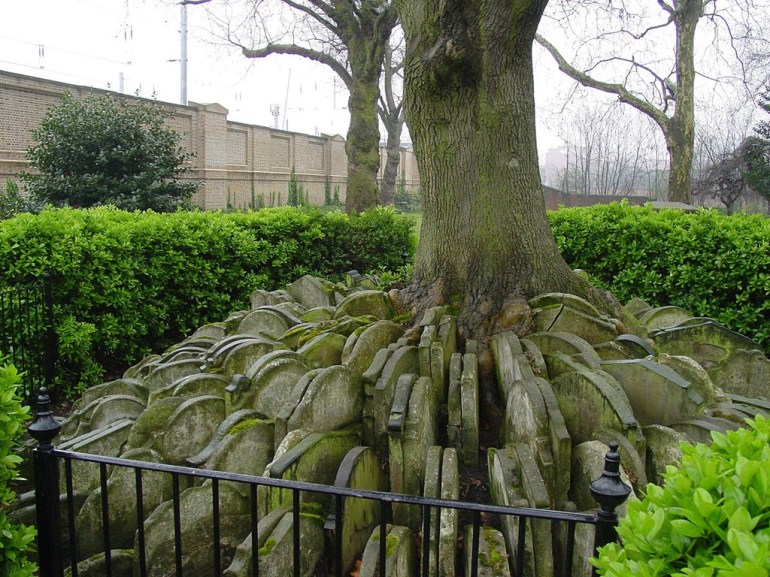
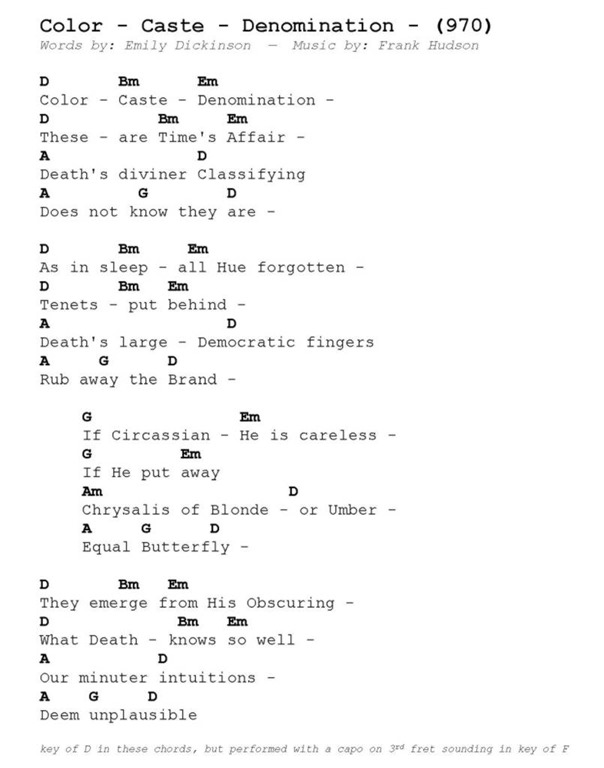


 Frank Hudson