Four Performances-Part Three: Punk Folk. Folk. Folk!

It took me an extra beat or two to continue this series, because I soon see myself as inappropriately going on too long about myself — this recounting influences and small events, even if personally meaningful, starts to seem out of proportion. I don’t know if there’s another way to write memoir than to engage in that “objects closer to the mirror” distortion, but I can’t help but think it’d be more appropriate if there was some greater payoff in achievement. The simple fact of the matter is that these are not stories of a performer’s early days before finding a notable level of success with audiences — more its opposite.

I’m grateful for the hundreds that might read one of these posts, for the thousands of times someone has listened to one or another of the audio pieces over the years. I try and honor your attention by being respectful of your time. I’m not so much afraid of embarrassing myself as I’m afraid of wasting your time.

A number of bands that came out of Minnesota in the Eighties did gather national attention — the scene punched above its weight — but as in most artistic or commercial activities, even a successful scene had many more failures-to-thrive than notable acts.*  This band of poets, Dave and I, wasn’t going to be one of the notables. Today’s performance was an inflection point for that.

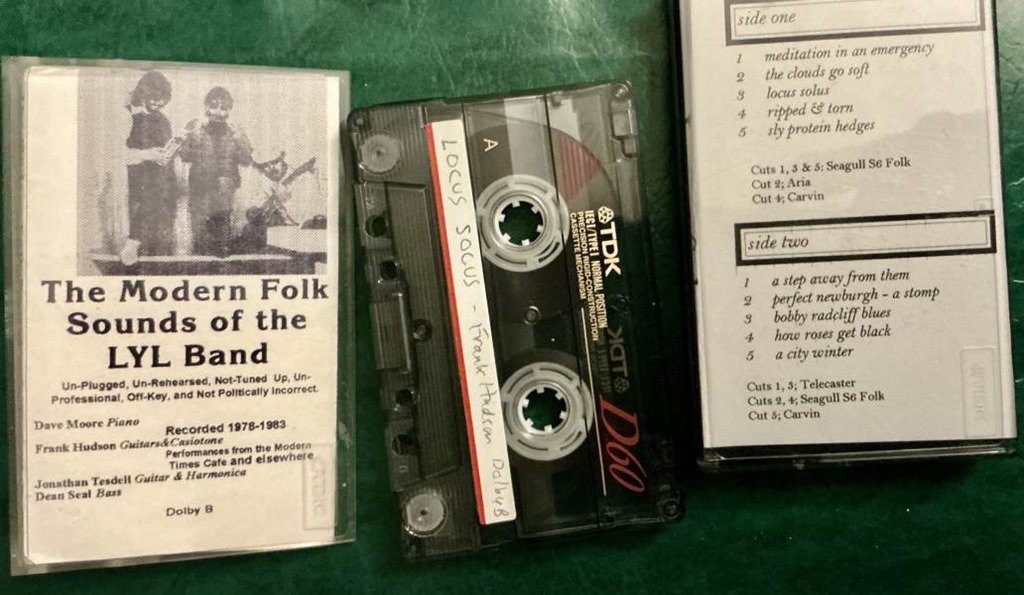
We’d recorded our official album, which was released on cassette tape for lack of capital funds to get LPs pressed.** The local alt-weekly, The Twin Cities Reader,  reviewed it, and its cover linked us, the LYL Band, with a new record from The Time.

LYL Reviewed in Twin Cities Reader

The Time article promised on the front page teaser was a longer feature in the same issue. Great, but too forgotten too often local rock band Fine Art and their guitarist Colin Mansfield gets mentioned here too.

.

As reviews go, Paul Fishman Maccabee’s “So engagingly out-of-tune and cheerily offensive: it could well become a cult item” wasn’t exactly Robert Sheldon’s “Bob Dylan is one of the most distinctive stylists to play in a Manhattan cabaret in months,” but it allowed us a modicum of creditability. We were trying to evolve from a pair of acoustic folkies to an electric rock band (the recording was largely played on electric instruments), but we were doing that in a meandering way. A neighborhood guy, Jonathan Tesdell played electric guitar — and, we were assured, conga drums. I hoped he might become our analog to the Fugs Ken Weaver as he joined up with us.

At the time of that Reader  review we got an offer to play at the University of Minnesota. We took them up on it. We were practicing regularly now, trying to solidify our repertoire. This could be, if not our break, our foot in the door.

A small blip in our ascension dropped before the show date: the University called and asked what kind of music we should be billed as. I think Dave gave them a capsule description of our weirdness — and Dave’s an articulate guy — whatever he said it included the genre label “Punk Folk.”

That week as I walked across the never-named-that John Berryman bridge to the U, I noticed the posters along that span and on into the campus. They said “local PUNK FUNK.” Typo? Mishearing? I don’t know, but if Punk Folk wasn’t yet a common genre category in the early Eighties, Punk Funk was a term Rick James was using at this time for his work, and in the less-commercial indie scene the term was used to describe acts like James Chance’s NYC No-Wave skinny-tie-white-guy James Brown extrapolation. We were a trio expanding from acoustic instruments to electric ones without a bass player or a drummer.

Okay.

LYL Band concert poster Univerity of Minnesota Willey Hall

Photo in the poster by Renee Robbins. L to R: Dave Moore holding my tiny CasioTone that was my first synthesizer (it was also a calculator). Jonathan Tesdell, the new guy in the group and 25th Century Quaker, and Frank Hudson trying to look like he had Jazz chops, which he didn’t. Yes, our backup singers “The Cookies” did serve cookies and cider to the audience. The Replacements confounded audiences at key times in their career, but they never tried that.

.

The day of the concert came. We loaded Dave’s newly purchased used Farfisa combo organ and my homemade speaker cabinet for it, Jonathan’s Firebird electric guitar and Roland amp, my sound-hole pickup 12-string acoustic and heavily modified Japanese Sixties’ electric guitar along with my Fender Princeton amp into our rattle-trap old cars. On arriving, we found the concert location was a broad stage, the width of the room in front, with audience seats for a few hundred.*** The venue had supplied a full-sized Yamaha grand piano for Dave to play. I recall it had a paper band across the keyboard, which I joked was like the “sanitized for your protection” bands on a hotel toilet.

The audience arrived, accumulating to not a full-house. My memory isn’t clear on this, perhaps just a third or a quarter of the seats. Even so, that could mean at a minimum there were 80 people there, and unlike the shows at Modern Times, most weren’t folks we knew from the neighborhood. I don’t know what Dave or Jonathan felt, but I was hoping to put on a good show, to put forward our intent: some satire and civic points, some music with the not-necessarily-perfect, but perfectly-necessary energy of the still underground indie music movement that was also called around then “College Rock.” How well would we go over with this barely-Rock, with this audience, at this college?

I was on the stage performing when my nerve started to fail. That came during the song that the audience showed the most response too: four-songs-in we played a number that I think we informally called “Booker T”  or “Memphis Thing”,  an instrumental based on a nice riff I’d come up with as something of a concession to new-member Jonathan, the non-poet who wasn’t much of a lyrics guy. I could sense the audience perking up with that piece’s groove, hopes out there in the seats that things were going to lock in for more of a Rock show. Did some of the audience come for the poster’s Punk Funk? Did they at least expect something more like the other young Twin Cities rock bands that would play the Longhorn, 7th Street Entry or Duffy’s? Whatever, I knew “No, it’s not going to lock in. We’re going to do more folk songs about social issues and weird observations from two poets.” Not being able to change that, however true the set list was to our concept, dismayed me — yet I needed to carry on, while confidence was draining away.

I recall those feelings hanging on after the concert. Rather than having stubborn pride in presenting our band and its shambling, eclectic, cabaret setlist, I felt I’d let the band down. If Dave, the better performer felt any of this, he didn’t show it, and Jonathan , as ever, was by nature a quiet, pacific guy. I remember sitting in the car after loading back out immersed in a sort of punk folk funk, and on the radio — of all things — came Jimi Hendrix’s “Voodoo Chile/Slight Return.” I, the guitar-playing poet. heard him in my mood not as the obligatory guitar-great Hendrix, but as the lyricist Hendrix, the kid who’d scrawled spaceship doodles and poetry in his school-lined notebooks.

I stand up next to a mountain
And I chop it down with the edge of my hand
I pick up all the pieces and make an island
Might even raise a little sand

That’s what artists do. We are at essence pretentious, that thing we fear, that prideful sin we are sometimes called on. And the charge, that indictment, is sometimes true: we fail, or sometimes certain audiences fail, sometimes we lack conviction, sometimes we are convicted, a just verdict. Still, we think we can raise mountains, raise up islands from our imagination. Sometimes that imagination lets others climb on those mountains, take shelter on those islands — other times we fall through our dreams. When nothing is beneath our feet, are we falling or flying? Hendrix continued, singing:

I didn’t mean to take up all your sweet time
I’ll give it right back one of these days

When I took up your time today with the continuing shaggy dog story of my band of poets, I asked if it was worthwhile telling this story about a band that didn’t make much of an impact. Here’s a plausible reason: despite that outcome, I’d do it again — maybe harder next time— and the music-making with fellow poet Dave Moore continued, continues. I know some of my readers are younger and are making music or other art within a career that doesn’t yet know it’s apogee. Have courage: you’re falling or flying.

Here are two pieces from a lo-fi tape of that U of M concert in 1981: Dave’s adaptation of a poem by Kevin FitzPatrick “Bugs in the System”  and my own Surrealist summer meditation “China Mouth.”   You can hear them with the graphical audio players below, but if you don’t see those players, the highlighted titles are links that when clicked on will open a new tab with an audio player.

Here’s Dave Moore singing a tale from the front-lines  of minimum-wage, Bugs In the System (keys to the drop safe):”   This was the second song in the 1981 concert.

And here I am singing the third song in the concert’s set list, “China Mouth”,  a song of Summer discontent. The “Memphis Thing”   groove-oriented instrumental I write about above was the next song we played.

.

*An off-the-top-of-my-head Eighties Twin Cities list: Prince, The Time, Hüsker Dü, The Replacements, Soul Asylum, Babes in Toyland, Alexander O’Neal, The Jayhawks, Flyte Tyme (Jimmy Jam/Terry Lewis, largely as important producers). And like most scenes, the above acts are a quick list of those someone elsewhere might have heard of, when there’s a list at least as long of good acts that remained at local hero status. Given the LYL Band’s penchant for satire, I could also have mentioned that the Eighties saw the Twin Cities grow a substantial comedy scene, one participant in that became our bass player for a while.

**I believe it was the first cassette-only release in the Twin Cities scene. I duplicated the cassettes myself, and Dave made the packaging for them. I got the idea from ROIR in New York City who in 1981 put out its first cassette-only release (James Chance and the Contortions). Their release and ours followed the introduction of the Sony Walkman, a small battery-powered portable cassette with headphones that was a cultural artifact of the era. I wrote a press release for our recording that exclaimed “Teach your Sony Walkman to crawl!”

***Looking online today I see there are two possible Wiley Hall rooms, one that seats just under 700 and another 362.
Reopening the Scrapbook, Part Two

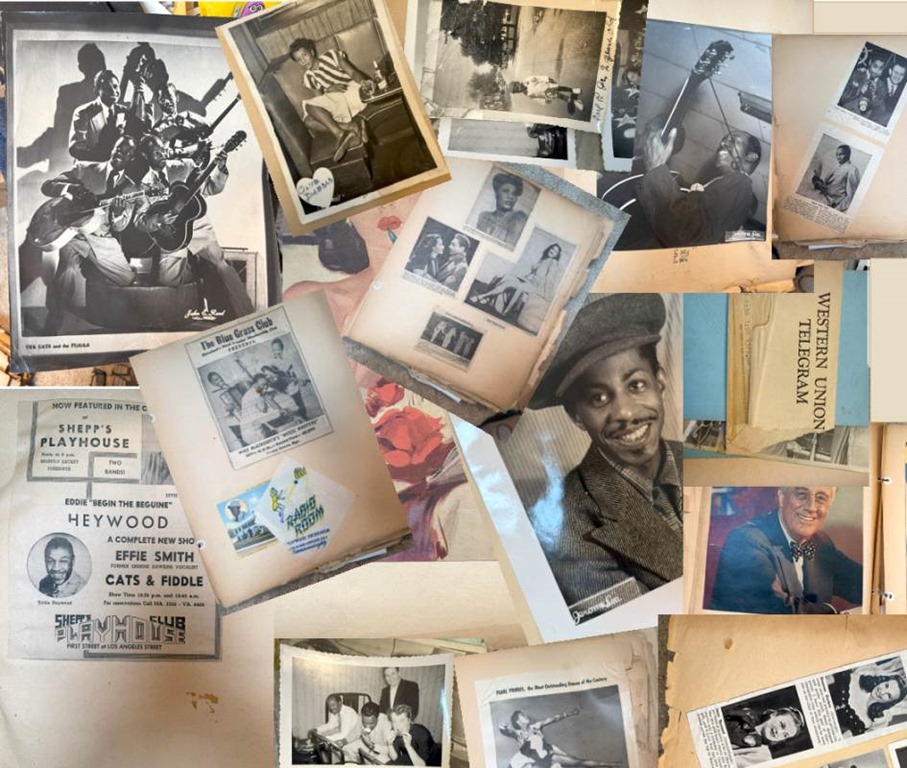
So, what’s in that scrapbook? There were a bunch of clippings from magazines or newspapers, sometimes pictures from them, sometimes articles, often about people in the entertainment business. A couple of letters. Ephemera from places, like business cards, tickets, a cocktail napkin. A few things related to Hollywood movies. A theater program. A restaurant menu. And photos, some posed “publicity shots” for musical combos or performers, some amateur snapshots. Even more than 40 years ago when I received the scrapbook, the pages these things were attached to were starting to fragment, and stuff that was likely attached to the dried-out paper was now loose inside the book, making it hard to leaf through. Alas, there were almost no captions or notations anywhere by the scrapbook’s maker. From clothing, cars, and dates on the clippings it was from the 1940s and 50s.

I think I tried when I received it in the 1980s to determine if it had a story, but I couldn’t really figure it out. Because a majority of faces in the scrapbook were Black, I thought it was safe to assume it was kept by someone who was also Black. On thinner grounds, I made another likelihood assumption: that it was made and kept by a woman. Somehow, it seemed feminine to me, and I could imagine someone fan-crazy about music collating this book. But there was a lot of miscellany to it too. One plurality thread seemed to be in the entertainers’ pictures and clips: a band that called itself The Cats and the Fiddle.

Cats and the Fiddle Collage

Stuff from the crumbling scrapbook that I’ll be examining this month.

.

I’d never heard of them, and back in the pre-Internet age it wasn’t easy to find out about them. In the pictures they were an all-Black group in sharp suits. The “fiddle” was the bass fiddle — a standup bass player* was in all the pictures of the band. The rest of the small combo were playing a range of fretted stringed instruments. I could see one of the guitars had just four strings, and I knew that was a tenor guitar, an instrument that otherwise looked like the acoustic guitar I was playing with Dave in our punk folk band then. I knew that it was developed to allow 4-string tenor banjo players to transition over to the guitar as the banjo faded out as a Jazz instrument. Another would hold a regular archtop hollow-body guitar. And there as an odd instrument I could make out in some pictures: smaller than a conventional guitar, with more than 6 strings. The Cats and the Fiddle looked pre-rock’n’roll, but it didn’t look particularly like the Chicago Blues bands I knew of then, nor was it a typical modern Jazz combo that I listened to. No keyboards, no drummer.

I somehow located an LP record, a reissue collection of some of their recordings. They played hot tempo, small combo, hard swinging Jazz backing accompanying their own tightly-grouped vocal blends. This was a genre I knew only a little about. It had largely faded out as popular music by the time I was aware of music, but I had encountered something like it in acts that were reviving 40s-era genres, nationally: The Pointer Sisters, Bette Midler, Dan Hicks and His Hot Licks, and locally a band called Rio Nido. As a guitarist The Cats and the Fiddle were easy for me to take a liking to. Though a vocal group, the energetic short solo breaks on the guitars still sounded fresh to me, a fellow stringed instrument plucker. I’m not sure if I stole any licks, but I would have liked to have.

What is this group doing in cold Minnesota? A movie clip shows they can take to the snow!

.

There was something else about the songs: many of them were lyrically about what might have been called the Jazz life: referencing the music itself, but also things connected with it: drinking, partying, hepcat slang, and those “Jazz cigarettes.” There were a handful of lovelorn ballads, but the approach more often was near-hypermania good times. No drummer, but the combo’s rhythm was solid, and that accompaniment was not mixed down low way behind the vocals.

Proof that Jimi Hendrix and Stevie Ray Vaughn didn’t invent the behind-the-back guitar strum

.

There were liner notes on the LP sleeve. Yes, they were a ‘40s group. I can’t recall if the notes mentioned where the musicians were from or what region the band worked out of, but I know I was looking for a tie to Minnesota where the scrapbook ended up, and didn’t find any. One thing the reissued LP did reveal: one of the members was Tiny Grimes. I’m not a hard-core Jazz historian, but I knew of Grimes — a contemporary, though longer-lived, of electric guitar pioneer Charlie Christian. Guitarist Grimes, like Christian, was present at the creation as Swing music morphed into Be-Bop.

I put that scrapbook away, and when I moved to my present home, it stayed on an upper shelf in my study where I work on the pieces you read here. Did I decide I had hit a dead end with the scrapbook, or was I just busy with my life then as sometime gigging member of a band? Probably a little of both. I’d sometimes look up at it, look at it looking down at me, and I’d think: I should get back to it sometime, see what more I can determine.

And this is the month I did that. More to come, as I examine the scrapbook again for Black History Month 2025.

.

*Well, not always an upright bass player, as you can see in the second video clip.

One need not be a chamber to be haunted. You could be a cassette tape.

However similar if amorphous shapes, everyone’s ghosts are private spirits, and I have a new musical piece with words by Emily Dickinson testifying to that — but let me slide over to a couple of personal things first, as if I was a regular blogger externalizing their internal story.

I’ve had a couple of weeks when I’ve needed to come back to the Parlando Project stuff from other things. I had a colonoscopy with unremarkable results. Huzzah. That’s some prime blogger internal dialog! But before that, I searched around my crowded little bedroom/office to find old cassette tapes. The oldest are from The Sixties when I had one of those small battery powered monaural cassette recorders with a slide-out chrome handle, a single speaker on the top, and a chorded plastic microphone with a start-stop slider button on its side. Others were from the 1970’s-2000 era when I recorded musical things, first on the stereo tape decks of the late 20th century home hi-fi era until I was able to afford one of the legendary Portastudio models designed for musicians, using the same humble cassette tapes, but able to record 4 distinct tracks. My task: to make digital copies that I can store in no appreciable physical space and are independent of an obsolete format.*  More than 30 years of this stuff, much of it of only private interest, though you may hear some of it eventually.

Cassettes 600

Some of the cassette tapes.

.

The ubiquitousness of inexpensive video is fairly recent, but assuming no catastrophic events, many born in the past 15-20 years will likely have color video with sound of their childhoods and young adulthood that could follow them the rest of their lives.**  Is that a good thing, something they welcome? I don’t know. Before this some folks had diaries and journals, or kept letters, so some level of self-documentation is not entirely novel. Still, for me, a person whose Project lives in music and sound, whose favored form of literature began in sound before writing was invented — retaining an element of the sound of the words, and their sequence, and echoes — my particular audio time-capsules have a special tang. And fears.

Most of the tapes are not just me, in a few I’m just the man holding the microphone, though I’m there as the shadow that chose to start the recorder. They hold our imperfections: things before we knew, before we learned — and then too the persistent faux pas that we still commit: there, and committed to a recording. Given that most can record now anytime with the tap of screen, how many will simply erase to save future embarrassment?

So back to Emily Dickinson and this poem about ourselves and what we think we fear — which may not be what we actually fear, or should fear. “One need not be a chamber — to be haunted”  is a poem about that self we either can’t lose or can’t consider. In five stanzas Dickinson lays out some conventional gothic scenery (some of which she herself will erect in other poems) haunted houses, undead ghosts, church graveyards, and finally an assassin laying in wait for us.***  Dickinson points out that the self may be making or amplifying those fears, and perhaps that self, making scary movies in our imaginations, may be doing it to displace us from seeing the real fear source, our mind’s-self. “Ourself — behind Ourself — Concealed — Should startle — most” Dickinson’s poem concludes. You can read the text of Dickinson’s poem at this link. And yes, you might note I sang “alley” by mistake instead of “abbey” messing up Dickinson’s graveyard implication.

So, is that our choice? To ignore ourselves, out of fear of what we’ll find, or to disappear into a copious kingdom of solitary solipsistic self, many of us with the digital equivalent of Krapp’s Last Tape  clanking and dangling from them like Marley’s ghost? Socrates decried the unexamined life. Memoir can be an honorable genre. Despite my taking the time this month with the old tapes, I think of this Scylla and Charybdis, and in the end there’s ultimately no keeping of this life and self, though sometimes there is sharing.

Today’s musical ensemble is a Rock-band of some kind: drums, bass, piano, 12-string acoustic guitar, and two electric guitars, one of which is run through enough effects to mask its guitaristic nature. No need to rewind, you can hear it with the audio player below. No player? No need to untangle that with a pencil in the reel-hole — this highlighted link will open a new tab with its own audio player.

.

*Many years ago, I was on a committee working on the technical design for a radio network’s archives (most of which were still on audio tape then) which involved long-term storage and public accessibility elements. The online “New Media” folks had their ideas about what formats to use for listeners to stream over the Internet, the audio engineers had concerns about what would give the longest life and best fidelity, and the computer IT folks had thoughts about what media would have the capacity to hold something that might climb into the then hard to imagine “terabytes” of digital storage. The three groups weren’t always in agreement, and a grizzled consultant from some outside large, already in existence, archive was brought in to meet with us. Should we use digital tape, hard drives, optical disks? What file-system format on which? What audio file format should be used on that media? Is some of this going to die from “bit rot” on the media in how many years? We had lots of questions and wanted the wizard to arbitrate our concerns. He listened for a while as we cross-talked.

Then he answered. “It doesn’t make much difference what you choose. You’re going to have to convert to other media, file-systems, and audio formats in the future, and every few years going forward. Plan for that.”

**Many of my mid-century generation have photos from their youth. I had a “baby book” that lasts into my grade-school years in black and white. A few families had movie cameras (though no one I knew did) but many of those shot silent film. The cost of film and developing that film constrained the amount of pictures and home movies made. Lots of birthday parties, weddings, holidays. Parts of life yes, but selected shorts.

***I was working on this in the wake of the news of a planned, lay-in-wait killing of an insurance company CEO, which will be followed in the American drama by the killing of a teacher and a teenage student in a school reported by a 2nd grader who called 911. The first was caught on ubiquitous digital video, and the emergency call of the second perhaps made on one of those smaller than a fat postal-letter things we call phones even when we aren’t making phone calls. More than social embarrassment may haunt our digital archives as we live going forward.

I also note that final stanza of this poem’s “revolver” is another example to go with “My life has stood — a loaded gun”  of Dickinson poetry citing a firearm being held as the high card in some kind of deadly personal dispute.