May Day, Monarchs, Milkweed, and Langston Hughes’ “Teacher”

I went to one of the marker events of my year, the May Day Parade in South Minneapolis last Sunday. It’s a wonderful thing to return to, kids and neighbors dressing up and marching from Lake Street to an urban park, some putting on elaborate homemade puppet exoskeletons, others holding signs of local resistance, beating drums, playing instruments, and riding on contraptions ranging from customized bicycles to the mighty fire belching Southside Battletrain hauled upstreet by local Anarchists, a tribe of pierced and tattooed Sisyphus.

But more precious than all this exuberance was that I got to meet up with my old friend, poet, cartoonist, and musician Dave Moore and his partner. We did as we have for many years: we sat on the low concrete curb near the start of the street parade. The little curb, inches high, is a perfect seat for the lower children, the ones that would leap up near us on either side of the march as any promise of tossed candy delighted them. Dave and I are not children, far from it. Oh, very far. Our old bodies creak up and down when we stand to clap, call out, and cheer “Happy May Day!” as the parade passes by. The tumult covers the sound of our joints, our happy shouts outstay our grunts and groans.

And then there is the silent thing Dave does as our neighborhood starts to disperse back to their homes or other activities after the parade passes. Dave carries a bag of milkweed seeds to the parade each year. The bridge whose street side we’ve been sitting on spans the Greenway, a reclaimed railroad right of way that’s now a walking and biking trail. In its older, more overgrown times milkweed lined the tracks, and the hulking trains then whipped up their fluff from the dried pods — little vegetive boxcars unloading the slightest, near weightless freight of their commerce. And so after the parade, Dave takes handfuls of those seeds he’s brought, and tosses them to the present air. They rise like tiny albino angels, swirling into May skies with a job in their seeds: milkweed is the manna of the immigrant monarch butterflies who migrate from Mexico, whose children depend on it when they are infants bundled as caterpillars.

That, kind readers, is a holy moment. The noise, the quiet, the Spring, the joy of workers celebrating their day.

But there’s another chapter in this story. Someone Dave knows sees him and stops to chat. He’s happy enough with the parade of course, but his conversation is troubled. He’s a schoolteacher. Looking nearly as old as Dave and I, he’s still working as such, and he despairs. The children have no attention span, no lessons can adhere, he reports. No one realizes how tough it is now, he says, and I guess I’m an example of that, but I hope he’s partly wrong. I’m one of those dried seed pods now, I don’t know where the escaped fluff I release here lands, and that lofted randomness releases me.

May Day and Milkweed Collage

I made a choice to not take pictures this year at the May Day Parade — but here are some older pictures: part of the Southside Battletrain, a bike-powered puppet-float, Dave with his bag of milkweed, and a milkweed pod

.

I thought of this teacher and his tale alongside this poem I perform today written by the young Langston Hughes. Hughes was in his 20s when he published it, so it seems to be another of those poems about old age written surprisingly in youth. Did Hughes have a particular teacher in mind, or was he (even unknowingly) writing about an element of himself as he created this epitaph? In “Teacher”  Hughes is engaging the poetic trope of the grave as a place of unending reconsideration, but as a person in their 20s he was a chrysalis where the pulpy worm may turn to wings — not a pulpy corpse under a dissolving summary. Hughes has his teacher in the poem speak as if the unvarnished holding on to virtue pinches the soul – and yet virtues are something that young people are always being told they need to develop. I don’t think such lessons are entirely wrong, but they are not the entire either. I think the star-dust that cannot penetrate the poem’s speaker is the diffuse, the random, the broad-spreading possibility. It’s a signifier of entirely unsure hope, a precious kind. Here’s a link to the text of Hughes’ poem.

You can hear my performance of Langston Hughes’ “Teacher”  with the audio player below. Because I wanted a slow, long-hanging-in-the-air, timbre for the guitar here I chose to play electric guitar on this performance— appropriately my Guild Starfire guitar for this representation of star dust or milkweed fluff. No audio player to be seen? Some ways of reading this blog won’t show it, this highlighted link will germinate a new tab with its own audio player so you can hear it.

.

Happy May Day to the workers in song

It was quite the April for me, and I’m resting up today before getting on with a bunch of tasks I’ve put off while working on the accelerated posting schedule for National Poetry Month. Readership was up substantially, busiest month ever for visitors at this blog, and page views blew past the old record by over a thousand. I should be better at replying to your comments and encouragement, but besides being focused on the work I have a mental Catch 22 where I often can’t decide the best way to respond, and in that indecision put off responding.

Car Sandburg - The Sandburg Test

.

I didn’t put anything new for International Workers Day today, but I’ll repost this piece with Carl Sandburg’s words from his longer poem “The Windy City”  that I created for last autumn’s U. S. Labor Day. In posting it last year I suggested something I had bounced off my old compatriots in The Lake Street Writer’s Group, something I call “The Sandburg Test.”

Let me suggest a rough analog of the Bechtel Test.  Let me call it The Sandburg Test. To be clear, it’s not my suggestion that every poem has to be about work, about the things we do for our daily bread. But, if we are viewing an anthology or substantial poetry collection from a poet, to pass The Sandburg Test it has to have poems that deal with work in some substantial way. How does the speaker or characters in the poem relate to work? What are they doing that work for? What is it in presenting them that portrays something about life? What are the mysteries, sensations, and systems of that work?

Here’s that musical performance of Sandburg’s words from “The Windy City” accessible with the graphical audio player you should see below. No player to been seen?  This highlighted link is an alternative.

.

There’s No Reception in Possum Springs

I asked the teenager if they had any ideas for a poem I could use for May Day, the international workers day. She thought for a minute and then said, “Well there’s one, but it’s from a video game.”

Have I intrigued you? Perhaps only the unusual folks who follow this project might be. May Day. Video game? Poem? Maybe even: teenager? Every one of those things are keywords that might drop readers. Add that your author is an old guy, one not very hip to video games, and I don’t know how many are still reading by this paragraph.

Still here. Good — because the poem is excellent, and we’ll get to it in a moment. First, a short summary of the context it came from. The video game is titled Night in the Woods.  It’s now around 5 years old, and it seems to this outsider to have an unusual premise: it revolves around teenagers and their peer relationships in a declining industrial town of Possum Springs. There’s a mystery to be solved, at least after a fashion, but the richness of the characters and their milieu makes it more a novelistic experience than a puzzle escape room or series of mini to macro baddies to battle. Oh, and did I mention that the characters are anthropomorphic animals?

Sound cute? Well, here we go with opposites again. Mental illness and violence are part of the world. Nancy Drew Case-Of… or PBS Kids style animal parables this isn’t. Our main characters are teenagers, and yet the weight of this world is on them — and the world, despite the fantastic elements, is our world, set in the declining rural America inhabited not by animated animal-faced kids but by a gig economy and our new-fangled robber barons.

The poem is spoken in the game by a minor character — in the nomenclature of game mechanics, a non-playable character — a spear-carrier in this small-town opera. I’m told she appears in various episodes as the game proceeds, speaking funny little poems while the foreground, playable characters, deal with weightier things. As she starts to read this, it’s not clear from the opening words that this poem isn’t just another little sideways humorous piece of verse.

It’s not. Yes, the people in it, the working class this May Day is ostensibly for, are counted as small, but the poem builds in its litany of smallness increasing, of inequality compounding. At the end the poet-character finishes stating her dream of justice. In that night dream, she’s alone, and that’s why it’s a dream — and will always be a dream on those terms. A century ago when the Wobbly songwriter Alfred Hayes dreamed he saw the dead Joe Hill, Joe Hill tells him to organize. When Martin Luther King said “have a dream” he was standing in front of thousands who’d say it with him. That’s why we have a May Day.

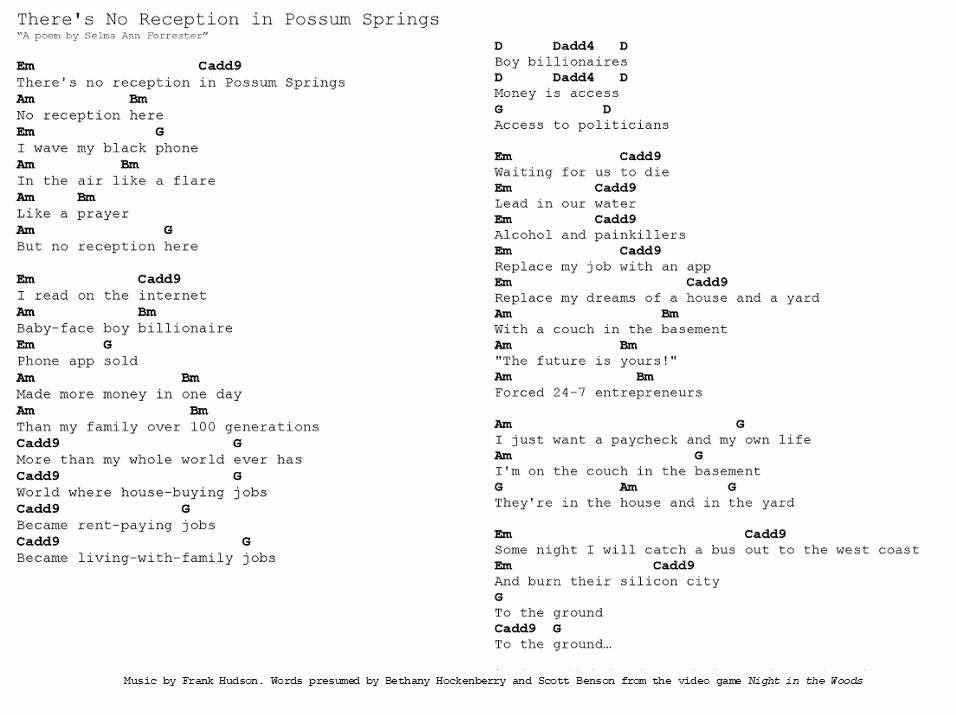
Here’s the poem presented as the chord sheet that I performed it from today, credited to the fictional character in the game. Best as we can figure, the actual authors of the game’s dialog and therefore this poem are Bethany Hockenberry and Scott Benson.*  The chords listed show the chords I was fingering on guitar, but I had a capo on the first fret in this recording, so they sound a half-step higher. The main reason I’ve been presenting these chord sheets is that while I do my best in my rapid production schedule on these pieces, I figure others out there might do a better job with this. One person singing a song is a performance. The second is a cover version. More than that, and it might be a folk song!

There's No Reception in Possum Springs

.

To hear my performance there’s an audio player below. Player not there? Then this highlighted hyperlink will open a new tab with its own audio player.

.

*They have no connection with this performance, other than the eloquence of the words impressing my daughter and then myself. Apologies in that I hurried to do this for May Day and haven’t contacted them.

Working Girls, Happiness, and Muckers: three Carl Sandburg poems about workers

I wrote a short piece a few years ago, which goes like this:

The Temple of Summer is guarded by two pillars:
Memorial Day for those who gave up their lives in war,
And Labor Day for those who gave up their lives in peacetime.

This Monday is American Labor Day.*  What constitutes a laborer, a worker? Someone who works for someone else, who doesn’t own their own business? Are poets and musicians workers, or small businesspersons? These things are not simple — after all, that musician-derived term “the gig economy” shows that grants of independence can be superficial. Anyway, let me defer that discussion and say that poet and musician Carl Sandburg was a worker, knew he was a worker, and understood work. It should be no surprise that I’ve chosen to present three poems from his 1916 breakthrough collection, Chicago Poems for Labor Day — or for any working day if you read this later. They’re observed and written in the situation of their time, but let’s not dismiss their concerns and experiences as outdated this Labor Day — at least, not without hearing Sandburg out.

How many times, even today, when someone seeks to portray the working class, is a white male presupposed? Sandburg doesn’t make that mistake as his “Working Girls”  will show. My wife, a nurse, came home this week concerned around a strike deadline, and it’s safe to say that women have carried proportionally more of the stress of the past few years in the workplace. She tells me her coworkers are riven by this announced possibility. Some of the most stressed, see this as adding to their stress; others see this as an attempt to remedy some of what’s wrong in their field. Sandburg sees a dialectic in his river of working women, though his poem’s more about the general wearing-down of a life of work.

“Happiness”  is probably the best-known of the three Sandburg poems in today’s piece. It’s significant to know that Sandburg is a 1st generation immigrant, and he writes continually of the immigrant experience in his poetry. I don’t think it’s too hard to translate from Sandburg’s immigrants to today. My weekend summer nights here in my neighborhood feature accordion music as this poem mentions, though the singing is in Spanish for my ears. Oh, my wife and teenager sometimes have trouble sleeping, and then there’s this noise. I have trouble sleeping too, but I also hear this Sandburg poem in my head, accompanying from his time the Mexican songs from the yard three houses down the street.

Consider this on a holiday: no one feels leisure like a working person.

“Muckers”  may take a little translation. When I was growing up, closer in time to Sandburg’s than today is, a ditch digger was not a job description so much as a derogatory term. It stood for someone who had no ambition, no skills, no ability to advance. If you lacked those things, you might be cursed to become “a ditch digger.” It was essentially workplace hell — and the inhabitants, damned by their sins of omission. My father once preached a sermon I can recall from my youth in which the dignity of a ditch digger’s work was proclaimed. The detail he spoke of then, the part I can remember, was that some care as well as muscle was required to carve out a stable and straightaway ditch.

Sandburg’s poem takes a red-wheelbarrow to the job site, writing (as he would often do) an Imagist poem concerned not just with concise precision in the observation, but more at why so much depends on what is observed. And he’s got a punch line, one anyone who’s ever suffered through the worthlessness of unemployment will understand.

Together these three poems I perform today celebrate those who give up their lives in peacetime. “You dreamy poet,” some may be saying now, “That’s the way of the world. Don’t you know?” Oh, Sandburg knows. He went to work at 13. I was self-supporting at 18. The difference between us and some other poets is that we’ll write and sing about this. It’s as universal as love and heartbreak, near as universal as death, and it’s the mundane ground upon which poetry and music and all the arts are stroked upon.

Carl Sandburg with light guitar

Carl Sandburg: proud to be the guitar strangler, rockin’ maker, stacker of tracks of wax, hex-string player, and folk-rock maven of Modernist poetry.

.

My musical performance is longer today than most Parlando pieces, but then it does present three poems and asks for a quantity discount. After working out and executing the acoustic guitar and “punk orchestral” setting of Emily Dickinson last time I wanted to plug in a Stratocaster and wail a bit, and so what you’ll hear today is a live electric guitar performance recorded then. One production oddity I’ll note: I recorded the two chordal “rhythm guitar” parts after the lead melodic part. The player gadget to hear the performance is below for many of you, and I provide this highlighted link for those viewing this blog in ways that cannot display the graphical audio player.

.

*My teenager reminds me that “Labor Day” is not the international workers day that is May Day. I remind them that American Labor Day came out of the labor movement too, and no matter how you parse things, having two days to celebrate work and workers is not too much, no more than we should be embarrassed in America to have a Veterans Day and a Memorial Day.

Corinna, Corinna Let’s Go a Maying

Robert Herrick wrote in the awkward 17th and 18th century era in English poetry where if you aren’t Milton you get tabbed in the minor poet folder. That didn’t stop Herrick, as he wrote a couple thousand of poems without ever achieving widespread cultural impact. There’s likely some overriding reasons why the gap between the inventiveness of Shakespeare, other Elizabethan poets and John Donne; and then Blake, Wordsworth and the Romantic movement was a fallow period for innovation in English language verse.

What poetry of Herrick’s I recall from my youth had a chaste lustfulness about it—a difficult combination to make work. I haven’t thought much since then about refreshing my experience of his work until I came upon this May Day poem looking for material this spring: “Corinna’s going a Maying.”  It’s yet another carpe diem poem, a genre that can’t escape the imprint of the patriarchy on it.*  But Herrick doesn’t really launch into the hard-core let’s get it on before we die argument until after a fair number of stanzas that are so much “Spring! Time to get outside and enjoy that frostbite is no longer the charm that nature has on offer.”

And yet this May, a springtime carpe diem poem has a different cast. We didn’t really folk-dance around maypoles much in our century, but this May we know we can not do what we didn’t do. Even the poem’s warning that our days may run out before we know our liberty, dark as that thought may be, is more present.

And yet this May, a springtime carpe diem poem has a different cast. We didn’t really folk-dance around maypoles much in our century, but this May we know we can not do what we didn’t do.

So mopey guy that I can be** I zeroed in on the final stanza, which seemed to have by far the sharpest lines, and if performed alone wouldn’t tax my listener’s patience. Herrick’s “Corinna”  is written in rhyming couplets, which was in fashion in his age (as it is for Hip Hop now). Since carpe diem tropes go back to Roman poets, Herrick adopted to his English poetry some verbal riffs from Latin.

Which is when I flashed on the idea for how to present “Corinna’s going a Maying.”  It’s easy to adapt rhyming couplets to the Blues Stanza (two repeated lines completed by a third rhyming one that often surprises in its completion). And then the name of the woman addressed by Herrick is the same addressed by an American folk song “Corinne, Corinna”  or “Corinna, Corinna”  that’s been recorded by dozens of blues, folk, country, and rock artists. I knew it mostly from Joe Turner’s blues version from the 50s and Bob Dylan’s mildly electric cover from his  Freewheelin’ Bob Dylan  LP.

So, the die was cast. I would try to perform Herrick’s closing section as a set of blues stanza adaptions. The feel I fell into was my approximation of the Vee-Jay*** records of my youth that featured Jimmy Reed or John Lee Hooker. Unlike ex-big band blues shouter Joe Tuner, Hooker made his early mesmerizing recordings with just voice and electric guitar, but by the time he was recording for Vee Jay they often added drums and sometimes a second guitar to make the records more palatable to the R&B audiences of the late 50s and the early 60s. Which leads to a remarkable thing about Hooker’s Vee-Jay recordings: the singer/guitarist at the center of those recording dates wasn’t the most regular in his song structures. Rather he was steeped in the drifting Delta style where the little breaks and asides were thrown in at various times depending on the feeling he was building in any one take.**** This meant the drummer had their work cut out for themselves in those days before everyone would be asked to sync to a click track and verses are expected to snap to a fixed grid. That “backwards” style where the drummer follows the guitarist has a certain charm to it, and you can see its rock’n’roll descendants in the Rolling Stones and The White Stripes.

Hooker 'n' Herrick

“Let that girl go a Maying. It’s in her, and it’s gotta come out!”


All that is to say that it took some precise work to do the loosey-goosey May Day take of what I call “Corinna, Corinna Let’s Go a Maying”  even if I don’t sound much like Reed or Hooker. I doubt Herrick would mind too much, after all he was adapting Catullus and Ben Johnson for his times, just as John Lee Hooker was adopting his style to the space and tail-fin age. The player to hear my performance of the final section of Herrick’s poem is below. The full text of the Herrick poem is here. Just jump to the final stanza if you want to read along to my performance.


*Are there any poems written to men from a woman’s perspective that make the argument that they need to get busy with the woman poet because, well, you’re aging and death awaits all? There are male to male poems that fit this genre (some of Shakespeare’s sonnets are examples), but I can’t think of an example by a woman off hand.

**Sometimes I wonder if I hold with songwriter Townes Van Zandt who famously stated, “There’s only two kinds of music: the blues and zippety do-dah.”

***Chicago-based Vee-Jay preceded even Motown as a black-owned record company, and besides recording R&B, jazz and gospel they were the American label that cut a deal in early 1963 to release records by The Beatles. You’d think that would be the beginning of a great success story. That’s not how the record business works.

****Lightnin’ Hopkins was another. Jas Obrecht in his book Rollin’ and Tumblin’  quotes ZZ Top’s Billy Gibbons with this tale of a recording session: “We were playing a traditional blues and we all went to the second change, but Lightnin’ was still in the first change. He stopped and looked at us. Our bass player said, ‘Well, Lightnin’, that’s where the second change is supposed to be, isn’t it?’ Lightnin’ looked back and said, ‘Lightnin’ change when Lightnin’ want to change.’”

Smoke and Steel

Today is May Day, the international labor day, so I spent it working, looking through poetry books for something about our lives of work. There’s less there than there should be I think, the world of work somehow not seeming as poetic as human love and desire or as sublime as the observation of nature and things of the spirit without any human sweat in it.

This lack leads me to admire poets who address this imbalance. And the first one that came to my mind turned out to be the one I ended up using today: Carl Sandburg. That Sandburg might come to mind for others too as a poet of labor probably didn’t help his reputation at the start of our current century. He doesn’t come by that classification lightly, having had a career as an itinerate worker and labor organizer before he began as a poet, and even while he was publishing groundbreaking works of early American Modernist poetry like his Chicago Poems  in 1917, he had a second, less well-known life as a Socialist radical.

Carl Sandburg at work

Carl clocking in in his later years when his day job was goat farmer

Somehow Sandburg survived both the post WWI and post WWII red scares without great harm to his reputation, but by late in the 20th century there was less interest in Modernists who wanted to write about work and labor issues. The bohemian fringe more or less looked at straight work as an unfortunate event*, and the academic establishment was more interested in aesthetic rigor and the ability to carry lightly evidence of a full-fledged college education for its poets.

Proletarian writing had been done already. Time to move on.

As I keep reminding you and myself, our current century is now old enough to vote, it’s approaching adulthood. It might want to re-evaluate those judgements the old century made about its youthful innovators.

So, for today, May Day, I took the opening to Sandburg’s longer poem that gave its name to his 1920 collection Smoke and Steel and turned it into a labor hymn. “By this sign all smokes know each other.”

The player gadget to hear it is below. If you want to read the whole poem, or just read along to the opening section I used, the full text is here.  Don’t see the player gadget. No problem. This highlighted hyperlink will also play it.

.

*as leading beat-generation scholar and theorist, Maynard G. Krebs put it in his famous essay “On Work, An Existential Examination” “Work!?”

I Thought It Mattered

Today is May Day, a day that combines many things. Neo-Pagans can point to it as Beltane or the morning that follows Walpurgis Night. Since the late 19th Century it’s been “International Worker Day” associated with labor and Socialist movements. It’s about midway between Spring Solstice and Summer Equinox.

It was also once a more or less secular holiday celebrated because by now it’s likely Spring in essence, not just Spring in some calendar’s notion in northern climes. A long time ago, in my childhood, in my little Iowa town settled by Swedes, May baskets were still exchanged—this before Easter had become one of the commercial candy holidays paired with Halloween. In Britain May Day still a bank holiday, celebrated next Monday with sundry celebrations.

In Minneapolis, this Sunday is the date of an annual parade organized by a local urban puppet theater. We will sit on the curbsides as Indigenous dance crews, drum bands, anarchists, political candidates, stilt dancers, decorated bicycles, giant papier-mache puppets, and various cause marchers pass by to music by flat-bed truck rockers and strolling brass bands. The Minneapolis May Day parade combines all those May Days into one thing, a Whitmanesque democratic cultural event, a container of multitudes spilled open on a city street.

I used to take pictures and film it, but now I just go and watch it. It may be just me, but in the past couple of years the level of invention in the costumes/puppets seems to have fallen off, but that may just be me and nostalgia filters. Ah, for the good old days of 2010! I’m holding that this is just random variation—but in the end it’s the gathering of South Minneapolis people, parading and watching who make me most appreciate it.

The 2010 theme incorporated William Blake, and my soundtrack to this slideshow features Blake’s “The Tyger.”


Today’s audio piece, “I Thought It Mattered,”  has words and music by Dave Moore, and is sung by him along with our more spontaneous incarnation, the LYL Band. Dave’s song speaks of lifetimes, marchers and causes. I think it’s one of his best songs, so give it a listen using the player below.