Meru

Poet William Butler Yeats had interests and a life that spanned times and poetic styles. His earliest poems whole-heartedly exhibit 19th century romanticism and prosody, but like the English Pre-Raphaelites he sought to vividly revive elements of the deeper past while doing so. His interests beyond poetry ranged as well. Last time I performed Yeats, I mentioned he had deep interests in esoteric magic, and yet the same man had a firm grounding in civic poetry while supporting an Irish cultural revival and independence from England. A poet with an already established style, he crossed paths with the American and British Modernists early in their revolution, and his later poetry shows that rather than getting his back up about their changes, he adapted some of their make-it-new approaches. Yeats employed influential American Modernist critic Ezra Pound during Modernism’s rise, and while he dipped his toes into fascist movements,* unlike Pound he seems to have drawn back from that.

Today’s piece, “Meru,”  is a late poem in Yeats’ career. I find it balancing the worldly and spiritual, and on no more authority than my own necessary to come to grips to perform it, I see it as commenting on the rise of rapacious authoritarians contemporary with its composition in the 1930s.**   Here’s a link to the poem as Yeats published it.

“Meru”  is a sonnet, a rather regular one structurally. Though the word we use for this lyric poetry form literally means “little song,” many sonnets are hard for me to perform with music. Their length is good, and lyric poetry in this context means that they focus on a compressed scope of time and experience — but the form rarely uses refrains, a powerful, almost indispensable, tactic for song attractiveness. Seeking a good musical structure, I divided Yeats one-stanza poem into four verses, with refrains after verses two and four.

Meru

The song form I reformed Yeats’ sonnet into. Note the chords shown are what I fretted on guitar, but I used a capo on fret 3, so the piano, bass, and the song song sound in Eb.

.

What do I think, as I chose to perform this, the poem conveys?

I like Yeats opening here, with its circular word-choice of “hooped,” for describing civilization’s shared beliefs. I’m unaware that this is any kind of established British Isles idiom, and the choice of this scene-setting word seems to invoke something like a key-ring or perhaps a wooden barrel or cask — and in the last image, that’s a construction that can fall apart. The opening statement continues to say civilization’s order is only an illusion, but the first three lines end by reminding us that such creations of the human mind are none-the-less great movers of reality and life. I’ll come back to that at the end today.

The second, four-line, group is remarkable in its ferocity, and I think it’s a description of mankind’s often perverse desire to gather more power, more wealth, and perhaps something they vaingloriously ascribe as rough justice while doing so. The ending line of this section serves as my first refrain: “The desolation of reality” that results from this.

Third segment, as I read it, brings in a distinct element of Yeats’ occult beliefs, starting by reminding us that the “desolation of reality” is a repeating motif of history and the fall of empires. But what’s with the two mountains introduced? Everest is Earth’s highest mountain, but it’s remoteness and location in Tibet links it with a late 19th century form of occultism: Theosophy. Theosophy is too large a subject to go into here,*** but its founder posited that certain Ascended Masters located in Tibet held onto ancient secret wisdom becoming super-human in the process. Mount Meru is more obscure to most readers I suspect: it’s a symbolic mountain, and like other symbols such as Mount Ararat, the Garden of Eden, or the entrance to the underworld, it is not an actual fixed map point, but is often referred to as being in some part of the Himalayan region. Some read the poem’s plural hermits as two hermits, one-per-mountain, and Theosophy holds to two current Ascended Masters.

I suspect these Theosophical details were in Yeats’ mind as he wrote his poem, but I don’t know if he ever wrote about the genesis of this sonnet. And luckily for most readers (and listeners today) you don’t need to know any of that. After a description of desolation of nations, I think the image of two or more hermits, ascetics living naked in snow and ice shelters in famously remote places stands as an image of the other-worldly mystic surviving with nothing but belief and the knowledge that the world’s disasters are part of some reoccurring process driven by human greed for power and wealth. Is this removed survival our fall-back in today’s world of raging authoritarians, blinded in their ravening?

And once more, I suspect the aged Yeats was thinking of his own age, of the rising of fascist authoritarians then, not just specifics of Theosophy — as a poet, one uses the images in one’s cupboard. This aged singer certainly thinks of those men and the desolation they cause as I sing Yeats poem this month. The poem ends — and I refrain on this — with a twist on the old saw: “it’s always darkest before the dawn.” Chillingly, naked in the snow, Yeats has as his dawn consolations that all tyrants (and alas, all mankind’s) glory and monuments are gone.****

Is this fate? Is this prophecy? Is this inevitable? I’m no Ascended Master — if you are, you tell me. I’m just a composer drafted by words and asked to sing them. But I promised I’d come back to the “manifold illusion” of peace, of some sustainable rule without unleashed tyranny. “Man’s life is thought” the poem said. A diverted American poet turned President once spoke of a conception, a particular manifold illusion, imagined on: “Liberty, and dedicated to the proposition that all men are created equal.” If enough believe, the mage’s trick works. I’d rather it be a kind trick.

You can hear my musical performance of Yeats’ “Meru”  with the audio player gadget below. Has the audio player become subject to the desolation of reality? No, just some ways of reading this blog suppress it. This highlighted link will conjure up a new tab with it’s own audio player so you can hear it.

.

*I’m not a Yeats scholar, and there are surely many who know more about the man and these political matters. While disappointing, I was not surprised to see he found some connections in fascistic groups, as trappings of cultural nationalism and nostalgia for some mythic past were widespread then, just as they remain in the fascistic nationalists now crowding under the aged wings of my country’s self-fancied mad king.

**Because of the later date of publication, this poem may not be in the Public Domain in the US, and this entirely non-commercial project almost always uses work in that class out of respect for author’s rights. I’m making an exception here out of a renewed commitment to civic poetry in the current world.

***Here’s more info on Theosophy if you want to wade in deeper. Having had some interest in esoteric beliefs as a young person, I carried some knowledge of it as I encountered this poem. As the Wiki article points out, Theosophy continues to influence various “New Age” ideas, but I’m not a believer.

****Some readers of the poem hold the “His” in the last line to be a godhead. I’m not sure why that would be. Could it be the then traditional capitol letter at the beginning of the poetic line leads to that reading? Or is it some element of Theosophical mythology? There’s another, non-cap, “his” in the poem, and I read that pronoun, along with its partner, to refer to elements of mankind.
Rosemary

It’s been awhile since a new post, what with holidays and family occasions, but here’s another piece, “Rosemary,”  using the words by Edna St. Vincent Millay.

Millay was one of the most popular, most often read, poets of the first part of the 20th Century, but the later part of the century gave her less consideration. A contemporary of the Imagists and other poetic Modernists that we’ve featured a lot this year here, and while connected to their world, she didn’t sustain favor with the rise of the “New Criticism” that became the dominant academy in the English-speaking world after WWII.

Reasons? Well, there’s gender. One must assume that played a role. And popularity of the general-readership sort would not have been an asset either, as perhaps only Robert Frost and Emily Dickinson survived being read by a general readership in the mid-century without losing their high-art cred. Why couldn’t Millay have joined Frost and Dickinson in these critics’ esteem?

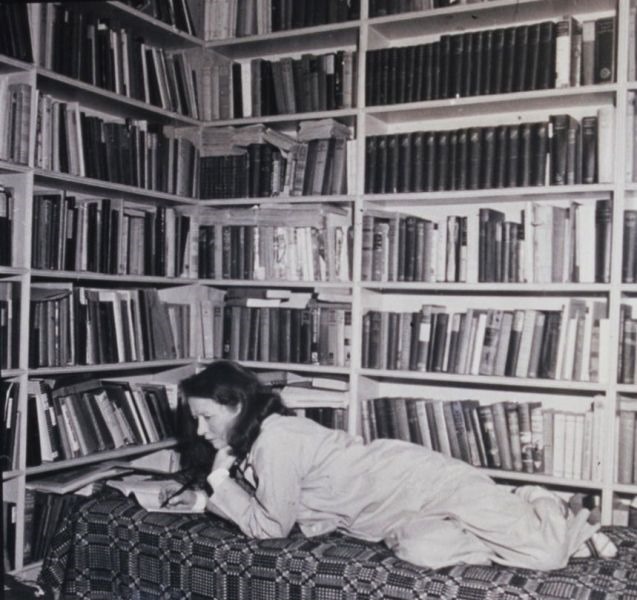
Millay with books

Millay at work. Other than the lack of guitars, just about the perfect décor.

I think it’s largely a case of her poetry not seeming to have the subject of their criticism: fresh, complex, allusive and illusive, imagery. Frost and Dickinson may have used homey sounding language, but in the end those funerals in the brain and snow, roads and woods added up to something to talk about in critical prose.

The New Critics were an inflection point. Before them, poetry was largely considered musical speech, a container that could hold a variety of subjects, after the New Critics, poetry was about the imagery, how you portrayed things with it. And unless one aimed for satire, such complex rhetorical structures must be in service to serious matters.

And so, there’s subject matter too. Millay’s great subject was love and affection, it’s presence, absence and all the shades in-between. In doing so, she addresses much of life and its condition, but did she receive enough credit for that? Is a heartbroken man a tragic philosopher of fate, and a woman merely a spurned lover? Narrow-mindedness can’t be ruled out.

“Rosemary”  allows us to examine these issues. This looks to be a poem about the death of a passionate love or the death of a dear one. I’m not sure which of those two possibilities is standing for the other, but for an audience, it does not matter as both events are common to our hearts.

I think there is an intent here to conjure a complex world of timeless folk magic. Though written in the 20th Century, it could have been written anywhere up to five centuries earlier. In the title we have rosemary, an herb associated with remembrance even in Shakespeare’s time (Ophelia’s mad speech in Hamlet for example), and in the first stanza we have rushes being scattered on a room’s floor, a custom from medieval times to hide the stink and mess of a less hygienic age, a strewing of reeds that may have included rosemary because it was thought to be something of an insecticide. Bergamot is another fragrant plant. Stink, rot and pestilence are all inferred subtly in this verse that on the face of it seems only a short catalog of flowers.

The second verse adds a rain barrel to catch rain, or is it tears? And what’s with that iron pot. Is it a cauldron? The poems last two lines are in quotes on the page. I was suspicious that the “An it please you, gentle sirs,” line was a quote, and finding out what it was from might be important, but I can’t place that line—if any reader knows, please clue me in.

And at the end of this timeless lament: “well-a-day,” which might sound to you or me like “have a nice day,” but is instead a word that harkens back to Old English, meaning woe-is-me.

What I think we have here is a poem, that read quickly, seems to be a trivial verse about some flowers with a bit of a kitchen scene, but it’s stated with deliberately archaic specifics so that the attentive modern reader might notice that time cannot heal this loss. And each thing in it is an image, though they don’t loudly announce themselves as such.

I’m reminded of my distant relative Susan Glaspell’s famous play “Trifles,”  where the domestic clues hide all the information the dense men seeking important information miss.

The Pentangle

The Pentangle. It’s not fair to compare. There’s 5 of them, and only 1 of me. Oh, and talent.

Musically, I went with bass, drums, two acoustic guitars and my voice for this. I was aiming for an impression of the sort of thing The Pentangle did many years ago. They were better at it, but it was good to try. Use the player below to hear my performance of Millay’s “Rosemary” or failing that, this highlighted link.

Oread

How did you spend your extra hour given to us by the Daylight Savings Time changeover? Some spent it snuggled with a loved one, or others for splendid dreams given time for extra chapters. I spent my night and hour wrestling with another poet’s poem and creating and performing music for it.

A few posts back we presented William Carlos Williams “The Red Wheelbarrow,” a widely anthologized and very short Imagist poem. My current feeling, shared in that post, was that Williams really was talking about a red wheelbarrow, a simple tool used for important tasks. Of course, he was also aware that the rain-glazed red paint of the wheelbarrow and the white chickens around it was a bold visual image, consistent with the modernist art he appreciated, and that he didn’t mind the provocation of calling attention to this without elaborate justification, any more than a classical painter or poet would think they would have been required to tell us why we should give a fig about Artemis.

Here’s another short Imagist poem, this time by Hilda Doolittle, who wrote as H. D.   H. D. knew William Carlos Williams from when Williams was a college student, but then H. D. knew or crossed paths with many of the principals of Modernism over her lifetime. Modernist poetry admitted more women creators than painting or music, or most other arts at the start of the 20th Century, but that’s a low bar to clear. H. D. cleared it however, and she continued to run her own race on her own course from the start of her career.

HD in Egypt

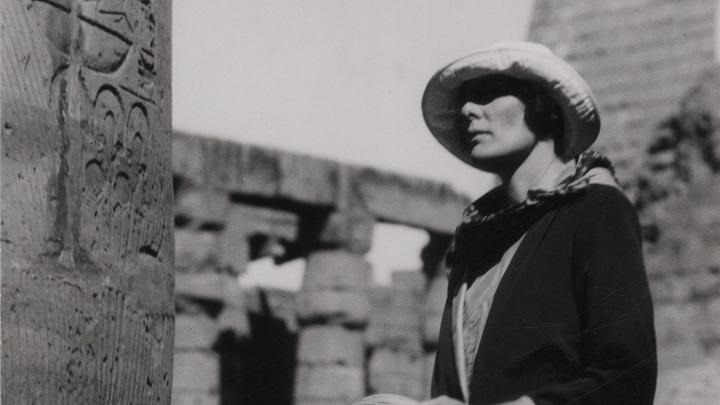
Another episode from HD’s remarkable life: she was present when King Tut’s tomb was opened in 1923


H. D.’s 26 word poem is much different from Williams’ 16 word one. It’s much stranger, and the internal state the external images present is more complex than even many longer poems reflect.

In some ways, the title “Oread”,  the effective 27th word, helps us. For those not up on Greek mythology, we can look it up, it’s a mountain nymph or spirit. Like many Greek nature spirits, an Oread is female.

So, from the title of the poem, we can say that it’s an Oread that’s speaking—but even if we grant that, this ain’t Tinkerbell. The supposed nymph is commanding nature, as a full-fledge god or goddess or a magician would. And the Oread is not asking it for protection, or forbearance, or even for it to put the hex on someone else, it’s asking it to do it’s best to overcome her. “Whirl” “pointed” “splash”, and “hurl” are some of those 26 words.

Another huge difference between Williams “Wheelbarrow”  and H. D.’s “Oread:”  the former is intensely visual, the later, just as intensely, tactile.

And who’s the Oread talking too? Three words in, it seems to make that clear: “sea.” Except the sea is described largely as a forest—a forest that can splash and form pools, but a forest at least as much as a sea. The sharpest readings of this is that the Oread is speaking of the sea with the images of the forested mountain (waves are like trees, water drops are like the needles of pines), but by saying it so, she is saying that the overcoming she commands is a merging of two like things.

I’m left with a conclusion that this is a spell of desire. Whether it is sensual, spiritual, or artistic desire makes no difference in the frenzied merger that is being called into being.

So, what did I do in writing music and performing “Oread?”  I repeat most of the lines at least twice, to emphasize the incantational aspect. Despite my recently expressed desire to re-explore artificial drum machine sounds, the percussion has lots of little instruments for a ceremonial air: shakers, maracas, cymbals, tambourine, even a chiming triangle. The main musical motif is a four-note synthesizer phrase that seems to be looping, but once again isn’t, as permutations occur throughout. The bass part rarely plays the same note as the synth motif, a musical effect that can be likened to “rubbing,” an apt metaphor for this sensuous poem.

To hear it, use the player below.