Sometimes the things we present here come together quickly. For example, some of the LYL Band pieces heard here are first takes where the musicians are reacting to the words spontaneously the best we can. Other pieces ask to spend a little time underground to think, like seeds think.
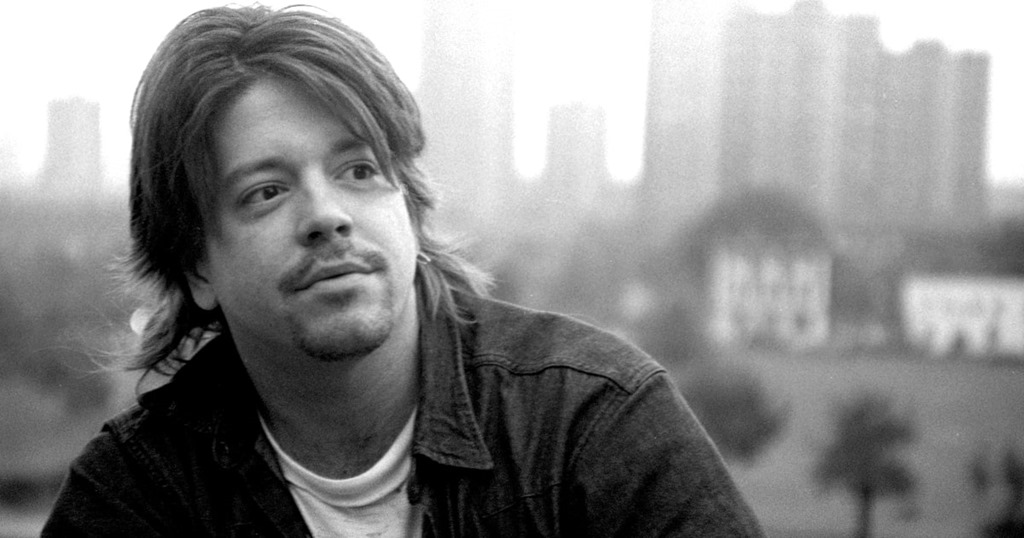
Today’s piece is one of those later ones. Nearly two months ago Grant Hart, a founding member of Hüsker Dü, a Minnesota indie rock group that achieved some fame before breaking up in the late 1980s, died. After Hüsker Dü broke up, Hart had continued working in music and visual art, some of it quite striking, none of it as well-known as it should have been. We are used to stories of a young person whose indie band is on the rise, there is less notice for those artists whose work continues past middle-age. After all, even when there are new levels to the work, there may be no apparent market. While thinking of him, I noticed, strangely, for the first time, that Grant’s name was, in effect, a two-word prayer.
Young musicians, young artists, need will and lot of work to get a chance to succeed.
But at a certain age, they will need even more of that will to continue to make art.
.
Around the same time, I was talking with Dave Moore (who you’ve heard here, vocally, keyboardely, and composerly) about his household’s garden bounty coming to an end.
These two thoughts combined into the words for today’s piece back in September. And early last month I wrote the music—so this piece has existed, on paper, for a month. I performed it on acoustic guitar for a handful of people in a living room in October. It seemed to work. So why haven’t you heard it yet?
I really wanted to get the performance right. And this month I attempted that, getting as close as this recording. I wanted it to be good, but I didn’t want it to be polished either.
Here are the words to “Garden Elegy (for Grant Hart)”
.
The LYL Band began roughly the same time as Hüsker Dü. We even shared a producer of our first recordings back in the day (Colin Mansfield). But we were much different. We were a band of poets and artists, closer to the Fugs or Billy Bragg than the Who or the Jam. And I was then, as now, not a consistent and confident performer and a problematic singer. That was my problem as a band-member back then. As passionate as I could be in my writing, I couldn’t find the heart to focus that passion on stage, to the detriment of the band.
So, it didn’t take just the two months the song was in process, it took some decades to get close to what this song requires. When you listen to “Garden Elegy (for Grant Hart)” you’ll hear me going for it as best I can, trying to focus passion. About halfway through you’ll hear the body of the guitar bang into the amplifier.
And that’s my prayer for artists today, perhaps your prayer too: that we may be granted heart.
Let’s get one more Halloween appropriate piece in before the holiday.
We’ve featured a lot of words from Dave Moore this month, but not enough of his voice, so let’s get to that with a performance by Dave backed by the LYL Band. Dave’s a founding member of the LYL Band, singing and playing various keyboards with it. Beside his own band, Moore wrote lyrics for other bands back in the beginnings of the Twin Cities punk/new wave/indie rock scene. Around the same time, Dave worked with Kevin FitzPatrick on a well-loved literary magazine “The Lake Street Review.” Besides poetry and songs, Dave Moore has produced the comic “The Spirit of Phillips” for many years.
Besides Dave’s words, voice and keyboards that are often present here, you’ve also read me talking about Dave’s father, Les Moore (he of the Bauhaus name). That should be enough background from me.
Alan Moore didn’t share any birthday cake with Dave. “Isn’t the book enough?”
I found Moore’s “Did You Miss It” mysterious, in a good way, so let’s let him tell us how it came to be:
“I could have called this ‘3 Moores Stew,’ where the ‘philosophies’ of Dave, Alan and Les collided in my head around the issue of predestination. It’s also an attempt to celebrate first-and-only-take songs.
For my birthday last year (#67), I got (my hero) Alan Moore’s 1200-pg. novel Jerusalem. Wonderful, literally. Took a while to read such an intricate structure, and parts of it started to show up in my dreams.
Concurrently, I was editing my dad Les Moore’s sermons, typing over 50 transcripts. I’d class him as liberal Methodist, the admirable socially involved 60s Christian. I heard him speak every week till I went off to college & expected that many of his words would bang something up from my subconscious.
The lyric starts in Alan-psychogeography-zone, where one of his characters is choking to death for hundreds of pages as reality is explicated.
The joke of the chorus is also from Jerusalem, shared by Sir Thomas More with another shade. How could you miss the free will you didn’t have?
2nd verse (‘more hairy’) extrapolates Alan’s simultaneous beauty & death across time.
3rd verse (‘Belief’) is Les’s gift of Heavenly beauty despite death.
4th verse (‘Lights go on’) Dave points out you make your own beauty & might as well enjoy it. If it’s yours, you can get the joke.
Unlike most of my mistakes, those in the concluding instrumental are intentional. If everything’s pre-destined, who would bother pre-scripting this? Or could they?”
“Beef stew, I tell you there’s no beef stew…”
Dave points out the contrast we get from having LYL Band performances mixed with the more composed stuff here, where I play all the parts. “Did You Miss It” is one of those “first and only takes songs” that we’ve done, were the arrangement and parts are happening just as the recording light is lit. Trick or treat? Mostly treat here I think.
It’s been too long since we featured one of the looser live performances of the LYL Band here at the Parlando Project, and with the interval, it’s also been too long since alternate voice Dave Moore has been featured. Given that we’re running up to Halloween, and that Dave has a long-standing interest in fantasy and scifi, it’s time to redress that.
Today’s piece is Dave’s adaptation of a short story by Anglo-Irish writer Lord Dunsay from Dunsay’s fantasy collection “The Book of Wonder”. The story is called “The Return of the Exiles.”
Yes, it’s Avebury, not Stonehenge. Poetic license applied for.
Lord Dunsay is one of those writers who had a long successful career during the first half of the 20th Century, but who now gets mentioned more as an inspiration than read as a writer. His Wikipedia entry has one of the longest lists of writers who’ve acknowledged him as an influence that I’ve run across. Everyone from Tolkien to Gaiman has tipped their hat to Dunsay.
Dunsay served in both World Wars and the Boer War.
Besides writing, Dunsay appears to have served in three wars. One hopes that future soldier-writers will be able to avoid reaching that achievement.
Dave adapted the short story to make it more musical, but his telling is generally faithful to the original. One detail retained, that I personally liked, is that our narrator is on a bicycle journey as the story begins.
To hear “The Return of the Exiles” use the player that should appear below.
Today’s selection was also recorded a few years back, and is more conventionally in that “poet reading beat poetry while a band backs the poet up” school of performance. While that’s one of the influences that has led to the Parlando Project, I didn’t want to confine myself to that style, and if you’ve been following along here with what we’ve done over the past year, you’ve heard some of the other approaches we’ve taken.
As I’m in a busy end of August, I don’t have time for much commentary on this piece, but I don’t think it needs it either, which is part of why it’s here today. This is a story set distinctly in South Minneapolis and the early 21st Century, and it talks obliquely about the time of falling in love with my wife. The Riverview Theater mentioned in the poem is still a going concern, a neighborhood single-screen movie house that shows movies near the end of their theatrical release without concentrating on any one cinema genre, leading to marquee billings like the one the poem mentions, a series of titles that often seem like little Dada poems to me.
Minneapolis’ Riverview Theater: Dada poem generator or movie house marquee?
Outside of the localism of the poem, the main obscurity in it is the title: “Like John A Dreams.” That’s a reference to one of my favorite speeches in Shakespeare’s Hamlet. In the play’s Act II, the hero Hamlet is asking why he cannot take action on the death of his father, and he rebukes himself as “Like John A Dreams, unpregnant of my cause, and I can say nothing…” John A Dreams was apparently a stock folk character in Shakespeare’s time, a foolish character who lived in his imagination and ignored more pressing reality—a character flaw all writers should be able to appreciate.
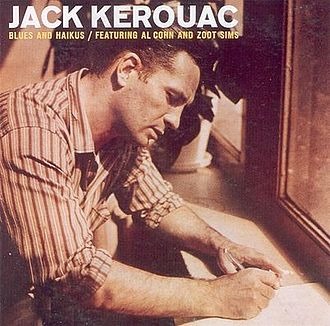
Parlando influence Jack Kerouac. “Beat poetry while a band backs the poet up”
Allen Ginsberg once recalled Jack Kerouac reading Hamlet aloud, and in particular this speech, with special emphasis in his voice when he landed on the “John A Dreams” charge.
So, if you’re a writer or other artist, Hamlet’s speech is for you. Your life is quite possibly bifurcated between that artistic thing you do and the life you press aside to do it. Art is often about making “and” choices. Life is often about making “or” choices.
To hear the LYL Band perform “Like John A Dreams,” use the player below.
We seem to be in a month of sky omens in the Midwest, with the Perseids meteor shower and a solar eclipse following one after the other. Perhaps because solar eclipses are rare, poems about them are rare too. I’m going to cheat then, and present two pieces about lunar eclipses, a slightly more common event that occurs when the Earth comes between the Moon and the Sun, blocking the moon‘s reflected shine.
I’ll lead off with one written sometime in the 19th Century: Thomas Hardy’s sonnet “At the Lunar Eclipse.” I remember the moon-trip photos, taken near the middle of the 20th Century, looking back at Earth, where for the first time, we could see our planet whole. Hardy reminds us, a hundred years before that, that we could see our whole Earth in a shadow play during the lunar eclipse.
For the first time we could see the big blue marble
…also, composting toilets!
Optimists at the end of the 1960s thought these whole Earth pictures would help us understand our solitary yet majestic unity and common cause. Hardy, though he had only the Earth’s shadow during an eclipse to work with, is not so sure.
The LYL Band’s performance of this Hardy poem is a live recording from a few years back and it strains to reach “bootleg tape” recording quality, but still I hope it retains some vitality. And since this Hardy poem is referenced in the next piece, I’m going to give this rougher recording an airing.
Though neither I or the Parlando Project had anything to do with it, if you’d like to hear a restrained and lovely simple solo voice and piano sung setting of the same Hardy poem, you can view it here. To hear the LYL Band performing our louder version of Hardy’s “At the Lunar Eclipse” use the player just below this.
My own lunar eclipse piece is set in our century, and in my Midwestern place. I start off by musing on the same planetary shadow play that Hardy wrote of, but wondering if we were our planet, might we make sport of our standing between the sun and moon, as we did as children when the film strip broke in class, or the slide tray of vacation photos needed to be changed, by making hand shadow puppets in the light. Then, as the blood moon eclipse neared totality, and the dark was dark, save for the streetlight at the end of the block and a houselight here and there left on, every hand up and down the street raised itself to the heavens, holding their lit smartphones, as they took pictures of the moon blocked by ourselves on our planet.
A blood moon eclipse. “Can immense mortality but throw so small a shade?”
Unlike our last pairing, the perennial face off between Marlowe’s Shepherd and Raleigh’s Nymph’s reply, my poem “Lunar Eclipse – The Earth in Transit between the Moon and Sun” isn’t really an “answer song” or a diss on Hardy. In a lot of ways I wanted more to simply update the scenery of Hardy’s poem. Oh, and that title is awkward, but enough listeners didn’t know the mechanics of a lunar eclipse, that we are in the middle on the earth blocking the Moon from the Sun.
What did I mean by the last line? Well, as I sometimes do, I wanted to mean several things. I wanted to say we thought we could capture this cosmic event that had stopped our routine in with the birthday pictures on our smartphone camera roll. I wanted to say, as Hardy did, that we are seeing the whole of our planet, the lives of all our neighborhoods, yet it is only one disk in the wide sky. I wanted to say that our present, particular lives: all our details, our family, our neighborhoods, our homes—though they are the way we experience living—are but one transit of life. Maybe I wanted to say something else that even I wasn’t sure how to say? If so, I wouldn’t know. Sometimes that happens in poems.
Again, we have the LYL Band performing this piece, but it has better recording quality. To hear it, use this player just below.
Here’s a piece with a short story written and read by Dave Moore.
Just as I have my bicycle ride poems, Dave has his morning dog walk poems and stories, and this one is one of my favorites. Dave tells me that he thinks he may have messed up the ending in this performance of “I Was Not Yet Awake ,” but I think it works just fine.
I’ll let the story unfold as you listen to it without a lot of commentary from me this time. “I Was Not Yet Awake” is a story about neighborhoods, neighbors, and trust, distrust and need.
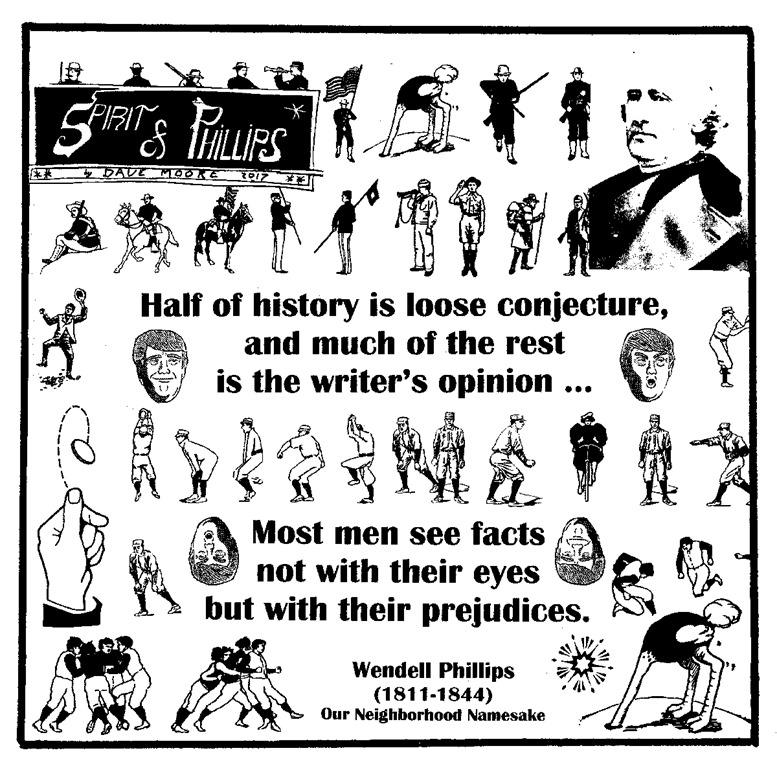
Dave Moore is also a cartoonist. His “Spirit of Phillips” reinvigorates the work of radical Abolitionist Wendell Phillips.
Dave is the alternative reader with the Parlando Project, and he also plays most of the keyboard parts you hear here on other pieces featuring the LYL Band. This story is much different from the last piece, where I tried to mash up Capt. Beefheart and Gertrude Stein, and it will also be different from the next episode. That variety in music and words is part of what we do. So go ahead and listen using the player you will find below.
Our audience growth in the past year has been largely as result of readers and listeners like you who have spread these audio pieces by sharing on social media or through their own blogs. Thanks to everyone who’s helped!
I promise you, we will end up today very close to the love song of the last episode, though we will travel a ways before we get there.
I’ve not featured any French writers yet with the Parlando Project, but as this summer has used the words of many 20th Century English poets, we may be overdue for that, as the start of that century found some of them looking to the French for some new ways to write.
French poets started to go “modern” before the British poets, around the same time that Emily Dickinson and Walt Whitman were making their own breaks with past practice in America, so they had a head start, and their avant-garde was way past the supply lines of conventional narrative and sentiment by the time the 20th Century really got rolling. The absurd casualties of WWI, largely fought in France and its neighboring countries, and so deadly to some of the generation of men doomed to fight in it, only accelerated the modernist direction away from the kind of meaning you might find in a political speech or battle plans.
This summer, 50 years ago, the Polish-French writer Guillaume Apollinaire coined a new word to describe a new way to approach the world in words: “Surrealism.” A few years later, his term was taken up by a group of artists who went about trying to practice a new idea, presented in 1924 as if it was a political manifesto, to write and create from:
“…The actual functioning of thought. Dictated by thought, in the absence of any control exercised by reason, exempt from any aesthetic or moral concern.”
The Surrealists went on from there, going in various directions, becoming less an idea and more of a brand—but stop and think for a moment, that original idea, isn’t it powerful? The idea that there is a reality that we agree not to apprehend, not to speak of, that we constantly reframe our thoughts to, isn’t that idea political as well as aesthetic?
You take the idea of Surrealism, add music to it, and later that century you get Bob Dylan. You take the idea of Surrealism, apply it to the current reality, and you are woke, not from the dream, but to the dream that should not be denied.
Today’s piece uses the words of one of the French Surrealists, Paul Éluard. Éluard, like many of the British poets of this era, was another veteran of WWI. One story of his war service was that, since he was a writer, his military superiors assigned him to the office tasked with writing the official letters to the relatives of the casualties, and such was the efficiency of modern war that he sometimes needed to write 150 of them a day. After a year of this, he asked to be sent to the frontline trenches.
Jean-Luc Godard’s film “Alphaville.” “I love you” could be the ending.
I have exposed you several times this month to pieces about the horrors of war and slavery, but I also told you we must travel a ways to get to today’s piece. After the war, as a founding Surrealist, Éluard produced verse with strange images and seemingly arbitrary combinations—Surrealist tactics to break the conventions—but his great subject, against the night, pain, and suffering, was love. Perhaps after those 150-letters-a-day forced march, he too wanted to look to war’s opposite.
Paul Éluard and the beloved, Gala. Eyelids not visible in this picture.
“L’Amoureuse” (The Beloved) is one of Éluard’s most famous early works, and uses my English translation of his words. The LYL Band performance of it was recorded live several years ago. To hear it, use the player below.
It’s now a commonplace to note how divided the United States is politically. The way the story is told, there are now two tribes, each sure the other side is largely wrong. We are said to know this, even if we are less than sure about everything “our side” may say, even if we are skeptical, even critical, of some in our faction. You may not believe that this is true about you, but this is what is widely said, and you may say something like this about others, even if you do not believe it about yourself.
I’m about to simplify a story, condensing its humanity so that you will only see moments in several people’s lives. That means you are going to need to pay attention, because the things it may lead you think about are only going to be there for moment.
On a summer day, 177 years ago, a sheriff bearing a writ from a judge knocked on the door of a house on the banks of Lake Harriet, which was then on the outskirts of Minneapolis Minnesota. If you live in Minneapolis, perhaps you know this lake. It just so happens that I’ve spent many mornings this summer reading poetry beside it, as panting joggers and conversing walkers surround it like clockwork.
The judge’s writ commanded the appearance in court of a piece of evidence. As he knocked, that piece of evidence was being told by the people inside to run out the back door and hide. The evidence did not obey. The evidence’s name was Eliza Winston, a 30-year-old woman held as property by the family inside. By her home state of Mississippi’s laws, her mother would have been property too, and her children, if she would have any, would be property as well, the same as livestock on a farm.
How did she happen to be in Minnesota? The man that owned her had traveled up the Mississippi river with his family to escape the heat of the South’s summer, taking a steamboat as far north as the great river was navigable. For his and his family’s comfort, he had taken one of his slaves, Eliza Winston, with him. The laws of the state he traveled to explicitly forbade slavery, but three years earlier the national Supreme Court had ruled that a slave named Dred Scott remained property when he had been brought to Minnesota.
Living in Minnesota then were people allied with a faction that sought to end the practice of slavery. They were looking for people claimed as property to contest those claims. How did they view the slave owners? Of course, as evil you may think. Wouldn’t anybody? Somehow, Eliza Winston had made contact with these slavery opponents. One of them, William Babbitt, would swear out a complaint that her slavery on Minnesota soil violated Minnesota law.
Imagine if you could own something as useful as another human being as property, to have complete control over them. Wouldn’t that be useful; and as a business venture, potentially profitable? The faction that owned other people certainly felt that way. How did they view that other faction, the ones who sought to end that practice? They viewed them as wrong certainly, but they also saw them as annoying self-righteous busybodies that needed to be taught a lesson, a view that was sometimes shared even by those that weren’t sure that slavery was a good and necessary thing.
Since Eliza did not hide, she was taken to directly to a courtroom. Despite the rapidity of the actions, the courtroom was packed with those from both factions. Eliza’s owner was there with his lawyer, who pointed out Dred Scott. The lawyer for Babbitt had testimony from Eliza Winston that she was indeed a slave, that she’d been passed around like property between several owners, and the lawyer stipulated that Minnesota’s constitution clearly forbade slavery in the state.
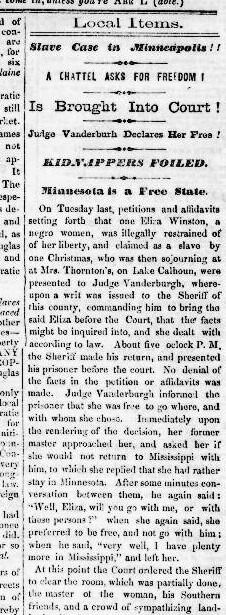
The judge ruled, that based on Minnesota law, Eliza Winston was now free. As soon as he pronounced, a clergyman in the crowd jumped up and condemned the decision as “unrighteous,” pointing out that, regardless of the state or federal law, Christianity and its scriptures approved of slavery. I don’t know more of what he said, but he could have claimed that Babbitt and his faction were worse than thieves and rustlers, in that they not only stole, they were self-satisfied in their actions. The crowd stirred at this, and then there was moment of calm in the summer courtroom. Eliza Winston’s owner walked over to the woman that he had owned like a horse or a cow, and he calmly asked her if she wanted to come back with him and return to Mississippi. And Eliza, no longer property, answered that she wished to be free and remain in Minnesota. As Eliza Winston left the courtroom, the Minnesota clergyman was still orating on the wrong that had been done to the slave-owner.
“A chattel asks for freedom”
That night, those angry at the decision went out around the town looking for Eliza Winston. What would they have done if they had found her? One can only guess. They surrounded Babbitt’s house and battered down the door seeking Winston or Babbitt, and crying for blood. They similarly broke into another house seeking Winston. Winston, however had been moved somewhere else, and may have fled as far as Canada. A year later the Civil War broke out, and Winston, no longer property, became as if a ghost. There are no pictures of her, no tales of great or even small things that she may have done. Some even say she went back to the south after the war. In Minneapolis there is an inconspicuous historical marker about her case, placed along the Mississippi river that brought her here, and not much else.
An inconspicuous historical plaque about Winston in Minneapolis
William Green has the most complete telling of the story I’ve seen. For a PDF click here.
Then last year Dave Moore was told a version of Eliza Winston’s story by a friend. The friend, or perhaps Dave, got a couple of the details wrong, and I have left a lot of details out of the story as well—that may not matter. Dave was struck, mixing Eliza’s story and the tale of his friend choosing to tell him this story together, and then forming this lovely, vulnerable song.
Here’s what I ask you, now that you’ve heard my telling of Eliza Winston’s story. If you ever find yourself in a world of factions, and you find yourself in one of those factions, perhaps not sure of what you think, but sure that the other side is clearly more wrong. Ask yourself what Eliza’s story, and the story of slavery tells you.
To hear Dave sing his Eliza Winston song with the LYL Band, use the player below:
The subtitle of the Parlando Project is “The Place Where Music and Words Meet”. As I mentioned last night, this project, which combines words sourced from a variety of sources with a variety of music, has now reached 100 available audio pieces since it’s official launch 11 months ago. Note that stress on variety. In terms of writers, I have my favorites, and the short format of our audio pieces strongly favors poetry, but the Parlando Project has featured words taken from other sources as well, and some of the poets featured were unknown to me until I ran across them looking for material, and I’m trying to vary the music as much as I can. Sometimes our pieces are as simple as acoustic guitar and voice, as in our most recent post The Oven Bird. Some pieces have full arrangements with multiple instruments, and some feature spontaneous performances by the LYL Band, a folk-rock band that’s been playing a rough and ready mix of electric instruments and literate lyrics since the early days of Minneapolis punk rock.
We’ve gotten thousands of downloads and streams so far, and though I don’t have the time to thank everyone personally for the likes and the shares, it’s been your passing on the existence of our audio pieces that has grown our audience from a few hundred downloads to thousands. I don’t have time for a social media presence myself. Researching, writing the majority of the music, as well as arranging, producing and recording these 100 pieces has taken an untold number of fascinating hours, but it leaves me little time to promote this work myself. So I’m very grateful for you, the readers/listeners who have done so.
Since we last did did a Top 10 in the spring, that growth in listenership has meant that there is only one returning piece since that list a few months ago. Which piece has the staying power? Lets start off the countdown in the traditional order, with #10.
10. Adlestrop – a late surge brought this piece with words by fateful British poet Edward Thomas into the top 10, just beating out Zalka Peetruza and Spring Grass as the final slot shifted back and forth this week. Adlestop’s download rate is noteworthy too in that its the newest post to make this list. Listening to this hazy slide guitar piece I still recall my own muggy summer unscheduled lay-over in Kingham a year ago, but that’s a private moment, though I feel somehow I’ve shared it with Thomas thanks to his words. In a more public way, this poem gains resonance from it’s connection to Robert Frost’s The Road Not Taken and to the Centenary of WWI.
9. Grass – speaking of WWI, here’s the first of two placings of a Carl Sandburg piece on this Summer’s Top 10. My private memory is performing this with the LYL Band, spontaneously as usual, with no rehearsal or warning as I read Sandburg’s words, and having us stop on a dime for line that starts “What place is this…” as Grass approaches Sandburg’s ending. For other listeners, particularly those with friends, families, and even ancestors lost to war, Sandburg’s piece asks a powerful question of forgetfulness.
8. Intro to The Waste Land – One could say this continues our WWI Centenary theme, as T.S. Eliot deals with his personal depression in the context of the aftermath of The Great War in this poem, but it was instead intended as part of our April “National Poetry Month” celebration, which I will always link to the poem’s famous opening line “April is the cruelest month.” This is one of my composed pieces musically, were I get to write and perform all the parts myself, which means I get to fully realize my personal “vision” of the music (something the listener needs to care not a bit about) and to therefore be responsible for all my own mistakes. My personal memories of The Waste Land are two-fold, one a memory of reading it for the first time in college, and though mystified, feeling an intense musical thrust in what Eliot wrote, and then to a time more than a decade ago when I felt just past my lowest ebb emotionally and then performed the last sections of The Waste Land spontaneously with the LYL Band, and found it as musical as I expected it would be, but also was surprised at how it expiational performing it was. Publically, the downloads of this have been steady, and have continued long past #NPM in April, so it’s either due to your sharing of it, or the poem’s continued fame.
7. To A Friend Whose Work Has Come To Nothing – Irish poet William Butler Yeats is another writer whose work we’ve mined for more than one piece here. One thing I learned while looking at material for this blog was that Yeats too believed that poetry performed with music was a necessary combination. Another investigation, brought on specifically by this piece, was to find out just who the friend was whose work had been thwarted, and what that work was. This has been another piece with a steady listening rate since posted. My guess is that the experience Yeats was telling us about is common to many, and whenever it is encountered it is not easily forgotten. Weeks after this was posted, I watched the former FBI director James Comey testify before Congress, and thought if Yeats was his friend, he would have said the same things in verse to him.
6. Clark Street Bridge – Carl Sandburg gets his second appearance on this Top 10 with this wistful story of day and night on this busy downtown Chicago river bridge. As a personal experience I got to see the Clark Street Bridge this spring on a visit to Chicago, and though the current bridge is almost 100 years old, it’s not the one Sandburg watched and wrote of. Another thing I learned during my trip: his night scene with silver singing stars equal in number to all the broken hearts in Chicago contained a larger number than I would have estimated from modern urban nights, as the poem was written before the widespread adoption of all-night electric lights. What are, or could, the listeners be attracted to? Well, broken hearts remain as numerous as the stars in a dark sky for sure, and Chicago has taken Sandburg to it’s heart; despite, or because, he says that that heart is broken.
5. The Death of Col. Bruce Hampton – I’ve written a number of direct tributes to musicians that I’ve featured here, but this is the most popular. Particularly now as the main lot of musicians fall back into the lower levels of the “gig economy” they gave their name to without additional payment, I see them as retaining the heroism of artists in general, who do what they do to general indifference, but now with a much lower chance of professional earnings. This is the only piece in this Top 10 where I wrote the words and the music, but that’s about the right amount, as the Parlando Project is about appreciating “Other People’s Stories” after all. The defensive shells and double-ended poison stingers that artists grow don’t always lead to happy lives, but those who knew Bruce Hampton have grateful things to say about him as a person and collaborator. And by chance, he got to come to the end his life with some of those folks thanking him, while he encouraged the creation of even more spontaneous art. I assume that’s the reason for so many people listening to this piece.
4. These Fought – Here’s one I’m a little surprised about. Ezra Pound may have done more than any other person to create modern poetry, but he’s less read today than many he influenced and championed. And though other modernists dabbled in between-the-wars nationalism and racial theories, Pound became America’s most notorious fascist apologist. And this piece, posted around Memorial Day is an uncompromising denial of the honor in the sacrifices of WWI. If you like your poetry feel-good and inspirational, if you like your poets cuddly and full of civic pride, this piece is not your choice. The LYL Band tries to equal Pound’s fierceness in this performance.
3. Love and Money – Unlike many other poetry and spoken word blogs, we feature other people’s words almost all the time in the Parlando Project. Of course, there’s nothing wrong with self-expression, but in following the Project’s dictum “Other People’s Stories,” we don’t do that often. Perhaps in consolidating that stated aim with the catalog of thought-provoking words that Dave has written over the years, many of the Dave Moore pieces I’ve posted so far have been performances where I perform Dave’s words–a mixed blessing that–because, to steal an old Columbia Records ad from the 1960s “No one sings Dave Moore like Dave Moore.” I was sold on this one the moment I heard Dave sing the first line of this piece as we spontaneously performed it, and there’s no way I could do it justice. The popularity of “Love and Money” probably has the same private and public reasons, it’s just a good song. Oh, and Dave’s pounding electric clavichord performance might have something to do with it too.
2. Up-Hill – Here’s an example of a poet I knew close to nothing about before looking for material in the public domain to adopt for Parlando performance. Having a long time love of the Pre-Raphaelite painters and knowing that poetry and poets were part of their artistic circle, I went looking for Pre-Raphaelite poems that I could relate to musically. I kept striking out. I really wanted to find something by Algernon Charles Swinburne, because, well, “Algernon Charles Swinburne”. Is there any name that says more clearly that you don’t give a damn about sounding cleanly modern and approachable? Only Ezra Pound’s invented persona “Hugh Selwyn Mauberley” comes close. Alas, I could find nothing I felt I could inhabit–and then I came upon some of Christina Rossetti’s shorter poems. Read this on the page just once, and you know it’s crying out to be sung. Perhaps Up-Hill draws listeners because it’s a Christian religious poem, but Rossetti’s writing personally connects with me because it’s imagery and expression is so non-abstract and modest.
1. Frances – Here’s the only repeat from last Spring, and it’s still on top, with almost double the total listens since released of the any of the others on this list. I released Frances on a lark to mark US President’s Day last February. I suspect it got picked up and linked somewhere more popular than other pieces that have been linked from here, but I haven’t been able to find out where. Here’s an example of how relatively popular it’s remained, long after it’s author’s, the first US President George Washington’s, birthday this winter: it was the 8th most listened to piece from the Parlando Project in May, still 19th in June, and currently it’s the 13th most listened to song in July, with a hundred alternatives competing with it. What accounts for this? Well it’s a love song for one thing. Maybe it’s the pared back Pixies soft/loud arrangement? It’s a mystery.
So that completes the Summer 2017 Top 10. I plan to do another one next Fall. If you’ve got a favorite you’ve found here, do what someone must have done with Frances, and go ahead a link to it to see if it can get more listeners.
Back when I was kid there was something we were taught to be concerned about, our “vocation.” This was somewhat like the perennial question “What do you want to be when you grow up?” but with a religious and spiritual aspect.
As the word “vocation” suggests, we, while still children, were asked to consider our calling, what task God would ask us to do with our lives. Yes, there as an expectation inherent in that, that some of us would find that we had been called by God to become Christian clergy, but at least in my small town and church, this was not set out as the answer most of us were to find. It was assumed that each of us would obtain a distinct answer fitting to our talents and the universe’s needs.
Religious paintings depict a calling as a clear and vivid action,, like in a comic book
The folks who provided religious instruction in my town were practical people, and I couldn’t picture any of them expecting us children to be visited by spirit birds, or hear mystic voices to lead our country into battle. Rather they expected a small inner voice to whisper to us that we should be family farmers, or mechanics, or nurses and so forth. In my family, I could look to a grandfather who I never knew, who was called to the Christian ministry, or to an uncle who followed his father’s path, or to the more complex stories of my parents, whose vocational path I’ll defer talking about for reasons of space now. It never occurred to me, but I could have asked my teachers or myself about my great-grandfather and namesake, who would have had to have been called to be a common laborer by this scheme. Somehow this talk of calling and vocation seemed a bit grand a process for that.
I never knew what to answer that question with until my late teens when I decided that I would be a poet. That’s certainly a grandiose enough answer for this religiously-infused process, but even in my naïve youth I knew that meant I’d be doing something else beside that with my lifetime. So, a calling, but no answer to what I wanted to be when I grew up.
Most decisions to become an artist of any kind expose a person to things that will mess up one’s life. First off, you are going to do something that is likely unlikeable—you are going to privilege your own interpretations of our common life as somehow more valuable than modest silence or undecorated space. Even successful artists most often have a majority of people judging what they produce as not worthy of their time, or generically replaceable by something similar but different from what you do. And these odds of rejection, combined with the concentration of effort needed for much artistic work, make many artists defend their self/center with self-centeredness.
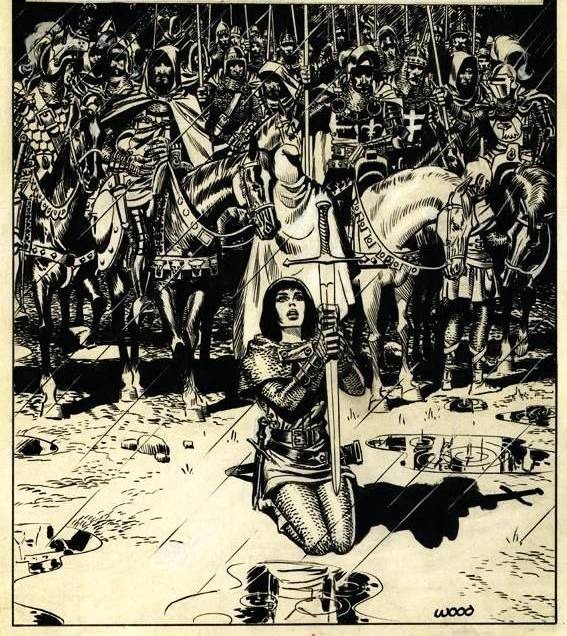
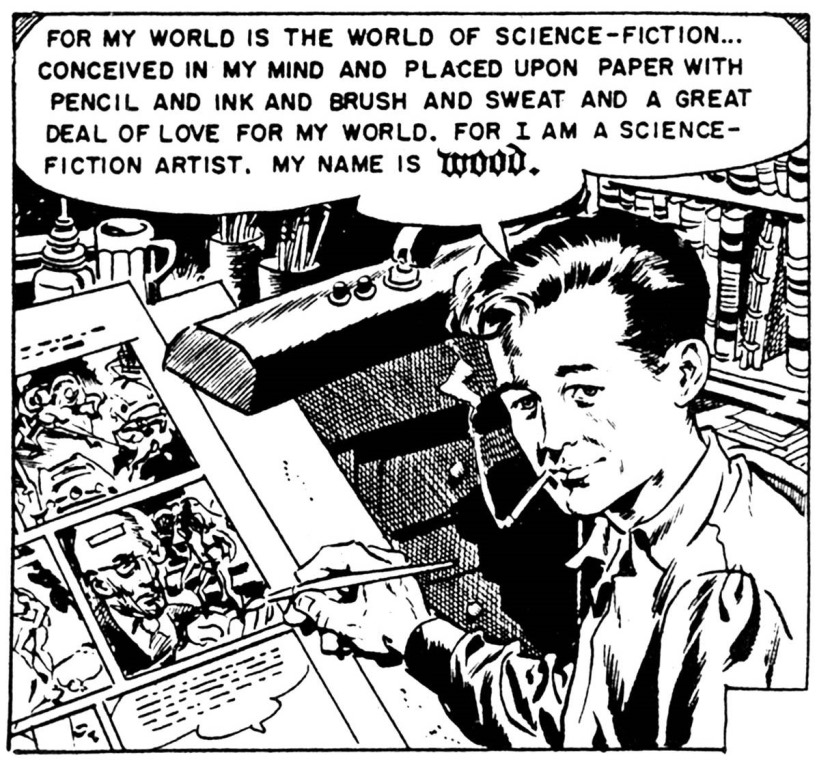
So there, as so often here in the Parlando Project, I’ve violated one of the principles that I set out to follow: I’ve spent time here with my story, talking about myself. Alternate Parlando Project presenter Dave Moore avoided this in today’s episode “Wally Wood” which Dave gave the longer title “Wally Wood’s Co(s)mic Philosophy.”
Here’s what Dave had to say about the piece:
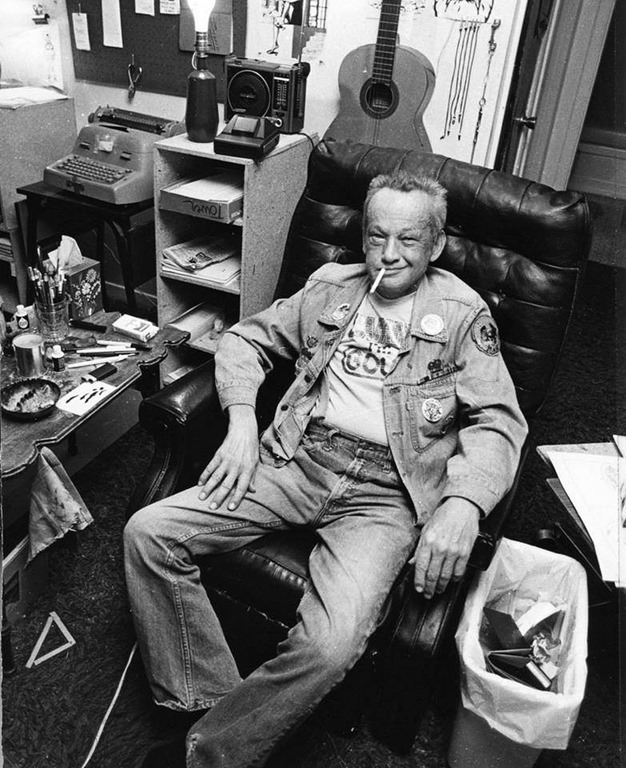
“Wallace Wood was one of the great comic book artists of the fifties and sixties. His detail work for EC Comics and Mad is still astounding to look at. Like many, he was also an alcoholic, and increasingly bitter as he aged. His words in the song are from a late interview in some fanzine.
I can’t draw, so far be it from me to draw conclusions about success or happiness. Or the scope of a talented artist’s frustrated Fifties ambitions. What strikes me most are the words ‘And yet’ after a pause. No matter what he says, no matter how things ‘work out,’ it was worth it for me and all the thousands of others who enjoyed his work. Go look him up, you won’t forget him.”
Wally Wood, combustible master of line
What did Wally Wood add the “And yet” to? Listen and find out, using the player below.








 Frank Hudson