Like the Touch of Rain

I wanted to get another musical piece up this week as I was somewhat dissatisfied with my performance in my last one here for Armistice Day/Veterans Day. I looked a pieces I had near ready, and selected this one, by Anglo-Welsh poet Edward Thomas. Thomas is lesser-known in the United States, but is more recognized in Britain where he often gets grouped as a “War Poet.” The main reason for that: he volunteered and was killed in WWI, and some of his poetry speaks about his thoughts as he considered volunteering for overseas front-line service.

Sitting in America, which hasn’t regarded Thomas enough, I’d like to expand him a bit from behind that label. First off, like Wilfred Owen (another British poet filed under war poets, and another WWI casualty) Thomas was something of a beginning poet,* but like Owen his poetic voice is so strong it doesn’t need to apologize for being early days. As powerful as Owen’s poems about trench warfare are, I’m just as impressed by his home-front poem “Shadwell Stair.”   And Thomas, this other “war poet,” seems not to have finished any poetry about his short front-lines experience before his death in that service. As we celebrate Veterans Day it would be good to remember that each person who served is not just their service.

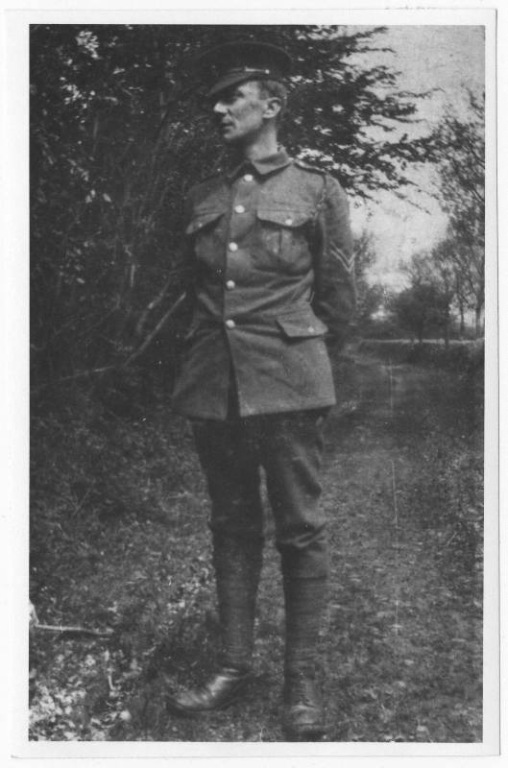
edward_thomas_in_uniform800

Edward Thomas in his uniform. He was married and past the age of most soldiers, but still volunteered.

.

So, here’s a poem that I think has nothing to do with the war directly – perhaps not indirectly either. “Like the Touch of Rain”  seems to me to be a love (or rather a loss of love) poem, though the nature of the relationship is not spelled out.** It uses as its central symbol rainfall, and I suspect it’s speaking of erotic love because of the sensuous opening where the rain, however wild, is caressing the poem’s speaker and he sings and laughs here. The poem ends by telling us he’s now closed in, out of the rain, not by his choice but by some her’s “Go Now.” It’s a turn-about from the typical “Who’ll Stop the Rain”  or “Shelter from the Storm”  depiction of rain vs. shelter. Here’s a link to the text of the poem that I’ve now turned into a short song.

“Like a Touch of Rain”  is not the most complex or virtuosic poem, but it also doesn’t detract from its depiction with any overreaching or stilted poetic diction. There’s a power in that. Reading Thomas’ contemporaries’ poetry in search of material for this Project I’ve read a great deal of published poetry that doesn’t escape those faults. My wife gave me a copy of Thomas’ collected poems a few years back – it’s not a thick volume, and I believe that most of the poems in it were first published in this collection posthumously through efforts of Thomas’ friends.***

After overreaching with my Padraic Colum poem setting earlier this week, and having to settle for an incomplete recording, it may behoove me to leave today’s piece as just voice and acoustic guitar accompaniment – and as rough-hewn as my voice is on this performance, I think it’s better too.

You can hear my performance of Edward Thomas’ “Like a Touch of Rain”  with the audio player below. What, has the door to any such player gadget been shut? Well, this highlighted link will open a new tab with its own audio player.

.

*Thomas took up poetry only a couple of years before his death, at the insistence of his American friend Robert Frost.

**I have not read a full biography of Thomas, but before the war he seems to have had a complicated set of affections as well as bouts of depression and drug use. Those two things might cause one to suspect a ne’er-do-well life, but through-out that he wrote voluminous freelance reviews and essays to pay the bills for a young family.

***Friends? Well, Frost for one. And since one of the good things in my post before this one was the discussion of poets best remembered for what became a song lyric, one of his close affections was with a young writer Eleanor Farjeon, who wrote what became the lyrics to the song “Morning Has Broken.”

Credo (The Will To Love)

A friend of the blog noticed today I used a particular phrase when I wrote about late-night work on the musical piece you can hear below. I’ll try not to take too much of your time, but I thought I’d expand on my explanation to him, and at the bottom you’ll be able to hear a 2-minute song made from a poem by Alfred Kreymborg.

The early years of the Parlando Project benefited from several things that are not in as great a supply now: I had multiple days in each week when I could work on finding and making these musical pieces. I worked regular workday hours on this, beginning after my morning bicycle ride for breakfast. I was eight years younger then, and those days were filled with rewarding creative work as I learned more about musical composition and recording technology. Shortly after the public launch of the Parlando Project, we had a consequential election in America,*  but that (if anything) increased the energy I found most weeks.

Those who happen upon early posts here might notice a tone that isn’t as common in recent years. Without announcement, I was writing back then with my child in mind as an audience. They were going to be entering the 6th grade, and I vividly recall from my own youth how a great vista of complex, connective, and evaluative thought opens up around that age. I wasn’t going to make it a point to them to read this — adolescents aren’t looking for that sort of thing from parents — but rather more, I thought others in their peer group might come upon this Project and find some interest in my promotion of discovery and enjoyment. Working from that aim, as my child grew, I gradually changed the age group I was aiming the blog writing here at — though I don’t know if I ever achieved an adolescent audience.

Then a few years ago my family went through a series of crises, and it was only after a period of distress that the wise and resourceful members of my little family met those issues and managed them. I tried to be supportive — I probably was, to my imperfect degree — but that work was largely their doing. I’ll say that in that year or so of the greatest distress, my time spent here was a tonic for me from the stress and worry. How much of that was (in the modern terminology) “self-care,” and how much was temporary flight from responsibility? I can’t say, my perspective is too close-in.

But now in the past year or so, the time I can devote to this Parlando Project is constrained by external and internal factors. By choices outside my control, days go by when I’m restricted from recording, and even the blocks of assured time to compose or research are harder to come by. At the same time my energy endurance is lower as I age. As grateful as I remain to have the opportunity to do this Project, I guilt and grumble as an old codger when an opportunity comes — time when I can play or record — and at that moment my body is saying: take a nap instead. If I could schedule creative time, if I was to ask for concessions to schedule it, I’d probably face complex outcomes and reactions when my old body can’t be assured the energy levels and ready fingers like my 70-something self could.

Let me be complexly-clear about that though: that frustration doesn’t outweigh the gratitude. To have the opportunity and resources to do this Project remains a blessing! I just have to work with this, that’s all.

Here’s one “how” of that: after everyone in the house has gone to sleep early, or is at work on an evening shift outside our home — I can do my work, as long as it’s in silence. Knowing this, I often get a “second-wind” after 8 or 9 PM or so. I might spend this time researching or writing early or final drafts of these posts. There’s even limited music-making that can be done without making noise. I can go over the things I have been able to record, evaluate if they are worth using, perhaps adding additional parts silently using my little plastic keyboard, and mix the results into something suitable for releasing to the public. So: the hours between 9 PM and 1 AM have increasingly become working hours for the Parlando Project.

I’ve come to call that time “burning the midnight lamp.” As I told my online friend this morning, that phrase is taken from two particular sources — ones you might not guess could be combined.

“Burning the Midnight Lamp”  is a song, a lesser-known “deep cut,” by Jimi Hendrix. The song had a long gestation, Hendrix struggled to complete it. It was written early in his Jimi Hendrix Experience career, while living in London. Hendrix was a young man who previously had been in the care of a succession of childhood relatives, foster homes, and then a short Army barracks stint followed by couch-surfing until this point. For the first time he had his own place, shared with a woman in what sounds like an equality of love.**  That Hendrix London flat has been restored to appear as it did then, and when I visited it some years back I thought of what a special place it must have seemed to him. I imagine his thoughts: my own place, paid for with my own money, living on my own recognition, work done under my own name. In anyone’s life (not just a “rock star”) the time when one has achieved that — that’s something.

Here’s an odd connection: when you visit the site it’s a joint institution. Hendrix’s apartment is upstairs, but the main floor is laid out to reflect another emigrant musician of another era: this address was also George Frideric Handel’s London home.

When Hendrix was searching for the extra sound needed to complete his “Burning the Midnight Lamp,”   he found the recording studio he was in had an odd instrument present: a harpsichord. Comparing Hendrix’s guitarist skills to my own would be laughable, but things even out in naivete when at the musical keyboard. Today’s song uses piano, but I had to play separate right and left hand tracks to realize the simple part. Likewise, Hendrix hacked out a little harpsichord part for his song. Was Hendrix tipping his hat to his downstairs ghost with that harpsichord?

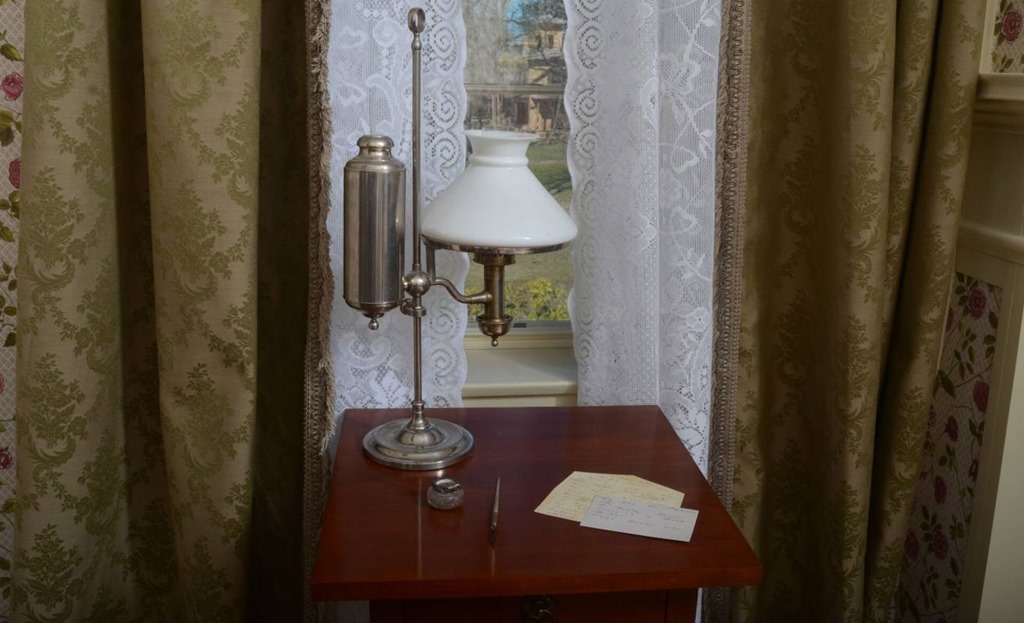
Why did Hendrix write his tune about working late within the endemic uncertainty of creatives using the image of a lamp? No guess. But another lamp, elsewhere, in another visit: something I recall when visiting Emily Dickinson’s bedroom was the little table that was her writing desk. On the small top of the table was a whale oil lamp. Dickinson, living with her family in a household, with household tasks and human needs that would take the daylight hours, had this little mid-19th Century, middle-class luxury of a warm effective light to work by after the busier-with-others’ hours.

dickinson's desk and lamp

“Ready for the same old explosion/Going through my mind…” A small writing table and lamp in Emily Dickinson’s bedroom (photo from the Emily Dickinson museum)

.

Looking at Dickinson’s lamp, I thought of the whole system that represented: the swimming mammals of the dark, cold sea, the diverse Moby Dick industry which captured, killed and deconstructed those massive bodies — and so, extra hours glowing with North Atlantic juice opened for a woman to scribble and sew little booklets. If I’d try to tell these thoughts and feelings when looking at the lamp to the average person, they’d sense a disproportion. Someone might even harrumph to me “It’s just a lamp — an unexceptional, domestic thing.” Readers here? You’re not that sort of person — and on her part, Dickinson too, she had further thoughts.

And so I continue, to burn the midnight lamp. Alone.

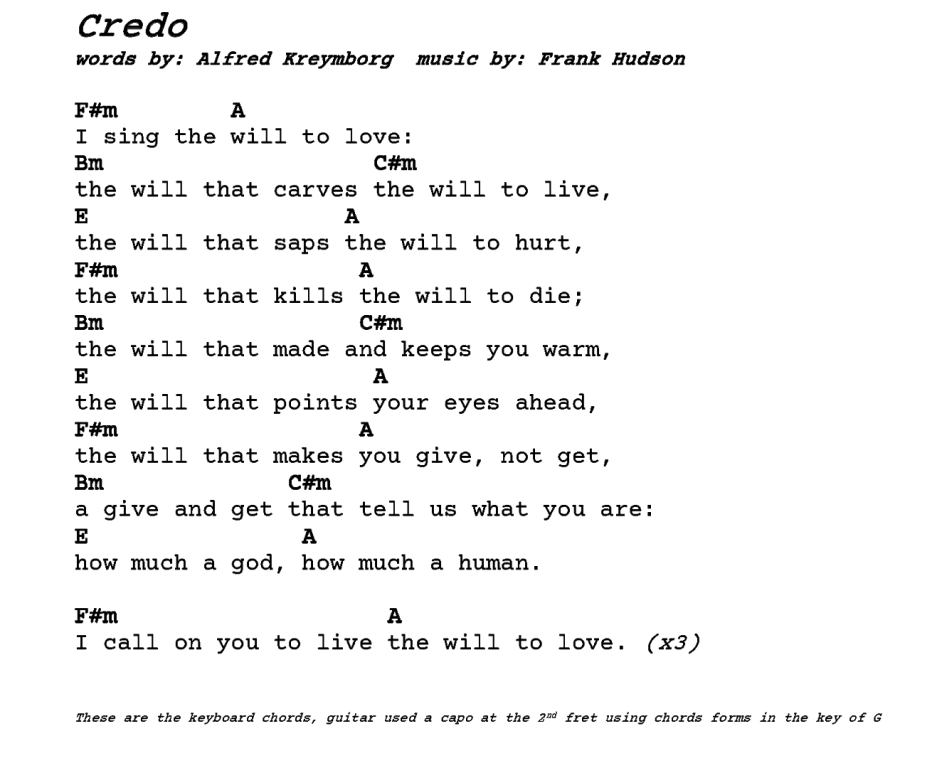
Today’s results came after a week of disappointing myself as I looked for some words to express what I was feeling, words that would ask me to sing them out even with my inexact and unprofessional voice. I was seeking words that would add something hopeful in a time of extraordinarily slipshod callousness carried out with motives of punishment as a virtue. It was this short poem by early American Modernist poet, editor, and publisher Alfred Kreymborg that captured me.

Credo keyboard chords

As I often say here under these chord sheets: someone out there can likely sing this song better than I can.

.

Last post here was a series of inspirational maxims carried by a Jazz musician. Maybe Kreymborg’s “Credo” seems a little too hopeful, too earnest for some of you. It’s probably not the sort of poem you’d first think of as an early text of American Modernist poetry from a colleague of William Carlos Williams, Man Ray, and Mina Loy. Little matter, I felt I needed to sing it. That’s enough for now.

You can hear my performance of “Credo”  with the graphical audio player gadget below. No gadget? It’s not that you didn’t keep your lamplight trimmed and burning, it’s just that some ways of reading this suppress showing the player gadget.  This highlighted link will open a new tab with its own audio player.

.

*Decades before, longtime Parlando contributor Dave Moore and I started the LYL Band just before Ronald Reagan’s election. Then too something that wasn’t very good for the country paradoxically encouraged creativity as contrast.

**This short video shows the flat decorated to look just as it was in the mid-Sixties, and features Hendrix’s then-partner, Kathy Etchingham, speaking briefly about their time together. Hendrix, like other struggling musicians, lived before largely at the behest of his hosts. From accounts, the two lovers seemed to be in a somewhat equitable partnership (within the expectations of the time). Etchingham worked as a DJ in London clubs and had a resident’s knowledge and straight-white-British appearance to bring to the arrangement. Hendrix’s fame was still somewhat localized, and his uprising career had offered him a semblance of a regular income.

Isabel

I enjoy the part of this Project that gives me cause to examine the lesser-known and forgotten poets and poems. Even the most famous literary poetry principally exists in quiet books, but give me a book now largely unread and my interest is perked.

Today’s poem is by Richard Hovey, one of the co-authors of a remarkable yet forgotten three-book series that began with Songs from Vagabondia  published in 1894. Who was Hovey?

He was the son of a Civil War general* who privately published his first book of poems in 1880 when he was a teenager. He attended Dartmouth College, graduated with honors in 1885, and was highly active in literary activities there, coming to write what remains the official school song. After college he seems to have considered various paths. He studied for a while in New York’s General Theological Seminary, taught briefly at Barnard College and Columbia University. In 1887 he met his Vagabondia  co-author Bliss Carman, and true to their eventual series title, they spent some time tramping around New England. Hovey wrote that he decided to dedicate himself to writing on New Year’s Day of 1889 while viewing a solar eclipse, which seems somewhat magical for an epiphany, but yes, there was an eclipse on that date. In 1891 he began publishing a planned lengthy series of verse plays based on King Arthur’s court, and he seemed to have traveled to Europe around this time where he met writer Maurice Maeterlinck and took on the job of translating Maeterlinck’s work into English. Hovey was also enamored with the French Symbolist poets and did English translations of their work.

Let me set the literary stage for this young poet as he began his career: Verlaine, Rimbaud, and Mallarmé were still alive. So was Walt Whitman. So was Mark Twain. The first and just-posthumous volume of Emily Dickinson’s poetry was still in process. Ezra Pound was a toddler in Idaho. While Hovey was a college student, Oscar Wilde toured America giving lectures on Aestheticism.** Hovey and Carman, with their on-the-road poems of beauty and poetry, of wit over dour seriousness, seemed to have resonated.

Richard Hovey with his mother

Richard Hovey around the time of the Vagabondia books. The woman here is his mother Harriet, not his “older-woman” wife Henrietta. A cousin who knew the young Hovey wrote that he “was so strikingly good-looking that I have seen people turn in the street to look after him.”

.

I learned one other possibly salient fact about the time Hovey and Carman were putting together the first Vagabondia  book. In 1893 there was a sudden economic depression in the United States. Vagabonds were not always free-thinking college boys yet to establish their literary careers. Was there a sub-rosa political/economic point at the start of this series? There’s little I’ve found in the Vagabondia  books that tip me to Hovey’s political stance, if he had formulated one.

I chose Hovey’s poem “Isabel”  from Songs from Vagabondia  partly because it was short and naturally suggested being set to music on first read. Given that I was also trying to get a grasp on Hovey’s life, I wondered who this Isabel might be. I didn’t find out. There’s no Arthurian Isabel, and I haven’t found any prominent Isabel characters in the works of Hovey’s literary heroes. I believe it was a somewhat common name in this era.***

Despite Vagabondia’s  praise for male comradeship, I’m not (as yet) catching any homoerotic overtones there. Where eros does appear, it seems directed at women. The only romantic relationship I know for Hovey was a married woman who he had a child with and later married after her divorce. If you want to wonder at Hovey’s sexuality from afar, clouded in a sexually repressed time and with the small amount of information, I can only offer this tidbit: his lover and eventual wife was said to be “old enough to be his mother.”

Indeed, after all this search for biographic info, today’s poem might seem a tad insignificant. As a short love poem “Isabel”  reminds me of Robert Herrick more than any of Hovey’s contemporaries, and she might be only a device to let Hovey write that sort of poem. In straightlaced society I suppose the poem’s breast-pillow line could have seemed 1894-era hot stuff, but I’m immune to that level of “I’m so naughty” eroticism — likely why Swinburne (also still alive in Hovey’s time) always seems laughable to me.

But Aestheticism holds that a poem doesn’t have to have great wisdom or weight as long as it’s beautiful, so I spent more than my usual amount of time with this 6-line poem’s music to justify asking for your attention to it. “Isabel”  uses some of my favorite odd chords and flavors, and you can hear it with the audio player below. No player?  This highlighted link will open a new tab with its own audio player.

.

*Father Charles Hovey was the President of what is now Illinois State University in its early days, and organized the 33rd Illinois Regiment (known as “the Teacher’s Regiment”) at the outbreak of the American Civil War, serving the Union as a Brigadier General.

**The fact of Oscar Wilde’s tour I first learned about from an episode of the TV Western Have Gun Will Travel Those who knew him remember a young Hovey who seems to have taken Wilde for a model, dressing like him with colorful topcoats, long hair in a center-parted style, and dyed carnation corsages.

***I wondered about writers with that name Hovey could have read. The only hit in that search was the marvelous early 19th century folk poet, folk singer, and tavern keeper Isabel Pagan. Pagan’s poem “Ca’ the Ewes to the Knowes”  was popularly set to music by Robert Burns, a poet who Bliss Carman extolled earlier in this series. I did read that Hovey either knew or took classes with Francis Child, of the famous Child Ballads collection. That the Vagabondia  series calls itself “Songs” is evidence that folk song, at least of the literary variety, is one its elements.

The most famous poetic Isabel remains Ogdon Nash’s from 25 years later.

O But My Delicate Lover: Canadians translate Sappho

I regularly read and take part in a daily poetry thread on X/Twitter. Its host, Joseph Fasano, posts a theme word and an example poem reflecting a topic most mornings, and other poetry readers respond with poems that relate to that. Early this week the theme was “Longing.”

One of the responding poems was this one:

Sappho-Carson Longing

The X/Twitter poster here happens to be a relative of mine, though I’m not sure which one

.

This is an English translation of a poem by the ancient Greek poet Sappho rendered by famed Canadian poet and translator Anne Carson. If we didn’t know it was a translation, if we thought of it as a poem by a modern poet, here’s one thing we might notice on the photographed page: those short lines, those white spaces, those fenced-off blanks kept apart by square brackets. Looking at the text this way, the poem on the page has a striking effect. Its incompleteness — its, well, longing — is amplified in those spaces.

In Carson’s presentation that’s an inescapable part of Sappho’s work. We have only fragments of Sappho after all, only a handful of her poems are even comprehensively within sight of being complete. Some Sappho fragments are but single words, and many, a phrase or a few lines. And we know so little of the poems’ context. What details recorded about Sappho’s life date at best from centuries after she is thought to have lived, and are inconsistent. That she was a woman in a male dominated world, and lived in an outlying area away from the centers of classical Greek culture that we most know from later surviving works adds to the mystery. That the Greeks of the Athenian Golden Age, or the later Hellenistic Greeks, misread is some way the larger corpus of Sappho still available to them as they supplied us with Sappho quotes, commentary, and biography is plausible.

As readers of modern poetry, we likely assume when reading a Sappho poem that it’s a more-or-less authentic voice of someone describing a moment in her own life. I can’t say that as being a sure thing (any more than it is for, say, Shakespeare’s sonnets). But maybe that makes little difference, especially in the absence of well-attested facts — the words have the effect they have on us, based on our own lives, our own culture, our own time.

Carson’s translations are well-regarded, but she’s not the first to translate Sappho into English — she’s not even the first Canadian to do so. The first attempts there I know of, likely the first in fact as it’s by such an early Canadian poet, were by Bliss Carman.*  In 1904 Carman published Sappho: 100 Lyrics.  Unlike Carson, who is a scholar, I don’t know if Carman was all that knowledgeable in ancient Greek, and from what I can find he’s less open in sharing translator’s notes on his methods. The preface to his book, written by a friend, says only he more-or-less imagined the poems as complete and wrote then from that imagination.

From a scholars’ standpoint this is an outrageous act. On the other hand, there’s a current in poetry of writers finding something in assumed characters, some for anonymity, some for fraudulent reasons, some to burlesque writing styles they wish to make fun of. Carman’s life was not straightforward. There were a lot of bumps and setbacks in his career — all as one might imagine at a time where the idea of a Canadian literary poet was yet to be established. So, to take a vacation from all that to the isle of Lesbos and imagine Sappho strumming her lyre within his earshot? Maybe understandable.

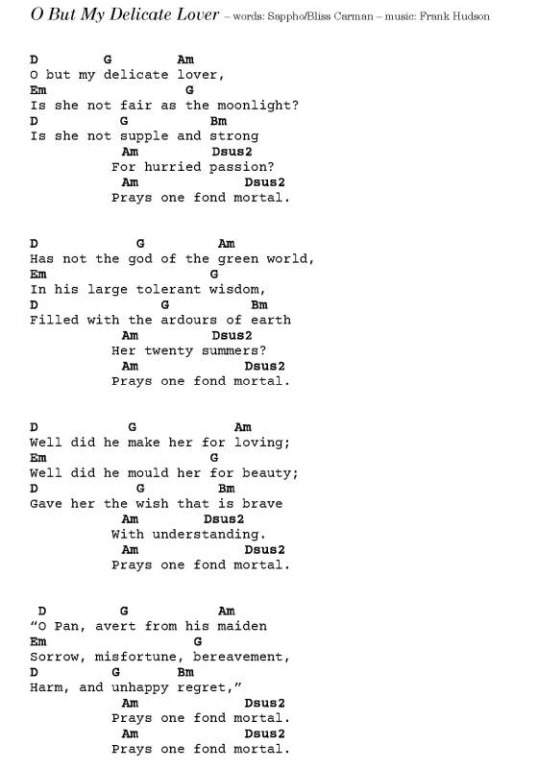
O But My Delicate Lover

Another green world. Here a chord sheet for today’s musical performance.

.

Published in the era just before the outbreak of English-language Modernism, Carman’s version of Sappho found some readers. Ezra Pound apparently read them, and in his loose Chinese translations and elsewhere he seems to have adopted a no-hurt, no foul practice of translation as a personal recasting of the original work. Carman’s Sappho is sensual without overelaborate decoration or any “I’m so  naughty” stance. I can imagine some of those Not-Yet-Modernists who kept a well-thumbed copy of Swinburne in their back pockets circa 1900 appreciating these poems. If the tropes in these love poems are often common ones, he’s portraying Sappho who would have predated those tropes becoming commonplace, and he’s asking us to believe our moments are repetitions with a long heritage.

Many modern readers of Sappho have adapted Sappho as a pioneering Lesbian poet. In the many centuries between Sappho’s 600 B.C. E. and the present there have been a variety of renderings of Sappho’s sexuality. The text, fragmentary as it is, often shows attraction and praise for women and female gods. If we assume Sappho herself is the voice in her poems (and why not, we know so little, and nothing for sure, and Occam’s razor) this would follow. In this poem of Carman’s Sappho, the lover and object of longing is certainly female. Bliss Carman was an apparently hetero male, but his poem’s assigned author is a woman. Parsing….

Those that object to drag-time story hour at the library will have a hard time with all that. If for only that alone, I’m going to give voice to this poem from Carman’s collection of imagined Sappho translations. You can hear my musical performance of “O But My Delicate Lover,”  with the audio player below. Has the important fragment that includes an audio player disappeared for you?  This highlighted link will open a real, not imaginary, tab with its own audio player.

.

*Carman’s 1904 work may also be the first American translation of Sappho, as it predates the top hit in a web search that shows Mary Barnard’s 1958 volume as the first from the U.S.A.  Coincidently, Ezra Pound is attributed as someone who encouraged Barnard to do her book of Sappho translations.

Carman studied in the U.S. and was distantly related to Ralph Waldo Emerson. His ancestors emigrated to Canada as Tories escaping after the U.S. Revolutionary War.

Sara Teasdale Again: Advice to a Girl

Here’s another short poem by Sara Teasdale that I’ve done the Parlando Project thing to by making it into a song. As a young woman, Teasdale won the Pulitzer Prize for poetry in 1918, but as the century continued her poetry lost some of its literary/academic esteem for not being written in the manner of High Modernism’s Hermetic allusions.*

Teasdale grew up in the same turn-of-the-century St. Louis Missouri as High Modernism’s Chief Mage T. S. Eliot, though I’ve never been able to establish that they ever met as young people. One plausible reason why not: both were educated in gender-segregated schools for the most part. And Teasdale’s early life was like late-life Emily Dickinson in its isolation, largely confined to a room in her family’s home due to some vaguely defined illness. As a young woman she was able to break away from that confinement, moving to New York City and engaging with other literary figures there during her heyday as a poet. Like her contemporary Edna St. Vincent Millay, she married a non-literary man after romances with other poets, but Teasdale’s marriage was less successful.

Teasdale’s Pulitzer-honored collection was titled Love Songs,  and that does describe her most common subject. Today’s poem, at least on face value, is one step removed from a personal experience love poem, posing itself as a poet-supplied maxim applicable to a disappointed-in-love younger woman.** I’d dispute that the poem’s advice is only useful for women — but then the specific in poetry often stands for the general. Here’s a link to the text of this short poem.

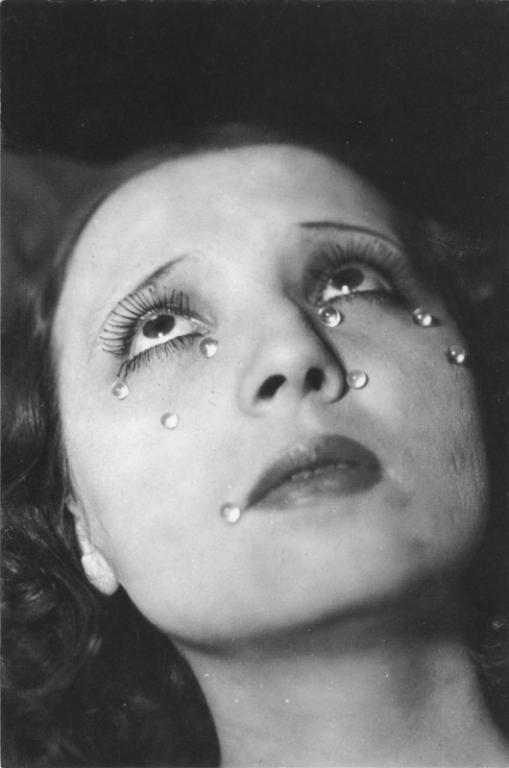
Man Ray Tears 800

“This truth, this hard and precious stone, lay it on your hot cheek.” Photograph by Man Ray

.

Like many of the poets I feature here, Teasdale’s Wikipedia page is brief and fragmentary — but one thing it does document: her work has been set to music often, and by a wide range of composers. Early in this project I mentioned that singer-songwriter Tom Rapp’s setting of a Teasdale poem was an early inspiration for me. One could make the case that it was us composers, more than literary academics, who maintained Teasdale’s art until it could be re-engaged with.

Part of me wishes I could’ve produced a more polished performance of Teasdale’s “Advice to a Girl,”  but my current life often reduces the time I can spend on the musical pieces. I like the harmonic cadence in this song’s music, but I expressed that with just an expeditious strummed guitar part along with some acoustic bass accompaniment. Still, the idea’s there now, and an unexpressed idea easily fades and disappears. You can hear my performance with the audio player below. If you don’t see any audio player, there’s also this highlighted link which will open a new tab with its own audio player.

.

*That I’d write “Hermetic” there indicates that my moods and mind are not opposed to that kind of poetry — but then I’m also not opposed to poetry that speaks of our ordinary and present human relationships, which in their complexities and footnotes exceed any grimoire’s or textbook’s breadth. Just as with music, I’m a poetry eclectic.

**This poem could easily be read as someone talking to and soothing the memory of their own younger self. Our youth may lord over us with its misapprehensions we cannot correct, and that time-separated self often benefits from our wiser selves speaking to them from later up the years.

Dooryard Roses & the death of John Mayall

Here’s another one of these posts that is going to jump around a bit, though I’ll keep it brief, and there’s a heartbreak poem set to music that I’ll end with.

I don’t post every time some figure influential to me dies. It should be apparent to long-time readers of this that that group of influences is wide, and therefore large. Still sometimes the spirit moves me. This week a midlist musical figure, John Mayall, died. He was 90 — so not a surprise to any actuaries in my audience — but his extraordinarily long musical career (he was still regularly touring up until the last few years) might have masked the imminence of that death.

I can’t quite figure how many of you will recognize his name, and of those that do, how many will see why I’d count him as an influence. I often worry, what with the variety of the musical settings I publish here for strangers to listen to, that someone listening to one, two, or three of the Parlando musical pieces will think that I’m fixed in some musical genre. “Oh, he does folk-song-like stuff with solo acoustic guitar.” “Some kind of rough garage rock thing, isn’t it?” “Do you know you sound like Bob Dylan?” “What’s with all those orchestral instruments — and was that a sitar?” “You know, that beatnik to poetry slam kind of spoken word over spare Jazz backing stuff.”

To my mind, my aim is to vary the music, just as it’s my intent to present different sources for the words. But what’s that got to do with John Mayall who was not generally filed in any of those genre bins. If you look for Mayall’s work, he’ll be filed under “Blues.”

Blues, that great Afro-American musical approach, is (while often imperceptibly) as close as a center as I can find in my music. The other day one of the household teenager’s friends arrived when I was in another part of the house practicing guitar over an entirely not-Blues chord progression I had ginned up. I stopped, wanting not to intrude sonically on their get-together. When I met up with the young visitor (who plays guitar themselves) I apologized for the racket, and they replied, “Blues is always cool.”

Odd, I thought. I certainly didn’t think of the idea I was working with was Blues, but then the things I was playing over it used embellishments that I learned from musicians who played within a recognizably Blues song and harmonic structure.

In an interview with the Guardian newspaper later in his career Mayall was asked to define the Blues. His answer? :

“[Blues] is about – and it’s always been about – that raw honesty with which the blues express our experiences in life, something which all comes together in this music, in the words as well. Something that is connected to us, common to our experiences. To be honest, though, I don’t think anyone really knows exactly what it is. I just can’t stop playing it.”

Read the whole interview in that link above if you want an overview of the man’s career and its variations on what you might think defines the Blues— but I admire Mayall regardless of genre borders, because his career exemplified something I call the Indie Spirit. He was a “get in the van” sustainable-costs touring musician when D. Boon was a fresh kindergarten graduate. Like Grant Hart, he did the graphic design for his band’s records from the very start. He played for small audiences in small venues through most of his career, and ballroom and converted movie theater venues were about as big a draw as he could muster at the height of his popularity. If that bothered him (it didn’t seem to) it didn’t stop him. He played his music without a thought to maximizing its commercial potential, a genial stubbornness that I admire. Furthermore, every band he put together over around 60 years of music-making had musicians that were better than he was, and he based his bandleading on letting them shine. Every obit tries to list those once bandmembers, but the list extends over the horizon because that group of boosted musicians, like the bandleader, included many individual talents that never became big stars while making fine music.*

Roses Mayall 600

A song not by John Mayall: “You look to me like misty roses…” The roses from a morning walk my wife took. The picture of Mayall is on a pillar overlooking where Dave Moore plays in my studio space.

.

That went on longer than I expected, but here’s a piece I just finished, with words from the American poet Sara Teasdale. Teasdale is another writer from the first third of the 20th century whose poetry I can’t resist setting with music. Much of Teasdale’s poetry is short and compressed like today’s selection “Dooryard Roses.”  And much of it expresses heartbreak, as this poem does. But like the Blues, it tries to be honest and straightforward about it, and to sing it so we can say back to the singer “Yeah, I’ve been there too. Is that what you figured about it? Well, we’re both still here, so sing it some more!”

You can read the text of Teasdale’s short poem at this link.

The music I composed for this piece, is it Blues? Maybe I don’t know, but I don’t think it is. I just can’t stop playing it. You can hear it with the audio player gadget below. No gadget? This highlighted link is your alternative then.

.

*A personal factor in my connection to John Mayall’s music: alternative voice and frequent keyboard player in this Project, Dave Moore, is the person who introduced me to Mayall’s records. In those 20th century days when one might fruitfully evaluate a person by their record collection contents, Dave didn’t need any help there — I’d already heard his poetry — but he’s why I came to hear and follow Mayall’s music.

Whispering Often

Perhaps we should remind ourselves in this pre-AI age that every poem, any poem, is written by another human being. I did the math with the years, and this is a poem published and likely written about a hundred years ago by a 40-something Midwestern American.

I’m decades past that age, as was Donald Hall when Hall gave us his law that states that most poets, even prize-winning ones, will be forgotten 40 years after they die. This may sound callous, but that process is likely necessary. How many poets can we hold as a culture, as a reader? Dozens? Certainly more. Hundreds? Whatever, there’s a limit. The poet who wrote today’s piece? Who would we give up in the pantheon to let him in?

I came upon the poet who wrote today’s poem, Edwin Ford Piper, by reading a striking poem he wrote of the closing American wilderness that I’ve already presented earlier this year. I know little about him as a person.*  I almost worry to find out more, since human beings are full of all kinds of faults, deleterious opinions, vanities, and misapprehension. Did he write this poem in this time of the year, in the Spring? Who can say. Writers are full of memories, and imagination that can redress any cold or baren place, but it feels like he did. The poem’s trope of Spring’s reincarnation of driving/seeking life paired with the Christian holiday of Easter is far from unique — but the poem’s not, in feeling, much of a Sunday-dress observance — it’s luxuriously pantheistic. “Whispering Often”  was written in a past era we still call Modernism, published in a journal that put forward many of the great English Language Modernist poets, Chicago’s Poetry Magazine, and it was included in Poetry’s  founder’s anthology shortly afterward that had Modern American Poetry  imprinted on its end-boards — but I can’t call it an example of Modernism.

Whispering Often song

If you can un-embarrass yourself, you could sing this Spring poem too.

.

It’s not end-rhymed. It does sing on the page, despite having a meter that I can’t easily chart out. There’s a familiar iambic rise to many of the phrases, but I don’t think I can call it blank verse, a form that Piper used elsewhere. Oh, but does this rite of Spring want to sing! The title says whispering, so maybe the poet is abashed at the voice that is called forth. Not a lot of today’s poetry sings like this. Instead, we’re more often interested in a poem showing us a particular apprehension the poet has uncovered, an apprehension we are to recognize and share. We are want to pause and recognize the matter of typical 21st century poems, like a friend speaking with us. A wise friend perhaps, a little better with language than we normally are — but still, we wouldn’t want them to break out into a song over shared teacups or beer glasses. How gauche that’d be!

And so, I think of this poem now, as Spring is rebeginning here in my Midwest, as the Abrahamic religions are celebrating holidays of freedom, rebirth, and revelation — but more so as the northern half of earth is celebrating something that Abraham could have seen in a place outside Ur. In this case, a man in his 40s, a Midwestern American like myself, stopped and wrote this down.

What an odd act! If he paused to think about it, he would know that by all odds this poem will be soon forgotten. Yes, Piper was a professor of literature, but he was an adult, someone who knows the comings and goings, the correct way to behave, the agreed worth of this and that. Yet the poem will appear as something as outrageous as an unbidden public song, one with a crush of erotic desire for life. Religion can shape and seek to make that solemn — and perhaps such a transformation teaches wisdom, brings thoughtful ethics to our roots and melting eddies — but that Spring is older than wisdom.

It’s enough to make a grown man break out into song after all.

So I did. Earlier this month I hurriedly sang a bunch of pieces I had written that I feared wouldn’t have time to shape and improve into full arrangements in an interrupted life. Long-time listeners will know my voice isn’t going to be polite, though maybe it should be. You can hear that quick, short, performance with the graphical audio player below. No player? You don’t have to rush past, you can use this alternative highlighted link that will open a new tab with its own audio player.

.

*It’s not certain, but there’s a fair chance that later this year I will make another trip to pay respects to one of my poetic heroes, Carl Sandburg, and on the way tarry awhile to see if I can learn more about Edwin Ford Piper.

Anna Akhmatova’s “Love”

It wasn’t a conscious plan, but I’ve been pretty tough on love within recent presentations here. Today’s piece from Russian poet Anna Akhmatova continues that, but it wasn’t something I just started to work on either. My efforts on this 1912 love poem “Liubov”  began when I did a fresh English translation of it last June. Perhaps because of its striking winter imagery, I decided not to publish it until later in the year. I stuck with this decision even though I’d also completed writing the music eventually used for the performance you can hear below.

It was only this week when I decided it was winter enough to complete my work on this, and oh does Akhmatova’s “Love”  fit in with the Australian poet Kenneth Slessor’s “Wild Grapes”  and Margaret Widdemer’s “The Dark Cavalier.”   Her poem wastes no time making its sinister case for distrusting love: it opens with a cold-blooded snake shape-shifting itself into a frosty heart, persistent, and pretending to be as harmless as a dove. It ends with the poet warning others that desire “Knows how to cry so sweetly/with prayers of an aching violin” and its final statement that the hint of interest shown by any man’s smile now sends fears, warning, to the poem’s speaker.

It’s such an arresting statement that it sounds like the judgement of a woman’s hard-won experience. One never knows with poets and their conjured personas, but this is a poem of a young woman, written when Akhmatova was in her early 20s, and the poet herself later rejected her early work off-hand as “naïve poems by a frivolous girl.”*  Yet, even by that age she was already participating in avant-garde circles within an adventurous life of shifting romantic alliances.**

Akhmatova by Modigliani

Portrait of the young Akhmatova reclining on a couch by Modigliani

Anna Akhmatova on couch

Later photo of Akhmatova on a couch. “Is that a smiling winter snake-heart-dove at my frosty window? I’m in no mood to get up to answer.”

.

In my translation (which relied on English literal glosses as I don’t speak Russian) I followed my usual practice: to try to determine what images the poet is presenting, and then to vividly portray them in a way in contemporary English language word-music, even if that’s not closely tied to the original “tune” of the poem’s native language. I thought the solutions I came up with for this poem worked well, and I hoped my instrumental music would add to that. I had recorded the basic tracks of energetically strummed acoustic guitar and my vocal first, and then found it somewhat difficult this month to work out a keyboard part to flesh out some additional melodic interest. I tried to follow myself with the added keyboard arpeggiation, but the eccentricities of the rhythm was challenging. My final judgement was the tension of my attempts might be a feature not a bug, and perhaps you’ll find it so too. You can hear the musical performance of my translation of Anna Akhmatova’s poem “Love”  with the audio player below. If you see no player, this alternate method is offered: you can use this highlighted link which will open a new tab with its own audio player.

*Akmatova’s life was complicated by more than love affairs, as she lived through two world wars, a revolution, and shifting and threatening political currents in the USSR. It’s not impossible for older writers to see their work as a progression and to discount the fondness readers have for their previous work, but living through such history suggests that shifting cultural expectations could have made expressing such doubts an external expectation.

**From choice, chance, and restriction, she lived her life within the bounds of the old USSR. However, before this poem was published, she’d traveled to Paris where she met artists and writers there. If Gertrude Stein had her Picasso portrait to display in her famous French apartment, Akhmatova had a portrait by Modigliani which she carried with her and displayed in her living spaces throughout her life.

I Was Blind with Hunger for Your Love (Summer Morn in New Hampshire)

A lot of the poetry I combine with music here was published around 100 years ago, making it clearly in the public domain for reuse. Given my age, some of the poetry from the Previous Twenties doesn’t seem all that old — after all, many of the poets’ lives overlapped mine — but some poets and poems look back, as I do now from my 2020s, to older styles of poetic expression, ones from an additional 100 years before the 1920s poet. That may be too much for some younger audiences I think.

Since poetry is at least partly about how  something is said, it’s not out of line for style to be substantial when we choose to read or listen to poetry — but, sometimes we might choose to “translate” poetry for performance to make it more immediate.

Here’s an example. I came upon this 1922 poem by Claude McKay while looking for summer poems. I’ve presented McKay a few times already here.  A figure stored away in the Tupperware container labeled The Harlem Renaissance, McKay’s poetry is still preserved and sometimes read — often the portion of his poems that speak eloquently about racism and the double alienation of being a Black Caribbean emigrant to the United States. Since these things are still factors in the 2020s, that supplies relevance to continue to consider them. A poem like his 1919 sonnet “If We Must Die,”   however formal in prosody, presents clear reasons to our current ears.

But McKay is also a passionate love poet.*  Now, to say the least, love is still a contemporary experience, so one might think his love poetry would also get more contemporary exposure. My casual estimate says this hasn’t happened. Yet.

Why not? This poem is significantly old-fashioned, 19th-century-like. Its sentences are poetic in an outdated style, they don’t flow casually in a spoken way. This is a style we might forgive in 19th-century verse if written back then, particularly if the poem is a Hall-of-Fame, “Poetry’s Greatest Hits,” poem — but not so much for a 20th century poet’s less honored selection.

Young Claude McKay

Don’t make the mistake when reading old poetry to think that the poets must be old too. McKay was just 30 when he first published this poem.

.

This poem also makes a mistake writers can fall into. McKay seems to think that leaving a surprise for the ending will strengthen the poem — that when the reader finally sees that surprise they will be happy to have waited for the poem’s context.

There are poems that work that way.**  To me, this one doesn’t. Coming upon it, one may not read through the facile but not necessarily compelling nature poem that makes up more than ¾ of the text. Therefore, in my “translation” for today’s performance, I’ve decided to create a refrain out of the poem’s final line, spoiling the surprise but urging the listener to consider the nature and weather report portions of this poem as reports of human desire and inner weather. You’ll hear how it works in the musical performance you can hear below.

Taking liberties like this is one reason I use public domain work: it’s now free for one to do with it what one wants. If you want to read McKay’s work as he intended it, here’s a link to the 1922 version. That link includes its own link to an even earlier published version by McKay, evidence that the poem’s author himself was trying to improve his poem’s impact.

Writers: if you are ever writing a surprise-ending piece, if you ever are withholding something from your reader or listener because you think it’ll be a grand or witty “Aha!” moment at the end, consider the alternative. The alternative here, the bringing out the key context that the poem’s speaker is viewing his summer night and morning “Blind with hunger for your love,” strengthens listener engagement I think, and it lets the listener see that the speaker/singer is just as attracted to the early rain-storm, sleepless-night portion of the weather, as the “miracle” of the subsequent sunny morning which is so incongruent with their present feelings. I’ve doubled down on that revision by making the newly refrained line the title too. ”Summer Morn in New Hampshire,”  as McKay titled it, is too specific yet generic in my hindsight judgement.

I did my best with the musical performance of this as a song. I enjoyed playing my big, heavy, 20-plus-year-old 12-string Guild guitar and weaving in the rest of a quartet of ringing and raining instruments. It’s not a humble-brag, but a statement of the song’s potential to say that this piece would benefit from a higher-skilled singer than I am. Perhaps my voice’s approximations can be heard as bringing an imperfect human immediacy to the words? You can hear the performance with a graphic audio player below (if you see that). No player?  This is a hyperlink that will open a new tab with its own audio player.

.

*Let me leave this final point to a footnote. Best as can be determined, Claude McKay’s erotic connections seem to have been with men. Given the homophobia of his time — or perhaps from artistic choice — McKay has written this poem, as he has many of his love poems, in an entirely genderless manner.

**This poem isn’t a sonnet, but it is “sonnet-ish,” and the popular English/Shakespearean sonnet conventionally expects a somewhat surprising summation in its final couplet.

Come August, September

The usual remit of this Project is to take words — somebody else’s words, words that were intended as literary poetry — and to combine them with original music in some way. Every so often, I’ll use my own poetry, but the journey there is similar, not like most songwriting where the songwriter will as likely as not begin with a tune, or a set of words that seem to emerge with a tune.

But I have written that way. No one can spend as much time with music as I do without having the music muse show up dancing with the lyric muse sometimes. Today’s piece is an older composition, one that I considered posting for the Parlando Project since its beginning years ago. You haven’t seen it before today because of that difference, because it always was a song.

I recall distinctly how this song began. I was reading an interview with Brandon Flowers, the lead singer of the modern rock band The Killers. In it he wanted to make plain that for all the traveling showmanship and flash of that part of his life, he was a guy who grew up in a small town where one could see a farm tractor driving down a main street as an unremarkable occurrence.

Bang!

As I read that I thought of the small mid-century Iowa town I grew up in. A tractor on main street? Yes, that had never registered as unusual until this other person made a point to remember that. A version of this song came quickly from that moment of coincident remembrance. Taken back to my mid-century small town in my mind, I could see this teenage schoolkid who had a springtime crush on a fellow classmate, but who couldn’t get up the nerve or words to speak to her of his feelings. And then it would be summer vacation. In my town, my school, in my time, most of the kids lived in the surrounding countryside and disappeared from the town outside of the school-year.

And eventually, as I saw this kid in my mind, this time of year, late August, would arrive. He’d have another chance to speak to her. Would he have the courage? He knows half-way at least that he might not. Does he? We never find out.

Good Tractor 5

Another AI generated image. I couldn’t get the AI genie to generate one of the tall, narrow farm tractors I remembered from my youth, so I had to settle for this.

.

A version of the words came out fairly quickly as I inhabited that kid’s mind and the tune was nearly there simultaneously. The somewhat odd phrase that became the refrain and title was there from the beginning. I don’t know why that phrase came to me. Researching, I see there was a 1961 Rock Hudson movie with the title Come September.   Not a small-town setting, more the Italian Riviera. Our little town did have a movie theater then, or that film might have played on our black & white TV as a “movie of the week.”  Bobby Darin was also in the film and wrote music for it, including a title-tune “Come September.”*  That title laying fallow in my unconscious is plausible — but whatever, I like my variation, as the overlap from late August to September seems a distinct “month” on my calendar, and perhaps yours.

Maybe I should have performed this with a full rock-band setting in honor of The Killers, but my mood and logistics brought this voice and acoustic guitar version out instead. You can hear it with the graphic audio player below if you see that. No player? This highlighted link will open a new tab with its own audio player.

.

*I checked this morning, it was an instrumental.