Let’s open the scrapbook we’ve been talking about this month and look to see what it shows us about the beginnings of its central subject: the guitarist and singer Lawrence “Hank” Hazlett who’ve we know was a sometime member of a Jazz guitars-with-standup-bass quartet The Cats and the Fiddle. From previous posts in this series we know the Cats started in Chicago with a group of musicians that knew each other from high school. In 1937, while group members were not yet out of their teens, they left Chicago for Los Angeles and Hollywood where they managed to perform in a couple of small movies as themselves while also snagging a few appearances as extras in larger budget motion pictures. In 1939, back in Chicago, they get a contract with Bluebird records and start recording their material, most of which are short, self-written and self-accompanied songs, featuring Swing-Era hep-cat outlook, humor, and slang. Signed to the William Morris talent agency, they begin touring nationally.
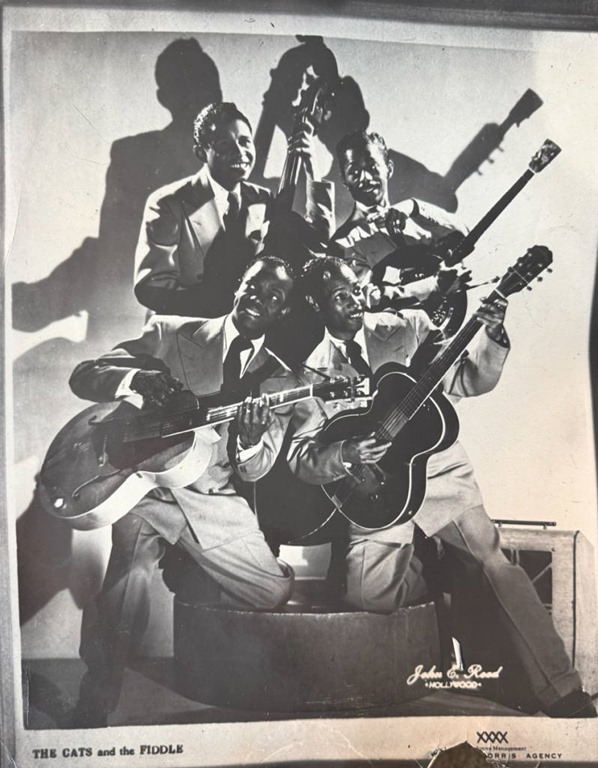
I have not seen this picture elsewhere outside of the scrapbook. It shows the act as still represented by William Morris. The shadowy photography here of a dark skinned face in the lower left doesn’t make it certain, but this could be a rare promo shot of Hank Hazlett with the WWII-era Cats without their leader Austin Powell.
.
As far as the scrapbook’s scope goes, Hazlett barely appears before joining the Cats midway in the combo’s career. The earliest thing the scrapbook has on him is a well-worn U.S. Employee Service Applicants Identification Card for Lawrence Hazlett. The card gives his address as 5159 Prairie Ave, but there’s no visible city. That address exists in the L.A. area near Lennox and W. Century Blvd., but also in Chicago’s Bronzeville — so we could place Hazlett in either city the Cats were active in during the late 1930s. The card has him 5’ 10” in height, 147 pounds, and there’s a filled-in blank that has the number 24 — I’m guessing that’s his age. Given that Marv Goldberg has Hazlett as being born in 1911 in St. Louis, that would make the card’s issuance as around 1935, and from that approximate date the card could be a government form related to unemployment insurance or the New Deal WPA.* There are two blanks to enter in “ssification” which I read as classification, a P. and S., with that second filled in as a “Jr. Artist.”
Anyone know more about this kind of ID card?
So, here we have the earliest thing I know for sure about the scrapbook’s leading man: a slip of paper from before the Cats and the Fiddle existed that says Hazlett may have pursued a career in art circa 1935.
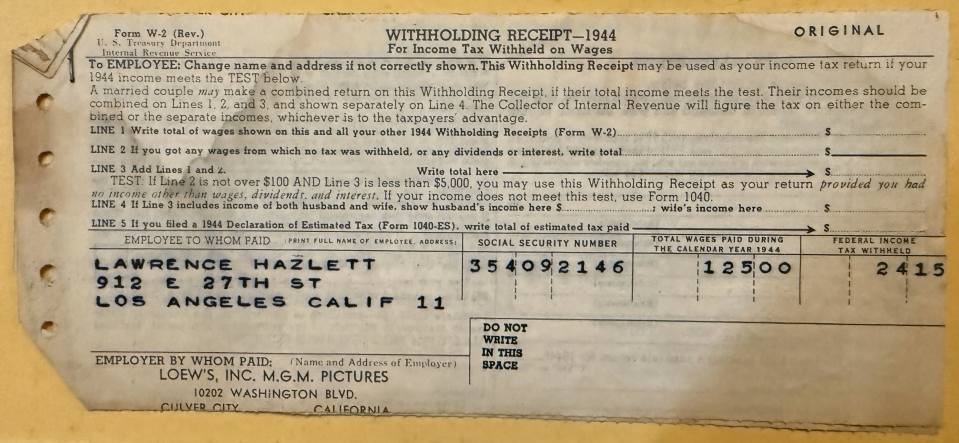
Histories of the Cats and the Fiddle tell us that in 1943, Austin Powell, the most often featured lead vocalist of the all-singing and all-playing quartet was drafted. This would be a serious blow to the group. Recordings were scant during the war years, but the act was touring and likely had gigs to meet. Hank Hazlett is selected as Powell’s replacement. Like Powell he played guitar, and evidence suggests he may have been at least Powell’s equal on that instrument.** I also assume he was a good singer with some on-stage showmanship. We don’t know where Hazlett joined up with the Cats, but it’s likely in Chicago or L.A. We have one other document in the scrapbook with a firm date around this time, a W2 for the year 1944 which shows Hazlett earned $125 from Loews Inc, M.G.M Pictures of California giving Hazlett’s address then as 912 E. 27th St. in L.A. This might have been for work as a movie extra or musician.
Extra in a movie? Soundtrack work? Movie theater appearance?
.
There are clippings and a few photos documenting the 2-3 years Hazlett was a member and touring with the Cats and the Fiddle in the scrapbook. Here are a few of them.
Some of the places and bills as Hazlett toured with the Cats and the Fiddle 1943-46. In the upper-center photo that’s Hazlett on the left playing a guitar that may be the one in the promo shot above.
.
The hypnotist Capt. De Zita’s work? Typo on the headline and dubious hype that the Cats and the Fiddle are appearing in person in L.A. for the first time in 1944
.
In 1946, Austin Powell is mustered out and returns to the group that is still working though not breaking through to upper levels of fame. Having the original lead singer back doesn’t seem to revive their career fortunes, though the act will continue until 1950. As far as anyone knows, Hazlett’s tenure with the Cats and the Fiddle ends when founding and featured member Powell comes back.
Hazlett seems to remain a professional musician though. There are new promo pictures made, taken by a Chicago-based photo studio for a new act: upright bass, piano, and Hazlett on guitar: the Hank Hazlett Trio. What we can see of them in the scrapbook is our topic for next time.
.
*I’m thinking more likely the WPA. The Works Progress Administration was a unique New Deal program to counter the Great Depression. In sites around the country it gave jobs to workers, writers, actors, musicians, and artists to produce or teach various projects and works of art. I know little about Hazlett’s family or situation growing up, even how long he was in St. Louis, his stated birthplace. His place of death was Los Angeles in one report I’ve seen, so he may have some connections there. It’s only a feeling, but I’m guessing he may have had a middle-class Black family with exposure to arts and culture before we find him in the scrapbook as a nationally touring musician.
Time for me to lay out all I know of the story of a 1930s and ‘40s Black American Jazz vocal quartet: The Cats and the Fiddle. Last time in this February series, I reminded moderns that so much in my parent’s and grandparent’s time revolved around neighborhoods. That’s going to continue today as I tell about some kids who shared a location. Previously we’ve seen the Cats and the Fiddle appearing in small-time Hollywood pictures in the Thirties, which might give you the idea that they were a well-established band with hit records and thriving career. That’s not the case. They were young, from out of town — and though they did have a few years of performing under their belts, they were likely around 20 years old. How’d they get there? Where did they go?
The Cats and the Fiddle didn’t start in Southern California. The original quartet were classmates at Wendell Phillips High School, an important school in Chicago’s Black South Side. Last February here we featured Fenton Johnson, an ambitious Black poet who graduated from Phillips decades before the Cats’ founders attended, but some other folks could have passed the band members in the hallways in their day: Nat King Cole and just possibly singer Dinah Washington. Cole was likely the same age — Washington 5-6 years younger but there was a Junior High section at the school.* Oh, let’s not totally leave off poetry — poet Gwendolyn Brooks was the same age as Cats members, and Phillips High School was one of three Chicago area high schools she attended. The thought that these teenagers, poets, singers, musicians, and songwriters, might have taken inspiration from each other, or some other, lesser known commonalties is intriguing.
While in High School the future Cats were in two different bands, the Harlem Harmony Hounds and another group which was — at least at times — performing as Four Dark Flashes. No, the first band had nothing to do with Harlem, these were Chicago kids. There’s a round-up of Cats and the Fiddle history available online put together by Marv Goldberg. He’s found a reference to the Harlem Harmony Hounds as early as summer of 1932, which says they were appearing on radio station WCFL in Chicago.**
The Four Dark Flashes appeared to have traveled some. In October 1936 they were listed as playing the Casino Theater in Toronto Canada, a 1,200-seater which would have just opened earlier that year. If they were all Barksdale’s age, they’d be 16 or so, and traveling out of the country during the school year. This would indicate that some of the Cats-to-be had dropped out of school early to pursue music. ‘36 was likely the year the Four Dark Flashes group lost a fourth, their lead singer. Harmony Hound Austin Powell singer and guitarist was the handy neighborhood replacement to join Ernie Price (tenor guitar), James Henderson (tipple), and Chuck Barksdale (bass). The whole group sang, and beside Barksdale holding down the upright bass, the fretted stringed instrument combinations of 6-string guitar, tipple, and 4-string tenor guitar might shift from song to song.
In October 1937 we get the first mention of Cats and the Fiddle as an act that Goldberg has found. The famous Chicago Black newspaper The Defender wrote that “Four Cats and a Fiddle” were booked to play the Dome Club in Bismarck, North Dakota along with a Bessie Mitchell.
OK, who’s asking “What are a bunch of teenage hep-cat Black musicians doing in Bismarck ND in 1937?” I don’t know. I can find nothing about the Dome Club there, but chances are slim that there were enough Afro-Americans in Bismarck in 1937 to support a Black entertainment establishment. Another Afro-American vocal act with guitar accompaniment, the four Mills Brothers from Ohio, had gotten on nationwide radio, and though their hit records are a smoother sweeter sound and have none of the jive talk found in the early Cats’ lyrics, it’s possible that our group of teenagers had a set-list of tunes tailored for white audiences. The Chicago Defender, when announcing the act’s road gig on its pages says the Cats had “one of the greatest floorshow acts in the game.” Promotional hype supplied by the Cats themselves? Or had they already done some show-stopping appearances in Chicago? Were upper Midwesterners plausibly ready for something like that “Killin’ Jive” hard-swinging Jazz aimed for Black audiences?
Then on November 20th the Pittsburg Courier (another Black newspaper) says The Cats and the Fiddle, consisting of the quartet of guys and a Bessie Sutton are playing at the Airplane Club Café in Denver this week. Not sure why anyone is concerned about this in Pittsburg, unless that Bessie is from there. What kind of venue was the Airplane Club Café? The only thing I can find is this picture of a matchbook once offered for sale on eBay.
The young Jazz guitar & vocal combo was going places. Lenny Kravitz’ grandma not pictured. (just checking to see if you get to the footnotes)
.
That pair of odd Fall ’37 notices bill a Bessie Mitchell and a Bessie Sutton as being with the Cats. It’s unclear if they are one or two different people, and if they are full-fledged members of the band or a separate act that might use the Cats as road show accompanists.*** If neither Bismarck or Denver seem like a common tour stop for a locally-known Chicago Afro-American combo in 1936, swing Jazz had a generalized popularity that was testing racial barriers. It’s also possible that clubs expected the Mills Brothers and got something a bit wilder, or that Bessie or Bessies were the headliners.
Where can we put our Cats on the map next? On January 13th, as 1938 has begun, Goldberg finds them in another Black newspaper, the Los Angeles California Eagle. The paper names the original four schoolmates and a Willis Rogers as members and they go on to say the group will “go far in pictures.” Once more I provisionally assign PR from the group to that prediction. I wondered if the late ‘36 Bismarck and then Denver gigs were just part of a “play your way to pay your way” tour to get to the American west coast. I’m just enough of a trainspotter type to wonder about passenger train service from Chicago to Bismarck to Denver to LA.
Want to figure their transit route with me? Chicago to Bismarck to the Pacific Northwest coast. Sure, the North Coast Limited. A lower Midwest route from Chicago to Denver with connections to LA? Yes, those are options on the Union Pacific Overland Route. But Bismark to Denver? Your faithful researcher looked. You’d likely have to go back to Minneapolis from Bismarck, and then from Minneapolis to Denver before going on to Southern California from Denver. But what’s the alternative? They could have driven, though I know nothing about their family’s financial resources to buy a car, and there’s the season of that traveling: modern indie band road dogs would dread a late Fall tour itinerary from Chicago to North Dakota then off to Denver before a jaunt to LA, when if LA is your goal from Chicago, a southernly “Route 66” highway beckoned. So, if the three dates Goldberg lists are accurate, I think of these four or five ambitious young Midwestern musicians zig-zagging like water bugs on train routes aiming for Hollywood. Yes, I’m grasping here at details, hoping that like a detective they lead to solutions to greater mysteries. The mysteries remain.
You’ve seen the high points of that movie career in the earlier installments of this series. For Afro-Americans in the mid-1930s that would be low-budget all-Black cast and audience pictures, novelty appearances in B movies, and possible work as extras or as a musician for soundtracks. Seems pretty meager when I list those opportunities, but to look at it another way it wasn’t that far from what bigger Black musicians were getting in the movie industry then. Racism and segregation were still unavoidable, overt issues, but Jazz as a rising popular music was softening some barriers in that decade. And it was the Great Depression. Black unemployment was even higher than the general unemployment rate. Appearing as “native” extras on a studio backlot might be demeaning, but even that level of employment meant a paycheck.
Still, they were all about 20-years-old, and they didn’t even have a record contract— yet. And our intrepid group still seems to be traveling back to Chicago from Hollywood.
Lawrence Cohn, who wrote liner notes for a 1976 reissue of the Cats and the Fiddle recordings, tells that Cats were visiting outstanding guitarist Tampa Red’s apartment in Chicago in the spring of 1939 after their spate of 1938 movie appearances, when Red introduced them to Lester Melrose. Melrose was A&R for Bluebird, RCA Victor’s “race records” label for artists of color. In the 1930’s and ‘40s, Bluebird was making good money on a variety of Blues related vocal records, often featuring small combo accompaniment, catchy rhythms, and double-entendre lyrics. Melrose worked out of Chicago where he collected a lot of Black talent for the label.****
How well did the Cats records do? Middling at best. Their closest approach to a hit was a ballad recorded on their first studio session in the summer of ’39, “I Miss You So” — but as WWII was about to break out in Europe, no one knew yet how big the young Cats could be. Cohn compares them to the Ink Spots, a vocal combo who started having big hits on Columbia Records around this time. He tells us the Cats and the Fiddle were repped by William Morris (the same talent agency as the Ink Spots) who started booking them all around the country to see what kind of career they could have. The subsequent gigs Goldberg tracks are mostly at Black audience theaters, but they include the big ones, the ones the most successful Black stars would play.
In America, WWII was still two years away. Victor records recorded more than two-dozen songs as they toured. That maybe-kinda hit “I Miss You So” wasn’t issued until 1940, and it wasn’t representative of their typical fast-tempo jive-slang songs.
Then the war came, and the previously stable, self-contained quartet group of high-school-pals started to churn. Henderson (who wrote “I Miss You So”) died shortly after the record came out. The bass-fiddle guy Barksdale died in ‘47, but was in and out of the lineup from ’41 on. Henderson and Barksdale were replaced by ex-Harmony Hound members Herbie Miles and George Steinback. In the midst of this ’40s churn Tiny Grimes was in the group for a couple of years, even wrote a tune or two for them. Grimes would leave the Cats to play with Art Tatum and Charlie Parker, and along with Charlie Christian, he would help popularize instrumental bebop styles for the guitar. Grimes left our vocal act because by then it wasn’t paying much, and he didn’t think it was going anywhere. A musician’s recording strike and a shellac shortage greatly reduced the issuance of records during the ’40s, and the audience mix for live shows must have changed some due to the overseas war. Amidst all this, Austin Powell, the most prominent singer and songwriter in the Cats was drafted. Hank Hazlett, a guitarist originally from St. Louis, was brought in when Powell went into the armed forces. Hazlett would play with the Cats from ’43 until late 1945. Powell was de-mobbed in Spring ’46, and the somewhat tattered group was still recording and playing, but to smaller and smaller returns. In 1950 the Cats and the Fiddle disintegrated, though surviving individual ex-members continued to be involved in music.
Lawrence Cohn was a highly knowledgeable man about this era, and he worked on a number of important late 20th century reissues of classic Blues and Jazz recordings. When in 1976 RCA collected most of the Cats and the Fiddle’s recordings in a double LP, Cohn wrote the liner notes, yet he only rises to faint praise there. He thinks the songs sound too samey. He says their musicianship was mediocre at best. In the end he’s left with the idea that their humor might be viewed as a corrective to the (in his opinion) too serious and artsy Jazz around when he wrote the notes. This sour summation ends Cohn’s notes:
In general this kind of happy jazz and pop combination disappeared, along with most of the melodic kind of jazz, during the Fifties and Sixties when rock and roll replaced the earlier style of music, and when jazz became politicized. A lot of people stopped going out when this kind of music was not being presented. Perhaps this release may in some small way facilitate its return.”
So besides knocking the Cats, Cohn seems to want to take some shots at the Spiritual and Black Arts Jazz musicians contemporary with his notes. I apparently like those musicians more than he did, and I like the Cats and a Fiddle more too. As to the Cats’ musicianship, I’m of the school that says the essential is that the players did a good job putting their own songs over, and that’s what counts more than an academic skills comparison. Barksdale was good enough for Coleman Hawkins when playing outside of the Cats. Tiny Grimes could trade riffs with Charlie Parker. Austin Powell was still gigging and recording with Louis Jordan and his Tympani 5 until the end of the 1950s, apparently playing not only guitar, but sax and piano.
Decades after Cohn, Australian critic Bruce Elder got the job to write up the Cats and the Fiddle for the current music streaming service Apple Music. Writing there Elder says
If anything, the Cats & the Fiddle were ahead of their time, producing a bolder form of R&B than critics were prepared to accept at the time, such as ‘That’s All I Mean to You,’ which likely would have slotted in perfectly a decade later, but in 1940 just seemed like style-less noise with a swing beat.”
Being slammed as “Style-less noise, with a…beat.” Does that sound like a description of something else that would come around after the Cats broke up post-WWII? Self-contained combos who play their own instruments with guitars mixed to the foreground, brisk tempos, uninhibited stage performances, energetic, youthful, close-harmony singing, witty lyrics that might wink with some “the squares won’t know what we’re talking about” slang?
I’m leading you to say “Rock’n’Roll.” I suspect older readers will be the first to follow that lead with that response, as I find many listeners in middle-age (and younger) think of the later evolution of what gets called Rock — or now, Classic Rock — as a more overdriven electric guitar thing, backbeat drums with less swing laying down the beat, with lead singers often singing alone only with occasional backing vocals. I used to shake my head (and type someone’s-wrong-on-the-Internet posts) in my 20th century Usenet days when the admittedly problematic Rock’n’Roll Hall of Fame would select some (usually Black) harmony vocal group for enshrinement and posters would object that’s Do Wop, or Soul, or something, but not real Rock. I’d try to remind them that Rock’n’Roll originated as a diverse mongrel genre, and that groups who approached music with an outlook, energy, and vocal blend like the Cats, were all over the first decade or so of Rock’n’Roll. These Black high-school students from the South Side of Chicago had an idea and put some audacious energy into propagating it.
About thirty years after the Cats and the Fiddle took their warning-track fly ball swing for the fences, this group of plaid suited white rubes — who looked exactly like you’d expect to find them at the Dome club in Bismarck North Dakota — got to have their moment in a low budget Hollywood movie. This is how they looked and sounded:
On discovering this band in a rural roadhouse, the film’s hero enthusiastically shouts “It isn’t boogie. It isn’t jive. And it isn’t swing. It’s kind of all of them.”
.
*I’m basing age estimates for the original Cats members on a military draft registration record Marv Goldberg indicates he’s seen for original member bassist Charles Barksdale, documenting that he was born January 11th, 1918. Nat King Cole and the Cats were seen again in Hollywood, as Black extras playing South American natives in the Myrna Loy/Clark Gable romcom Too Hot to Handle. Dinah Washington was playing in Chicago with the Cats and the Fiddle as her backing band for the gig when the club owner dragged Lionel Hampton to hear her and nationwide fame for that great singer ensued.
**This radio show was said to be weekly, and other references led Goldberg to think the show lasted until January 1935. WCFL’s history is interesting. Nathan Goldfried’s book WCFL, Chicago’s Voice of Labor has it that it’s “the first and longest surviving labor radio station in the nation, beginning in 1926 as a listener-supported station owned and operated by the Chicago Federation of Labor…” and that ““The station emphasized popular entertainment and labor and public affairs programing, seeking during its earlier decades to help organize workers, increase public awareness and support for the union movement, and enhance public awareness and culture.”
***Entering into wild/just plausible territory: Bessie Mitchell was the birth name of actor Roxie Roker’s mother, musician Lenny Kravitz’ grandmother, and actor Zoe Kravitz’ great-grandmother. She would have been in her mid-20s in 1937, but I have no info that she was ever in entertainment at all, or connected with the Chicago scene.
****Bluebird recording artists included Memphis Minnie, Big Bill Broonzy, Jazz Gillum, Memphis Slim, Victoria Spivey, Arthur Crudup, and LeRoy Carr. Melrose reportedly passed on Muddy Waters — Waters said Melrose was looking for a sweeter style of music than he and his post WWII generation played. One thing I wonder regarding Melrose likely having some responsibility for how big a promotional “push” might be given the Cats. Members of the Cats and the Fiddle from the start wrote most of their own material. Melrose often engaged in the pernicious practice of taking co-writer’s credit on records by acts he shepherded, cutting himself in on that element of royalty monies. At least on the Victor reissue LP I have, Melrose is never listed as having a songwriting contribution.
We left off last time in my Black History Month series this year, with a crumbling scrapbook filled with mid-20th century things someone had gathered. The scrapbook compiler was concerned with entertainment, particularly Afro-American’s in that role, and the largest number of items they’d pasted in focused on a somewhat obscure musical act: The Cats and the Fiddle. Was the compiler a fan or a musician themselves? Woah, we get ahead of ourselves. Let’s stay with the musical evidence we have for a little while longer.
Once I get out of bed in the morning, I grab a newspaper from somewhere in the vicinity of my front door and read it. This is antiquated behavior. I often linger in bed before or after sleeping reading near-instant news on a large tablet connected to the Internet before I later get to the morning paper’s headlines that were written yesterday, yet still I take comfort or distress from reading them printed on paper. This is memory/habit working. I’ve read a newspaper in the morning since shortly after I learned to read. I even delivered them door to door as a youth in my little Iowa town, a place where and when the newspaper might be the only way you’d find out about some things in any detail.
Though I compose music and operate various musical instruments constantly as part of this Project, I’m somewhat removed from the general life of a musician today though I read accounts, I observe. But all of us listen to music, experience it some way. I know of no culture anywhere that for any appreciable span of time has been without music.
In the 1940s and ‘50s world the scrapbook photos, magazine clippings, and ephemera collected would have overlapped my childhood, would have been my parent’s adulthood. I experienced music some from records, some from television or movies, and largely from radio.* Music face to face? Church music once a week, and the school’s student marching brass band a few times a year. I enjoyed rock’n’roll cover bands just twice, at the Junior and Senior proms in my high school. Concerts? I once got to travel to the large auditorium at the state capitol to hear Handel’s Messiah oratorio. But that’s a rural, small-town story within a family that had no special connection to music, played no instruments.
For other white folks in cities, and in other areas, music could have been more central, more direct. Step back a generation to my grandparents’ youth? Recordings, perhaps some, radio not yet broadcasting, movies silent. Non-commercially, there was the parlor and folk music of those whose neighbors or families played. Music at events meant musicians playing, making the entirety of the noise right there and then. Let me repeat: that era’s connection to music was almost entirely performer in the room or performance space — and so where you lived or traveled to impacted your music heavily, and overwhelmingly your connection to your music was as fully dimensional, occupying the same space at the same time with you.
Some who read this may be two full generations younger than me. Your connection to music will likely be more removed: streaming playlists, the soundtrack to video games, concerts that could be large TV screens over a distant stage of dancers and miming singers with microphones in their hands. Or it could be a sweaty basement or a club with a small stage at one side, or something you try to record on the ubiquitous computers surrounding us, to hopefully exist elsewhere momentarily on phones, like a brief, wrong-number phone call that each connected party, embarrassed, occupies briefly, and leaves. You may think: I decide how I experience music, or how I make music! Yes, you do have choice, even if you may, out the other side of your mouth, decry that most all others are dictated by culture and capital. The in-between truth is that you, musician or listener, and the musical audience and musicians in general, are still living inside a present culture that changes things. The older ones living now still remember past cultural contexts, a diversity of time.
Because Afro-American representation lagged in mainstream American culture, representation of their music in mass media was filtered out, shown behind a screen for much of America. A Black American circa 1930-1960 is going to make and experience music because of their contemporary cultural particulars, their landscape in time. How long this post would be for me to try to even outline or list those things I think I have a smidgen of understanding of: the divide of parochial cultural ignorance from non-Black folks can fill volumes, Black History Month a pitcher of a lakeful. Demeaning white superiority, colonial European cultural hierarchies, and minstrel show comic-fool stereotypes are the proscenium for Afro-American performers. Sometimes violence lurks at the meeting edges. A well-meaning paragraph in a blog post staggers to carry that weight.
So then, if a Black American was going to use music to relax, or as a balm against the absurdities of your life and times, how much easier is it going to be to find that in Black entertainers, in Black saturated places among fellow Black audience members. But also consider: your experience of music is going to be that fully-dimensional one most often. In the room. In the same time. You can smell the music, which you can’t on Spotify.
Think back to that short movie clip from the previous post in this series,“The Harlem Yodel.” The Cats and the Fiddle and the Dandridge Sisters are dressed up for the Alps in the roomful of mirrors that we’re to know to be an indoor ski meet. It’s 1938. I notice as the Cats enter our frame at one minute into the video clip, they drop a short series of sour, single string plucks. Is that a musical Dada expression saying: we know this is ridiculous, but we’re getting to be in the MGM movies, even if it’s a B minus, undercard short-subject? One of the producers of the short, Jack Chertok, would work on more than 30 shorts in 1938. By the early 60s he’d be the producer of My Favorite Martian, a half-hour TV sitcom about an undocumented extraterrestrial alien living incognito on a grey-scale Earth — not exactly Ralph Ellison, but some of the strangeness is intentional. In the movie, the audience is white.
White folks on the right: “What, we can’t even have segregation at an indoor ski jump competition?”
.
In the second music clip, “Killin’ Jive,” the audience is black in the film and in the producer’s movie-house intent. It’s from one of a series of Westerns made for Black audiences, and the picture’s star (unseen in the clip) is the “Sensational Singing Cowboy” who was variously billed as Herb or Herbert Jeffries or Jeffrey. Wikipedia decided on Herb Jeffries, but I don’t know if the last name varied for carelessness or branding tweaks. His Wikipedia article goes on to write about the unsettled ethnic background of the man born Umberto Valentino, but he was clearly marketed at the time as an Afro-American. The band’s performance there is intense and uninhibited — can’t-top-this showmanship. This clip, and publicity photos, would mean that the Cats would need to do this live on club stages at some point in their sets. This song (like many in the Cat’s recorded repertoire) is by a member of the band, and “Killin’ Jive” is, full of insider Jazz/Black slang. Here’s a link to the lyrics.
Clearly, it’s a song about marijuana intoxication, and it’s performed in a let’s-get-high-and-party manner. The lyrics, which as I said are written by one of the group’s founders, Austin Powell, can be read as adding an undercurrent to that performance. A line is refrained in the song “He’s a sad man, not a bad man,” and I expect “bad man” in Thirties Jazz argot could carry the same “formidable and unrestrained” (in this case, when high) Afro-American slang meaning as well as the mainstream cultural meaning of he’s not evil, he’s just depressed. There are lines too about “darkest days” and “got no rent” (not transcribed correctly in the link) If this were a Brecht and Wiell song from say The Rise and Fall of the City of Mahagonny, we’d read these lines and expect Modernist irony. What do I expect? That Powell had a brain and a viewpoint and meant what he wrote.
CORRECTION: The “Killin Jive” song was actually performed in another Black-audience-targeting picture called The Duke is Tops. They did appear in Two Gun Man from Harlem too, I just trusted my memory more than double-checking my notes,
“All Star Negro Cast” in the film from which “Killin’ Jive” appears
.
In real life and not in front of Hollywood backlot cameras? I can’t say for sure what kind of places the Cats and the Fiddle played in, but as working musicians the places they performed in would surely be physical contexts in a segregated society. Los Angeles had its own Black musical scene and audience around the Central Avenue neighborhood, and they could have played there. In a following post in the series we’ll get into what I can figure out regarding their musical career and travels from supposition, elements in the scrapbook, and some new information I was able to gather this month. More to come here soon in this series.
For a musical note, here’s a Langston Hughes poem remembering time on the other side of the tracks. There should be an audio player gadget below, but if it’s been red-lined out for you, this highlighted link will open a new tab with its own audio player.
.
*Radio was more-or-less the streaming of my era, but it had the extra dimensions that you knew that others were listening to the same music you were listening to at the same time. When “your record,” the one you made, or simply the one you cared about as a listener, was played on the radio, you may have been alone in your room or your car, but you knew also you were one of some many in a simultaneous nexus. Music on television or in the movie house was most often a generation behind. I’m nowhere near a Jazz musician in skills, but I owe it to TV and movies of my youth that when I hear a Jazz take on a “Standard” I usually know the tune.
Let’s leave off those modernists of the era around WWI for a while, and move to a few songs about some midcentury mods. This is the time when popular culture mutated into something recognizable as ours, as it still is into this 21st Century.
Somewhere in this second decade of the 21st Century a new modernism is likely being born, but I do not know it yet. Back in the early 1950s people expected something new, perhaps as much or more than we expect change today in 2017. As it turns out, we may have not gotten all the change we thought we were due.
Today’s piece is the opening song in a song-cycle about one woman who had a moment in this moment of change in the early 1950s in Los Angeles/Hollywood. The woman was a second-generation Finnish-American, Malia Nurmi, who created a character that for a short time, just about a year, captivated TV audiences in Southern California with a strange take on sexuality and various horror tropes, blending in a beatnik/Dada critique of “normal” as a reaction to the unthinkable. The character was named “Vampira.”
Somewhere in the later 1960s it became a commonplace to view the 1950s as an era of calm, peace, satisfaction and complacency, and this characterization has only increased over time. But this was also the era just after a cataclysmic war ended with atom bombs, a horror that eventually moved from reality, to nightmares, to repressed acceptance, to forgetfulness and finally now again to present fears. This was the decade of a forgotten, brutal, war in Korea. This was an era when society tried to put back into the bottle the broadening social roles for women and Afro-Americans that WWII had allowed. This was the time that revealed the horrible efficiency of the extermination and slave labor camps, and the decade in which the utopian dream of Communism exposed its shames and shams. This was a deeply uneasy time when some feared everything “normal” was a dream and others saw clearly the waking hours outside the dream.
All of which makes this campy TV quipster host who created the makeup, costume and persona of Vampira seem inadequate to address this. Well, what is? As we move to celebrate Halloween, that strangest of holidays, where we make fun of our inability to escape fear, death, and too much candy, let’s reconsider her.
Media in black and white: Aimee Semple used religion, Maila Nurmi used Vampira
“Helen Heaven” has words written by Dave Moore, the alternate voice and writer/musician here at the Parlando Project, along with music written and performed by myself. This piece is the first song in the Vampira song-cycle, contrasting the LA-based white-dressed pop-religious phenomenon Aimee Semple McPherson with Nurmi/Vampira’s dark negative.
To hear “Helen Heaven” use the player you should see just below this.



 Frank Hudson