Three things mark Louis Untermeyer’s taste in his between-the-world-wars Modern American Poetry: comfort with elements of the Modernist avant garde, appreciation of the fantasy/gothic (Poe) strain in American poetry, and the inclusion of humorous verse in a “serious” anthology. We’re only partway into our National Poetry Month series featuring selections from that book, but we’ve seen H.D. and Maxwell Bodenheim’s Imagist poems, and Elizabeth Coatsworth’s subtle visitation of fantasy. Now we have a poem that combines elements of the last two – one written by a poet that many mid-century readers would have been as familiar with as with Frost, Eliot, or Millay: Ogden Nash, the at least once well-known 20th century practitioner of “light verse.*”
How much has Nash’s fame persisted into the 21st century? I suspect a small portion. That his verse includes humor might be a factor in that. Humor’s subjective and subject to fashion, but unlike the subjectivity regarding serious literary modes, few take the effort to make allowances for superficial mutations in its particulars or a joke not making a direct hit on our sense of humor. A solemn, carefully crafted poem about weighty subjects promotes itself for a balanced appreciation – so, even if we find it imperfect, we feel propriety requires we give it its due. In the age where much poetry presents memoir, “personal truth,” and exposition of experiences intimate, harrowing, or non-denominationally spiritual, this must be yet more so.
Even when present, humor may be deemphasized or missed in our poetic literary cannon. Many modern appreciators might be shocked to learn that Auden’s “Stop All the Clocks” elegy was not intended to be fulsomely solemn. Most readers miss the sly Robert Frost tweaking indecision about decisiveness in “The Road Not Taken.” Frank O’Hara’s beautiful humor can’t be denied, but it can still be deemphasized. Early readers of Emily Dickinson saw elements of what could be called light verse in her work, and that once hurt her standing in the literary canon. 21st century readers now are asked to see the signifiers of trauma and suppression in her poems, which there may well be, but some of the most sharply funny people have grown accustomed to injuries in the dark.
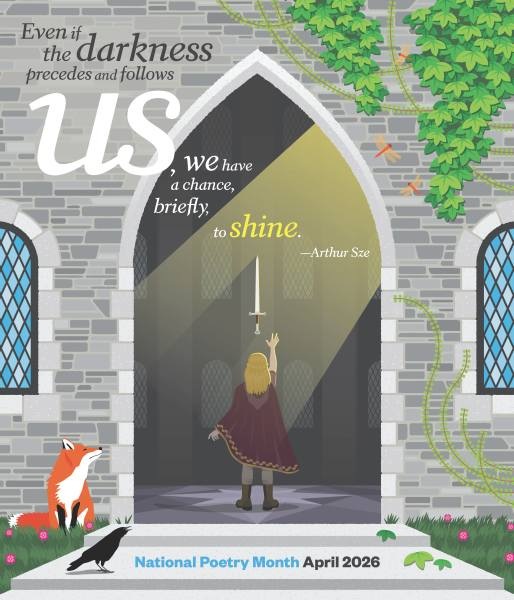
No chord sheet today, but this gives me a chance to say how much I love the Arthur Sze quote used on this year’s poster that speaks to what this Project hopes it’s doing.
.
Now, is Ogden Nash as essential as those poets? I’m not making that claim, but he can still be a whole lot of fun. What I have said, and still fervently believe, is that we harm poetry by worrying too much about “not-great poetry.” Because literary poetry now has a historically low presence in American culture, we may feel obligated to guard against a Gresham’s Law defacing its value. I question that tactic. I think vibrant arts are happy with all kinds of expression, and even if one’s aesthetic has constructed a defensible hierarchy, there’s room for vin ordinaire.**
Here’s a link to the text of today’s poem by Ogden Nash if you’d like to read along.
So, I’m for intervals of fun, and “Adventures of Isobel” is fun, and I’d suspect even the toddler depicted in Nash’s mock epic might enjoy it once they become self-conscious – but there’s more: in our current times isn’t it good to revisit the stubborn “it’s not for me” or “you don’t scare me” bravado of the poem’s heroine? Those Americans recently pictured, standing up at streetside in their bathrobes (adult jammies, missing the bunny rabbits and shooting stars) as flack-jacketed masked federal troops are arrayed about them could be reviving that spirit. I often wonder about conscious intents and purposes that I speculate are found implied in poems I write about here. I can hear other intelligent readers – even the poets who wrote them – laughing at what I see under the poems. I may be subject to seeing shapes in clouds and tricks in the shadows, but were Nash and his muses just writing a funny poem with some jokes and outrageous rhymes to momentarily amuse a reader in 1936?*** Or did something compel him to prophesize: “You’ll be called the Greatest Generation. What’s fearful now will be yet more so. Look at how your kid takes on that which disgusts her, or demands that she mix fear with respect. You know that stuff is actually scary – but you’re going to need that.”
Alternate voice, and frequent keyboardist here, Dave Moore took a crack at Nash’s poem as a song to his music a few years ago with the LYL Band. I quite liked his take on it, and for today’s presentation I remixed the recording of that performance fixing a couple of things he and I thought didn’t work. You can hear it with the audio player below. Has the audio player fled, pursued by a bear? No, it’s just that some ways of reading this blog suppress showing it. There is a bear, but it won’t mind if you use this highlighted link to open a new tab with its own audio player to hear the song.
.
*Untermeyer also includes work in his anthology by Nash’s contemporary in between-wars light verse, F.P.A., as well as his own parodies of other poets, one of which I’ve performed here for the Parlando Project. I loved this Untermeyer loving parody of Walter De La Mare!
**There could be an argument against my stance based on overwhelming oversaturation. I worry that’s the case with music today. We have made its creation and distribution so trivially easy (something that happened even before the onset of AI) that we now have a market were new music qua music has a tough time finding traction. Visual capital (youthful good looks, sexual attractiveness, elaborate stage shows and video) becomes a requirement – not just an advantage – to bring forward a substantial audience. I don’t believe this is the case with poetry. With the exception of song lyrics in their ears, the modern literate person is likely to go for extended intervals without encountering any poetry whatsoever. And did Nash, F.P.A., or Untermeyer’s japes waylay readers from reading the canonical “great poets” of the 20th century?
***This year indicates that today’s poem is not clearly in the public domain. I normally refrain from using non-PD work. I plead good intentions toward keeping Ogden Nash’s work in mind and the Parlando Projects educational and entirely non-revenue practices.
 Frank Hudson