Sedition. A poem which isn’t, and that’s a point it’s making

Edmund Vance Cooke was a Canadian poet. At least I think he was. There’s not much on his life I can find, and sometimes his last name is rendered as “Cook.” His sparce Wikipedia entry says he was born in what was then known as West Canada in 1866, and back around the beginning of the 20th century he wrote a type of popular published poetry in a style that has largely died out. Wikipedia calls his genre “inspirational verse,” and some of it I’ve found is that: paeans to earnest striving and social virtues that now-a-days would be reduced to short easily-sharable quotes or the captions on “hang in there” motivational/affirmation posters. But there are indications that social criticism was also part of his repertoire, and this poem I perform today has some bite to it. Though written in 1917, I felt I should work up some music and sing it as a freshly-made song in 2025.

One of the things that irks me most this year is the outrageous lying by my country’s mad despot and his fawning courtiers. I can’t say for sure what drives all these fabulations and alibies across his administration. For some personalities a lie is a demented reflex, a neurological tic. Others spout the lies as a cold tactical choice of propaganda, with a sense that it will gain them some rewards. A more generous assumed motivation: that by saying this or that is so, when it’s not, may help manifest the thing not yet in existence – and this is akin to what affirmations invoke for personal improvement. Alas, most of the things not yet in existence that our current regime members are manifesting by statement are ugly, cruel things. We shudder – while considering the exaggerations, we fear they might not stay lies for long.

Today’s Cooke poem “Sedition”  is a statement of the countervailing powers of truth. It reminds me of an anonymous poem about truth that was widely printed in the same era as Cooke was writing, “Truth Never Dies.”   Five years ago in this Project, I presented that poem and wrote about what I found about who had republished it. This link will be of interest if you wonder about that. Though it’s a statement without evidence, it’s not impossible that Cooke was the author of the much reprinted “Truth Never Dies”  poem – but “Truth Never Dies”  is a more religious and spiritual poem than “Sedition.”   I composed music for the former with acoustic guitar and strings presenting it as a firm, but gentle prayer. The latter, Cooke’s poem, is more sardonic, defiant, even militant – and so I decided to crank up some electric guitars for it.

Sedition

Here’s a chord sheet for my version of Cooke’s poem. I won’t take responsibility if you decide to play and sing it yourself, –  that might make you part of a conspiracy.

.

I played three guitars in the recording via multitracking. For the electric guitar nerds, the center channel has a Gretsch hollow-body playing the chords, the right channel’s a Jazzmaster solid-body with a pitch-shimmering wiggle stick, and the left side a Telecaster whose wide vibrato here was created by having enough personal frustration to expiate that my fingers directly wrung the strings sideways to way above their fretted pitch.* I associate this kind of guitar solo with Canadian Neil Young’s credo that sometimes your intent is to not sound like a “professional guitarist,” some master of tasteful licks and precise intonation.

You can hear the performance with the graphical audio player gadget below. No gadget? I’m not lying – some ways of viewing this blog suppress the player, so I offer this highlighted link that’ll open its own tab with an audio player.

.

*”Hey, posh-guy, you’ve got a lot of guitars there.” I accumulated cheap imported versions of these guitars over 30 years, using trades, hunting up second-hand examples, and waiting for sales. Coincidently, the current regime’s tariffs are threatening what has been a golden age of reasonable quality, good sounding instruments for musicians with limited funds.
Shakespeare’s Sonnet 152

Besides being National Poetry Month in America, April is also the birth month of William Shakespeare. The 23rd of April is sometimes celebrated as his birthday, though we don’t actually know that, only that his family baptized him and entered him into their church’s records on April 26th. The 23rd is also a handy date in that it’s the day Shakespeare died in 1616 back in the same small English town he was born in, only 52 years old. One theory has it that he’d just celebrated his birthday—well, a little too much—and that did him in.

No one knows exactly when Shakespeare wrote his sonnets, but ironically for our 2020 April they were first published in 1609, when the playhouses of London where shut down due to a plague.

The sonnets present themselves as outpourings of personal feelings and thoughts, which makes them tempting clues to the personality and biography of Shakespeare, but of course Shakespeare made his bones as a playwright, and so was well able to create characters and put them in motion with various plots and outlooks. Since today is the anniversary of his death, I thought I’d perform Sonnet 152, which can be viewed as the last sonnet in the sequence, since the two sonnets that follow it are an unconnected coda based on a classical poem about Cupid.

Sonnet 152 is a lover’s fight where we hear one side, with an overall structure as if the speaker is investigating the matter of lovers’ relationship to the truth as if it was a legal contract dispute. You might think that an odd choice, though there are lawyer-poets. Wallace Stevens comes to mind, and I think at times Emily Dickinson’s mind was fully capable of succinctly absorbing the modes of her family of (male) lawyers.

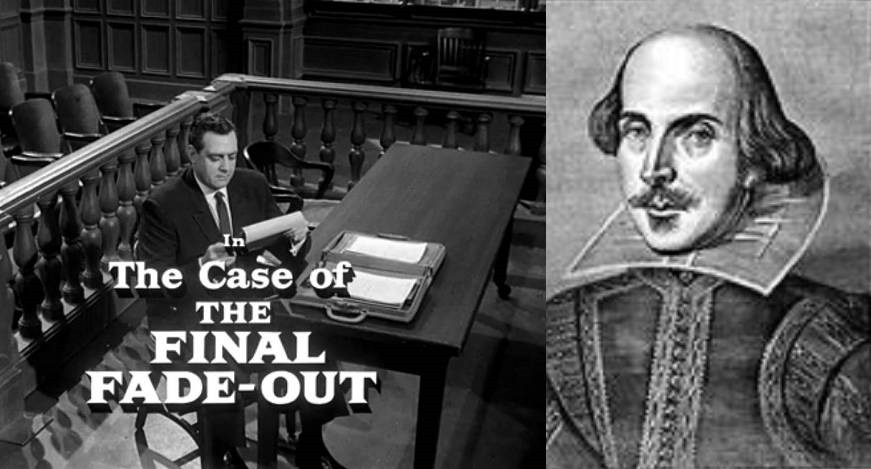
Was Shakespeare having fun with this? Perhaps. Anytime one writes 152 sonnets you’d have the opportunity to try out a lot of metaphors. Even if he was drawing on life experiences of some actual tumultuous love affair, it is a showy poem that renders the breakup as if Perry Mason or John Grisham was closing the case—but since the Elizabethan-era language may make this less than clear, I’ll summarize how I understood this poem today.

Perry Mason and Shakespeare

Well, I’ve looked over this book contract and it doesn’t say you need an ending. But Will, I’ve got this idea for a sonnet…


For simplicity’s sake, I’ll just call the speaker of the poem “he” as if he’s Shakespeare for the rest of this discussion—but as I said above, we don’t know that. And this particular text isn’t even gendered, and a woman could play the text in the first person without needing to change a word.*

He starts out saying that he and his lover are both sworn, as if witnesses or officers of some court, as lovers are often said to be to each other. But he then claims that the lover has in effect taken two oaths. This is ambiguous to me, some read this if the lover is married to another (and if “he” is Shakespeare, so would he have been too). A “bed-vow” has been broken and some faith has been broken too, a state of new hate after new love has broken out. Is this the lover forsaking their spouse for the he of the poem? Or the lover forsaking the he of the poem? Or both? Shakespeare may be intending this confusion, laying out the case that the adulterous lover may be just as untrue to him as to their spouse.

Now goose and gander here, if we play the “he” speaking in the poem as the married Shakespeare, then he’s just as guilty regarding marriage oaths. But he’s onto his next point. He confesses! Look, you broke your vow to me and to your spouse: that’s two. But I’ll say right out I’ve done ten times more oath breaking!

Six lines in, he, and the poem make a turn. He starts to layout his lies, his broken oaths, his sworn perjuries:

Yes, I’ve vowed that I’ll only misuse thee. “Misuse” in this era has a strong connotation of exploiting someone for selfish sexual pleasure. So he’s saying that now, he’s now hooked in love.

I’ve placed faith in you. Sort of a “I’m culpable because I should have known.”

I’ve “sworn deep oaths” that the lover is kind, loving, truthful, and constant.

I’ve been blind to the lover’s deceit, and I made my eyes swear they aren’t seeing what they are seeing.

Obviously every one of those statements is ironic. He’s saying he was “living a lie” when he trusted that the lover was really devoted to him, and that he has moved from thinking of them as someone he could dally with (misuse) and move on. And yes, if you are judging the character of the poem’s speaker, he seems to be a bit slick in his legalese.

So, an odd ending to the series of sonnets. It’s like one of those TV series that gets cancelled right after an episode with a big scene which is never resolved. And that could be exactly what happened. Shakespeare may have left off writing sonnets. Or the publisher may have only had access to part of what Shakespeare wrote. Accidental or not, like the lovers in Keats’ painted urn chasing each other, we’ll never know if anything will be resolved, and that somehow keeps them alive in some strange way, hundreds of years later.

Musically, I threw together a small orchestral arrangement for this.You can read the text of the sonnet here, and unless you’re reading this on the WordPress reader for Apple IOS, you should be able to click on the player gadget to hear my performance of it. IPhone and iPad users who use the WordPress reader should catch the performance by opening frankhudson.org in a regular web browser like Safari on their phone or tablet.


*After posting this yesterday, I looked at the a few other readings/performances of this sonnet. A number of them were by women. I think this one, posted the same day I did mine, is the best I’ve seen.