Here in Minnesota, the weather is turning, as it does at a time of its choosing in the Fall. Tomorrow morning the Fahrenheit temperature will be in the teens when I get up, and the forecast says single digits will greet me by Friday.
I began work on setting this poem by Edna St. Vincent Millay last week after seeing it at the Byron’s Muse blog. Two things grabbed me when I saw it: sitting there as silent words it begs to be sung, and it’s tantalizingly ambiguous.
This poem was from Millay’s first collection, published (1917) as Modernism was starting to find an audience in America. Americans in the last decade to be called The Twenties saw Millay as a Modern, though her prosody wasn’t like the free-versifiers, and her lyric’s narratives weren’t fragmented word-Cubism. So, a more comfortable Modernist to those whose expectations of poetry still flowed from the 19th century? Somewhat. Still, though not so much in her first book, but soon, Millay began to stand for The New Woman, a character that took up the prerogatives of independent thought, act, and agency in love and desire. A William Carlos Williams might have absorbed radical Modernist visions in Modern Art into prosody. A Carl Sandburg may have taken his Imagist eye and cast it toward workers and immigrants in his poems. But soon after this poem, Millay was using somewhat traditional verse to speak about female independence in life and desire. Cubism and Socialism were controversial, sure, but the kind of change Millay was covering in her poems was large in scope. Man Ray or Monet, Debs or Debussy, Pound or Reverdy — change was in the air — but as far as art such as poetry was concerned, the charge for change from women (and Afro-American artists) in the Last Twenties is a big deal, not something to shelve off as some sideline.
OK, so what does this early poem have to do with that? I’m not entirely certain. Yes, the overall scene of the poem is clear to any Northerner — but even as the poem starts the seemingly simple language has faceted surfaces. The poem is titled “When the Year Grows Old,” but I’d suspect you might mistakenly remember it as “When the Year Grows Cold.” It’s not just the rhyme, the poem is clearly about the weather getting colder, all the images intensify that. Intensities of anything old are not there directly at all. And then, I can’t say how idiomatic the opening statement (refrained at the end,) “I cannot but remember,” would be in 1917 — but it’s easy to read it (out loud, or in understanding) more than one way: “I will reflexively remember,” “I have only memory of this,” or even “I can’t do this, but I am forced to remember.”
And who’s the “she” in this poem? I had a thought in early-days with the poem it might be a pet, likely a housecat. Beside a generalized factor of love for warmth, cat owners might recognize the bird watching vocalizations — that, and a reference to “the warmth of fur” led me to that consideration. One reader’s reaction I read online this week thought “she” was a mother. I’m not sure of Millay’s mother’s (if that would be the mother here) characteristic feelings for tending a fire or even the specific kitchen task of making tea. My cursory non-scholarly thoughts are: not likely her happy place.* Still, I could imagine that a general poetry reader in 1917 (like the Internet contemporary I came upon this week) could think that, or that the “she” is a friend of the poem’s speaker (which we might expect to be Millay), and so find this poem Millay’s predecessor to something like the young old Bob Dylan writing “Bob Dylan’s Dream” about his remembering lost friends who’d once gather around a wood stove.
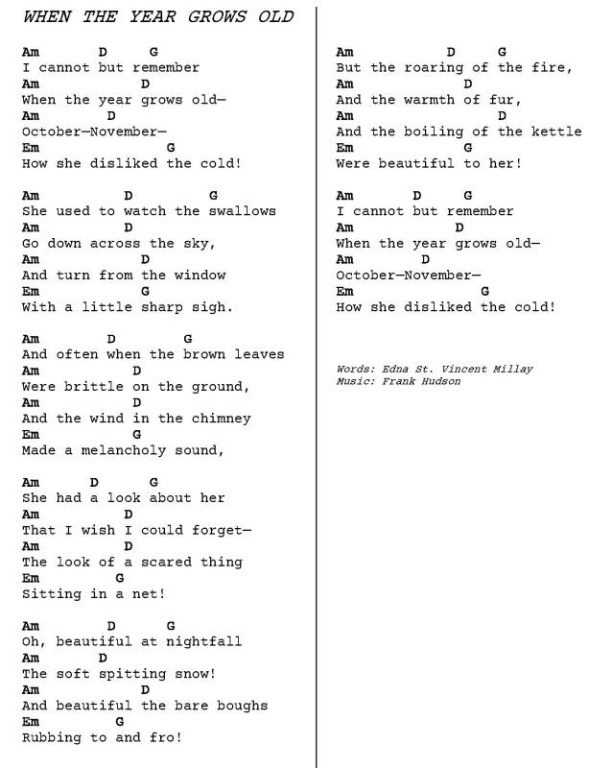
Simple chords for today’s piece, presented here as chord sheet in case you’d like to sing it too.
.
Living with this poem as I set it to music and performed it, I came to think of it more at “Girl from the North Country” — a song about a lover who is longingly thought of lovingly, but who is now separated. By the time of the performance that you can hear below, that was how I was singing it. Why did I think that?
Partly from reading later Millay poetry, partly in biographic clues of Millay’s sexuality. There’s a definite undercurrent in the poem of the “she” feeling ambivalent: the sighing look at the flying birds, the melancholy chimney wind, and most directly in the abrupt “look of a scared thing/sitting in a net!” And what follows that line feels lustily sensual to me: those rubbing “bare boughs,” that fur by the fire verse.
That reading also answers the why the year being “old” is the title, not “cold,” other than just seeking variety. A once passionate attachment has been reconsidered by the other party, has grown old/cold.
Millay could have made other meanings (“cat lady,” “dear old mom.” etc,) clear with no commercial readership risks, but following my understanding, this presentation is coded so those who know will see that, and others will see a vaguer poem while recognizing late autumn weather. If I’ve misread it, or if Millay ever explained what she was intending — well, it wouldn’t be the first time — but it worked for me to find an experiential place to inhabit the poem.
You can hear my performance of Edna St. Vincent Millay’s “When the Year Grows Old” with the audio player gadget below. No gadget? It’s nothing personal, just that some ways of viewing this blog suppress that. This highlighted link will open a new tab with its own audio player.
.
*As poetic testimony: tender as Robert Hayden’s well-loved poem “Those Winter Sundays” is, it’s not a story of a parent finding happy beauty in loading up a household’s fire box.


 Frank Hudson