Free to Fall

Allow me to be more internal than I usually am when presenting these pieces. Today’s piece uses my own words (we do that rarely here) and it’s here today for a peculiar reason — and peculiar is something I enjoy indulging in.

Early this autumn I was looking for a musical piece that represented the season, and I recalled this poem of mine that I had written music for. When? I probably wrote the poem early this century, and from a file I found, I was able to determine I wrote the music in 2007. Sometime after writing the music, I recorded what I recall was a pretty good version of it, likely with Dave Moore playing keys.

“Maybe I made this one of the early Parlando Project pieces” I thought. At the beginning of this Project as I was figuring out how to compose and record our combinations of original music with literary poetry, I had used several recordings of that vintage. Having some already completed pieces gave me time to get a handle on other tasks while getting this thing going.

But, what, I didn’t know? Well, I’ve put up over 700 publicly accessible pieces in this Project’s lifetime since 2016 — and that doesn’t count the ones that just didn’t work or didn’t fit the concept. One might like to think I keep my eye on every sparrow — but with that amount of catalog, it’s not fully accessible in my head. So, I looked. Here. For my own work.

Nope. I hadn’t presented it. It might not have made the cut because I wrote the words, and the Parlando Project is about other people’s words. Where else might it be? I looked in my somewhat disorganized collection of sessions and finished non-public pieces. Nope, not found there either.

My solution then was to re-record it. Recording time has been hard to come by lately, but I remembered this poem-which-became-song as being effective, so I tried to have it ready when I could open my microphone and record.

The piece is called “Free To Fall.”  As I wrote at the start of this inward story, I said I remembered it as being an interesting variation on the poetic perennial of autumn. In the first verse I already hit the falling leaves motif (can that one be escaped?) and I think the “every tree grows tall” was me referencing the British folk song “The Trees They Do Grow High.”   I continued to try to bring some longstanding tropes into this brief song: my own restatement of François Villon’s “Mais où sont les neiges d’antan*” starts off the second verse. I think the lines “Old men carry winters/in which the children play” are my own, but like my memory of where I put this song’s older recording, who knows if I just don’t recall some inspiration or reference.

The third verse’s reversion to summer memories and grief may be influenced by what I consider to be one of the great autumn songs, one found in every fakebook: Joseph Kosma/Jacques Prévert/Johnny Mercer’s “Autumn Leaves.**”  That song too begins with falling leaves, but references a summer lover now gone. Having lost my late wife in August might have made sure I made that step back in memory in the song.
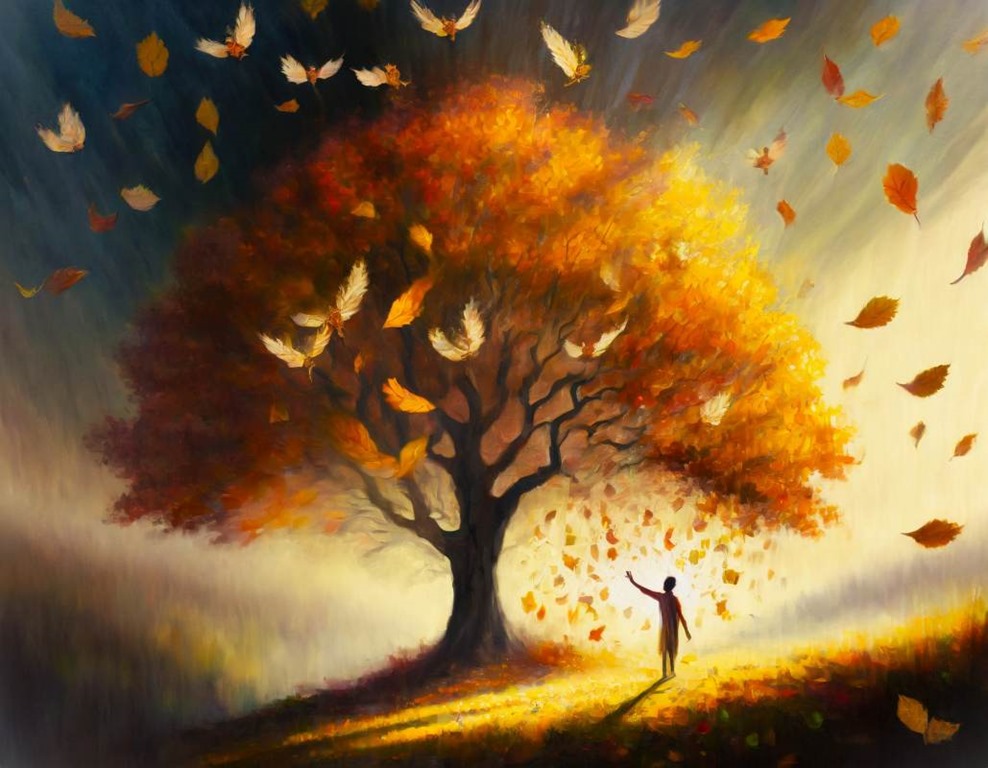
Free to Fall Illustration 800

“Everything is free to fall”

.

The originality of this compressed catalog of autumn thought comes in the refrained pair of lines “I grew up believing/everything was free to fall.” What was my intent there? I’m not sure if I’m articulate enough to do as brief a job as the poet me did in writing the poem. Yes, I knew many readers/listeners would think of things like free will and predestination, shibboleths of theology — but in the lines’ first statement I wanted the connotation that autumn’s falling leaves are freed from their work in photosynthesis and now can flutter and drift. The fourth verse refrain may (or may not) put this in a different context. Is this a compressed statement of “free will,” the doctrine that humankind has the choice of choosing good or evil, which also carries a connected thought that this is what makes good, good, not just an inherent trait? I was likely aware of that when I wrote it, but in performing it this fall I took another plausible memory: that there are those who believe in an afterlife, or a rising or rebirth of the souls of the dead, but that the song’s singer believes that however temporary or final autumn’s dying off is, that there’s a freeing element in it, like that leaf that has been loosed at the start. That’s a bittersweet freedom I wanted to convey.
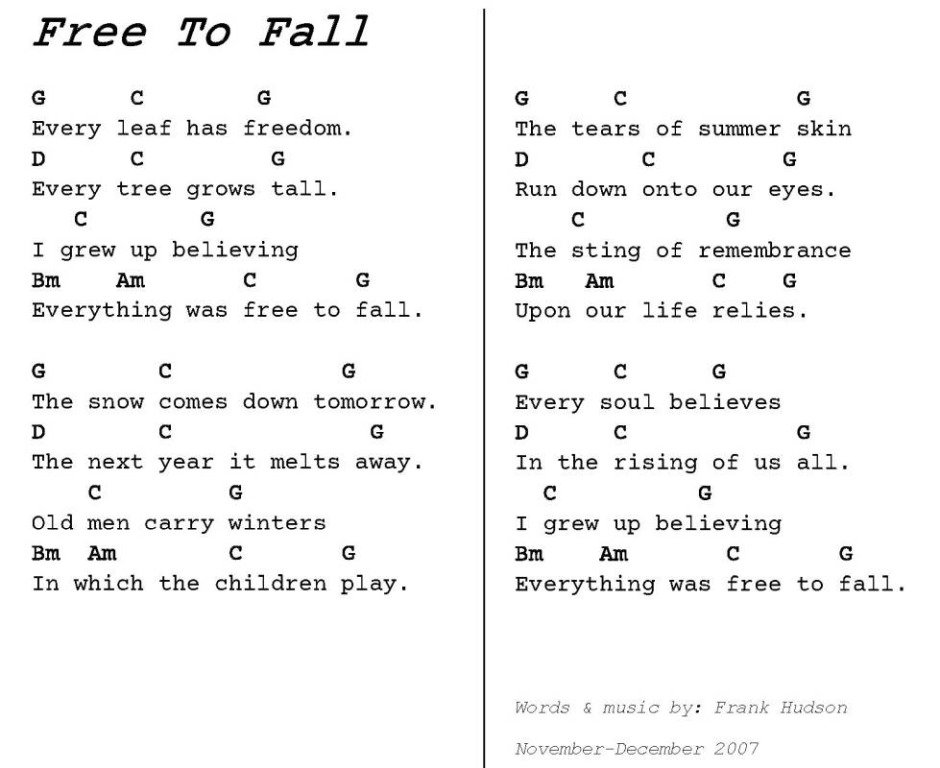
Free to Fall

Here’s a chord sheet so that other singers can extend or improve my performance

.

This poem/song works for me. Maybe it has some worth to you. In summary, the way I think it works is from the ability of compressed verse and song to collect things in a small memorable chunk of words, a portable experience. I’m glad I remembered this 16-year-old song and that I was able to record a new version to share with you. You can hear it with the audio player gadget below if you see that. No gadget? Some ways of viewing this blog won’t show them, but this highlighted link will open a new tab with its own audio player.

.

*“Where are the snows of yesteryear” is the concluding line of his “Ballade des dames du temps jadis”  published in 1533. Yup, those snows are definitely gone.

**One of the abandoned Parlando Project songs you won’t hear came from my idea to do a fresh translation of Surrealist-associated poet/lyricist Prévert’s French “Autumn Leaves” lyrics. I got a hold of those lyrics in French, and found that Johnny Mercer’s English lyrics are a freer, looser sort of translation. Prévert’s lyric is longer and more miserable, while Mercer’s cuts right to the nub of the situation without wasted elaboration. I found there was nothing I could do with Prévert’s French that would even approach the recasting that Mercer had already done.

The name of it is “Autumn”

Did Emily Dickinson mistake her tone, her presentation? This question occurred to me as I went off into the deeper, album cuts* of Dickinson’s work looking for autumn poems this fall. Her early poem, titled on posthumous publication “Autumn”  is charming and very much in a mainstream short poem tradition of the day. If she was seeking publication or just checking in on an honorable hobby of an upper middle-class** young woman, it would do.

The next Dickinson Autumn poem I found and presented, “Besides the Autumn poets sing”  is still charming, if self and otherwise referential in a sly way. If I was to “translate” it into the diction and particulars of New York in the 1950s it could be written by Frank O’Hara. I believe she intentionally means that poem’s opening word: “Besides,” and that is not a careless rendering of “beside”. That little “s” makes it a poem about what the poets of her time did “Besides” (meaning “in addition to,” or perhaps “surplus too”) Autumn, not merely poets rendering in verse the season while metaphorically writing en plein air. That makes the poem an expression of what is other than, or in opposition, to what a leading American poet of Dickinson’s day like William Cullen Bryant was writing.

If I was to read this poem in isolation, if it came to me “over the transom” would I make that assumption? I’ll be honest: I suspect most times I’d miss it. I’d hurriedly read the poem as another simple Fall season lyric. I’d miss that “s.”

Did Dickinson intend this slyness, if I’m right in my more careful reading? My understanding of her character is yes, she did. I could be wrong. If writers, if poets, can misunderstand how their tone will be read, certainly us readers, busy and full of our own prejudices, can also do our part to misread or read ourselves into their work.

But then I came onto this remarkable Dickinson poem, one that’s frankly strange on the surface: “The name of it is ‘Autumn’.”  Even now, over 150 years after it was written, this makes no pretense to being a conventional poem.

The first thing I noticed was that as a poem of fall, it doesn’t really work—or work the way we expect a poem on that subject to work. Yes, fall leaf color is a common trope for landscapes that have this event.*** But this poem goes overboard if that is all it’s trying to do. Yes, many of the autumn leaves are red, and yes we can say they are blood red. But if that was what Dickinson was intending, and if repetition of that trope might add to its power, I think many readers would think it’s overdone.

And so my first thought was, that must be Dickinson’s intent—to over-do it—because I now trust Dickinson as an artist, and feel from reading her that she often is seeking some doubleness in her expression.

But before I continue with my sense of the poem, let me alert you to two other readings that have been put forward to explain what this unusual poem is on about. The first is that it’s a poem about a particularly deadly section of the American Civil War in the fall of 1862. Historically aware readers often wonder why Dickinson (unlike her contemporary poetic revolutionary Whitman) doesn’t deal with this deadly domestic war directly. Unlike Whitman she didn’t live in close proximity to the battles, but she was the daughter of a politician who had been caught up in the slide into this war, and an avid reader of the journalism of the day. The Civil War reading says this is her recasting of the slaughter of these battles.

If one accepts that idea the images make sense, a strong argument for it. But I’m unsure how Dickinson, even as an aware news-reader, could have received this explicitly gory battlefield scene. I’m unsure that the Republican newspapers she read would have featured detailed descriptions of the slaughter.**** The only way I can imagine Dickinson having an opportunity to pick up these specifically blood soaked slaughter/war images would be if the somewhat self-sufficient semi-rural Dickinson homestead slaughtered their own animals for food and Dickinson (who came to be responsible for the gardening food aspect of the homestead) observed that.

The other reading is that this is a menstruation poem. Likewise, the images can be fitted to that conception. And while we know nothing of Dickinson’s gynecological history (which as readers we need to know, along with the sperm and motility counts of all male authors) there is no barrier here regarding Emily Dickinson’s experience and knowledge, and so I think this one is more likely.

The third possibility is that Dickinson did intend this to be another autumn poem, just with stronger imagery; and if she may have misread how the poem’s tone would be encountered by others, that by this time in her life she didn’t care. She could intentionally have brought in those things other, modern, readers have seen in it, warfare and menstruation, and created one of those bidirectional images where the thing signified and the images used to illuminate it are of roughly equal importance. One clue to that is that she’s once more making use of quotation marks. “The name—of it—is ‘Autumn—’” the first line seems to say we need to examine that word. What could we find on examination? One thing I, the punster, finds is “Awe-tum.” The other thing she may be saying is: “Well, it’s got a common name we might find unremarkable, a mere label for a season, but it’s serious business to nature.” Then, all that blood—and in my reading, the intimate linkage to human fertility—is to make that case, to drown that conventionality.

In such a case, the imagery takes over from the subject. If in the process of composition, the poem became not about autumn but about menstruation, then autumn becomes an intense outward image for what would have been a private, if widely shared experience.

Given that frankly feminist examination of literature is no longer a rare thing, I wonder how unprecedented this was poetically as a subject? Anyone know of any poem preceding Dickinson’s that has a plausible focus on menstruation? A passing line in the old ballad “Willie O’Winsbury”  doesn’t compare to this level of imagistic intensity.


Rather than some colorful fall landscape photo, here’s Anne Briggs whose singing helped bring the ballad “Willie O’Winsbury” to the fore.

Well, all that talk, and the comic incongruity of mansplaining my experience of Dickinson’s poem, but this poem is lovely again as word-music. Dickinson is famously sing-able, so I was charmed to put even my shaky voice on the line here. I keep thinking I’m building up to a big-time orchestral score or a mass of synthesizer lines, but today I’m musically down to just acoustic guitar once more. This past week, I found online an entire 90 minute coffeehouse set by Tom Rapp and Pearls Before Swine, and the melody today is similar to one used in Rapp’s “There Was A Man.”  I even planned singing a couple of verses of that song in a sort of a round with Dickinson’s, but I couldn’t make that work.

The text of Dickinson’s poem is here. My performance of it is available in a player you should see below, or on most podcast platforms or Spotify as the Parlando Project.


*(in geezer voice) In my day there were musical collections sold on disks, and they had to have a bunch of songs, not just the hits. A kind of wireless streaming service called “radio” sometimes played cuts that weren’t the ones that you’d pick out for your playlist. It was a primitive existence, but we didn’t know any better back then.

**It’s not straightforward to place the mid-19th century Dickinson household in class hierarchy. Clearly they were a prominent family in their town, so in the context of Amherst, likely the 1% for the latter half or more of Dickinson’s life. But Amherst also wasn’t a wealth center, thus my approximation.

***It occurred to me as I looked at my series of autumn poems I’ve been presenting this month, that there are large portions of this globe that don’t have the “theater of the seasons” that Dickinson’s Massachusetts and my upper Midwest share. The whole leaf-turning fall colors event is a big deal and traveling to rural areas where the largest canvases can be seen is a thing here. One academic paper behind a paywall that I found an abstract for even suggests that fall-colors tourism in the mid-19th century to New England places like the Franconia Notch might have contributed to this Dickinson poem.

****The political career and situation of Dickinson’s father is too complex a subject to detail today. He was a unionist Whig, who supported the compromises with slavery-states meant to prevent the Civil War, while likely opposing the practice of slavery itself. When the Whig party died out it was largely absorbed into the newly founded Republican party, which included those who were more militantly opposed to slavery and such compromise.

Dickinson’s father stood with the compromisers who thought preserving the union primary over the more aggressive anti-slavery factions of the Republicans. It was the election of the first Republican President, Lincoln, who presented himself as unifying those two wings of his new Party which was the proximal cause of the outbreak of the American Civil War—in other words, the slaveholders in slave-holding states figured Lincoln wasn’t serious in acceptance of the ex-Whig and unionist wing of Republicans and that he would allow the more abolitionist wing to take power.

Once the war broke out, there was considerable agitation in the North to settle with the Southern slave states, either to reform the pre-war union or to accept the formation of the new slaveholder Confederate nation. A prime argument for this was the deadliness of the ongoing war. So, in general, Republican papers in the day would not have been in the business of publicizing the grizzly nature of the warfare instead of bloodless gallantry and sacrifice.

Autumn Movement

I’ve been a bit long-winded in the past few posts, so a short-winded post about today’s piece. The words are another poem from Carl Sandburg, this time from his 1919 collection “Cornhuskers.”  There’s not very many words to it, a warning that there are not many leaves left here in the upper Midwest.

Cornhuskers cover

They were listening in London, and Sandburg’s “Cornhuskers” won him the Pulitzer prize.

I can compress talking about those words because I’ve already talked about Sandburg on the previous occasions when I’ve used his words here. In his poems of this era, he’s as perfect an imagist as any of the expatriates mixing up modernism in London and Paris around the same time.

Many of the Sandburg poems I’ve used previously have been from his landmark “Chicago Poems”  collection, but Sandburg, a child of middle, rural Illinois, spent time across the Midwest in his youth, from urban centers to the farms and small towns. The poem I use today, “Autumn Movement,”  is from that rural setting.

Images for autumn and fall foliage have been mined forever, which makes Sandburg’s key image here as unusual, even a century later, as T. E. Hulme’s red-faced farmer appearing as the harvest moon in his British autumn poem. Sandburg has the red and yellow of autumn leaves in a farm field vista as a yellow scarf with the copper color of a literally red-necked woman. So nearly has this skin color become an epithet, that few would think of using it today, as honest an image as it is.

Today’s audio piece is musically ars longa to the vita brevis of the words. I’ve been telling myself to allow space compositionally, and then going ahead anyway and filling things up like a compulsive cluttered room with only paths between piles of old newspapers. So, for this one, the drums (which are often quiet and spare) are the densest element. I added a simple bass line played on my fretless bass, a theme played on a Telecaster, and a digital synthesizer part that is a mix of four different patches played together rather than filling up the space with multiple synth parts. Give it a listen with the player  below. Or if you don’t see the player, you can use this highlighted hyperlink to play it.