In 1970’s age of the Singer-Songwriter, Poet and folksinger U. Utah Phillips had an anachronistic career. In performance he might sing for only a portion of his time on stage, mixing in story-telling, verse, jokes, and his brand of political advocacy that reflected his even-then old-fashioned connections to Catholic Worker activism and the Industrial Workers of the World.* He would sing his own songs sometimes – and while he apparently didn’t write an awful lot of songs, a couple of them I know are extraordinary. Today’s musical piece, performed for American Labor Day, is one of those.
Here a video of my performance of U. Utah Phillips’ song
.
On the dusty surface of it, “On the Goodnight Loving Trail” is a cowboy song, one of the real ones that recognize that cowboy is a job title after all, not a romantic name for a gunfighter or wandering charismatic cinematic horseman. That type of cowboy song existed of course – Phillips didn’t have to invent it – but his take on the genre is sui generis. Consider the historical appropriation in the song title and the chorus’ refrain from a historical cattle drive route going from Texas to Wyoming. That trail was named for two cattle-driving ramrods: Charles Goodnight and Oliver Loving. A mere accident of family names, but Phillip’s choice to use them imbues the song from the start with elegiac affection.
Calling the aged cowboy whose cattle drive job fell to being the camp cook “The old woman” is also taken from fact. Is this gendered part of the song’s refrain an inevitable accident, or a choice by Phillips? That the song reinforces the old cook’s abrogation of manhood in a verse’s line about “wearing an apron instead of a name” says that the author wanted to underline that – it’s a choice. If this song isn’t Brokeback Mountain or the sibling of Paul Westerberg’s and the Replacements’ “Androgynous,” I’ll take the leap and say it’s maybe a second-cousin. Is it possible that Westerberg knew Phillips’ song? That’s impossible to say – the underground aquifer of the folk process is dark and damp.
U. Utah Phillips: an IWW member in the days of James Taylor and Carole King
.
I chose to present “On the Goodnight Trail” todaybecause it’s Labor Day weekend here in the U.S. This song about work ends with the ground-truth that the lot of many of us is to use up most of our life in our labors. Years ago, thinking of two specifically American holidays, I wrote this short statement caught commuting itself towards a poem:
The temple of summer is guarded by two pillars:
Memorial Day for those who gave up their lives in war,
and Labor Day for those who gave up their lives in peace.
I’ll flatter myself and say U. Utah Phillips would have liked that one if he had heard it. I did my best to sing his song. Seven years ago I did a musical performance which included these three lines about The Temple of Summer, and if you haven’t had enough Parlando Project music after the video above, here’s an audio player below to play that performance as we ride up to the gates of autumn this weekend.
Does the summer feel like it’s gone by like a dream, one of those dreams where the ungainly night-plot finds its own winding path? I started this summer with a May Day suggestion to remember to write of our workday labors, and then too, I presented back then a cover song marking my teenager’s last childhood summer. And now it’s Labor Day weekend, and I’m going to present a poem that is the antithesis of paid labor, another poem from the 1894 Songs of Vagabondia book by Bliss Carman and Richard Hovey. We’ve already heard from Carman this month, now let’s sample some Hovey.
Richard Hovey is another of those pre-Modernist era poets who wrote in the final years of the 19th century. Because his work falls before the Modernist revolution and the ascension of American poets to a preeminent place in English language literature there’s lesser interest in it, but with a figure like him I think of a bright young man living in an age that felt stirrings of desire to form its own poetic styles.
His Songs of Vagabondia struck a carefree chord in its time. Tennyson, Longfellow, or Robert Browning would have presented a very serious life that should be attended to. The Vagabondia poems, with intent, fail the Sandburg Test I’ve proposed to assay poetry collections. If my beginning-of-Summer cover song asked the listener to indulge in “That Summer Feeling,” these poems concur. There’s no Winter and barely an Autumn there. No work or studies either. Instead, we have flirtations and libations, the comradeship of likeminded friends, and here the open road and heart are spent without anything much in one’s purse or paycheck.
For this Hovey poem from Songs From Vagabondia I chose to create a denser piece of music, a presumptuous rock band ensemble with two drumsets, electric bass, piano, two electric guitars, along with string synth and wind instrument parts. For a Labor Day holiday song about an aimless trip down a Maine river, I spent quite a few hours working to form this into shape. I’m not sure I produced the perfect arrangement after all that, but I enjoyed the process.
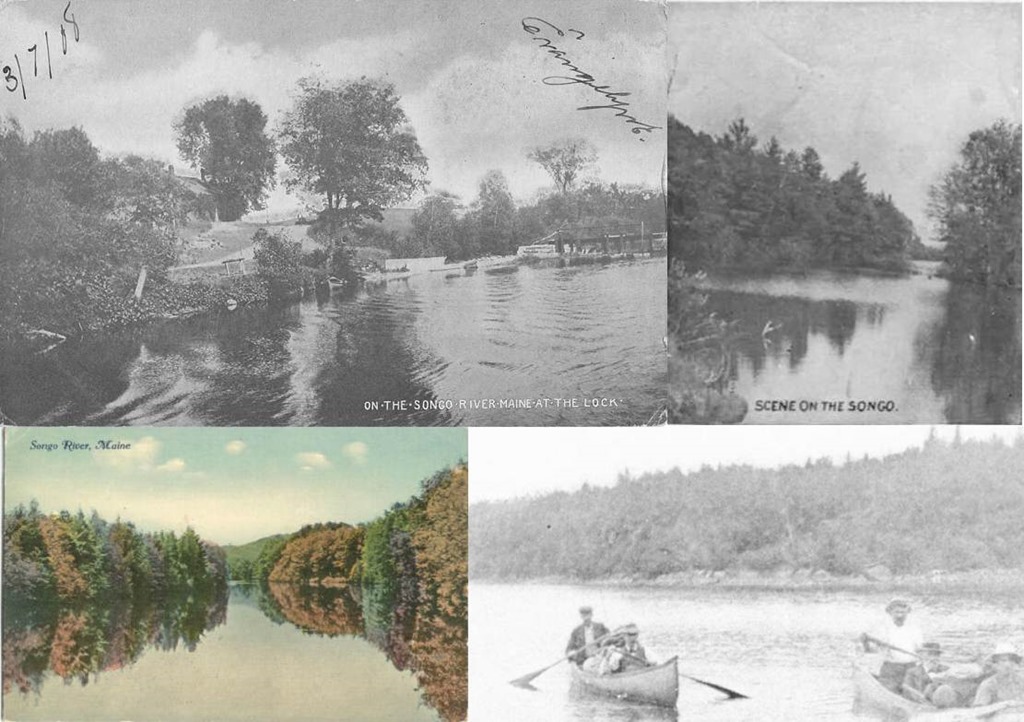
These Songo river photos look like they could have been taken within a decade or so of Hovey’s poem. Looks bucolic in these, but others show passenger steamboats (one named for Maine’s poet Longfellow) plied the river too.
.
The Songo in Hovey’s poem is a short river in Maine, but the Songo connects a large lake and some other bodies of water — and though I don’t think the poem mentions it, it had then (and still has!) a hand operated set of locks and a swing-away draw bridge constructed in 1830.* Hovey’s poem makes this river sound rural and solitary, but having never been to Maine, much less the Maine of the late 19th century, I can’t say how busy it actually would be. The poem’s voice says someone is using oars for propulsion, so even if this is an aimless pleasure trip, there’s work involved just as there was in my recording the song I made of the poem. At the end of the poem there appears to be someone else in the boat, as the poem’s voice cries out “Kiss me” unexpectedly. Who is the other there? Could this be a Hendrixian excused kiss of the sky-blue-water-sky? Maybe, but a lover would be the likely (if unprepared for) guess. The unprepared suddenness of this ask seems dream-plot strange to me.
In my performance I turned the poem’s remarks about the experience being dreamlike into something of a refrain to further emphasize that element for someone who might hear this once as I perform it. I also removed one short stanza from the poem’s original text in the interest of shorter performance length. You can hear the full band performance of “Down the Songo” with the graphical audio player you should see below. No player? This highlighted link is an alternative that will open a new tab with its own audio player.
.
*This short modern video shows the continued remarkable operation of the manual lock and drawbridge. Yes, these are hand-cranked mechanisms! So, Sandburg Test met with this post, there are necessary folks working a job on this river, even if unmentioned in Hovey’s poem.
This Monday, Labor Day in the U. S., is a legal holiday which arose from the idea of a day to celebrate workers. Some see this holiday as being in conflict with May 1st, International Workers Day, but I myself have no beef with having two days to celebrate work and those that do it.
Poets and poetry are not, as a rule, oversaturated with attention to labor. Creative work such as writing is, in itself, labor — but the wages are so scant for poetry that it’s hard to see it as allied with such. Currently television and movie writers are on strike, but poets have little in the way of wages and rights to negotiate. If the weekend and the 8-hour workday were obtained through labor struggle, it’s hard to imagine poets picketing for a full honorarium for the 12-line sonnet, or chapbooks for sale on every bookstore shelf that stocks James Patterson books.
What I find less forgivable is that poets don’t write about labor as much as I think is due. Poetry’s Greatest Hits will tell us about mystery, death, love, war, dreams, desire, loneliness, family, friendships, every facet of our non-commercial relationship with nature, all the panoply of pain and joy. What poetry won’t speak of much is the third or so of our lives spent making or getting a paycheck.* And I don’t think the situation for the subject of labor is getting better. Farm work, even if romanticized into shepherd tropes or the like, supplies many of the poems in the canon that speak of work. As the percentage of Americans engaged in, or even living among others engaged in that line of work decreases, we see fewer of those poems.
Around Labor Day or May Day, I often find myself dipping into the work of Carl Sandburg. Despite his less than illustrious education, not of the Ivy League but more a Row-Crop League college with hobo semesters, and attendance in The Front Page era of journalism, rather than sessions abroad and drawing room soirees. Sandburg was by intent a thoroughgoing Modernist artist, making it new as much as any of the early 20th century Americans, but his Modernist solutions and prosody get little respect currently. Maybe they’re right, though I find Sandburg can be effective for my purposes. Judge those things as you might, he does pay attention to labor and laborers as colleagues. He can portray all kinds of struggle in doing so, but also endurance, achievement, and harbored joy.
Before I get on to the piece I found in Sandburg to celebrate Labor Day, let me suggest a rough analog of the Bechtel Test. Let me call it the Sandburg Test. To be clear, it’s not my suggestion that every poem has to be about work, about the things we do for our daily bread. But, if we are viewing an anthology or substantial poetry collection from a poet, to pass the Sandburg Test it has to have poems that deal with work in some substantial way. How does the speaker or characters in the poem relate to work? What are they doing that work for? What is it in presenting them that portrays something about life? What are the mysteries, sensations, and systems of that work?
What Sandburg poem did I choose? I picked a selection from the 6th part of a longer, multipart poem, “The Windy City.” This one is sort of an extended revisiting of Sandburg’s Greatest Hit “Chicago,” sometimes remembered as a boosterish paean to the great Midwestern American city, which it’s not — “Chicago” is a poem about a city and a workforce in struggle. “The Windy City” on the other hand is more mystic, and the section I chose is essentially a labor hymn. Physicists tell us that the things we see about us, solid things apparently, are in fact full of moving atoms and vibrating particles, their close motion making solidity. Sandburg’s windy city is such. The labor we celebrate on Monday, and do most every other Monday, is the gusty current that makes our world.
Looks solid enough, but it’s made of something as transitory as work. Carl Sandburg looks out on mid-century Chicago.
.
My music for today’s piece is in my punk orchestral mode: simple musical structures making use of orchestra instruments and a few interlopers. You can hear it along with Sandburg’s words with a player gadget below. No gadget? Here’s a highlighted link, that’ll open even on Labor Day to present you with an alternative audio player. Want to read more of from the poem from which I selected today’s passage? Here’s a link to that.
Thank you for reading and listening. Thank you for the work you do when you’re not doing that. Yes, you may be paid for that, well or not, but our lives and communities are made out of that work. How can that not be mystical?
.
*My diagnosis of this avoidance is that poets may still feel an expectation that they should either be full-time poets earning a living from their poems, or if not that, rich enough to not need a “day job.” Their day jobs then are not poetic, and so don’t appear in their poems. Poets with academic jobs are a considerable middle case however. I suspect administrative policies and faculty politics still don’t seem poetic. Perhaps office-based work in bureaucracies is harder to press into non-humorous verse than the village smithy or a steel-drivin’ man?
I wrote a short piece a few years ago, which goes like this:
The Temple of Summer is guarded by two pillars:
Memorial Day for those who gave up their lives in war,
And Labor Day for those who gave up their lives in peacetime.
This Monday is American Labor Day.* What constitutes a laborer, a worker? Someone who works for someone else, who doesn’t own their own business? Are poets and musicians workers, or small businesspersons? These things are not simple — after all, that musician-derived term “the gig economy” shows that grants of independence can be superficial. Anyway, let me defer that discussion and say that poet and musician Carl Sandburg was a worker, knew he was a worker, and understood work. It should be no surprise that I’ve chosen to present three poems from his 1916 breakthrough collection, Chicago Poems for Labor Day — or for any working day if you read this later. They’re observed and written in the situation of their time, but let’s not dismiss their concerns and experiences as outdated this Labor Day — at least, not without hearing Sandburg out.
How many times, even today, when someone seeks to portray the working class, is a white male presupposed? Sandburg doesn’t make that mistake as his “Working Girls” will show. My wife, a nurse, came home this week concerned around a strike deadline, and it’s safe to say that women have carried proportionally more of the stress of the past few years in the workplace. She tells me her coworkers are riven by this announced possibility. Some of the most stressed, see this as adding to their stress; others see this as an attempt to remedy some of what’s wrong in their field. Sandburg sees a dialectic in his river of working women, though his poem’s more about the general wearing-down of a life of work.
“Happiness” is probably the best-known of the three Sandburg poems in today’s piece. It’s significant to know that Sandburg is a 1st generation immigrant, and he writes continually of the immigrant experience in his poetry. I don’t think it’s too hard to translate from Sandburg’s immigrants to today. My weekend summer nights here in my neighborhood feature accordion music as this poem mentions, though the singing is in Spanish for my ears. Oh, my wife and teenager sometimes have trouble sleeping, and then there’s this noise. I have trouble sleeping too, but I also hear this Sandburg poem in my head, accompanying from his time the Mexican songs from the yard three houses down the street.
Consider this on a holiday: no one feels leisure like a working person.
“Muckers” may take a little translation. When I was growing up, closer in time to Sandburg’s than today is, a ditch digger was not a job description so much as a derogatory term. It stood for someone who had no ambition, no skills, no ability to advance. If you lacked those things, you might be cursed to become “a ditch digger.” It was essentially workplace hell — and the inhabitants, damned by their sins of omission. My father once preached a sermon I can recall from my youth in which the dignity of a ditch digger’s work was proclaimed. The detail he spoke of then, the part I can remember, was that some care as well as muscle was required to carve out a stable and straightaway ditch.
Sandburg’s poem takes a red-wheelbarrow to the job site, writing (as he would often do) an Imagist poem concerned not just with concise precision in the observation, but more at why so much depends on what is observed. And he’s got a punch line, one anyone who’s ever suffered through the worthlessness of unemployment will understand.
Together these three poems I perform today celebrate those who give up their lives in peacetime. “You dreamy poet,” some may be saying now, “That’s the way of the world. Don’t you know?” Oh, Sandburg knows. He went to work at 13. I was self-supporting at 18. The difference between us and some other poets is that we’ll write and sing about this. It’s as universal as love and heartbreak, near as universal as death, and it’s the mundane ground upon which poetry and music and all the arts are stroked upon.
Carl Sandburg: proud to be the guitar strangler, rockin’ maker, stacker of tracks of wax, hex-string player, and folk-rock maven of Modernist poetry.
.
My musical performance is longer today than most Parlando pieces, but then it does present three poems and asks for a quantity discount. After working out and executing the acoustic guitar and “punk orchestral” setting of Emily Dickinson last time I wanted to plug in a Stratocaster and wail a bit, and so what you’ll hear today is a live electric guitar performance recorded then. One production oddity I’ll note: I recorded the two chordal “rhythm guitar” parts after the lead melodic part. The player gadget to hear the performance is below for many of you, and I provide this highlighted link for those viewing this blog in ways that cannot display the graphical audio player.
.
*My teenager reminds me that “Labor Day” is not the international workers day that is May Day. I remind them that American Labor Day came out of the labor movement too, and no matter how you parse things, having two days to celebrate work and workers is not too much, no more than we should be embarrassed in America to have a Veterans Day and a Memorial Day.
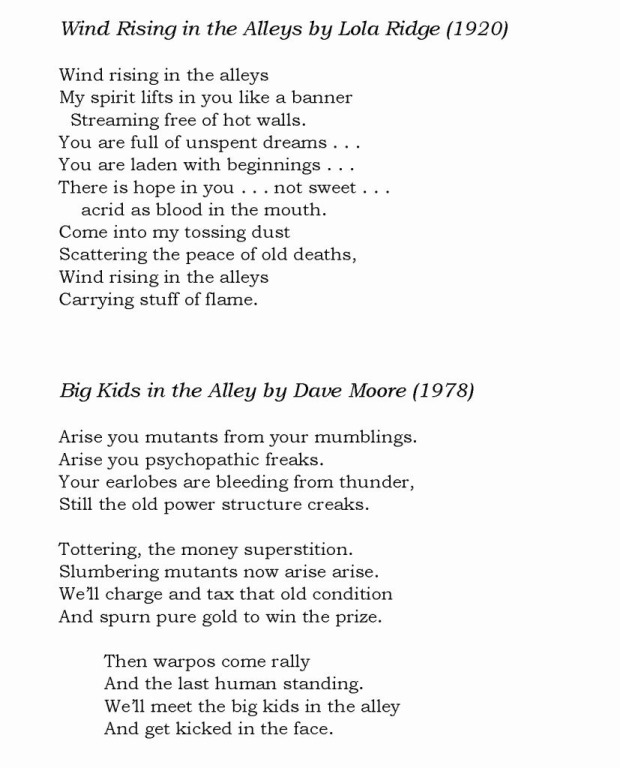
I thought I might get a second American Labor Day piece in from a few ideas I had last week, and this is the one that survived the cut. Well, maybe it’s more than one, as it’s a two-in-one, combining poems written 40 years apart: Lola Ridge’s “Wind Rising in the Alleys” and Dave Moore’s “Big Kids in the Alley.”
Ridge is a figure that could fascinate several different ways. She has a life story that would defy the most expansive novelist to invent. She was “on the scene” in both the literary avant garde of the NYC area of the first half of the 20th century and in touch with the political radicalism* of that era, and as woman who clearly saw the limitations of gender roles, she was allied with the wave of feminism arising then as well. A several-time immigrant herself,** she wrote with insight into the immigrant experience.
Having an interesting life isn’t the same as writing interesting poetry or poetry that compounds its interest over time, and I blow hot and cold myself as I once more start to read some of it. She has more than one style of poetic diction, occasionally sounding a little bit 19th century, and then sometimes flat and spare, to other times striking out with passionately with intense tropes of natural phenomena intending prophetic power. The first time I featured her work here I could easily see how that last kind of writing could link in with our era of Climate Change. In my second time into her work this summer I may be starting to “get” her, and Ridge may be one of those poets who one needs to get over the ways she seems “wrong” before understanding what she’s doing that’s uniquely “right.”
Accidents or coincidences, can sometimes help me do that. Reading her poem about a so red sky in contemporary times of widespread fire-smoke is one such connection. And my second time with Ridge happened when I saw this poem where nature in an urban alley is portrayed at a prophetic level. When I read this poem first published in 1920 I thought of a Dave Moore lyric used in the first Fine Art record in 1978. I made a note immediately to myself that they could be combined.
Are these Labor Day poems? Sandburg’s piece from “Smoke and Steel” I used last time is certainly one in the context of the larger poem it concludes. “Wind Rising in the Alleys” is the concluding poem in Ridge’s Sun Up, a collection of mostly short, sometimes Imagist style, poems and “Wind Rising in the Alleys” is the last one printed in the book’s final sub-section which also includes poem-portraits of famed Anarchists Emma Goldman and Alexander Berkman. The poem for which the section is named, “Reveille” starts “Come forth, you workers!” and ends “Let us meet the fire of their guns/With greater fire/Till the birds shall fly to the mountains/For one safe bough.” “Reveille’s” militant final lines compress parts of Ridge’s rhetoric: fervent radicalism combined with a “who would guess it would come next” poetic image.
As I mention here political beliefs and calls for direct action following from them, I’m thinking that some of you may not share those beliefs. So, let me stop for a moment and mention something important to poetry as an art. Poetry is not a very efficient method of communicating ideas, much less particulars of strategy and tactics. To say that it fails in these things (or to overstate what it may do in some part) is to find the obvious, for poetry fails as expository work or argument closer to the degree that music does. What poetry can do instead, is to tell you what having some idea or intent feels like. Do you recognize what it feels like the moment that someone you love or desire lets you know that they feel the same? That’s what poetry can do, and do intensely. Of course, it may happen that that lover turns out to be flawed, or an outright heal, just as much as they can turn out to be a partner for a lifetime and the treasured ancestor of ancestors.
That moment of love and connection is powerful to feel, and it’s not just romantic love poetry that can present that connection.
The optimistic winds in the alley Ridge speaks of have hope in them, hope for change. I can’t say exactly when it was written, but for publication in 1920 it may have been written in a time that was not at all hopeful for American labor and political radicalism. Berkman and Goldman were deported in 1919, and that year saw red-scare round ups and a particularly deadly year for anti-Black race riots. Whatever it is, “Wind Rising in the Alleys” is not a victory march.
I write about poetry and music on May Day or Labor Day, you can easily find others who will discuss political and economic matters. Let me just summarize a lot of complex history to say that workers and capital have both advanced their lot in the United States greatly since 1919. Hooray for Labor Day. Has justice advanced too? Yes, but the argument that that has been to a lesser and insufficient amount is strong. Hooray for Labor Day — and the days afterward.
Here are the texts of the two allied alleys that I’ve put together today.
.
Step forward to 1978. Dave Moore’s “Big Kids in the Alley” was written at the request from a rock band named Fine Art forming and making its debut album. I’ve written elsewhere a short history of that band, one of the earlier bands in the Twin Cities area to make and record original music in the Punk to New Wave transit station on the route-way of Indie music. Just as “Wind Rising in the Alleys” was the “album closer” for Ridge’s Sun Up,“Big Kids in the Alley” closed Fine Art’s record and was the encore or set closer for a lot of live sets I saw. At this time it remains one of two studio-recorded songs of theirs that can be found on the Internet, and it was even sampled and used in a hip hop record in our current century. Here’s the YouTube link to that cut from the vinyl record.
You may think that’s quite the intense showpiece. On stage it could be even more so, and it’s certainly not the kind of song you’d want to put in the middle of a set list with other songs immediately following. Rhythm guitarist Ken Carlson was always solid and tasty, and vocalist Terry Paul used a more aggressive style here than what was customary for her, but “Big Kids in the Alley” was also a feature for Fine Art’s lead guitarist Colin Mansfield. You can hear effects pedals sweep frequencies in the song, and Colin would usually play all or most of the parts using the edges of a Zippo lighter in his right hand as a string and pickup exciter as well as a pick. Colin had some understanding of avant garde and other orchestral instrument music under his belt before Fine Art, and while what he was doing here was unprecedented in punk and new wave bandstands in the Twin Cities in the 70s, unorthodox sound generation methods had some pedigrees there. Outside and Free Jazz players would also do similar things, though because those styles were usually wind instrument based, the precedents are less direct. A short-lived rock band movement in NYC at the same time (documented in the No New York LP also of 1978) used random noises and alternative guitar tunings often played by naïve players.*** Colin wasn’t a naïve player.
Lyrically, Dave Moore’s words for “Big Kids in the Alley” starts as a parody of “The Internationale” the 19th century labor anthem. If you read this Wikipedia article compiling the various versions of “The Internationale’s” lyrics over time and in many languages, you can see that they vary considerably, but the opening’s general thrust, retained with some intensifying language in Moore’s parody, is mostly honored. I sometimes wonder how many folks in pioneering venues that supported “punk” or “new-wave” bands in the Twin Cities 40 some years ago recognized the reference. You never ask such things when dancing.
The final chorus of Moore’s version adds an unexpected departure. This morning I realized I’d never asked Dave what his intent was in what he wrote there. I called him up, and he explained “That you’re going to have setbacks, that they are going to react violently. That you should realize that.” Note that the arrangement on Fine Art’s version ends on Dave’s final thought, which emphasizes its impact.
I didn’t use Fine Art’s music for this performance, and my musical setting is simpler while referencing a similar flavor. I did dig out an old Zippo lighter I keep in a drawer in my studio space, but I didn’t quite get Colin’s exact effect in my “get’er done” charge to record today’s piece.
You can hear this loud rock band combination of these two texts written 40 years apart with the player below, or if winds haven’t blown that up your alley, this highlighted hyperlink in an alternative way to play it.
.
*Early American Modernists, unlike an appreciable number of European or European-based Modernists, tended to be left-leaning, even radical. Many of the American publications that printed the work of Modernist poets or visual artists were equally if not more so concerned with social reform or outright restructuring.
**Though, I do not consider the elements in anyone’s background determinative, I enjoy on a superficial level the diversity of ethnic and regional variety in English language poetry. Ridge is a case where the hyphenation cannot cope. Born in Ireland, immigrated to New Zealand at 8, then to Australia where her career in the arts gained a foothold, then to the American West Coast were she at least touched bases with the contemporary arts there, and finally to New York City where she lived the majority of her life, including time in the teaming immigrant Lower East Side.
***A less-remembered pioneering American punk band Pere Ubu was working some of these ideas as early as 1975. Sonic Youth was connected to and arose after the NYC No-Wave scene was receding, becoming a successful band in the Indie Rock era. In the Twin Cities, The Wallets later presented a more song-oriented version of what some of the NYC No-Wave bands did.
This is the weekend that ends in American Labor Day, and I’m going to see if I can put up at least a couple of pieces celebrating that.
The relationship between poetry and labor is complicated. On one hand, unlike entertainers, popular prose writers, or some other fields in the arts, almost no poet earns enough solely from poetry to escape a complete lifetime of some other everyday work. This could lead to the world of work and the concerns of those that do it being widely incorporated into poetry, but in my observation that’s not so. Why should that be? Well, as much or more than any other art, poetry, in self-image or in public image, sets itself apart from ordinary work.
Poets are seen as dallying with the muses, observing unsullied nature, being drawn to erotic passion, explaining the godhead and the nearly unreal, or engaging in an endless spree of derangement of the senses. None of this seems related to the world of work. Things like that may be a way to spend the weekend or a holiday, and so poetry may be attractive to those seeking to temporarily escape their workdays — but then not an art used to understand them, or to interrogate them.
American Modernist poet Carl Sandburg conspicuously didn’t avoid work and workers as a subject. Some elements of Modernism liked to write about the products of early 20th Century industry — odes to locomotives and airplanes could stand in for birdsong or daffodils just fine for the make-it-new crowd — but the systems that built them and the human effort involved were largely not viewed as fit subjects. Satires of the management classes could be undertaken, and by damning their mundane concerns, the world of work could be dismissed as a fallen human state.
In variety and extent of opportunities to observe work the poet Sandburg may have had an advantage, and he didn’t squander it. Itinerant laborer, municipal government functionary, labor-union agitator, journalist, small-time farmer — Sandburg certainly had his perch to observe work. He wrote about all of those trades from inside and beside. Today’s piece is taken from the very last section of the long title poem in his 1920 poetry collection “Smoke and Steel.” In the poem Sandburg concentrates on that backbone of American industry in his time, the smelting of iron ore into steel, and he does so by focusing on the laborers in that system. While he’s in a long-winded Whitmanesque mode, he brings to this task the miniatures of Imagism, and in this final section, if separated out as I did here, he presents an Imagist poem. Earlier in his poem we meet a lot of people and their tasks involved in the manual labor of steel making; and now in this Imagist ending we’re left with three or four objects. Once he violates the unity of the charged moment, but otherwise it follows Imagism’s rules. Here’s a link to “Smoke and Steel”, and the section I adapted and used today is at the end of the opening poem.
We first meet cobwebs, called “pearly” to indicate a beauty in them, and they’ve caught and held raindrops. Just a “flicker” of wind tears them away from the scene. Moonshine, golden and so also portrayed as beautiful, perhaps in a pool of rainwater, is likewise shivered and dispersed by the wind. Finally, a bar of steel is presented, and there’s contrast. It’s not so transient. Violating the unity of the moment, the poem says it’ll last a million years, even if nature will coat it with a “coat of rust, a “vest of moths” and “a shirt” of earth, images that seem to me to connotate the grave when we are also told the steel bar will “sleep.”
I’ll admit that while I could visualize the cobwebs with pearly rain drops and the moonshine rippling in short-lived puddles, just exactly what the steel bar was as an image to be visualized was puzzling to me. A railroad track? We don’t usually call rail tracks bars. A fence, or even a jail cell (“steel bars” as shorthand for jail)? Nothing earlier in the poem prepares us for that reading in this section. Some steel ingot stockpiled and stored outside? But destined to be forgotten and left for a million years? Other than that “million years” permanence we’re told only one other thing about the steel bar: that it looks “slant-eyed” on the cobwebs and pools of moonshine. I understood this as “side-eye” and that reading seems pretty solid to me. The steel bar knows it’s going to be there longer than the cobwebs and moonshine, so it can dismiss them as ephemeral.
Then looking to confirm if a slant-eye look would have been understood to Sandburg as side-eye, I could only run into the use of, and disparagement toward “slant-eye” as an ethnic slur. Though that slur wasn’t news to me, it hadn’t occurred to me as I don’t think it’s what Sandburg intends.* Realizing this after I’d completed recording today’s performance, I considered that it might harm the ability of some listeners to receive the poem’s intention, and if I was to perform the poem again, I might take my privilege with a work in the Public Domain and sing it as “side-eye.”
Coming as it does at the conclusion of Sandburg’s longer poem “Smoke and Steel” what do I think the cobwebs, steel and moonshine mean as they are met by the wind of time and change? We may abide by the convention that poetry and work are separate things, but as Sandburg has just written a long poem about work, we know he wants these things to be combined. The things we do everyday for pay, the work we do in arts like poetry — are the later the cobwebs and moonshine, beautiful, transitory, little noticed; and the former the steel, the solid, useful things that will last? Or is the steel the “real” that is buried, and the cobwebs and moonshine it distains the eternal now that returns fresh?
And then, can either be both?
The player gadget to hear my performance of an excerpt from Sandburg’s longer poem that I’ve titled “Cobwebs, Steel, and Moonshine” will appear below for many of you. Don’t see a player? Then this highlighted hyperlink is another way to play it.
.
*Sandburg is too comfortable with ethnic slurs for many modern tastes in his poetry, and “Smoke and Steel” contains a handful of them earlier in the poem. The unabashed way he uses them in his way argues against this ethnic-Asian slur being a 1920’s dog-whistle.
This Monday is American Labor Day, so here’s a poem about work from Robert Frost: “Mowing.” Like a lot of Frost’s early poetry it’s an example of words that want to sing, and so I’ll sing them today. Also like a lot of Frost’s best poetry it seems simpler than it means. It doesn’t scare the reader or listener away with its surface, but if you really stop to ask why it says exactly what it says, a more complex and subtle work emerges. Here’s a link to the full text of the poem if you want to follow along.
That about scythe’s it up. NC Wyeth’s “The Scythers”
On first reading this poem is a description of mundane work, mowing a field with the time-honored hand tool: the scythe. How old is that tool? It goes back to the pre-historic days of agriculture, to the making of the first blades for that, and then for the battles over that. It was still in use in Frost’s youth, in the late 19th century. And in the house I grew up in, in the mid-20th century in Iowa, in the crook of a tree in the big back yard there was a scythe caught there, high above my head, stored, captured, put away until it seemed as natural as any other part of the tree.
So, the poet or his speaker counterpart is mowing with a scythe. And since that poet is Frost, we get sound imagery regarding that work. The Imagists contemporary with Frost didn’t require their images be visual, but as a practice they strongly preferred them to be. Frost, on the other hand was the audio guy, not the word painter. The scythe as it swings and cuts, punningly sighs, but Frost has it as a whisper. About this, the poet is curious: if it’s whispering, what’s the scythe (and by extension, the work the man and tool are doing) saying?
The maker of this video on Frost’s poem demonstrates the sound
Frost’s poet says he doesn’t know. Interestingly he speculates it might be talking about the heat of the workday, and the phrase he uses “The heat of the sun” may well be reminding him of a poem from Shakespeare we recently featured here: “Fear No More.” Shakespeare’s poem and the connection with the scythe has with the “grim reaper” brings in an overtone of death.
And then he speculates it may be about why it’s whispering, why it’s not speaking something out-loud and plain.
Next the poem moves on to the realness of work inherited from its physicality. It’s not a dream or imagination without consequence. And it’s not some fairy story. Gussying it up with such trappings or comparing it to mental work with no embodiment would be enervating it. The poet instead calls this work “earnest love.*” This isn’t some secret crush, even with the whispers and all, this is actually sweaty stuff.
Frost then drops one of his better-known mottos: “The fact is the sweetest dream that labor knows.” That line is end-stopped with a period, and set off that way it’s a statement that real work on real things is superior to mere fancy. But this is Labor Day, so I performed it as if there’s a colon after “The fact is” and that its meaning carries on through the period and into the last line. The sweet dream then is the scythe whispering and the concluding matter of the hay.
What is the scythe whispering?
Because after all, there’s an unanswered question from the poems opening. What is the scythe whispering? It’s something intimate it wants to say, that good work says, but doesn’t say. It says it is—paid or unpaid, self-employed or employed, the labor of a poet or of a farmer, done grudgingly or with joy, appreciated or overlooked—it says it is done with love. Not the magic love, not the imagined love. The earnest love.
Happy Labor Day to the readers and listeners here. Wishing you good work and earnest love.
The player gadget to hear my performance of Robert Frost’s “Mowing” is below.
*This section of the poem, lines 10 through 12 in this unusual sonnet, is the most mysterious. I had to perform it before I could figure it out. There may be an overtone here (something that English folksong often made a practice of) of farm work being used as a metaphor for sexual lovemaking. There are snakes, flowers, and then named flowers that are “orchises” which are a genus of flowering plants and also etymologically testicles. Frost made a choice for what flowers he names, and his poet/scyther could have scared off a field mouse or chipmunk not a snake.
On the other hand, he may be just saying that like all artists his work will fail, some flowers get scythed. And the snake could be a Garden of Eden thing.
Or the flowers and snakes may be the beauty and the evil of what we do, that the Grim Reaper scythe will cut off.
Today is May Day, the international labor day, so I spent it working, looking through poetry books for something about our lives of work. There’s less there than there should be I think, the world of work somehow not seeming as poetic as human love and desire or as sublime as the observation of nature and things of the spirit without any human sweat in it.
This lack leads me to admire poets who address this imbalance. And the first one that came to my mind turned out to be the one I ended up using today: Carl Sandburg. That Sandburg might come to mind for others too as a poet of labor probably didn’t help his reputation at the start of our current century. He doesn’t come by that classification lightly, having had a career as an itinerate worker and labor organizer before he began as a poet, and even while he was publishing groundbreaking works of early American Modernist poetry like his Chicago Poems in 1917, he had a second, less well-known life as a Socialist radical.
Carl clocking in in his later years when his day job was goat farmer
Somehow Sandburg survived both the post WWI and post WWII red scares without great harm to his reputation, but by late in the 20th century there was less interest in Modernists who wanted to write about work and labor issues. The bohemian fringe more or less looked at straight work as an unfortunate event*, and the academic establishment was more interested in aesthetic rigor and the ability to carry lightly evidence of a full-fledged college education for its poets.
Proletarian writing had been done already. Time to move on.
As I keep reminding you and myself, our current century is now old enough to vote, it’s approaching adulthood. It might want to re-evaluate those judgements the old century made about its youthful innovators.
So, for today, May Day, I took the opening to Sandburg’s longer poem that gave its name to his 1920 collection Smoke and Steel and turned it into a labor hymn. “By this sign all smokes know each other.”
I spent Saturday riding my bicycle on the Mesabi Trail and visiting Hibbing, the Minnesota Iron Range hometown where Bob Dylan grew up non-ferrous.
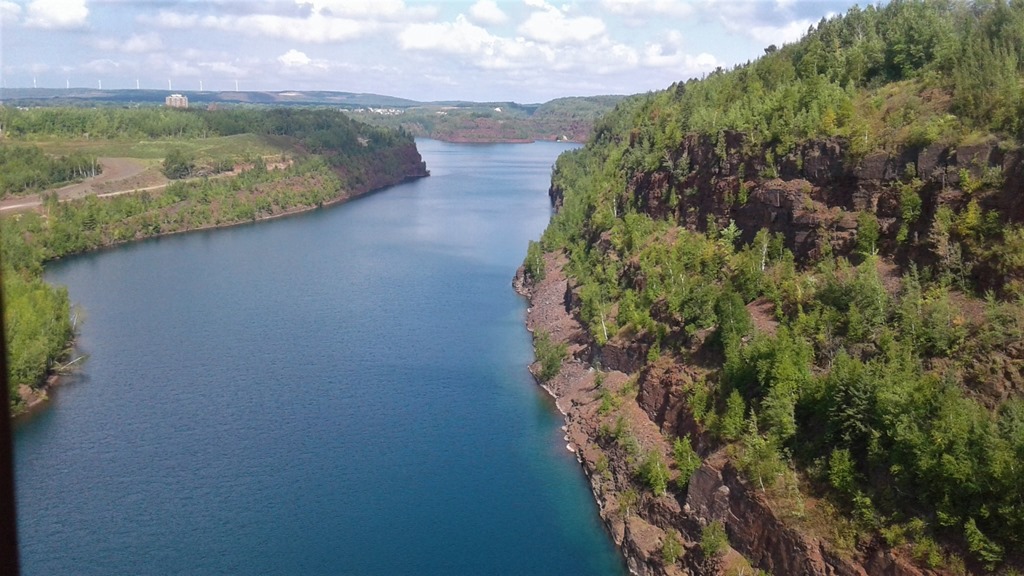
To the visitor, the landscape there has a strangeness. Since the late 19th Century, open pit iron mining has been the industry of the region. An open pit mine is not the kind of underground tunneling and mole-dark pick-axe work you might visualize when you hear the word “mine.” Instead it is the removal of cubic miles of earth with explosives and huge shovels, work my wife describes as “making your own Grand Canyon.” The iron gives exposed rock and dirt a Martian red hue, and this colossal earthwork of generations of open pit mines has added extra hills, ridges, gorges, and small lakes. Though trees and brush eventually regrow and give these acts of men something of the appearance of nature, some hills retain the terraces where the trucks drove, giant Northern ziggurats or Mayan temples, now sprouted with pines—the Hanging Gardens of Bob Dylan.
“Making your own Grand Canyon”
Since Bob Dylan grew up here, the strangeness of this landscape may not have impressed him in his youth, but an adulthood away might have eventually revealed its uniqueness. It is a singular place on a Labor Day weekend where one can see the mark of daily labor sculpted in a giant tableau.
How many of us can say the same for our labors? Children are raised, daily cares are met, that meeting makes a decision, a sick person is comforted and will live another couple of decades, the number of widgets on the planet increases infinitesimally, a project that will impact things for a few years is completed. In contrast, in the land around Hibbing, Virginia, and Mountain Iron, vistas are forever altered to mark a work life.
A view from the highest bridge in Minnesota spanning part of a no longer active open pit mine now filled with water outside the town of Virginia. The landscape you are viewing is man-made, not a natural feature.
An artist’s work, for all the literary pretentions to immortality, is at least as ephemeral as other work. The work is finished, and the earth has not changed its face. The work is read, seen, heard by its handful, and it melds at best into a memory in some part of those.
So, punch a clock or not, these are the same jobs, the same work. The poem, the performance, the painting, no less, no more, the product effort of applied human energy as any other work.
Occasionally, someone gets to be a Bob Dylan, and the vistas change. Leonard Cohen said that giving Bob Dylan a Nobel Prize is like pinning a medal on Mount Everest for being the highest mountain. I stood next to my bike on the state’s highest bridge spanning a man-made gorge and thought, maybe somehow, even subconsciously, this landscape gave Bob the idea.
“Cruising down the highway in a Greyhound bus/All kinds of children they was hollerin’ at us…”
Today’s audio piece will not remind you of the Bard of Hibbing, as it is a fuzzy epitaph using Mellotron instead of giant earth-moving trucks to get its rocks off me. Here’s wishing all Parlando Project listeners a lanquid fall into the fluffiest possible snowbank. As you exit the Temple of Summer, listening to the music using the player below, I remind you that the Parlando Project appreciates your attention, but still needs listeners and readers. If you can, let others know what we’re doing here, and if you’re new to us, you may want to check out our archives with 250 other audio pieces combining various words with original music.
Tomorrow many US schools begin their school year, so here’s an audio piece about a child going through that first week back in school after what seemed to be an infinite summer.
The schools in Iowa, where I grew up, began a week earlier than the “day after Labor Day” start that is more common elsewhere in the US. I’m not sure why. Maybe farms needed kids more in the spring to summer transition weeks than in the summer to fall interval. Maybe it was an advance allowance for the inevitable “snow days” that would cancel school during the winter, days that if made up in the spring would move the end of the school year into June. Maybe it was, in some way, a gesture to say Iowans cared more about getting down to education than slacking neighbor states.
All I know is that as a kid I thought this terribly unfair. A whole week! My cousins in Minnesota got a whole week more of summer! That next week was always going to be the best week of summer, the one that you got to do whatever you hadn’t done, or done enough of, during the rest of the summer vacation.
Now my son goes to school, and the school yard the kids are walking across to get to the first day of school is like my schoolyard was. Maybe all schoolyards are like this. The grass is still a little beaten down from every independent path the kids have taken too and from, still worn from every recess outside last spring.
To hear the spoken word/music piece “The School Year Begins” as performed by the LYL Band, click on the gadget below this.






 Frank Hudson