Yellow Air (Heat)

Are you new here? If so, this is what the Parlando Project does: we take words (other people’s, mostly poetry) and combine them with a variety of music we compose, create, and perform. I find this fun, and I also find that even more than reading another person’s poem — even reading it aloud — performing it illuminates corners inside the text that I might otherwise overlook, so I write here about that experience. Then when you listen to the pieces you get to hear the poem in this new context to freshen your appreciation of poems you know, or to allow you an entry into a poem previously unknown to you.

Most of the time I’m faithful to the texts I use to create these pieces. Oh, I might take a part of a poem and make it a refrain/chorus, or I may select some tasty phrases from a prose paragraph so that expresses something more sharply, as if it was a poem — but my usual idea here is to honor some poet or their poem no matter how famous or little-known it is.

John Gould Fletcher is shelved in that little-known section these days, even though he was associated with writers and movements that are still studied, still read (at least by those interested in early 20th century American Modernist poetry.) I wanted to look at some of his work because I read that one of those associations was with those pioneering Modernists who took to calling themselves Imagists. Imagism was often that 2:40 punk-rock single of a hundred years ago. Instead of spendthrift merely decorative language, rhyme, and imagery, the Imagist poem wanted to get right down to it: direct treatment of something observable, not some ideal distilled from abstract thoughts imagined or philosophically proposed. No extra points would be scored for extra words. Rhyme, while not forbidden, was also not the main point. If rhyme led to extra words, those unneeded ones, it was worth discarding.

The musicality of poetry wasn’t thrown out, but like Modernist music, Modernist verse wasn’t interested in the old formal beats so much.

Best as I can tell from my early readings, Fletcher’s personal interpretation of Modernism and Imagism was not the same as others. He didn’t write much in hyper-short forms, while many of his fellow Modernists published whole collections, or sections in collections, made of sub-20-line poems. At least at first glance, Fletcher cared more for sound and less for freshness and concreteness in his imagery than others.

This Project likes shorter pieces, even more so now because my time and opportunities to compose and record are less than in the Project’s early years. In reading through a couple of Fletcher’s collections from a hundred years ago, I did come upon this short poem that was part of one of those roman-numeral separated sequences like other Modernists used. “Heat”  seemed an attempt at the short Imagist poem to me. Here’s how “Heat”  goes:

As if the sun had trodden down the sky,
Until no more it holds living air, but only humid vapour.
Heat pressing upon earth with irresistible langour.
Turns all the solid forest into half-liquid smudge.

The heavy clouds like cargo-boats strain slowly against its current;
And the flickering of the haze is like the thunder of ten thousand paddles
Against the heavy wall of the horizon, pale-blue and utterly windless.
Whereon the sun hangs motionless, a brassy disc of flame.

Short as it is, it’s a little wordy and formal in its manner of speech compared to other Imagists, but a palpable feeling is evoked in the description. I could have performed “Heat”  as it is above — but then a week ago tonight, I was sitting on my front porch after a summer thunderstorm when the entire outdoors started to take on an intense yellow cast.*
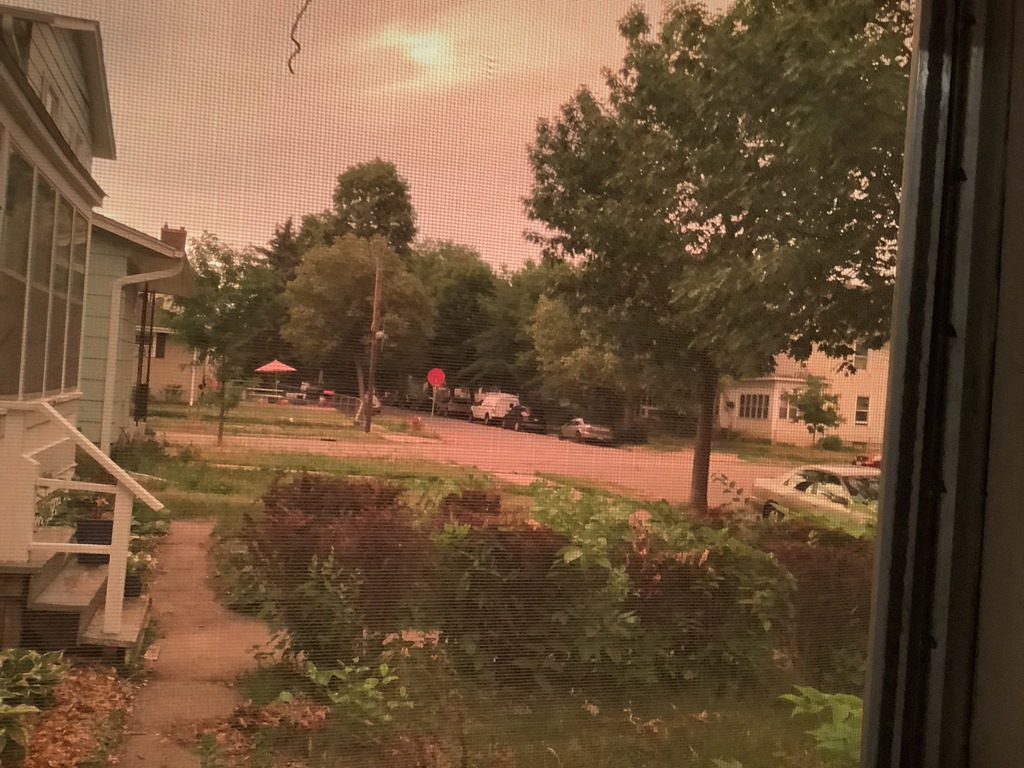
Yellow Sky the Picture 2

It was hard to get a modern digital picture of last Tuesday evening’s sky with a phone. The smartphone kept correcting the heavy yellow and darkening cast to that sky, and as I looked at the photo preview on the phone I wondered why my phone wouldn’t believe me as it showed things brighter and blue. I resorted to using a much less smart device with a lesser digital camera to get this.

.

I decided then and there to use Fletcher’s poem to remark on that experience. This recasting went through a few drafts and produced this reuse of some of Fletcher’s words in a different poem:
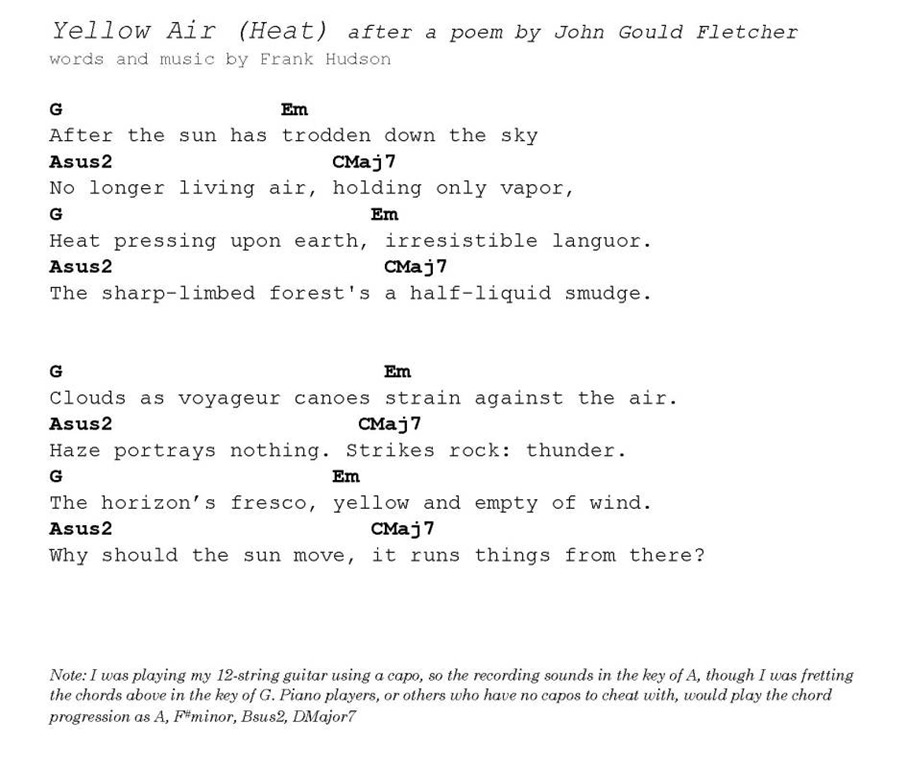
Yellow Air song PRINT VERSION

Here’s “Yellow Air” with chords in case you want to sing it yourself.

.

What did I change? I wanted my own yellow air in a hot, humid summer experience to be portrayed. Though I retained many of Fletcher’s original words and phrases, my variation is present tense and uses a much less literary/formal sentence structure. Mine’s 61 words — Fletchers, 80. The clouds as ships image is borderline cliché and Fletcher’s “cargo-boats” wasn’t specific enough to fight that, so I substituted my own upper-Midwest image: the 18th century indigenous cargo-boats of our region, the voyageur canoe — still reflected even today by those who use their modern canoes to carry themselves and gear into the Boundary Waters for camping. I wanted a more definitive ending too, and so ended my “After…” poem with the sun portrayed as a ruling strong-man who doesn’t care that the sky is yellow and the heat and humidity oppressive.

What I kept, or even tried to bring out was Fletcher’s word-music. Rhymes near and perfect were increased in number and paused on, and I tried to make this variation more easily singable than Fletcher’s more prolix lines.

You can hear the resulting song with the player gadget below, or if that won’t show up in your way of viewing this blog, with this backup highlighted link.

.

*The Twin Cities Weather Service explained last week’s yellow sky cast this way: “Behind thunderstorms in the evening, high clouds remain. The setting sun emits light that is bent with longer wavelengths. While the blue (shorter) wavelengths are scattered out, the yellow-orange-red part of the spectrum remain, thus producing the sky we’re seeing tonight.”

John Gould Fletcher’s weird “America”

It appears that no one reads or is concerned with American Modernist poet John Gould Fletcher these days. I came upon him in a passing mention that he was associated with Imagism, a pioneering English-language Modernist style that I find worthy of sustaining. Turns out this was only the half of it: in Fletcher’s “associated with” resume, later in the first part of the 20th century Fletcher was associated with a southern American ruralism movement known as The Agrarians which then morphed into The Fugitives who furthermore helped birth — not sheep or lambs — but the monastic New Criticism that reigned supreme when I was in school as a young man. I’ve learned only a little about Fletcher, so don’t make me out to be an expert on him, but this linked short bio is much better than his sparse Wikipedia entry for flavor and detail, and it makes it sound like sometimes Fletcher’s “associated with” was a brief prelude to a falling out.*

John Gould Fletcher by Edward McKnight Kauffer 1024
“Tell you ma, tell your pa, gonna send you back to Arkansas!” Fletcher traveled and lived overseas early in the Modernist era, but spent the last part of his life back in his home state of Arkansas. Here in 1924 he could pass for “Remain in Light” era Brian Eno don’t you think.

.

Thanks to the wonderful collection of scanned books at the Internet Archive I’ve spent this month looking through two of the nine books that Fletcher published in the era surrounding WWI. My impressions are early and will be subject to change, but he seems to be writing in a different mode than other early American Modernists that I admire and have presented here.

Like early Pound you can see elements of Victorian era poetry remaining in his verse. He’s generally less interested in short poems of specifically observed moments than many Imagists. His free-verse often has a definite beat and attention to sound — using, a century ago, word-music techniques that a skilled modern slam poet might select today. Reading poems like today’s selection, I could imagine a live in-you-face-off between Vachel Lindsay and Fletcher in their primes in front of a raucous audience.

He’s a more genteel poet than Lindsay, and among the 19th century influences I see in what I’ve read so far are Whitman, Rimbaud, and William Blake, and today’s selection will help illustrate that I think.

Fletcher’s “America, 1916”  comes in near the end of his 1921 Breaker and Granite  poetry collection. This “America”  is a six-page prose poem that, like the poems that precede it in the collection, attempts to sum up the state of America in 1916, but ends, in the final section that I performed, rhetorically like one of Blake’s prophetic books sung to the word-music of Rimbaud’s The Drunken Boat.**   There are no good online sources for the full text of this poem, but I’ll link here to a Google Books result that may allow you to read the whole thing.

Is there a prosaic political point to this poem? In the context of the rest of the poem it could be reduced to a call for America to enter World War I — which though the war had been raging for two years in 1916, was something that wouldn’t happen until a year after the poem’s date. But like Blake’s America, a Prophecy  (which after all includes specific contemporary references of the American Revolution) Fletcher’s poem is doing so by making a more esoteric call for an elusive greater spiritual body of America to be born.

Is America still in an extended, excruciating, labor toward that birth? I’m no prophet, I won’t tell you, but I’ll do my best to give voice to Fletcher’s 100-year-old-words. The final sentence of the poem is one place where I made a slight change in Fletcher’s text. Weirdly, in a way I can’t quite pick out the intended significance, Fletcher ends his piece with “thou shalt arise, perhaps in vain shalt seek, to rule the earth!” As a prophecy of the subsequent “American Century” this could be counted as a palpable hit. Here in 2022, I sought to echo the internal subtlety of Bob Dylan’s opening line to his “License to Kill:”***  “Man thinks ‘cause he rules the earth he can do with it as he pleases — and if things don’t change soon, he will.” With Fletcher’s last line I did it mostly by repeating the “in vain” twice more to add weight to the dangers of vanity.

I performed only the closing section of Fletcher’s “America, 1916”  today because composition and recording time are hard to come by right now. Lots of drums and I was able to play my own horn section this time thanks to getting short-term access to a better set of virtual instruments than I previously had at my disposal. You can hear my performance below either with a graphical player many will see, or with this backup highlighted link provided for those who won’t see a player.

.

*The bio mentions bipolar disorder, which might help to explain the bursts of output and the periods of disengagement.

**Stop the presses, ah, blog post — whatever. I’ve just discovered that the prose-poem style used in this and some other pieces in Fletcher’s collection are “Polyphonic Prose,” a term most associated with Amy Lowell, who Fletcher was specifically aligned with at the time. This short notice of Lowell’s use of the form in Poetry Magazine,  November 1918 shows Fletcher highly praising that poetic form two years after the date of “America, 1916,”  but before the publication of the collection in which I found Fletcher’s poem. Lowell (and to a lesser degree, Fletcher) credit a contemporary French poet Paul Fort as the inspiration of this form. At least in the Wikipedia article on Fort, Rimbaud is not mentioned as a direct influence on Fort, even though I heard Rimbaud word-music in Fletcher’s expression of the form.

***While there are few live-take liberties with the lyrics, this version of that song by Richie Havens is definitive to me.