R. A. Lafferty. An Irish-American writer walks into a bar and it’s a SciFi story

I’ve made note that I didn’t do a piece from Dave Moore for St. Patrick’s Day, but I’m about to deal with that. Readers of earlier posts this month know that I was writing about falling in with a group of Irish-American writers almost 50 years ago. The group in its last decade or so was just four of us, and you’ve heard my performance of words from the two of them who died a few years ago. Dave’s not in that group — well, he was in the group, but he isn’t dead — and I don’t know if Dave ever considered himself an Irish-American writer either. At the other pole, we have Ethna McKiernan who spent time living in Ireland, whose father was a figure in the Irish cultural renaissance, who ran an Irish-arts focused store for many years, and some of her poetry was published by an Irish publisher. That’s more Irish than green beer.

What makes one an Irish or Irish-American writer? I’m just an observer here, but I suppose opinions differ. It never crossed my mind to consider Edna St. Vincent Millay an Irish-American writer, but there’s Irish heritage there, and while her most well-known poems don’t explicitly speak of Irish themes or history, I eventually found and performed this poem of hers that’s quite Irish. Shortly after I discovered Joseph Campbell and was in my first burst of enthusiasm for him, I asked Kevin and Ethna if Campbell was counted in the realms of Irish culture. He was as unknown to them as he remains generally, but he was deeply embedded in Irish culture in his writing and life in both Ireland and the United States, and even his downfall was largely due to ending up on the losing side in the Irish Civil War. Campbell’s clearly an Irish writer who lived in the U.S., but he’s just so little-known. Let me add one more: does anyone consider Frank O’Hara an Irish-American writer? I once did a web search looking for anything written along those lines. If I didn’t come up dry, what I found wasn’t enough to dampen the leather above my bootsoles. If I was asked to find such a connection, I’d point to O’Hara’s manifest sense of mischief and his greater interest than most mid-century Americans in poets who weren’t British.

Perhaps it’s somewhat a coincidence if one is an Irish-American writer or one isn’t. You don’t have to write one way or the other, and it may not have to do with where your parents or grandparents were born. And by coincidence too long to interject here, I came to see that this Tuesday, the day after St. Patrick’s Day, is the anniversary of SciFi writer R. A. Lafferty’s death. I saw this and — ta-da — I remembered that I have a recording of Dave Moore singing his song about that writer. Recalling that, I found that recording and worked today on spiffing it up a bit sonically since it was 10-years-old and reflects some older recording tech. And sure enough, right in the lyrics Dave claims Lafferty as an Irish writer. So, an easy job to complete today’s musical piece and post?

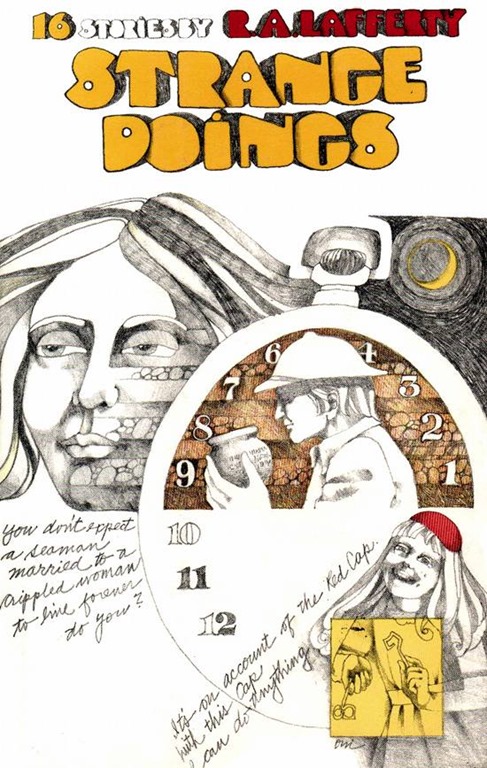
Sort of. I didn’t plan this enough ahead of time to give Dave time to say anything about Lafferty and his writing. I had memories of his telling me, or trying to tell me, about Lafferty’s writing, which had a brief flowering in the 1960s-80s — but what was that he said back then? I thrashed about this afternoon finding a copy of his 1972 short-story collection Strange Doings.  I rapidly read a half-a-dozen of his stories just trying to get a flavor, and I got some sense of why Dave had a hard time encapsulating Lafferty’s virtues. At least in this collection, his prose style is somewhat creaky pulp, yet with that instrument he sets out to tell rather strange metafictions in even stranger ways, often ending in a shaggy dog joke. The image I got was I’m at a dive bar, and there’s this man sitting on one stool. He wants to tell me a story. As he goes on, I try to get a read on who he is. Is he some kind of scientist on a weekend bender, or an in-his-cups academic from a nearby Catholic college? Or maybe he’s a man who’s watched too many episodes of Ancient Astronauts, and takes Neil Oliver and Graham Hancock as his vademecum? Are the beverages why the story started to twist, or are you just not ready to understand the essence of the fractal he’s generating? I ask him what he does for a living, and he tells me he’s an electrician.

One thing’s certain: he needs just one more drink  to finish his story.

“So why are you so interested in all this you’re telling me?” I ask.

“Oh, I’m also a writer. You said you’re a writer. I thought you might be interested in this.” He looks at me, expecting reply.

“If you write like you talk, you’re more like how I play electric guitar. I run off in some direction until I hit something, then I bounce off in another direction.”

strange doings cover

This 1972 collection of Lafferty short-stories credits the cover design to “ONI”

.

There should be a graphical audio player gadget below to hear Dave and I playing Dave’s song “R. A. Lafferty”  back in 2015. At the very start of the Parlando Project I set this recording in a folder of possible pieces to use for it, but I never did because I feared the audience for literary poetry might not find much relevance in Lafferty. Well, the imp of the perverse convinced me otherwise. No audio player? You see, Lafferty has documented that the audio player gadget was invented by Higgston Rainbird and — oh never mind, you can use this highlighted link which will open a new tab with its own audio player if you don’t see the gadget.

.

Barn, Burning

Here is a piece based on a poem by a second Irish-American poet, Ethna McKiernan, who before her death in 2021 would host a reading every St. Patrick’s Day. I can’t say I knew her very well as a person, though as mentioned last time she was a long-time participant in the Lake Street Writer’s Group with myself, Parlando contributor Dave Moore, and the poet featured last time, Kevin FitzPatrick. I’ll next be going off on a short tangent, as is my nature, but it any of this writing displeases or tires you, just skip to the bottom. I quite like the piece that is the occasion for writing this today, and you are excused to go there and just listen to it.

I don’t think Ethna liked me much as a person, and I can imagine any number of reasons why that might be so. Let me leave most of those guesses behind for today’s purposes. In my old age I’ve come to the realization that I am often a careless and inappropriate person. I suspect that’s for neurological reasons, but who can say, it may be a defect in my soul as would have been said in the old ways.

One peculiarity that I had in writing groups is that I was prone to writing long responses to drafts shared by other members. I’d often get quite detailed with noticing what works, and at least as much so with what I thought didn’t or had alternatives to be considered. The audience of this Project know that I have a broad appreciation for styles and approaches. I don’t hold to a narrow poetic style and down-rank anything that doesn’t follow it, but just as I do with editing audio or trying out compositional ideas in music, I tend to look closely, and over the years of doing this, I’d notice how zoomed in and nit-picky some of my responses were — and I wasn’t at all sure my suggestions for alternative approaches were actually improvements. It’s been a few years since I’ve done that, but I still cringe at some of the things I wrote, particularly in response to Ethna’s poems. After all, here was a poet with several published collections, a grant-winner with a distinct cultural connection to a great poetic culture, and who had taken advanced academic creative writing study. Me? I’m a high-school graduate from nowhere, who has no distinct poetic style to trumpet, who last was published in the 20th century. And need I add one more kicker — I would be in Etna’s case a man writing to a woman poet. Women poets reading this know how that often goes.

So in summary: matters of technique and poetic tactics vs. being emotionally myopic. A lot of the first only emphasizes the second.

My reactions to Ethna’s poems continue to trouble me because, at her best I considered her to be an excellent writer, but one that left me tantalized by another poet within her — a far stranger one, one that only materialized from time to time, and seemed to be constrained by her internal editor and self-anthologist.* Yes, it’s a writer’s prerogative to choose what to present or emphasize, but I wonder if other writer’s group respondents, creative-writing seminars, or outside editorial preferences/fashions kept that element down in McKiernan’s writing. Those things have standing, and it may be me who’s out of step, whose taste is questionable or unlikely. But that’s how I felt when reading the poem “Barn Burning” used to make today’s musical piece. I was compelled to do something that may be regrettable. I strongly thought that a developed image just past the midpoint of the poem was not quite as vivid as possible, and that the poem’s ending was short of how sharply spoken it could be.**

Light Rolling Slowly Backwards front cover

Want the author’s final selected poems collection without my blather? Ethna McKiernan’s “Light Rolling Slowly Backwards”  is available here.

.

Ethna is some years dead now. Poets have trouble finding audiences when alive, and once they cross the Lethe, our forgetting often matches the dead’s. Improper, inappropriate, imperious, presumptuous — convict me of the lot. I’m taking the risk that I’m damaging the poem, though that’s not my intent. It’s done out of love for the poem and in hopes of bringing forth this element of the poet who might be condemning me from the other side.

If the worst is the case, take the performance below as damaged, counterfeit goods. If the best of the case is so, enjoy this poem’s mystical experience with my best efforts at adding music to it. I’m not Irish, I just hung out with some Irish-American poets, and it seems consistent to make this offense out of admiration.

You can hear the resulting “Barn, Burning”  with the audio player below. What, has the player been incinerated and not even ash remains? Well then, your listening can be reborn with this highlighted link that will open a new tab with its own audio player.

.

*I remain puzzled why her poem “Letting Go the Wolves”  was not included in her own final new and selected collection Light Rolling Slowly Backwards.  While it’s a fine collection, well worth reading, to my tastes that’s a pluperfect anthology piece, one I’d say any poet could be proud of having be the one poem others know of their work. Of the poems included there, poems as strange as “Stones”  and “Barn Burning”  display moods not widely indulged in, even though her other poems have their virtues too.

**Should be? Let me say again, I don’t know. I’m just one reader, but one who chose to perform it, and who wants to maximize its impact. Here are the last six lines of “Barn Burning”  as McKiernan had them in her final collection: “The outline of the lit barn/and its lean bones;/the world changed suddenly/as baptism, my life changed/forever with the knowledge/of fire.” Here is what I performed: “The outline of the barn,/the eager edges of its light/surrounding reluctant bones./The world, now sudden as baptism./My life forever with fire knowledge.” And as evidence of how zoomed in my suggestions sometimes were: I think the poem’s title is stronger with a comma in the middle.

Kevin FitzPatrick’s Farewell

Nearly 50 years ago when I moved to the Twin Cities I fell in with a group of Irish-American writers — only they didn’t call themselves that, they called themselves the Lake Street Writer’s Group, and when my friend Dave Moore wanted to roughly categorize them back in those days he’d say many of them worked as bartenders. And so, at first, their monthly meetings would be at a bar table, I think the first one I attended was at the Artist’s Quarter, a bar and music venue.

Time and writing changes one, and so it changes groups of writers. Over the years some wandered off to other pursuits, or to other cities, and one or two died. In its last decade of existence, the group winnowed down to four people. Dave Moore and myself, and two other poets: Ethna McKiernan and Kevin FitzPatrick.*  None of us remainers were bartenders. Dave worked for a co-op grocery after working in bookstores. I worked for a public radio network. Ethna ran an Irish-Arts store until it needed to close, and then worked as a social worker. Kevin had a job with the state labor department, but he spent every non-workday at his life-partner Tina’s farm across the border in rural Wisconsin.

The poet I perform today and his last book.

.

Kevin was a healthy seeming guy, able to handle the manual small-farm work in contrast to his desk job. During that decade our little quartet of poets would hear Kevin recount his latest news from the farm, and then we’d hear what he’d transformed out of that when he showed us drafts of poems about the odd turn his post middle-aged life had taken. In this series of poems an office-worker who grew up in the Cities was encountering country labors, mores, and situations, being befuddled or making sense of them.

Kevin’s poems were narrative, and he had a real knack for that form, particularly in his talent for drawing characters in a few words and letting you get a sense of them in a stanza or two.**  One of the charming characters we met as the series of poems spun out was the farm dog: an incongruous poodle named Katie — not a Collie or German Shepard, not any other breed you’d naturally think of protecting the flock and farm. The poet didn’t invent that detail of the farmstead’s dog, but the poet knew a symbol when he came upon one.

Farm dogs are pets with job descriptions, but I don’t think Katie was a herding dog in a professional sense, any more than Kevin was a professional farmer. Still, there were in the poems a sense of Katie being an intermediary between the livestock and the bipeds, and she was portrayed as a useful watchdog and companion when Kevin needed to return to his workweek office job.

In Kevin’s poems we learned that Katie had gotten sick; and though it strained budgets, she had gone through some veterinary treatment. Then, at one month’s meeting, we learned that the poodle farm-dog had succumbed to her illness.

The Kevin FitzPatrick poem I perform today came shortly thereafter. For me, this poem works well, even though intellectually it could seem maudlin or sentimental if summarized. We should be wary of such reduction — poems are much more than AI summaries. Kevin undercut the merely weepy here with his dry sense of humor and understated anger — and then too there’s the poem’s sensual detail: a man at work with the remains and memories of a working dog, the corpse as light as a cardboard cutout, the unthawed March cold.

The poem’s ending has extra poignance for me: it was not that long after the poem was written, and the collection that contained it, Still Living in Town,***  was published, that Kevin unexpectedly took sick and died. I think I remember talking with Kevin — before that knowledge on either of our parts — about liking the final part of the poem, how it implies that when the fear and final of death might come to the poem’s speaker, that the dog’s spirit, preceding over the hill, that hearth and home animal in-between livestock and us humans, would be there faithfully there to assuage the fear of what may be nothing in an empty darkness. I call the piece today “Kevin FitzPatrick’s Farewell”   because to me its writer ended up making that statement while writing a poem about a farm dog.

Kevin heard a couple of my performances of his poems, and his feedback was that I overstated them — and my performances were certainly different from his. He had that drier Robert Frost reading tone down whenever I saw him do public readings, mixed with the kind of Irish wit that evidences just a slightest eye twinkle and unvocalized “a-ha!” while it spears some folly with an off-hand brickbat or dagger. So, to honor that contrast between us I had to fire up the electric guitar and make the speaker in his poem a little shoutier than Kevin. You can hear that performance of mine with the audio player below. No audio player to be seen? Listen: Katie is barking that you can use this highlighted link that will open a new tab with its own audio player.

.

*Kevin and Ethna took to hosting a poetry reading every St. Patrick’s Day. The last ones not at some Lake Street dive bar, but at a more tony academic site: The University Club near St. Paul’s Summit Avenue. I’m not Irish, but personally I don’t favor the mandatory cute intoxication elements endemic to that celebration, so I preferred a spotlight on that culture’s poetic side. As the holiday approaches this year, I’m planning to get to Ethna’s poetry too in time for St. Patrick’s Day.

**I admire conciseness. I’ve sometimes compared Kevin’s poems to the narrative poems of Robert Frost. While Frost’s longer blank-verse narrative poems have their power and richness, it’s not the mode that I read for pleasure. Kevin’s rural life poems take more after Frost’s shorter narrations like the “Mending Wall.”  And Kevin’s poems make more use of humor than Frost’s do.

***That book, and others, are available via this web site link.