Four Performances-Part One: a 19-year-old Reads Leonard Cohen

I don’t know what I should tell him about the performance.

I think I know some things he doesn’t, but of course all knowledge is transient, subject to new knowing, new conditions. And the matter is complicated because the person whose performance I’ll present today is by my teenage self.

I was a few weeks into being 19. I was beginning my second year of what will become a foreshortened higher education at a small college in Iowa. The year before, my first year there, had been a high point of my then shorter life. I met my continued friend and musical co-conspirator Dave Moore there, along with his partner Celia Daniels; Jim Scanlon from Chicago, a right guard football player who wore an ankle length wool cape and shared lefty politics; John Schuler, a southern Illinois boy who soon grew a full John Brown beard and became a searcher for American ideals; and Louis Fusco, an east-coast kid who told me he’d sat right next to Steve Winwood’s organ on a stage back in Fusco’s hometown, and who like me had a little cassette deck and liked to record with it. Since I had grown up in a 700 population town near nothing much more than that, I’d never met anyone with these varieties of interests and experiences. I had made do with reading. First, 19th century gothic Poe, then iconoclasts like Mark Twain, George Bernard Shaw, and William Blake. Listening too: The Fugs and the Mothers of Invention, the skeleton key blurt of Bob Dylan, the psych-fi of the Jefferson Airplane, and that Rimbaud of Venice Beach: Jim Morrison.

But all that was assimilated inside my own head — an empty auditorium. Now an old man, that’s where these things, and much since, still echo.

I’d likely tell that teenage me that I was not conscious of class differences. I’m largely right in that — but the 19-year-old might say I knew of those differences, he was just ignoring them. In this time-spanning colloquium I’d reply ignoring this is close-enough-same to ignorance. The school had rich kids, and kids more secure in the mid-century middle-class than my family was. Besides the loans that seemed massive to me in Sixties dollars, I made ends meet as a “Work-Study” student, washing dishes and doing other tasks for the on-site food service. Most of the students were there enjoying their draft deferments and class-appropriate dating and social opportunities — education was largely a customary set of exercises secondary to that.

At the end of my first year, Dave, Celia, and Jim all left this small Iowa college for a better one in Wisconsin. We’d all worked on an “underground newspaper” at the little Iowa college — mimeographed pages filled mostly with satire, though one page printed my first published poem, an ode to the new Brutalist student center on campus that owed a lot to my fresh fascination with Wallace Stevens. That newspaper may have been how I was selected as editor of the official college newspaper for my second college year at the end of my first. I was the last man standing from that independent effort, even though I knew nothing of the editorial role. Celia gave me a crash-course in print layout and production, and I learned in a day from her things that I still used years later.

I’d first met Dave Moore when he presented a Sunday service at the college chapel in the fall of my first college year. The service included his reading from Dalton Trumbo’s Johnny Got His Gun  and Bob Dylan’s “With God on our Side.”   So, as the new school year began, this elevated-by-vacuum me decided to present something similar.

There were a couple of problems with that: I was (still am) a lousy performer — but I didn’t know this yet; and I would have to find something to present, choose a message which I’d justify by what was billed and playing inside the auditorium of my head. For some people this might be a good enough idea: their internal repertory aligns with the zeitgeist. With mine — not so much.

What was playing in my head? Leonard Cohen. In my last year of High School I heard a recording by Noel Harrison, the nepo-baby son of famous non-singer Rex Harrison performing Cohen’s song “Suzanne.”   That 45-single record had briefly fallen within the nether borders of the local Top-40 format radio station, and hearing it with no introduction or other context was profound. It starts like a somewhat genteel love/or crush song — but bang! there in the second verse Cohen brings Jesus in, as a character fully as present in the song as the love object — and then, as you’re reeling from this, the final verse assays a synthesis of the first two verses while folding in some workman sailors. Sixties pop songs were allowed psychedelia by then, but few leapt and gathered with such craft and reach. “Suzanne”  and its value had been discovered by Judy Collins the year before, and it was placed on her LP In My Life  where it kept company with songs by the Beatles, Brecht/Weill, and Dylan. Since hearing Collins’ version presumed access to the LP, it was Noel Harrison on the radio who did the job of introducing Cohen to me before I encountered Collins’ better version.*

There was a strong resemblance later in Cohen’s career: in the 21st century Cohen’s song “Hallelujah”  went from his own recording of it that his record company deemed uncommercial** to a widely beloved song of generalized endurance. How many were drawn by the similar jump cuts of devout psalmist David and his functional harmony lesson, the same’s Biblically accurate homicidal lust, and the light bondage of being tied to a kitchen chair? How many elided over the sex and stuck with the spirituality? I can’t say, but my judgement then, like my judgement of the bubbling under “Suzanne”  in the Sixties was that many heard a different song than I was hearing. And expressing that difference could be, well, easily felt as snobbish.

Dunn Library

My campus memory fades, so I’m not sure this is the correct side of the library where the performance took place. The library was less than 5 years old then, and subsequent landscaping may have changed the grassy area.

.

So, one early fall dusk, in The Sixties, on a small Iowa college campus, I gathered my coterie for this chapel service, outdoors on a grassy mound by the library. I can’t recall why outside rather than inside the chapel, though the chapel bells can be heard on the recording announcing the start. Brian Lynner, who’d founded the college’s SDS chapter but was now concentrating on becoming a good actor would sing “Suzanne.”   Another student, who’d I’d met just a couple of weeks before, Don Williams,*** would play a fine rendition of a Leo Kottke song,**** and talk briefly about selfhood. And I would perform — for the first time really. I didn’t play guitar. I didn’t sing. I’d read from Leonard Cohen’s 1966 novel Beautiful Losers.

Beautiful Losers is an unusual book, ostensibly a novel. It contains everything found in the jump cuts of “Suzanne”  and “Hallelujah”  and then some. There’s polymorphous sex, a lengthy sub-plot on the as yet uncanonized 17th century Native-American Catholic saint Kateri Tekakwitha, a hilarious deconstruction of the famous Charles Atlas comic book ad, a vibrator that attains sentience, and much, much more, including a remarkable litany about magic that seemed apt for performance to me,*****  but I started my Cohen reading with something else from the book: a satiric recounting of the contradictory desires a likely Cohen stand-in character had for his life before flowing into the more celebratory and spiritual litany of “God is Alive, Magic is Afoot.”

Not the best order I’d tell that teenager now. The first section likely alienated the audience before the second could beguile them. And to conclude the service as a matter of benediction, I read short poem of my own, one that sounds presumptuous and pretentious to me now. That teenager thought he was being brave. Is he right, at least in part, at least from his side? Oh, if only we could sit, separated as I pretend today, and talk.

You can hear my part of the chapel service, recorded live on a cassette tape in The Sixties with the audio player below. If the player doesn’t appear out of the mist of memory, it’s only that some ways of reading this suppress it, and I provide this highlighted link that will open a new tab with its own audio player.

.

*Collins is largely responsible for Cohen becoming a musical performer. When he played “Suzanne”  for her, he told her he wasn’t even sure it was song (it had been a page poem first) and Collins assured him it was a very good song. Shortly after this, and her recording of it, Collins cajoled Cohen to perform “Suzanne”  at a benefit concert. Her account of this is somewhat surprising, as Cohen had been documented previously as a skilled performer reading his own poetry in 1965’s “Ladies and Gentlemen Mr. Leonard Cohen,”  and in broadcast interviews on cultural programs he was consistently provocative and confident in even the earliest extant interviews. But the Collins story has it he stumbled only partway into the song, tried to leave the stage, and was only able to complete the song with Collins returning to the stage and singing the song beside him. I knew none of this in The Sixties, but Leonard Cohen, the man who was to inspire this simultaneously over-and-underconfident teenager in Iowa, was in this account capable of conflicted shame in calling forth his performing nerve.

**The immortal words of his record company said after hearing and rejecting the album containing “Hallelujah”  were “Leonard, we know you’re great, but we don’t know if you’re any good.”

***I keep saying this to the void, but I owe Don Williams an immense debt. His approach to guitar (I suspect secondary to his family’s ability to provide him lessons back in his Minneapolis hometown) formed the basis of my approach to the instrument to this day. Due to Don Williams’ entirely generic name (no, he’s not the late 20th century country crooner) I’ve never been able to track him down to thank him.

****Kottke would have been largely unknown outside of the Twin Cities at this point. His 6 and 12-string Guitar  (the “Armadillo LP”) was freshly released on John Fahey’s tiny Tacoma label, and the Kottke song Williams sang was written before that LP.

*****The same year, singer Buffy Sainte-Marie thought so to, and recorded a musical performance of the “God is Alive, Magic Is Afoot”  section of the novel. Other than that passage, nothing of Cohen’s novel made much of an impression on the culture, even among the eventual admirers of Leonard Cohen as a singer-songwriter. Cohen himself didn’t retrospectively speak much of it, describing it as a grab-bag, last-ditch effort to make a literary reputation beyond his native Canada just before his pivot to music. Cohen did recount though that when he first met Lou Reed at the Chelsea Hotel in NYC in 1966, Reed immediately gushed: “You’re the one who wrote Beautiful Losers!”

Records In Childhood

As December begins, I’m going to be taking some time to celebrate and elaborate the roots and concepts of this long-running Parlando Project as we reach our 800th-released audio piece milestone.

For those who are new here, let me restate again what we do: we take various words, mostly literary poetry that was never intended by its authors to be performed, and combine them with music in differing styles. Sometimes the page-words are sung, sometimes they’re spoken or chanted. Sometimes the music will patently match the text, sometimes not. The latter class are some of my favorite pieces: Emily Dickinson as blues singer or psychedelic ranger, Robert Frost with EDM, Longfellow at a beatnik coffee-house, Li Bai with western orchestral instruments, Jean Toomer or John Keats as performed by an indie-folk combo. I expect long-term listeners to scratch their heads at times, though I also fear that some will sample a piece that they don’t much care for and leave off from future listening here.

No one idea or artist inspired this all, but today’s piece is about the farthest back I can recall anything that might have inspired the Parlando Project. I think this happened when I was around age 10.

I grew up in a mid-century Iowa town of 700 folks, and it wasn’t a particularly musical place. There was a small high-school marching band, a handful of children probably had piano lessons of some kind, if only in hopes there’d be someone to play piano in the three Protestant churches in town. The two best musicians in my childhood cohort played trumpet and accordion. The former was surprised to admire Louis Armstrong despite having personally absorbed dismissive racial stereotypes, the other might aspire to Myron Floren level of showpieces on the stomach-Steinway. The same little town might have over-achieved in literature though. It was named by its 19th century town-platter “Stratford,” and its streets were named for British poets and Longfellow — main street being Shakespeare Avenue. If you grew up on a street that was merely numbered, or an avenue named for some animal or geographic feature, such things never had a chance of shaping your worldview. I grew up thinking of Milton or Shakespeare as being a local possibility.

My father sang, mostly in church. My mother thought he had a good voice (“better than Perry Como” she once said) and I recall it having a very nice timbre when I was a child, but there was no piano or other instrument in the house, and he didn’t sing a cappella that I recall. We didn’t have a TV until I was 7 or 8 (and even then it was a chancy fringe-reception, rabbit-eared, used set that would send its display to snow or tumbling whenever it felt like it). There was some kind of radio, for which I’d hurry home from school to listen to the Lone Ranger on, though I can’t recall what the radio looked like. And at least some of the time there was a phonograph. I recall it was one of those that looked a bit like a portable typewriter with a luggage-finished case that could be clasped-closed. It may have been one of my parent’s from their college years. It sat in a little side room off the kitchen at home that we called “the breakfast nook.” And with it was a small cache of records. And here it gets odd — specifically odd — but applicable to the Parlando Project.

I clearly recall four 78-rpm disks, an unexpected set for a Fifties, small, rural-town-in-Iowa record collection. Two were commercial spoken word recordings, the sort of thing that was a viable genre then.** Record one: Robert Frost reading his poetry. My recollection that the featured poem was his “Two Tramps in Mud Time,” but so far I’ve found no Frost recording of that poem to refresh my memory or share here.*** The second was Vachel Lindsay reading from his “The Congo,”  which has an insistent, chanting, rhythmic flow. The fact that I can remember them would be clearly meaningful, but to be honest I have to say that I didn’t like either of them. I’m not sure what I expected from poetry that came from poets more recent than those whose names were on my streets, but Lindsay seemed overwrought to me, and even at a young age I might have been put off by the whole white-guy-doing-primitive-African vibe of his poem. And Frost? I’ve often written here that I didn’t care for him until I started to explore things musically that became this Project in the 21st century. Only then did I discover that he was a supple lyric poet — and furthermore, a much more subtle observer of humanity than I had appreciated in my youth.

The fact that I didn’t really dig these two poets didn’t keep me from playing the records. Experiencing them felt exotic then, and I liked that even if I didn’t admire what was engendering that feeling.

The third record didn’t match suit. It was a recording from the 1940s of a song called “Open the Door Richard.”   I didn’t know then, but this was an unusual “Novelty Record” piece, charting in versions by as many as five different musicians within one year, 1947. All those musicians were Black, and before it was one of their recordings it apparently was a Black Vaudeville comic number that the musicians spruced up with swinging jive-cat musical settings and choruses. The musical versions all differ in detail while sharing the chorus. Some of them are largely drunk-act comedy,**** while others are more at down-on-one’s luck frustration and focus on the riffing, musical, chorus-hook. From listens today I suspect the recording I listened to back them could have been the Count Basie Orchestra version or (best guess) this one by the Three Flames. I liked that record, though I thought it a little odd, and I probably didn’t fully understand it. If these first three records have a link, that’s it, isn’t it? I enjoyed the strangeness, the difference.

Open_the_Door_Richard_sheet_music_cover

Tortured Poets Department, but my childhood: disks containing a psalm of comfort, a song of misapprehension,. and two early 20th century Modernist American poets.

.

The final record was the one I listened to the most. It was not a commercial 78, but a recording, perhaps from a record-yourself booth (or offers like that) which provided the earliest Elvis Presley recordings. It was my father reading “Psalm 23,”  the famous psalm of David. The voice was someone in my life, no exotic stranger, but I was totally mesmerized. If no one is more mundane than one’s own parents, this everyday, ordinary person had their voice on a record!   And the text, in familiar English translation, is one of the most comforting pieces of poetry in the canon. When I’ve revisited the Psalms periodically as an adult I’m sometimes shocked at violent and authoritarian themes I find weaving in and out of Psalms’ religious rapture — but if “Psalm 23”  implies frightful things, it does so to say that they pale in comparison to a connection with a godhead.

Parents sometimes comfort their children, do so by saying “it will be all right, we’re here to protect and care for you.” My parents weren’t much like that in expression however, though by action in life they were being that with much effort. This object, this record, did that, using someone else’s words translated from a Bronze-Age king, poet, and musician.

I think I asked about the “Open the Door Richard”  record and the “Psalm 23”  record. I can’t recall what my dad said about the Psalm recording, though I wish I did. I have a vague memory that he said the “Open the Door Richard”  song was something of an in-joke between his brothers. I didn’t get, or can’t remember the full story, but one of my father’s brothers went by the name Richard (one that became a successful Protestant minister). Another brother was named David, though he never talked to Leonard Cohen about secret chords or sling trajectories.

So there you go, in summary: I had formative exposure to poetry on recordings. One case with my own father’s voice offering comfort; and another, an Afro-American tale of misapprehension. It would be years before I had any idea to do likewise, and decades before I could do something from this early experience regularly in ways that you could hear.

Longish post, but here’s a short musical piece called “Records in Childhood”  using a sonnet I wrote this year casting some of that remembering my early experience with recorded words. You can hear it with the audio player below. No player?  This highlighted link will open a new page with its own audio player

.

*There may have been other records, though it was not any kind of large stack. The fact of memory that these four are the ones I recall testifies to their impact.

**Besides poetry recitations, sermons, and even some secular speeches were released on disk — and spoken-word comedy records were often big general-interest sellers. In a previous post I talked about how vividly I experienced Hal Holbrook’s one-man stage show of Mark Twain Tonight on an LP record in a library in Iowa.

***I did find this professional recording of Frost reading some of his “greatest hits,” and was surprised to hear quiet piano backing was used in a way that could be compared with some Parlando pieces.

It’s possible that my home’s Frost recording was a separated part of a set. 78 RPM records were sometime sold in a bookbinder of page-sleeves holding multiple disks, which is the reason we still call a longer form vinyl LP, CD, or issued-together set of digital files “an album”

****Drunk act comedy goes back to at least Shakespeare’s Falstaff, and in an earlier personal history Parlando piece I found out how my teetotal great-grandfather might have perceived the sometimes brutal alcoholic folk-song “Rye Whiskey”  as stoner comedy.

One benefit of having an acquaintance with this largely forgotten song was that when I first heard the Bob Dylan Basement Tapes song “Open the Door, Homer”  I knew the reference.

At the Threshold: marvels with French on sky-blue waters

We’re going to travel to one of the best short poems that late 19th century American poet Richard Hovey ever wrote, a strange poem about approaching death, a place far or near, with no trusty mileposts. As I like to do, we’re going in a round-about way. Let’s start with a blue lake.

I can remember what a wonder it was. My father and his youngest brother loved to fish on lakes, and in search of ever more pure sport-fishing beyond the sky-blue waters of northern Minnesota, they took to traveling up further into Ontario Canada. I was maybe 10 or 11, still at an age when I was open to whatever my parents led me toward. We stayed at a family-owned fishing lodge at the end of a gravel road outside of Reddit. A few small, well-kept cabins, a couple of outhouses, and a lake-dock — which was all the two brothers needed, as the day was mostly spent out fishing.

As I said, I was accepting of this. I gamely came along, earnestly operating a rod and reel, waiting, sensing for any piscatorial tugs on the line, listening to the two men occasionally talking about what fishing tactics were most promising. My youngest uncle, maybe 18 or 19, had been about my age when their father died, and my father now served as his younger brother’s father-figure. I was unaware then that more than lures and casting targets was in their talk.

I was never bored. I had a vast imagination when young, and could sit quietly daydreaming stories and ideas in my head for hours. I suspect a good poet would have been more observing of the boundless nature around me; and while I watched and listened to my dad and uncle some, they were too commonplace for me to treasure.

Instead, here is what I recall being fascinated by: I was in another country, Canada, subject to its laws, and a Queen, a governmental oddity that seemed a little out of time to me. A gallon wasn’t even the same gallon there, nor a dollar exactly a dollar! The lodge owning family and everyone we met in Canada spoke English of course, but since my imaginative and book-minded mind lived in words, I was amazed that all the groceries we picked up in Kenora on our way up had bilingual labels including French.

I was as if I had found the Rosetta stone all by myself. As a native Iowan, I already had a passing place-name experience with French from my state’s then 160 year past life as a French possession, but here in Canada a box of Wheaties or a carton of milk could be held inside other words. So, later in high school and in my truncated college studies, I selected French as my foreign language.

I was terrible at it as a school subject. I did OK (not outstanding) in basic vocabulary. I was passable in recalling the tenses and such. I accepted the arbitrary gendering of nouns. But my mouth stumbled entirely in the speaking of French, so obtusely bad at speaking it that I strongly suspect it is something in my neurological wiring. That I persisted with French as I entered college was at least in part because I was learning that French poetry had been so interactive with English language poetry, particularly in the formation of Modernism.*

After my formal education ended, I continued translating French poetry, not by any right of fluency, as I’ve confessed above, but because I wanted to bask in the secret sauce that helped form Modernism.

Richard Hovey seems to have been greatly enamored of what was modern French poetry to him. His published work includes translations of Verlaine, Maeterlinck, and Mallarmé. While going through his published work this summer I came upon this sonnet “Au Seuil,”  in French, dated as having been written in 1898. When I translated it, I found this graceful consideration of dying and some possible judgement and afterlife which I present to you in English today. As an old person, dying no longer requires any heroic situation, acute illness, or grandiose gothic stance to make such consideration apt for me. It’s a matter of petty logistics now.**

At the Threshold as published in French

The poem as published posthumously in a collection by the Vagabondia co-author titled “To the End of the Trail.”

At the Threshold

My translation, presented here as a chord sheet for the musical performance you can hear below. In performance I refrained the final line of the sonnet as shown here.

.

Was today’s poem written by an old man, or a young man staring down a deadly disease? No, Hovey was 34 years old, likely in vigorous health. Still, in less than two years he’d be dead, dying during a routine operation for something as unromantic as a varicocele. One can only wonder how he would have coped with the upcoming English poetic Modernism that would be sparked in part by French writers he admired.

Though subject to my language limitations, today’s poem to song turned out to be a relatively straightforward and faithful translation — with one exception. My usual poetry translation tactic is to primarily find the images in the poem and work at carrying them over vividly to English. I strive to have a non-creaky, natural syntax and word choice in the target language, and to make from that a poem in modern English word-music rather than trying to mimic the prosody of the poem’s native language. What was that one exception? In the poem’s 13th line, “ Qui nous benira de ses grands yeux bleus,” there’s an image I think.***  It could be that Hovey intends a witty little aside about a Nordic male god-in-heaven sitting on a throne of judgement, the cliché being then his point. As I worked on this line I wanted the possibility, however unexpected and wishful, of something universally marvelous. I dropped the andromorphic gendered pronoun as more than unnecessary, and then perhaps unconsciously recalling the poetry of the first-nations name for my current home-state of Minnesota, made the apprehending eyes more than humanly large.****

You can hear my musical performance of what is now an English language poem with the audio player gadget below. No player seen?  This highlighted link is the alternative, and it’ll open a new tab with its own audio player.

*Oddly it wasn’t Spanish poetry. In England we can assign this to not forgiving the Armada and all that — but large portions of the United States had been Spanish possessions after all. And while Canada’s French is spoken regionally, Spanish is the predominate language across our equally large southern border and in the American commonwealth of Puerto Rico.

**For example: when I replaced two bicycles stolen early this summer, ones I’d ridden for 20 and 40 years, I wondered at the return-on-investment of spending like-amounts in current market prices to replace them. My favorite old-person’s joke is that when someone offers me a lifetime guarantee, I ask if there’s a better offer.

***Literal: “Who will bless us with his big blue eyes.”

****Lakota compound word for the place of sky-reflecting-waters. And there I have returned to that boat with my father and his youngest brother, as Hovey wrote in a different language: “we know this hidden way/as one knows the ghost of a dead friend.”

Paying the Piper chapter 6: bonus library time & the widow Piper has some formidable opinions

After my rewarding visit to the Carl Sandburg birthplace, our plan was to return to Iowa City and leave early the next morning to return home. I felt I knew more about the lesser-known early 20th century poet I’d come to find out about, Edwin Ford Piper, and I had had the experience of seeing something of Sandburg’s roots. My wife had gotten to explore several habitats. And I was pleased to find out my old body could still get around walking while carrying a 10 pound bag — even as a shade of the young student I once was.

Every trip is like this for me: enjoyment at the new place, appreciation of the new things experienced — but once the final day arrives, I’m ready and looking forward to returning home. But that evening as we were getting ready for bed, I was making a quick check of Internet things and saw that I’d received a response from S. L. Huang, a writer who had initiated my interest in the idea that Piper had been foundational in the University of Iowa Writer’s Workshop method of teaching creative writing students.

Why would I (and plausibly you) care about that? The Iowa Writers’ Workshop was the origin-point of some things that have become pervasive in creative writing: the MFA degree, the workshop method of developing writers and critiquing work in progress, and the practice of literary writers being brought in and paid to be instructors in such programs.

Little I’d read in the Edwin Ford Piper papers before the Sandburg finale had addressed that element of his life directly, but Huang’s reply said there was more info on this in his widow Janet Piper’s papers which the University special collections also had. I mentioned this to my wife — she was agreeable to leaving at noon instead of dawn for the long drive home, and she would find one more landscape to explore while I made the walk back to the library for a half-day looking at Piper’s wife’s papers.*

By now I already knew the routine in the special collections reading room. The tough part would be that Janet Piper’s collection was larger than her husband’s, and only generally cataloged. I had gone into the husband’s papers knowing at least a few things about him, but all I knew about Janet Piper were references that she thought “politics” had led to her husband’s early and sudden death in 1939 just as the Workshop was getting underway.

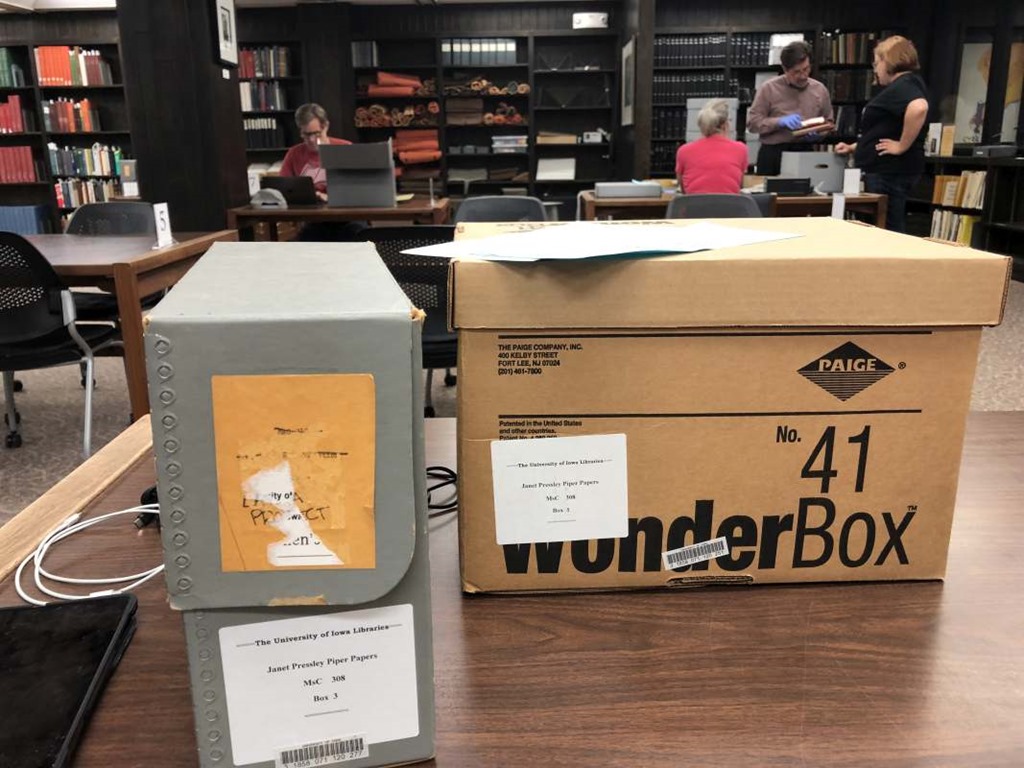
Janet Piper files 800

A small portion of Janet Piper’s papers in the University of Iowa collection, but my best guess at what might answer my questions about the beginnings of the Iowa Writers’ Workshop.

.

It’s taken me until the first day of July to read and comprehend what I captured for later perusal in those few last hours at the reading room. Later in June I also read Stephen Wilbers’ 1980 book The Iowa Writers’ Workshop  which aimed to show how that noted program came to be. Wilbers corresponded with Janet Piper while researching his book, duplicating a slightly earlier attempt by Janet W. Wylder to get information from Edwin Ford Piper’s widow. Wylder was attempting a similar book on the Writers’ Workshop that was never completed.**

Janet Piper’s papers include correspondence from these two with her, and a more than 100-page, response that seems to have gone through several revisions and titles, eventually being called “Edwin Ford Piper and the Iowa Workshop: a prehistory.”   It’s likely the best we have on the later adult life of Edwin Piper, who taught at Iowa for more than a generation and encouraged student creative writing throughout that time — right up until his sudden death just as the official Writers’ Workshop was launched. But spoiler alert: his wife’s account doesn’t live up to that promising title.

Since Janet Piper is even lesser-known than her husband, here’s a capsule bio extracted mostly from what I read in her papers and some web research:

Born (family last name: Pressley) in 1902 in Des Moines Iowa. May have moved to eastern Nebraska sometime in her childhood, and eventually attended college there and completed a Masters. She knew other young literary people in Nebraska and was already a poet who had won a couple of awards for her poetry while in that state. Began advanced degree work at the University of Iowa in Iowa City in the 1920s. Her academic work was interrupted by her 1927 marriage to Edwin Ford Piper, one of her professors, and by the following birth of their only child Edwin Ford Piper II in 1928.***  She writes little about the day to day of her marriage other than asides to the considerable duties of motherhood and being a faculty wife. She seems to admire and support her husband in his work and notes increasing change, stress, and conflict at the University then. She had resumed her academic work toward a PhD by the later 1930s — and then in 1939, her husband dies suddenly. She describes completing her final thesis defense in the midst of new widowhood in a disassociated state, flying on under auto-pilot. Various statements, some as corroboration, say this is likely the first PhD granted for a thesis consisting of creative writing.

She leaves Iowa in 1940 and within a couple of years takes up a teaching position at Sam Houston State in Texas, where she taught until retirement. In 1949 she made a suicide attempt by pills and was committed by her 21-year-old son to a facility in Texas, where she later writes she received the kind of coerced treatment, including electro-shock, that was common then. There’s some heartbreaking but formally-stated correspondence in her papers with her son from the early 1950s when they are estranged. She blames him for that mental facility commitment, and she says that he blames her for expecting too much of him as a child and not giving him appropriate attention.**** At her retirement in 1972 it’s written that she has continued to write poetry. She lives until 1997.

The Iowa Writers’ Workshop in their official histories started in 1936 — or it started in 1939 in other accountings. Edwin Piper had been encouraging students creative writing for decades, but the administration was now committed to allowing these efforts to be given academic credit and to become substantive toward degrees, a new concept for American academia. From Wilbers’ book and Janet Piper’s account, Edwin had some level of prominence in the mid-1930s in this now officially academic writers’ program — Wilbers writes it was more over the poetry sub-section while Janet Piper portrays her husband as being increasingly marginalized by the department’s administration, making the department head Norman Foerster a particular villain in the matter.

Yet, in a 1976 letter Wilbers includes in a footnote, a fascinating (but secondary to our story) figure Wilber Schramm recounts that he took over as director in 1939, being drafted into the job because of a pressing need occasioned by Piper’s death. In the Workshop’s official history, Schramm was the first director of the Iowa Writers’ Workshop, but Schramm doesn’t tell it that way.

Alas, from what I’ve been able to find out so far, there’s no solid information about how central Edwin Ford Piper was to instigating those Iowa Writers’ Workshop changes to how literary writing and writers live and work in our century. His career shows he’d long favored working with young writers, but Janet Piper portrays that she and her husband didn’t like some of the leaders making Iowa a pioneer in granting degrees, or their matter of going about it. There’s a cryptic report from the 1930s that Edwin didn’t like how the Workshop was turning into a promotional effort which I cannot completely evaluate. I was at first skeptical at Janet Piper’s constant reference to the malign forces of something she calls “New Humanism” ruining her life, her husband’s life, and literature in general. I knew nothing of that term, but a little research confirms that that was overtly the flag that her chief villain Norman Foerster and some of his allies were flying.*****

For a person like me who likes to know how directional changes happened, to see what turned us from one path to another, it was engrossing to try to chase this down, even if the crossroads turned out to be shrouded in fog. I’ll close by saying I’d like to thank Edwin and Janet Piper. Though they are dead, and they likely never concerned themselves exactly with my questions being formed in the 21st century, their papers gave me a window into their times and challenges. I’d like to thank the folks at the University of Iowa Special Collection section who were always helpful to this old and informal scholar. And thanks to you, rare and curious readers, who granted attention to this 1930s couple caught up in the changes in American literature and this 2020s couple celebrating their anniversary with their particular interests.

Watching my time carefully, just a few minutes before noon I packed up in the library, went down to the street, and swung into the car as my wife pulled up at the entrance curb. We were leaving for home.

.

*Coincidence: as I went looking into the beginnings of the Iowa Workshop, she visited the Devonian Fossil Gorge which I later read famed Workshop Director Paul Engle also liked to examine while still a student.

**This double pump seemed to frustrate Janet Piper. She at first thanked Wylder for rekindling her memories of her dead husband and her time with young writers at Iowa. Piper’s response appears to be a version of the around 100-page memoir which includes a long side-discussion of New Humanism. In her following correspondence with Wilbers she’s upset that Wylder had in effect ghosted her, and she wonders why Wilbers doesn’t have the material she sent Wylder. Moderns, remember: this is the era when producing 100 pages meant typing that singular ms. entirely and inhaling correction fluid, not just cutting/pasting and pressing send, or dumping pictures off your phone’s camera roll.

***More notes for Moderns: I can hear the ick factor bursting in your minds. This sort of thing was quite common, even into the years of my youth. Their contemporaries wouldn’t necessarily think this scandalous — or even unusual — though the age difference (56 to 25) here is broader than many of these male prof/female student marriages. That said, everything you object to was still possible despite different mores. Janet Piper’s papers give no indication it wasn’t a happy marriage.

****Whatever led Janet Piper to her suicide attempt isn’t spelled out in what I’ve read. The number of stressors and level of endurance it would take to be a single mom, a widow, a rare woman/academic in an era when that was even tougher than today, and while society is in the transition from the Great Depression to a World War — all that might batter anyone’s defenses. Similarly, I can only imagine a 21-year-old son having their only parent, their mother, trying to kill herself and being put in a position to try to decide what to do about that. I don’t know the particulars of Texas law at that time, but authorities themselves might be pressing for civil commitment. I’m not suited to be a novelist, but reading in Janet Piper’s papers on this matter I thought “There’s a novel.”

*****Let me resist trying to give an outline of New Humanism. Like a number of Fugitives, New Criticism proponents, and neo-Thomists that followed this movement and somewhat evolved from it, they tended toward political conservatism, and in the 1930s many were, at the least, permissive of fascist authoritarians, which some (including JP) might lay to them being already authoritarian in aesthetics. Janet Piper speaks distressingly of fascist Iowa professors in that era, even names some. Janet Piper’s papers that I’ve read don’t tell me exactly what Edwin Piper thought of this. Though a Chaucer specialist carrying that interest into a project completed at the end of his life, Edwin’s papers don’t demonstrate a pervasive appeal to timeless classical truths, and his folksong fascination would likely oppose a tight highbrow/middlebrow/lowbrow outlook. I can’t say for sure what Edwin Piper’s politics were, but his widow seems left/liberal in the 1970s and makes no mention that they disagreed on politics back in the 30s. Janet Piper’s summary that “politics” led to her husband’s early death leads to the question: what level of politics? In her mind it appears university politics and civic politics were indivisible.

When asked about this era in the 1970s. Janet Piper continually wants to talk about what she views as more than a cultural tendency or scheme, and more at an active, effective, powerful conspiracy originated by New Humanism. At times she’s detailed and footnoted with her charges, at other times vague and implying great harms in a broader and fuzzier way. More than once in her papers she refers to Ezra Pound, T. S. Eliot, and Conrad Aiken as the heads of a secret cabal advancing evil work — and I can’t quite “read” if I should take those expressions as satiric exaggerations. In a letter from Robert Hillyer, he agrees with her that she’s not a crank, using that word as if it had been applied to Janet. In what I read she spends less time than my curiosity would like expounding what she prefers in literary or cultural theory rather than what she damns.

It would take more study and knowledge to fully understand or evaluate that element in Janet Piper’s later writing. This element, often present in what I read, shows a life of great reading and learning exceeding my own, evidence of great energy for a person roughly my age — and likely at times I can’t quite measure, effective moments of literary criticism and insight.

Paying the Piper chapter 5: Carl Sandburg’s “Gone”

I think there’s a misapprehension of Carl Sandburg’s poetry: that it’s simple, prosy work: that it says what it says, hearty single-minded messages with some decorative metaphor. Tastes differ, and mine may not be a guide to anyone else, but I sometimes don’t find him so. As I continue trying different things during the summer with this multipart personal story, I’ll return to our regular stuff at the end today with an example of Sandburg mysterioso.

The finale of my June trip to Iowa City to see what I could find out about an even more under-considered Midwestern 20th century poet, Edwin Ford Piper, was planned to be a visit to Galesburg Illinois, a small city just east across the Mississippi river where Sandburg was born. Piper and Sandburg compare easily. Both born in the American Midwest a couple of decades after the Civil War, both part of early 20th Century literary movements we no longer take as much notice of. Both were attracted to a broad swath of memorized vernacular music that would be called “Folk Music.” They knew each other, even shared stage programs. Sandburg’s 1927 music collection The American Songbag  established what American folk music would be for my mid-century generation,* and from examining Piper’s papers I could see his definition paralleled Sandburg’s. Piper was one of the contributors to American Songbag.**

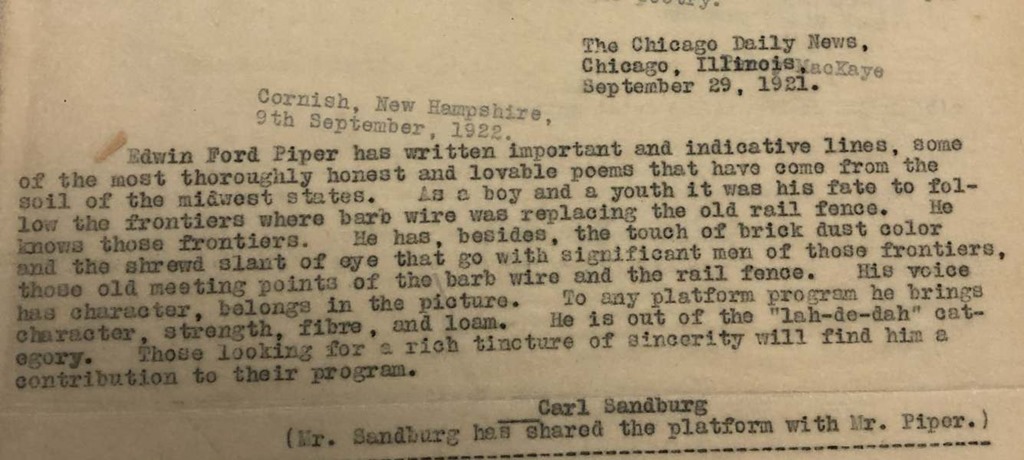
Sandburg's blurb of Piper 600

Poet Sandburg blurbing  poet Edwin Ford Piper. I also saw a note from Sandburg thanking Piper for songs used in Songbag, but don’t have a picture of that.

.

We arrived at Galesburg early for the 1 P.M.-opening of the Sandburg birthplace site. We wandered the wondering-what-it’ll-become-in-the-21st-century business district with its building facades still showing a variety of past decades abandoned styles left to fade, and browsed a charming small bookstore there. We were going to have an early lunch somewhere, and decided to just get sandwiches and go eat them in the small area behind the birthplace on benches by the Remembrance Rock there.

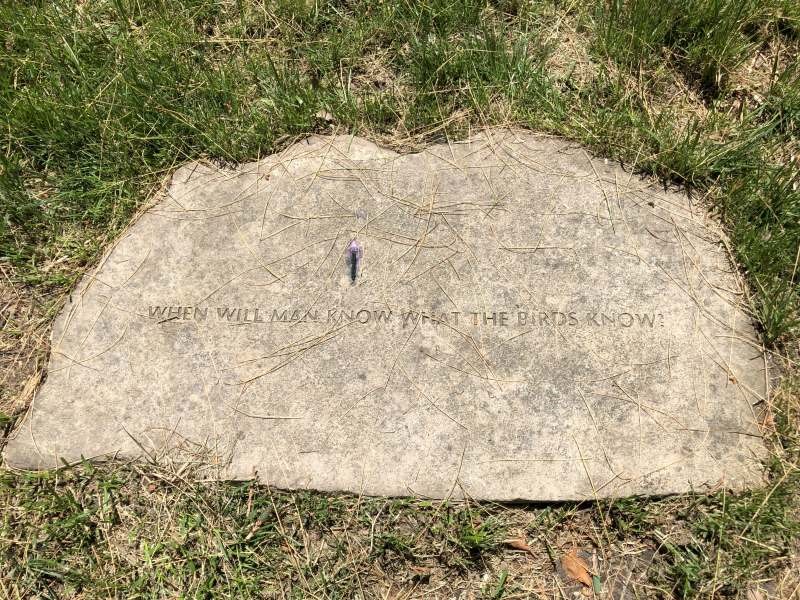
The rock is an unremarkable bolder, utterly plain and unshaped as a design choice.***  Sandburg and his beloved wife and partner’s ashes are buried under it. The lawn it sits on behind the house is circled by bushes and a few trees, and rather than any sense of a park, it reminded me of the backyard of the house where I grew up in Iowa. One thing the photos I have seen of the rock didn’t show: a ring of irregular, small, flat, stones that circle it, each engraved with a line from a Sandburg poem. If one wished, one could ceremoniously walk from flat grounded rock to rock stepping with your foot-soles on his words, which it seemed to me to be what one of Sandburg’s models Whitman has commanded — and so I did. There’s a nice bust of Sandburg on a stand there too, but to my sense of the place, walking his words was more meaningful. I’d told my wife that Sandburg’s father was a railroad blacksmith, and she figured that the neighborhood might have been handy for rail workers. After our lunch, she took a little stroll while I waited, and she came back to report that just over a rise a block away was the railroad line.

Sandburg When will man know Bird Poop 600

…but then all the birds know is to poop on poetry-engraved rocks, same as any other.

.

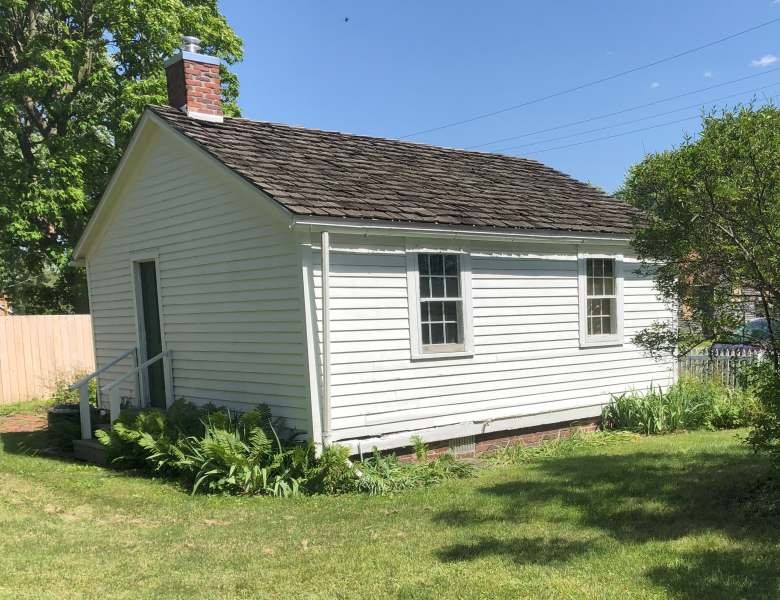
One of the site’s staff members arrived ahead of opening time to do a little yard work, and when that time arrived, he changed tasks to welcoming and serving as a guide for about 30 older folks in an adult learning program who arrived from Peoria in two small busses. Beside the birthplace (our host preferred to not call it a house, but a railroad worker’s hut) there was another small, somewhat rundown house next door that served as the site’s offices and a small room of memorabilia backed with an illustrated wall timeline of Sandburg’s life. Behind the two houses was a garage that has been turned into a cozy theater space where they host musical acts in homage to that part of Sandburg’s heritage.

My wife and I plus the 30 others overwhelmed the birthplace site’s capacity. Resourcefully the staff divided the group into two, and after watching a short video on Sandburg our half got to walk through the birthplace hut or house. If you are familiar with the modern tiny house movement, the floorplan and the maximal utilization of it would strike a resonance. Outhouse, no plumbing or running water, it’s decorated in late 19th century Swedish immigrant homey style, but a couple, a young child, and a baby would have been a tight fit, much less our troop of visitors. I recall visiting a reconstructed Lincoln birthplace cabin as a child, and though the Sandburg birthplace is wood-frame construction, not a log cabin, the square footage and amenities might have struck Lincoln biographer Sandburg as similar.

Sandburg birthplace 600

Sandburg’s birthplace: house, hut, cabin. This side shows the smallness best I think.

.

Perhaps because of the touring group’s visit, there was a special performance by a singer-guitarist whose name I didn’t catch, who did a short re-creation of Sandburg singing and talking about his life. I enjoyed that effort. Before leaving, I asked one of the leaders of the visiting group, an old professor, who had some years on your old guy reporter here, what Sandburg biography he’d recommend. He cited Penelope Niven’s bio, and I bought it at the site’s store.

No one hides the fact Carl Sandburg might not have much direct memory of the birthplace as his family moved to another Galesburg house while he was only a toddler****  But the link to his parents and the choice of it for a burial place (which was I believe his doing) speaks to the meaning to him. Unlike the larger house and goat farm where Sandburg spent his post-WWII life until he died that is a National Parks Service site, the birthplace is run by the State of Illinois and some local spirit and volunteerism. Sandburg retained throughout his life a fondness for Galesburg, never hid his roots there, and Galesburg was also the place where he attended college after his stint in the Army, though he never completed a degree.

Which brings me to today’s new musical piece, a setting of a Sandburg poem about someone who apparently left town wiping the dust off their shoes at the city limits. In his collections Sandburg called the poem “Gone,” but the main character’s name sticks in some memories, so it also gets called by the first line, or by the character’s name that appears in that line: “Everybody loved Chick Lorimer in our town.” Here’s a link to the text of the poem.

I promised mystery in this one. There are things left out, and various implications some of which complicate, some of which conflict, are left open. Can we even take that opening statement at face value? Not now, certainly not in 1916 could it be said that we all love “a wild girl” with a dream “she wants.” Some might, many would not. Wildness and dream-holding create envy, often a lot of it.

Is Chick Lorimer someone that everyone in town has marked as special, marked for greater things — someone so preeminent in their youth where that envy would be tamped down? If so, why the sudden leaving, with no one knowing where or why? Does a recognized prodigy, much loved, leave a place without saying goodbye? That would be a rare story.

Perhaps the “everyone” is a casual overstatement, referring only to a small group of friends who shared ideas? Later the poem seems to refer to larger numbers however.

Is she not actually loved by much of the town, and “loved” in a narrow, sexual, sense by many men? The “Dancer, singer, and laughing passionate lover” line could give testimony to that thought. That line is followed by two specific but puzzling lines, and their very specificity says we should pay attention to them. “Were there ten men or a hundred hunting Chick?” “Hunting” is a word choice, though we do say we hunt for the lost all the time without thinking of hunting as in wild game. Why the specific range, “ten or a hundred?” If this noteworthy young person is gone, no other info, that’s a missing person. Have they come to harm, are they being hunted for something they’re suspected of doing wrong? Why can’t they say, between 10 and 100 for the number of hunters? This hunt seems secretive from that wide range: 10 might be a small matter, 100 a greater one — but even 100 would be small if this is a universally beloved light of a town, unless it’s a very small town. It seems significant that the poem’s speaker can’t give a better estimate. And that’s followed by another stat: “five men or fifty with aching hearts.” The numbers are still widely separated, but they’re also halved from the number of hunters.

To perform this, I felt I had to have some plot in mind as I sang it. In my mind, Chick is a free-spirited libertine, and to a large degree that “loved” means no-strings sex. Chick likely left because she wanted something more, or because the disapproval of her “loving” everybody was getting intolerable. The maybe just five “aching heart” men thought they were, or could be, her significant partner.*****

How bohemian was poet Sandburg’s experience early in the 20th century? When he first moved to Chicago he lived in what was in effect a free-thinkers commune run by a strange guy, Parker Sercombe.  From my reading, “Free Love” was just as much a topic in bohemian culture in the early 1900s as it was in the 1960s.

But maybe I’m wrong, and maybe your reading is different. It could be that Chick is like “Chuck” Sandburg (the name he used then) wanting to see the world, wanting to follow their dream. Sandburg had bicycled around Illinois, rode trains legally and illegally to other parts of the US, and he’d already been to Puerto Rico in the Army by the time he wrote this. Chick could be his anima. Sandburg never felt entirely alienated from his hometown or family however. He came back through town, wrote letters to his family, and so on. And if you want to see his beginnings and his decided final place to remember him, one goes to Galesburg.

To hear my performance of “Gone” AKA “Chick Lorimer”  you can use the audio player below. Do you feel nobody knows where the audio player has gone?  This highlighted link will open a new tab with its own audio player.

.

*If you never cared about the post WWII folk revival for whatever reason, I will point out that Rock’n’Roll became self-aware artistic and literary-flavored “Rock Music” in the later 60s because folk revival musicians transferred their backgrounds into bands with electric instruments after The Beatles, electric Blues bands, and “Dylan goes electric” emerged to take over college and post-graduate audiences in the US. Over in the UK, the folk revival to Rock pipeline was supplied by “Skiffle” — an American jug-band folk revival style that swept UK youth in the 50s, merging with a peculiar British Trad Jazz revival that often featured the Blues element of pre-WWII Jazz.

**Piper’s wife, in her own papers collection at the University of Iowa library, claims that Piper’s contributions were greater than Sandburg credits in Songbag. Possible, I suppose, though the nature of Piper’s song collecting revealed by my examination of his papers shows a collaborative effort with collectors sharing with each other freely. Piper’s unpublished collection, like Sandburg’s published one, wasn’t done with a sense of ownership of songs.

****The family didn’t get sudden wealth, it supplemented the railroad wages by renting out rooms in the succeeding houses, and the children worked to add to the family income as they grew older.

*****For a fuller story fleshed out from the short poem’s details, there’s this 50 minute early 1960s TV episode from the Route 66 series which uses the poem idea as its central motif and title, with the leading man reciting Sandburg’s poem 2/3 of the way in. This linked version has hokey colorization of the series fine B&W photography, but it is easily viewable.

Paying the Piper chapter two: time travel, wagon trains in space, & folk song

The walk across town to the University of Iowa main library turned out to be no problem, even in the heat. I walked into the modern lobby of the facility decked out with LCD screen-signage, a set of computer carrels, and airy windows. I used handy lockers with touch-screen set-your-own-combination lock panels there to store my bag and hat.*  The library is one of those amended buildings, representing different eras in décor as it was added to over time or remodeled — so it was almost a theme-park-ride effect as I walked further into the main entryway to reach an old elevator with a flickering florescent fixture that took me up to the third floor with dark wood trim that reminded me of the libraries of my mid-century youth.

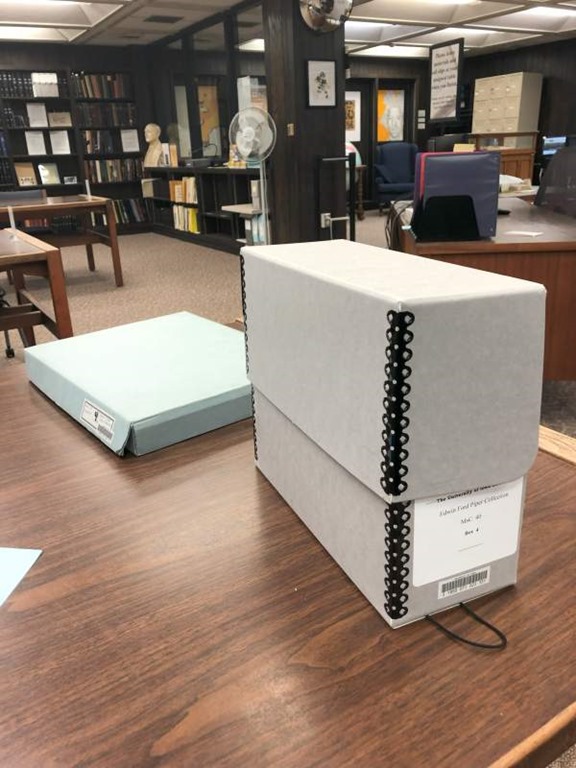
The special collections staff set me up on a placard-numbered plain table in the reading room. It took only a few minutes for my selected boxes from the Edwin Ford Piper collection to be delivered by cart. Looking around the reading room as I waited, there were filled bookshelves, a globe, a couple of busts,** and a few framed posters. Curiously, there were life-sized carboard standups of 20th Century Star Trek actors in their character costumes in a couple of corners. Why? Generalized nerd culture? LaVar Burton’s following enlistment in Reading Rainbow? I momentarily thought, at the commencement of my time-travel by library collections, that the original Roddenberry Star Trek concept was travel to “seek out new life and new civilizations.” They called it Star Trek,  not the second-word choice of the later movie franchise Star Wars,  nor something referencing a technology-based science fiction premise. Pitching to SF resistant TV programmers, Roddenberry famously described his show it “Wagon Train in space.”

The U of Iowa Special Collectons Reading Room 800

Transporter or time machine: archive boxes in the University of Iowa Special Collections Reading Room.

.

I don’t know how Piper’s parents came to rural Nebraska. His mother’s family (Ford) emigrated from Ireland first to Canada around 1810. The Ford brothers who emigrated were stone masons. His father’s line had settled in Massachusetts from 17th century, near-Pilgrim times. Piper’s mother was born in rural south-west Ontario and his parents were married there in Zorra township in 1848. The parents moved to Auburn Nebraska in 1869 where Piper was born in 1871. The 1869 date means it was likely by wagon, as that date predates railroads there.

I know no particulars about why the Ford brothers emigrated to Canada. 1810 preceded the infamous Irish famine years a generation later. My guess (by inference) is that the Fords were Anglo-Irish protestants. I don’t know why Piper’s father was in a non-descript rural area of Canada either.***

It’s hard for me to judge his parent’s economic status. Piper speaks briefly in papers in the archive about his father being a rancher who raised livestock and that the barb wire that titled Edwin’s poetry collection came to Nebraska with homesteading post-Civil War farmers who tended crop-fields cordoned off with that fencing, causing his father to move his livestock grazing farther west to Alma Nebraska (southwest of Kearney) and then Box Elder, which is more than halfway to Colorado. In a short biographic note Piper prepared and found in the archives he says he “rode in the movers wagon.” In the same note he says he had “broken sod and raised corn to sell at ten cents a bushel; I have paid three percent a month interest.” Since he went to Omaha and university there when he came of age and was an academic the rest of his life, this would indicate that his family wasn’t exclusively a cattleman or other livestock operation.

In talking about places and names I found in the archives, I get ahead of myself, it’s just clear that the young Piper was a traveling man coming from a traveling heritage. When we speak nowadays about the Midwest as “the heartland” or casually assign it as a homogenous place in stasis we miss that it was (even its rural areas) just as much an immigration site as the tenements of New York City — there was just more space between farms or towns.

In effect I was another immigrant in the library archives. I was eagerly opening the contents brought to the table from first box and on, lifting out folders from inside them and examining the mix of handwritten letters and notes, typewritten pages, fragile yellow newsprint clippings, and occasional whole publications. The libraries abstract of the contents, and the Piper collection’s mixed filing, meant that I never knew what I’d find “over the next hill.” I had been concerned if I could keep my focus on this task for a full workday. I could. Easily. I was back in the era which The Parlando Project so often refers to, the first quarter of the 20th century when Modernism emerged. I’ll look at Modernism later in this series, but the folk songs are things the travelers carried with them from the past. Same quarter-century, Janus like, looking forward and backward.

As the collection abstract promised, the folk music collection materials were considerable. Many of them have marginal notes or material showing either they came from other collectors or that they had appeared in versions in other contemporary published collections. Some of these notes are from a 1934 run through of Piper’s folk song materials by a graduate student who cataloged and categorized the material while Piper was still alive, though his organization is not reflected in the current filing in the archive boxes. That student, Harold Daniel Peterson, no doubt using Piper as an informant, says that Piper first collected the songs to sing himself, that WWI interrupted Piper’s personal collecting, and that post-WWI, his students at Iowa contributed songs their families and locals knew. Correspondence and marginal notes with associated names show that Piper seems to have assembled or participated in an informal network of other folk song collectors. Piper also mentions the Journal of American Folklore multiple times, and that publication and society started in 1888.

There’s a number of files dealing with hobo songs (some with notes presumably by Piper about the particular hobo who shared the song) and articles about hobo culture, Hobos were migratory workers who often hopped trains to move from place to place.

Coincidences can move me, even if I realize I’m the one making chance meaningful. The very last folder in the last box I went through in my days examining the Piper archive folk song collection contained a version of “Jack of Diamonds”  a traditional song with a variant that also goes by the name of a commonly included verse: “Rye Whiskey.”  Long-time readers here may recall that I was told by uncles that “Rye Whiskey”  was a favorite song of my great-grandfather, after whom I am named. In my time travel during this June trip I wasn’t just traveling to the time of Modernism’s emergence, I remembered at that moment opening that folder that I was traveling back to that man’s, a common laborer’s, time too. When investigating something else years back, I was taught that folk culture isn’t uncomplicatedly pure, always the result of children learning songs from the old folks on the porch of an isolated cabin. I recorded a performance with music of a plausible theory of how my great-grandfather might have come to fancy and appreciate that song. You can hear that performance with the audio player below, or with this highlighted link if that player isn’t visible to you.

To be continued…

.

*As is now common in special collections, there are rules about what you can bring into the reading rooms. Alas, theft has been a problem in such places, so bags (much less spill-risk food or drink) are not allowed. I noted the University’s rules also restricted paper notebooks and outside writing instruments.

**Of who? I never left my focus to find out, but the human form amputated to a head and shoulders is already concentrating on the life of the mind. The Piper Archive papers mesmerized me, time passed rapidly as I tried to take in as much as I could. The first day I had packed a bagel in my shoulder bag, necessarily left in the downstairs library locker in case I needed to take a lunch break outside of the Special Collections Reading Room. I ate that bagel in the evening back at my room.

***This basic genealogical detail is from a typewritten sheet titled “Notes on Family History” with some pencil annotations in Piper’s handwriting in the archives. It also says that he was “the tenth child in a family of eleven children” and gives the date of Edwin Ford Piper’s own later marriage to Janet Pressley in Iowa City as 1927.

Paying the Piper chapter 1

Very often I find myself unable to tell a story simply. While I find internal joy in expanding complexity there is a painful element too. Even when under the spell of things I’ve experienced and learned, I retain enough self-awareness to see what effect my expression has on others, the burden of strangeness. Then the reach between the teller and the listener becomes haphazard, unstable — pile it too high and it tiresomely topples — and so in some break for breath partway in, I realize I’ve dumped a cluttered mass of thought debris on a listener, long past any interest.

Perhaps this is why I’m attracted to lyric poetry, constrained as it is to moments, often held tight within the stiff glass bottles of forms.

Here’s a personal story that’ll go many places coming from the place I find myself in this June. It starts, I’ll guess, earlier this year when I came upon a poem, “The Last Antelope,”  a striking, empathetic account of the end of an animal’s life and wildness after settlers captured it. Edwin Ford Piper was the author, and there were only scattered bits of information to be found about him. Scattered and bits do not constrain my curiosity — if the bits were great distances apart, the space between them could hold a lot of things: born 1871 in rural Nebraska, parents part of early European-origin settlement there. Largely self-educated in a land of necessary child-farmhand-so-never-more-than-half-year schools, still goes on to university in Omaha studying literature with a specialization in Chaucer, and then to the University of Iowa where as a professor he helped establish the idea of teaching and granting degrees in creative writing.

The modern convention of a university as patronage for artists, and the rise of the credentialed MFA-holding poet is not without controversy — but isn’t it odd, this man who taught himself in a small town on the fluid boundary between the 19th Century Wild West and the 20th Century staid Midwest took that journey.

In the middle of this, the same man had a compulsion to collect songs ordinary people brought with them while journeying, the words and music carried in the light baggage of memory. He wrote down songs his relatives and townsfolk knew by heart. He asked others to send him more by mail. He paid particular attention to the songs of those on the move: hobos, cowboys, and other traveling workers. Did this connect with his literary poetry? There are no recordings of Piper reading his poetry, but accounts say he declaimed it with a musical lilt — perhaps like the surviving recordings of Yeats, or maybe like the more bombastic Vachel Lindsay — and at times he would break into full song. His students took to calling him “The Singing Professor.”

Since this Project is “Where Music and Words Meet” you can see why I’d be attracted. And I’m a small-Midwestern-town boy, though without degrees. But did that seem strange then, to mesh high culture and the songs remembered by old women and rude mechanicals?

Piper was born just west of the Missouri River in Nebraska — and in Illinois, just to the east of the Mississippi River and less than a decade later, Carl Sandburg was born to an immigrant railway blacksmith who signed his name with an X. Iowa, the state where I was born in the middle of the next century, and Minnesota, the state where I’ve lived the longest, sit in a delta between those two tremendous rivers. Sandburg too mixed the latest in Modernist poetry with folk songs he collected and sang. Did Piper influence Sandburg? Did Sandburg influence Piper? Or are they the same genus of plant, raised in the same climate, but in separate plots? Questions.

Answers fork like river systems. Even with little information being readily available on Piper, I was already in flood stage. And here’s how much my wife loves me: for our 20th anniversary she agreed to go on a road trip with me to Iowa City and Sandburg’s home-town of Galesburg. My scenery in Iowa City? An archive of Piper’s papers* held in the university library there. Our grand museum of the arts of poetry and song to visit on the trip: a railway worker’s shack in a small rust-belt city, a town worn-out but still running like a paint-shedding Oldsmobile.

Two considerations worried me as I thought about this trip, one for my wife and one for myself. For my wife, I worried if there’d be something rewarding for her to do while I enthused at the library. She was able to solve that one easily, locating nature reserves, parks, and trails within an hour’s drive. I often tell her that she’s a nymph, and I complement her on how seriously she takes her job to supervise the plants and animals when she returns with soggy hiking boots from her hikes with pictures of landscapes, mushrooms, wildflowers, birds, and other critters. I love her pictures and stories on return (her stories briefer and better organized) — but my old joints ache just thinking about hiking for hours.

For myself I worried about my old-ager endurance. The library was two-thirds of a mile from where we’d stay. I’d need to hoof it with my laptop bag back and forth, which would have been a trifle in my youth, but nowadays longer term standing and walking is troublesome. I considered taking a bicycle with me, which would have made the library to-and-from easy, but a lot of hotel/AirBnB places don’t have any good places to lock up overnight, and on further consideration I thought that a bike would just be one more thing to worry about, taking my focus away from the trip’s main goals. And then I worried too about spending full days at the library’s special collections reading room. Because my time was limited, and to minimize the walking, I planned no break for lunch. I’d need to keep my focus and energy up, something that I have not been consistently able to do this year even with all the comforts of home.

On average I bike at least once every day in my normal routine, often in the morning. In the past two years I’ve not been a longer distance bicyclist, but 30-50 miles a week easily exceeds those 150 minutes exercise recommendations, and it lets me get to a café for morning breakfast and handle a lot of routine shopping and other trips. I ride year-round. In 2016 I bought my first 21st Century winter bike with studded tires; and in 2019 I upgraded the winter season bicycle to a Fat Bike with monstrous 4.5-inch-wide tires that handled ice and snow with the challenging ice ruts and potholes that my city’s current “We’ll get to all the streets in 3 days after the snow stops” plowing regime supplies. My overall stamina for the walk wasn’t my worry so much as how well my joints and stiff back would take the more load-bearing walk.** And to make it through the day I’d planned, there’d be no old-man’s afternoon nap either.

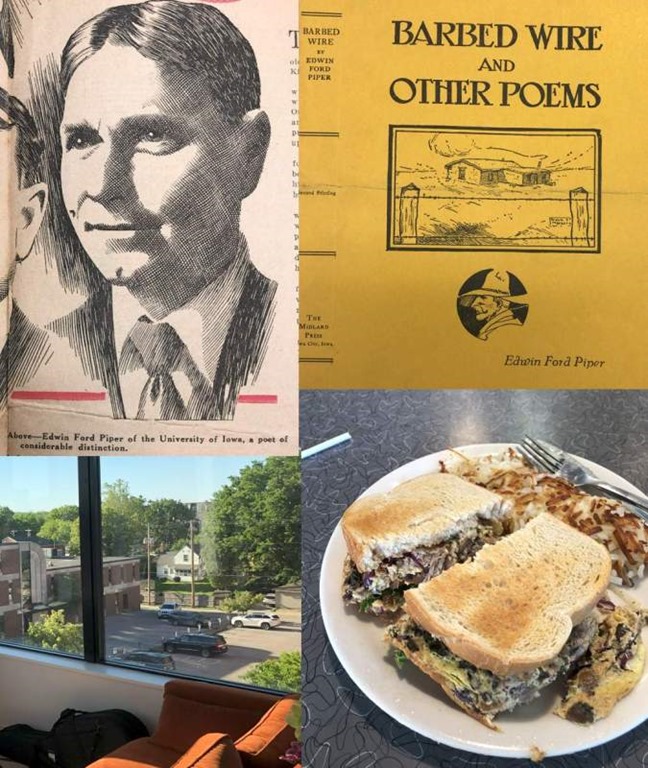
Pay the Piper Chapter 1 800
Piper, once a “poet of considerable distinction.” A later version of his collection Barb Wire. My Iowa City view, and yes the guitar got some use. Example breakfast.***

.

The first day we arrived at Iowa city was hot and very humid, so I put on my best hot weather clothing. Spouse-nymph headed off at dawn for her day’s supervisory encounter with nature, and I planned a big breakfast fuel-up. I’m a “eat little meat” kind of guy, but for good or ill I take the lacto-ovo part of my lesser meat diet seriously, so I’m a big frittata, omelet, hash, scrambler kind of guy most mornings. I note that I eat like an old-time farmer, despite never farming, but the good thing about this higher fat/protein kind of meal is that it can hold me until supper, and that was my plan.

I put on my best hot weather clothes, slung my bag over my shoulder, and headed for the university’s main library building for my encounter with poet-professor Piper’s papers.

Thus ends Chapter One.

Here’s a musical performance I put together in March of Piper’s “The Last Antelope.”   You can play it with the audio player you should see below. No player?  This highlighted link is another way to hear it.

.

*When I arrived at the library archives will-call desk, I asked them to pick Piper’s Papers. The librarian suggested puckishly that I was nearly reconstructing the old tongue-twister folk-rhyme, Roud Folk Song index 19745.

**Local papers/forums are full of folks who bemoan bike lanes in my city, often remarking that “not everyone is young and fit.” Despite that, most bicyclists I meet and see on my city’s streets aren’t of the MAMIL (Middle-Aged Man in Lycra) variety — and I’m maybe 1.5 letters of that acronym. I joke with my wife that as my joints get older, a bicycle is becoming a “fore-and-aft wheelchair” for me, allowing me increased mobility and beneficial low-impact movement for the old joints.

***That’s a St. Paul Sandwich: egg foo young on sourdough with lettuce, tomato slices and mayo. Near as anyone knows, my Twin City of St. Paul has no tradition regarding it, and no restaurant there serves it now. Its origin is something of mystery.

The Last Antelope

Nothing excites me more while doing this project than coming across a little-known poet that I had never heard of. Some of these poets have perhaps a single poem worthy of interest; others, whole bodies of work which have slipped off the page, fallen to the floor, and have then been lost in the cracks.

Just how interesting is Edwin Ford Piper? I don’t know yet — and that’s fascinating! I’ve picked up a few things about him. He grew up during the closing act of the American frontier in the vicinity of the small town of Auburn Nebraska near where Nebraska’s southeastern border meets up with Missouri and Iowa. Despite a typical rural childhood of his era, with schooltime being “Sometimes two months a year, sometimes none,” he largely educated himself as a child by reading, graduated from the University of Nebraska, and he then became a long-time college professor of English Literature at the University of Iowa until he died in 1939.*

But here’s what’s intriguing me so far: unlike a great many of his contemporaries, it appears he takes as his subject the local culture of the Midwest in his time, including the ordinary working-class and underclass. At least at first glance he’s a Modernist of a sort. Some of the first poems I’ve read look like a melding of Sandburg** and a Midwestern, not New England, Frost — but with his own vision and sound.

I’ve been long-winded lately trying to share as much as I’ve been able to find out about another lesser-known Midwestern poet of this time, Fenton Johnson. So, let me rest your eyes from the historical matters of Piper so far, and share a performance of the first poem of his I came across: “The Last Antelope.”

In its deep cross-species empathy the poem reminds me of Kenneth Rexroth, who’s a generation later. Piper tells its story using some Modernist tactics, including abrupt time-shifts and changes in point of view, always chasing the most vivid perspective. It’s in an unfussy iambic pentameter, but like Frost, the language and word-music seem so natural you don’t hear the pentameter, just feel the rhythm without noting it. If  you’d like to read the poem along with my performance of it available below, you can find the text of it here.

Edwin Ford Piper

Like Fenton Johnson, there’s not a lot of pictures of Piper to be found online. How little-known is Piper? Not even a stub Wikipedia page!

.

A few pieces of detail about the pronghorn antelope that might serve as background for this poem: it’s the fastest land animal in North America (55 mph top speed!), and unlike some other speedsters world-wide, it can keep up significant speed over a long time and distance. The method of hunting implied in Piper’s poem is similar to what Indigenous tribes used, but with guns improving on bow and arrow: large groups of hunters driving the antelope into a natural or constructed dead-end pen where it can’t use its speed to escape.

Why did it become extinct in the Iowa/Nebraska area in Piper’s childhood era? He concisely notes the reasons in the midst of the chase the poem takes us on: they are skittish prairie creatures who want the lookouts of high ground and long free spaces to run. Early attempts to conserve them in fenced ranges failed, they refused to thrive where they couldn’t run. Barb-wire, a famous marker of the closing of the American frontier, was particularly dangerous: the pronghorn generally don’t leap over fences, they prefer to kneel and crawl under them. The barb-wire then tore at them, their crown of thorns.

Simple music for this closing of the frontier story — just acoustic guitar — but I hope I can tell well the story Edwin Ford Piper wrote. You can hear it with the audio player below this. No player? This highlighted link is an alternative way to get an audio player for it.

.

*Coincidences: for a few years late in the 20th century the University of Iowa’s Iowa Poetry Prize was named the Edwin Ford Piper Poetry Award, but for whatever reason, this name was abandoned. While it had this name, Missouri-to-Minnesota poet Phil Dacey, who I treasure for his early kind words and influence to me, won that prize.

**Like Sandburg (actually “with,” as he submitted collected songs to Sandburg’s landmark American Songbag  that helped kick off the American Folksong Revival) Piper was known to break into song when reciting poetry. He got called “The Singing Professor” for this, and that makes him a natural Parlando Project interest.

Van or Twenty Years After

One of the interesting things about 20th century Modernism was that so much of its propagation seems to be based on a handful of pollinators who migrate from one place to another. Some of these pollinators are known but little-read today, others lesser-known, their names themselves faded from cultural memory.

I suspect Gertrude Stein fits into the first group. As a personage, often handily viewed via Picasso’s painted portrait, she remains known. Her main location, early 20th century Paris, remains revered for its scene, and her salon there filled with Modernist paintings can’t be left off the maps as Americans in Paris then gravitated to her. We can add to that notableness, that as the fluent domestic partner in a long-term relationship with another woman, she remains to this day something of a gay icon.

But is she read? I suspect her The Autobiography of Alice B. Toklas  retains interest for its witness to the era. Her novels? Not sure they’re read much beyond scholars — and maybe they’re under-read even there. I gather her poetry remains controversial in this sense of the word: it’s spoken of in passing, its unusualness taken stock of — and after that its import is generally dismissed. When it was new, Stein’s poetry was often treated as a breathalyzer test. If you heard it and took it as meaningful or important you must be an intoxicated acolyte of Modernist excess. I don’t know if we’ve moved on from that stance. We may forget Hemmingway was a Modernist nowadays,* but we can never see Stein as anything more than an Modernist provocateur.

Reading Stein’s prose-poems today we still find them sounding unlike most literary poetry of the present. If we’re reminded of anything, it might be Dr. Seuss books for early readers, full of repetitions rhythmically repeated.**

Sometime in my Twenties I was curious about her work, part of my early interest in Modernism and the movements that emerged from it in the last decade to be called The Twenties. I remember plowing through one or more of her novels*** and reading what of her poetry I could find, out of consideration that as an experimentalist she might have some discoveries I could put to use in my own writing. What do I remember from doing that a half century ago? Not so much passages or particular elements, more an idea which I continue to hold for: that the way we use language to express reality and consciousness has been constrained by expectations and convention.

What remains of that interest in Stein now decades later? I enjoy her in limited doses because it still can break those expectations on the floor, and stomp on the broken fragments in time to a word-music I can enjoy.

Stein-Van Vechten-Dodge-Seuss

Gertrude Stein, Carl Van Vechten, Mabel Dodge, Dr. Seuss. First 3 pictures are photographs by Van Vechten.

.

I don’t know how much of that old interest of mine my friend, poet, and bandmate in The LYL Band, Dave Moore remembers, but when we got together earlier this fall to record some new things, he broke out this Parlando-worthy selection from Stein’s prose-poetry portraits of those she had met and interacted with. I asked him what he’d want readers/listeners here to know about “Van or Twenty Years After,”  and this is what he wrote back:

To avoid Morrison conclusions, I might shift the title to Van & Stein (Iowa boy made weird) — otherwise, references to Mabel Dodge in a history of first American surrealists, found in the library free stack, made me seek out the Gertrude piece about her, which turned out to be in a collection featuring this piece referencing her friendship with Van (sheesh my brain won’t pull up his name, I’m sure it wasn’t Dyke or Heusen), from which I excerpted this section delighted the way it concluded with a joke, then when I presented it to Frank I was incapable of delivering the sound of repetitious notes I had in my head, so anything salvageable here is probably due to Frank’s remixing skills.”

So, who’s the man the Van in Stein’s piece? Carl Van Vechten. Like Stein, Vechten was another of those Modernist pollinators, and he was an early and ardent proponent of Stein’s writing. His name, his own writing? By now he’s largely fallen into the second group, as Dave’s honest stumble testifies. Myself? I knew his name from my interest in Modernism, but nothing of his biography or work until I began to run into him as I read and studied more about the Harlem Renaissance which he was intimately involved in.****   It was only then that I discovered where he was born and grew up: Cedar Rapids, Iowa. And the Mabel Dodge Dave mentions? If you were to cross-reference Gertrude Stein, Carl Van Vechten, and Mabel Dodge’s blue links in their Wikipedia articles, you wouldn’t have to make more than one Kevin-Bacon-jump to encompass the whole Modernist enterprise in Europe and the United States. Pollinators.

After all that history, some of it often forgotten, we’re left with Stein’s words. Here’s a link to the whole prose-poem portrait which Dave took his segment from. You might enjoy them as word-music not having to judge them, or risking them replacing other poetries you enjoy. I did when Dave performed them. You can hear that performance with the graphical audio player below.  See no player? This highlighted link will open a new tab with an audio player.

.

*We’re likely to charge Hemmingway with a lot of other sins — most of which he committed in flagrante — while forgetting his successful revolutions. Hemmingway, the young writer forging his style, was one of those who sought out Stein in Paris.

**Dr. Seuss (Theodore Geisel) likely knew of Gertrude Stein from the circles he ran in. I did a quick web search and found no instant citation of any considerations of a stylistic influence there. I can’t be the only one this has occurred to.

***An admission: I’ve never been much of a novel reader. Most book and literature lovers can embarrass me by exposing my lack of chair time with novels.

****Van Vechten wasn’t just Iowan, he was white. Some early Modernists recognized elements of Black and African culture as aligned with their Modernist project, and some young Afro-American writers and artists felt the same way. Modernism was not immune to racism, but this cross-pollination brought attention and prestige to Afro-American artists and art. This connection had and has its strained and strange elements — no doubt about it — but it’s important.

Another connector here: Van Vechten was bisexual, so were some of the members of the Harlem Renaissance (though some variation of The Closet was usual then).

Quiet Sanctuary

I have trouble at poetry readings.  Oh, I enjoy them, but they tend to spark off ideas and associations* in my mind. When I come back from those jumps in my consciousness the poet reading in front of me may have gone off to the next poem — and I feel like I have been delinquent in my duty as an audience.

A couple of months ago at the poetry reading series I try to attend regularly,** a poet was introducing a poem, and somewhere in between that poem’s introductory material and the poem itself this connection, this metaphor, occurred strongly to me. I don’t now recall what it was the poet reading said. Was it something about an acoustic guitar? Possibly. Something about a church? Maybe. That I can’t remember says something about the utter rapidity and completeness of my leaving that room and into the germ of this poem.

Quiet Sanctuary

Here’s the poem presented as a chord-sheet with the guitar chords I used to accompany it.

.

I saw immediately the churches of my parents’ and grandparents’ generation, small Midwestern US churches. Usually wooden and white with a steeple’s neck outside, and inside largely one room, the sanctuary within the single story, filled with dark brown wooden pew benches. A basement below, small children’s bible class spaces and a kitchen that smelled of brewing coffee, the sanctum of wives, mothers, and grandmothers of the congregation after weddings, funerals, baptisms.

South Marion church

The particular church most in my memory is decades gone, but this nearby one will serve as an example.

.

When one thinks of churches, I suppose some think of grand spaces, cathedrals or those more modern large urban churches built to approach that scale and presumption. Weighty stone buildings, as unresonate as tombstones, intricate carvings and décor. Grand halls, chambers, perhaps a pipe organ, for they are the pipe organs of buildings, elaborate and encyclopedic, overwhelming anything human that would manipulate it.

The modesty of those small-town Midwest churches, the woodiness of them, has its own glory. And so it seemed natural to connect them to a instrument that is somewhat of a point of origin to me musically, the acoustic guitar.

I don’t know how well this little poem will communicate that to those who do not share my experiences with those buildings. I accept that a poem can’t be everything. There’s one detail in my poem that might not make sense or image to some readers: the attendance list. In my recall, it was common for these churches to have a board that toted up the attendance for the last service. I’m not sure that sign’s entire purpose. To remind those in the sanctuary that they were part of a continuance? Could be. The small continuances are what these churches contained.

You can hear my musical performance of “Quiet Sanctuary”  with the audio player gadget you might see below. No player to be seen? I offer this highlighted link as fall-back then. The link will open a new tab with its own audio player.

.

*It occurs to me that I rarely have ideas as such so much as I have associations, things that seem to recall other things or suggest other things yet to be connected. It’s possible to write poetry without the poems containing metaphor, that kind of association, but most poets don’t. That trait may be why I’m drawn to poetry.

**That reading series, held the second Thursday of the month in St. Paul Minnesota, is the Midstream Reading Series. I know some of my readers are from the Twin Cities area. I find this event worthwhile, and you might too. Though I’m often inarticulate in person, I would try to say hello if you were to greet me there. Next reading is this coming Thursday, October 12th.