The Drunken Singer

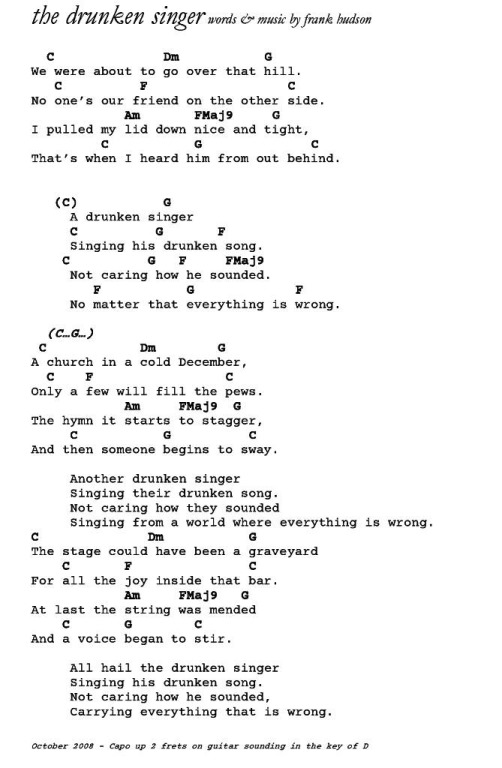
Even though the Parlando Project is about presenting other people’s words,* I sometimes remind myself that I still write poetry and lyrics. Every so often I’ll think of a song, sometimes one I wrote years ago, maybe one that never got a presentable recorded version, and I’ll wonder if I could record it like a regular Parlando Project piece.

“The Drunken Singer”  is one of those songs. It’s well over a decade old, predating the Parlando Project altogether. A couple of coincidental things made it come to mind. At another place online that I participate in, there was a recent thread on another older song, one by the extraordinary singer-songwriter Richard Thompson called “God Loves a Drunk.”   I love Richard Thompson’s work, but his fans sometimes feel called to warn potential listeners that he can be very dark. Like the British Isles folk music that influenced him, he can produce songs of death and misadventure — but he’ll also go another step further and produce songs of even greater bleakness. “God Loves a Drunk”  is one of those.

Early in this Project I told the story of my misapprehension of a folk song of alcoholic abandon “Rye Whiskey.”   I had wondered how my teetotaler great-grandfather could have been fond of it. In the process of working with this Project I discovered it was an oft-performed set-piece for the popular “Cowboy Singer” Tex Ritter, who played the song for laughter by imitating a drunken fool while he sang it. Thompson’s drunk song has no plausible laughter, though it does point out something ironic: that inside their degradation, the alcoholic touches on elemental things about the limits of the human condition.

Thompson’s song, and his performance of it, are skilled and intricate as are the many details he uses in it. None-the-less, it reminded me of this song of mine. “The Drunken Singer”  uses only three sketchily presented incidents, a less-is-more approach that I often favor when writing lyrics or other poetry.**
The Drunken Singer

A part of the inspiration for writing this song: despite my being in the cold-water army, my voice often produces sounds that too are not proper or correct.

.

The second reason “The Drunken Singer”  came to mind was that I found myself working this month on a handful of possible songs I could set from poems that referenced singers, and you just heard one of them last post: “The Late Singer”  by William Carlos Williams.

So, these are my reasons for inserting this, my own song, into the Project today. You can hear my new recording of “The Drunken Singer”  with the player gadget you should see below. If there’s no gadget (some ways of viewing this blog suppress it) you can use this highlighted link that will open its own tab with an audio player.

.

*New here? The Parlando Project takes those words, usually literary poetry intended for the page, and combines them with music we compose and perform. Because I almost always use poetry in the public domain, I often use poems from the most recent period that has clearly moved into that status: the early 20th century, the era when Modernism emerged. But I don’t keep to the early Modernists only, as an examination of the more than 700 audio pieces available here since we started eight years ago will demonstrate.

**As to the “Are song lyrics poetry?” question, my summary answer is “They are a kind  of poetry.” Do lyricists and literary poets focus on, or stress different things, or work with different expectations? Yes — but the range of what is canonically literary poetry shows those things vary widely within literary poetry too.

This Project knows there’s a tension there between page poetry and songs. I just think it’s fun to work within that tension, to push: to pull, to refer and to connect.

Drinking Alone Beneath the Moon

Our last audio piece this month had American satirist Mark Twain pointing out incongruities in the longstanding trope of the tortured poetic genius who dashes off “weird, wild, incomprehensible poems with astonishing facility, and then gets booming drunk and sleeps in the gutter.”

How far back does that trope go? Well at least to 8th century China, and the authentic poetic genius of Li Bai.*  Li Bai and Du Fu are the two most highly regarded poets of the Tang dynasty period, and given that the Tang dynasty can be viewed as the artistic high water mark of an extremely long and wide culture, that makes this pair probably the most esteemed Chinese poets. The metaphor is rough, but unavoidable: either have been called “The Shakespeare of China.”  Their lives overlapped, they knew each other, even wrote poems that drop each other’s names.

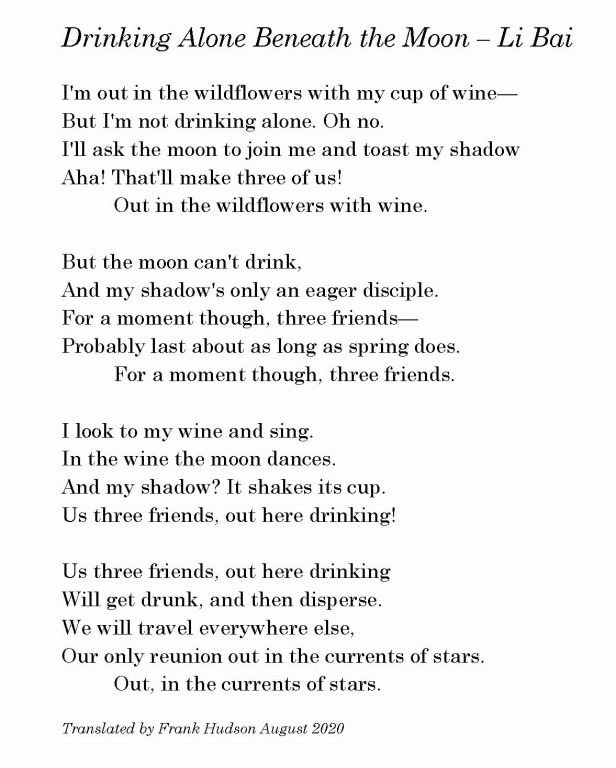
Li Bai both by reputation and through the persona that appears in his poems, has some similarities to Twain’s poetic genius. References to wine** in Chinese poetry are legion, but even against that background Li Bai stands out for the number of poems he wrote about the consumption of wine and examination of intoxicated states. The Li Bai poem I’m performing today, “Drinking Alone Beneath the Moon”  is one famous example.

Li Bai by Jin Guliang crop

Li Bai sleeping off the work of translation from English to Chinese: “The 白色 is the white, the 港口 is the port, the  柠檬 is the lemon, and the 果汁 is the juice. White port lemon juice. White port lemon juice. Ooh! What it’ll  do to you!” 

I think this poem pulls off a neat trick. Somewhat like Twain’s “Genius,”  on the surface it’s comic: Li Bai portraying himself as a sort of Falstaffian character whose meditation practice this evening in nature is to get hammered on some juice. But to my reading this short poem also portrays the progression of his intoxication subtly. The opening has him cleverly figuring out how to bypass any guilt from society’s admonitions regarding solitary drinking. And then he quasi-surprises himself that his plan is only partly working. I love the image of him finding that his shadow is merely a disciple—that Shadow will only follow Li Bai’s own drinking and not spur him on by proposing additional draughts. Then as his hand gets less steady, the moon’s reflection in his wine cup wiggles and dances. He of course doesn’t sense that he’s  getting unsteady himself, but that shadow guy, he sure looks shaky.  Finally as intoxication becomes deeper, he senses that his senses are going to be blotto, that the disciple Shadow-man, the companion moon, and yes even Li Bai himself are going to be out of it, cast off into some state not in the here and there of his actual moment.

Where does he go, where does his imagination go? The final image is of stars, moving, swimming it seems, movement-blurred. These could be the actual stars if he’s now flat drunk, or even abstract visual stimuli as his consciousness slips away. Footnotes in some translations tell us the idiom Li Bai uses in his ending may be understood as the Milky Way, the visual smear of our own stellar galaxy visible on some clear non-light polluted nights. My reading is that Li Bai may be using that image, but any stars are blurred and multiplied to his character in the poem now.

Drinking Alone Beneath the Moon

My new translation of Li Bai for today’s performance.

Oddly, it takes a clear-headed poet to portray drunkenness. Twain may have had some moment of empathy for his dying in rags and dirt “Genius”  poet, however foolish he can portray him. Li Bai starts his poem alone—and though he imagines his two drinking partners, he knows that they too, not unlike real companions absent at the start of his poem, will disappear with his consciousness as the wine flows.

In the original Chinese, Li Bai was a meticulous poet, observant of the traditional forms, a fluent user of rhyme and the Chinese version of meter. I can’t tell if any of the poetry Twain’s genius wrote justified the rough and foolish life, but from Li Bai’s esteemed poetry we know that whatever is true of his now legendary life, that his poetry gives us something worth reading. It’s possible the poet Li Bai used the character Li Bai, the dauntless romantic unconcerned for moderation—just as Samuel Clemmons, the ambitious young man who fled west to become a writer, used the character of Mark Twain.

I’ll probably write a follow-up post regarding the process I went through in creating this original English translation of Li Bai’s poem, but in summary, my observation at the start of that task was that most existing translations worked hard to be poetic, and some achieved that to a degree, but at a cost of not vividly embodying the process and character of the poem’s speaker. So, I went another way.

Musically this started out as a rock quartet: two electric guitars, drums and a very saturated overdriven bass guitar that sounds almost like a synth bass. I used some woozy Mellotron strings again, adding a bit of simulated worn tape cartridge wobble. I was going to go with the infamous Mellotron flute (any two or three notes using that, and many will forget what you’re playing and start to go: “Let me take you down, where I’m going to, Strawberry Fields…”) and then I thought: why not a Chinese bamboo flute instead? The last part I played was an approximation of a guzheng, a long scale zither-like Chinese instrument that I thought of since I had recently seen some examples in a museum this summer.

The player gadget to hear my performance of my fresh translation of Li Bai’s “Drinking Alone Beneath the Moon”  is below. Don’t see a player? Here’s another way: this highlighted hyperlink will play it too.

.

*The names we type and read in western alphabet for Li Bai’s name are approximations, and the schemes have varied. Li Bai is also rendered as Li Po and Li Bo and if we take the carom shot off the backboard of Japan’s pronunciation (as Ezra Pound did), he can also be called Ri Haku or Ri Taihaku.

**I had to look and see as I worked on this translation what kind of wine was common in 8th century China and would be known to Li Bai. Most Chinese wine in those days was grain-based from millet or rice. There were regions that made fruit wines then, but they were much less common.