Jazz and reading John Darnielle: Part Two, This Year 365 Songs Annotated

Here’s the final piece of this two-parter, and the place where I take off that hair shirt for a while and present a review of John Darnielle’s new book This Year, 365 Songs Annotated.

I largely owe my appreciation of singer-songwriter John Darnielle to my daughter, who found solace in his earlier recordings as she moved through adolescence. One 2005 song, the one that gives its title to a new book by Darnielle, features a 17-year-old speaker refraining: “I am gonna make it through this year if it kills me.” It resonated more than a decade later with another 17-year-old. What a good thing for a song to do.

I knew Darnielle’s work from a couple of songs recorded under his long-running project name “The Mountain Goats,” most notably the mysterious anthem “Jaipur.”   My daughter gifted me his All Hail West Texas  album one Bandcamp Friday a year or so ago. My immediate thoughts on Darnielle were that he was a good song lyricist. Like the late poet-associate of mine Kevin Fitzpatrick, his work is full of “other people,” and those people are often working class or lost-soul types who make themselves known as if in overheard declarations in his songs. Writing in Boomer classic-rock consumer-guide style “he’s like…” comparisons are misleading in Darnielle’s case. Saying he’s lyrically a mix of Randy Newman, Bruce Springsteen, Ray Davies, and John Prine is a bad assay, because he’s like all of them at once or in sequence, and he is his own man too. Still, the range of characters is an important strength. A lot of poetry, and a lot of indie songwriting too, is a singular solipsistic narrative, and Darnielle’s of the songwriting school that avoids this.

This Year cover

More than a collection of song lyrics (though they’re good lyrics)

.

Yet, This Year  is largely the story inside one person, a memoir in a different form: a book of days where he writes somewhat sequentially, but not by strict intent or always, about how 365 songs came about, what he thinks he was trying to express, and what his life was like as he wrote and recorded them. The entries can be quite short, a couple of hundred words typically, though a few extend for a few pages. The lyrics to each day’s song are included with each entry, which is helpful for any reader who’s not familiar with his work. I’m half-way through reading it straight through, but the book can also be read an entry at a time, as sort of daily thought-starter. I’m somewhere between a hardcore fan and someone that doesn’t know any of Darnielle’s work, and I’ve sought out some of the songs after reading of them in the book.

Things I’ve learned? It was not apparent to me beforehand, but he’s a poet who converted to songwriting, and many of his early songs had preexisted as page poems that he wasn’t planning to sing. Reading his lyrics silent on the page in this book demonstrates a literary poet’s craft in his writing, but my finding this out in memoir is a testimony to their lack of crusty poetese. Poets as well as songwriters would benefit from exposing themselves to Darnielle’s lyrical tactics, and he talks effectively about them in this book. I also learned that he spent formative years in his songwriting’s development living in a small town in Iowa, the kind of place I grew up in, in roughly the same part of the state, though I’m more than a generation older than him.

Another part of his story, which unreels through the day entries each devoted to a single song from his now large catalog of original songs, is that he began recording and making these songs public using meager equipment. He so far mentions almost nothing about the particulars of his instruments which are likely unremarkable and inexpensive, and a considerable part of his early career recordings – including the original versions of some of his best-loved songs – were recorded on a boom-box cassette tape machine at home. I resonated with that, having spent around 20 years using such cassette tape along with low-budget equipment. A late 20th century indie-music and fanzine samizdat network allowed Darnielle a slow-burn career doing that, around the time that my own nerve to share my work had faded. He recounts in the book, that royalties from the tapes sometimes paid part of the $170 a month rent,* but he had a day job in a lower-paid nursing field, again something I rhymed with in my cassette years.

The short entries in the book also tell a story of Darnielle’s religious journey, which began as a Catholic youth and has had elements of return, though I’m midjourney on that arc so far in the book.

These similarities paradoxically bring up the personal gap which makes reading his book so meaningful to me now. From what I’ve read so far, Darnielle apparently retained confidence in his own work through these long-beginnings, low-rent, lo-fi years, and even if there are dark nights of the soul in coming parts of his book, he displays that now as he discusses the work in retrospect. I had, and still have, substantial gaps in being able to carry that in public during my cassette years. Having days of private levels of self-confidence in some of my musical work is not an effective dose to properly present it to others, and my doing so “blind” without that confidence led me to some painful comedy of misreadings of likely interest. Those two things (managing self-doubt, being able to present one’s work effectively to others) interact. Darnielle may have been more personally engaging, or just more persistent in his networking. Elements of luck might have been significant (with me, they were in my “day job.”) Thinking of this difference as I read Darnielle’s book, it’s (too) easy for me to think, “Well, it must have been easier for him, his work was so darn good.” He’s a better vocalist and performer than I am (no-biggie, almost everybody is), and though I’m not sure how far apart we are in “on a good day” guitarist skills, his song lyrics are teaching me new tactics even after decades of my doing this on the page and with guitar.

In the first part of this pair of posts I sincerely worried about my work and hubris when I put it up against the skillset and history of Jazz. Despite those differences in how we’ve used our parable of the talents, I find reading Darnielle’s book heartening so far. You don’t have to be a songwriter, if you are any kind of writer – and likely if you are an artist of any kind – spending time with this book may be helpful.

Here’s an early song of mine, recorded on primitive equipment before the nearing 900 songs of the Parlando Project had started counting off, but consistent with its principles, a setting of John Keats’ “In the Drear Nighted December.”   Audio player gadget should be below, but if not, this highlighted link will open a new tab with its own audio player.


.

*For any younger folks reading this, the $170 a month rent (for a house!) must seem a dormouse fantasy. For younger musicians, the idea that royalties from indie recordings might contribute in any substantial way to making rent must seem equally fantastic.

Four Performances-Part Three: Punk Folk. Folk. Folk!

It took me an extra beat or two to continue this series, because I soon see myself as inappropriately going on too long about myself — this recounting influences and small events, even if personally meaningful, starts to seem out of proportion. I don’t know if there’s another way to write memoir than to engage in that “objects closer to the mirror” distortion, but I can’t help but think it’d be more appropriate if there was some greater payoff in achievement. The simple fact of the matter is that these are not stories of a performer’s early days before finding a notable level of success with audiences — more its opposite.

I’m grateful for the hundreds that might read one of these posts, for the thousands of times someone has listened to one or another of the audio pieces over the years. I try and honor your attention by being respectful of your time. I’m not so much afraid of embarrassing myself as I’m afraid of wasting your time.

A number of bands that came out of Minnesota in the Eighties did gather national attention — the scene punched above its weight — but as in most artistic or commercial activities, even a successful scene had many more failures-to-thrive than notable acts.*  This band of poets, Dave and I, wasn’t going to be one of the notables. Today’s performance was an inflection point for that.

We’d recorded our official album, which was released on cassette tape for lack of capital funds to get LPs pressed.** The local alt-weekly, The Twin Cities Reader,  reviewed it, and its cover linked us, the LYL Band, with a new record from The Time.

LYL Reviewed in Twin Cities Reader

The Time article promised on the front page teaser was a longer feature in the same issue. Great, but too forgotten too often local rock band Fine Art and their guitarist Colin Mansfield gets mentioned here too.

.

As reviews go, Paul Fishman Maccabee’s “So engagingly out-of-tune and cheerily offensive: it could well become a cult item” wasn’t exactly Robert Sheldon’s “Bob Dylan is one of the most distinctive stylists to play in a Manhattan cabaret in months,” but it allowed us a modicum of creditability. We were trying to evolve from a pair of acoustic folkies to an electric rock band (the recording was largely played on electric instruments), but we were doing that in a meandering way. A neighborhood guy, Jonathan Tesdell played electric guitar — and, we were assured, conga drums. I hoped he might become our analog to the Fugs Ken Weaver as he joined up with us.

At the time of that Reader  review we got an offer to play at the University of Minnesota. We took them up on it. We were practicing regularly now, trying to solidify our repertoire. This could be, if not our break, our foot in the door.

A small blip in our ascension dropped before the show date: the University called and asked what kind of music we should be billed as. I think Dave gave them a capsule description of our weirdness — and Dave’s an articulate guy — whatever he said it included the genre label “Punk Folk.”

That week as I walked across the never-named-that John Berryman bridge to the U, I noticed the posters along that span and on into the campus. They said “local PUNK FUNK.” Typo? Mishearing? I don’t know, but if Punk Folk wasn’t yet a common genre category in the early Eighties, Punk Funk was a term Rick James was using at this time for his work, and in the less-commercial indie scene the term was used to describe acts like James Chance’s NYC No-Wave skinny-tie-white-guy James Brown extrapolation. We were a trio expanding from acoustic instruments to electric ones without a bass player or a drummer.

Okay.

LYL Band concert poster Univerity of Minnesota Willey Hall

Photo in the poster by Renee Robbins. L to R: Dave Moore holding my tiny CasioTone that was my first synthesizer (it was also a calculator). Jonathan Tesdell, the new guy in the group and 25th Century Quaker, and Frank Hudson trying to look like he had Jazz chops, which he didn’t. Yes, our backup singers “The Cookies” did serve cookies and cider to the audience. The Replacements confounded audiences at key times in their career, but they never tried that.

.

The day of the concert came. We loaded Dave’s newly purchased used Farfisa combo organ and my homemade speaker cabinet for it, Jonathan’s Firebird electric guitar and Roland amp, my sound-hole pickup 12-string acoustic and heavily modified Japanese Sixties’ electric guitar along with my Fender Princeton amp into our rattle-trap old cars. On arriving, we found the concert location was a broad stage, the width of the room in front, with audience seats for a few hundred.*** The venue had supplied a full-sized Yamaha grand piano for Dave to play. I recall it had a paper band across the keyboard, which I joked was like the “sanitized for your protection” bands on a hotel toilet.

The audience arrived, accumulating to not a full-house. My memory isn’t clear on this, perhaps just a third or a quarter of the seats. Even so, that could mean at a minimum there were 80 people there, and unlike the shows at Modern Times, most weren’t folks we knew from the neighborhood. I don’t know what Dave or Jonathan felt, but I was hoping to put on a good show, to put forward our intent: some satire and civic points, some music with the not-necessarily-perfect, but perfectly-necessary energy of the still underground indie music movement that was also called around then “College Rock.” How well would we go over with this barely-Rock, with this audience, at this college?

I was on the stage performing when my nerve started to fail. That came during the song that the audience showed the most response too: four-songs-in we played a number that I think we informally called “Booker T”  or “Memphis Thing”,  an instrumental based on a nice riff I’d come up with as something of a concession to new-member Jonathan, the non-poet who wasn’t much of a lyrics guy. I could sense the audience perking up with that piece’s groove, hopes out there in the seats that things were going to lock in for more of a Rock show. Did some of the audience come for the poster’s Punk Funk? Did they at least expect something more like the other young Twin Cities rock bands that would play the Longhorn, 7th Street Entry or Duffy’s? Whatever, I knew “No, it’s not going to lock in. We’re going to do more folk songs about social issues and weird observations from two poets.” Not being able to change that, however true the set list was to our concept, dismayed me — yet I needed to carry on, while confidence was draining away.

I recall those feelings hanging on after the concert. Rather than having stubborn pride in presenting our band and its shambling, eclectic, cabaret setlist, I felt I’d let the band down. If Dave, the better performer felt any of this, he didn’t show it, and Jonathan , as ever, was by nature a quiet, pacific guy. I remember sitting in the car after loading back out immersed in a sort of punk folk funk, and on the radio — of all things — came Jimi Hendrix’s “Voodoo Chile/Slight Return.” I, the guitar-playing poet. heard him in my mood not as the obligatory guitar-great Hendrix, but as the lyricist Hendrix, the kid who’d scrawled spaceship doodles and poetry in his school-lined notebooks.

I stand up next to a mountain
And I chop it down with the edge of my hand
I pick up all the pieces and make an island
Might even raise a little sand

That’s what artists do. We are at essence pretentious, that thing we fear, that prideful sin we are sometimes called on. And the charge, that indictment, is sometimes true: we fail, or sometimes certain audiences fail, sometimes we lack conviction, sometimes we are convicted, a just verdict. Still, we think we can raise mountains, raise up islands from our imagination. Sometimes that imagination lets others climb on those mountains, take shelter on those islands — other times we fall through our dreams. When nothing is beneath our feet, are we falling or flying? Hendrix continued, singing:

I didn’t mean to take up all your sweet time
I’ll give it right back one of these days

When I took up your time today with the continuing shaggy dog story of my band of poets, I asked if it was worthwhile telling this story about a band that didn’t make much of an impact. Here’s a plausible reason: despite that outcome, I’d do it again — maybe harder next time— and the music-making with fellow poet Dave Moore continued, continues. I know some of my readers are younger and are making music or other art within a career that doesn’t yet know it’s apogee. Have courage: you’re falling or flying.

Here are two pieces from a lo-fi tape of that U of M concert in 1981: Dave’s adaptation of a poem by Kevin FitzPatrick “Bugs in the System”  and my own Surrealist summer meditation “China Mouth.”   You can hear them with the graphical audio players below, but if you don’t see those players, the highlighted titles are links that when clicked on will open a new tab with an audio player.

Here’s Dave Moore singing a tale from the front-lines  of minimum-wage, Bugs In the System (keys to the drop safe):”   This was the second song in the 1981 concert.

And here I am singing the third song in the concert’s set list, “China Mouth”,  a song of Summer discontent. The “Memphis Thing”   groove-oriented instrumental I write about above was the next song we played.

.

*An off-the-top-of-my-head Eighties Twin Cities list: Prince, The Time, Hüsker Dü, The Replacements, Soul Asylum, Babes in Toyland, Alexander O’Neal, The Jayhawks, Flyte Tyme (Jimmy Jam/Terry Lewis, largely as important producers). And like most scenes, the above acts are a quick list of those someone elsewhere might have heard of, when there’s a list at least as long of good acts that remained at local hero status. Given the LYL Band’s penchant for satire, I could also have mentioned that the Eighties saw the Twin Cities grow a substantial comedy scene, one participant in that became our bass player for a while.

**I believe it was the first cassette-only release in the Twin Cities scene. I duplicated the cassettes myself, and Dave made the packaging for them. I got the idea from ROIR in New York City who in 1981 put out its first cassette-only release (James Chance and the Contortions). Their release and ours followed the introduction of the Sony Walkman, a small battery-powered portable cassette with headphones that was a cultural artifact of the era. I wrote a press release for our recording that exclaimed “Teach your Sony Walkman to crawl!”

***Looking online today I see there are two possible Wiley Hall rooms, one that seats just under 700 and another 362.

A Birthday, Vampires, and The Greatest Original Music Band Minneapolis Ever Forgot.

If Halloween is about shadows, ghosts, the dead and un-dead etc etc, it comes in the month I celebrate the birthday of my friend, the living Dave Moore, an occasional alternate voice here at the Parlando Project. Dave’s a poet, songwriter, cartoonist, and my longtime musical partner in the LYL Band. Back in the 1970s his lyrics were frequently used by “The Greatest Original Music Band Minneapolis Ever Forgot,” Fine Art.

I wrote about Dave and Fine Art a few years back. TL:DNR summary: Fine Art were a Rock band that emerged in 1978, issuing a self-produced, self-titled, vinyl LP, and then performing often in what few Twin Cities locations that were open to the handful of original music bands.* “Punk” was still the sticky label used for young bands that performed non-conformist new material then, but it was not a homogeneous scene of Ramones and Sex Pistols cadre three-chord-shouting-in-leather-jackets-and-frayed-cotton.**  Television, Patti Smith, Pere Ubu, Talking Heads — all these were formative bands in the Seventies, present at the beginning. Yet, oddly enough, labels like New Wave, and Post-Punk were generated to try to describe those that didn’t follow the stance of regimented simplicity for concentrated force and/or skill-set necessity. Fine Art were one of those from that non-traditional tradition.

As the famous Minneapolis First Ave club moved to presenting young original music bands, Fine Art played there regularly in the early Eighties, both in the small side-room the 7th Street Entry and in the big main room. When someone reprints a poster of that fabled club’s scheduled acts from that era to highlight Husker Du, The Replacements, Soul Asylum, or even Prince, you’ll often see the Fine Art band name playing the week before or after.

When this era is covered in overview, even by locals who want to concentrate on “the scene” not just the national acts that emerged, Fine Art barely makes the footnotes. That’s not exceptional, history-is-written-by-the-winners and all that. But here’s the thing: Fine Art’s material was all original (they never performed a cover), and it was very very good. The band two guitarists were excellent: Ken Carlson’s driving chordal center on rhythm guitar and Colin Mansfield the genius lead guitarist who could do song hooks or Free Jazz, sometimes in the same song. The two women lead singers format was unusual then as now, and the original pair Kay (Carol) Maxwell and Terry Paul, and later Kay and Jennifer Holt were effective. But it’s the songs, those constructions that were passing sounds on a club stage and remain only on the barely surviving and out-of-print records that shock me to revisit. They’re still  unconventional — and as such, they still sound fresh 40 years later. Dave’s lyrics are part of that, even if he wasn’t the only lyricist in the band.

Vampires. Coffins. Fear of being suffocated. A song with a Dave Moore lyric from Fine Art’s LP issued at the start of the band’s existence in 1978.

.

Fine Art didn’t survive past the Eighties, but the LYL Band still gets together. You still can hear songs Dave wrote and ones he contributes to here sometimes. I do my best trying to be musically adventurous to support Dave’s words.

In one’s youth you are told you should think of the future.

Generally, you don’t.

In one’s old age you are said to think too much of the past. I generally don’t. A smaller future is the treasure I consider, the treasure I want to spend. Playing with and knowing Dave is part of the treasure.

.

*I think this surprises some younger indie musicians or fans today. In the Twin Cities in the Seventies, if you wanted to play in public in a band you were expected to perform songs people knew, which meant cover songs. If you wanted to buck that trend, there were in 1978 maybe 2-3 places that would let you try it. When you hear of The Replacements doing one of their live piss-take cover song tangents, there’s likely just a bit of residual anger at that constraint behind it.

**In retrospect, many assume an amoeba, fish, surfacing amphibian, stooped monkey, biped man with club picture of how indie evolved from punk. But the earliest CBGBs bands were a very mixed lot. The Ramones stood out  because of their fast, faster, and fastest strumming rock minimalism in that scene. And Ur-source band The Velvet Underground mixed simple and complex, pop ambition and alienation noise with abandon. New Wave and Post-Punk existed from the beginning — or before the beginning. Fine Art may have produced fewer hard core adjacent songs as the band evolved, but they were always composing fresh, heterodox musical concepts.

Heaven and Hail

I sometimes think I’m working against gathering a larger audience for this.

Twice in the past month or so I’ve had an opportunity to speak in passing with poets about what I do with the Parlando Project. I’ve got my elevator pitch carved out: “I combine poetry, usually literary poetry not intended to be performed, with original music in different styles.” Both poets came back with this replying question: “What kind of music?”

Maybe I should start hitting that word “different” with hard emphasis — but Midwesterners know that kind of spoken underline could be parsed in our regional argot as cloaked disparagement. If I was to say:

“I’ve written a piece for a string quartet in which the instruments are placed on the floor and filled with nuts and seed. A herd of squirrels is then unboxed and will proceed to chew through strings and tonewood for the course of the musical evening.“

The Midwesterner is bound to reply “Oh, that sounds different.”

Squirrel Quartet 3

For Friday the 13th: presenting the unexpected, not gnawful, just “different,”  the Squirrel String Quartet.

.

Now, I believe both of those poets this past month are perceptive, I read it in their admirable poetry. If they miss the word “different” it’s because many people have strong feelings about the music they care about.* Long before reaching the age of those poets most listeners have strong affinities for some music and equally strong dislikes for the sounds that they don’t wish to put in their ears. The idea of combining poetry with music is attractive, but what kind of music is an unavoidable point in describing the Parlando Project, and I can’t encapsulate that. Elevator pitch? If I tried, I’d be out of breath and walking up flights of stairs. To both poets I was reduced to trying to start my response with “That’s my problem: it varies.”

Readership of the blog posts here continues to increase through the years, while listenership to the audio pieces has been for the last half of this Project’s life flat to somewhat lower. This bothers me, and I have theories, but one that seems particularly plausible is that the variety itself turns off listeners. One day acoustic guitar folk-scare strumming, the next day some kind of synthesizer sound, a garage-rock quality electric combo, something like Jazz, small orchestral ensembles, Blues slide-guitar, or alt tunings in a matrix somewhere between John Fahey, Joni Mitchell, and Sonic Youth. And then on the third day, a combination of one or more of the above.**

How well do I (who much of the time needs to play or score all the parts) present that variety? I think my own judgement approximate, but it goes like this: on good days I think I do it well enough, on bad days I feel embarrassed by the faults in execution and conception I hear. So, my limitations are a factor here, but even if I was a master of all these forms, I think the problem would remain. In this theory it takes only one or two “bad fit” musical pieces for a new listener’s taste to judge the work has no value, and no further listening occurs.

What will I do about this? I don’t know. I can’t help the eclecticism — it’s been in me since my youth*** and I don’t think I want to try to scrub it out.

Today’s musical piece comes from that “We’re a garage band, We come from Garageland” mode — looser still in that like most of the LYL Band pieces presented here over the years it’s spontaneous, not the execution of parts each instrument is supposed to play. As keyboardist Dave Moore says at the end, the words are “a personal experience story,” an exception in the Other People’s Stories texts the Parlando Project finds, experiences, and presents. Just over a year ago a storm with 60 mph winds and golf-ball sized hail struck Minneapolis. Overall, it caused 1.1 billion dollars in damages. On my roof, my shingles were totaled (the classic hail-storm result), windows were shattered, and there were plenty of cracks in the siding from the wind-driven hail. As “Heaven and Hail”  tells it, it took months, well into the winter, for overwhelmed builder crews to get all the home damage repairs completed in my neighborhood.

Last year at this time work started on fixing the damage at my place. One experience amid the hammers, ladders, and supply pallets: hearing one of the crew’s boomboxes playing a record of garage rock classics all sung in Spanish. Another Rosetta Stone moment, like reading those cereal boxes in French.

To hear this short account of the storm and aftermath you can use the audio player gadget below. No player? This highlighted link is an alternative that will open a new tab with its own audio player.

.

*Neither asked me —and few people ask me — “What kind of poetry?” With non-poets, I ascribe that to the lesser interest in poetry as an art and therefore a lack of strong likes and dislikes.

**This leaves out the subjective qualities of my voice, something which I recognize is of overwhelming importance to most listeners.

***”Top Forty” rock’n’roll radio was extraordinarily broad in “The Sixties™” and I was listening to the classical music station and a country-western station along with that format. Hootenanny was on TV, folkie music was part of church camp. Other than the occasional cross-over hit I’d hear on the radio, the Jazz waited a bit to creep in late in my youth. Eventually the smart programmers figured out that a pop music station that played a “button pusher” record would cause the listener to switch to a competitor. I’m the odd-duck that when I hear a record I don’t like, right after one I do like, I want to hear the third and maybe fourth or fifth record played, particularly if any of the small sample (liked or not-liked) is something I don’t think I’ve heard before.

Dooryard Roses & the death of John Mayall

Here’s another one of these posts that is going to jump around a bit, though I’ll keep it brief, and there’s a heartbreak poem set to music that I’ll end with.

I don’t post every time some figure influential to me dies. It should be apparent to long-time readers of this that that group of influences is wide, and therefore large. Still sometimes the spirit moves me. This week a midlist musical figure, John Mayall, died. He was 90 — so not a surprise to any actuaries in my audience — but his extraordinarily long musical career (he was still regularly touring up until the last few years) might have masked the imminence of that death.

I can’t quite figure how many of you will recognize his name, and of those that do, how many will see why I’d count him as an influence. I often worry, what with the variety of the musical settings I publish here for strangers to listen to, that someone listening to one, two, or three of the Parlando musical pieces will think that I’m fixed in some musical genre. “Oh, he does folk-song-like stuff with solo acoustic guitar.” “Some kind of rough garage rock thing, isn’t it?” “Do you know you sound like Bob Dylan?” “What’s with all those orchestral instruments — and was that a sitar?” “You know, that beatnik to poetry slam kind of spoken word over spare Jazz backing stuff.”

To my mind, my aim is to vary the music, just as it’s my intent to present different sources for the words. But what’s that got to do with John Mayall who was not generally filed in any of those genre bins. If you look for Mayall’s work, he’ll be filed under “Blues.”

Blues, that great Afro-American musical approach, is (while often imperceptibly) as close as a center as I can find in my music. The other day one of the household teenager’s friends arrived when I was in another part of the house practicing guitar over an entirely not-Blues chord progression I had ginned up. I stopped, wanting not to intrude sonically on their get-together. When I met up with the young visitor (who plays guitar themselves) I apologized for the racket, and they replied, “Blues is always cool.”

Odd, I thought. I certainly didn’t think of the idea I was working with was Blues, but then the things I was playing over it used embellishments that I learned from musicians who played within a recognizably Blues song and harmonic structure.

In an interview with the Guardian newspaper later in his career Mayall was asked to define the Blues. His answer? :

“[Blues] is about – and it’s always been about – that raw honesty with which the blues express our experiences in life, something which all comes together in this music, in the words as well. Something that is connected to us, common to our experiences. To be honest, though, I don’t think anyone really knows exactly what it is. I just can’t stop playing it.”

Read the whole interview in that link above if you want an overview of the man’s career and its variations on what you might think defines the Blues— but I admire Mayall regardless of genre borders, because his career exemplified something I call the Indie Spirit. He was a “get in the van” sustainable-costs touring musician when D. Boon was a fresh kindergarten graduate. Like Grant Hart, he did the graphic design for his band’s records from the very start. He played for small audiences in small venues through most of his career, and ballroom and converted movie theater venues were about as big a draw as he could muster at the height of his popularity. If that bothered him (it didn’t seem to) it didn’t stop him. He played his music without a thought to maximizing its commercial potential, a genial stubbornness that I admire. Furthermore, every band he put together over around 60 years of music-making had musicians that were better than he was, and he based his bandleading on letting them shine. Every obit tries to list those once bandmembers, but the list extends over the horizon because that group of boosted musicians, like the bandleader, included many individual talents that never became big stars while making fine music.*

Roses Mayall 600

A song not by John Mayall: “You look to me like misty roses…” The roses from a morning walk my wife took. The picture of Mayall is on a pillar overlooking where Dave Moore plays in my studio space.

.

That went on longer than I expected, but here’s a piece I just finished, with words from the American poet Sara Teasdale. Teasdale is another writer from the first third of the 20th century whose poetry I can’t resist setting with music. Much of Teasdale’s poetry is short and compressed like today’s selection “Dooryard Roses.”  And much of it expresses heartbreak, as this poem does. But like the Blues, it tries to be honest and straightforward about it, and to sing it so we can say back to the singer “Yeah, I’ve been there too. Is that what you figured about it? Well, we’re both still here, so sing it some more!”

You can read the text of Teasdale’s short poem at this link.

The music I composed for this piece, is it Blues? Maybe I don’t know, but I don’t think it is. I just can’t stop playing it. You can hear it with the audio player gadget below. No gadget? This highlighted link is your alternative then.

.

*A personal factor in my connection to John Mayall’s music: alternative voice and frequent keyboard player in this Project, Dave Moore, is the person who introduced me to Mayall’s records. In those 20th century days when one might fruitfully evaluate a person by their record collection contents, Dave didn’t need any help there — I’d already heard his poetry — but he’s why I came to hear and follow Mayall’s music.

William Blake’s The Poison Tree

There’s much commerce between fantasy and fable — and William Blake, as literal as he may have drawn the angels of his visions, was one such trafficker. In this poem a metamorphical form of pomology creates out of anger a beautiful, attractive, and cursed fruit, so I thought this poem suitable for our Halloween Series.

One question asks for an answer in Blake’s poem: what makes the poison apple grown from wrath, fear, and tears “bright” and “shining,” and eventually so irresistible to the poem’s enemy?

Many readings concentrate on the poem’s singer, the one who instead of forgiving as he had done with a friend, grows their anger, sorrow, and fright into the Poison Tree. But let’s consider the other party, their enemy. Let’s look at the song from their view.

The emotions that grow the Poison Tree are often stronger than the more positive emotions like trust, love, and mere happiness — and the alloys of these negative emotions can be made into purer metals. Thus the human reaction, however unacknowledged, to envy the tactics of our enemies. Oh, what great evil they use, how powerful that is, how greatly we’ve been hurt by it — so, shouldn’t we be allowed at least some of the fruits of that tree? No, not all the root and trunk of that evil —for we are not like our enemies, — we are just owed a little of that power, maybe one apple?

The poison apple “shines” because it seethes with the power of hatred. It’s “bright” because the dark fruit becomes reflective the moment we reach to pick it. A convex apple is a strange mirror. We see ourselves magnified, we see our enemies too, we see wrath distorting us.

Blake’s fable in that reading says then: do not plant that poison tree from the injustice done to you, as the poem’s singer does, for the fruit will be impossible for your enemy to resist. “Oh, that’s not so bad,” you may first think, “the foe ‘is outstretched beneath the tree” as the poem ends. But beyond the poem’s ending there’s another refrain: the foes survivors have wrath, fears, and tears — and a seed poison apple for another tree.

One thing I admired about Blake was his multiple skills, out of which he created the poetry, the book design, and the artwork for his Songs of Innocence and Experience. Indie!

.

My performance of Blake’s “A Poison Tree”  is full of the sound of an American invention most often used by British bands of the late Sixties and early Seventies, the Mellotron. The Mellotron was supposed to be a home or light theater/salon entrainment device. It had tape recordings of instruments, including recorded sections of orchestral strings and woodwinds, one recording for each note to be triggered by a keyboard. When it was discovered by rock bands they found they could saturate their recordings in these orchestral textures. Because the articulations of the taped instruments were “canned” not freshly played, the result was a little ersatz — but eventually this was embraced and the output of the polite Mellotron was sometimes patched through overdriven amplifiers like an electric guitar might be. That’s part of the sound in the LYL Band performance of “The Poison Tree”  that you can hear with the audio player gadget below. No player?  This highlighted link is an alternate way to hear it, as it will open a tab with its own audio player.

.

700

I released the 700th Parlando Project audio piece earlier this month. I consider this an extraordinary achievement. I’m unaware that anyone has ever done anything like this* at this scale.

Sometime around 2015 I had an idea: that while poetry and music had long been combined, the ways you could do that hadn’t been fully exploited. I thought of the strains of Modernist poetry that were presumed to be obscure and non-musical, and believed that they had musical elements that would allow those poems to seep into one’s consciousness under the decoration and repetition of music. And I thought too of dusty words safe in their paper alabaster chambers — obsolete poetry, or lesser-known poets — could some of them be asked to come out and sing and dance?

If one would combine these words with music, how could the music illuminate or vivify them? I knew there were answers that’d already been given, so I wanted to try some of the other answers and maybe even find new ones. I knew the traditions of Art Song a bit, admired much of that; but I sometimes felt that Art Song settings and performance styles, while beautiful, didn’t always communicate all a poem’s possible environments and emotions. I knew the old-fashioned mid-century traditions of Jazz and Beatnik poetry pretty well, and despite Rap owing something to those things ancestrally, Rap’s insistent flow of words sometimes seemed more demonstrative than denotative to my ear. Indeed those two traditions, Art Song and Rap, poles apart in cultural associations, often suffered from a similar flaw: they needed to demonstrate talent and skill in the singer or rapper to execute tricky stuff, vocal feats. I’m not against that per se, I just thought there could be more than that.

Musically I was more aligned with two movements, also closer than superficialities might lead one to suspect: “folk music” and what was called variously punk rock, alternative, and indie music. These two musical movements could allow virtuosity, but they didn’t require it. They knew that simple could be as effective as complex, that one could be both simple and distinctive, that expensive equipment and recording perfection wasn’t essential.

I originally thought that the Parlando Project could best be done by other people. I even pitched it as an adlib series of collaborations between various musicians, bands and ensembles with words that might not be overly familiar to them. Sensible radio network people listened and wisely chose not to try this. They were wise because such an effort has opportunity costs, and the results could fail embarrassingly. My idea was not a good bet and would take resources from safer bets.

So, I decided to try another route, one most consistent with my alignments: Do It Yourself. Like hootenannies, sing out, kick out the jams, get in the van, DIY is a way to bypass the might-have-been, the we’re-not-ready, we-haven’t-been-given-permission obstacles. My singing voice didn’t suit Art Song, my less than agile speaking voice didn’t suit Rap.**

Who’d write the music? Mostly, I would. Who’d perform the music? I planned to pitch-in on what I could play as things started out, but later it was often myself playing all the instruments. Who’d select the words and present them? I would. Who’d record the music? Me. Who’d promote this and call proper attention to it? Alas, mostly me.

The result? It got done, however imperfectly. Things that hadn’t even been imagined had realizations that now exist, that others could hear. What was beyond my imagination? How many writers work I’d have meaningful encounters with. Those writers are almost always long dead, yet the work of composing, performing, and recording these combinations with music means I have hours of collaboration with them. The poem I start out with is often not the understood poem I’d write about at the end — and frankly, my understanding sometimes changes after I finish presenting the audio piece to you. We understand poems, if we understand them, with our whole lives.

I’ve learned new things musically out of necessity. I’ve become a somewhat better vocalist. As a recordist, I’ve figured out some things that work well enough. Would the pieces be better if someone more talented in each of these fields did these things? In most cases, yes. But that didn’t seem the choice. The choice seemed to be: nothing, silence, possibilities that remained “how about/what if…” thoughts and nothing else.

Then there’s that last part of the DIY bargain, promoting this Project and bringing it to attention, something that was done badly. I’m a lousy self-promoter. Many artists are. When I get up the courage to do it — which I consistently fail to do — I often do it badly with insufficient skill at figuring out the hook that draws interest. It’s also quite possible that the general idea here: a variety of words (not always “poetry’s greatest hits”) combined with a variety of musical styles has a very narrow appeal. That musical eclecticism, a choice that suits me, I suspect reduces appeal. The listener who might like my simple folk music style examples will not care for the electronic pieces will not like the let’s give it a go live small rock combo stuff, will not care for the “Punk Orchestral” pieces, will not care for the weird drone and minimalist stuff, and so on. I fear it may only take one or two examples someone doesn’t like to end their engagement with the Project. Yet, I can’t help myself, all different kinds of music are always in contrasting discussions in my head.

In summary, as I look over the more than seven years I’ve been doing this, I’m left with pride at what I’ve done. The self-questioning and pitying part of my emotions whispers to me “No one else is astonished. Are you the fool for thinking it astonishing, or are they the fool for not?” The sensible me judges those self-whispers. Replies that a few hundred read or listen on the best days to things that would not exist otherwise. I’ve received kind words from some of you, and if I haven’t replied enough to those messages it’s because I’m so grateful for them I can’t think of adequate words to respond. Some readers and listeners have gone even further and re-blogged or re-posted some of the things from the Parlando Project on your own blogs or on social media, something that’s been important in growing the audience for this.

But still the question sits in my mind on my doubting days: literary poetry and approximately realized indie music are both smallish groups. The combination of the two may not be additive as in my initial hopes, but subtractive. It’s possible I’ve done the most substantial job ever toward a goal inherently of not-much-interest. Or that I’m not good enough at it. Sobeit, it’s what my soul wants to do, and if such doubts try to stay me from doing this, I’ll listen to them and try to continue.

Earlier this month, as this post sat in drafts as I wondered how embarrassing, needy, or self-aggrandizing it was, I saw this quote in a column by someone who I never really knew, though she was technically a co-worker.*** In a final column in a local arts and entertainment paper, The Dispatch,  that was itself folding its tents, long-time local radio host Mary Lucia wrote:

“Ultimately the world owes you nothing, but it’s OK to secretly believe it does.”

How can I tell if that’s true or not? I can’t even tell how I could tell. It’s one of those things that might take more than one lifetime to know. I remember that quote and  I remember the trio of things I wrote above examining myself: “embarrassing, needy, self-aggrandizing.” I may not have enough time in my aging lifetime to find out what is most true in the balance — and any younger person reading this, even you may not have enough time for whatever you bill out to the world. Doubt has value, doubt may keep you from doing something foolish, but as of now, doubt doesn’t tell me what else to do. If I’m a fool, I must do what fools do, or nothing.

The 700th Parlando Project Piece bw

I can’t draw for beans, but I’ve had fun generating illustrations this year using Adobe’s new AI technology that claims it doesn’t use uncompensated work of artists.

.

* New here? What’s this?   Words, usually literary poetry from a range of eras, combined with a variety of original music, with posts here discussing my impressions of the poets and poetry as I encountered them in the making of those pieces.

**More than 50 years ago, in my naïve solitude, I imagined a type of music that would use a chorus of rhythmically spoken words to represent music. I even composed a couple of short pieces that I imagined could be performed that way, and eventually a script for a short play that expanded on these ideas. A year or so later, I heard The Last Poets recording and heard something partway like what I had imagined. I looked with admiration at the beginning of Rap, but I honestly have to say that I haven’t kept up with it. Besides my lack of speedy vocal chops, and generational distance from the modern masters of this form, the word-music I hear in my head sounds more like Carl Sandburg and Langston Hughes. I’m just as generationally removed from that latter pair as from today’s rappers, only in another direction. I guess I’m just weird that way.

***She would come to work about the time I was leaving my shift at a radio network, so I knew her more the way ordinary listeners did, as an on-air host.

Winter 2022-2023 Parlando Top Ten

It occurs to me that it may have been a while since I’ve reminded new readers what the Parlando Project is, has done, and tries to do. It started as an idea around 2015 to focus on something I’d done off and on for decades: to combine other people’s words, usually literary poetry designed to be seen on silent pages, with a variety of original music.

I did this not only because I think it’s fun, but because the process allows me to more deeply absorb some sense of what the poets are trying to convey. At least for me, I can read a poem with my eyes and sense that there’s something wonderful there — but then to read it aloud, perhaps even to sing it, allows me to inhabit it, to visit the environment inside it, as if one is deep inside some forest, awash at a water-brink, or walking down its street or inside some meaningful building.

Reading a poem silently is like looking at a picture. Performing it aloud is painting the picture with the words still wet.

Early in the Project many of these performances were with others, most often my long-time musical partner Dave Moore. For a number of reasons those opportunities have decreased. These days the typical musical setting here is composed, and all the parts played or scored, by myself. I’ve done a handful of pieces in the Project without instruments, but that’s unusual. I think that even though they are played by a one-man-band I want the words to have companions. Even the loneliest poems can have these here.

I do these pieces myself, not because I have great confidence or a high appraisal of my musicianship. Far from it. I compose and play the parts because I’m available. I’m an amiable contractor to myself, I enjoy playing different instruments, and I’m unafraid to dive into a variety of musical environments. My estimate is that most musicians who hear what I produce for the Parlando Project are unimpressed by this work, in that I almost never get responses from them when they are exposed to it.*  My guess is that is because I use simple ideas, and my realization of even these basic conceptions via my own playing has imperfections. My musical “thing” is more at participatory folk music or the punk/indie ethos — and though I try to produce good work here, and I’ve put effort into that, I don’t consider many of the Parlando Project pieces the best realization they could have. When I’ve taken to putting up chord sheets of some of the simpler acoustic guitar pieces here in the past year, I’m thinking that a better singer or player might take them to a better musical place.

Hepcats of Venus

Imaginary band gets down in beatnik cellar. Illustration shows my younger self & spouse in the center. W. H. Auden taps his cig on the ashtray in the foreground. Behind the drummer, Gertrude Stein considers Virgil Thomson.

.

Now let’s get on to a brief rundown of the Parlando pieces that were most liked and listened to this past winter. I do this countdown style, from 10 to the most popular. The highlighted titles are links in case you’d like to see what I wrote about the pieces when I first presented it.

10. All Souls Night by Hortense Flexner.  Long-time readers here will know I like to go beyond “Poetry’s Greatest Hits” here, and this spooky piece by a little-remembered author from the time of WWI continued to be listened to long after Halloween.

.

9. “Uncle Sam Says” by Waring Cuney.  This one, jumping forward to the WWII era, is almost cheating, as Cuney, a friend of Langston Hughes, engaged here in straight-out songwriting with bluesman Josh White. I’ve been playing a bit more bottleneck slide guitar this winter, and that’s what I used to accompany this message song about a segregated military.

.

8. “Now Winter Nights Enlarge” by Thomas Campion.  Speaking of songwriters: poet, musician, and Elizabethan-age physician Campion also intended this to be sung — although, as with “Uncle Sam Says,”  I didn’t use the original music for my performance.

.

7. “The House of Hospitalities” by Thomas Hardy.  A poet who spanned significant chunks of the 19th and 20th centuries, Hardy was well-versed in poems of rich remembrances, as in this Christmas season memory of holiday celebrations past and gone.

.

6. “I’m Sorry for the Dead Today” by Emily Dickinson.  One of three appearances by this crucial American genius, this one a jolly remembrance of a cooperative harvest time in Amherst.

.

5. “I’m Afraid to Own a Body” by Emily Dickinson.  An opening line or two in a poem can grab even the most inattentive reader sometimes, and this poem’s opening pair of lines certainly did so for me this winter.

.

4. “Fairy Song” by William Butler Yeats.  Like many a Yeats poem, this one beguiles you and me with its lovely word music. Then I read the play whereupon the poem appears and discovered that its context is exactly that for the song’s singing fairy: a beguiling away of a distressed person from their heart, hearth, and home. That wind that opens this poem is chilling once you know.

.

3. “I felt my life with both my hands” by Emily Dickinson.  I cannot say authoritatively what Dickinson intended the context of this poem to be, but I read it as an examination of body dysphoria, though I’m unsure if anyone else has “read” her poem that way. As I have sometimes done, I’ve performed this with what I call an “Inline Epigraph,” quoting a line from a Lou Reed’s song “Candy Says”  before the concluding section of Dickinson’s text in my performance. I often think of poems as being in conversation with each other.

.

2. Railroad Avenue by Langston Hughes.  I spent an enjoyable but inconclusive time searching for the “real” Railroad Avenue, thinking it could be like Van Morrison’s Cyprus Avenue or a NYC address in a Frank O’Hara poem. Couldn’t find it. May be it’s only mapped in Hughes’ imagination, a construction for the purposes of the poem. Long-time reader rmichaelroman reminded us in comments that America’s separations often are lined by being right in one’s memories from the “wrong side of the tracks.”

.

1. “I’m Gonna Make Love to my Widow ‘fore I’m Gone” by Frank Hudson.  Another bottleneck guitar piece that readers and listeners liked a lot this winter. Well — a self-penned piece about good old-fashioned winter randiness made it to the top of the Top Ten. Go figure. They’re talking single digit wind-chills and a March snowstorm as this week ends up here in Minnesota. Codger cuddling is carbon-free heating people!

.

.

*I ascribe this to politeness on their part. I tell myself that I overvalue the audacity and aims of what I do, when simple competence with simple ideas might be preferable.

Sappho’s Old Age (Rimbaud version)

The ancient Greek poet Sappho is one of the oldest poetic voices we have record of. Like the Greek epic poet Homer, her work likely predates written literature and was originally intended to be sung. How much more do we know about her?

Almost nothing for sure — or even by likelihood. As with Homer there are traditions and later stories about her, none of which are plainly based on first-hand accounts, all written centuries later. If one prefers to base their literary analysis on the text alone, that would be just about the only choice in Sappho’s case. Yet for many people not generally interested in ancient Greek poetry, Sappho is best known for being a lesbian writer — indeed the very term for that erotic affinity is derived from the Aegean Island where Sappho lived, Lesbos.

I’d need to be more knowledgeable than I am to discuss how Sappho’s lesbian identification came to be accepted as general knowledge, but some arguments are made using evidence from the text of her poetry. Which brings me to the next thing I was reminded of as I looked at using some of Sappho’s poetry over the past couple of weeks: there’s really very little of it. Very little of it.

Imagine you are a couple of centuries after some event which has erased a great deal of our formerly recorded literature. Suppose you were, in such a time, to try to assess the works of T. S. Eliot, Bob Dylan, or Emily Dickinson based only on other writers’ surviving references to them, references you can only hope will be buttressed with a short quote or two. Everything else would be lost. Sure, those commentaries in surviving texts would be tantalizing, testimony to the author’s greatness — but because they were written before some general loss of literature, they are painful too in their assumption that they needed then to be only pointers to something every cultured person would know.

In such a world of imaginary loss T. S. Eliot would be the “April is the cruelest month” and “bang not a whimper” guy without necessarily the rest of the poems that contained those lines in context surviving. And what could we make about a lost work about, what — cats? Dylan’s music*  might well be lost, but a few pithy phrases would survive because so many others liked to quote him to make a point about their times. Some accounts would say he was a great performer, yet others would make fun of his voice. Dickinson? Perhaps a legend would survive of a lifelong, lovelorn hermit, since that makes for a good story,**  but beside that we could have only a stanza or so of her short poems, her actual art retaining only the “greatest hits” lines that got quoted, “Hope is a thing with feathers,” “Because I could not stop for death,” and so on.

Sadly, this is what’s left of Sappho’s art.*** So perhaps it’s consolation during Pride month that we have presently imagined her as someone like those we know today: a breathing, living individual of desires and feelings.

Until this century there are only a couple of Sappho poems that were complete enough to consider as an entire work. Then in 2004 another mostly complete poem was added to the canon. The text was found incorporated into the structure of a paper-mache like mummy case that had languished in a European museum. The ancient makers of the mummy case had just recycled what was then garbage dump material, but this dump just happened to contain a manuscript from the 3rd century BCE of a poem by Sappho.

If you’d like to see the text in archaic Greek, a gloss in English, and several English translations other than mine, you can find it at this page. Alas, I can’t link to this section on the long web page that this poem’s entry is part of, but if you search for (Control F on your keyboard) Lobel-Page 58 you’ll jump to it.

Once more in my translation I was tempted and gave in to changing a concluding cultural reference made by the original author. Sappho used a mythological story of Tithonus, but having just this spring translated a poem (“Dawn”)  by 19th century French poet Arthur Rimbaud that imagined a strikingly similar story of a tryst between a young man and the personified dawn, the vividness of that similarity set against the biographical course of Rimbaud’s life was too powerful to resist.****  Up until that last part of the poem I tried to render my best estimate of what Sappho intended in modern English.

Sapphos Old Age

My translation, which substitutes Rimbaud for Tithonus

.

You can hear my musical performance of what I’ve titled “Sappho’s Old Age (Rimbaud version)”  with either the player gadget that some will see below, or with this highlighted hyperlink that will open a new tab to play it.

.

*Sappho was a composer and lyre player. Some accounts have her as the leader of a school that taught music, which led me to translate the opening of today’s poem as a musical admonition.

**That summary of Dickinson’s life isn’t all that different rounded-off from the one I received in my youth anyway, even though our modern scholarship has established a roughly normal life for Dickinson, whose noticeable agoraphobia came after her literary work decreased.

***There doesn’t seem to be a single cause for so little of Sappho’s work surviving intact. The random acts of time alone would account for much of that loss. The famed lost libraries of Alexandria no doubt carried some of her work.

****Rimbaud, who wrote his entire influential corpus of revolutionary poetry before he turned 20, spent the last years of his short life as a merchant-trader in an Ethiopian branch office dealing in coffee.

What the Thunder Said Part 4 and completing our performance of “The Waste Land”

During this project’s first April #NationalPoetryMonth back in 2017 I started what has become a 5-year serialized performance of the entirety of T. S. Eliot’s “The Waste Land.”  And here we are today, finally completing that portion of our Parlando Project.

Why “The Waste Land?”  for this lengthy each-April presentation? Several reasons.

Like a number of literary cultural artifacts, the single thing widely known and carried forth from it is only a single line. A certain significant ratio of us knows “The best of times, the worst of times,” or “Do not go gentle into that good night,” or “To be or not to be” — and so you may know “The Waste Land”  from its opening line: “April is the cruelest month.” That small keepsake of a long poem is much brought forward for anything that occurs in any April, and as much or more than Chaucer’s April preface to his Canterbury Tales, it’s likely the reason April is National Poetry Month. As an opening line it’s not misleading. Much cruelty happens in Eliot’s poem. Is it cruel to be kind as Shakespeare and Nick Lowe might put it? Is it just cruelty for shock effect — or can it cure, however partially? Our long serialization explores that, covering all those parts that you may have forgotten even as you remember and repeat the first line only.

“The Waste Land”  is also a landmark, a milepost, a line in the sand for a certain kind of Modernist English language poetry. While this project is not entirely about the rise of Modernism, the current rules of public domain make work from the first quarter of the 20th century the latest I can surely use for my project’s purposes without complications. If time permits me, I may follow up today’s post with a later one about what I’ve learned about Modernist poetry before and after “The Waste Land”  while working on this project; but when I first encountered the unescapable “The Waste Land”  in a schoolbook and classroom as a teenager one thing that I understood about it (perhaps the only thing I understood about it) was that it’s quite musical in most all of it’s movements.

“The Waste Land”  is not, at least in America, a beloved poem from what I can tell. Even among college-education-exposed Americans it’s not commonly memorized, kept in a commonplace way, used for occasions, or re-read for pleasure or new insights. Consistent with that, for the most part, these every-April “Waste Land”  segments have not been among the most popular here.*  Even among poetry lovers there are some that actively dislike it, find it a pretentious mishmash overrated by those afraid to speak plainly. Eliot himself seemed to avoid speaking about it or reading sections of it at later public readings. He may have thought his later poetry more accomplished, but I also wonder if he didn’t care to revisit the more unbounded elements of his life reflected in The Waste Land.

Which brings me to the main reason you’re about to get a chance to hear this performance today: The Waste Land  is not just one thing by design or execution, but it is significantly about someone in the throes of depression. Indeed, much of this year’s final section, “What the Thunder Said,”  was first drafted while Eliot was hospitalized for this. This section is not “The Waste Land”  of scholarly footnotes, bank officer work, gender blurring and questioning, or the knowledge of a night-class schoolteacher for working class women, or the lament of a man who has a personal sense of the intimate losses of a great war. This is the howl of personal despair of a consciousness who can portray those things — and it’s the howl of someone seeking to explode and break out of that state.

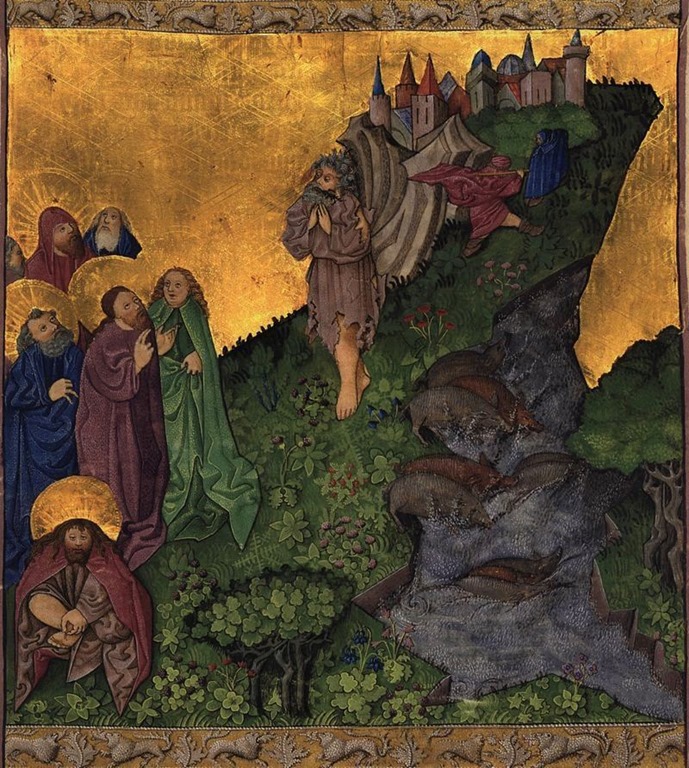
The LYL Band performance you’ll hear if you click on the player at the bottom of this post is a live performance from more than a decade ago, long predating the other sections I’ve presented here of “The Waste Land”  over the past 5 years. At the time of that performance I myself was emerging then from an episode of depression, one of two I believe I have gone through in my life. Depression has a variety of feelings and absence of feelings, and if one reads good writers describing their own depression experience you may well get a sense of the blind men’s elephant of fable, but my own feelings on the day and hour this was recorded were largely feeling sick and tired of those depression feelings. At some level I felt this section of Eliot’s poem was similar to what I was seeking, feeling, finding: an expression of an expiation of that, of demons transferred into mad pigs being cast into the sea. This coincidence of my life, a performance, and the poem would make it dear to me.

Ottheinrich Folio casting demons into swine

Jesus casting demons into swine. Guitar feedback not shown.

.

As I said, this is a recording of a live performance. Besides my voice and electric guitar playing, you’ll also hear Dave Moore’s voice spontaneously following along as I unfurled mine. I was cold-reading Eliot’s text here, I had not rehearsed or prepared for this performance, other than printing out the text. Embarrassingly, as I reached many of the foreign words in the text and fully in high transport of the moment, I mangled their pronunciation or dropped them from the reading. I used a handful of short samples you’ll hear mixed in the background to restore some of the dropped text.

In later, calmer reflection I continue to think this element of expiation is part of Eliot’s design here. A line I recall feeling strongly and intimately as I came upon it in my reading and performance that day is:

We think of the key, each in his prison
Thinking of the key, each confirms a prison.”

Whatever part of the elephant of despair or depression you might jiggle, touch, or be crushed by, we think of the key. Can we also think, hope to think, expect to think, of the prison as invalidated, destroyed, or obsolete?

What you’ll hear if you click on the player or hyperlink is rough, it has some mistakes, and being recorded live there is little I can do to fix them — and by intent it’s not a very genteel and formal presentation of Eliot’s poem. If that was my intent on that day over a decade ago, I today renew that intent by concluding our long, serialized The Waste Land  with this performance that predates all the other segments. In one of Eliot’s later poems (“The Little Gidding”) that he may have uprated over his 1922 landmark, he wrote:

We shall not cease from exploration
And the end of all our exploring
Will be to arrive where we started
And know the place for the first time.”

And so it is here too: every episode for this serialized presentation of “The Waste Land”  has been informed by that beginning, performed and recorded long before, that is now being used at it’s conclusion.

The player is below in most full-fledged web browsers, but this is an alternative hyperlink for those reading in apps or views that won’t show the player gadget. Yes, a longer audio piece than we customarily present —nearly 14 minutes — but it may still be worth your time and attention.

.

*For whatever reason, the Hyacinth Girl segment is one part that does get viewed over the years.