I mentioned last time that I’m cleaning out things I can no longer reasonably expect to use, and found a box which included poems by my late wife. Perhaps such things are past the use test, but I asked what use can I make of them?
After paging through the papers, I transcribed the handful of poems I found, typing them into documents on my computer, a now ordinary device which would have been a SciFi marvel to her back when she wrote these poems in the 1970s. Could I perform some of them, here, as part of the Parlando Project? Could that seem like special pleading, an enforced overlay of widower husband wants you to shed a tear for his dead wife? Let me try to move you past that. Decades after a death, and when one is old enough to reasonably consider one’s own death to be a nearish interval, shorter than the one from that loss, loss begins to take on a universal and obligatory aura. These aren’t sentimental poems – my late wife, Renée Robbins, was funny and was wearing the full costume of life when she wrote them. Those costumes of life go back into storage, kept for use in later productions. Perhaps her poem “In Another Language” can be worn by someone still treading the boards?
Yes, these poems are little pieces of someone I loved deeply, written early in her too-short life, and bringing them on to you extends a tiny bit of what she was. Yes, it was particularly nice to feel I was working with and playing this part of her when I performed this poem this month – but yes too, it’s October: everyone’s wearing costumes and pretending they can see ghosts.
I can hear her responding to this situation. How? I’ll explain it with a quote from Woody Allen* that has been reverberating through my mind:
I don’t want to achieve immortality through my work; I want to achieve immortality through not dying. I don’t want to live on in the hearts of my countrymen; I want to live on in my apartment.”
So here you have it, a poem likely written while she was still in college, studying writing under Howard Mohr and Phillip Dacey. I’m fond of the obscure strangeness in the framing image. I can’t be sure what she, the author, was seeing. My best guess is a whole crab or lobster on ice in a seafood display, a mundane piece of unintended Surrealism – and being in a world of frozen water is also an accustomed strangeness to Minnesotans. I like the poem’s leaps, like the dream of the crab escaping to her bathtub, and the totally unexpected leap into the genderless cross-shifting-borders of “Finno-Ugaric.”**
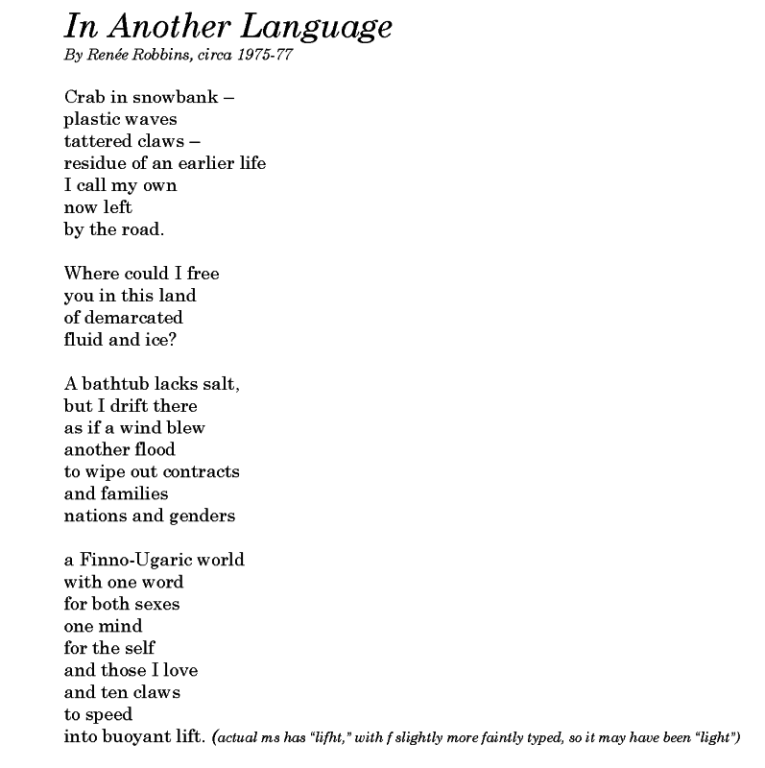
Besides the crab image, I see Noah’s flood in the third stanza. I chose “lift” from the alternatives for that last line because it’s more sensual.
.
I performed Renée’s poem in a style that still hadn’t gone-out-of in the Seventies, as spoken word with an approaching-Jazzy musical backing: drums, bass, and two electric guitars. I believe the music, taken by itself, might shows the subliminal influence of a current band, Khruangbin. It’s subliminal because I don’t use as much reverb.
So, there you go. Looped through with the footnotes, we’ve got Khruangbin, Krasznahorkai, Woody Allen, my late wife Renée Robbins, Phil Dacey, The 1970s, and a fifty-year-old poem by a twenty-something. There’s a lot of intervals and strange harmonies there, but I’ll end with another quote from an artist (actually, from his less famous brother). I read this one in a recent interview answer given by Ken Burns when asked how he makes those famous “Ken Burns Effect” intelligence flights over photos as he edits his work:
It’s all music—my brother, Ric, said that all art forms, when they die and go to heaven, want to be music.”
So, there you go Renée, not immortal from non-dying – but you get music.
As you can see today, we stay narrowly focused on the topic here at the Parlando Project, and we will return with poems by more famous literary poets soon – but to hear Renée’s poem “In Another Language” as I performed it with music, use the player gadget below. No graphical audio playing gadget? I offer this heavenly highlighted link that will open a new tab with its own music player.
.
*I know a fair number of possible readers of this have strong opinions when they hear his name. I’ve got at least half of those myself. There’s a second, artistic, set of subjects regarding his work that would overwhelm the focus of this piece. To stay on topic, let me just say that my late wife was a comedy fan who could recite from memory the entire 30-minute Firesign Theater Nick Danger radio drama parody, and that Woody Allen movies were a constant date night thread in our relationship. Renée had opinions too, consistently caring ones, but she would have laughed at that quote, and I’m laughing now too, but with a deeper resonance to that laugh.
**My memory of seeing Woody Allen movies with my late wife was intensified by the recent death of Diane Keaton, but there was even more coincidence as I worked on this: the Nobel Prize for Literature went to László Krasznahorkai, who writes in a Finno-Ugaric language. And yes, that language group is non-gendered, even the pronouns – at least from what I find when I checked on Renée’s reference in her poem. And if I may risk one more Woody Allen reference, in my life back then I was (roughly speaking) playing more the Annie Hall role.
 Frank Hudson