Late February, repairs, and Claude McKay’s “To Winter”

My winter has been impacted by things a regime of some coarsely-ground humans brewed up, but it’s been good this February to take a quick dive into the poetry of early 20th century Jamaican-American poet Claude McKay. Yesterday I was closing in on completing a new musical piece in my series combining McKay’s poems with original music in differing styles. I’d sung McKay’s “To Winter” accompanied this time by electric guitar instead of acoustic, and I had constructed some nice harmonic support from spare MIDI piano. I wanted a melodic top line though since my rough-hewn singing wasn’t doing enough to carry that role in the song. I decided to use a Mellotron virtual instrument.*  Long-timers here may recall that I love some of the sounds that cranky mechanical 1960s tape-based sampler produces. Back then they were sold because it used actual recordings of real instruments – but the results? They didn’t sound all that convincing – and all that machinery was subject to glitches and breakdowns. However, once one stops aiming for verisimilitude, its sounds have a certain character. It probably doesn’t hurt that their very cheesiness brings back memories of crackling mid-century LPs and hazy concerts.

I was able to record those Mellotron parts, but my city was filling with heavy wet snow while I did that.

Authoritarianism of a meteorological kind as it accumulated, but I had another task for Wednesday. My newly inherited 12-year-old car had a worn drive shaft that needed replacing. I was to drop it off at a mechanic’s shop in a nearby suburb, and my wife had set a time to give me a ride back. She wanted to go right away, as the roads were getting worse from the snow. Long story short, what would have normally been a 45-minute round trip turned into over two hours of slow going.

It was later Wednesday evening when I returned to mix the resulting new and old tracks for the song in my home office, and I couldn’t get my home office Mac to light up my computer screen. First thought: a normal glitch, as the Mac sometimes just forgets that it should see the screen, but a restart or a re-plug did nothing. Connecting the monitor to another computer revealed the sad tale: my 15-year-old LCD screen had chosen that night to die.**

And this was a problem. All my mixing software is installed on the computer connected to that dead screen. So, no mixing Wednesday. It occurred to me: maybe the now dark computer monitor decided to go out because it was Ash Wednesday: remember, from silicon dust you came and to silicon dust you’ll return.

Thursday morning I pulled a smaller, lower resolution monitor from my studio space and hooked it up so I could finish this piece.
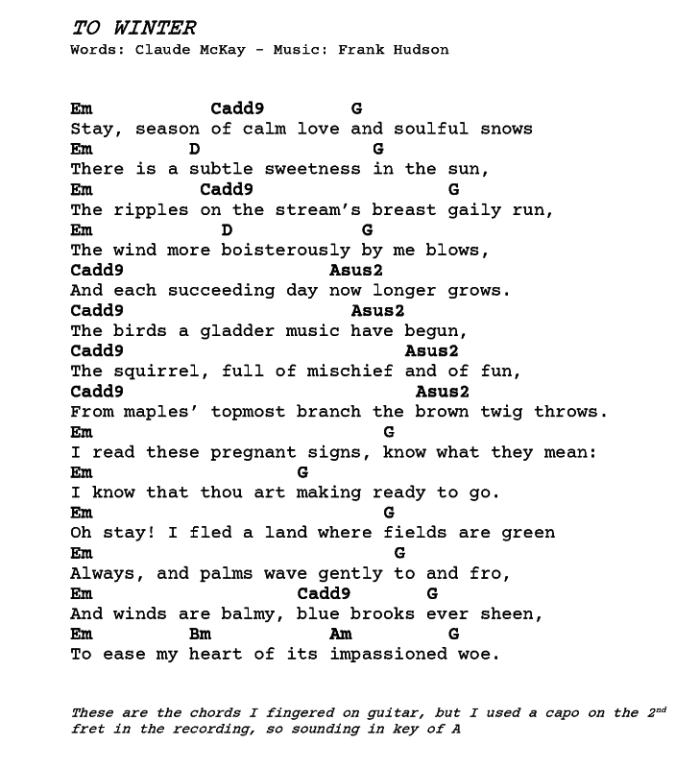
To Winter

Just as I trust the mechanic to fix my drive shaft, I trust that someone out there can probably sing this song better than I can, so here’s a chord sheet.

.

“To Winter”  is Claude McKay considering this very time of the year in the Northern U.S. Days are getting longer, there’s more animal activity, water, once ice, will break and flow. McKay’s poem has a complex reaction to this. He concludes he’s feeling winter inside within the moment of the poem, and finds winter outside permits that mood. Last time, with his Tired Worker”  I found some tension between McKay’s Keats-like language and prosody and the weariness of a 20th century blue-collar laborer. This poem’s my-time-is-like-Keats’-time-may-be-like-some-later-reader’s-21st-century-time choices cause less strain.***

What a wonderous range of coincidences wove into the past few hours. I chose the Mellotron, 19th century orchestral sounds as approximated by mid-20th century technology, mixed on a modern computer whose old LCD monitor left this mortal coil on a snow swirling night at the beginning of the Abrahamic religion’s overlapping spring holy days.

The mechanic has seen to my drive, shaft (“can you dig it”) so that it no longer makes disconsonant noises. I should have a replacement high-resolution computer screen by next week. February snows can be wet and heavy, but to water and mud-luscious they will soon enough go. Crude regimes? I can’t say just myself, but perhaps Carl Sandburg’s “The People, Yes” will increasingly say. So much to repair.

I hope to have a couple more Claude McKay pieces here soon, but to hear this one today, use the audio player below. No audio player to be seen? Mais où sont les neiges d’antan – but I offer this highlighted link as an alternative which will open a new tab with its own audio player.


.


*A virtual instrument contains the modern, much more sophisticated expression of the same idea (the various notes and timbres of a “real” instrument stored as digital recording data instead of one timbre and expression on a strip of magnetic tape for each note pulled along by clockwork springs and levers). My initial attraction to virtual instruments was reading that for only a handful of dollars one could rather precisely “fake the fakery” of the Mellotron without searching out and maintaining a finicky, costly, and increasingly antique instrument.

**The deceased was an HP Compaq LA2405wg model from back when that deleterious merger was fresh. It was a stretch for me to afford then, but in 2010 it was a rare 16:10 1920×1200 display, and I can’t even begin to calculate how many hours I’ve looked at characters and controls on that screen! Everything I’ve ever mixed, every video I’ve ever done, and a lot of writing and research for this Project were done on it.

***McKay’s poem reminds me a little of my favorite John Keats’ poem, “In the Drear-Nighted December.”

Claude McKay’s America

As we enter into the weekend celebrating American Independence Day on July 4th, I thought I’d put together some poetry about the American experiment. While not unprecedented, this is a complex time to be doing that. We are clearly in troubled times, and while I myself am as troubled as the times, I can still try to grasp what some others in their troubles and troubled times have chosen to say about America.

Let me start off with what a particular immigrant had to say almost exactly 100 years ago. The immigrant was Claude McKay, a Black man who came from Jamaica in 1912. Now of course, the presence in the then English colony of Jamaica of a man of African descent can be traced to the violent and involuntary diaspora of the slave trade before McKay’s time, but in his own lifetime, as an immigrant, McKay chose to come to America.

By the time he wrote this poem, first published in 1920, a number of then current events would have been impressed upon his thoughts. He first landed at the Tuskegee Institute in the de jure segregated American south, as close to the time of American slavery and the Civil War as we are to Martin Luther King and Woodstock today. He eventually traveled to the onset of the Harlem Renaissance in New York as well has visiting London and Russia. The life of a Black man was complicated by racism in all these places. Furthermore, if we are to apply the 21st century term “intersectionality,” McKay was working class, gay, and a committed Leftist.

Troubled times? The Palmer Raids and the original “Red Scare” imprisoned or deported many. The now better-known* and understood series of race riots and other acts of terrorism in the service of racial oppression were raging. Even in black and leftist circles, issues of black sexuality were a third rail, and McKay touched that rail.

And, as we now all know, 1918-1919 was also the time of the last great worldwide epidemic.

Given this background, as you listen to or read McKay’s sonnet “America”  you may be surprised that this cri de cœur is as nuanced as it is. In the three quatrains before the closing couplet McKay is essentially making the case that he’s energized by being at a time and place when these evils are present and unmasked to confront. I’ll personally extend his statement: The American Experiment is this. It’s not the absence of evil, our country was never an Eden. That we are still fighting for our ideals of openness, opportunity, and equality under the law is evidence of our frailty—and our stubbornness.

McKay America

Tragic persistence of metaphor: in 1920 McKay would paraphrase “I can’t breathe.”


Now what to make of McKay’s closing couplet, the turn the poem takes there as many a sonnet does? My first reading was that this is just the judgment of history: Babylon will always fall. Ozymandias leaves so fast he forgot to pack his trunk. That’s the clear reading of the 13th line.

A final line follows though. I think McKay the prophet here might have meant this too in his warning: we must change to extend our republic’s life, that all is at risk—even if every human, and every civilization, like every artist, will fail. Did we change from his time to extend our experiment? I believe we did. Are we called, are we in need of, more, further, change today? Well, what I think is less important that what you think, particularly if you are younger.

The player to hear my performance of McKay’s sonnet as a song with acoustic guitar is below. Is this the only statement for the 4th of July? No, I’ll be back soon with a reading from another American prophet.


*I was a history and civics nerd as a young person. I can tell you there was next to nothing to read about the racially charged riots of the WWI period until this century unless one knew to dig into primary sources from that time. The more distributed evil of lynching was acknowledged to some degree, but even when urban unrest returned less than 50 years later in the United States during The Sixties, I can’t recall a single pundit or think piece that referenced these events of the post WWI era.

For the American Hendrix

Today’s piece uses my own words to present some images regarding American musician and songwriter Jimi Hendrix. Just like William Carlos Williams meditation on a small plant last time, I pretty much follow the famous Imagist rules: direct treatment of the thing, no unnecessary words, and musical phrasing instead of mechanical metrical feet.

Each one of the images opens up what I hope is a rich question. It’s my hope that the resulting poem and audio piece assists you in remembering these questions that I see as posed in Hendrix’s life. Here is the poem I wrote and used with today’s music:


For the American Hendrix


And then he laid the guitar down, and set it afire

Which seems silly or sacred, depending on the art

He had only to keep himself alive, which would kill him.


He took every stop on the three 21 fret train tracks,

Slid between the rails, rode them underwater,

Understood the train-whistle called his ancestors


Living in the amplifiers, that he could not shake out,

That he could not know, that were here,

Before European words, that were here,


Brought in shackles, that were here,

Building in electricity, that were here

Now, for children who did not know they were children.


Voluntary orphans, immigrants discovering new worlds,

Walking on squatters’ land, not forgetting to bring their chains.


Jimi Hendrix

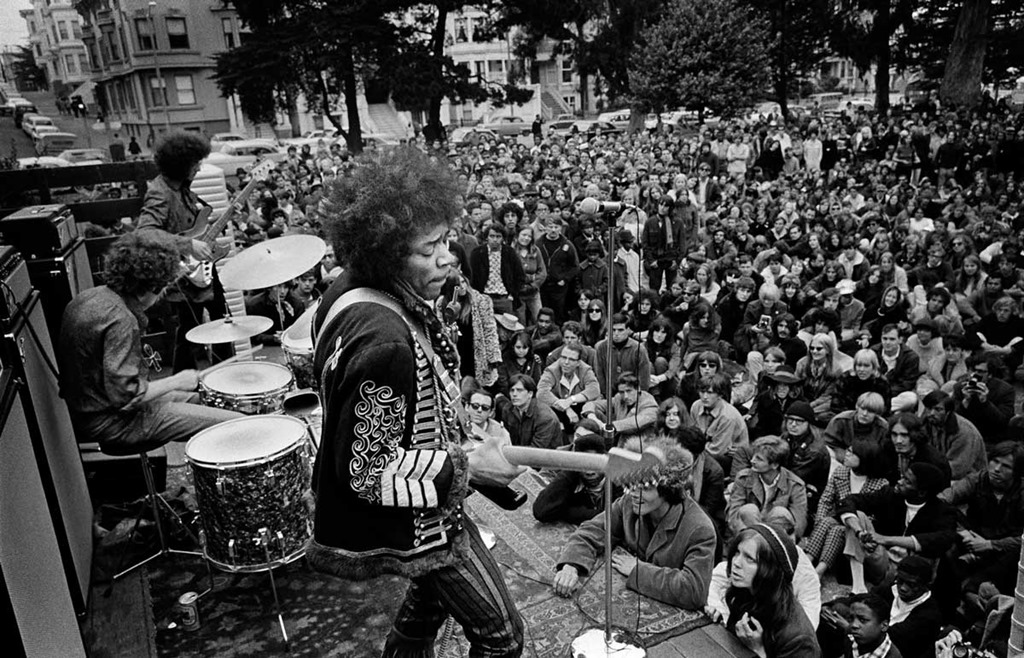
Jimi Hendrix plays for hippies in 1967. Do you envy them or feel superior to them?

In the first stanza, I remind us that Jimi Hendrix was a consummate showman, and that he used showmanship to wrest attention for his art, specifically when he appeared at his first significant concert as a bandleader at the famous Monterey Pop Festival and burned a guitar at the conclusion of a flamboyant act. I present this performance as being consistent to Hendrix’s commitment to his art, as a rock’n’roll musician, an itinerant life with associated dangers, which in his case lead to short life and career. Worth it? Necessary for success?


Hendrix ends his first American show as a bandleader with a sacrifice to his art.

The next stanza acclaims Hendrix for expanding the vocabulary of the electric guitar, using an image of the six-string guitar fretboard, which he transcended with notes beyond the temperament of the frets and though the use of feedback where the notes from the amplifier speaker reflect back to the guitar in the musician’s hands producing sustaining overtones that can be difficult to control but produce extraordinary effects. The question here: these sounds can be harsh, discordant, even painful, but do they too have a necessity?

Next stanza: this feedback is presented as Hendrix’s ancestry: part indigenous, native-American; part Afro-American, a descendent of slaves. This makes Hendrix the point where two arcs of American heritage cross: those that were brought to American against their will, like as to livestock; and those that that were already here and were supplanted by brutal or conniving invaders. The questions here should ask themselves, don’t you think?

The final lines move from Hendrix, to his audience while he was alive and performing: largely white, largely young, many taking a hippie bohemian voyage I liken to America’s famous immigrants, choosing to leave the world of their homes for some promised new world that cannot, and will not, be exactly as promised.

Whatever generation you reside in, you cannot get on a boat or plane to visit another generation’s time; but when you look at a picture or video of a crowd watching Hendrix play, consider those faces. They may be distracted by the day, transfixed or stunned, ignorant and seeking, intoxicated but intent, pleased and puzzled—they may not look like Hendrix, many will seem by their faces to not share his heritage, and none can know the depth of that heritage—and yet, they are dealing with the experience of his art. I ask you not to feel superior or inferior to them from the position of your age or the accident of your generation, but to instead to look to your own heart and ask if there you find some blindness or power, and then to ask, as the concluding words of “For the American Hendrix”  does: when coming to your new land, did you carry with you chains?

47 years ago today, Jimi Hendrix died, perhaps alone, perhaps ignored by his companion of itinerant convenience, trying to continue his art, ignorant of the strength of European sleeping pills.  To hear my performance of “For the American Hendrix,”  use the player below.