The Vanishing Red

Do you think you know Robert Frost? You know: steadfast New England farmers, Currier and Ives snowfalls, happy roads less traveled by. We might think of Frost as the friendly Modernist, with good ol’rhymes and rhythms and narratives of American scenes of Americans bearing up to the burdens of life.
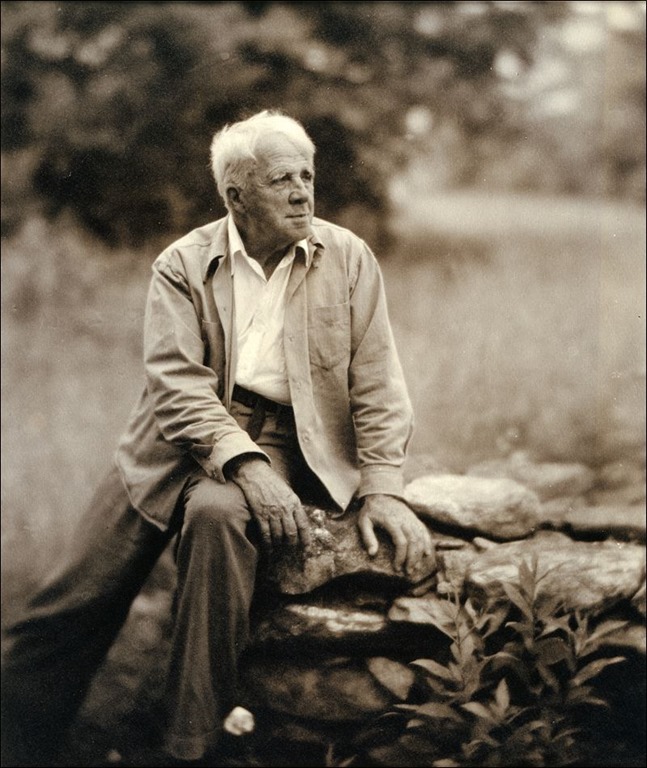
Robert-Frost on a wall

Robert Frost. Wry poet of the good old days—or maybe not?


Today’s piece is instead the hard-boiled Robert Frost. It’s blank verse, but the beat is implied, the sentence structures beat against it, and my performance choice was to not emphasize the meter. What “The Vanishing Red”  portrays is, straight up, a racially-motivated murder, and the way Frost tells the tale uses sly ways to frame this story.

He doesn’t get out of the first line before he starts this framing. One of our characters is called the “Red Man” by history. A term roughly equivalent to the N-word for indigenous Americans, but one that in Frost’s time was not considered socially unacceptable.*  Frost wasn’t going to shock or disgust his readers in 1916 with that epithet at the start of his poem, like he might some today, but he wants us to know from the start that the race and history of this man is material to what is going to happen—but we don’t meet him yet.

Instead we meet another man, the Miller, who’s talking in a way we might find familiar. He starts out by telling us he’s not guilty of something before he’s even been charged with it, claims too that he’s not one of that PC brigade who “talks round the barn” instead of straight talk, that he’s a get-it-done doer.

Frost adds just a tiny bit of narration after the Miller’s speech. Some may read this narration as excusing the man, but the narrator’s pointing us to think about two things as the story will continue. The narrator says, let’s not consider this as history (“too long a story”) or politics (“who began it”). As we’ll soon see, we’re going to consider this as an Imagist poet would consider it, as a presentation of what Ezra Pound called “an intellectual and emotional complex in an instant of time.” History can be dulled by time. Politics says there are two sides.
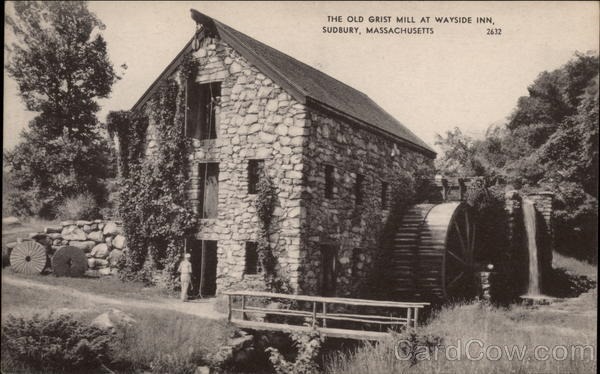
Old Grist Mill

Nostalgic postcard or dark satanic mills?  Frost reports, you decide.


But first we have one more exchange of dialog. Our unnamed “Red Man” is at the Miller’s mill, and we hear nothing he says directly, but we do hear what the Miller puzzles about what the other man is communicating. The Miller portrays the other man as without English words, but he interprets some “guttural exclamation” anyway as surprise, and this is somewhat sketchy. Is the native American puzzled by the mill’s mechanism? Surprised at being seen by the Miller?

Is the Miller even reading the other man well? I think not. Afterall, the Miller has another reaction, stronger than his sense of what the other man may be feeling, and Frost’s narrator also doesn’t “talk around the barn:” it’s disgust. But that’s not what our Miller portrays in his next piece of dialog. He acts friendly, offers to show “John” his mill.**  Ah, the “Red Man” has a name, he’s not some reductionist cypher for an entire continent’s indigenous peoples, and since it’s an English name, we might surmise that he might even be one of the Massachusetts tribes that attempted to synthesize with the new rulers, taking to Christianity and living in “praying towns.”

And now the Imagist poem begins, ten lines. The Miller opens a trap door and shows John the water-power wheel, and a poem that has been entirely without imagery suddenly gets a vivid image. The wheel’s water forebodingly is like struggling, thrashing fish. The door closes, and the door’s handle (a metal ring) we are told makes enough noise with this shutting to be heard above the noise of the mill. And the Miller returns upstairs, alone. The wheel’s turned around to the beginning of the story where the Miller laughs, though it’s not quite a laugh. He meets a customer carrying more meal to be ground at the mill, who doesn’t understand what has just happened. We ourselves are just understanding what has happened.

What has happened? The racist Miller has thrown John, the “Red Man” into the mechanism and killed him. Frost wants you to feel that by showing you this moment in time, but he also wants you to vividly feel the lack of notice, the vanishing in the title, which isn’t some passive mystery, it’s an act of human cruelty.

Today’s music is two pianos, bass and drums. I’ve been suffering from a cold for the past few days which made completing today’s spoken word component a challenge, and I did miss one phrase in Frost’s text and didn’t get another one completely correct, but you didn’t get to hear any of the coughs and voice cracks from the bad tracks either. To hear “The Vanishing Red”  use the player below.


*For example, the college I went to over 50 years ago called its sports teams the Redmen then. I had a tiny part in the beginning of the process to change that.

**Acton Massachusetts had a grist mill and more. I can’t find any pictures of them, but the town still has a Grist Mill Road.
Parlando Spring 2018 Top 10-Part Three

We now come to the top half of our count-down of the most listened to and liked pieces during the past three months. But what if you’re new here, and you wonder what this Parlando Project does?

In short, we take various words, mostly poetry, combine them with original music, and perform them. My intent at the start was not to do this the same way each time, to vary our approach as much as we could. We’ve been doing this for a couple of years, and there are now over 220 Parlando Project pieces available here if you search through our archives. From time to time, as I look at what we’ve done, I seem to notice a “style” developing, and while I have no objection to that arising organically from my predilections and limitations as a musician, performer or composer, when I hear that I usually ask myself “What can I try that’s different?”

The poems are not always the famous ones, I like to mix in some “deep cuts,” but it just so happens that these three recently popular ones are all pretty well-known, but maybe we can bring something new to them?

In position number four we have Emily Dickinson’s “We Grow Accustomed to the Dark.”  Last time I talked about how I’m finding that Modernist poetry in English moved from a recognizable natural landscape freshly observed in it’s early poems to a more interior landscape, another darker country where new dialects of language and syntax seemed the natural tongue of that region. It may well be that WWI, with its unstoppable socially-accepted murders, was a cause for this change. The rise of Freud contributed too. But more than half-a-century before WWI, and decades before Freud published, Emily Dickinson, spurred by American Transcendentalism and her own individual genius, was exploring some of those same places.

When Dickinson gets furthest inside her own head and tries to use her mutation of mid-19th century language to describe it there, she can be inscrutable; but when she’s half-way there like in this little masterpiece, she’s exploring poetic areas that won’t be visited again until the 20th Century.

This is another of the pieces where I think my music works particularly well. Perhaps you’ll agree. Player below:


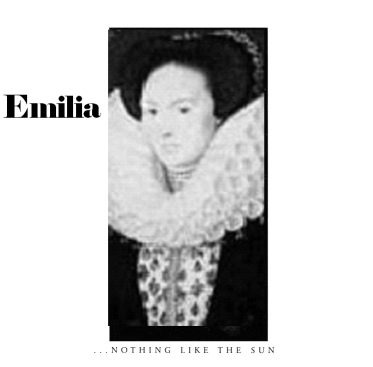
Funny how these count-downs seem to form a sequence. From Dickinson’s dark we move to the  third place piece, by that little-known poet William Shakespeare, with one of his sonnets about The Dark Lady, “My Mistress’ Eyes are Nothing Like the Sun.”  When we wasn’t supplying titles for late 20th Century Sting CDs, or writing a play here and there, Shakespeare wrote a collection of sonnets that are full of ideas woven of memorable phrases.

Emilia Lanier Nothing Like the Sun

Emilia Lanier, musician, poet and possibly Shakespeare’s Dark Lady.


I’ve always loved the sonnet, even shared a few of mine here. It just seems the perfect length for a lyric poem, long enough to develop two or three ideas costumed as images, but not so long that one will find them frayed and soiled at the cuffs before it’s done.

Hear my performance of Shakespeare’s Sonnet 130, “My Mistress’ Eyes are Nothing Like the Sun”  with the player gadget below.


And now we’re up to the second-most popular piece this past quarter, Marianne Moore’s “Poetry.”  Shakespeare’s poem in slot number three declares his love by saying the things his beloved isn’t. Poet Moore’s poem about poetry starts off famously by saying she “too dislikes it,” and goes on to tell us what she feels works an doesn’t work as poetry, including the poem’s other famous line about poetry’s goal, to show “imaginary gardens with real toads in them.” I think here again of those early Imagist poems, with their unromantic and ordinary things made into central images: T. E. Hulme’s red-faced farmer standing for the moon or Aldington’s poplar tree as a young woman or F. S. Flint finding the moon taking on the terror of a WWI Zeppelin raid. Toads all, ordinary nature, not the battalions of classical gods or the obligations of sentiment.

This piece’s popularity on Spotify continues steadily, as with “Sky”  from earlier in the count-down, I wonder if it’s the short, somewhat generic title that brings in curious listeners there.

My initial idea of the Parlando Project did not have my voice as the only reader, and the first voice you hear in this version of “Poetry”  is Dave Moore who’s been the voice in a number of pieces over the past two years. The other voices in this performance are two fine poets who’ve spent a lifetime raising toads to see what works in their gardens: Kevin FitzPatrick and Ethna McKiernan. Hear them read Marianne Moore’s “Poetry”  with the gadget below.


That leaves us only the number one to count-down, the most popular piece this past spring. It’s not a well-known poem, and it’s not by a well-known poet. See you back here soon for that.

The Black Riders XXXIX

In my episodic way here, I’ve touched on the rise of Free Verse in Modernist poetry. Free Verse poetry may still be rhythmic and musical, but it follows no strict meter, nor does it use any rhyme scheme. Now an established tradition, it came to poetry written in English in a non-straightforward way.

I think we can largely assign this happening to Walt Whitman, the American who was writing verse with eccentric line lengths and no rhymes by the middle of the 19th Century. Whitman did not immediately gain imitators in English, but French poets like Jules Laforgue took up the cause of Vers Libre later in the century. In Laforgue we can see a direct link from Whitman through his pioneering French translations of the American’s work.

The main thread of the Free Verse revolution for poetry in English then jumps to England, where before WWI Britons F. S. Flint and T. E. Hulme made common cause with American ex-patriot Ezra Pound. Pound must have certainly been aware of Whitman (more on this later) and though I’m unsure if Flint or Hulme knew of the American poet, all three shared an interest in Modernist French poetry.

I can only surmise, but in starting their Free Verse revolution, it may have been advantageous for this small group to present this as a French idea rather than as an American one. At the beginning of the 20th Century, France was an established cultural force, a place from where new intellectual and artistic ideas were expected to emerge—and in painting and music Frenchmen were the leading edge of artistic Modernism then in a way that Americans were not yet.

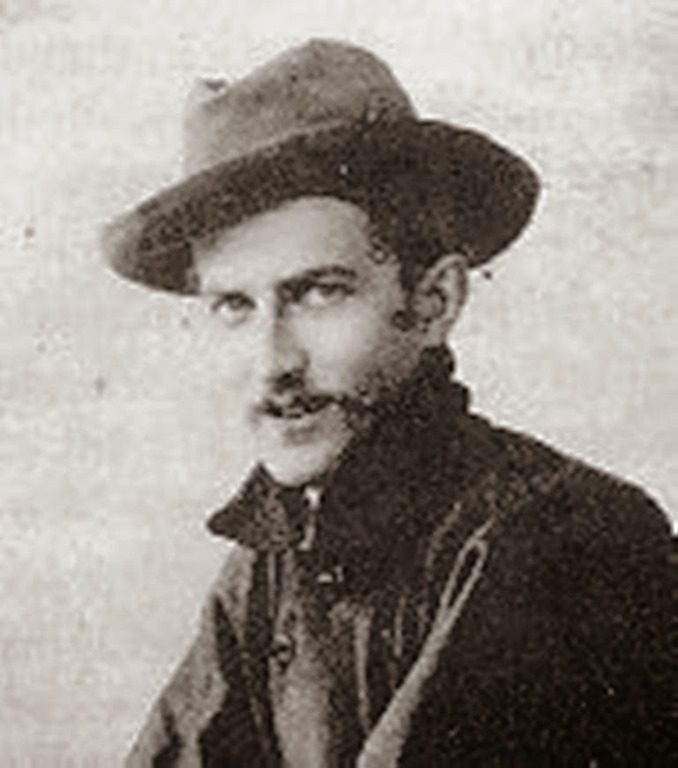
This strange path, from America to Paris to London misses one poet, a too often forgotten writer of Free Verse before the 20th Century, Stephen Crane. As a young man in his early 20s he was introduced to the just-published first collection of Emily Dickinson (1890), and mixing his take on Dickinson’s compressed musings on the infinite with the just-died Whitman’s Biblical cadences and love of parallelism, Crane in 1895 published a collection of short Free Verse poetry “The Black Riders.”  Today’s piece uses the words of one of those short, untitled poems from Crane’s book.

Stephen Crane

Stephen Crane:. He’d written Free Verse when Ezra Pound was still weighing in with sestinas

If, a couple decades later, one of the short poems in “The Black Riders” was to appear in an Imagist anthology, on a quick glance or reading it wouldn’t look or sound out of place, but the pieces in Crane’s collection are not really Imagist poems, not even in the same way that sections of Whitman or Dickinson are. Crane’s “Black Riders”  pieces are too full of abstract concepts and romantic notions—and even though Crane is questioning or mocking these concepts, he’s not presenting the issues through concrete new images as the Imagists would.

It’s interesting to wonder how Crane might have developed if he’d lived a full life, rather than dying at age 28 at the end of the 19th Century. Still and all, here was an American, in America, writing Modernist verse with Modernist attitudes while still a young man and with the 20th Century still on the horizon.

Musically, today marks a return of new pieces recorded with the LYL Band and Dave Moore. The music I compose and play myself can be created over a varied length of time, and in whole or in part, reconsidered and redone. The LYL Band on the other hand, just goes.  When we did some recording this week, Dave told me he was waiting for another instance of us starting off something with no more than my announcing  “G Minor.” Today’s Crane piece “The Black Riders XXXIX”  is not particularly complex or unpredictable musically, but we needed to knock off the rust. To hear it, use the player below.

I Wandered Lonely as a Cloud (Daffodils)

It may be U. S. National Poetry Month, but one can’t deny the impact that English poets have had on poetry, particularly before the Modernists launched with significant American participation.

Modernism, as practiced by those early 20th Century Imagists sought to cleanse poetry of the rust and rot of “poetic language” and rote abstract metaphors. Strong, exact words, no more complex or numerous than necessary were to describe things that were actual things, not merely decorative analogies to describe something else. By the 1920s, that American import, T. S. Eliot, became the standard of one large stream of Modernism. Although inspired by this fresh use of language, the Eliot wing of Modernism sought to rid poetry of “romanticism,” defined as a relentlessly subjective expression of personal experience unshaped by a greater historical and cultural understanding. Poetic language might be refreshed, but the cult of the great poem returned, and said that poetry is best to be in service of great themes and elaborate—rather than elegant—structures of thought.

Early Imagist/Modernist poems were about moments. The High Modernism of Eliot allowed it to be about eras. Imagists prized images of things formerly ignored or costumed only in the rhetorical finery in 19th Century poetry. High Modernism still allowed the mundane to stand for sublime thoughts, but it often sought to display a level of knowledge and literary scholarship along with the everyday in its choice of images.

This is why it’s important to look at the early part of artistic movements. Often their best ideas become mutated as the movements develop. Their revolutions become the new orthodoxy.

Today’s piece, “I Wandered Lonely as a Cloud (Daffodils)”  is by English poet William Wordsworth, one of the founders of Romanticism. It’s a poem that can be attached to an exact (April, Poetry Month) date: April 15th, 1802, and to a walk that Wordsworth and his sister took in rural England. But that’s not how the poem was written. Wordsworth wrote it a couple of years later. He referred to his sister’s detailed journal entry about the April walk to refresh his particulars. His wife supplied two critical lines for the final stanza. This was not a spontaneous outburst of subjective personal feeling at all.

Daffodils at Kew Gardens

I couldn’t make it to the Lake District, but even a month ago, daffodils were blooming during an English Spring in Kew Gardens
In a few weeks my lawn will look like this in Minnesota—only dandelions, not daffodils.


When I performed the version you’ll hear below, I made one significant change and one minor one. The minor change? I dropped the adjective golden from his line “A host, of golden daffodils.” I suspect I did this by accident as I performed it. Not to dis Wordsworth (and by the way, Billy, what’s with that obvious pen name “Words-worth” for your poetry gig?) but I think I improved the line when I sung it as “A host, a host of daffodils.” First off, daffodils are a common flower, and they are in the wild always yellow. Strict Imagists would say the golden adjective is therefore unnecessary—and it is, well, a gilding of the lily. I can’t recall my reason for the major change, dropping the next to last stanza—I may have desired to shorten the piece for performance—but it is the weakest stanza in the poem.

The resulting “Daffodils”  I perform wouldn’t have been far from what F. S. Flint or Richard Aldington would have written a century or more later as pioneering Modernists. After all, Wordsworth said that he was trying to cleanse English poetry from special, high-flown, poetic diction too, to return it to “as far as is possible, a selection of the language really spoken by men.”

I do retain something else Wordsworth does here, something I don’t recall the Imagists doing much. “Daffodils”  is presented in a framing device, while the Imagists were all about the presentation of immediacy. Wordsworth doesn’t say merely that looking at all these wildflowers, the temporary exultation of spring, was transfixing—and he says that less with that next-to-last stanza removed. This is not a poem only about letting us see them in their wild, external multitude through his eye on an April walk in nature.

No, the poem starts, deliberately, in past tense. “I wandered lonely as a cloud.” And the poem closes even more removed. The speaker of the poem is not the energetic nature-walker strolling in Spring. In the actual, unknown, later time of the poem, he’s lying on a daybed, vacant or pensive. These daffodils are now only obtainable by the “inward eye” of recollection.

Setting something in the past can be seen as a tactic of sentimentality, something the Modernists distained, but what we have here is worth that risk. How so?

I thought it a delightful little nature poem when I read it as a teenager. Then I read it decades later, as my Eagle Scout father, the angler long accustomed to waiting perpendicular on the flat surface of lakes, the man who had bicycled across his rural state many times—while then, as I re-read, he was further and further confined to lying flat in rooms with the erasing of days. In that later time, noting the wild daffodils bliss is told to us in memory, I reversed Wordsworth’s famous dictum on the origin of poetry. In my reading, in that time, it became a poem, a song, of tranquility recollected in emotion.

Here’s my performance of “Daffodils”  as I sang and accompanied it on acoustic guitar.

Snow Storm on a Blank Page

Longtime readers will know that one of the principles for the Parlando Project is “Other People’s Stories.” I partly do this out of a contrarian streak, as the Internet is full of folks telling their own stories. Yet, obviously, I do not take my path due to a condemnation of personal stories. After all, without other’s stories, I would not have the ones I present and react to here.

I believe something additional happens in my process of presenting my encounters with other people’s stories. You, the valued readers and listeners here, add a third part to this. Do you see, what I see, as I am looking at, speaking someone else’s silent words; while you remain off to the side, with your ears at each side of your own mind and memory, your eyes parallel to your own mouth? No, you will see something slightly different.

Yet, this morning, let me violate my self-imposed principle, and write, as if this were a conventional blog, about myself.

I awoke today after a week that finally found promised 50 degree Fahrenheit temperatures to an utter snowstorm that had itself awakened from a night sky that fitfully dreamed rain, sleet, hail, and freezing rain. The wind outside had someplace to go in a hurry.

I am an Amateur of Velocipeaes by Leonara Carrington

Leonara Carrington dreams of bicycles with oversize tires

As a contrarian, I dressed and took to my marvelous Minnesota invention, the fat bike fitted with 4 inch wide studded and knobbed tires. A morning with few moving, yet full of noise. Snow crunching under the tires, wind restating its case more insistently over again, the typewriter of snow against my goggles.

Parked at the curbs, even the most fearsome cars were growing a white carapace, their windshield wipers stretched out, insect arms, quivering in the wind.

Windsheld wipers stretched out insect arms

“Insect arms, quivering in the wind”  wipers left out to keep them from being encased in ice

To be an old man on a bicycle is to know gratitude. Does a fierce April snowstorm tell a story? Perhaps it does. Is it beautiful, or a false and comfortable frightening that leaves others inside, deciding that internal pleasures are best this morning. But I wished to hear its story today, to see it. As I rode, the wind said yes and no in its one direction. The snow said music is frozen yet moving. The whiteness says color can only exist if you make it.

In the middle of the week I had driven two friends to the airport. They saw this sign “If you see something, say something.” I thought, isn’t that the fourth Imagist rule, one unstated by F. S. Flint and Ezra Pound? Yes, you must honor the thing and your reaction to it, using no word just because you believe you must use that word, and remember you are making music, not marching. But the first rule, which I understand now in the multitude of a blizzard: if you see something, say something.

Hyacinth Girl

Since April is National Poetry Month, let us return to that April epic of  High Modernism, T. S. Eliot’s “The Waste Land.”  Readers here will know that I’ve made great use of the works of the pioneering Modernists, that generation that formed itself on both sides of the Atlantic in the years before the outbreak of WWI.

We’ll continue to talk about them later, but for now I’ll point out that one thing they all shared was a commitment to shorter works with new imagery often drawn out of immediate contemporary experience. Given how I later encountered Modernism in Mid-20th Century American schools, I have been surprised at how simple, how commonplace, were the materials they used for their fresh imagery. Subtlety and ambiguity were not forgotten, but they were not belabored.

To “make it new” in this pre-WWI era, it was often to radically simplify. If traditional poetry was referred to, it was not the grand epics or the most serious verse of the past centuries, but the highly compressed Chinese and Japanese forms, Greek lyric fragments, or vernacular verse from folk traditions.

Modernism as it mutated after WWI had no such concentration. Grand themes and grand works were once more the best goal. Allusions to tradition abounded. As High Modernism marched forward toward my own Mid-Century youth, its poetry began to take an air of post-graduate knowledge as a pre-requisite to understanding or enjoyment.

Eliot’s “The Waste Land”  is a landmark for this change. I’m not an Eliot scholar. I won’t presume to psychoanalyze him accurately at the biographic point where he wrote this, with some key editorial re-shaping by Ezra Pound. As I said when I presented the opening section of “The Wasteland”  here last April, the poem is clearly informed by personal depression. Since a large percentage of contemporary people have experienced depression and grappled with it, parts of “The Waste Land”  communicate with us on an emotional, associative level even if we don’t understand it in a “pass the exam” way. This is good for the poem.

T S Eliot at the blackboard

I’ll show you fear in a handful of chalk dust! Evidence of T. S. Eliot trying to invent Sudoku.


Eliot’s complex, even maddening, use of distancing tactics in “The Waste Land:”   the rapid dislocation of location, time, speakers, and national language, along with a plan to make everything a possible reference to something else—usually something old and not mundanely immediate—is not at all like the pre-WWI Modernists. Still, that didn’t keep that sort of older Modernist style from breaking in every so often.

Today’s piece “Hyacinth Girl”  is one such part of “The Waste Land.”  If it had been presented as a standalone poem in one of the early Imagist anthologies it would have fit right in. There’s no post-graduate work necessary here, as was demonstrated by an 80s college-rock band who conceptionally used the same trope with no need for footnotes.

Not Eliot’s, nor my “Hyacinth Girl,” and not Winter Hours’ either. This is the original version by Ward 8, a predecessor band that make it sound more like the Velvet Underground.

Studied academically and considered as a part of the rest of the poem, Eliot’s “Hyacinth Girl” section needs not to be experienced this way, directly. One can consider any intended connection to the Greek myth of Apollo and Hyacinth and their tragic Frisbee accident with homoerotic overtones. I did so just yesterday, reading some papers and summaries of papers which if nothing else made me conscious of how often gender is unknown and shifting in “The Waste Land”—but I did this long after recording my performance of “Hyacinth Girl.”  I didn’t feel the need to revise it in the light of the papers or the classical reference, no more than I needed to know if it refers to Eliot’s girlfriend, or his wife, or a young man who was killed in WWI. Pound had once said that the image is “that which presents an intellectual and emotional complex in an instant of time.”  Eliot seemed unsure that it should be only that, if that was enough, which lead him and Modernist poetry to some strange places and practices, but it didn’t stop such direct poetry from breaking into “The Waste Land’s”   manifesto of High Modernism.

To hear my performance of this part of Eliot’s “The Waste Land,”  use the player below or with this highlighted hyperlink with will open a new tab window and play it. It starts out with just acoustic guitar and voice, but eventually some bass, strings and piano arrive. What would additional parts of “The Waste Land”  sound like if combined with eclectic original music? Stick around during #npm2018 as we’ll be letting you find out.


.

The Poplar

We’ve already met most of the small circle of poetic Modernists that assembled itself in London before World War I. From the United States, H. D. (Hilda Doolittle) and her one-time fiancé Ezra Pound; and from England, the combative and influential T. E. Hulme, and the risen from poverty F. S. Flint. Other poets, William Butler Yeats, T. S. Eliot and Robert Frost, touched them tangent in England, but were still bent with the gravity of what Flint called, and Pound promoted, as Imagism. If you’re new here, you can check our archives (now almost 200 audio pieces) and you’ll find all of them represented.

Today we use the words of the man we’ve left out, Richard Aldington. Another Englishman, he married the American H. D. in 1913. He worked with Pound to promote T. S. Eliot. Unlike T. E. Hulme, he survived WWI, but many said his combat experience changed Aldington, and retroactively the diagnosis of PTSD has been associated with him.

His long career had more than a few bridge-burning episodes, all disputes which I know not enough to have an opinion on. Partially because of this, Aldington is not well-remembered as a poet, even though at the start of the Imagist movement he was universally considered a principal.

Richard Aldington in sweater

Aldington, wearing an example of regrettable fashions of the early 20th Century


Like his partner H. D., Aldington looked to, and translated, classical Greek poetry; and like Pound he was fascinated by Chinese and Japanese compressed poetic forms, and produced work connected with these traditions. Today’s piece, “The Poplar”  isn’t one of those poems. In some ways “The Poplar”  reminds me of F. S. Flint (that other too often forgotten early English Modernist), as it’s free verse in Flint’s “unrhymed cadences” mode. It’s blissfully easy to read. It’s homey and unfussy images remind me of T. E. Hulme. It’s odd now that we think of Modernist poetry as requiring obtuse and learned images, when it’s founders like Hulme and Aldington in this poem have no images that wouldn’t be clear to a grade-school student.

Musically, today’s piece has a core guitar part that I played on a small acoustic guitar I’ve owned for 35 years now, but instead of “real strings” (which in my case would be “virtual instruments” where various notes and articulations of actual acoustic string instruments are sampled and then played by a keyboard or a guitar MIDI controller) I used a virtual instrument which sampled a 1970’s vintage keyboard “strings” instrument. I feel the dual falsity of this instrument, a simulation of a simulation, produces something that has its own validity. I also wanted to use a harmonium, but I don’t have that available as a real instrument or a sampled one. The closest I could come was a slightly modified “toy organ” patch which had some of the wheezy reed timbre I wanted.

Enjoy “The Poplar”  by using the player below. Even though it’s from the dawn of modern English poetry, it remains fresh because it’s not that well-known; and it doesn’t ask you to enter some dimly-lit labyrinth of images you cannot decipher. Yes, elusive images can have their pleasures, but so do these.


The Wood-Pile

Robert Frost is every bit the master of word music as Yeats and Millay. What makes Frost stand out is that he was every bit the thoroughgoing early 20th Century modernist as any of his free-verse contemporaries, while retaining an ease with accentual syllabic meter.

Here’s an example of Frost handling a subject just as a free-verse Imagist would. His aims, his presentation, hold to the Imagists’ principles. He deals with the thing directly (as we shall see, two things, but still…), and there are no tacked-on metaphors, no stock comparisons, no extraneous “poetic” language. Context is shown, but not explained. He loosens and varies his meter, so the poem sings and never seems to be a shackled march. At 40 lines, it’s a bit longer than Yeats’ poem considering “The Wild Swans at Coole,”  but Frost’s extra detail is even more specific and concrete than Yeats, though both begin their poem with the poet walking in a rural wetland. Yeats slough is a well-known place to him, conditioned with 19 previous visits. Frost is far enough into his swamp to not know exactly where he is, and so experiences what he sees with a first-time immediacy. Yeats’ slough then contains tradition, Frosts’ the more Modernist “Make it new!” place.

Though presented as one simple rural scene and story, “The Wood-Pile”  is more at two poems, though each part speaks to the other. As Frost’s tale starts, we are in the midst of one of his characteristic journeys, just as we are in other famous Frost poems. There’s a need for decision (“Turn back” or “go on farther”) and his choice, also made in other Frost poems, is to go on regardless of whatever doubts brought the question. If he’s lost in the dark by a wood on a snowy evening, keep going. If you come to a fork in the road, pick one and go on. If you’re walking in a swamp in winter and your foot is sometimes falling through the frozen crust, well, keep going “and we shall see.”

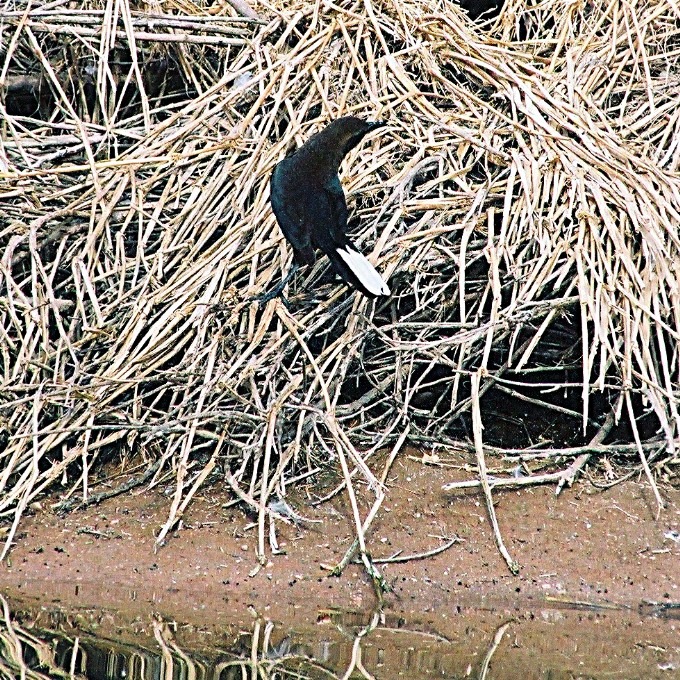
And so, here he sees his bird. No Keatsian nightingale, not Millay’s elusive flying swans with their awkward dangling legs and cries, nor Yeats’ majestic 59 swans, but a small bird. This bird becomes a mirror to the poet. Frost’s bird too must make choices in direction, and the poet, sensibly, thinks the bird’s guided by fear. “Keep something between little me and the big lummox trodding through the winter swamp,” he humansplains. And there’s a bit of humor at human’s expense as the poet muses that the bird, like humans with their self-importance, may think that the only reason for Frost to be out in the swamp is to go after the little bird.

Gackle with white tail feather

“He thought I was after him for a feather—the white one in his tail”


But, we don’t know why Frost is out in the frozen swamp explicitly. The only reason he’s given, or will give, is the Imagist poets’ reason: “and we shall see.”

The bird leads Frost to the second thing the poem wants to present: an abandoned fire-wood cache. Here Frost zooms in close. Every detail of the cut wood and the once neatly stacked and propped wood-pile is stated. Frost turns forensic, like some New England Sherlock Holmes: this pile has been abandoned for years. Mature vines have grown through it.

wood-pile

“The slow smokeless burning of decay”


Here is another context left unsaid. Why would someone abandon a purposeful wood-pile in a swamp? Frost leaves it for us to be detective and to solve the mystery. This isn’t some lot of fire-wood left temporarily to be gathered later in the day, care has been taken to stack and prop it.

The only thing I can think: someone once built a shack (now completely disappeared) on the swamp land. Frost muses, sardonically, that only someone so busy with “fresh tasks” could abandon such effort in cutting and stacking. Does he mean to say, “only a fool would be so industrious to cut and stack this wood and yet not notice he was building his shack on a swamp that would not support a homestead?”

Now, the small bird with his “little fears” and oh-so-human misapprehensions of reality—and now, the steadfast Frost of miles to keep going, even if you may be lost, are set in contrast to this choice. Your fears may lie to you—but so will your optimism.

I once heard an astringent biological statement that the length of our lives can be reduced to a slow-burning chemical reaction. Frost’s last line here is a sad and beautiful analog to that truth.

Turn back or go farther? Go on, and we shall hear my performance of Robert Frost’s “The Wood-Pile”  with my original music. Just use the player below.

A Dust of Snow

Here’s another winter poem by Robert Frost to put to our uses. Writing about my last piece here, Frost’s “Stopping by Woods on a Snowy Evening,”  I wondered about the actualities of the scene the poet was describing: a New England winter road in a dark snowy evening before the coming of rural electrification. Frost would know, of course, that it would be quite dark in those conditions. But did he use that knowledge when he wrote the poem? Did he, the author—like I did as a reader once (despite knowing too the darkness of rural night)—visualize a well-lit snowfall on trees, an alluring and beautiful sight that might tempt him to stay and watch for a while?

I can’t say for sure.

Frost’s “A Dust of Snow” is even shorter, and the accepted meaning of its images has been a settled thing for some time. Last time I wondered if “Stopping by Woods”  was more a poem about a man who was lost in the dark in both levels of meaning rather than a man who was tempted by bright beauty. I could have been wrong, but I think it’s worth considering. With “A Dust of Snow”  certain images have been determined by most academic readers to be, well, symbolic. What if we consider them as real, natural objects and not as handy metaphors?

Robert Frost with axe

Let’s cut down on our use of overdetermined symbols with Robert Frost

We start right off with a crow. “A symbol of death” it is said. Perhaps it doesn’t hurt the poem to think that. I think it’s a crow. A dark bird, darker yet against the snow, and no crow would let the poet that near without a racket of loud caws. The poet doesn’t let us hear the caws though. Instead, like the uncanny sound of sifting snow in “Stopping by Woods,”  Frost wants us to feel just a dusting of snow falling from the branch as the bird flaps off. He wants the main action in the poem to be almost microscopic. He could have written that the bird’s takeoff “dumped a pound of cold slush down my collar”—but that wouldn’t be the poem he wrote. Is the dust a symbol of death too? Or is it an image of a tiny action of little weight? I hold to the later.

Oh, and symbol alert! The tree the bird left is a hemlock tree. Or as the movieReal Genius  reminds us in “the immortal words of Socrates, who said: ‘I drank what?”

How aware was Frost that the American Hemlock is a pine tree and the European poison is a completely different, smaller plant? If this were written by the avid amateur botanist Emily Dickinson, we’d know the poet would know this. Even William Carlos Williams M. D. might have need to know about the derivations of poison. Like the crow being “death” or a bird, “hemlock” could be a reference to death or suicide—but the evergreen is also a symbol of life in winter too, if it must be a symbol. Frankly I think either taken in a one-to-one direct simile way may overdetermine the poem. In the book of nature, having a black bird against white snow causing the small, light amount of snow to fall from an evergreen tree is sufficient.

And this snow falls on the narrator of the poem, and the small sprinkling of snow lifts the rueful mood. I think that’s the essence of the poem: the smallest action of nature, a flighting crystalline snow sprinkle that may not have weighed an ounce, can lift a human out of their dense internal fixations. I think that’s a more graceful poem than the leaden march of death-crows, grave-dust snow and poison trees. I could be wrong, but I like that poem better.

Musically, a much simpler arrangement than last time, just a bass and 12-string guitar. I’m trying to carve out time to prepare for some more recording with the LYL Band tomorrow. Even if we are successful, you won’t hear those pieces for some time, so use the player below to hear “A Dust of Snow.”

Thanks again for the likes, comments, and the sharing of these pieces on your blogs or on social media.

Oread

How did you spend your extra hour given to us by the Daylight Savings Time changeover? Some spent it snuggled with a loved one, or others for splendid dreams given time for extra chapters. I spent my night and hour wrestling with another poet’s poem and creating and performing music for it.

A few posts back we presented William Carlos Williams “The Red Wheelbarrow,” a widely anthologized and very short Imagist poem. My current feeling, shared in that post, was that Williams really was talking about a red wheelbarrow, a simple tool used for important tasks. Of course, he was also aware that the rain-glazed red paint of the wheelbarrow and the white chickens around it was a bold visual image, consistent with the modernist art he appreciated, and that he didn’t mind the provocation of calling attention to this without elaborate justification, any more than a classical painter or poet would think they would have been required to tell us why we should give a fig about Artemis.

Here’s another short Imagist poem, this time by Hilda Doolittle, who wrote as H. D.   H. D. knew William Carlos Williams from when Williams was a college student, but then H. D. knew or crossed paths with many of the principals of Modernism over her lifetime. Modernist poetry admitted more women creators than painting or music, or most other arts at the start of the 20th Century, but that’s a low bar to clear. H. D. cleared it however, and she continued to run her own race on her own course from the start of her career.

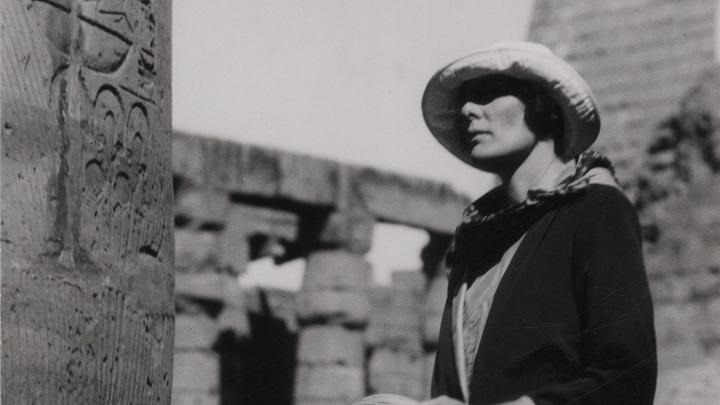
HD in Egypt

Another episode from HD’s remarkable life: she was present when King Tut’s tomb was opened in 1923


H. D.’s 26 word poem is much different from Williams’ 16 word one. It’s much stranger, and the internal state the external images present is more complex than even many longer poems reflect.

In some ways, the title “Oread”,  the effective 27th word, helps us. For those not up on Greek mythology, we can look it up, it’s a mountain nymph or spirit. Like many Greek nature spirits, an Oread is female.

So, from the title of the poem, we can say that it’s an Oread that’s speaking—but even if we grant that, this ain’t Tinkerbell. The supposed nymph is commanding nature, as a full-fledge god or goddess or a magician would. And the Oread is not asking it for protection, or forbearance, or even for it to put the hex on someone else, it’s asking it to do it’s best to overcome her. “Whirl” “pointed” “splash”, and “hurl” are some of those 26 words.

Another huge difference between Williams “Wheelbarrow”  and H. D.’s “Oread:”  the former is intensely visual, the later, just as intensely, tactile.

And who’s the Oread talking too? Three words in, it seems to make that clear: “sea.” Except the sea is described largely as a forest—a forest that can splash and form pools, but a forest at least as much as a sea. The sharpest readings of this is that the Oread is speaking of the sea with the images of the forested mountain (waves are like trees, water drops are like the needles of pines), but by saying it so, she is saying that the overcoming she commands is a merging of two like things.

I’m left with a conclusion that this is a spell of desire. Whether it is sensual, spiritual, or artistic desire makes no difference in the frenzied merger that is being called into being.

So, what did I do in writing music and performing “Oread?”  I repeat most of the lines at least twice, to emphasize the incantational aspect. Despite my recently expressed desire to re-explore artificial drum machine sounds, the percussion has lots of little instruments for a ceremonial air: shakers, maracas, cymbals, tambourine, even a chiming triangle. The main musical motif is a four-note synthesizer phrase that seems to be looping, but once again isn’t, as permutations occur throughout. The bass part rarely plays the same note as the synth motif, a musical effect that can be likened to “rubbing,” an apt metaphor for this sensuous poem.

To hear it, use the player below.