The Spider and the Ghost of the Fly

As Halloween approaches, here’s a song that focuses on the playfully frightful aspects of the holiday. Wait a minute – I debated typing “playfully” there with “frightful.” I went with that combination as it’s my best guess at the intent of the Vachel Lindsay poem that I converted into a song, though I can’t be sure.

Playing with fear and horror is clearly a part of Halloween. We expect children to celebrate the holiday, and the adults participating in Halloween celebrations plan them to be happy occasions, even though the decorations will be full of spiders and their webs, and monsters, and skeletons, and those dream-flickering pumpkin skulls.

But if you take the poem (now a song) at face value, this is about a woman who is personified as a predator, the femme fatale trope and her victim fly. Had poet Lindsay felt himself wronged by some lover to come up with this piece? I don’t have biographical evidence to point to with an emphatic gesture,* and the internal evidence within the poem speaks to me of a playful mode to the condensed tale of horror it tells. There seems to be a paradoxical agreement on the part of the singer: they’ve been done wrong, but they’re going to speak lightly about this, and while the song’s fly doesn’t say it out-loud, they might be open to just a little more peril.**

Spider and the Ghost of the Fly

A poem that literally describes tearing the wings off flies, yet I’m still holding it as playful.

.

Earlier this month I wrote about the mid-20th century “folk scare” in passing, and as someone who has some grasp of the songs revived by that movement, I couldn’t help but think that Lindsay referenced a floating verse that appears in some American folk songs. Did anyone else catch it from listening or reading the text above?

The spider takes her prey with the line: “She drove me to her parlor/above the winding stair.” Reading this, I immediately heard a specific tune – cementing the idea that this poem would get the Parlando Project treatment. What tune? One widely sung song that features the verse about a woman taking a lover to her parlor goes by the title “Cindy, Cindy.”   Besides the parlor destination – sometimes sung in the folk song as “She took me to her parlor and she cooled me with her fan” – most “Cindy, Cindy”  versions have devouring women in them too, with verses like “I wish I was an apple a-hanging on a tree and every time my Cindy passed she’d take a bite out of me”*** or even “My Cindy is a pretty girl. My Cindy is a peach; she throws her arms around my neck and hangs on like a leech.”

Quick research says that “Cindy, Cindy” was sung in America in the early 20th century when Vachel Lindsay wrote his poem. I’m going to suspect Lindsay knew one of the variations of it – and he might have thought some of his audience would too.

So, I’m calling it: playful. Likely erotically  playful.

I also suspect my music for today’s performance of “The Spider and the Ghost of the Fly”  had “Cindy, Cindy’s”  tune in its ear a little bit too. You might be able to hear that performance with the audio gadget below – but like the devouring and dangerous love between the spider and the fly, some of you may find the audio gadget hidden and suppressed. Aha! I have this highlighted link, a veritable grail-shaped beacon, that will open a new tab with its own audio player so you can hear the song.

.

*Vachel Lindsay and Parlando Project favorite Sara Teasdale were romantically linked for a time. For more on the story of how that turned out, you can read one of the most popular posts in this Project’s history. The Teasdale poem musically performed in that above linked post also talks about the surrender of love.

**As per Sir Galahad’s tale in Monty Python and the Holy Grail.

***This verse in the folk song rhymes in with the apple stealing fairies in Leigh Hunt’s poem from earlier in this month’s series, and I’d suppose the song’s connection of apples with erotic passion may echo back to the Garden of Eden. And that choice of Cindy as a name? Could that be evoking sin?
One need not be a chamber to be haunted. You could be a cassette tape.

However similar if amorphous shapes, everyone’s ghosts are private spirits, and I have a new musical piece with words by Emily Dickinson testifying to that — but let me slide over to a couple of personal things first, as if I was a regular blogger externalizing their internal story.

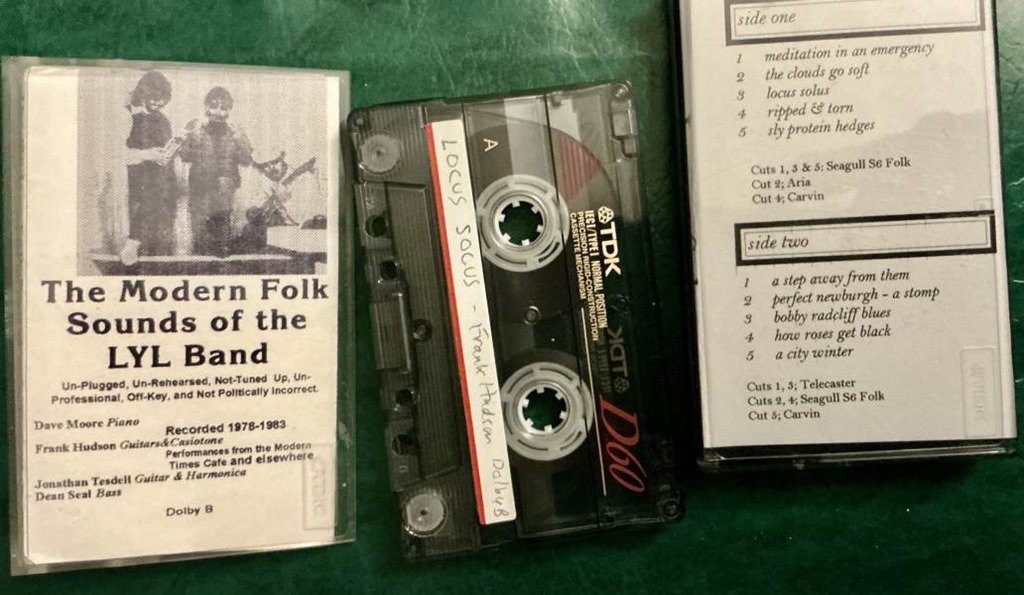
I’ve had a couple of weeks when I’ve needed to come back to the Parlando Project stuff from other things. I had a colonoscopy with unremarkable results. Huzzah. That’s some prime blogger internal dialog! But before that, I searched around my crowded little bedroom/office to find old cassette tapes. The oldest are from The Sixties when I had one of those small battery powered monaural cassette recorders with a slide-out chrome handle, a single speaker on the top, and a chorded plastic microphone with a start-stop slider button on its side. Others were from the 1970’s-2000 era when I recorded musical things, first on the stereo tape decks of the late 20th century home hi-fi era until I was able to afford one of the legendary Portastudio models designed for musicians, using the same humble cassette tapes, but able to record 4 distinct tracks. My task: to make digital copies that I can store in no appreciable physical space and are independent of an obsolete format.*  More than 30 years of this stuff, much of it of only private interest, though you may hear some of it eventually.

Cassettes 600

Some of the cassette tapes.

.

The ubiquitousness of inexpensive video is fairly recent, but assuming no catastrophic events, many born in the past 15-20 years will likely have color video with sound of their childhoods and young adulthood that could follow them the rest of their lives.**  Is that a good thing, something they welcome? I don’t know. Before this some folks had diaries and journals, or kept letters, so some level of self-documentation is not entirely novel. Still, for me, a person whose Project lives in music and sound, whose favored form of literature began in sound before writing was invented — retaining an element of the sound of the words, and their sequence, and echoes — my particular audio time-capsules have a special tang. And fears.

Most of the tapes are not just me, in a few I’m just the man holding the microphone, though I’m there as the shadow that chose to start the recorder. They hold our imperfections: things before we knew, before we learned — and then too the persistent faux pas that we still commit: there, and committed to a recording. Given that most can record now anytime with the tap of screen, how many will simply erase to save future embarrassment?

So back to Emily Dickinson and this poem about ourselves and what we think we fear — which may not be what we actually fear, or should fear. “One need not be a chamber — to be haunted”  is a poem about that self we either can’t lose or can’t consider. In five stanzas Dickinson lays out some conventional gothic scenery (some of which she herself will erect in other poems) haunted houses, undead ghosts, church graveyards, and finally an assassin laying in wait for us.***  Dickinson points out that the self may be making or amplifying those fears, and perhaps that self, making scary movies in our imaginations, may be doing it to displace us from seeing the real fear source, our mind’s-self. “Ourself — behind Ourself — Concealed — Should startle — most” Dickinson’s poem concludes. You can read the text of Dickinson’s poem at this link. And yes, you might note I sang “alley” by mistake instead of “abbey” messing up Dickinson’s graveyard implication.

So, is that our choice? To ignore ourselves, out of fear of what we’ll find, or to disappear into a copious kingdom of solitary solipsistic self, many of us with the digital equivalent of Krapp’s Last Tape  clanking and dangling from them like Marley’s ghost? Socrates decried the unexamined life. Memoir can be an honorable genre. Despite my taking the time this month with the old tapes, I think of this Scylla and Charybdis, and in the end there’s ultimately no keeping of this life and self, though sometimes there is sharing.

Today’s musical ensemble is a Rock-band of some kind: drums, bass, piano, 12-string acoustic guitar, and two electric guitars, one of which is run through enough effects to mask its guitaristic nature. No need to rewind, you can hear it with the audio player below. No player? No need to untangle that with a pencil in the reel-hole — this highlighted link will open a new tab with its own audio player.

.

*Many years ago, I was on a committee working on the technical design for a radio network’s archives (most of which were still on audio tape then) which involved long-term storage and public accessibility elements. The online “New Media” folks had their ideas about what formats to use for listeners to stream over the Internet, the audio engineers had concerns about what would give the longest life and best fidelity, and the computer IT folks had thoughts about what media would have the capacity to hold something that might climb into the then hard to imagine “terabytes” of digital storage. The three groups weren’t always in agreement, and a grizzled consultant from some outside large, already in existence, archive was brought in to meet with us. Should we use digital tape, hard drives, optical disks? What file-system format on which? What audio file format should be used on that media? Is some of this going to die from “bit rot” on the media in how many years? We had lots of questions and wanted the wizard to arbitrate our concerns. He listened for a while as we cross-talked.

Then he answered. “It doesn’t make much difference what you choose. You’re going to have to convert to other media, file-systems, and audio formats in the future, and every few years going forward. Plan for that.”

**Many of my mid-century generation have photos from their youth. I had a “baby book” that lasts into my grade-school years in black and white. A few families had movie cameras (though no one I knew did) but many of those shot silent film. The cost of film and developing that film constrained the amount of pictures and home movies made. Lots of birthday parties, weddings, holidays. Parts of life yes, but selected shorts.

***I was working on this in the wake of the news of a planned, lay-in-wait killing of an insurance company CEO, which will be followed in the American drama by the killing of a teacher and a teenage student in a school reported by a 2nd grader who called 911. The first was caught on ubiquitous digital video, and the emergency call of the second perhaps made on one of those smaller than a fat postal-letter things we call phones even when we aren’t making phone calls. More than social embarrassment may haunt our digital archives as we live going forward.

I also note that final stanza of this poem’s “revolver” is another example to go with “My life has stood — a loaded gun”  of Dickinson poetry citing a firearm being held as the high card in some kind of deadly personal dispute.

Poe’s The Haunted Palace

Let’s continue our series of fantasy and supernatural poems with a musical performance of a poem by Edgar Allan Poe — a poet that might be expected to appear in any such series. Before we go to that poem and my performance, let me take a quick jaunt back to my mid-century youth.

Poe sat in a unusual place in literature back then (and probably still does now). His writing, including his poetry, remained in circulation. Unlike Longfellow, it wasn’t likely because it was deemed worthy lessons for young people — Poe’s writing kept its place for its gothic sensation into the 20th century. Without Poe or his sensibility, would there have been then a Vampira, EC horror comics, pedantic pulp detectives, Lovecraftian horror, a great deal of Heavy Metal lyrical content, or a post mid-life movie career for Vincent Price? And that’s not even broaching the topic of Poe’s influence on the French Symbolists, who took elements of his strange and abnormal on an emigration journey from the asylum to the academy.

For a year or so around middle school age, I went on a Poe jag, reading a great many of his stories in collections that also included his poetry. It was a short-lived enthusiasm, and I’m not sure what remains of it. Did I start there with my love for an unreliable narrator? Was the on-the-spectrum “Aha” moment attractive to me neurologically anyway before this reading? Since I can’t say, let’s get on with an example of Poe being the inevitable poet that a Halloween series calls forth when the boundary-line between the dead and the living becomes permeable.

The scenery about the ghosts in “The Haunted Palace”  is something of a poetic trope. Poetry loves a ruin, and poets being the unacknowledged back-benchers in the world of political power, there’s a draw to poems about the death of kings — and so we have poets writing “Ozymandias”  or “Jade Flower Palace.”

Poe though is drawn almost entirely to the sensuousness of the decay here. There’s no lesson about unwise or tyrannical rulers in the poem. There’s no tragedy — if we can even guess the kingdom’s tragic flaw it might be that it was all too beautiful.*  On one hand I find the poem a hallow poem of hollowness — but intended by the author or not, that hollowness is a statement about great kingdoms and their lovely riches. And the ending’s invocation of always escaping — and therefore not escaping — unsmiling ghosts of hideous laughter completes the poem with a powerful rhetorical burst.


Take a sideways jump to the genius of SCTV

.

Perhaps because of the simple harmonic structure of my musical setting, I worked some hours unproductively this week on additional musical decoration. I made two attempts at twin bowed-string lead lines for this, and abandoned both those ruins to our mutual benefit. After that wrong turn, I decided that the piece’s feature is more its swaying, understated groove which I left to stand for its value. Mid-century ghosts visiting this music are welcome to do The Frug or The Jerk while listening, but those on any side of the Samhain borders can visit “The Haunted Palace” with the audio player gadget below. Has such a gadget disappeared within a fetid mist? Oh, no matter, you can hear it with this highlighted link then, as that will open a pale-doored new tab with its own audio player.

.

*Poe wrote that the death of beauty was the ultimate poetic theme — the gothic manifesto in short. I’d note in that an undercurrent there that many (most) artists feel: that they create all their beauties, only for them to become abandoned ruins with rare and uncommon audiences. As Frank O’Hara’s fraternal twin brother Count Floyd said: Pretty scary, huh, boys and girls!

The Wraithie’s Message

Is there anyone reading this far in these posts today mumbling to themselves “It’s Black History Month — and instead of the eclectic variety I expect from the Parlando Project, Frank is giving us this little-known early-20th century Black Chicago poet, this Fenton Johnson guy (who, huh)?”

Let’s keep you here, because Johnson is bringing the variety again today, with a piece that could pass for early William Butler Yeats, or someone else from the Celtic Revival that was happening contemporarily with Johnson’s first poetry collection A Little Dreaming  of 1913. And if our last piece of Johnson’s that had the Roman underworld didn’t warn you, this one is further into the dark fantasy/horror poetry genre as well.

Wraiths and wights, two names given to the wicked messenger in today’s poem have been popularized by later, fantasy books — Tolkien and Rowling et al. But Yeats and others in the Celtic Revival touched on various kinds of supernatural spirits around the time of Fenton Johnson. The non-human beings in these dealings were often at least chaotic or untrustworthy — and as a class, wraiths tended to be even more so. Though named as fairies, not wraiths, I’ve recently presented two linked fairy poems by Yeats and Robert Frost for example where the fairy is seeking to trick a human couple so that they can abduct one of them to fairyland.

Fiery Mask 800

Don’t stay up late reading blogs, for a wraithie might visit you

.

In Johnson’s “The Wraithie’s Message”  the poem’s initial speaker beholds a marvelous creature made of “living flame” at his window. The creature tells our mortal, who the wraith addresses as “dreamer” that there is a lovely sea-side woman, the dreamer’s soul’s desire, who he has beguiled with “burning song” so that this woman is now dreaming of, desirous of, our dreamer.

The dreamer at the window is all in on this. He sees not an untrustworthy wraith in this apparition of living flame, but a “good elf” who might be of service to humans. And besides, as the poem ends, he explains that this dreamer is tired of his  dreams — ones that have not been realized. What really awaits? In my understanding of this poem, the wraithie is a siren by proxy. The promised maiden may be by “the deathless sea,” but that may be in the sense that the enthralled or the dead have no more dying to do.

Should it surprise us that a young Black Chicagoan is writing this poem? Perhaps a little, but it shouldn’t be a lot. I come from the Midwestern city of Prince Rogers Nelson after all. Versatility with many styles has been demonstrated by Black Americans over and over. In regard to Afro-American musicians, I lost my constrained surprise decades ago when I learned that Fenton Johnson’s early 20th century contemporaries, Blues musicians —who I prized for their distinctive “authentic” recorded music — had a wider repertoire and spread of influences than I had guessed, and that they were often capable of essaying a variety of white ethnic styles with aplomb.*

But the choice of this Celtic Revival flavor by Johnson may not have been entirely random. Remember that last time Johnson was trying on the title of “bard,” and a bard for a generation of Black Americans who were trying to propagate an Afro-American culture of achievement and distinction — not just out of some parochial ethnic pride, but out of a very serious need to establish their humanity in a country that still retained nearly its full measure of white supremacy. The Celtic Revival of Johnson’s time was similarly seeking to present themselves as full human beings by displaying a rich culture, and it’s not unlikely that Johnson was seeing what he could appreciate and adopt from that.

With a Celtic myth via an Afro-American, there is after all a story here of a despairing dreamer and an untrustworthy power willing to trick them to their doom.

The Wraithe's Message

Simple guitar chords, but my recorded version will sound different because I used a CGDGBE tuning

.

I had planned to do this Fenton Johnson piece this month, but as I’ve mentioned before, I’m nearly always unsure of what time and focus I will have to do these pieces now. I had written a sketch of the music already (that helps) and in the middle of the day today I was able to try it out. It came together so quickly I was able to complete a basic track before attending a Canadian Zoom salon featuring friend of this blog Robert Okaji reading new poems. Then later tonight I finished mixing it, leaving it simple enough, though I hope it’s effective. This is another piece that may depend a great deal on my vocal abilities “of a subjective quality” — but that’s up to you the listener. You can hear my musical setting of “The Wraithie’s Message”  with the audio gadget below. No player? A substitute can be summoned with this highlighted link which will open a new tab with its own audio player.

.

*Some might be wondering if Fenton Johnson utilized or valued Afro-American music and modes. Yes indeed — he was early and effective in that, a decade before those in the Harlem Renaissance did similar things. I’ve got a couple of pieces planned demonstrating that yet this month.

Storm Fear

Of all the English language poets who have achieved a general readership, it’s likely that Robert Frost is the most misunderstood. I don’t say that to shame that broad audience — after all, in my youth, when asked to read Frost, he seemed too full of tired maxims and quaint commonplace situations. Sure he comforts folks I ignorantly thought, and maybe I undervalued comfort, but that wasn’t what I was looking for.*

I won’t blame that youth I was then too much. I was onto other things — but as far as Frost goes, I was carelessly understanding his best work too quickly. Decades later, partly as a result of this Project, I came to his short lyrical poems, beginning to appreciate their supple word-music — and then once beguiled, I began to see what he’d put in these concise pieces.

“Stopping by the Woods” isn’t about lollygagging when there’s duties to do“The Road Not Taken”  isn’t about the so-consequential road taken. This poem, “Storm Fear”  from Frost’s first collection, A Boy’s Will, isn’t about settling down to a little hygge-time in a winter snowstorm. Here’s a link to that poem’s text if you want to follow along.

Maybe it’s its concision, or the careful way Frost uses incremental details, but this poem was first published in 1915 and yet the horror it contains seems to have passed most readers by. As I read it this month, now more attuned to how Frost can work, my first thought was this is as harrowing as Bob Dylan’s “Hollis Brown”  or as stark as Bruce Springsteen’s Nebraska  album.

My first reminder as you read this poem is that it’s set in a circa 1900 rural America that was more isolated than you might imagine today. Farm families didn’t always have daily connections with others, and those institutions that offered connections: churches, shopping towns, exchanged labor, and rural schools were episodic. Long winter nights and snowstorms restricted what travel there was. Frost himself went through a brief attempt at living that farm life in this era. Perhaps he had a writer’s lighthouse-keeper fantasy of splendid, thoughtful isolation. His poetry testifies that he learned the reality.

Frost’s poem opens with a snowstorm in progress in the nighttime. How many poems, stories, blog posts, other accounts portray such a scene? Frost wants to let us know this isn’t a greeting card picture. The wind is a “beast” and it’s curiously imploring “Come out!” How many readers will miss this odd inclusion and take it as so much filler merely indicating that there’s a wind?**

The poem’s speaker, who we’ll find out is a young husband in the house with a wife and child, responds that it doesn’t take much interior debate to not obey what the beast outside is requesting. He’s thinking: there’s a storm, I’m staying in.

Then we get a different calculation. He tells us about the wife and child. They’re asleep, there’s no awake partner to bounce ideas off of. Suddenly he’s worried about the isolated farmhouse’s sole source of heat, a wooden fire. I think the implication here is that at the very least he thinks he needs to visit an outside woodpile. Or perhaps the winter has been hard enough that he’s short on fuel.

In the poem’s concluding scene, he’s now set on going outside. In the snowhills and blowing snow, even the barn looks “far away.” Is he even considering trying to make it to a neighbors for fuel? Is he making a difficult but sane decision, or is his isolation and “cabin fever” such that he’s thinking of making a risky trip for less than necessity?

Storm Fear 1

I thought too of the deadly rural winter isolation of Susan Glaspell’s “Trifles” reading today’s Frost poem.

.

Let me note one other thing about the poem. For Frost, the famous formalist, this poem’s form is very irregular. Poetic feet, meter, rhyme scheme? It’s all over the place, though periodic iambs are there in the confusion. Formalists who teach Frost would likely skip over this example for lessons. Workshopping this poem with a formalist? I can imagine the markup.

In setting “Storm Fear”  for performance I was able to deal with the irregularities in Frost’s design, but then I’ve worked in this Project with a lot of outright free verse and have found it not as difficult to sing or mesh with music as some might guess. But when you’re performing (rather than writing a page poem) there are a couple of things you might want to add stress to: a sense of repetitive or choral structure and some additional guidance to the listener to intrigue understanding on one listening.

My choice here was to make the poem’s 7th and 8th lines into a refrain that repeats twice more, the last with a variation. The first time we hear “It costs no inward struggle not to go,/Ah no!” we hear it as the easy rejection of the beast-storm’s call. The second time, as the singer thinks of his wife and child, it seems more as a statement of the imperative for him to take action and leave into the storm. And in the final statement at the end of the song, he’s about to enter the storm thinking he must seek aid.

Would Frost have approved of my changes? Who knows. He was a man of strong opinions and an often brusque manner. Many poets or their rights-holders would forbid changing even a word. But this old poem is in the public domain now, I need no permission, and I hope my setting honors the intent of Robert Frost.***

You can hear my musical performance of “Storm Fear”  with the audio player gadget you may see below. Is that player snowed out?  This highlighted link will open a new tab with its own audio player in those cases.

.

*So yes, I was a dolt about Frost, but not singular in that ignorance. Frost’s first two poetry collections were published in England after he left America for there. One reason for that hejira: American publishers were not in the least interested in his poetry. Frost was nearing 40 when A Boy’s Will  was published. So at least in 1915, the experts were also misreading Frost.

**Some Faustian readings of this poem take that beast as The Beast — that the poem’s speaker is a sinner being stalked by his sins’ debt collector. Frost may have been aware of that implication, though it doesn’t strike me as consistent with what I understand of Frost’s own theology. Making the wind “howl” or “growl” is a commonplace, and calling it outright a beast may be stronger — but if enough readers miss the eminent dread in this poem, maybe it wasn’t strong enough.

***Generalizing, poets who feel they’ve worked their words with a fine touch are often resistant to editing by collaborative outsiders. Since Faust has entered the chat, I think of the collaboration between Bob Dylan and Archibald MacLeish who were slated to do an adaptation of Steven Vincent Benét’s “The Devil and Daniel Webster”  for Broadway. MacLeish knew Benét, and likely thought he could do right by his late friend’s work. Dylan has his ways, and MacLeish had his — so the two fell out, and Dylan’s songs in progress for the play were not used. The eventual Broadway production bombed. Dylan used some of the songs later on his own. His “Father of Night”  is often attributed as one of those rejected songs.

“Stones,” rolling slowly and backwards

Nine days ago I started this Halloween Series with my sung adaptation of a graveyard poem by Robert Frost. Now we’re nearing the end of the series, and today I’m going to present another graveyard poem that sits with my sense of Halloween, Ethna McKiernan’s “Stones.”

I also promised in the beginning of the series that I would say why I’ve decided to make an extra effort to note Halloween. Decades ago, I met a young man (we were both young then) who had many interests, John Brower. The immediate bond: we both loved unusual music, not just strange or adventurous Rock that one could find in many a large record store back then, but harder to find Modernist orchestral music, and the even harder to find musics from other cultures around the globe. John also had a strong interest, much stronger than mine, in fantasy and horror genre fiction and film. What links those two groupings? For one thing, they were outsider-ish things then. If you want direct evidence of this mysterious connection you only need to investigate the trope of using the musics of the first of John’s interests with the movies and TV shows within his second one. The first signals the second: dread, tension, and the unknown. Scary movie, unknown planet, unsettled minds, eldritch times and places, it was a good chance that the less tonal string sections, the theremins and early electronica, the gongs or tuned percussion, the swooping vibratos and strange timbres of otherwise unheard avant-garde or exotic musics would emerge in the soundtrack. In the obverse, can anyone think of a well-known happy or loving scene similarly soundtracked with odd music? I can’t.*

But that doesn’t explain John. He gathered about him an eclectic mix of folks interested in these things, many of whom would be loners by inclination or classification. And every Halloween he would take them into the dark autumn north woods to his family’s cabin for a celebration of the holiday of the things less -heard than feared, we all in this group lit by the light of frightening movies until deep into the night.**

John grew up, continued to be engaged in many things, keeping those core interests and working to foster them. Then he died suddenly, while still young by the way I’d measure lifetimes from my current age.

There so much more to his story, and I’m sure parts I don’t really know, but within the briefness I prefer for these posts I want to say that I learned things from John and his enthusiasms, and in the scattered pre-Internet age he was a rare ear interested in some of the things that I spent my time thinking about and seeking out. Two decades after his death, I still will hear a piece of music, see a movie referred to, or encounter a piece of dark fantasy, and I’ll think of John, remembering some of what he thought of it, or I’ll be occasioned to consider what he might say about it today,

John had this spirit of Halloween, the old spirit of the things we repress and shush-up the rest of the year. Now, long after his death, and the death of others who so graciously tolerated and helped inform my interests in music and poetry, I have this personal graveyard in my head that I’m tending. As the Blues Poet Bo Diddley sang, I find “I’ve got a tombstone hand and a graveyard mind…”

Stones Illustration 800

One of the most striking and effecting poems in my Halloween Series, Ethna McKiernan’s Stones. If you want more, and I’m thinking some of you will, buy her book, linked below.

..

Which brings me to today’s poem I set to music. Regular readers may recall Ethna McKiernan from earlier posts. She was part of a small poet’s group alternate Parlando voice Dave Moore and I were part of — and unlike Dave or I, she published her poetry regularly both locally and via her connection with Ireland.***  She died nearly two years ago now, but in my head she has a mind’s gravestone like my late wife, like John Brower, like Ethna’s friend and poet compatriot Kevin FitzPatrick.

Poets, musicians — we play in our heads all the time. We look back at inscribed dates inside there, and compose in that dark using beats and sounds strung over time. Those beats come to rests, those sounds fade to silence. When I set Ethna’s poem “Stones”  to music I chose to refrain a line from her beautiful poem so that it won’t end before you pay attention to it: “I am watching over all of you.” In Ethna’s poem that line is hauntingly unclear by design. We the living are charged with watching over our personal graveyards. We hope, transparently and by wisps of sight, that their residents are also watching over us.

Happy, yes, Happy Halloween that we knew them. The audio player to hear me trying to do justice to Ethna McKiernan’s poem “Stones”  with my own music and performance is below. No player on your screen? This highlighted link will open a new tab which will supply you with an audio player.

.

*While the avant-garde or the exotic was only used for terror and unrest, for some reason the foundational composer of western classical music, Johan Sebastian Bach was the other go-to music for frightening undercurrents. Why? As young children, did filmmakers sit under towering pipe organ tubes fearing that wolves would appear out of that forest, or that teetering from low notes, that they would fall over and crush them?

**John was one of the first folks I knew with a home VCR, and even as video rental stores started to emerge he proudly purchased movies he admired, just has he collected esoteric avant-garde records, and small-press books. Neither of these things were inexpensive to his income level then, but he considered this his form of patronage of artists and their art.

***As she was dying, Ethna finished her final new and collected book, and it’s very very good. You can order Light Rolling Slowly Backwards  from your local bookstore or from the publisher at this link.

They’re All Dead Now

In the last two posts I’ve mentioned how early 20th century Irish poet Joseph Campbell used the concision of Imagist poetry to present eerie folkloric material. However, today’s piece, written some 70 years later by Dave Moore, shows how the reiterative storytelling methods used in many traditional ballads can still work. Because of the way it tells its story, it’s somewhat longer than usual pieces here, but well worth 8 minutes of your time.

I quite vividly remember the first time I heard this song. I’d known Dave for over a decade then, but there was something new: he told me that he had written some songs and I offered to record them. I setup a cassette recorder in his living room where a patinaed old upright piano sat against a wall next to a set of framed pocket doors that he and I had spent some time stripping a few years before. I had a pair of Radio Shack microphones to hook up to record him. I think one of my mic stands was a second-hand-store gooseneck floor lamp that had given up its socket for a mic clip.

I don’t recall most of what Dave played and I recorded that day. Maybe four or five songs, but the last one was the piece I’ll perform for you today. Dave was a powerful, pounding piano player in those days, and the old upright was ringing out pretty good as he gave forth the lyrics of “They’re All Dead Now”  loudly over the top of that. By the end of its 11 verses, his voice was getting ragged — but the story he was singing was powerful enough that it probably should wear one out. He finished, and his voice was too.

The tape I made is now long lost, though “They’re All Dead Now”  remained recorded in my memory. Also to my recollection, that day was the day that the idea of the LYL Band that you’ve sometimes heard here as part of this Project took hold.

I think we may have tried to play or record it once or twice since, but it’s a difficult piece to bring off. Effective singing of long ballads in this kind of traditional form and length is extraordinarily difficult. While trained singers have built up stamina and technique to do that, this untrained singer will testify that it is as wearing as singing a set of hardcore punk — and since traditional ballad singing often uses sparse accompaniment, you have nowhere to hide and nothing else to bring the fury or shock to the audience other than the song’s story and one’s voice. Which is why, even in folk clubs among aficionados, long ballads are an iffy thing. The emotion too often invoked is boredom. Polite audiences will not throw things at the ballad singer, but they will fall into talk among themselves, and some will drop their eyes to half-mast and tune out to thoughts of more exciting music or leaf raking.

But of course, these songs can work. To build up to doing this performance I listened all morning to June Tabor recordings. Tabor (and Anne Briggs) are two of the best I know at performing this kind of material, and Tabor often uses instrumental backing (Briggs more often sang unaccompanied). I wasn’t ready to expose just my bare voice for this piece.

The piano part you hear is actually two piano tracks. Here I was thinking of the simple repeated motifs that John Cale,* with his association with what was called Minimalist composed music, would sometimes play. I added a synth part, which is more faithful to what Tabor would sometimes use, where the easy to transport and amplify electronic instrument serves almost as some droney acoustic folk instruments might at a traditional ballad sing.

I sang my vocal at my most energized part of the day and managed about four takes, and what you’ll hear is the best of that. I wouldn’t say my vocal timbre is pretty, but then maybe this song can survive that.

Yes, Dave’s song. I still think it’s a great song, same as the first time I heard it. The story it tells is historical,** it happened on the West Coast of Scotland just as the lyric says in 1618. Though it’s heavily refrained and has those 11 verses, it still doesn’t waste much time, dropping you in media res and progressing in presenting a horror that should be more frightening than witches.

Illustrating your 17th century Scottish Facebook feed: political instability, patriarchy, and religious fervor (or excuses).

.

I used to dream of hearing a great singer sing this song, but folk music’s principles say that a song needs singerrather than necessarily waiting for that. June Tabor is my age,*** I’m not sure she still performs. Rhiannon Giddens, the ball is in your court. Contact me.

But the rest of you can hear my best at transforming Dave’s song right now. There’s a player gadget some will see below, and otherwise this highlighted hyperlink will also play it.

.

*Yes, I’m still on a Velvet Underground jag this month.

**You might think 1618 is fairly late in the ugly history of witch prosecutions, but if you go to this account from the town of Irvine in Scotland I link here, you’ll read that “In 1650, a total of 17 women were also executed for witchcraft – 12 in March and 5 in June. Other burnings similarly took place in the town in 1662 and 1682.” So, there was enough of this that the story of Margaret Barclay, John Stewart, and Isobel Crawford is sometimes not included in round ups of the atrocities. Walter Scott did his own investigation in the 19th century, and the Irvine hyperlink above includes some of Scott’s account.

***October –  besides being the occasion for this week’s Halloween series – is also Dave’s birthday month. Happy Birthday Dave! Age has taken some ounces off of Dave’s keyboard pounding, but I still hope to present more of his voice here as part of the Parlando Project.

Reynardine

Are you familiar with the song “Reynardine?”  You might be. It’s been performed by many of the best performers in the modern folk revival: Anne Briggs, Fairport Convention, John Renbourn, June Tabor, Bert Jansch and others.*  Today as I extend our Halloween series, I’m going to introduce you to a version of the song you haven’t heard, a version that I’ll maintain uses more efficient and effective methods to convey an air of mystery. There’s supposition that this version may have been an indirect catalyst in the way the song you may know was presented, but this little-known version’s lyrics are so good that singers should consider using them in contemporary performances.

Where did I find this new version of “Reynardine?”   In the 1909 book of collected poetry by Irish poet Seosamh MacCathmhaoil (AKA Joseph Campbell) titled The Mountainy Singer.

I’ve spent a day or so in hurried research on this, even though long-time readers (or readers of our last post for that matter) will know that Joseph Campbell** has been of interest to me for a couple of years now. Here’s the shortest version of what I know that I can make.

Songs related to “Reynardine”  go back to the early 19th century in the British Isles and the U.S. Wikipedia gives us a representative early (1814) example, and this helpful page gives us a catalog of later 20th century versions. The older versions sometimes vary the name of the title character and contain no supernatural elements. The typical plot is a broadside ballad variation of what is still a staple romance-story trope: a woman meets an erotic stranger who she thinks may be disreputable and possibly stranger/dangerous — but who also may be wealthy or noble (Reynardine claims to have a castle in most versions.)  Over several verses there may be Victorian code-words like “kisses” and “fainting,” and the title man may leave the lady wondering where he’s run off to.

Skip forward to the early 20th century: in 1909 (the same year that Campbell as MacCathmhaoil publishes “The Mountainy Singer”)  a musicologist Herbert Hughes publishes the first volume in a series of successful song collections titled Irish Country Songs.  A great many songs that will be featured in Celtic and general folk-revival recordings, performances, and song anthologies are included in Hughes series of books.*** Hughes’ printed version of “Reynardine”  is shorter than most extant versions, a verse and a once-repeated refrain, and it’s even called a “Fragment of Ulster Ballad.” In a footnote at the bottom there is this note, unsupported by any of this song’s lyrics:

In the locality where I obtained this fragment Reynardine is known as the name of a faery that changes into the shape of a fox. -Ed.”

A century-old song, with many collected versions, and this is the first time that “Reynardine”  is said to have supernatural elements. Where did Hughes get this? I don’t have a direct link, but there is our version of “Reynardine,”  published in the same year by the Ulster-native Campbell who is not credited on Hughes’ score, though Campbell/ MacCathmhaoil is  credited in at least two other songs in Hughes’ Irish Country Songs.  The supposition is that Campbell is either “the locality” — or that Hughes and Campbell shared a traditional source which has left no extant song version that indicated to both of them that Reynardine is a supernatural creature.

Hughes' Irish Country Songs version of Reynardine

Footnotes! Pretty scary boys and girls! Herbert Hughes’ songbook presentation of Reynardine that likely changed how the song was viewed.

.

Did some of the later 20th century folk revival singers know of this footnote? Possibly. One highly influential revivalist A. L. Lloyd sang a version that included at times a remark that Reynardine had notable teeth which shined. In pre-dental-care England this detail may have been enough supernatural evidence. Furthermore, he wrote of the were-fox context in liner notes more than once 50-70 years ago which led other performers to explain the song that way, either as their own subtext or to audiences.

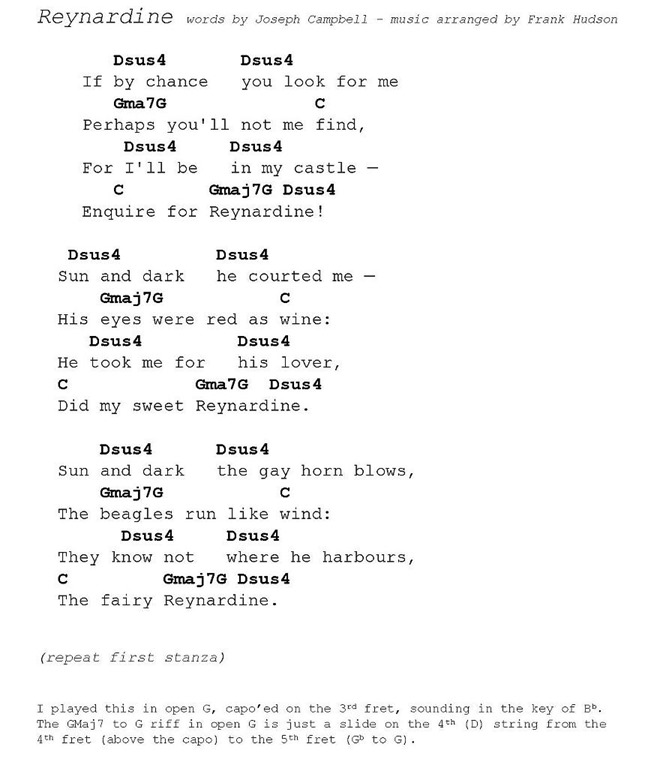
But here’s another mystery — and I’m saying, a useful one — why isn’t Campbell’s version of “Reynardine”  known and sung? Let’s look at it. The chords here are the ones I fingered, though I used Open G tuning and I formed the chords while capoing at the 3rd fret, so it sounds in the key of Bb. But the music “Reynardine” is sung to isn’t harmonically complicated (you could simplify the chords), and a better singer than I could better line out the attractive tune used by myself and most performers. ****

Reynardine Song

I made one change to Campbell’s masterfully compressed 1909 lyric. I use the more instantly recognizable, less antique word “lover” where Campbell had the easy to mishear “leman.”

.

Poets and lyricists: this is a marvel. No need of footnotes or spoken “this song is about…” intros. The supernatural element is subtly but clearly introduced. The refrained first stanza was as published by Hughes, and is commonly sung in modern versions. The second makes the bold move of changing a folk-song readymade where some damsel’s lips are found to be “red as wine” with an animalistic short-sharp-shock of Reynardine’s “eyes were red as wine.” The third stanza lets us know he can be a fox in form, subject to fox hunters with the brief but specific statements of the horn and hounds. Another subtle thing: Campbell repeats the “sun and dark” all-day-and-all-of-the-night lyrical motif to tell us this isn’t an ordinary fox hunt scheduled for seasonable days befitting rich people’s leisure, but a 24-hour emergency. The hunters know this fox isn’t normal. The refrained first verse reminds us that the lover may know that the were-fox can also take a human form, and make use of human defenses, such as castles, which the assiduous hunters do not.

As a page poem this has the vivid compression that Imagism preached. Compare the efficiency of this story-telling to “La Belle Dame sans Merci”  which has its sensuous pleasures, yes, but takes it’s time getting to the point. The two poems convey essentially the same tale, but Campbell can leave us with an equally mysterious effect using so few and aptly chosen words.

There’s a player below for some of you to hear my example of a performance of Joseph Campbell/ Seosamh MacCathmhaoil’s “Reynardine.”   Those who don’t see it can use this highlighted hyperlink instead.

Hopefully, I haven’t put any of you off with my own footnotes about this song’s unusual history and transformation. If you skipped to the end, here once more is my message today:

If you perform this sort of material, consider using Campbell’s lyrics instead of those you may have heard from other singers. They’re that good.”

.

*And more recently in a softly lovely version by Isobel Campbell, formerly of Belle and Sebastian.

**Obligatory statement: no, not the Power of Myth  guy. I suppose it could be worse, Campbell could have been named James Joyce or Sinead O’Connor, and confused us too.

***Besides “Reynardine,”  Vol. 1 includes another popular folk-revival song, erroneously considered to have wholly traditional lyrics: “She Moved Through the Fair”  which Hughes’ correctly credits lyrically to Irish poet Padraic Colum.

****I was somewhat working from a very rough memory of Bert Jansch’s version on his Rosemary Lane  LP. It’s a good thing I was rushing this and didn’t stop to listen to Jansch — his version is an acoustic guitar tour de force. If you’d like one performance to demonstrate why I, and many acoustic guitarists, revere his playing, that would be a good choice.

Dave Moore’s Cathedral

Here’s a surreal, enigmatic, and yet compelling story by Dave Moore that I adopted and combined with some orchestral music I composed for it several years ago. Dave wrote this during a period when he had returned to Iowa to help is aged father who was dying, and while nothing in the piece refers directly to that situation, this reader feels something of that experience is present in its absence in this.

Dave’s father was a Protestant minister, and so church buildings of various sizes would have been part of his upbringing. And the mysterious boxes within boxes that the story’s protagonist must pack may be a visual image for the tasks of dealing with the stuff of wrapping up a life. But neither of those things can completely anchor the way this tale unwraps itself.

Easily the strongest, most enigmatic, and potentially objectionable image in the tale is the encounter with a young woman. A listener may meet this image in the story and react to it quickly (or thoughtfully) as an intrusion of some kind of male gaze trope, that thing that can be a tiring and reductionist frame on the real lives of half of humanity. But to my reading of this, it is the core image of this piece and it’s remarkably faceted with a cubist/surrealist multiplicity of reflections: an anima, a reminder of the exiled female in the masculine church, a strange mixture of sexuality, ambivalent reactions to sexuality, and yet also with a bit of the nature of parental caretaking roles reversing themselves. Many a time when I revisit this image by listening to this piece, I see something new in it.

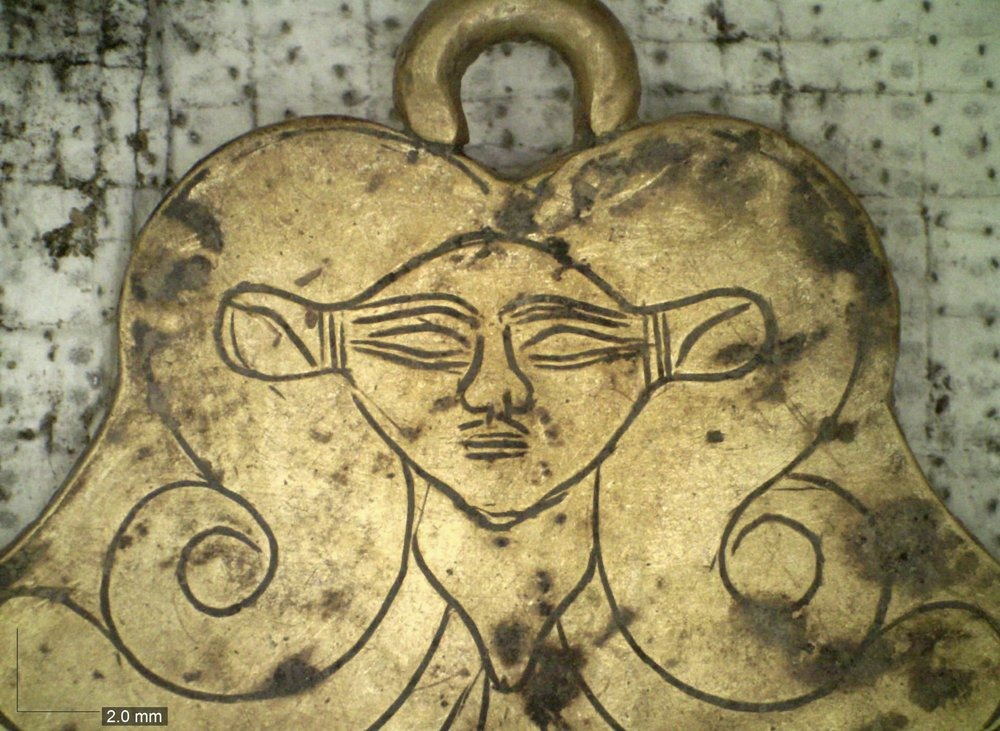
Hathor pendant from Pylos gravesite

Gold pendant depicting Hathor, an African goddess, unearthed in a Greek tomb dating from the time of Homer

.

Long time readers here will know that I admire Dave’s work, and once more I thank him for his contributions to this project with his voice and keyboard playing—but for you that is of little matter. Perhaps my specific and not necessarily popularly aligned taste, or knowing Dave and the circumstances around this pieces creation including that it’s my own music and performance that presents it here, distorts my evaluation of this image; but listen to this piece and see if you agree that the strange encounter at the center of this dusty and enigmatic tale is a remarkable image worth contemplating.

The player gadget to hear “The Cathedral”  is below. If you are reading this in a reader or reading view that hides that player gadget, this highlighted link may allow you to listen to the audio piece. There is no text to link to today, so you’ll need to experience this less than 4 minute story by hearing it.

.

The Listeners

I have one more audio piece for our Halloween celebration, this one using a mysterious poem by Walter de la Mare. The way it goes about being scary is unusual—weird even.

After you read or hear it today, how would you describe what’s frightening about it to someone else who doesn’t know this poem, “The Listeners?”   Would you find that a hard task? Our previous two Halloween pieces have easy anchors to something describably frightening. Even though those two are short poems, you could point out their fright potential just as one could blurb a Stephen King novel or a horror genre film. Bronte’s “Spellbound”  has its character held unable to move as cold night approaches. While it’s not “spelled out” (and there’s a jump scare for you: boo! language play!) it is implied that this immobile state has the character suspended in the air. And Housman’s “Her Strong Enchantments Failing”  has poisons and weapons drawn and multiple deaths assured.

OK, now watch a movie in your mind of de la Mare’s “The Listeners”  with the sound off. A man rides up to a somewhat elaborate house in a woods at night. Close up: you see his hand knocks on the door. And he knocks again. And one more time—oh the heavy suspense—he knocks a third time. No one comes to the door. Back to wide shot: he rides off. Gripping! I was on the edge of my seat! Goosebumps!

Now of course suspense, fright, that sense of out-of-joint weirdness are all subjective feelings inside an audience. Nothing is assured to be delivered by any artist or writer’s work, no more than all readers will find something sexy, delicious, or beautiful. But almost nothing happens here, and that little is not unusual, at least in the days when the horse was unremarkable transportation, back before we Zoomed or IM’ed our associates instead of riding over to them.

But if you listen to “The Listeners”  (hey, is that title a clue?) you may get that ghost story jolt that de la Mare intended. After enjoying this as a poem (full text here) or in my song version, let’s look at some details of how de la Mare casts his spell.

First off, the poem is full of assertions of silence. For something that’s not a there, there—it won’t shut up about it. Helping us endure the author pointing and asking us to notice that, some of the descriptions of silence are quite nice I think, particularly the last one: “The silence surged softly backward.” And oddly, to enforce our sense of the silence, sound effects are used in a couple of places to richen the silence. We can hear the mouth of the horse grazing early in the poem as his rider goes to the door. And as the rider mounts up to leave, we can hear the sound of the leather stirrup strap stretching as his sole meets the stirrup and then the differing sound of the horse’s shoed hooves when they strike a rock in the forest trail away from the house. What we hear enforces the feeling of silence.

Dialog (strictly speaking, monologue) is used sparingly, but it finally tells with the rider’s final utterance. This is no chance encounter, though the rider is called “The Traveller” he’s not a curious passerby or a man looking for a cup of oats for his empty-tank horse. That this is an unexplained appointment is a wonderful choice! Like the silence it can let us fill it with detail.

I just got done exchanging new work this month with a small group of poets that have been doing this for decades. I’m sure many of my responses were suggestions to clear something up or to expand something the poem seems to start but doesn’t finish. And the same was likely said about my work. I thought my advice was valid when I gave it, if only from an example reader, but “The Listeners”  points out there’s no law that a poem needs to answer every expectation—maybe instead there’s a statute that says that at least in a small yet significant way it needs to surprise or even confound expectation.

And yes, that title: “The Listeners”  really helps here. The rider knows they’re there somehow, just not in the state or mood to answer. Like the silence, their nonappearance is silhouetted with outlines of absence.

The Listeners Turn2

She Don’t Care About Time. Walter de la Mare’s writing had an affinity for the weird, so David Crosby’s anachronistic cape seems fitting.

.

I went with one of my favorite rock music sounds today, the 12-string electric guitar, an instrument made indispensable for a short time in my youth by The Byrds’ Roger McGuinn. The 12-string electric is an unusual instrument today, as rare to see in a guitar store as a horseman is on the road now. I bought mine a couple of decades ago because I love the sound McGuinn and his engineers developed for it, which I exploit today. The player to hear my presentation of Walter de la Mare’s “The Listeners”  is below. if you don’t see the player, this highlighted hyperlink will also play it. Thanks for being one of the Parlando Project’s listeners.

.