Ten Cents a Bushel

I seem to have the kind of mind that, unbidden, sees connections. Probably drives some acquaintances around the bend, but regular readers here will have become accustomed to this. After all, this Project is about making a connection — likely unintended connection — between literary, page poetry and musical performance. Still, even though it relates to a mental reflex of mine, there’s “making,” work, involved in that combining.

So it was, that this month I went consciously looking for a connection, one I thought I might find between our American election results and the fear and despair around that event with the early 20th century era which I often look for to find free-to-reuse words to set and sing.

Where and what to look for in the era if trolling for such a connection? I wanted a short poem to leap out at me, one that I’d immediately flash on, in hopes it would attract even the casual listener here with a sense of recognition. I started paging through my Sandburg, who remains one of my personal models, but found no strong candidates I haven’t already performed.*  I next moved on to a 1930’s volume A New Anthology of Modern Poetry  edited by Selden Rodman. Rodman is one of those little-remembered figures I enjoy encountering in the Project, a litterateur and socialist activist who admired American Modernists — so connections right there.

The selections in Rodman’s volume look like an index of this Project’s authors, I counted 37 poets whose texts I’ve used in the nearly 800 published Parlando Project pieces.** His lively introduction promised what I was looking for, connecting the artistic discontent with old literary modes and tactics with social change and discontent.

Eagerly, I read on, looking for that flash of connection with the way folks I know are feeling this month. I read some fine poems, some I might even use someday here, but nothing came out of that quick skim and read that hit me with my sought property: “This sounds like it could have been written today.” Why not? When those poets wrote of their social injustices and feared outcomes the details of their times didn’t match closely enough to the details of our times.***   “It’s just details, what about the essence?” you might think. I thought that too, but I wanted listeners to feel it  from the poem I was looking for. Details usually aren’t ephemeral in poetry, they are often the source of its emotional power.

If I’d left it there you wouldn’t have a musical piece to listen to today. But then I recalled Edwin Ford Piper, a man whose work I discovered earlier this year. Piper’s family settled in frontier Nebraska just after the American Civil War. He grew up there, knowing rural settlers, ranch-hands, and farmers at the turn of the century. To keep this a reasonable length, here’s a link to some of what I wrote about this deserving of more current attention poet earlier this year.
Ten Cents a Bushel

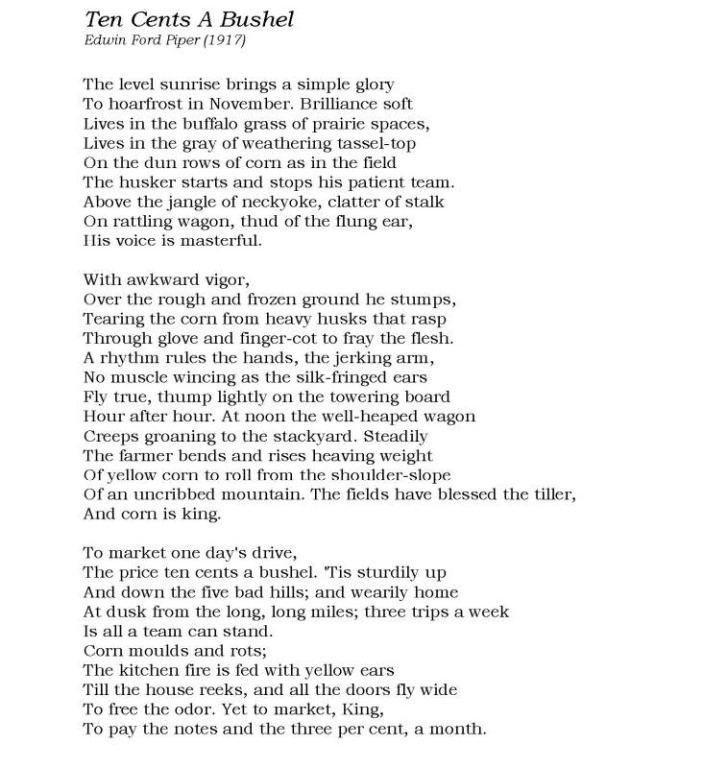
Here’s Piper’s poem I performed today as it was published in his collection Barb Wire

.

Piper’s poem “Ten Cents a Bushel”  is about a small farmer. I doubt I have any readers who commercially harvest corn by hand, though some may have experienced something close enough. There are still agricultural workers, but modern field workers are usually employees, not caught in the exact resident small-farmer serfdom that is the center of Piper’s poem.****  I went with this poem anyway. In doing so, I accepted failure on my goal — at least so far — I didn’t find the brilliant connection between eras I was seeking. But if the poem’s details are off-target to today’s burdens, they are still powerful details. Piper’s poem lets us feel those details in our muscles and smell them with our noses, and the essence of the poem’s world, the repetitive stress of its rural Sisyphus’ burden, is something I expect some tired people can feel this month.

Today’s music? I prefer to call myself a composer, not a musician, even though I operate numerous real and virtual instruments in making these pieces. Modern digital recording allows me to maximize my inconsistent skills and to do with guile and planning what fingers and breath couldn’t accomplish. Be assured: “composer” sounds like a pompous title to me too, while “musician” retains the nobility of the worker. But there’s an element of my personality that sometimes tells the composer-me to back off with the theory and a build-the-musical-piece-with-ideas workflow, and barks “I just want to play!” Weeks like these, or times when I can plug into a loud amp and welcome that power vibrating in a room brings that energy forward. Today’s piece started with two inexpensive electric guitars and a bass playing loud in a room. The lead guitar I played is a Squier Jazzmaster, a model that wasn’t designed for loud, sustained-note playing, but can be forced to do it under volume by an elderly guitarist who can’t rip out rapid flurries of notes. You can hear that performance, my speaking Piper’s account of this November farmer’s harvest while playing more my mood than worked-out musical ideas by using the audio player below. No player? The bank hasn’t foreclosed, some ways of viewing this blog suppress the audio player gadget. This highlighted link is an alternative that will open a new tab with just an audio player of its own.

.

*I’m not disenchanted with Carl Sandburg. My results in this browse through his work may be because he doesn’t really do fear and despair as a predominant emotional frame. This may still be a good attitude to assay in these times, but not what I was specifically seeking. If you want Sandburg for this moment, perhaps this previous Parlando Project performance will serve you well.

**One blind spot: Rodman (who had considerable interest in Black Caribbean culture and history) didn’t include any of the Harlem Renaissance generation of Afro-Americans. I must resort to an academic meta-cultural term of art when I consider that: WTF.

***I did think this week about how to compare the injustice and fears which I naively thought I could measure between the 1930s and our time. I’m certain the levels of injustice were massively greater then. The fears? Even given their Great Depression, fascist governments, genocide factories, and a coming World War — I can’t say our fears are lesser.

****I started to write a conclusion here that would need to spin out more than a thousand words to do it justice. Such an epic would point out that those early 20th century rural farmers caught in an economic squeeze by powerful business forces up the supply chain from their crops, founded radical, effective, and practical political movements: The Farmer Labor Party, the Non-Partisan League. In the same parts of the land that today wave the red flag and the red hat, a very different rural political force was electorally successful. What’s with the same fields bearing different fruits in these two eras? That’s more than a blog post, something for someone with skills beyond mine. One naive half-formed theory: was there something about the largely immigrant-or-child-of-one, practical farmer or small-town-dweller of a century ago that saw through urban sharpies and charlatans, and focused on specific economic remedies?
After Apple Picking

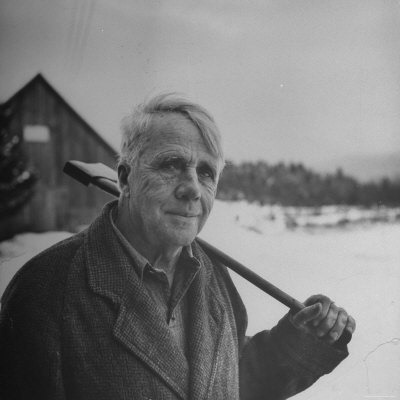
Around America people are getting ready to celebrate Thanksgiving Day, a sort of remembered harvest festival, now a family get-together mostly celebrated by eating as most Americans are separated from farm work by some distance and decades. However, back in 1914, American poet Robert Frost was close enough to that work to write a masterful and closely observed poem about harvest time that I’m going to present for today: “After Apple Picking.”  While I hope you’ll listen to my audio performance with my original music below, here’s a link to the poem in case you’d like to follow along with the text.

This poem is full of sensuous detail. Encountering it — even if you don’t do farm work — you should feel the completion and weariness of the poem’s speaker who is falling asleep at the end of his harvest season. The poem’s farmer has been working in an orchard, and that place is full of the scent of apples. In a fall orchard such as this, much of this scent may be from fallen apples which, even as they start to rot, give off a sweet musk. And it’s frost time, not just the poet’s name on the poem, but the livestock water-trough has a frozen sheet on top, so the picker has been racing against a loss of the crop. In a piece of rural surrealism, the farmer has, that morning, picked up a plate of this surface ice —which would be thin, wavy, and fragile — and looks through it as if they are magic spectacles at the morning frost on the grass. This lasts but a moment, the magic glass will disintegrate in his hands, but that’s of no matter, there’s work to complete.

While falling asleep his body is still weary, his feet are sore from standing on the round ladder rungs, but as dreams approach his mind once more magnifies and intensifies reality like the view through the wavy ice sheet, and he’s haunted by apples, by his job of picking and inspecting, his rush against the end of season frost.

As the poem moves to its conclusion the farmer seems to imply that his work to gather the crop before it’s lost is like unto the work of salvation. We might remember and notice that the poem started with a ladder pointing “toward heaven.” And those apples that touch the earth are held by it and not offered heavenly worth.

Frost ends his poem whimsically, not with an angel or a prayer, but with a small rodent, the woodchuck, which hibernates (“his long sleep”) in the winter. As the farmer falls off to sleep, he wonders how long a rest he has earned.

How big a slice of apple pie do you want? Stand back, I’ll cut you a piece.

.

When Frost wrote this poem about a third of Americans were farmers and farm workers. Now, most of us have other labors. Our harvests may not be food, we may not be tied to the cycle of seasons as exactly. My wife will be getting time off from working in a medical clinic, where she works to gather as many as she can, and Thursday she’ll be making a meal for us and her mother with dementia. I’m working past midnight to bring you a presentation of this poem. Our labors are many, they may make us weary, but perhaps, yet, we can be thankful for them.

My audio performance of Robert Frost’s harvest poem “After Apple Picking”  can be heard with the player gadget below, or with this highlighted hyperlink. My music today is percussion, piano, cello, two violins, horn, and harp.

.

Longfellow’s Harvest Moon

What value is mystery and strangeness to gratitude, to a sense of thanks? Let me try an experiment with you here.

American Thanksgiving still retains a degree of its nature as a harvest festival, and so when looking for a text to use today I came upon this one by highly unfashionable poet Henry Wadsworth Longfellow. Looking at the poem on the page one can see why modern poetic esteem may have passed Mr. Longfellow by. It’s a sonnet, intricately rhymed (ABBAABBA CDECDE), an antique skill that we no longer appreciate as much. Its imagery is both pat and removed from most of our daily lives, a rural landscape at night before the coming of electric lights, where moonlight can illuminate reflective objects and cast discernable if low-contrast shadows. Harvest signs include loaded wagons (“wains” is the charming old word for wagons chosen perhaps for rhyming needs), bundled sheaves of grain after reaping by hand, the changing of the bird population, falling leaves. In summary, we have imagery that is largely meaningless or lacking impact to us today in our modern America. It looks like stuff that is, and justly is, filed away in dusty poetry collections.

Harvest Moon

An illustration for “The Harvest Moon” from an 1880 edition of Longfellow poems

.

But what if we were to experiment a bit with Longfellow, and make him stranger and more mysterious? After all, this past rural world is now alien to most of us as some far-off land. And Longfellow, who we mistake as a rote poet here, has a subtle point to make, one that cultured British people might excavate and polish if this were a poem by Shelley or Keats, but which Americans may be too willing to overlook due to the old modes of Longfellow’s poetry.

In today’s performance of Longfellow’s “The Harvest Moon”  I attempt that act of mysteriousation. It started with breaking up the lines and underemphasizing the end-rhyme. This lets it act as an occult undercurrent, rather than a regular chime we know is coming. I sing the words as if this is new and not fully understood to the singer or listener. And as I often do here, I make the music I wrote and performed carry a lot of the load. The main harmony is carried by a 12-string acoustic guitar, which is playing primarily suspended chords, chords that remove the 3rd of the scale that makes a chord major or minor, and replaces that significant note instead with a not fully discordant but unexpected 2nd or 4th. The bass plays a busy but similarly unsettled melody line under this. And as a final signal that we are to regard this old American landscape with a time-tourists’ eye, and not as an old poem full of discarded conventions, I play a higher melody line and drone on a sitar,*  an instrument from another continent.

All that distancing effect is to force the listener to hear this poem as if it may have some meaning other than a decorative picture of a quaint and therefore meaningless scene. Longfellow outright begs us to do this in the text when he writes “All things are symbols.” This poem is late Longfellow, he’s nearly 70 when he wrote this, his America has passed through a horrible civil war, his life has passed through multiple family sorrows, and he is now an old man. The songbirds gone here are but counters perhaps, but his life of poetry is nearing its close. He’s spent his life helping establish that there can and should be an American poetry, that there can be American poets. We are them. Our grandparents and great-grandparents are the children asleep in those strange and now far-off curtained rooms. We are the piping quails, grounded birds gorging on the grain-seeds fallen to the under-shadows of the harvested sheaves.

Let us be grateful, let us be thankful, for those before us. Wrong and right they labored for us. Enslaved and wrongful masters they planted and harvested on lands that cannot forget the exiled feet of those before us. How strange, that it was exiles and the tempest-tossed that appropriated this place. Exiles creating exiles. There is a mystery in that.

The player gadget for my performance of “The Harvest Moon”  should be below. If you don’t see the player gadget, you can try to use this highlighted hyperlink to hear it instead.

.

*If you visualize me sitting cross-legged on a damask pillow with incense wafting in paisley curlicues while plucking on that elaborate musical device, it may be good for the effect of the piece—but in the spirit of full disclosure I’m playing a MIDI guitar here which allows my plucking to be translated into the notes and sounds of that difficult to maintain and master South Asian instrument.

Theme in Yellow

Carl Sandburg. I get the impression that he’s been filed away as a folksy peculiarity, a 20th century and less-original echo of Walt Whitman, an artist not worth considering these days. Readers of this blog will know I find him otherwise: a first-generation English language Modernist, just as concerned with making it new as anyone else in that movement.

Carl Sandburg guitar kids goats

The young Josh Homme and Kim Deal get lessons from some old flannel-clad grunge guitarist.


Here’s a piece using words by Sandburg for Halloween. I’ll note that almost alone among the first-generation Modernists he sometimes writes poems about, perhaps even for, children. “Theme in Yellow”  can serve as both. Of course, since we’re all “obsolete children” the audience isn’t limited to them.

Anyway, it’s a good piece for the holiday that’s about the whimsy of fear and how far from reach we can hold death. Oh, and in our modern America, it’s also about candy, for which the Jack O’ Lantern’s teeth were meant to warn us.

David S Pumpkins

David S. Pumpkins. Any questions?


Sandburg’s poem is just slightly old fashioned—the harvest festival aspects of Halloween are now abstracted from most of us, though it was in Sandburg’s personal experience. But we might still dress our stages with straw, and with cobwebs and lanterns, setting our fears as old.

May all your fears be old.

Today’s music has lots of electric guitars (seven tracks, four different guitars) mostly because I’ve been missing their sound. Lots of coordination to get all that traffic running—and I don’t know if I did right by it—but it was fun while I had time to make some noise this afternoon. You can hear the results with the player gadget below, and if you’d like to read Sandburg’s poem while you listen, it can be found here.


Autumn Day

I was at the Midstream poetry reading series last night, and by choices, I therefore had to miss out on the wisdom that would be passed on by the elder chieftain of my nation who was speaking in the same town that night.

It’s often thought that age heightens certain perceptions, certain outlooks. In age one has a feeling for repetitions, the way that ox-turning time keeps bending back on itself so that the place one is plowing is beside the past and the future is just one row next over. There’s also a lessening of thought of one’s own self, which after all is a diminishing asset, one’s storehouse filled only with memories that the rats nibble at all night long.

So I missed what our aged chieftain said. From these considerations of age I’m sure he could hardly find time to speak of himself, which matters less and little; and instead he likely spoke from his heart, wise from his own failures far exceeding those of the younger ones, of how we can forgive and remember, and how our nation can continue to be born, cared for, urged on.

Instead I heard fellow poets read. Oh, we fail—as all artists do. We talk of ourselves, even us older ones. And when we take a break from that we talk of others imperfectly. We speak too softly, too loudly. We forget to reach for the music, or we do stretch for it and then fail to hold onto it. We search for beauty and come up with the same things over and over again, and how can we make that interesting? We are gloomy, forget to laugh, and hold our work back for funerals.

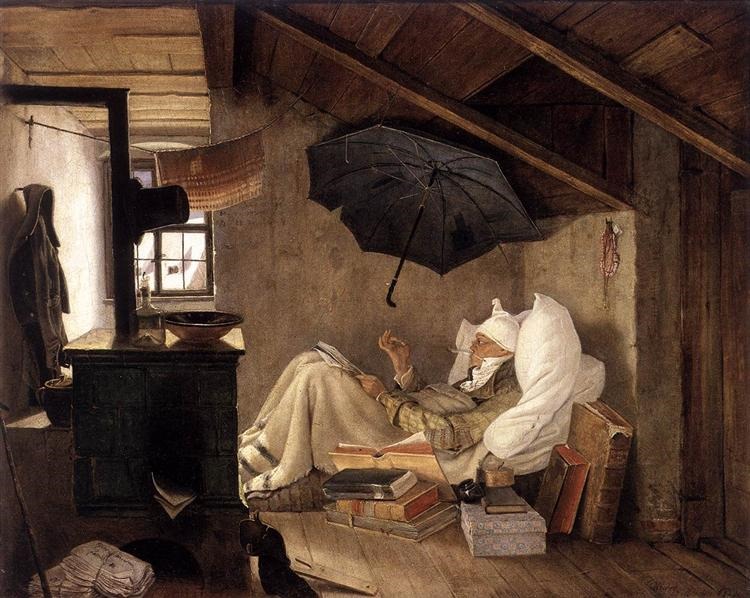
the-poor-poet-1837 by Carl Spitzweg

A graphic representation of the wisdom of poets such as myself


It was an older crowd last night, almost enough to make me feel younger for the couple of hours we were together. Today’s piece, Rainer Maria Rilke’s “Autumn Day,”  as much as Shakespeare’s piece from last time, seems to speak of the experience of age, but Rilke is much more directive. One doesn’t often see a poem so full of “You” statements as the final stanza of this poem is. I’m not sure of the idiomatic nature of “you” in German, the language Rilke wrote this in. There’s some sense that the rhetorical you in the poem may be directed at oneself: so Rilke speaking to Rilke; but as I read this poem, I can’t escape the sense of Rilke speaking to me, and as I perform Rilke’s words in my translation, I expect that you, particularly if you are an older person, will hear it as speaking to you, so concisely do those last five lines seem to outline this stage in a lifetime.

Autumn Day

If you’re curious to see a number of other translations and the original German, see this link.


But here’s why you come here and have read this far into this post: Rilke wrote this in his 20s.  These are not the biographical autumnal musings of an older man, and I’m not sure it’s even a poem adopting that persona. I almost translated the title here as Harvest Time but chose to stay with “Autumn Day”  because the copious other English-language translations used that for the title and using a different title would not allow searchers to find my fresh attempt to carry Rilke’s work into English.

Those who’ve followed my previous translations from other languages will know that I stress trying to express the imagery the author uses in a way that communicates to the modern English reader. Since that is my prime concern, I don’t make much of an effort to try to reproduce any of the word-music from the other language, but this time I did keep to a feeling of iambic pentameter for word-music’s sake. Much of my difference from other translations* was trying to sharpen the harvest imagery Rilke uses in the opening seven lines. The overall effect I aimed for was to clearly convey the weight and fullness of harvest bounty.

The final five lines converge more into a consensus with the other translations. One divergence: I read in one German speaker’s comment on their translation that “Alleen” (translated by many as alleys or avenues) was what they would call the tree-lined boulevards predominate in Rilke’s time. Not only did this strike home with me, who bicycles each day on tree-lined streets in my own town and time, but it seemed to be the linkage called for with the poems final image of following the restless wind-blown leaves on the pavements.

So back to this poem that may be read as a meditation on later life written by a 20-something. I think Rilke was trying to convey the harvest feeling, the fall into wintertime and that cyclical fallow season. Even as a young man he was able to convey this feeling an old man might appreciate. He didn’t need to be an old man to know this, he just had to read the book of nature which is older than all of us.

I often laugh as I think I’ve come across some wisdom from old age. “Aha! I’m just a slow learner” I exclaim.

To hear my performance of my fresh translation of Rilke’s “Autumn Day”  use the player below.


*I found almost 20 English translations of this poem almost immediately on the Internet. That seems extraordinarily popular as a translation subject. And I must give credit to Byron’s Muse blog who presented this poem earlier this fall which is where I first saw it.

Dunbar’s October

We’ve had Edward Thomas and Henry Vaughn waxing medicinal about autumn and affliction, and now it’s time to head back across the Atlantic to see what metaphor American poet Paul Laurence Dunbar brings to the season.

By coming to prominence in the 19th century, decades before James Weldon Johnson’s 1922 Book of American Negro Poetry  signaled the tip-off of what became known as the Harlem Renaissance, Dunbar proved to Afro-American poets of the 20th century that it was possible to get over to the culture at large.

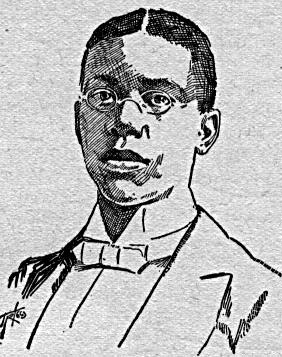
Paul_Laurence_Dunbar by Norman Wood

Paul Laurence Dunbar “Let the world dream otherwise…”


Like many cross-over artists, he did this by doing the established forms as well or better than the incumbents. One way he did this was by writing in regional black dialect, in poetry that is frankly hard for me to decode from my 21st century location. On one hand, regional dialect was all the rage in 19th century America across various regions and ethnic heritages, and there’s no reason that Afro-American dialect couldn’t be part of this—Oh, wait, there is a reason: white supremacy.*

Dunbar was born near the end of Reconstruction, right as the reaction to the possibility of full Afro-American humanity and citizenship was snapping much of his country back to a feudal system based on presumed, and if not presumed, enforced, inferiority. One can’t avoid the problematic nature of trying to portray a range of comic to simple-wisdom-dispensing Afro-American characters speaking a non-standard version of English in a context of a society that was fairly sure that was the extent of their intellect.**

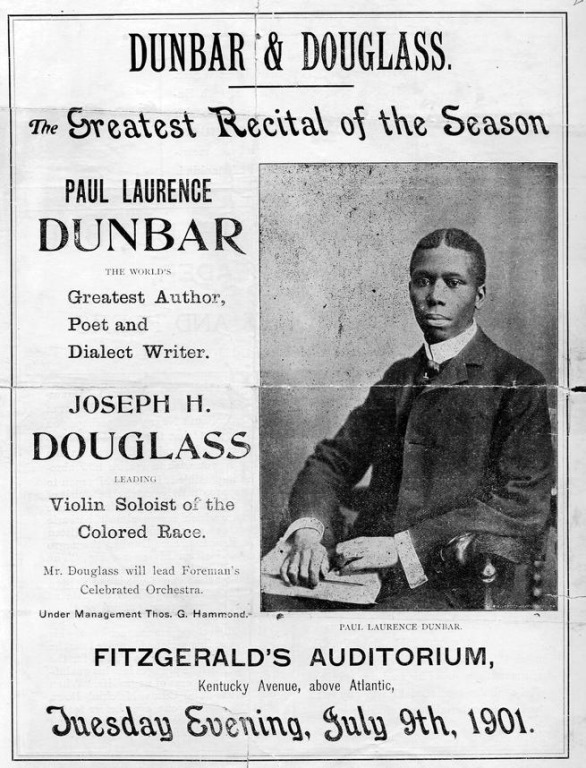
Dunbar Live!

Fitzgerald’s Auditorium later became Atlantic City’s “Club Harlem” and hosted jazz and R&B acts.


But that was only part of what Dunbar wrote. He also wrote supple 19th century lyric poetry in standard English, as good or better than the “Fireside School” of  East-Coast poets that were the standard for American poetry at the time. And it’s that side of Dunbar’s work that I present today with his poem “October.”

“October”  is an extended metaphor nicely developed over 24 lines of rhymed and metrical verse. Dunbar alternates his rhyme scheme of ABAB to AABB to add some delightful variety. The autumn notes of harvest bounty and oncoming winter are struck and sounded cleanly.

It was only after enjoying it as a good poem in this style that I began to notice another context, an undertone. This had happened to me earlier this year when presenting a Dunbar love poem, “Kidnapped.”   After performing that one, I moved on to ask: did the child of two formerly enslaved people write a poem about being captured like a butterfly and being taken far away from some home landscape? Yes, he did. Was he consciously encoding that undertone into a popular poetry form that could have been printed on a genteel valentine? I don’t know. It seemed a stretch as a conscious choice, if only because the undertone/metaphor wasn’t developed as fully as it might have been.

This time, with “October,”  Dunbar does develop his metaphor, and I know of no document where he comments on his thoughts on this poem. Autumn’s harvest is presented as if it were an economic system, and dare I say it: as a feudal/sharecropper system. October is wealthy and in charge, and harvest makes her wealthier. She is presented as foolish with this collected wealth. The poet observer’s persona is not outraged by this however—indeed he portrays her as happy, carefree, joyous, beautiful. And the poem is also unambiguously beautiful. Is this personified red-headed October, collector of the treasure and bounty, deserving of unstated disgust or even envy? Is this an idealized Daisy Buchanan-like character?

Your eye (like mine) as you first encounter this poem may be on the signified season. We can’t be expected to see the fall of the year as a real person, with an actual role and privilege in a system, can we? Is it only unconscious sub-text?

Ambiguous as this is, this is part of the wealth of poetry. It can be enjoyed as word-music. Its metaphors can be admired for cleverness and their own silent music of thought. But it’s also the way for the moving minds and experience of others to be shared. It is the concise literature of the oversoul.

I performed my solemn version of Dunbar with acoustic guitar, piano and electric bass. If you’d like to check out the text of Dunbar’s poem, or follow along as I perform it, it can be found here. The player for my musical performance is below.


*I expect a percentage of this blog’s treasured audience just clicked off when I typed that phrase. If you, indignant, at least followed to this footnote, thank you, I appreciate it. I know that some of you come to poetry and music to escape the turmoil of politics and social problems.

**It’s hard to do, but some Afro-Americans managed to do it. I can trace the musical line of it anyway, from Charlie Patton to George Clinton to the hip-hop movement.

To Autumn

October 4th is National Poetry Day in the U.K. this year, an event similar, though more condensed, to the National Poetry Month in April promoted out of the U.S.

No one’s revealed why April for the Poetry Month, though Chaucer and T. S. Eliot may have put in their votes, and the reasons for the fall date for Poetry Day could be arbitrary too. But autumn would have an emotional claim. Fall is changeable in weather, an underrated Spring of warm days and cold shuffling themselves. It has its long-established events: school years underway, harvests and harvest festivals, the closing of summer venues, Halloween, Veterans Day/Remembrance Day. Fall can also be an easy metaphor for approaching death, but poetry is one buffer we use to handle that subject anyway.

John Keats wrote one of his last and finest poems to the season almost 200 years ago in the autumn of 1819. It’s full of the strengths of Keats’ writing. Even in his time Keats was both praised and dismissed for the sensuousness of his poetry, and not a line goes by without some sensation of taste, touch, color and sound, and all that is contained in beautiful word music and an off-balance rhyme scheme that may couplet-rhyme two lines together, or tantalizingly wait two or four lines for the rhyme.

John Keats listening to the Nightingale on Hampstead Heath c1845 by Joseph Severn.

Look at that great single-track behind you John. In only 160 years someone will invent the mountain bike


Even if some of his words are 200-years-old antique, or for us Americans, peculiarly English, he crams all these sensations in his poem without them seeming forced, as if they were special or unnatural “poetic” things. Many of the sense words in this poem are of ordinary manual labor: load, bend, fill, set, reap’d, laden, press, and borne.

Where he is outrageously poetic is that this poem is an apostrophe. The entire poem is addressed, just as the title says, as if the season was a person: “To Autumn.”  A poet doing that today would, intentionally or otherwise, produce a humorous effect. Still, if we allow it, the second stanza gives us a leisurely fall, a farmer taking a break on a warm autumn day from rural labor, hiding in a barn, or taking a nap in a half-harvested field, but yet also returning to pressing cider from apples down to the last drop, and bearing away hand-gathered food on his head “like a gleaner.”

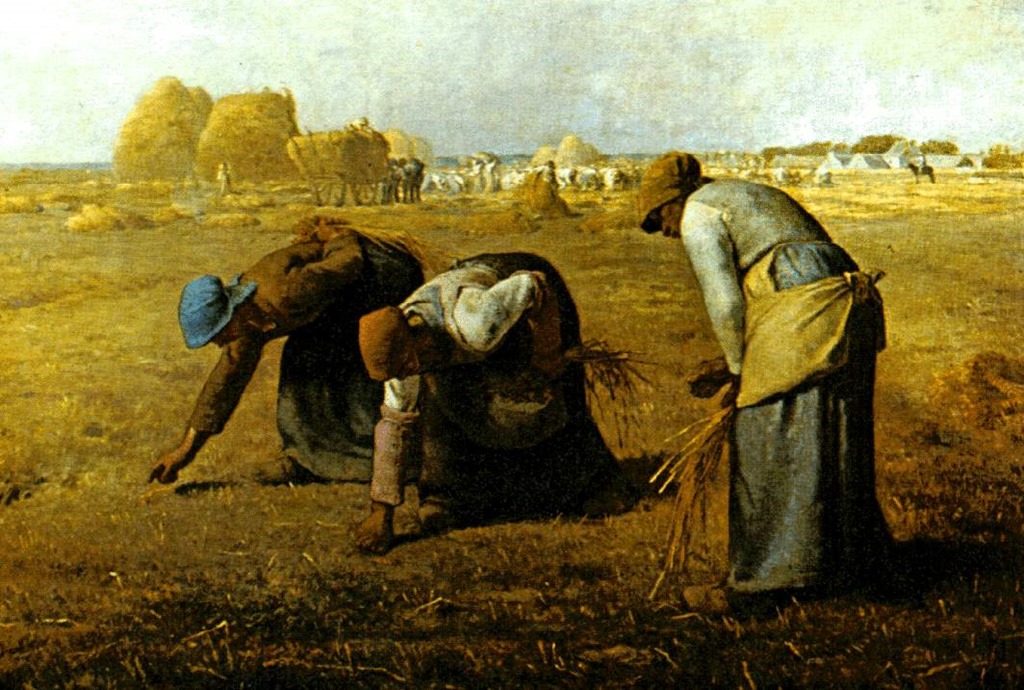
Gleaner is one of those antique words. It was a practice in some places to allow the poor and those without land to gather what leftover grain might be left in the fields after harvest. Just this week I was reading on the always Interesting Literature blog that Keats may have had this practice on his mind as gleaning had just been outlawed in England, and that other images in the poem may have had social resonances with Keats at the time.

The Gleaners by Francios Millet

Painters whose names suggest a subject for their painting: “The Gleaners” by François Millet


The poem’s final stanza retreats with distant banners flying, a symphony of extreme audio dynamic range. The infinitesimal sound of gnats flying is a choir. The wind crescendos and decrescendos. Lambs bleat loudly and then there is silence. Crickets arpeggiate for time. Birds whistle, twitter and leave in the sky, migrating away, and the poem ends.

Keats himself ends as a poet, this being one of his last works. He leaves for Italy in hopes it will help his tuberculosis, which it won’t. He’s dead in about a year.

My music for this today is acoustic guitar with bass and some orchestral parts: winds, a couple of cellos, a pair of violins. The player to hear it is just below.


Here’s a #nationalpoetryday bonus, featuring a very different British poetry from about a century later, T. E. Hulme’s “Autumn.”  Hulme was a too-little-known instigator of Modernist poetry in English, and like a lot of instigators he moved by opposition to previous schools. In particular, he disliked the English Romantic tradition of Keats, viewing it as too flowery, to full of images that were no longer real and which had become only conventional symbols.

Interestingly, in his “Autumn,”  Hulme’s central image is similar to Keats: instead of a farmer taking a break in his granary or napping in a field, he has a harvest moon looking over a hedge like “a red-faced farmer.”

Here’s my performance of Hulme’s “Autumn,”  which you can also listen to with the player gadget below. If you like this sort of thing, be sure to spread the word about what we do here at the Parlando Project.


Old Michaelmas Day

As long-time readers will know, I only write a small portion of the words used in the audio pieces here. That’s not because I couldn’t—Dave and I have written poetry for about as long as we’ve written music—but because the Parlando Project is, in part, an exercise in how I react to and present “Other People’s Stories.” Trying to get inside the experience of other writers, trying to find a way to inhabit their words, this is one of the objects of what I do.

I’m not against self-expression exactly. If I was, I’d have fewer other writer’s selves to express after all, but the nature of what one artist draws out of someone else’s expression is interesting to me.

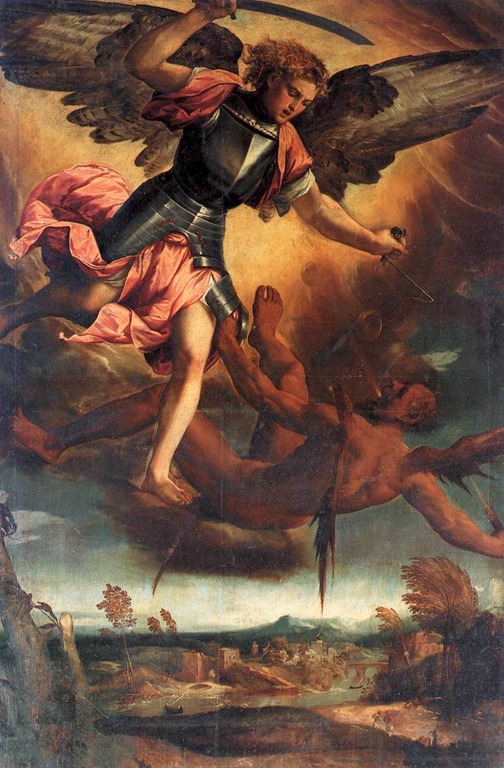
I wrote the words to today’s piece, “Old Michaelmas Day,”  thanks to a blog post on another blog I follow. Earlier this month, I was struggling with a more complex musical part for Hardy’s “The Self-Unseen”  when I took a break and read a new post over at the Daze and Weekes  blog. It’s there that I read of a marvelous British Isles folk tradition having to do with Saint Michael’s Day (Michaelmas). Michael is one of the Archangels, the warrior among them who cast a rebellious Satan out of heaven. Since he’s an immortal angel, he has no birth or martyrdom day to celebrate, so his day on the old church calendar is supposed to be the very day he cast Satan down.

Bonifacio St Michael Vanquishing the Devil

Let up Mike, I’ve had enough! Just don’t let me land on any prickly bushes OK?

But here’s where the myth gets interesting for me. In the Northern Hemisphere his day (September 29th on the Julien calendar, and either October 10 or 11th, depending on who’s counting, on the modern calendar) comes in the harvest season. In the British Isles variation on this, falling Satan lands on a prickly blackberry bush, and so mad at the prickles, or whole casting-down thing, he spits and or pees on the blackberries. And so, after Michaelmas, blackberries are no longer fit to be eaten, on the grounds of folklore, and all this expectoration and micturition.

It just so happens that my friend, and the better poet, Kevin Fitzpatrick has a great poem about blackberry harvesting, and in that poem Kevin refers back to a poem by Seamus Heaney, also about blackberry picking. So, from another blogger’s post, about another country’s folk-legend with the Devil’s happenstance landing, and my memory of a friend’s poem, adding perhaps even a bit of Thomas Hardy or Seamus Heaney stuck in my ear, this piece was born.

In such a way, “Other People’s Stories” gets honored, even in the breach.

The Thomas Hardy piece got done, though I decided to go with a simpler folkie musical accompaniment there. For “Old Michaelmas Day”  the music is more complicated, as it uses my more modern orchestral/electronic instrument ideas. The music consists of a conventional drum set and a series of staccato violin notes, bookended with some low, sustained piano notes in the left channel with higher register Rhodes electric piano on the right. And then, sweeping through it all, a close cluster of orchestra sounds, treated with constant and fast audio manipulation so that it sounds almost like a strange organ stop. As with many of my modern orchestra/electronic pieces it sounds like it uses “loops,” but also like many of my pieces, it doesn’t. Loops are easy to create and compose with using computers: import or create a few bars of a motif, and just tell the software to repeat as necessary. But in “Old Michaelmas Day” all the notes are played, with differences in timing, and with the notes themselves changing (albeit, there are only a small number of pitches used in the keyboard and violin parts).

This piece is another short one, so even if you don’t usually listen to music in this mode, give it a try, as even if you don’t like it, it won’t bother you very long. The player gadget appears at the end of this post. If you do like it, please help spread the word about the things we’re doing here, particularly on your blog, or on Facebook or other social media. No audio player gadget?  This highlighted link will open a new tab with an audio player then.