Two Houses on the Blue Ridge Mountains

While visiting western North Carolina this month I toured two houses built in the 19th century, each high on hilltops overlooking the mountains surrounding them. My mind likes to link things, I couldn’t help but look at them as a pair.

The first house was named Connemara by an owner that lived there in between the man who had it built and the man whose shade I’d come to visit. The man who had it built was Christopher Memminger who had enslaved workers to build it. Memminger eventually became the Confederacy’s Secretary of the Treasury, so he must have known something about money and the slavery that helped accumulate it.* The later owner was a poet and writer who somehow found his own words remunerative enough to afford it, Carl Sandburg. Sandburg was said to have found the place a bit baronial for a socialist poet, at least on first sight — but his beloved wife wanted temperate pastureland for her dairy goat herd, and this place had that. She’d helped and stood by Carl through his unlikely rise from hoboing between short-lived work, to being an aide to a mayor of Milwaukee, to daily journalism in Chicago, to becoming a prize-winning poet and multi-volume biographer of Lincoln.

The second house is Biltmore, built for George Vanderbilt II. If you know your Gilded Age, the Vanderbilts were likely the first great fortune family of enormous wealth in 19th century America. Brief accounts I’ve read of him don’t make him sound like someone all that interested in business or growing wealth. He was bookish, a bit shy — but also very rich and looking to use that wealth to put his mark on things, to enclose his life in the best as he saw it. If one wonders at the two socialist second-generation immigrants living in the large farmhouse of Connemara, Vanderbilt’s house makes that place look like an outbuilding. Biltmore’s not just bigger, it’s thought to be the biggest residence ever built in the United States, with around 4 acres of floor space beneath huge high-vaulted common rooms. The estate surrounding it was over 100,000 acres, and Vanderbilt had it landscaped by Frederick Law Olmsted, the man who had worked on a much smaller canvas with the 800 acres of New York City’s Central Park.

The mix of manicured and wild seeming landscape is beautiful in the Olmsted manner. We biked along a trail through 8 miles of it, past lagoons and along the banks of the French Broad river —and as we rolled over a wood-rimed rise down past a pasture I was delighted to see three hawks at tree-top level swooping over us, so low that the shadows of one passed over me rolling beneath them.

The two houses have similarities, if not in scale. Both Carl and George were packrats, though at the wealth level of a Vanderbilt, it’s called being an art collector. The Sandburg house was donated to the US government just after Carl’s death. His wife and two live-in adult children packed up as if going on vacation and left the house for residence in Asheville. The Park Service has maintained it ever since in Marie Celeste ghost-ship-shape. One of Carl’s cigar butts sits in an ashtray on the set-for-a-meal dinner table. Piles of books and magazines cover many surfaces as if they were just set down this week. Sandburg has thousands of books in bookcases everywhere around the house, and there are busts of Carl and his long-term subject Lincoln, art photographs by his wife’s brother Edward Steichen, and scattered knickknacks. Vanderbilt had even more thousands of books, all stored in a large floor-to-two-story-high ceiling library room, all arranged with leather and gilt bindings a-plenty. Life-size John Singer Sargent portraits abound and above giant elaborately surrounded fireplaces. Hallways are hung their entire length with framed etchings. Large Flemish tapestries showing Biblical virtues completely cover walls of a big room. Servants kept it all clean and ordered then, and that’s how it’s displayed now.

libraries

Sandburg Clutter

Vanderbilt Biltmore Library and a Sandburg bookshelf. Some Sandburg clutter.

.

The mood of the two places, as I sensed it, was very different however. Biltmore seemed dark, and though some of that was likely due to preservation of valued pieces from bright lights, both my wife and I had simultaneous Citizen Kane thoughts by the large tables and giant fireplaces. She nudged me and asked if I’d like to put together a jigsaw puzzle. In contrast, the Sandburg house seemed domestic in a familiar way to me. The metal handles on the hand-touch-patinaed Sandburg kitchen cabinets — chrome ones fluted like a Pontiac’s hood — were the same that were in my childhood’s kitchen. The clutter there, like my clutter.

kitchen_600

The Sandburg house kitchen

.

In the lengthy tour of the Vanderbilt house, the highlight was when we detoured outside onto a long stone veranda with splendid views of the Blue Ridge Mountains. We sat on deck chairs, as we might sit on our own home’s rickety screen-porch, and gazed not at a multicultural Midwestern neighborhood, but on the far hazy peaks as swallows darted to and fro just over the railing as they likely did when the Cherokee could not dream of steamboat millionaires or multi-volume biographies.

There’s a wicker chair out on a large flat granite rock, yards from the Sandburg house. It too offers a view of the tree-covered mountains, but with no roof over one’s head or seats for others. Carl Sandburg would go to that chair and sit to write first drafts. That unkempt shock of white hair of his would blow like leaves in the breeze, and the sun would remind him how blank the new page was.

Sandburg lived at his hilltop house bought with the proceeds from his own literary labors for two decades. Though George Vanderbilt was rich the day he was born, he had only about the same number of years to enjoy the extraordinary elaborate one he had built to his desires. Some of us still read Sandburg’s work in our homes — only tourists will now see Vanderbilt’s commissioned magnum opus.

I told you I like to connect things — and these two houses around Asheville are a natural pair — but I also look for the more tenuous connections. Last time I said that Sandburg’s most lasting influence, obscured by time and the others influenced by him, was being an original “roots” or “Americana” popularizer, the man with poems, a guitar, and songs from all corners and sub-cultures of America. What is perhaps the greatest lasting fruit of the extended Vanderbilt family tree? Not steamboats. Not gilded age mansions. Not art collections. Maybe not even philanthropic donations to long-lasting institutions. In 1910, Emily Vanderbilt Sloane, descended matrilineally from the Vanderbilts, gave birth to John H. Hammond. There’s no room to tell you all John Hammond gave us, so here his Wikipedia entry is linked. Why would you want to click that link? Here are names you’ll see linked to John Hammond there: Bob Dylan, Bruce Springsteen, Benny Goodman, Robert Johnson, Harry James, Charlie Christian, Billie Holiday, Count Basie, Teddy Wilson, Big Joe Turner, Pete Seeger, Babatunde Olatunji, Aretha Franklin, George Benson, Freddie Green, Leonard Cohen, Arthur Russell, Jim Copp, Asha Puthli, Stevie Ray Vaughan, Mike Bloomfield, and John H. Hammond’s own son John P. Hammond.

Today’s post is dedicated to my life partner of two decades today, Heidi. For a musical piece here’s one of Sandburg’s chief influences whose birthday also happens to fall today, Walt Whitman’s “I Hear America Singing.”   In his song Whitman reminds us of our labors, and as the son of a house carpenter, he knew directly who built the houses. Graphical audio player below for some, backup link here if you don’t see it.

..

*Carl Sandburg, Lincoln biographer, was not a Confederate, and was a proud “Civil Rights” supporter. When the tour guide noted the incongruence of this, I put on my village explainer hat and told the tour group that poet Longfellow, he of patriot poems like “The Ride of Paul Revere,”  lived in a house built by a Tory who fled the American Revolution.
I Am the Clod that has Taken Wing

Those new here may not know that the Parlando Project intentionally varies the words and writers whose work we present, and the types of music that we combine with them. We tend to use poetry as our word source, because compression and musical expression is baked in, but we don’t always use the most famous poets or poems (though I do enjoy trying to find something new in a well-known poem too)*.

Because obtaining rights to present poetry has difficulties, most of what you find here is from before 1923, but that doesn’t mean we won’t surprise or puzzle you with our authors. Today’s piece was written by Muriel Strode, who is an extreme case of biographical and critical obscurity. Almost nothing is known about her, and rather than Wikipedia, or one of the online poetry-promoting orgs or education sites, what info I could gather about Strode is largely from a single blog post.

As it often is with me, finding out a few things about someone opens up further questions. The bare bones reported in Terri Guillements’ blog post, partially informed by surviving relatives, is that Strode was born in 1875 in a rural township in Illinois, south of Galesburg where Carl Sandburg and Don Marquis spent their youth at nearly the same time. Her father was a “naturalist, teacher, and physician” and her grandparents were pioneer farmers and settlers according to Guillements. Her mother died when she was around 13 and her father remarried. At around the same time as her father’s remarriage, it’s said that she left home at age 15 (1890) to attend a business school, and a year later she started work in Long Beach California as a “stenographer and typist.” No context is given on this, but the remarriage and move far away from her childhood home happening at near the same time does lead one to suppose some friction.

The next markers in her life come in 1906, 15 years later. Guillements’ says Strode was able to buy two parcels of land in the Signal Hill area of Long Beach and the same year move to New York City. Also in 1906, Strode published her first book My Little Book of Prayer with Open Court Publishing out of Chicago. Open Court was the closely held venture of a German immigrant who had made it big in the zinc business, Edward Hegeler. Hegeler was a believer in something he called “the religion of science,” discussed briefly and tantalizingly in his Wikipedia entry, and Open Court worked to promote those ideas.

My Little Book of Prayer  might seem puzzling without those connections. It’s not a prayer book in the usual American Christian sense. God, even implied, is not present in most of its entries, nor are any conventional religious texts or figures present to an appreciable degree. The entries are short, aphoristic, and poetic enough that one might consider it an early book-length work of American free verse. On the other hand, they don’t exactly seem to want to work as poetry as Pound or the English and European Modernists were re-casting it. My Little Book of Prayer reads more like a self-help book expressed in strongly worded and rhapsodic affirmations. The general attitude is the that with the too-rarely understood right goals and attitudes, human potential is unlimited. You start out thinking this is Stuart Smalley in 1906 guise, then wonder if you aren’t reading a follower of Ralph Waldo Emerson, and finally end up considering if you are reading a very concise American and female Friedrich Nietzsche.

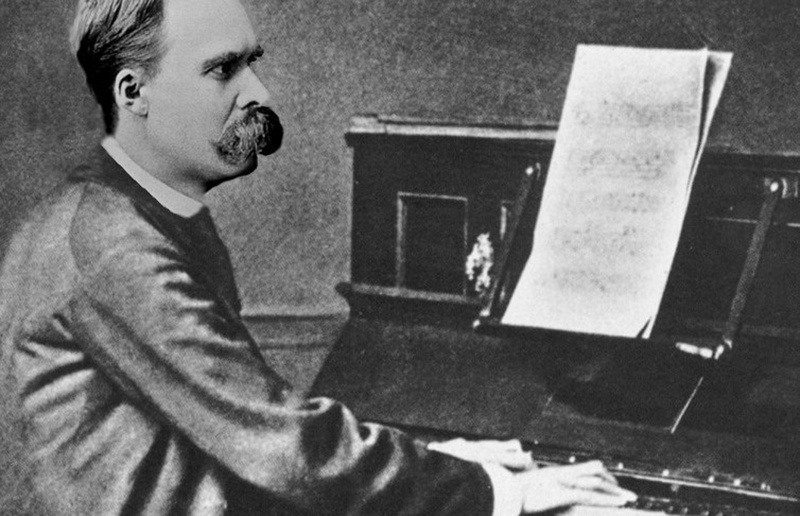
Nietzsche-piano

For today’s audio piece we feature Fred “Sonic” Nietzsche on the keys. Makes me think of the Bonzo’s “The Intro & the Outro”—which is a very good thing!


None-the-less at the beginning of The American Century as education, industrialization, science, and an expanded political franchise were in motion, the book seems to have struck some sky’s-the-limit chords. The St Louis Globe-Democrat published this breathless notice:

If you want to know the greatness of a soul and the true mastery of life, apply to the Open Court Publishing Company for a slip of a book by Muriel Strode, entitled simply ‘My Little Book of Prayer.’ The modern progress of sovereign mind and inner divinity from the narrow cell of the ascetic to the open heaven of man made in God’s own image, is triumphantly shown in it, yet a self-abnegation and sacrifice beyond anything that a St. Francis or a Thomas a Kempis ever dreamed of, glorifies the path. To attempt to tell what a treasure-trove for the struggling soul is in this little volume would be impossible without giving it complete, for every paragraph marks a milestone on the higher way.”

How Strode hooked up with Open Court and its philosophy is one mystery. Even Strode’s southern Illinois childhood is not in Chicago’s orbit, and we know too little about her parents’ social class or connections. One theory that occurs to me is that somewhere in that Stenographer/Typist job title was an intelligent and ambitious woman who made social, commercial and philosophical connections with entrepreneurs and businessmen in those 15 “lost years” that may have been in California.

One piece of evidence for that: two years later she married Samuel Lieberman, “the president of an iron and steel firm in Chicago where Muriel had worked.”

Today’s piece, taken from her later work, 1921’s A Soul’s Faring Instead of Open Court, this one was published by Boni & Liveright, a New York-based imprint much associated with literary Modernism.**  By this point someone had dubbed Strode as “The female Walt Whitman,” and her free verse is, if anything, more unabashed and heroic*** than Whitman, which takes some doing. One has to be of the right mind to read much of it—it’s so over the top. The same Nietzschean philosophical concerns remain from her Open Court books, and the individual, roman-numerated, sections are barely longer at times than her earlier aphoristic “prayers.” There may be a growing mysticism entering into the work as well as elements that at times echo deep-ecology thinking about nature.

After reading three of her books, doing this research, and working on incorporating something I took from the XXXV section of her “Songs of the Strong”  inside A Soul’s Faring, I still don’t quite know what to make of Muriel Strode. The gushing visionary true-believer attitude, even for a reader such as myself who enjoyed William Blake as a young man and who also appreciates Whitman is just so strong, and some underlying “Like attracts like” Law of Attraction elements seem unavoidable.****  So, I can’t say I’ve become a fan, as much as I must acknowledge her audacity and extremity of expression. Perhaps she’s best taken in small doses, in disconnected aphorisms?

In seeking to maximize that element in Strode’s poetry, I’ve adapted her poem, trimming even this already short work back even more, and turning one of its lines into a refrain. And for music? Well, I told you at the start we like to mix things up. Our last piece was orchestral, featuring strings and English horn, but today’s piece, which I call “I Am the Clod that has Taken Wing”  in my adaptation—it’s metal, and of the sludgy type. Maybe in honor of Open Court and the Gilded Age Mr. Hegeler (who must be a Galvanized Age figure), it’s “Heavy Zinc?” Metal is a type of musical expression where you can say anything, no matter how outrageous, and get away with it; so maybe that fits in an odd way, which is what we do here at the Parlando Project. Here’s the player to hear it.


*If you’re not in the mood to adventure into this unusual story of a small town girl who makes her way in the world and some transitory literary notice, our archives here have lots of  better-known poets from this same era and before.

**You, and the world, may have forgotten Muriel Strode, but Boni & Liveright were the first American publisher of William Faulkner, Ernest Hemmingway, E. E. Cummings, Jean Toomer, and Hart Crane and the US publisher of T. S. Eliot’s “The Wasteland.”  So, between the boards, Strode was in high-lit company.

***There’s also an erotic element in A Soul’s Faring  that might remind one of Whitman.

****What we know of Muriel Strode’s life story reads like a romance novel, doesn’t it? Here’s one more novelistic touch, and if you’re a skeptic about the “Law of Attraction,” you’d best ascribe it to a failure of authorship: those two parcels of land Strode bought before leaving California? Turns out about the time A Soul’s Faring  was published, they found oil under them. Lots of oil. If you listen to today’s audio piece over and over, and perhaps play it backwards, who knows what riches will come to you.