As Halloween approaches, here’s a song that focuses on the playfully frightful aspects of the holiday. Wait a minute – I debated typing “playfully” there with “frightful.” I went with that combination as it’s my best guess at the intent of the Vachel Lindsay poem that I converted into a song, though I can’t be sure.
Playing with fear and horror is clearly a part of Halloween. We expect children to celebrate the holiday, and the adults participating in Halloween celebrations plan them to be happy occasions, even though the decorations will be full of spiders and their webs, and monsters, and skeletons, and those dream-flickering pumpkin skulls.
But if you take the poem (now a song) at face value, this is about a woman who is personified as a predator, the femme fatale trope and her victim fly. Had poet Lindsay felt himself wronged by some lover to come up with this piece? I don’t have biographical evidence to point to with an emphatic gesture,* and the internal evidence within the poem speaks to me of a playful mode to the condensed tale of horror it tells. There seems to be a paradoxical agreement on the part of the singer: they’ve been done wrong, but they’re going to speak lightly about this, and while the song’s fly doesn’t say it out-loud, they might be open to just a little more peril.**
A poem that literally describes tearing the wings off flies, yet I’m still holding it as playful.
.
Earlier this month I wrote about the mid-20th century “folk scare” in passing, and as someone who has some grasp of the songs revived by that movement, I couldn’t help but think that Lindsay referenced a floating verse that appears in some American folk songs. Did anyone else catch it from listening or reading the text above?
The spider takes her prey with the line: “She drove me to her parlor/above the winding stair.” Reading this, I immediately heard a specific tune – cementing the idea that this poem would get the Parlando Project treatment. What tune? One widely sung song that features the verse about a woman taking a lover to her parlor goes by the title “Cindy, Cindy.” Besides the parlor destination – sometimes sung in the folk song as “She took me to her parlor and she cooled me with her fan” – most “Cindy, Cindy” versions have devouring women in them too, with verses like “I wish I was an apple a-hanging on a tree and every time my Cindy passed she’d take a bite out of me”*** or even “My Cindy is a pretty girl. My Cindy is a peach; she throws her arms around my neck and hangs on like a leech.”
Quick research says that “Cindy, Cindy” was sung in America in the early 20th century when Vachel Lindsay wrote his poem. I’m going to suspect Lindsay knew one of the variations of it – and he might have thought some of his audience would too.
So, I’m calling it: playful. Likely erotically playful.
I also suspect my music for today’s performance of “The Spider and the Ghost of the Fly” had “Cindy, Cindy’s” tune in its ear a little bit too. You might be able to hear that performance with the audio gadget below – but like the devouring and dangerous love between the spider and the fly, some of you may find the audio gadget hidden and suppressed. Aha! I have this highlighted link, a veritable grail-shaped beacon, that will open a new tab with its own audio player so you can hear the song.
Today’s piece, continuing our series as we consider the variousness of Halloween including the surrounding Days of the Dead and associated horror/fantasy elements, has odd origins. It starts, since it’s useful to mark a starting point, with the death of my late wife decades ago, something that led to an unusual instrument.
Shortly after my wife died, and I was left alone in the house we once shared, I decided I’d take to playing more music in the silence. I went looking for new instruments to inspire me. This intimate death, as it happened, was followed by another kind of ending. To tell you about that, I won’t get too deep into the weeds of the musical instrument business, but one of America’s largest musical instrument makers, Fender, had in the late 1990s quixotically decided to introduce an entirely new guitar brand, DeArmond. In short order they created an entire line of electric guitars and basses, around two dozen models, priced between their budget Squier line that featured inexpensive renditions of traditional Fender instruments and their more expensive American line that the Squier guitars copied – but the DeArmond guitars weren’t copies of the highly popular Fender designs at all. Instead, they were versions of electric guitars and basses once produced by another company, Guild, which had around the same time been absorbed into Fender. I expect few who read this Project will know anything about Guild guitars, and that explains why they ceased to exist as a separate company. But those who do hear the name “Guild” and have a light bulb illuminate, are most likely to think of Guild acoustic guitars.* Guild produced a successful line of acoustics. The Guild line of 12-string guitars were highly thought of: John Denver, Tim Buckley, and Ralph Towner constantly played jumbo-bodied Guild 12-strings, and other folk artists played acoustic Guild guitars in this era: Richie Havens, Paul Simon, and Bonnie Raitt.
So, this was a strange business idea: create a new brand, but make it closely reference past electric instruments many players had never heard of. So how did this turn out?
To quickly answer, I step back in marketing time and type: “Edsel.”**
OK, where are we getting to Halloween? This started with one death – trust me, we’ll get there – and now there’s the pseudo-death of guitar line. Fender pulled the plug abruptly just as our current century was getting underway. They had lots of unsold DeArmond electric guitar stock. I mean lots. They gave some away to schools and music programs. They sold the rest at fire-sale prices. Guitars made to be sold for around $600 ($1200 in 2025 dollars) were being blown out at $200. I quickly bought three of their guitars: a large hollow-body archtop, a 12-string electric solid body, and a 6-string electric with a Bigsby vibrato bridge – not at BOGO pricing, but at those BOG2 prices. I’m writing about a lot of things today, but not those – instead, it’s another DeArmond.
One of the weirdest Guild designs that that Fender/DeArmond revived only to kill – indeed one of the oddest guitar designs of all time – was the Ashbory bass. Guitarist readers are now visualizing an electric bass: bodies at least as big as an electric guitar, but with longer necks. Old guys like me that play electric bass also are thinking weight – heavy, too often more than 10 pounds.
Nope. This is my Ashbory bass:
White lines, don’t do it. The Ashbory is a fretless instrument, the fretboard lines are just markers. Exact intonation with the thick strings and very short scale is a challenge.
.
Weighs less than a Stephen King novel. Less than half the length of a regular electric bass. Body just a little bigger than a CD case. The original strings, specially designed for it, were translucent rubber bands. The current strings on mine are smooth white opaque nylon, essentially extra thick versions of a modern classical guitar string. Unlike a normal fretless electric bass, which is a beast to play, you need to be almost delicate when playing these extraordinarily low-tension strings.
Other than the tiny size, a goal here was to approximate the plucked sounds of the even more unwieldy upright bass, but neither the original 1980’s Guild Ashbory or the late ‘90s DeArmond copy sold well. I used mine when I wanted upright and fretless bass sounds for a while, but in the last few years I’ve moved over to using other methods to get that sound on Parlando recordings. This week someone mentioned they’d just purchased a used Ashbory, reviving memories of that time and leading me to revisit the instrument musically. In my studio space I got the tiny bass out and plugged it in to record. To get the upright bass sound from it you want to use bare fingers, but for some reason (habit?) I decided to use a thick rubbery pick – which is one way I play regular electric bass. This gave me a slightly more aggressive sound than I recall getting out of it and I then programmed in a drum pattern to match where that result was leading me. Building from the groove, I played some electric guitar and added a piano part, producing a short two-minute piece as my studio time ran out yesterday.
Listening to the result this morning I felt the music had a sense of longing or leaving. That may have leaked from my connection between the DeArmond Ashbory and the time after my wife’s death, which was followed by my mother’s, and then after an interval, my father’s death. Could I find some words to go with this music? Nothing I had in my files of poems for Halloween seemed to fit, so I did a web search for “poem about a ghost leaving or disappearing.” Bam, this lesser-known Sylvia Plath poem came up, right on point!
Plath’s “A Ghost’s Leavetaking” is an 8-stanza/40-line poem, not all that long, but longer than my just-over-2-minute music could cover. The poem describes a somewhat distressed awaking in a morning where the speaker is mixing dreams and remembrance of the dead with an ongoing adjustment to mundane household tasks.*** Just as in Phil Dacey’s “Frost Warnings” poem from earlier this month, Plath sets up tired laundry and bed sheets that “signify our origin and end” while they play the role of ghosts of the departed.
A good poem, but now I had two problems: an apt text too long for my music and a poem not in the public domain.**** “A Ghost’s Leavetaking” was written in the 1950s and has not yet reached PD status in the U.S.*****
I made a quick decision. I would use only some lines from Plath’s poem. Artistically I thought that worked. It made a shorter set of text to fit the music I had finished. I was able to zoom in on the Day of the Dead and ghost elements of the poem, shortening the examination of how we sometime wake still recovering mundane reality from our dreams. If you would like to read the entire poem, as Plath published it, here’s a link. As to the PD situation, my solution is at best mixed. “Fair use” is not a firm concept, and my Project’s entirely non-revenue and educational purposes are no guaranteed Kings X. Using only a few lines would bolster my case, but as I used about a third of the poem, that’s not clearly kosher. Even forgetting laws, if Plath were a living author, she’d be well in her rights, regardless of the law, to take issue with someone cutting her poem up, making it less than she intended it to be.
So, from that decision, we’re left with this musical piece where I quickly sketched out today in my little home office “Studio B” how one might sing some lines from Plath’s poem with the music I finished yesterday. I’m aware of the limitations of my voice, and in an ideal world the melodies could be better worked out and ornamented by a better singer. None-the-less, I found it personally rewarding to inhabit Plath’s words and do the best I can today to convey the emotions and images she put in them, and some listeners may gain something from that performance. You can hear my sketch using lines taken from “A Ghost’s Leavetaking” with the audio gadget below. Has the audio gadget gone to Plath’s “lost otherworld?” I offer this alternative as a keeper of the “profane grail,” a highlighted link that will open a new tab with its own audio player.
.
*Fender had never been able to make itself a factor in the upper end of the acoustic guitar market, so it was assumed that’s why they snapped up the distressed Guild company: for the well-thought-of acoustic guitars.
** There are car folks who will tell you that the Edsel was a perfectly fine late 1950’s American car, but that doesn’t change what the brand name invokes.
The Guild electrics were pretty good guitars, if not answering what the market wanted back in their day. Some of the DeArmond sort-of copies were arguably better instruments than the originals, but they were just as out of sorts with what the market wanted. In 1998 the electric guitarist customer wanted a Stratocaster or a Les Paul, with a Fender or Gibson name on it, or one of the slightly hot-rodded extensions of those Fender or Gibson models. The sort of funky, oddball looks of the DeArmond guitars would have stood a better chance a decade later after Indie rock stars started to come forward making a point of playing anything but a Les Paul or a Strat.
***I had the vivid experience of my late wife seeming to return to my bedroom in the liminal hours. From things I’ve heard from others, this is not uncommon for those who’ve lost intimates.
****I’m not all that troubled by asking for forgiveness from a ghost, but one of Plath’s children is still alive, and may hold the IP rights to Plath’s work. Her web site lists the Faber and Faber UK offices as the contact for Sylvia Plath rights permissions, but I got no reply early in this project when I asked that very organization about my small-time, non-revenue use of another Faber and Faber author. I would remove this piece on any objection.
*****If I did a little day trip up Highway 61, to say Thunder Bay Ontario, Plath’s poem would be PD there. And thanks readers for following me on this post’s road trip.
It’s been a busy week at the Parlando Project studio as I record more Halloween-themed songs freshly made by combining other people’s words (usually literary poetry in the public domain) with original music in differing styles. Let us go to the lab and see what’s on the slab.
Last dark-and-stormy-night-time we had a poem that started with someone at a household’s door asking to be let in. Waif or wraith? Therein lies that tale. Today we again have a piece that starts at a doorway — but the tale-teller here lets themselves in. What do they find there? Well, that’s the song.
The words I used today originated with a poem by early 20th century American writer Margaret Widdemer. While Widdemer is little remembered now, she was a successful presence in the literature of her day. And while the Parlando Project does the everlasting Greatest Hits of Poetry sometimes, I also like digging through old poetry collections and anthologies looking for overlooked poems and poets. Such “many a quaint and curious volume of forgotten lore” reading let me find Widdemer, and one thing that drew me to her was that she seemed to have absorbed some stuff from the folk-music collectors of her time — for example, this eerie poem of hers that builds on the “Lyke Wake Dirge”presented here six years ago.
One thing that folk-music tradition teaches us: the singer is free to change and adapt the song that was handed down to them. Entirely new words or new music may be applied. Verse order, much less exact wording is not sacrosanct. Instead, a good fit for the singer and the audience (these being the folk in folk-music) is the guiding force. Most composers who work in the Art-Song form are compelled to keep the text unaltered, and while I’m not of that tradition, I most often present the poet’s words as they published them for the silent page. But, for today’s piece I substantially altered Widdemer’s poem to make what I hope is a more effective song.
I started with a simple change: I created a refrain based on the initial verse of Widdemer’s original text when I found it ineffective for audience grabbing. In other revisions and additions, I sought to sharpen the “build” of the story’s details, and I excised antique words and diction that added no charm.
Musically I recorded a late-night laid-back Rock combo of two electric guitars, electric piano, bass, and drums for my resulting song. Here’s the chord sheet in case you’d like to play your own rendition. That’s also the in the folk-music tradition: the song shouldn’t belong to only one voice.
To hear the way I played and sang it you can use the audio player below. What? Has no audio player gadget materialized on your screen? This highlighted link will open a new tab with its own audio player then.
I plan to be back soon with an entirely different, more orchestral ensemble for the next piece in our 2024 Halloween series. Should I act like a YouTubber or Substack author and urge you to subscribe for this upcoming content?*
No, I’ll leave you as a free agent on that decision. This Project goes beyond non-profit — it is by design no-profit. I just love diverse music and poetry and get a kick out of exploring what’s possible. I have nothing to sell and would avoid anything that is paid by the click, because I have no makeup to be a small-businessman.** But my self-regard (or desire to promote a range of poetry) likes seeing viewers and listeners. Sharing this stuff on social media, or just telling a friend, will help keep this going.
.
*The Parlando Project started as a short-form podcast, one sans the usual blather, paid-for-promotions, and between-host jocularity — presenting instead our typically 2-5 minute musical pieces unadorned. It turns out that podcast audiences prefer one-to-two hours of gab — but if you want a break between the talkers in your podcast app, you can still subscribe to the Parlando Project on Apple Podcasts or most other popular ways to get podcasts.
I don’t believe I misunderstand those who appreciate the typical podcast format. I sometimes listen to podcasts while cleaning or fixing something with my hands. Alas, as a person who spends much of their time reading, composing, playing, recording, and mixing music, my own ears are usually occupied, and so I lack time to partake.
**I admire small-business people in general — and yes, I appreciate how hard it is for musicians, composers, and writers to make even a meagre living these days. While I work at this Project like someone with a small-business enterprise, I’m just not suited to bookkeeping, form-filling, and tax-law lane-keeping.
I left a comment on the Fourteen Lines blog last month when I saw he’d posted this Kenneth Slessor poem. I didn’t know the poem, but I wrote that blog’s host that he and I may be the only Americans who appreciate Kenneth Slessor.
Slessor is an Australian poet, and Australia is a long way off, but then over in our hemisphere we’re not obligated to keep all the poets of the first half of the 20th century in mind either. I know little about his life other than the short-ish Wikipedia article. I did a more elaborate search a few years back, and I recall he was considered by some as a pioneering Modernist in his country.*
Some of his poems I’ve read don’t move me on encounter. There are elements in his verse at times that vaguely remind me of a troop of other British poets contemporary to Slessor in the U. K. What is that that leaves me cold in that field of first half-century British poets? Stilted, too formal language, non-vital metaphors, musicality that can only barely contest those first two failures. This could be my failing, my taste may not be yours, and another apprehension (mis or otherwise) of mine is that there’s a whiff of posh-boy entitlement and clubishness in too many. I’m a Midwestern American, I could be wildly misjudging this. I make no claim of authority.
But no matter that, because his best poems move me like few other pieces of verse can. They have Modernism’s Classicism streak, that idea that the poet doesn’t always presume to tell you what the characters in the poem think, nor does he directly tell you what to think about what goes on, even though the selection of what he portrays intends an effect.
I know nothing of Slessor’s poetic influences.** In the Wikipedia article someone says he was compared by someone favorably to Yeats. I’d have to squint to see that one. Someone else said Baudelaire, and I can see that somewhat, though Slessor avoids the bad-boy-boast persona. Indeed, in my favorite Slessor poems, he’s not in them at all, he’s just the observer, and we only know him by his senses — which as we read those poems, become our senses.
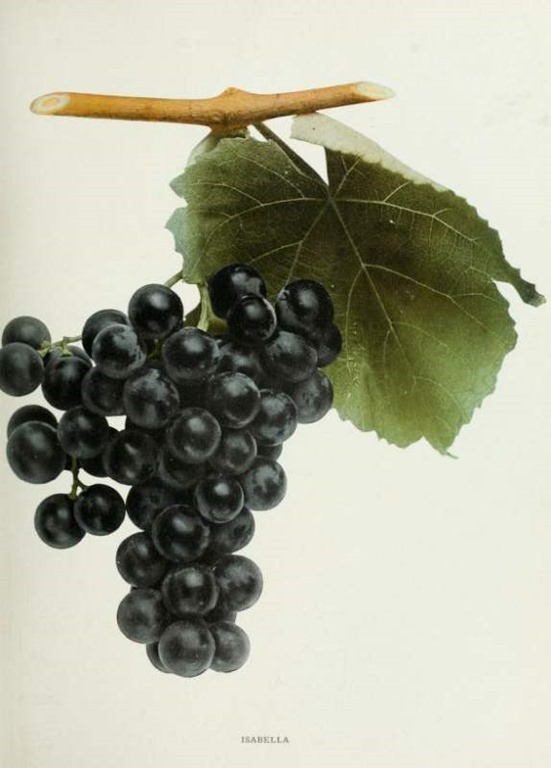
Such a poem is “Wild Grapes.” I can see and smell the marshy landscape, the broken orchard, and the sight, the shape, the texture, the musky taste of a wild black grape.
Then as the poem reaches its penultimate stanza, a bit of mystery arrives. There is a sense there of a ghost, a “dead girl” named the same as the grape variety — and as the poem moves to its conclusion, seen as a union of the two, before we move to a final disturbing line.
Ending poems is hard — at least I find it so. I could generate a hundred good starting lines, and yet with the same effort still not come up with a single good last one. Slessor’s last line grabs me. There’s a reason the ghost’s spirit stays in the deserted place. Maybe it’s her similarity to that wild black grape. Or maybe it’s some emblazoned event, before the orchard was abandoned, its sweet fruits of apple and cherry still tastable and ripe. The poem’s voice only suggests: kissed or killed there. Is there a dichotomy, a distance between those two suggestions? Perhaps Slessor intended that — but here’s what I think: I read that line, implying an “and” not the written “or,” as a vivid allusion of sexual violence.***
You can hear my performance of Kenneth Slessor’s “Wild Grapes” with an audio player many will see below. No player? This highlighted linkwill open a new tab with it’s own audio player.
.
*He wrote poetry between the end of WWI and the end of WWII, so not in the very first wave of Modernism elsewhere, but Australian culture might have lagged a bit from Britain, France, and the U. S.
**I can see Rilke and Robert Frost in his poetry, and there’s nothing outlandish to think he might be familiar with their work. A prominent object in this poem are grapes, and I thought of this poem by Rilke, and this one by Frost, which also feature that fruit — but I don’t know. Though my favorite Slessor poems are more sensuous, there’s an epitaph character sometimes that reminds me of a somewhat forgotten early American Modernist, Edgar Lee Masters.
***I suspect more women, from more experience of violence chained with sexuality, would see that reading. Slessor wrote “or,” and his typewriter had other keys if he wanted to use them. He could just be musing on a range of things and the unknowability of the lives on what sounds like a plot once occupied by lower-class settlers or convict exiles from Ireland.
Yesterday in our Halloween Series I mused on the appearance of ghosts in a garden with Millay’s blithe apparition. As I present today’s musical piece adapted from literary poetry, Thomas Hardy’s “The Shadow on the Stone,” let me start by asking questions. Many others will follow.
Do you want to see a ghost? Is that wanting part of what makes it appear?
Hardy’s poem is poised in that first question. As I have performed it as a song with music that I wrote for it, I should wonder if the words are clear enough in themselves to tell us what the situation is. Looking at the text of Hardy’s poem, I think it’s mostly self-sufficient in that regard, though some mystery (possibly useful mystery) remains if nothing else is explained.
When I first presented this in 2021, I went into the biographical specifics that engendered this poem, but for today let me just say that the “she” that the ghost is supposed to be is Hardy’s dead wife who was completely estranged from him before her death. Nothing in the poem spells that out, nothing tells us that when living she had grown to find Hardy completely unsuitable. Well nothing, save for a line that we can hear as modern idiom that Hardy may have intended only as a brief metaphor: “Her behind me throwing her shade.”
Ghost from a machine: illustration from Adobe Firefly, the AI engine that proclaims it doesn’t use uncompensated artists work.
.
Such a complex ghost, or a wish for a ghost, this is!
Does Hardy want to see the ghost? Does Hardy fear to see the ghost? Can either of them speak? Are either of them changed from what they once were? Is he haunted by her, or haunted from her? All the answers are all the answers here. The curly shape of the question mark the shifting curve of an ghost manifesting.
Spontaneously when doing the vocals for this piece I decided to throw in some more answers at the end of my song in the form of “inline epigraphs” that Hardy didn’t include with his poem, but this performer did.
You can hear my performance of Thomas Hardy’s “The Shadow on the Stone” with the audio player gadget below. You don’t see a player? This highlighted link will make one appear in a new tab.
Last time in our Halloween Series, an A. E. Housman poem combined with music had death on a knife edge. Placed at the end of the growing year in northern places, Halloween comes at a time in a yearly cycle that suggests death. Note: that statement includes the word “cycle.” Humans have memory, and song, and eventually writing, so we know the turning round — the end of the growing comes before the white none of winter and before the regreening of spring.
Should it be so with death, that full nothing? Some hope and believe that so, though we can have no memory of that. But even one life has many turnings, places we pass through and leave. Today’s piece ends by portraying that we open and close gates of memory, gates that are no longer there.
Edna St. Vincent Millay wrote this poem of a non-threatening ghost. It’s an earlier work, and some see the ghost as a wisp of her not-long-departed girlhood. I’ll add that the choice of having the ghost appear in a garden speaks to the placement of Halloween in a harvest/leaving time of the year. Gardens have needs: nutritious soil, water, sun, and care. Perhaps they need ghosts from time to time as well?
“She paused—then opened and passed through a gate that once was there.”
.
The music I composed and played for Millay’s “The Little Ghost” shows South Asian influences, what with harmonium, tambura, and my vibrato note electric guitar playing. You can hear that combination of words and music with the audio player below. No player to be seen? This highlighted link is an alternative, it’ll open a new tab with its own audio player.
What’s coming up? Halloween! And I’ve decided to dedicate the rest of this month to accelerated posting of some of the Parlando Project’s favorite pieces of fright, fantasy, and the uncanny. There will be ghosts a-plenty, curses, creatures, spells, and graveyards. The Project has done over 700 combinations of various words (mostly literary poetry) and original music over the past 7 years or so. The poetry is of different styles and eras, and the music differs to, at least as much as I can make it do so.
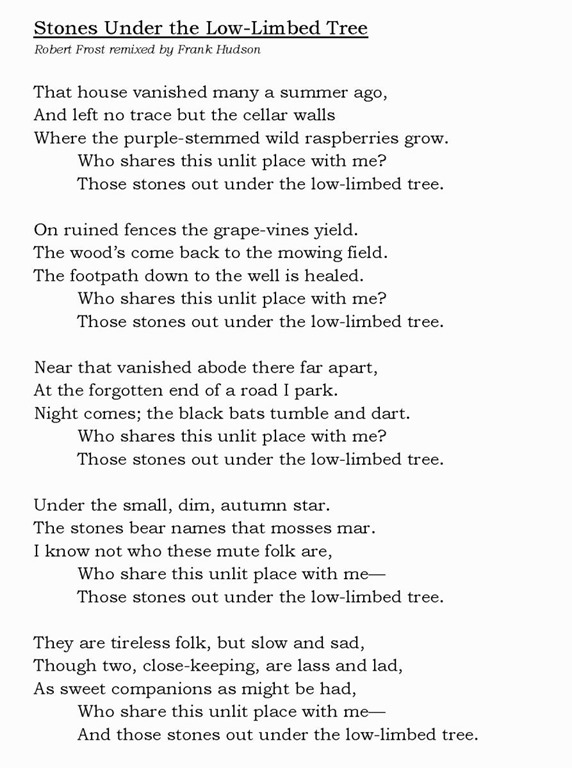
Here to kick things off is a poem by one of America’s favorite poets, Robert Frost, that I adapted and recast in making it into a song. Can Frost do eerie clothed in nature’s homespun? I think so. Frost called his poem “Ghost House.” I revised it enough that I decided to use a different title when I presented it in 2020 as “Stones Under the Low-Limbed Tree.”
If you compare my lyric to the original poem hyperlinked above, you can see I refrained things more than Frost did in his page poem
.
You can hear the resulting song with the audio player below. No player to be seen? This highlighted link is an alternate way to hear it. It’ll open a new tab with its own audio player.
There’s a story that a poet once read a poem to a small group. There were a few murmurs in that small audience, that kind of appreciation — the kind that a not-uncommon everyday poet might expect at a public reading. It’s a sound that says “That certainly sounded like something. Might be good, but can I trust myself? That was poetry, and poets can be clearly beautiful without being, well, clear.”
Yes, there are poems that can cause amen shouts. Yes, there are poems where audiences will applaud. Some of those poems are useful, and isn’t that a kind of beauty? Yes it is — but I said this was one of those poems one more commonly hears when a poet reads.
This time, one listener in the small audience spoke up. “What does that poem mean?” they asked.
The poet looked at the honest questioner for a moment. Looked down at the podium. Paused a moment more. And then they simply read the poem again.
Note, the poet didn’t chastise the listener. It’s good when readers and listeners want to know what they can take in from a set of words and sounds. The issue here is that many poems are written by sincere poets who wrote and crafted a poem without being able to express what they labored to put in the poem nearly as well otherwise. The object of such a poem isn’t a summary, an allegory, or single thread of argument or narrative, rather it may be something designed not to be vague, but to exactly reflect differently as one stands around it.
Are we to comfort and remember the ghosts or be frightened of them? Yes.
.
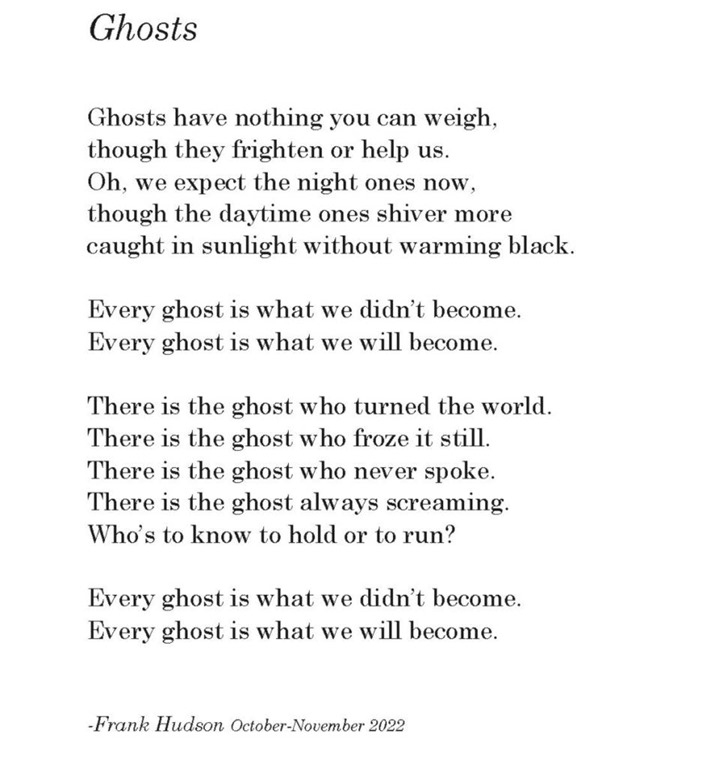
I wrote the text for today’s performance. I accumulated a few lines in my head during a day — and then when I should have been going to sleep, they asked to be written down. Three revisions later and it’s at the version I performed today. I think this is a fairly plainspoken poem, but I know from experience when I’ve presented my work to other people they often find poems in this style baffling and ineffective, this even though they too are poets. I could write here about what they’ve suggested, and what I’ve resisted in those suggestions, but let’s defer that for now. I could also write about what engendered this poem, what the lines seemed to mean when I looked at them from a variety of directions, but tonight I feel the poem at this level of revision says what it should say as well as I can say it in its resonances and refractions. You can hear me perform “Ghosts” with the player gadget below. Don’t see any such player? Use this highlighted link and it will open a new tab with an alternative player so that you can hear it.
Because they usually deal with brief moments in time, we sometimes think of lyric poetry as making do with simple thoughts, singular emotions felt distinctly. Today’s piece, English poet Thomas Hardy’s “The Shadow on the Stone” shows us it can be otherwise.
I suppose one can say it’s a poem about grief, or you could say it’s another ghost story. If it’s a ghost story, it’s poised entirely between belief and disbelief in such afterlife visitations. If it’s a grief poem, and it is that I think, it points out that grief doesn’t mean simple, singular, feelings.
Let me summarize a few things that are biographically behind this poem, even though I think some of its ambiguity can be sensed, felt, and to a degree understood without them.
The poem’s author, Hardy, was married in his thirties* to another woman of the same age. There was something of a romance in their courtship story. She was beautiful, looked younger than her suitor, and loved to ride around the English countryside on horseback. She was a doted-on daughter from a well-borne family that had had some financial setbacks. Hardy was from a tradesman’s family and was not established successfully in a trade or as the controversial author of novels he would become. Not long into the marriage, the wife began to think of this as what would have been called then “a misalliance.” He was beneath her standing after all — and Hardy’s eventual emergence as a novelist of note if anything made her more estranged. She considered herself a writer, while others dismissed her work as all the while Hardy’s began to succeed.
Eventually she moved to the attic of their house, and their emotional separation was an open secret among their acquaintances. In 1912, after more than 35 years of marriage, most spent in estrangement from her husband, she died.** In going through her attic quarters they was found a manuscript she had been writing. Some accounts give its name as Why I Hate My Husband and others What I Think of My Husband.***
For Emma, Forever Ago. Thomas Hardy and pre-ghost-wife wife Emma back in the 19th Century.
.
So, what happens in the moment of this poem, after her death, and after that life-history? Here’s a link to the poem’s text if you’d like to follow along. The poem’s speaker (I’ll just say “Hardy,” as Thomas Hardy was forthright about the subject of his grief poems) is working during the autumn in his garden and sees cast across a “Druid stone”**** a shadow shape which he says in his imagination brings to mind the shadow of his dead spouse when she would garden there. While he says this was “imagining” he’s not completely sure. Those aware of Hardy’s marriage history will hear a particular salience in the statement that the ghost of his dead wife is one “I long had learned to lack.” But this phenomenon, of intimates appearing in the imagination of the grieving is commonplace, and I can say in the experience of myself and my dead spouse, it’s not a simple wistful visitation. If one’s world has been turned upside down, you may not want it to spin some more, even backwards.
In the second stanza this “Is she really here, or my imagining” state is interrogated. Hardy speaks to whatever is behind him casting shadows, and says (perhaps just in case it’s a real, and maybe even a vengeful, ghost) “I’m sure you are standing behind me.” As if he’s conjured up a spirit and he’s letting them know he knows who/what they are, knows their name, and can query it.
The spirit doesn’t respond. I love the ambiguous skeptic’s final two lines here: “I would not turn my head to discover/That there was nothing in my belief.” Hardy wants to not face it if the spirit is real, not an imagining, and we don’t even know if from fear or love.
Continuing in ambivalence, Hardy says next that he wanted to look and disprove, a statement that he in action doesn’t do.***** Instead he leaves the garden without seeking to disprove or confront the spirit or imagining he believes is representing his dead wife. Best as I can tell, the idiomatic expression “throwing shade” is of Afro-American origin. This Merriam Webster note says it was popularized on Ru Paul’s Drag Race circa 2010, though I’m pretty sure I heard and used it before then. In my performance, I speak it in that meaning, even if Hardy didn’t mean it that way in his time. As in life, Hardy seems to say he must endure and miss his spouse, and so this ambivalence with a possible ghost resonates with his grief.
I mentioned performance above. I started composing here thinking about the Afro-American musical influences on the Velvet Underground, both in rhythm guitar figures and in Moe Tucker’s spare drum kit and approach. If I would have written the drums in this as a jazz-influenced piece, the high-hat would have marked the beat, but there’s no high-hat in this piece’s drum kit, though the tambourine playing does stand in for it somewhat. This didn’t turn out to be a Moe Tucker style drum part after all, but that’s where I started.
My original take had things ending on Hardy’s poem’s final word: “fade” — but overnight I decided it needed a reprise after that hung resolution, and while playing that I decided to riff on some other famous lyrical uses of the word “fade” as a trope of death and persistence. A player gadget is below for some to hear my performance, but if not, this highlighted hyperlink is another way to hear it.
.
*This is fairly late for a first marriage in the mid-19th century.
**She and Hardy were 72 in 1912. This is not one of those stories of the stricken young bride who died long before her time.
***We may wonder just what the real deal was with their relationship, who was meaner or more dismissive to who — and well, the patriarchy and all that may have colored within the lines, as most accounts by men and women seem to paint Thomas Hardy as the aggrieved party in the marriage. Interesting matters — but for the purposes of presenting this poem, beside the point. Flip a few gendered words in the poem, and imagine it being written by a widow who thinks of her abusive or belittling husband after his death.
****I wondered about this peculiar detail. Was this a characteristic English garden decoration, like a birdbath or garden gnome statue? No. A large flattened top stone was found during construction which Hardy thought was an actual Druid stone, perhaps used as an ancient altar. More evidence that while Hardy was a skeptic, the realness of a supernatural “apparition” is meant to be in question — and this may also allude to some metaphoric bone and ash sacrifices the marriage brought to their lives.
*****In a short essay on this poem, Jeremy Axelrod sees an allusion to the story of Eurydice and Orpheus in the underworld. Hardy doesn’t usually use classical Greek allusions in the poems I’ve read, but even if unintended, well, “death of the author” and “archetypes.”
Today’s piece has an eerie history. It started as a poem by Robert Frost, but I think four years ago I turned it into a song. I had more or less forgotten about it, but this past week I found it in some past work that I had separated out to work on for this project.
Looking at it, I put it near the top of the pile. I thought it representative of the best of early Frost, when he was a supple lyric poet. “This’ll be great. So clean in language. So concise in his laying out of the story.”
The process of producing the performance and recording that you can hear below went well enough. So today I was getting ready to write about my experience of Frost’s poem after going through this project’s process. As usual, I wanted to find a location for the original text for those that want to read along. I found a good link to Frost’s poem. It’s here.
Surprise! Turns out I had modified Frost’s poem much more than realized. I had recalled only that I had repurposed a pair of Frost’s lines to create a chorus/refrain—but when looking at the original poem I hardly recognized the text I had been working on during the recording of the performance this month. It turns out, “Ghost House” (as he titled this piece) was an early poem of Frost’s, written in 1901 and included in A Boy’s Will, his first collection of poems published in England in 1913. Unlike most of the poems in that collection, “Ghost House” had been published, back in 1906 in a magazine. The reason A Boy’s Will was published in England was the Frost had made little headway as a poet in the United States. At that point he was nearing 40 years old, so it’s possible that if Frost hadn’t traveled to and succeeded in England, this greatly loved American poet would be nearly unknown.
I stress the actuality that I had no recollection of recasting the poem extensively when I say that I prefer “my version” to Frost’s original. The lack of any memory of the work I did means that this judgement is rather impersonal. Frost’s “Ghost House” isn’t bad, but it’s not as distinguished as other poems in his early work. It seems more 19th century for one thing. It also overdoes it, seeming to confuse more elaboration and details for more impact and substance.
Here’s Frost’s poem as revised for singing.
When I briefly try to reconstruct what I did to make the text for today’s piece, I see I used his lines for the most part, but I trimmed out much. My lyric is essentially 17 lines. Frost’s is 30. I dropped entire images, some inconcrete and a bit trite (“I dwell with a strangely aching heart”—you’ve shown us that mood Robert, telling us that is less vivid), and some redundant (we’ve got raspberries and grapevines, we don’t need the apple tree* too). Then too, I chopped the entire whippoorwill stanza, which some argue contains the key image in the poem.**
I also may have just been trying to make it more sing-able.
These two things are lessons. First, poetry often gains power by saying something in its most striking, sensual, and strong way—or even when it’s being less direct, by combining a few things (perhaps only two things) in an unexpected but powerful way. Everything beyond that may detract. The second-best or third-best image subtracts by its addition. Frame your best images, don’t embarrassingly hide them in clutter. And secondly, at least with lyric poetry, when it sings it means. Poetry works through the music of thought. Even something that clarifies the meaning or explains further a point may sometimes be dispensed with in order to make a poem a musical statement that will lodge in the reader/listener’s ear, and via that canal to their brain. In this case I don’t think I sacrificed clarity, but also I don’t think I could sing Frost’s version—and at least in my case, I didn’t remember his.
Did what I do mean I think I’m a better poet than Robert Frost? Nope. I also may not be a better poet than you. But on any one day, on a particular task, with a particular aim, I might be. Frost was a famously grumpy personality, but perhaps his ghost has mellowed with immortality. If so, I hope he might think I served the inspiration of his early poem by trimming it back. Or maybe I didn’t make these changes, since I don’t remember? Perhaps Frost’s ghost came by and made the revision?
To separate this version from the canonical Frost version I call it “Stones Under the Low-Limbed Tree.” The player gadget for my performance is below. Oh, and do follow at least one of the links in the first footnote below. You’ll visit other ghost farmsteads in search of fruit still yielding outside fallen cellar walls.
**I didn’t know, but some readings of “Ghost House” say the whippoorwill is known as a bird foretelling death or other disasters. News to me. Even if I knew that, foretelling seems to blunt the impact of the poem as I cast it. In my mind the point is that the death/disaster has already occurred. Yes I know, some readings say that the poem’s speaker is either dead or gothically welcoming death for himself. I don’t disagree with that, but it doesn’t change my view. Even if the speaker is still alive but wants death, an omen bird’s warning is gilding the raven.






 Frank Hudson