I think there’s a misapprehension of Carl Sandburg’s poetry: that it’s simple, prosy work: that it says what it says, hearty single-minded messages with some decorative metaphor. Tastes differ, and mine may not be a guide to anyone else, but I sometimes don’t find him so. As I continue trying different things during the summer with this multipart personal story, I’ll return to our regular stuff at the end today with an example of Sandburg mysterioso.
The finale of my June trip to Iowa City to see what I could find out about an even more under-considered Midwestern 20th century poet, Edwin Ford Piper, was planned to be a visit to Galesburg Illinois, a small city just east across the Mississippi river where Sandburg was born. Piper and Sandburg compare easily. Both born in the American Midwest a couple of decades after the Civil War, both part of early 20th Century literary movements we no longer take as much notice of. Both were attracted to a broad swath of memorized vernacular music that would be called “Folk Music.” They knew each other, even shared stage programs. Sandburg’s 1927 music collection The American Songbag established what American folk music would be for my mid-century generation,* and from examining Piper’s papers I could see his definition paralleled Sandburg’s. Piper was one of the contributors to American Songbag.**
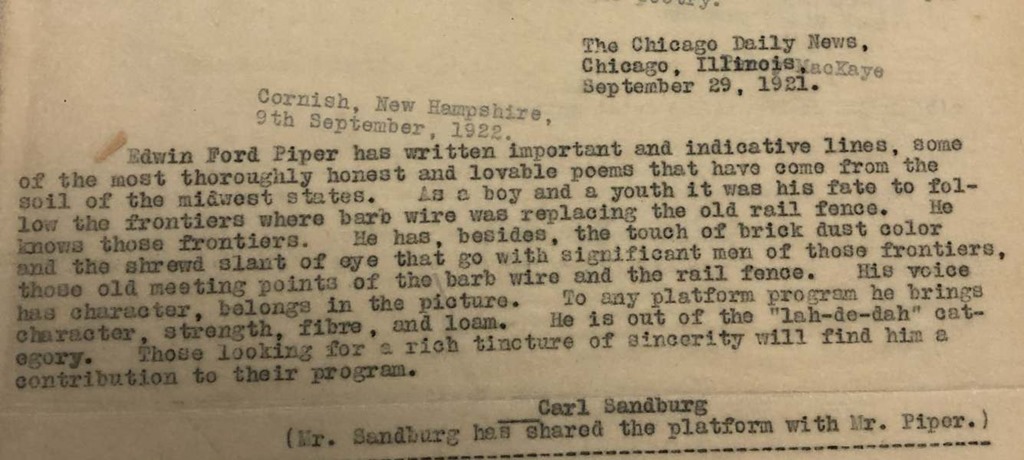
Poet Sandburg blurbing poet Edwin Ford Piper. I also saw a note from Sandburg thanking Piper for songs used in Songbag, but don’t have a picture of that.
.
We arrived at Galesburg early for the 1 P.M.-opening of the Sandburg birthplace site. We wandered the wondering-what-it’ll-become-in-the-21st-century business district with its building facades still showing a variety of past decades abandoned styles left to fade, and browsed a charming small bookstore there. We were going to have an early lunch somewhere, and decided to just get sandwiches and go eat them in the small area behind the birthplace on benches by the Remembrance Rock there.
The rock is an unremarkable bolder, utterly plain and unshaped as a design choice.*** Sandburg and his beloved wife and partner’s ashes are buried under it. The lawn it sits on behind the house is circled by bushes and a few trees, and rather than any sense of a park, it reminded me of the backyard of the house where I grew up in Iowa. One thing the photos I have seen of the rock didn’t show: a ring of irregular, small, flat, stones that circle it, each engraved with a line from a Sandburg poem. If one wished, one could ceremoniously walk from flat grounded rock to rock stepping with your foot-soles on his words, which it seemed to me to be what one of Sandburg’s models Whitman has commanded — and so I did. There’s a nice bust of Sandburg on a stand there too, but to my sense of the place, walking his words was more meaningful. I’d told my wife that Sandburg’s father was a railroad blacksmith, and she figured that the neighborhood might have been handy for rail workers. After our lunch, she took a little stroll while I waited, and she came back to report that just over a rise a block away was the railroad line.
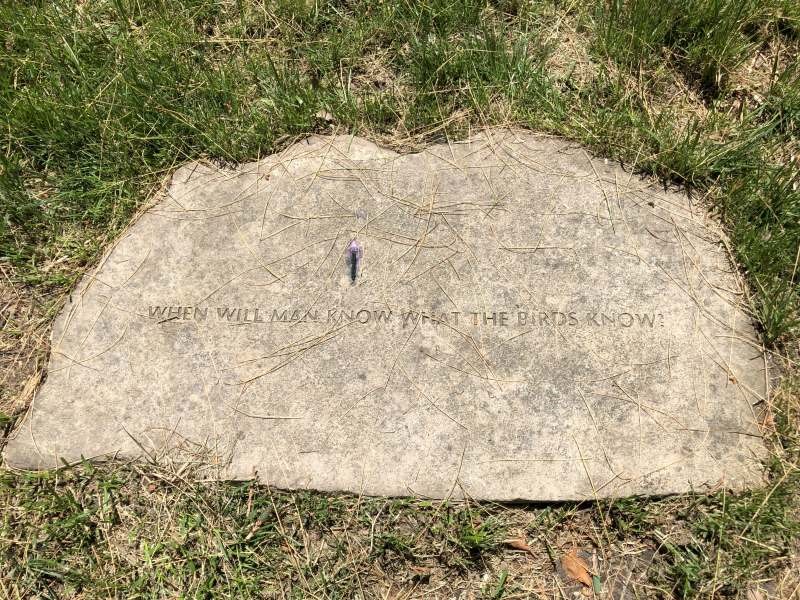
…but then all the birds know is to poop on poetry-engraved rocks, same as any other.
.
One of the site’s staff members arrived ahead of opening time to do a little yard work, and when that time arrived, he changed tasks to welcoming and serving as a guide for about 30 older folks in an adult learning program who arrived from Peoria in two small busses. Beside the birthplace (our host preferred to not call it a house, but a railroad worker’s hut) there was another small, somewhat rundown house next door that served as the site’s offices and a small room of memorabilia backed with an illustrated wall timeline of Sandburg’s life. Behind the two houses was a garage that has been turned into a cozy theater space where they host musical acts in homage to that part of Sandburg’s heritage.
My wife and I plus the 30 others overwhelmed the birthplace site’s capacity. Resourcefully the staff divided the group into two, and after watching a short video on Sandburg our half got to walk through the birthplace hut or house. If you are familiar with the modern tiny house movement, the floorplan and the maximal utilization of it would strike a resonance. Outhouse, no plumbing or running water, it’s decorated in late 19th century Swedish immigrant homey style, but a couple, a young child, and a baby would have been a tight fit, much less our troop of visitors. I recall visiting a reconstructed Lincoln birthplace cabin as a child, and though the Sandburg birthplace is wood-frame construction, not a log cabin, the square footage and amenities might have struck Lincoln biographer Sandburg as similar.
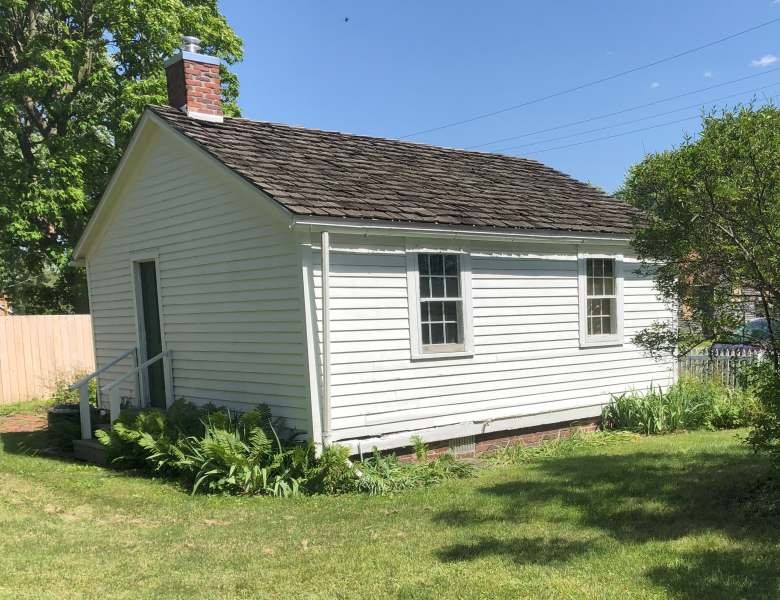
Sandburg’s birthplace: house, hut, cabin. This side shows the smallness best I think.
.
Perhaps because of the touring group’s visit, there was a special performance by a singer-guitarist whose name I didn’t catch, who did a short re-creation of Sandburg singing and talking about his life. I enjoyed that effort. Before leaving, I asked one of the leaders of the visiting group, an old professor, who had some years on your old guy reporter here, what Sandburg biography he’d recommend. He cited Penelope Niven’s bio, and I bought it at the site’s store.
No one hides the fact Carl Sandburg might not have much direct memory of the birthplace as his family moved to another Galesburg house while he was only a toddler**** But the link to his parents and the choice of it for a burial place (which was I believe his doing) speaks to the meaning to him. Unlike the larger house and goat farm where Sandburg spent his post-WWII life until he died that is a National Parks Service site, the birthplace is run by the State of Illinois and some local spirit and volunteerism. Sandburg retained throughout his life a fondness for Galesburg, never hid his roots there, and Galesburg was also the place where he attended college after his stint in the Army, though he never completed a degree.
Which brings me to today’s new musical piece, a setting of a Sandburg poem about someone who apparently left town wiping the dust off their shoes at the city limits. In his collections Sandburg called the poem “Gone,” but the main character’s name sticks in some memories, so it also gets called by the first line, or by the character’s name that appears in that line: “Everybody loved Chick Lorimer in our town.” Here’s a link to the text of the poem.
I promised mystery in this one. There are things left out, and various implications some of which complicate, some of which conflict, are left open. Can we even take that opening statement at face value? Not now, certainly not in 1916 could it be said that we all love “a wild girl” with a dream “she wants.” Some might, many would not. Wildness and dream-holding create envy, often a lot of it.
Is Chick Lorimer someone that everyone in town has marked as special, marked for greater things — someone so preeminent in their youth where that envy would be tamped down? If so, why the sudden leaving, with no one knowing where or why? Does a recognized prodigy, much loved, leave a place without saying goodbye? That would be a rare story.
Perhaps the “everyone” is a casual overstatement, referring only to a small group of friends who shared ideas? Later the poem seems to refer to larger numbers however.
Is she not actually loved by much of the town, and “loved” in a narrow, sexual, sense by many men? The “Dancer, singer, and laughing passionate lover” line could give testimony to that thought. That line is followed by two specific but puzzling lines, and their very specificity says we should pay attention to them. “Were there ten men or a hundred hunting Chick?” “Hunting” is a word choice, though we do say we hunt for the lost all the time without thinking of hunting as in wild game. Why the specific range, “ten or a hundred?” If this noteworthy young person is gone, no other info, that’s a missing person. Have they come to harm, are they being hunted for something they’re suspected of doing wrong? Why can’t they say, between 10 and 100 for the number of hunters? This hunt seems secretive from that wide range: 10 might be a small matter, 100 a greater one — but even 100 would be small if this is a universally beloved light of a town, unless it’s a very small town. It seems significant that the poem’s speaker can’t give a better estimate. And that’s followed by another stat: “five men or fifty with aching hearts.” The numbers are still widely separated, but they’re also halved from the number of hunters.
To perform this, I felt I had to have some plot in mind as I sang it. In my mind, Chick is a free-spirited libertine, and to a large degree that “loved” means no-strings sex. Chick likely left because she wanted something more, or because the disapproval of her “loving” everybody was getting intolerable. The maybe just five “aching heart” men thought they were, or could be, her significant partner.*****
How bohemian was poet Sandburg’s experience early in the 20th century? When he first moved to Chicago he lived in what was in effect a free-thinkers commune run by a strange guy, Parker Sercombe. From my reading, “Free Love” was just as much a topic in bohemian culture in the early 1900s as it was in the 1960s.
But maybe I’m wrong, and maybe your reading is different. It could be that Chick is like “Chuck” Sandburg (the name he used then) wanting to see the world, wanting to follow their dream. Sandburg had bicycled around Illinois, rode trains legally and illegally to other parts of the US, and he’d already been to Puerto Rico in the Army by the time he wrote this. Chick could be his anima. Sandburg never felt entirely alienated from his hometown or family however. He came back through town, wrote letters to his family, and so on. And if you want to see his beginnings and his decided final place to remember him, one goes to Galesburg.
To hear my performance of “Gone” AKA “Chick Lorimer” you can use the audio player below. Do you feel nobody knows where the audio player has gone? This highlighted link will open a new tab with its own audio player.
.
*If you never cared about the post WWII folk revival for whatever reason, I will point out that Rock’n’Roll became self-aware artistic and literary-flavored “Rock Music” in the later 60s because folk revival musicians transferred their backgrounds into bands with electric instruments after The Beatles, electric Blues bands, and “Dylan goes electric” emerged to take over college and post-graduate audiences in the US. Over in the UK, the folk revival to Rock pipeline was supplied by “Skiffle” — an American jug-band folk revival style that swept UK youth in the 50s, merging with a peculiar British Trad Jazz revival that often featured the Blues element of pre-WWII Jazz.
**Piper’s wife, in her own papers collection at the University of Iowa library, claims that Piper’s contributions were greater than Sandburg credits in Songbag. Possible, I suppose, though the nature of Piper’s song collecting revealed by my examination of his papers shows a collaborative effort with collectors sharing with each other freely. Piper’s unpublished collection, like Sandburg’s published one, wasn’t done with a sense of ownership of songs.
****The family didn’t get sudden wealth, it supplemented the railroad wages by renting out rooms in the succeeding houses, and the children worked to add to the family income as they grew older.
*****For a fuller story fleshed out from the short poem’s details, there’s this 50 minute early 1960s TV episode from the Route 66 series which uses the poem idea as its central motif and title, with the leading man reciting Sandburg’s poem 2/3 of the way in. This linked version has hokey colorization of the series fine B&W photography, but it is easily viewable.

 Frank Hudson