Like many days recently with this Project, I have been thrashing about looking for time to find an inspiration for a new audio piece, and some inspiration to spend that time. This weekend I found one sliver of inspiration in musical memory, and then yesterday, I found an Independence Day piece so monumental that I had to figure out how to grasp it inside music.
The sliver? I recalled a song, or rather just a line, a refrain from a song, from my younger years. That refrain was also the song’s title, and the title of today’s piece, but by itself it was insufficient. “Almost Independence Day” is a song that closes an early 1970s album by Van Morrison. It’s a peculiar song,* a lengthy (10-minute) two-chord jam with largely mundane lyrics that earns it’s interest — if it does — by the singer’s investment in presenting the ordinary, and by the unusual combination of instruments it uses to accompany itself. Morrison’s “Almost Independence Day” has drums, bass, two guitars, and keyboards. But the bass is an upright Jazz-sounding bass, allowed a high place in the mix at times, and one of the guitars is a 12-string guitar prominent in the song’s texture. And the keyboards? The keyboardist on the cut is Mark Naftalin, the son of a former mayor of my city. Naftalin was the keyboard player in the classic Butterfield Blues Band lineup, a tough sounding, gritty integrated band that played post WWII Chicago Blues — but on this song, the most prominent keyboard part is a low electronic synthesizer, reportedly played on one of those made by American synth pioneer Robert Moog. Wikipedia thinks it’s one of the earliest uses of that instrument on a “rock” record.
I had only remembered that song’s refrain — but even on re-listening to it, I found little besides the refrain and the song’s odd musical texture that I thought I could use.
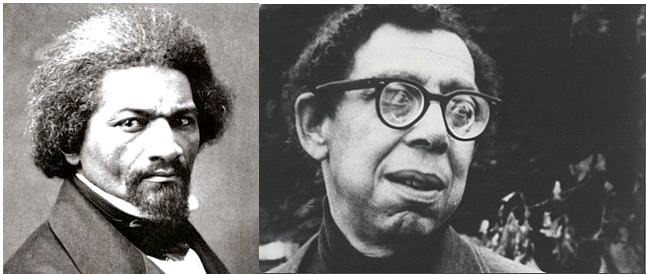
Then early yesterday morning I thought of another, more substantial, set of words for Independence Day: a speech given in 1852 by Frederick Douglass, “What to the Slave Is the Fourth of July?” I’ve read it silently before, and I read it silently again. It’s a 19th century oration, the kind of lengthy and precisely enunciated rhetoric that would seem archaic to modern ears and attention spans.** Yet, it’s worth reading because it’s a unstinting analysis of American Ideals (worthy), acknowledging of American scientific and civic achievements (evidence of the possibility of unimaginable change), and yet clear and precise on great failures in extending its best to all Americans. As the title given to the speech makes clear, Douglass spoke at a time when chattel slavery was a large part of our country, when he himself had been enslaved, when a reticent and resistant national government had (through the Fugitive Slave Act) made clear that the whole nation was to support and maintain this evil.

Does it seem odd that I’m linking Douglass with a Celtic song? Here’s an article about Douglass’ link to Ireland.
.
I assume we are all in agreement on that evil, on that horrendous disconnect.*** But continue: Douglass’ speech still speaks to us today if we can translate a bit from its old-style oratory. Doing so, it’s a forceful reminder on this holiday that American ideals, such as the things stated in our historic Declaration on the first Independence Day, aren’t an award citation — they are a to-do list. The work of our founding, the work of emancipation, the work of fulfillment of our ideals, is on-going. So, if we are clear in retrospect about the acceptance and legal enforcement of slavery, that’s only a beginning lesson. We need to be as unstinting in asking where we are today out of step from our best principles and practices.
American ideals, such as the things stated in our historic Declaration on the first Independence Day, aren’t an award citation — they are a to-do list.
In devising a way to use Douglass’ speech in our short musical format, I decided to take a short part of it, a litany of assertions made in 1852, and make them an enduring set of questions to ask ourselves (or for any nation to ask itself) about that disconnect now and in the future. Douglass’ recast litany starts at about 1:20 in the audio piece, and the other words are mine, though I’m seeking in them to convey Douglass’ insights.
So yesterday, in an hour or two that I had available after finding my inspiration, I worked to perform Douglass’ litany of questions, and still was able to finish with a couple of lines from an Irishman’s song. Why was Van Morrison singing about almost Independence Day? Perhaps, it was only July 3rd, and he was noticing, as an immigrant, the expectations of this American holiday. But maybe too, this white man who sang “they can’t stop us on the road to freedom” was thinking that we are always, should be always, like those men in granite who declared our Independence two days before July 4th, looking forward to Independence Day, not remembering it.
You can hear my musical performance of this recast portion of Frederick Douglass’ speech with the audio player below. No player? This highlighted link will open a new tab with an audio player.
.
*Peculiar and a Van Morrison record is a tautology.
**Consider this: for all its elaborate speech, it’s shorter than the usual modern podcast length, and spends less of its time with repetitive familiarities and co-host back-slapping. Have our attention spans really gotten shorter, or is it the density of 19th century speeches like Douglass’ that wears out our attention?
***Well, there are still some neo-Confederates out there who will tell us it was a benign sort of thing, unremarkable really, and so long ago that we need not think about it — and coincidently, we should not think or teach about this example, and so setting out laws or best practices against that.


 Frank Hudson