I move back and forth with musical instruments and intent here, but since I started as a guitarist, there’s a lot of guitar playing in the Parlando Project pieces. When someone asks about my musical stuff, such as what I play, I often redirect, and make it a point to call myself “a composer” even though the poet in me knows that word’s connotations are fraught.
“Composer” risks putting the listener either in mind of some long past-tense powdered wig guy or a highly serious and educated modern theoretician. I’m neither. What I mean is that my intents with music are to invoke certain sonic combinations. I use various instruments to do that, and often that’s a struggle as I’m not as skilled as many players. Every note I play here comes after a committee meeting between the composer and the musician where the composer asks for things the musician can’t do and the musician suggests to the composer alternatives it can accomplish. Sometimes these are drawn-out affairs, and sometimes they are small latencies as I am asked to improvise then and there.
My poor guitars sit silently in the middle of this struggle, in days between pieces being finished, or in the moments between notes. These two sides win and lose and compromise. I’d certainly be a better composer if I could experiment in areas which my musicianship cannot empirically enter. I think I become a better musician in the times when the composer pushes me to think thematically or to not make the reflex choice.
If all that above seems dreary, it’s not. Yes, there’s friction, but each side enjoys it most of the time. And making music and hearing it are both sensuous acts. Thinking and scheming are involved, but what happens after that, when the next note is sounded, that just feels.
I mentioned last time that every September 18th I take some time to play an electric guitar and commemorate the date that Jimi Hendrix died after likely mistaking the dosage of some foreign sleeping pills. Think for a moment during this paragraph about the troubled history of musicians and drugs. Drugs to stay up, drugs to mellow out, drugs to excite creativity, drugs to sleep fast and deep. In terms of the life the composer asks so much, and the musician abuses the body’s instrument trying to extract those timbres and notes. It’s unavoidable for the composer and musician to struggle, but sometimes external and internal factors let this get out of control.
I played for a couple hours this Saturday, as much as I could spare. I had no ready words to include until I read on the same day an interview in Premier Guitar magazine with a band called Squid.* Squid is a British post-rock/math-rock kind of band, and that’s a genre I have some interest in, as bands that get those labels often are seeking new solutions to using conventional rock combo instruments. The band’s two guitarists had some interesting things to say about the electric guitar as it stands in 2021, more than 50 years after Jimi Hendrix helped redefine its parameters. So, I copied out a couple of quotes from the interview** and read them along with what occurred to me on the guitar in that hour and time.***
Today’s piece is what resulted. In the text, Squid guitarist Louis Borlase opens with an abstract theoretical statement, but soon offers a testimony affirming the expressiveness of the instrument, and for all of Squid’s make-it-new Modernism he ends by saying that that expressive voice allows you to aspire to “those people who came before you.”
Borlase implies a lot into what for someone of my age seems objectively a short amount of history for the electric guitar, which was only about 20 years old when I was born, and then whose extraordinary timbral variations were first exploited in my lifetime. But he’s not wrong, electric guitarists have stuffed a lot into that time since Hendrix’s. And electric guitar is also just another instrument, something to make music with, and we know we’ve done that since someone drilled some holes in a hollow bone or reed.
The second part quotes the other guitarist, Anton Pearson, who speaks theoretically again. Pearson says that the electric guitar is the “perfect marriage of technology and a gestural nature” which I believe at this time is true. Just as the invention of the modern drum set allowed for one drummer and their four limbs to command a combination of percussion voices and roles, the modern electric guitarist can use the fingers of both hands and foot-operated devices to create a large amount of playing instructions and sounds.
As beautiful and fundamental as wind instruments are to music, no one has extended them to that level. Keyboards come very close, including their modern use to control synthesizer timbral range and their ability to use all the fingers and limbs at once, but Pearson wisely restates his “gestural nature” of the guitar to include “visceral nature.” I have seen Keith Emerson stab knives into his keyboard and wrestle it to the ground. I have heard the groans and watched the creative agony on Keith Jarrett’s face while he played acoustic piano. Yet, they never touch the strings directly with either hand in various ways, they never move the instrument into the spot where the amp starts to possess the note.
“Is this a crime against the state? No! Someone controls electric guitar”
.
Are we past all that, is the electric guitar now a long-tail, trailing instrument tied to a passing era? The very thing I pedantically call myself, a composer, is now often modified to “beat maker” as folks think of new ways to order and modify sound, often without touching a conventional instrument. As listeners the instrumentation is immaterial after all. As I wrestle compositionally with my drum tracks, I know that rewards care, and succeeds or fails just as playing an instrument does.
But does anyone just power up and make beats for the sheer joy of it, not for recording or an audience, but just for the physical feel of the sounds being made, and made in real time, and for the ambiguity of the aches in my old finger joints after a session of fretting and neck wrangling? Does Jimi Hendrix, if and wherever his consciousness resides, miss that feel of that neck and the strings under his fingertips?
The player gadget to hear the result is below for many of you, and if you don’t see it, this highlighted hyperlink will do the job too.
,
*If this sort of music sounds interesting to you, you can hear some of the actual sounds of Squid, touring dates, etc. at their web site at this link. Not your thing? I understand. It’s just one of the kinds of music that interests me personally.
**The full interview conducted by Tzvi Gluckin is available on Premier Guitar’s website at this hyperlink.
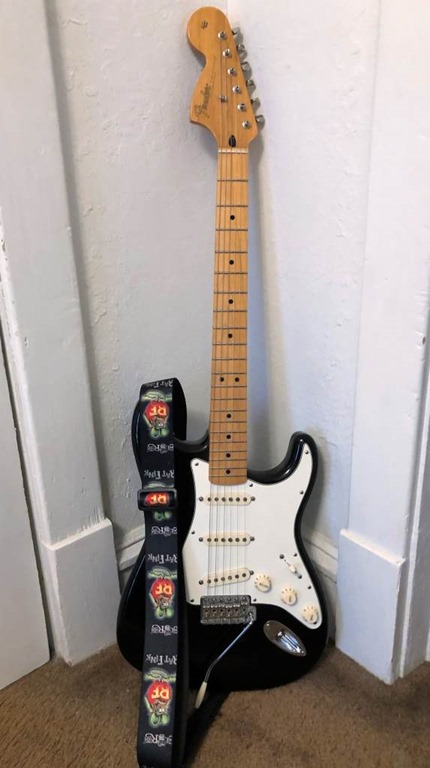
***Toolkit and process? Here’s details for guitar nerds. Everyone else is excused and can go home early. The drums are a software drum machine, which I intended to improve and then didn’t. I laid down the electric bass part with a Squier Jaguar bass. I did two passes and picked the best one. Last year I bought a set of TI flat-wound bass strings for this bass, which cost about a third of what the bass is worth, but I have old fingers and the soft feel of the TI strings are what they like. The guitar I naturally was drawn to on this day is my current Fender Stratocaster, a “reverse Strat” which emulates the pickup array and neck that lefty Hendrix would have on a regular right-handed Strat flipped upside down.
I tuned up and played for a couple of minutes to reacquaint my hands after playing bass, and then hit record and played for a bit over 16 minutes with the bass and drums. The lead guitar in the right channel is going through a reissue EH Triangle Big Muff fuzz pedal and a Cry Baby wah-wah pedal, though for some of what you’ll hear the wah pedal is left partway down for that Tallulah Bankhead “cocked wah” sound. Rather than emulating Hendrix (something I do sometimes on September 18th) I was aiming this time for the guitar to speak in different voices and over the 16 minutes it sort of does, but I decided to trim the piece down to mostly the parts where I read the Squid guys quotes about electric guitar. At over 6 minutes, even the edited piece is longer than I like to present for the Parlando Project.
The last track I laid down was the left channel rhythm guitar part. I used the same Stratocaster guitar, but it’s compressed with a Boss CS-3 compressor pedal and running through a Walrus Audio Lillian phaser, which even bought used is the most expensive guitar pedal I own. That track sounds almost like a modulated electric piano comping away, but it’s just electric guitar being versatile.
Both of the guitar parts are one pass, “live in the studio” parts. I didn’t have much time to do otherwise. The guitar amp for both electric guitar tracks is a Fender Hot Rod Deluxe.
My recording computer in my studio space is still an 11-year-old Mac Mini running an older version of Apple Logic Pro X.
 Frank Hudson