At the Threshold: marvels with French on sky-blue waters

We’re going to travel to one of the best short poems that late 19th century American poet Richard Hovey ever wrote, a strange poem about approaching death, a place far or near, with no trusty mileposts. As I like to do, we’re going in a round-about way. Let’s start with a blue lake.

I can remember what a wonder it was. My father and his youngest brother loved to fish on lakes, and in search of ever more pure sport-fishing beyond the sky-blue waters of northern Minnesota, they took to traveling up further into Ontario Canada. I was maybe 10 or 11, still at an age when I was open to whatever my parents led me toward. We stayed at a family-owned fishing lodge at the end of a gravel road outside of Reddit. A few small, well-kept cabins, a couple of outhouses, and a lake-dock — which was all the two brothers needed, as the day was mostly spent out fishing.

As I said, I was accepting of this. I gamely came along, earnestly operating a rod and reel, waiting, sensing for any piscatorial tugs on the line, listening to the two men occasionally talking about what fishing tactics were most promising. My youngest uncle, maybe 18 or 19, had been about my age when their father died, and my father now served as his younger brother’s father-figure. I was unaware then that more than lures and casting targets was in their talk.

I was never bored. I had a vast imagination when young, and could sit quietly daydreaming stories and ideas in my head for hours. I suspect a good poet would have been more observing of the boundless nature around me; and while I watched and listened to my dad and uncle some, they were too commonplace for me to treasure.

Instead, here is what I recall being fascinated by: I was in another country, Canada, subject to its laws, and a Queen, a governmental oddity that seemed a little out of time to me. A gallon wasn’t even the same gallon there, nor a dollar exactly a dollar! The lodge owning family and everyone we met in Canada spoke English of course, but since my imaginative and book-minded mind lived in words, I was amazed that all the groceries we picked up in Kenora on our way up had bilingual labels including French.

I was as if I had found the Rosetta stone all by myself. As a native Iowan, I already had a passing place-name experience with French from my state’s then 160 year past life as a French possession, but here in Canada a box of Wheaties or a carton of milk could be held inside other words. So, later in high school and in my truncated college studies, I selected French as my foreign language.

I was terrible at it as a school subject. I did OK (not outstanding) in basic vocabulary. I was passable in recalling the tenses and such. I accepted the arbitrary gendering of nouns. But my mouth stumbled entirely in the speaking of French, so obtusely bad at speaking it that I strongly suspect it is something in my neurological wiring. That I persisted with French as I entered college was at least in part because I was learning that French poetry had been so interactive with English language poetry, particularly in the formation of Modernism.*

After my formal education ended, I continued translating French poetry, not by any right of fluency, as I’ve confessed above, but because I wanted to bask in the secret sauce that helped form Modernism.

Richard Hovey seems to have been greatly enamored of what was modern French poetry to him. His published work includes translations of Verlaine, Maeterlinck, and Mallarmé. While going through his published work this summer I came upon this sonnet “Au Seuil,”  in French, dated as having been written in 1898. When I translated it, I found this graceful consideration of dying and some possible judgement and afterlife which I present to you in English today. As an old person, dying no longer requires any heroic situation, acute illness, or grandiose gothic stance to make such consideration apt for me. It’s a matter of petty logistics now.**

At the Threshold as published in French

The poem as published posthumously in a collection by the Vagabondia co-author titled “To the End of the Trail.”

At the Threshold

My translation, presented here as a chord sheet for the musical performance you can hear below. In performance I refrained the final line of the sonnet as shown here.

.

Was today’s poem written by an old man, or a young man staring down a deadly disease? No, Hovey was 34 years old, likely in vigorous health. Still, in less than two years he’d be dead, dying during a routine operation for something as unromantic as a varicocele. One can only wonder how he would have coped with the upcoming English poetic Modernism that would be sparked in part by French writers he admired.

Though subject to my language limitations, today’s poem to song turned out to be a relatively straightforward and faithful translation — with one exception. My usual poetry translation tactic is to primarily find the images in the poem and work at carrying them over vividly to English. I strive to have a non-creaky, natural syntax and word choice in the target language, and to make from that a poem in modern English word-music rather than trying to mimic the prosody of the poem’s native language. What was that one exception? In the poem’s 13th line, “ Qui nous benira de ses grands yeux bleus,” there’s an image I think.***  It could be that Hovey intends a witty little aside about a Nordic male god-in-heaven sitting on a throne of judgement, the cliché being then his point. As I worked on this line I wanted the possibility, however unexpected and wishful, of something universally marvelous. I dropped the andromorphic gendered pronoun as more than unnecessary, and then perhaps unconsciously recalling the poetry of the first-nations name for my current home-state of Minnesota, made the apprehending eyes more than humanly large.****

You can hear my musical performance of what is now an English language poem with the audio player gadget below. No player seen?  This highlighted link is the alternative, and it’ll open a new tab with its own audio player.

*Oddly it wasn’t Spanish poetry. In England we can assign this to not forgiving the Armada and all that — but large portions of the United States had been Spanish possessions after all. And while Canada’s French is spoken regionally, Spanish is the predominate language across our equally large southern border and in the American commonwealth of Puerto Rico.

**For example: when I replaced two bicycles stolen early this summer, ones I’d ridden for 20 and 40 years, I wondered at the return-on-investment of spending like-amounts in current market prices to replace them. My favorite old-person’s joke is that when someone offers me a lifetime guarantee, I ask if there’s a better offer.

***Literal: “Who will bless us with his big blue eyes.”

****Lakota compound word for the place of sky-reflecting-waters. And there I have returned to that boat with my father and his youngest brother, as Hovey wrote in a different language: “we know this hidden way/as one knows the ghost of a dead friend.”

The Coromandel Fishers

It’s Poem in Your Pocket Day in the midst of U. S. National Poetry Month. This lily gilding observance aims to integrate poetry more completely with ordinary life. A great way to do that would be to bring poetry and our workdays together, something we rarely do.

For National Poetry Month I have been selecting and performing poems from a pair of poetry anthologies published in the 1920s for children: The Boys  and The Girls Book of Verse.  There’s little in the two books about ordinary work life. You might explain that as “Well, those books were for kids after all” — but the same could be said about many a poetry collection or anthology, then or now.

Our last piece, a famous poem by Wordsworth, touches on the weariness of work, speaking of the getting and spending part of life. Other than military service, there is little else in these children’s books about working for a living, so today’s piece stands out. “The Coromandel Fishers”  sounds, even on the page, like a folk song, a work song, something that might be sung in the tedium and effort of daily labor. It’s author, Sarojini Naidu, published it in a section of her poetry that she called “Folk Songs,” so it really does ask to be sung, which you’ll see below I’ve done.

the Caromandel Fishers

A reminder of the casual game I’m playing here with this pair of gendered anthologies: was this in the girls or boys book of verse? Answer below.

.

Naidu is little known in America but led a fascinating and significant life. She was born in an India ruled by Great Britain as a colonial possession, was educated in England, and during that education touched bases with literary figures there. William Butler Yeats’ father, an artist, sketched her as a young student, and while a young poet she was called “The Yeats of India.” Despite that start, she more-or-less left poetry for a life of political activism. Upon her return to India she became a key lieutenant of Gandhi, marched and strategized with him, was imprisoned twice by the British for her activism, and after Indian independence served in the new Indian government.

Sarojini Naidu sketeched by John B Yeats and with Gandhi

The young Naidu while studying in England as sketched by W. B. Yeats’ father, and during the famous Salt March with Gandhi. Gandhi thought the Salt March would be to arduous for women, Naidu thought otherwise.

.

I happen to have had a few more hours to work on music this past week as my teenager has started their first job. I, an old man, think often about my decades of paid labor. I recall the dailiness — yes, sometimes the weariness — of that. But here’s what I think of more often: the coworkers — A fair feld, ful of folk, fond I there bytwene, of alle manere of men, the mene and the pore, worchyng and wandryng as this world asketh.*  I recall the thereness of these, my colleagues for the majority of my life’s waking hours, working in common cause. I’d often have a poem in my pocket in those years, a draft of my own, or a song of another on those days after days. Another thought: not often enough was the poem in my pocket about them, about the world of work we shared. Wordsworth said in his poem I sang last time that “The world is too much with us” — and we poets too often, too completely, stop at that phrase. I tried to outline in response: Wordsworth’s poem is more complex than we think it is, that his poem says everything is out of tune. Naidu’s fishermen, like the political activism she joined after writing this poem, says that we may sing to align us with the world.

Here’s an anecdote I read about Naidu. At the end of her life, she was weary from the wear-and-tear of political administration. Doctors said she must stop at whatever place she found herself, but she was restless, she could not rest. Finally, she asked a nurse to sing to her, and she fell asleep. In that night she died.

A couple unrelated last notes, and then you’ll have the opportunity to hear my performance of the song I made from Sarojini Naidu’s poem. She seems to have been the only person of color to have a poem in the two 1920s children’s anthologies,** and just as Wordsworth’s from last time, her poem of a world that’s with us, late and soon, ends up invoking the god of the sea. The audio player to hear me sing Naidu is below. No player? It’s not washed overboard, some ways of reading this blog hide it, so you can use this link as an alternative.

.

*Autocorrect didn’t have a stroke — can’t you read English? It’s a passage from the medieval poem Piers Plowman:

A fair field full of folk · found I in between,
Of all manner of men · the rich and the poor,
Working and wandering · as the world asketh.

**A fault I wouldn’t expect in any modern anthology for children, there are just too many good choices that are well-known and published now. It wouldn’t have hurt them to include a poem by American Paul Laurence Dunbar, or one of the translations from Chinese or Japanese by Arthur Walley — though the latter were new on the bookshelves at the time. I’ll allow them an excuse on a case near enough to the one for these 1922-1923 anthologies’ almost complete exclusion of Modernist poetry.

Are you taking part in this month’s quiz on which gendered book of verse Naidu’s poem appeared in. It was in The Boys Book of Verse.

It’s been hard to complete new work recently, so “Anglers” for Minnesota’s Sport Fishing Opener day.

The world of this poem is scribed with the understanding that when you’re on a lake’s surface you are at the boundary level of two worlds. Like unto angels in Medieval drawings, those fishing are pulling the fish from the aqueous world into the sky world, and I often felt I could sense the hooked fish’s wonder and distress. “Who are these scale-less giants unconcerned by gaseous air?” This poem is called “Anglers.”

Meanwhile, back in Chicago, the Yip Abides blog and rmichaelroman caught this wall painting in 2009. Whimsey aside, the very fish the anglers are seeking to catch in Minnesota today are spending their day trying to catch other fish.

.

It’s unsaid in the poem, but I was in the boat described. I didn’t put myself there because I wanted to focus the reader’s attention on the two brothers and yes, on the fish. There are other undercurrents that I think I kept out of the poem, and someday should make at least one other fishing boat poem. If any in this blogs’ diverse readership reads this before or after getting in a boat and wetting a line, net, or spear, the poem asks you to consider this if you like to think on the water and not just chum with talk: you are frighteningly miraculous.*  Don’t let it give you a big head or anything. There are angler forces without skin on another level above our surface.

My grandfather’s actual Johnson Seahorse outboard motor mentioned in the poem

.

I recall that the more published and noticed members of my little writer’s group Kevin FitzPatrick and Ethna McKiernan were not particularly satisfied as readers/listeners of this poem in an earlier version, and I may have made a couple of changes based on that in the version you can hear today. I think they may have been puzzled or unimpressed** by the pun at the heart of the title: that on the flat surface of the lake, the “anglers” are the highest upward length of a right-angle to the water surface, the sharpest break vertical the fish would ever experience. And then there’s the even more obscure eye-rhyme-ish pun of anglers and angels. Neither of them cared much for puns, while Dave Moore and I indulged generously, enough to wrinkle the other half of the group’s noses.

Now Kevin and Ethna have been, like the fish, also pulled through the surface, and today there’s a church-based memorial service for Ethna which I don’t think I will be attending, though I’m glad to have attended a poetry-centered one for her earlier this year, and I’m planning to attend the poet-focused one for Kevin later this May.  In lieu of today’s service attendance, and out of guilt from my absence, I’ll say that if their skin-less existence is in wonder and distress, that my thoughts go with them, and in my dim watery existence here I ask us on all our levels to turn our circle-eyes toward wonder.

And I know too there are practical voices in the fishing opener today. “That’s what I get for getting into a fishing boat with a poet. Such high-flown thoughts! Damnit. I’m trying to get a worm on this rig’s hook. We feed worms to fish, and then well, we feed worms.”

If you’d like to hear my performance of my own poem “Anglers”  there’s an audio player gadget below this for many of you, and for those who can’t see that, this highlighted link  will open an audio player  for it in a new tab. My music for this uses what I often call my “punk rock orchestration.” I use very simple orchestral instrument colors both because I lack the knowledge/skill to do more complex ones and because I think there’s a direct charm remaining and being featured by stripping that sound down.

.

*Ah, footnotes, the sinker-weighed lures bobbling along near the bottom! No, I’m not out fishing today, or most any days in this part of my life, though I think about my hours of fishing as a young person. I always considered the fish though, a little to a lot. One thing’s simple though: every poet wants to be miraculous.

**When a poem or poet doesn’t “hook” us, these two feelings can be cause and effect in either order.

The Fisherman

Complaints about the size of the audience for poetry are far from new. So too, complaints about the quality of its audience. Throughout the course of the 20th Century, one increasingly common theory was to assume that a quality audience for poetry is likely incompatible with a quantity audience for the art.

We’ve just about used up two decades of our century, and that theory is still around. This quantity/quality audience-linkage belief is not always stated plainly, but it’s not hard to see its presence. Poets that rise to modest or surprising audience size will sometimes face some degree of backlash from critics. It may naturally be so that their poetry is less worthy by some criteria. This could be coincidental, honest criticism. It may be that it’s hard to find an audience for poetry criticism, as it is for poetry, so writing about better-known practitioners who have failed in some way helps grow the audience for the critic.

Another way to hold to this theory is to limit what poetry is allowed to do, to narrow its practice or even its definition. Spoken word or slam poetry? Not really poetry, or it encourages a poor selection of poetry’s virtues. Song lyrics? Self-evidently a different art, though given that the consensus canon of poetry is so different among itself, surely difference alone cannot be the criteria. Mix those two as rap or hip-hop and risk both  explanations of why it’s not poetry. Short, aphoristic poems? Too insubstantial. Long poetic forms once much in evidence, like the poetic epic or verse drama? No longer living forms of the art for the most part, if for no other reason than the type of poetic techniques the modern academic poet often uses can wear out an audience in a matter of minutes.

Myself, I don’t disagree or agree with those judgements in particular cases, and they could even be theoretically correct, I just viscerally dislike the idea that this thing poetry is so small and limited, that it’s a desert island disc for a few scattered islands, deeply loved by solitary coconut eaters with a very constricted shoreline.

When I break out of those narrow roles and rules for poetry, I will fail, and I do get discouraged. My limitations are bothering me two years into this project; and now 240 published audio pieces later, I may be running out of rules to break and the motivating pleasures of audacity.

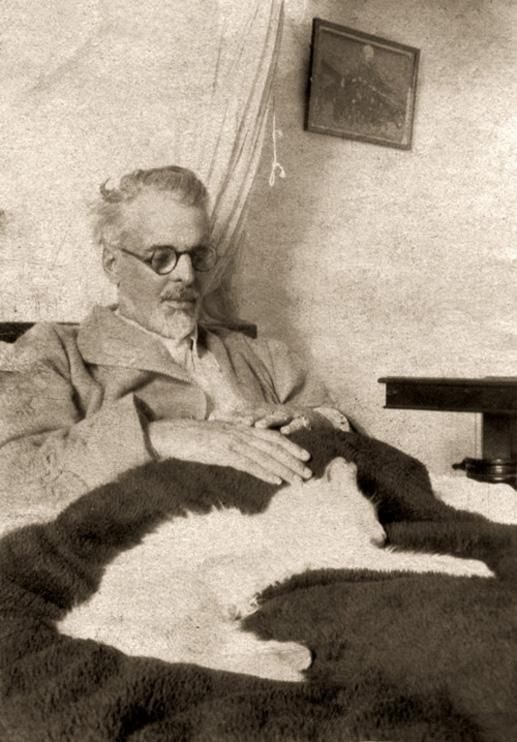
William Butler Yeats with cat

Also dreaming of catching fish. Are cat pictures the secret to gathering an Internet audience for poetry?


Here’s a piece today using a poem by someone who somewhat agrees with me: William Butler Yeats. In one way it’s specific to him, and his time. I’ve recently honored two working-class sport fishermen in one of my favorite pieces so far this year, but the fisherman in Yeats’ title, the simple man working his craft on nature to help feed himself rather than for hobbyist enjoyment—well, he, even in a much poorer Ireland of 1916, is admitted as imaginary.

Otherwise, how about those folks listed in the middle section of today’s piece that are harshing Yeats’ mellow? How little imagination is needed to see them today?

I admire Yeats in this poem, embracing his failure, even though he brought immense poetic talents to his work, so much so that I should be embarrassed to admit to that admiration. In one way, the fisherman here is Yeats, casting with deft wrist or verse, but not in the course of the poem catching anything. There’s a saying with the fishermen in my family, “It’s called fishing, not catching.”

But the imagined fisherman is also that audience Yeats seeks. Maybe once, Yeats says at the end, maybe once,  he can please an audience correctly, with a single valid poem and valiant audience—even if he can only see that audience in his imagination. I surely hope (and Yeats’ life helps me here) that the singular fisherman is an image for a possible greater audience, and not a headcount. After all, to write for something as large as “his race” (by which he means Ireland), is too small a target to hit, while that tweedy imagined fly-fisher inside his jacket might possibly expand to more countries, more times, more genders. In Yeats’ case, as with all artists, he failed; but he failed reaching for a larger audience with a larger poetry, a poetry which he risked allying with other arts. Many of us will not be able to accomplish that failure, but I’m glad Yeats tried.

You can hear my try to alloy William Butler Yeats “The Fisherman”  with a rock band by using the gadget below.


Parlando Spring 2018 Top 10-Part Two

Continuing on with our count-down of the most listened to and liked audio pieces from the Parlando Project during the past quarter, we’ve now come to numbers seven through five.

At number seven this time is an example of how the Spotify listeners differ from the blog listeners. This piece received only a handful of listens on the blog this past spring, which isn’t unusual, as “Sky”  was posted there last summer, and blog users tend to listen to the latest posts unless brought here by a search engine. On Spotify though, “Sky”  has seen steady action, and enough plays there to make it one of the most listened to this spring..

I like the idea and outcome of looking at the Midwestern sky that multimedia artist Laurie Anderson explained in an interview that I quoted to make the words for this piece, but I’m not sure what attracted all the action on Spotify for it. Is it the short, somewhat generic, title perhaps? As we’ll see later this month in the countdown, another of the Parlando pieces with a one word title was very popular on Spotify in the past few months.

Well, no matter blog readers, here’s “Sky” brought to your attention by the listeners on Spotify.


One of the Parlando Project principles is “Other People’s Stories.” There are a good number of Internet locations where people post their own poems, and blogging in particular is often autobiographical. I could do the same, but I have a contrarian streak, and I find responding to other people’s words and figuring out how to perform them interesting.

I don’t dislike autobiographical blogs, I subscribe and happily read a handful of them myself. If prodded, I can go on way too long about myself, just as I have a tendency to do on any subject, and having had my first poem published almost 50 years ago, I’m certainly not against revealing my own poetry. “Other people’s stories” is a choice I find helpful, that’s all.

I will use my own poetry/lyrics in the audio pieces here from time to time, though I like it when they are my words about other people, such as the number six most popular piece last spring, “Anglers.”  This is the story of my father and his youngest brother’s sport fishing, something they spent many pleasant days doing before my father became too old and frail for his beloved outdoors. Those days seemed timeless even as they were occurring decades ago, and those lakes have become mysteriously reflective in memory now. So, in writing of them I added notes about passing between dimensions.

I’m proud of how this came out, and glad so many have taken the time to listen.


These Top Ten lists often include well-known poems by well-remembered poets, but that contrarian streak in me likes to look at those less remembered and see what might be of interest there. Richard Aldington is one such case, a writer who was active in the pre-WW1 London circle that created Modernist poetry in English. Coming in at number five on this spring’s list is this charming poem of his “The Poplar.”

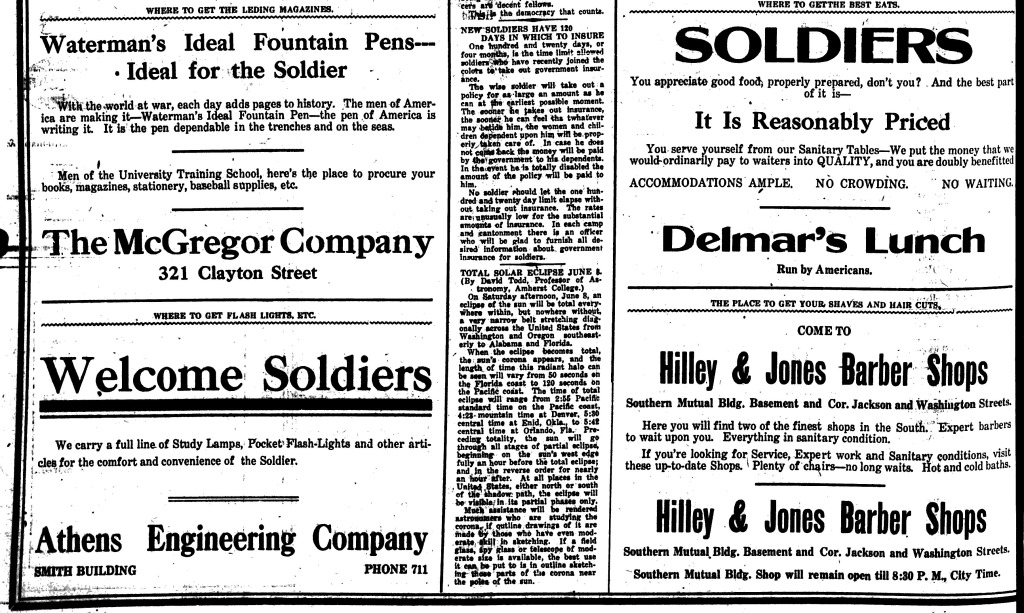
David Todd asks Athen GA artists to sketch eclipse

62 years before REM was formed in that town, astronomer David Todd asks artists in Athens Georgia to sketch the June 8th 1918 total solar eclipse. Note the ads pitching goods to WWI soldiers. “Delmer’s Lunch – Run by Americans”


Since it is easiest for me to use poems here that are in the public domain, the newest ones are often from that Modernist revolution that occurred in the first two decades or so of the 20th Century. There are weeks when I think I must be living 100 years ago more than in 2018, as I look for and read poetry from that era. Do I find this a refuge from 2018? No. The horrors of WWI (which impacted Aldington, who served, significantly), the realities of racial, class and gender attitudes then, mean this was no golden age. But what does surprise me reliving the genesis of English Modernist verse as I read their work now, is how they employed broadly accessible images in their Imagist poetry.

The post-1920 High Modernism that was largely used to represent the Modernist movement when I first encountered it is full of obscure references, exotic words and locations, events so far into the imagination and the special dialects the poet chose to reflect those inward locations, that a reader is confronted by a world they can’t comprehend the landscape of, much less the meaning of what occurs there. There can be beauty and insight in this, but it’s a world that assumes one will come prepared, well-equipped with poetry expedition gear and maps.

But before all this, as Modernism was forming itself, the poems are still in a world much like the one inhabited by the general reader, like this graceful and musical one. Give a listen to Richard Aldington’s “The Poplar”  below.


Other peoples stories. How can I connect sky-watcher and eclipse sketch promoter David Todd to poetry? Todd was a pioneer of “eclipse chasing” as well as a theorist of life on Mars. His wife, who documented his trips to view eclipses was Mabel Loomis Todd. Back in the 1880s Mabel had a scandalous long-running affair with Emily Dickinson’s brother, who lived next door to Emily. After Emily’s death, Mabel Loomis Todd was the person who saw to the publication of Emily Dickinson’s poetry. And when we return soon to continue our count-down, we’ll have a poem from Emily Dickinson.

Anglers

Next weekend is the Minnesota sport fishing opener. Today’s piece, “Anglers”  is appropriate for that—but to that opener I’ll bring 8th Century Irish monks, a strange airship cosmology, a Nobel prize winner, and tenderly, a pair of brothers.

I wrote the words for “Anglers”  combining two things, one biographic and one literary, mixed with some phrases that occurred to me.

The biographic? My grandfather died when my father was a young man, shortly after I was born. My father had four brothers and a sister, and the youngest of his brothers was only a few years older than I was. My grandfather never lived long enough to teach him much, and so my father helped teach his youngest brother some things their father did not live long enough to do. One of those things was sport fishing. As my young uncle grew up, he and my dad became fishermen of the most avid kind.

Over the next fifty years, the two men fished many places in Minnesota, but most memorably for me, in Canada. Not just on the border lakes like Lake of the Woods, but halfway up Ontario to lakes above the little town of Redditt. Their base there was a rustic fishing lodge: log cabins, outhouses, small aluminum rental rowboats to which they’d attach a 1930s Johnson Sea-Horse outboard their father had bought decades ago onto their flat stern. Their routine: out with the dawn, fish until noon, pull in some inlet, fry up some fish for shore lunch, then fish again until late solstice dark. The poem I wrote doesn’t mention it but I was with them as a child on some of these trips, though fishing was not something I kept up with as I grew up and went East. The two brothers though continued their angling until my father before his death became too frail and sickened with senility to continue.

Johnson SeaHorse outboard motor

“Uncoiling the Sea-Horse.” My grandfather’s Johnson Sea-Horse outboard used by his sons


That’s the biographic. The phrases? I often write, at least in part, in my mind’s ear. Sometimes it’s entire first drafts of shorter poems that are composed there, other times it’s only beginnings or endings, or even phrases that somehow seem to mean to be in a poem. I’ve told myself an advantage of writing this way is that poetry often works best if it’s memorable speech, so composing this way pre-tests things by holding them in memory and seeing if they adhere.

As I get older it’s harder for me to memorize works in process, and this piece had only phrases and parts of the beginning and end stanzas in my head before I started my first paper draft. One of the phrases was the idea of the sport fisherman, the angler, being at right angles to the surface of a lake. Another was a phrase which occurred to me, “lattices of fishes,” which I simply loved the sound of, but it also seemed like unto the vertical angle from the surface of the anglers in their boat.

It was that angle word-play that brought in the literary. The anglers point up and down in their angle from the surface. What do they point to? And lattices, obviously there’s another level under the water-surface plane.

The literary? Seamus Heaney, the Irish poet, wrote a poem I much admired about a story from the medieval Irish annals. The story was some monks at Clonmacnoise in 749 A. D. observed an airship snagged on the tower of their monastery and a crewman of that airship who climbed down from it to free his ship.

Clonmacnoise tower

Clonmacnoise tower. Don’t snag your anchor on the weeds or rocks.


In combining the two, I created a cosmology where the air breathing anglers on the surface of a lake are like angels, or the crewman of that medieval airship, to the barely comprehending fish who are brought across to the airy world. And that echoed the idea I had developed in my head from the anglers pointing up 90 degrees from the surface of the lake in their boat. They are pointing to the heavens, a place we can no better understand than the fish can know about the world of our air-breathing.

And there you are, that’s the entire poem’s metaphoric magic-trick revealed. Yet that isn’t the poem, much less this audio piece that presents it. I still had to work on the language through several drafts, and I may work on it more after this presentation—but the poem and the audio piece is more than its images or its ideas, because a poem and a musical composition are both machines that think with sound.

So, listen to “Anglers”  using the player below. And please, let others know what we’re doing here. I would so much appreciate that.