The Guitar, after a poem by Federico García Lorca

Today’s piece is a fairly well-known poem by the Spanish poet. Given that I’ve played guitar nearly for 50 years and been interested in poetry for more than that, I keep thinking I must have run into it before this year. If that’s so, why don’t I recall considering it?

My answer is going to sound more judgmental than I mean it: bad translations. No, maybe I shouldn’t use “bad” here. I don’t suspect any moral failing or lack of effort by translators of this poem. And given that I’m not all that knowledgeable about the work of Lorca and have only the most limited grasp of his native language, I should have no standing to rate other published translations of “La Guitarra.”   What I do know is that native speakers find his poetry passionate and vivid, and the English versions seem to my ears and heart (those being the entry points for poetry) stilted and muffled.

I’m not going to link any of the English translations I found of “The Guitar.”   None I’ve seen seem fully effective to me, though I cannot say that they might be effective for others. I’m not going to link or line-by-line dis the translations I’ve seen. I will say that the first one I saw at one of the leading poets and poetry organization’s site was representative. I didn’t find it musically compelling, and it was a jumble of abstracted images that had little sock, little immediate feeling evoked. I assume the translator had the advantages I must clearly concede I don’t have. Why might their work not succeed, at least to this reader?

Two theories. Other translators may have been too literal in carrying over Lorca’s original sentence structure, which might be natural and unaffected in his Spanish. This is poetry, so one can make a case that how it’s said is essential — but when languages order words differently, following the original sentence structure and word order too exactly damages the natural vividness of a person speaking. Secondly, Lorca to my slight knowledge connects to Surrealist expression, a style of poetry I loved as a young man and still like to connect with today. Surrealism likes the wild and incongruous image; and from its ancestor Dada, it’s often willing to take an image in a random, raw and undercooked state. This creates a problem for me when I translate Surrealist and Dada work.

You see, I view my task as a translator to primarily find the images in the work and to then portray those images in clear modern English, and secondarily give the poem a word-music in the new language that gives pleasing movement and return to the poem. What if the original intent was to mystify the reader, to present an image that was intentionally confounding? I risk, while puzzling out the text in a language I don’t know well, to over-simplify or over-determine an image. I fear embarrassment of doing that, but I think it’s the better risk because vivid images that the reader/listener grasps and gasps are compelling to me.

As to the word-music, my version of “The Guitar”  rephrased Lorca somewhat, aiming to make him sound like an English speaker. While doing that I tried to make the poem musical in English. The poem was already using repetition for poetic effect in Spanish, and I added just a touch more.

The Guitar - Lorca

A chord sheet as I urge you to sing this yourself. Here’s a link to Lorca’s poem in its original Spanish.

.

As you might imagine, this poem about the expression of a musical instrument has been set to music before my attempt you can hear today. While not a Lorca expert I know that he connected too with Spanish Deep Song and the evocation in that tradition of “Duende,” a difficult to translate term that some Afro-American musicians have seen as analogous to the Blues. I played a nylon string guitar for my setting, the type of guitar associated with Spain, and the simple chord progression I used would not be foreign to that tradition. But both from my skill level and inclination what I played for this song was simple and sparsely ornamented. Though the harmony wasn’t Blues, I approached playing this as if it was American Blues. Another Blues element I introduced that wasn’t in Lorca’s poem: my version has a gendered call and response. The guitar is a her, the singer (there’s no singer in Lorca’s poem) is a he.

You can hear a performance of my translation after this poem by Lorca with the audio player below. No player? No problem, this link is an alternative that will open a new tab with its own audio player.

.

The Parlando Winter 2018-19 Top Ten part 3

Should I stop for a moment in our count-down of the most liked and listened to pieces this past winter to describe briefly what the Parlando Project is? After all, there are always new people coming upon this stuff.

What we do is take various people’s words, mostly poetry, and we combine them in various ways with original music. The music too is not one style. Sometimes we sing the words, but not always, or even usually. Sometimes we read them or chant them or talk-sing them. Singing gives a particular effect to the words, and though I admire many examples of art-song, including some examples that use the same texts that I’ve used, I think there are other facets of the poetry that can be shown with other performance styles.

I wish we had more modern or semi-modern poetry here, but very soon in this project I determined that the effort to obtain the rights to creatively engage with work still in copyright protection would reduce the amount of encounters we could produce.

Limits and restrictions often engender creativity though. I’ve found that being largely restricted to the pre-1923 public domain world still allows me centuries of material to pour over, and there seem to be a great many under-appreciated and forgotten writers to discover. A lot of what I end up using is work from the first part of the 20th century, the Modernists that established the world of literature we are still continuing and reacting to. It’s been fascinating to experience this early formative time of Modernism by adapting and performing their words.

Now let’s return to our countdown with numbers 4, 3, and 2 in popularity this winter. Yes, they’re all early-20th century Modernists. And one poet takes two slots in the countdown today.

4. A Winter’s Tale.  D. H. Lawrence is another novelist who was also a poet. In my youth he was probably better known for his novels, and their spicy rep in the mid-century world no doubt helped his youthful readership. I recall reading some Lawrence poems in the sixties and I remember liking them then, but I have to say that my interest in them didn’t continue. Now in this project, in this century, I’ve run into him again. The Imagists who kicked off British literary Modernism considered him one of them.

I liked this poem of his, even though I still can’t say for sure what’s going on in it, but we often can forgive that in the context of music and words. My musical setting for an early 20th century poem kind of took some small inspiration from the late 20th century music of Mark Hollis (of Talk Talk) who died last month.


D H Lawrence in Mexico 1923

D. H. Lawrence asks “Is that a Mexican poncho, or is that a Sears poncho?”


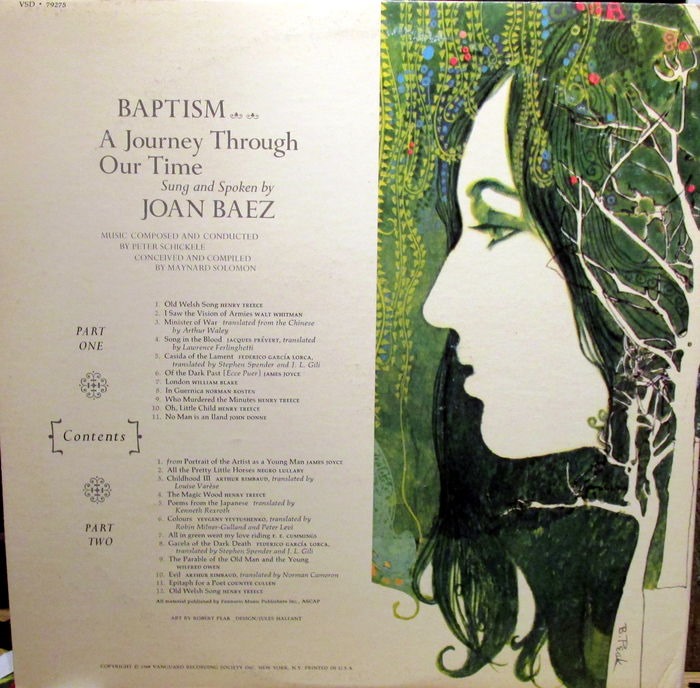
3. Gacela of the Dark Death.  Here’s another work that I translated into English myself for presentation here, a poem of passion and wit from Spanish poet Federico Garcia Lorca. I actually first heard this poem as part of a project that attempted to do something like what the Parlando Project does: Joan Baez and Peter Schickele’s 1968 LP Baptism.  Baez read Stephen Spender’s translation of Lorca’s poem earnestly there, and the poem’s title would lead one to read it as sorrowful. As I translated Lorca’s Spanish I sensed a more playful and mocking attitude in some of the images, and my performance tries to bring that out from my translation. As part of conveying the emotional range of the piece, I sang the opening and closing sections while speaking the middle of the poem—an example of how singing and speaking words changes the experience of them.


Baptism back cover

Baez and Schickele do Parlando 51 years ago


2. Self-Pity. D. H. Lawrence again, but a different kind of poem from “A Winter’s Tale.”  Shorter, and superficially an Imagist poem, it so clearly makes its “no whining” point that it was once used in a film by a drill sergeant. Poetry that makes straightforward self-improvement/empowerment points was not that common in early Modernism, and it’s not the usual way to literary cred these days either. I’m not sure why that would have to be. There’s an audience that likes it, and the 19th Century revered some poets who plied lessons like this poem does, although usually with many more words and stanzas. My best guess is that artists, particularly now in an era when literary poetry is something of an outsider art, like novelty and rebelliousness too much to settle for earnest self-improvement.

Well, this poem isn’t one of my favorites, but you know something: I need its message some days as much as anyone. I may have worked extra hard on the music I wrote and performed for it to compensate for that.


So what will be the most popular piece from last winter? I’ll be back soon to reveal that.

Gacela of the Dark Death

Here’s a piece using a fresh translation I made this month of a Spanish poem by Federico García Lorca. I’m sure there’s much to say about Lorca from those that know his work better than I do. That group of Lorca admirers includes many other artists whose work I respect, so it’s about time to present something by him here.

I’m told that a Gacela is a traditional Spanish form, but that Lorca’s poem follows the form only in spirit. Because Lorca was executed during the Spanish Civil War, not long after this poem was written, some view it as reflecting his experience of the war, but I get the impression that death elements were present in Lorca’s work even before the war. While encountering this poem in order to translate and perform it, I came to believe there’s a compound commentary on human mortality and more here.

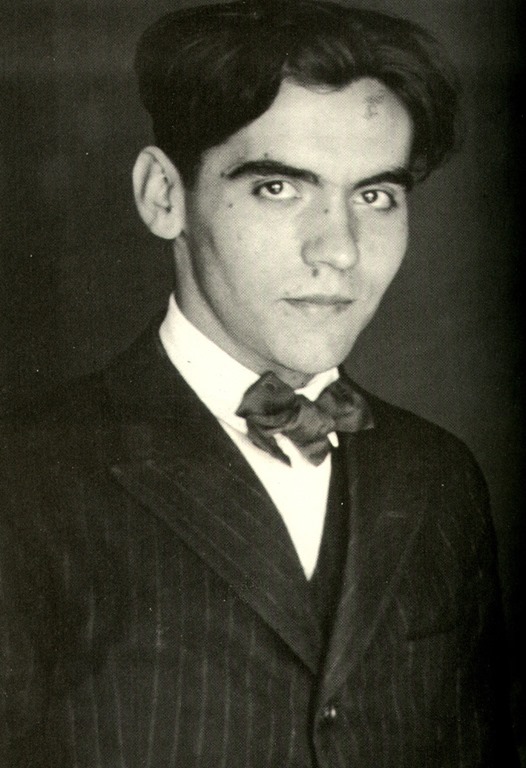
Federico_Garcia_Lorca

Federico García Lorca, a poet with open heart dreams


The poem opens and closes with a refrain that ends with a strong, bloody, and yet ambiguous last line carrying the image of a boy wanting to cut his heart. I chose not to overdetermine that image because I believe its ambiguity should remain. It could be an image of desire, or of self-harm, or emotional outreach—so let it be any or all of those things.

The middle portion of the poem, which I chant rather than sing, has a tone in my reading that has humorous elements, even if that seems to go counter to other readings of the text I found. When this section starts with what sounds like folk aphorisms about the dead, I take them as dark humor. In the next line “No quiero enterarme de los martirios que da la hierba” I decided for the only time in my translation to intentionally make the image stronger to American readers, by making the hierba, the grass, “leaves of grass” to connect to Whitman and his great image forged in the American Civil War. I can’t be sure, but I spent a long time on that stanza’s moon with a snake’s mouth image, “la luna con boca de serpiente” and what with the punch line about that mouth always working before dawn got me asking the question if this was a vampire image, which I decide to refer to sideways by determining that fangs were what serpent’s mouth means. Consistently in this stanza Lorca is giving us death images, but he’s also saying he doesn’t want to hear them.

I think the next stanza is meant to be humorous too, starting off with the wanting to sleep (perchance to dream?) for a moment to maybe as long as a  century—but “pero que todos sepan que no he muerto,” “let everybody know I’m not dead” as I translate it. Yes, like Hamlet he wants to compare sleep and death, but he’s playing with it. I’m at a loss if the “pequeño amigo del viento oeste,” “little friend of the west wind” is referencing something. It sounds almost like a children’s story or lullaby. I think this stanza’s concluding line is so wonderful that it transcends mood and attitude: “soy la sombra inmensa de mis lágrimas,” “I am the immense shadow of my tears.”

This stanza’s concluding line is so wonderful that it transcends mood and attitude: “soy la sombra inmensa de mis lágrimas,” “I am the immense shadow of my tears.”

The final chanted stanza before we return to the sung refrain also seems to me to be playing with death. Are we meant to take the insects here as accomplices of the grave’s earth? But this sounds like a boyish schoolyard dispute “He threw ants at me!” And what’s with the scorpion claw? As a northern North American I don’t deal with actual scorpions (hey, tropic readers, let me tell you about black flies…) but isn’t it the stinger that’s the weapon? I’m left wondering if there’s some idiom here that I just don’t know, even some kind of schoolboy pestering like unto a “noogie.”

And then the poem returns to a variation of the refrain, mysterious, beautiful, and I think serious. As to the intent of the poem, I felt I could perform the mystery and commit to the humor I found in the middle section without knowing the poem’s heart entirely. I think you can listen to it the same way. It is a darkly playful meditation on death? A comment on the outbreak and casualties of a civil war? Or is it a longing for childhood life and adventurous dreams? Or a love poem to a young man in Lorca’s life at the time the poem was written? Walt Whitman could sing all those things together, so why couldn’t Lorca?

I felt I could perform the mystery and commit to the humor I found in the middle section without knowing the poem’s heart entirely. I think you can listen to it the same way.

Musically, I sought to contrast the two refrain sections from the poem’s middle one. I was going to play my nylon string guitar for a Spanish flavor on this. Sadly, when I opened its case this week I found that its bridge had come completely off the top. Oh well, my battered Seagull Folk guitar had to stand in. My orchestration brings a bassoon part forward.

You can hear my performance of my English translation of Federico García Lorca’s “Gacela of the Dark Death”  with the player gadget below.