One need not be a chamber to be haunted. You could be a cassette tape.

However similar if amorphous shapes, everyone’s ghosts are private spirits, and I have a new musical piece with words by Emily Dickinson testifying to that — but let me slide over to a couple of personal things first, as if I was a regular blogger externalizing their internal story.

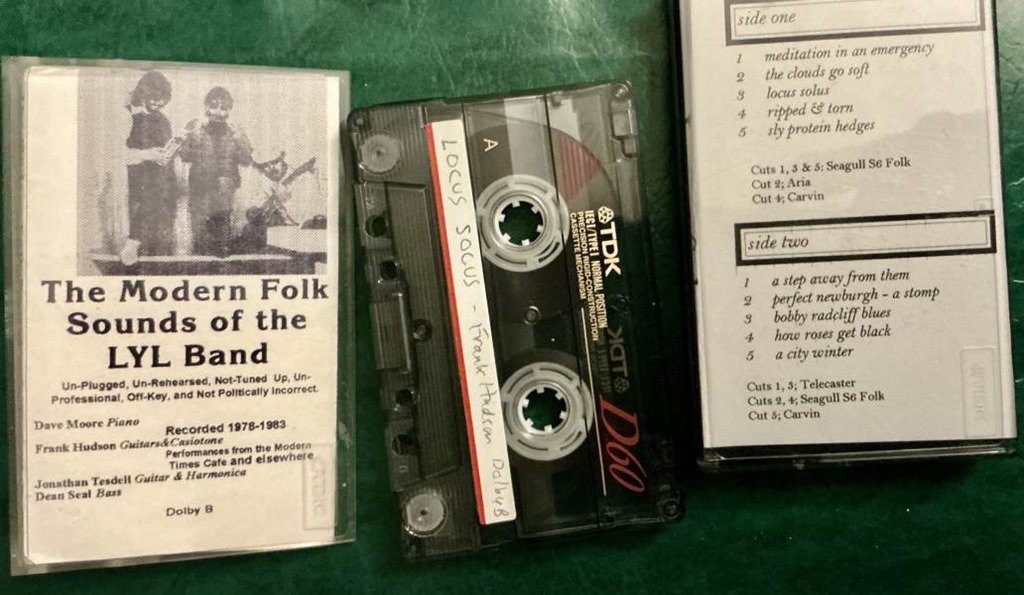
I’ve had a couple of weeks when I’ve needed to come back to the Parlando Project stuff from other things. I had a colonoscopy with unremarkable results. Huzzah. That’s some prime blogger internal dialog! But before that, I searched around my crowded little bedroom/office to find old cassette tapes. The oldest are from The Sixties when I had one of those small battery powered monaural cassette recorders with a slide-out chrome handle, a single speaker on the top, and a chorded plastic microphone with a start-stop slider button on its side. Others were from the 1970’s-2000 era when I recorded musical things, first on the stereo tape decks of the late 20th century home hi-fi era until I was able to afford one of the legendary Portastudio models designed for musicians, using the same humble cassette tapes, but able to record 4 distinct tracks. My task: to make digital copies that I can store in no appreciable physical space and are independent of an obsolete format.*  More than 30 years of this stuff, much of it of only private interest, though you may hear some of it eventually.
Cassettes 600

Some of the cassette tapes.

.

The ubiquitousness of inexpensive video is fairly recent, but assuming no catastrophic events, many born in the past 15-20 years will likely have color video with sound of their childhoods and young adulthood that could follow them the rest of their lives.**  Is that a good thing, something they welcome? I don’t know. Before this some folks had diaries and journals, or kept letters, so some level of self-documentation is not entirely novel. Still, for me, a person whose Project lives in music and sound, whose favored form of literature began in sound before writing was invented — retaining an element of the sound of the words, and their sequence, and echoes — my particular audio time-capsules have a special tang. And fears.

Most of the tapes are not just me, in a few I’m just the man holding the microphone, though I’m there as the shadow that chose to start the recorder. They hold our imperfections: things before we knew, before we learned — and then too the persistent faux pas that we still commit: there, and committed to a recording. Given that most can record now anytime with the tap of screen, how many will simply erase to save future embarrassment?

So back to Emily Dickinson and this poem about ourselves and what we think we fear — which may not be what we actually fear, or should fear. “One need not be a chamber — to be haunted”  is a poem about that self we either can’t lose or can’t consider. In five stanzas Dickinson lays out some conventional gothic scenery (some of which she herself will erect in other poems) haunted houses, undead ghosts, church graveyards, and finally an assassin laying in wait for us.***  Dickinson points out that the self may be making or amplifying those fears, and perhaps that self, making scary movies in our imaginations, may be doing it to displace us from seeing the real fear source, our mind’s-self. “Ourself — behind Ourself — Concealed — Should startle — most” Dickinson’s poem concludes. You can read the text of Dickinson’s poem at this link. And yes, you might note I sang “alley” by mistake instead of “abbey” messing up Dickinson’s graveyard implication.

So, is that our choice? To ignore ourselves, out of fear of what we’ll find, or to disappear into a copious kingdom of solitary solipsistic self, many of us with the digital equivalent of Krapp’s Last Tape  clanking and dangling from them like Marley’s ghost? Socrates decried the unexamined life. Memoir can be an honorable genre. Despite my taking the time this month with the old tapes, I think of this Scylla and Charybdis, and in the end there’s ultimately no keeping of this life and self, though sometimes there is sharing.

Today’s musical ensemble is a Rock-band of some kind: drums, bass, piano, 12-string acoustic guitar, and two electric guitars, one of which is run through enough effects to mask its guitaristic nature. No need to rewind, you can hear it with the audio player below. No player? No need to untangle that with a pencil in the reel-hole — this highlighted link will open a new tab with its own audio player.

.

*Many years ago, I was on a committee working on the technical design for a radio network’s archives (most of which were still on audio tape then) which involved long-term storage and public accessibility elements. The online “New Media” folks had their ideas about what formats to use for listeners to stream over the Internet, the audio engineers had concerns about what would give the longest life and best fidelity, and the computer IT folks had thoughts about what media would have the capacity to hold something that might climb into the then hard to imagine “terabytes” of digital storage. The three groups weren’t always in agreement, and a grizzled consultant from some outside large, already in existence, archive was brought in to meet with us. Should we use digital tape, hard drives, optical disks? What file-system format on which? What audio file format should be used on that media? Is some of this going to die from “bit rot” on the media in how many years? We had lots of questions and wanted the wizard to arbitrate our concerns. He listened for a while as we cross-talked.

Then he answered. “It doesn’t make much difference what you choose. You’re going to have to convert to other media, file-systems, and audio formats in the future, and every few years going forward. Plan for that.”

**Many of my mid-century generation have photos from their youth. I had a “baby book” that lasts into my grade-school years in black and white. A few families had movie cameras (though no one I knew did) but many of those shot silent film. The cost of film and developing that film constrained the amount of pictures and home movies made. Lots of birthday parties, weddings, holidays. Parts of life yes, but selected shorts.

***I was working on this in the wake of the news of a planned, lay-in-wait killing of an insurance company CEO, which will be followed in the American drama by the killing of a teacher and a teenage student in a school reported by a 2nd grader who called 911. The first was caught on ubiquitous digital video, and the emergency call of the second perhaps made on one of those smaller than a fat postal-letter things we call phones even when we aren’t making phone calls. More than social embarrassment may haunt our digital archives as we live going forward.

I also note that final stanza of this poem’s “revolver” is another example to go with “My life has stood — a loaded gun”  of Dickinson poetry citing a firearm being held as the high card in some kind of deadly personal dispute.

Shadwell Stair

Halloween is a chance for us to note our fears.

I first wrote “celebrate” in that sentence, but revised it to ”note,” with musical pun intended.* I don’t think we actually celebrate fear on Halloween, but rather we play with it: pretend we don’t have it, pretend we can sport with it — though perhaps some connoisseurs roll the sense of it around on their tongue to absorb fear’s full body and taste. But in any of those ways, however obliquely, we are acknowledging it.

How close are we to our fears the rest of the year? I suppose that varies. Can we name them? Do we bother? Do our friends, our intimates, know them? Do we even speak of them to ourselves?

Today’s piece is based on a hard to explain poem by one of the most loved British “War Poets” who wrote of their experience of WWI, Wilfred Owen. Certainly that war’s trench warfare, mixing squalid contemplation and carnage, would offer enough horror to write about, and Owen’s WWI poetry is loved while not flinching from that horror or buffering it in patriotic bunting.

But then there’s this poem. It is not set on the front lines. If it mentions the war at all, it must be implied from knowing his biography.

Shadwell Stair is on the banks of the Thames River in urban London. In Owen’s early 20th century it was apparently a noisy, smelly industrial area. This blog post has numerous pictures, some history of the Stair, and the delicious trivia that it’s next to “Labour in Vain Street.”

As treasured as Owen’s bleak poetry is, Shadwell Stair  isn’t one of his best-known “Greatest Hits.” Its effective condensed portrait of the locale isn’t the most-read poem of that time and place in metaphor, being eclipsed by “The Waste Land’s”  bankside sections written by an American, T. S. Eliot. Those portions of Eliot’s poem are alienated, partly by the recent Great War, and partly by his own sense of an educated visitor weighing England’s and Europe’s history and culture against the grimy realities of the London he had settled in. Eliot’s “The Waste Land”  doesn’t actually name the fears in the center of it, but it conveys them in vivid and varied silhouettes. Arguably, Owen’s poem is more coy — if only by being brief — but let me make a case for it. Here’s a link to the text of Owen’s poem.

The first stanza introduces lovely word-music that the poem carries on throughout. It claims to be in the voice of a ghost. We may (I did) anticipate a classic Halloween poem. If we know Owen’s biography, we might think the slaughter-house there is a reference to the war. It may be, but I think the second stanza gives us a different context.

It’s a fleshy context. I can almost feel the goosebumps on the skin, and the speaker’s eyes are lit up in what? Fear? Anticipation? Heightened vigilance? If this be a ghost, it’s an embodied one.

The third stanza is almost all scene-setting, lit by snapping arc lamps evoked between interrupting night noises — those streetlights had a sensual, buzzing, almost reptilian sound that younger readers now may not have had the experience to hear. Of our mysterious speaker, it only says of themselves here that they are watching. OK, watching for what?

Later readers have given an understanding to the mystery here: Owen’s sexuality had a homoerotic element. In this reading, the speaker (presumably Owen) is cruising for a hookup, and it’s said that the disreputable docks and titular Stair were known sites to London’s homosexual demimonde. As with the harsh arc-lights, this context illuminates the poem. I see vividness in this reading, and no reason not to give it credence. Let’s consider then the situation evoked: here is a man, likely on leave from the immense horror of a war that was grinding men up with ineffective tactics in the face of modern lethality. Many Halloween readers here with holiday ease to play with fears would likely have no gauge to measure that — but what has his flesh firming, his skin puckered with cold plucked-chicken skin, his pupils dilated out round as the gems of Rilke’s absorbing cat from last time? Answer: the anticipation of sensual, carnal, sexual contact — intensified by a fear of police trolling for arrests, complicated in the doubts of attraction or rejection with disgust that strangers meeting in the night would encounter.

If so, the enigma of this poem has a specific — if unspoken — core, and the last stanza is an aubade of something even more transitory than the average parting of lovers at dawn. We started being told this is a ghost poem, and the ghost here meets another ghost. The ghosts here are metaphor for spirits that could barely speak of the eros of their lives. A silencing louder than bombs.

shadwell stair MS1

Here’s Owen’s poem in work-in-progress form, He seems struggling most with the 3rd stanza yet at this point.

.

Today’s music had two challenges for me. The setting I devised might benefit from a “real singer,” someone who could carry a melody with confidence and a beautiful timbre. I’m not that. I decided I could do no better than I can do. And then too, while I was pleased at what I could come up with feeding parts into my orchestra instrument arranger, and particularly with the high trumpet part that comes in near the end, I was never satisfied that I could get the best trumpet Virtual Instrument I own to have the correct envelope I wanted. There I just surrendered. No one with a “no-revenue” independent musical enterprise could expect to be able to present the full richness of the actual instrument. Those who can, will know I fell short — but the rest will, I hope, accept my approximation. You can hear my musical setting of Wilfred Owen’s “Shadwell Stair” with the audio player gadget below. Not even a ghost of such a player visible?  This highlighted link is an alternate way which will open a new tab with its own audio player.

.

*”Note…fears?” See that final paragraph today.

The Poet’s Voice

Stick with me here valued audience. I know awards speeches are not a popular genre. First off, everyone watching has just lost except for the speaker—not just the tuxedos in the hall, but anyone watching at home who aren’t important enough to be invited to the event. So maybe it’s safest to thank others effusively until your time is up and the music plays you off. A choice to make other points can be ineffective.

Yet, this isn’t the first time I’ve used an awards speech as the text for a piece, though the other two times they were speeches by actors, David Harbour and Viola Davis. Both of those speeches made claims about the value of dramatic art: Harbour making the claim that we may use make-believe heroes to inspire us to do necessary things, and Davis testifying that art, because it includes the illuminated communication of intense human experience, is the only complete way to explore humanity.

The Nobel Prize award requests an acceptance “lecture,” which sounds more high-falutin and boring than an acceptance speech. The literature winners often take the bait and tell us something about the value of their art—but it just so happens that I’m listening for that right now, because I’m not sure about the value of the arts of poetry or music, the things this project is made of, in the midst of this year’s multiple crises: a pandemic, an economic downturn that I fear we haven’t sounded the bottom of, a king of misrule, and a tragic occasion to consider remedies to racial oppression. When I talked about these things this week with friends, they reminded me, “And we haven’t even talked about global warming lately.”

The first section of today’s piece is taken from William Faulkner’s 1949 Nobel Prize acceptance speech. Even a couple of decades later his statement was much loved in liberal arts departments as I was getting in touch with them in “The Sixties,” because we still hadn’t gotten over the fear we talk even less about: global atomic warfare destruction. Faulkner was a wordsmith to reckon with, even if he couldn’t figure out the plot of Raymond Chandler’s The Big Sleep.*  When I looked back at his speech this month, the line I open up with today grabbed me in 2020 as much or more than it would have back in the mid-20th century:

Our tragedy today is a general and universal physical fear so long sustained by now that we can even bear it.”

Don’t misread the end of that sentence. He is saying we can bear that fear (his contemporary fears, and ours) and go on writing. One may raise their hand before the Nobel-Dynamite-Prize winner Faulkner and ask: “Well, yes I suppose we could. But shouldn’t we be doing something else instead? A lot of people’s survival is at stake.”

The next section I quote from Faulkner’s speech tries to answer that. It’s a fine piece of writing too. If one abstracts the thought from the rhetoric, he’s saying that we have jobs in relationship to those that will be doing something else instead. This is akin to Viola Davis’ argument about art: no position paper, resolution, or negotiating point can fully connect one heart with another, and no struggle can see its way without full illumination of the human experience.

Is Faulkner right about that? I don’t know. It may not be right for you, but it’s a plausible idea for an old man like myself, one who lacks the social cohesion to build a barricade and the bravery to mount and advance over it.

Faulkner Stamp

An example of writers not being much good at other jobs, Faulkner was bad when given a job as a postmaster. His resignation letter read: “As long as I live under the capitalistic system, I expect to have my life influenced by the demands of moneyed people. But I will be damned if I propose to be at the beck and call of every itinerant scoundrel who has two cents to invest in a postage stamp.” The Postal Service had its revenge in 1987. Faulkner’s price had risen by 20 cents.


The concluding statement in today’s piece is from another American Nobel Literature prize winner’s “lecture,” Bob Dylan’s. The inspiration for this came from a gift Dave Moore gave me this month, a small, handsome book containing Dylan’s lecture. When Dylan won the Literature prize there was a great deal of consternation that what he did wasn’t literature, possibly also not very good, but for sure not literature. Some commentators seemed to feel that poetry might not even qualify, wondering what novels he had written.** But never mind, song lyrics can’t be poetry can they?

In the concluding part of his speech Dylan cleverly concedes that point, and then collapses his wings around those objecting that performed oral poetry is not literature. That’s books, stuff written and read on paper. Suddenly they are surrounded with no retreat. Shakespeare*** wrote for voices and audiences in common. We only know his plays in page form from bootleg tapers. Songs, music, are like that too. They are alive, they live on the currents of breath. Literature is an artifact—a voice is the art, a song is the immediate fact of an experience. I, you, anyone, can doubt art in its absence, in silence—while fear likes that space just fine. But while a song is sounding in your breath and ear, doubt is beside the point. “Songs are alive in the land of the living” Dylan proclaims.

My performance mashing up these quotes from the two Nobel Prize speeches accompanied by my own music can be heard with the player below. If you’d like to read the entirety of these two speeches, Faulkner’s text is here, and Dylan’s is here (with a link to his own audio reading).


*A Hollywood anecdote had Faulkner, who was working as screenwriter for hire in the 1940s, getting stumped about the famously convoluted plot of Chandler’s detective novel he was adapting for a classic 1946 movie. A point about an early murder that deepens the plot was unclear. “Yes, but who killed General Sternwood’s chauffeur?” he queried. Chandler replied: “Dammit, I don’t know either.”

**I found it interesting that novelist Faulkner more than once refers to poets as he speaks about the writer’s task in his speech.

***And Dylan closes with Homer, the blind one in the silence of sight, who didn’t ask the muses for paper but the music to tell the story.

Theme in Yellow

Carl Sandburg. I get the impression that he’s been filed away as a folksy peculiarity, a 20th century and less-original echo of Walt Whitman, an artist not worth considering these days. Readers of this blog will know I find him otherwise: a first-generation English language Modernist, just as concerned with making it new as anyone else in that movement.

Carl Sandburg guitar kids goats

The young Josh Homme and Kim Deal get lessons from some old flannel-clad grunge guitarist.


Here’s a piece using words by Sandburg for Halloween. I’ll note that almost alone among the first-generation Modernists he sometimes writes poems about, perhaps even for, children. “Theme in Yellow”  can serve as both. Of course, since we’re all “obsolete children” the audience isn’t limited to them.

Anyway, it’s a good piece for the holiday that’s about the whimsy of fear and how far from reach we can hold death. Oh, and in our modern America, it’s also about candy, for which the Jack O’ Lantern’s teeth were meant to warn us.

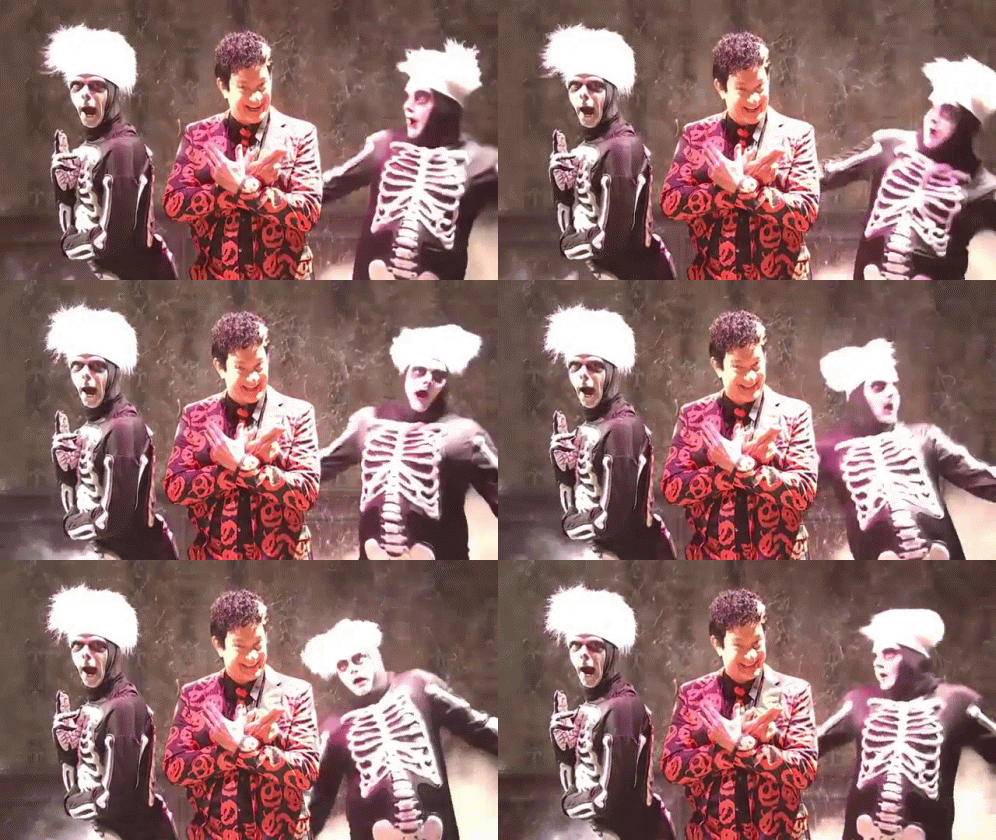
David S Pumpkins

David S. Pumpkins. Any questions?


Sandburg’s poem is just slightly old fashioned—the harvest festival aspects of Halloween are now abstracted from most of us, though it was in Sandburg’s personal experience. But we might still dress our stages with straw, and with cobwebs and lanterns, setting our fears as old.

May all your fears be old.

Today’s music has lots of electric guitars (seven tracks, four different guitars) mostly because I’ve been missing their sound. Lots of coordination to get all that traffic running—and I don’t know if I did right by it—but it was fun while I had time to make some noise this afternoon. You can hear the results with the player gadget below, and if you’d like to read Sandburg’s poem while you listen, it can be found here.


Witch Hunt

I’ve spent a lot of words this month talking about the history of poet and songwriter Dave Moore, who’s been the alternate voice here since we kicked things off more than two years ago. Today I’m going to end the history and get back to the present, shut up a bit, and let Dave’s words and performance tell its own story. Here’s a recent Dave Moore piece performed with the LYL Band this fall.

Let me tell you another thing about witches

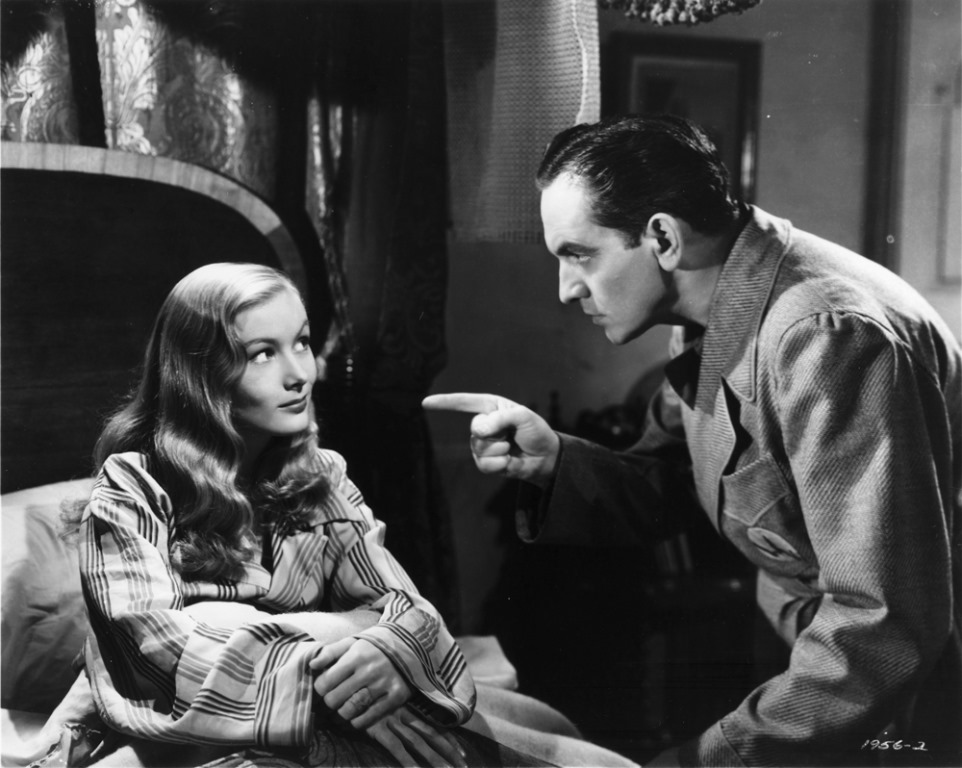
Little to do with Dave’s song, but I can’t resist including a still from René Clair’s “I Married a Witch”

Is this a Halloween song? A political commentary? An investigation of something that precedes and supersedes civilized politics? An excuse for me to fire up my Mellotron virtual instrument again? I could talk. You could listen. Today let’s choose the later. The player gadget is below.