Ollendorf’s Wife ‘Bout Changes and Things

Despite Orrick Johns’ lack of poetic fame, our curious audience seems to be responding to “Ollendorf’s Wife.”  Are you forgiving my unilateral revision of Johns’ 1917 words?

OK, here’s another rule breaker. The same day that I recorded the acoustic version of“Ollendorf’s Wife”  I also recorded this folk-rock performance with bass, drums, organ, and electric guitars. Is it better or worse than the acoustic version? I can’t say.

By subtitling this post/version “’Bout Changes & Things” I’m making an obscure reference to a quixotic mid-60s LP by Eric Anderson. Anderson was one of a handful of Greenwich Village folkies well positioned in the ‘60s to step into the new post-Bob Dylan breakthrough were the singers were expected to write their own songs with poetic sounding lyrics. ’Bout Changes & Things  had some of Anderson’s best early songs, songs that were already getting covered by some of the same acts that might also use a Dylan song.

However, about the time it came out another sea-change was occurring. Everyone’s folksinger records were starting to use electric instruments and drum-sets. Earnest acoustic guitar LPs with maybe Spike Lee’s dad on standup bass or Bruce Langhorne on “second guitar” were no longer what was expected. Dylan goes electric! The Byrds were having hits with folk songs and glorious electric 12-string guitars, John Sebastian and Zal Yanovsky had formed the Lovin’ Spoonful.

The trend was so strong that the production equivalent of revisionist history was resorted to. Tom Wilson overdubbed some session men on top of an already released but unnoticed Simon and Garfunkel song “The Sounds of Silence.”*  Alan Douglas took old tapes of Richie Havens and added new instruments to make “Electric Havens.”**  The former created a hit record and launched a career. The later couldn’t stop the undeniable soul force that was Havens.

Producers and Piano Players

Producers and piano players: Alan Douglass with Duke Ellington and Charles Mingus
Tom Wilson producing “Like a Rolling Stone” with Bob Dylan


Eric Anderson just went back into the studio and re-recorded his whole album with a band, and it was released as ’Bout Changes ‘n’ Things Take 2.  It did nothing for his career, and maybe even hurt it. It probably seemed not authentic, scene chasing, or some other sin.

Bout Changes and Things x2

Revisions: One set of songs, two albums.


So, there you go, one guy in Greenwich Village years ago who seemed at one point the equal of a lot of other up-and-comers but turned out to be a damp squib that didn’t ignite. And another guy. Same story.

To hear my folk-rock performance of “Ollendorf’s Wife,”  use the player below.


*Tom Wilson is another one of those “Why don’t more people know about him” characters. Besides midwifing Simon and Garfunkel’s first hit, even a brief look at who he worked with listed in his Wikipedia article should amaze anyone with any interest in mid-century American music. This labor of love web site can tell you more.

**Alan Douglas has an impressively varied producer’s resume similar to Wilson’s, but his ghost could probably stand to be less well-known. His overdubs of Havens work are largely forgotten, but he spent a couple of decades redoing tracks in the Jimi Hendrix archives (including replacing parts on the tapes with newly recorded session men) in an effort that was increasingly seen as fraudulent and cheesy. It’s not that I can’t see their critics’ point regarding Douglas’ Hendrix releases, and the resulting recordings are a mixed bag, but I indulge in the same sins of reusing and re-doing other artists work.
In the Time of the Breaking of Nations

As we celebrate the 100th anniversary of the armistice ending World War One, let’s bring in a writer not primarily known as a “war poet,” Thomas Hardy. Hardy is one of those bridge-poets between the era of the romantic and sometimes sentimental Victorian poets and the Modernists. Though I’m told Hardy never felt at ease in London artistic circles (he was country-born, son of a stone-mason and largely educated through apprenticeships as an architect) his poetry was admired by some of the Modernists. Why might that be? While his language can sometimes seem antique to modern ears, it was his language, the language of a rural 19th century working class Englishman. And while he will write about sentimental subjects, he’ll balance that with a cold eye.

In the Time of the Breaking of Clods

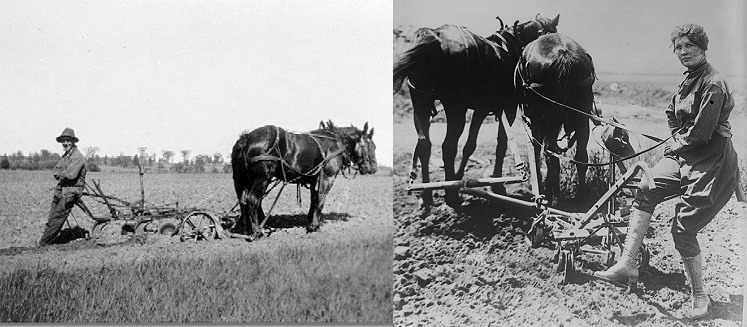
The horse-drawn harrowing time of the Breaking of Nations. But what’s that woman doing behind the horse?


Hardy grew up in a rural, farming district, as I did, and it may have been natural for him to relate the violence of the Great War to that setting. And I love how he does it here with three spare quatrains: the boustrophedon horse-drawn disk or rake plow that is literally breaking the earth*, in contrast with the prophetic “Breaking of Nations” warning from Jeremiah used for the title. Then there’s smoke rising, not a razed town after an army has swept through it, “only” the burning of invasive weeds. And finally, a mysterious third stanza with a mysterious word: wight.

It’s an old word, one of those that came to English with the German Saxons centuries ago. Chaucer knew it, used it in The Canterbury Tales,  and as best as I can tell it meant a sort of unimposing person or creature. Sometime later, perhaps after Hardy learned the usage of the word and after this poem was written in 1915**, it’s taken on a supernatural connotation. It’s fairly easy to trace that back to J. R. R. Tolkien’s use of the word in The Fellowship of the Ring  written decades after Hardy’s poem. Tolkien was a scholar of the ancestor languages of modern English. Did he know of other usages of the word, or did he simply take a very old word and choose to use it for an undead-spirit slain in battle?

So, in this last stanza, what does Hardy mean by his whispering maid and “her wight.” A flirting young couple? Are they whispering merely to shield their romantic bantering from others? Or is it something weirder? Is this a young woman whose man is off to battle, or even one of the battle-dead? Or, as part of Hardy’s theme are they both immortal ever-returning spirits, whispering because you only barely sense them in our time-bound world?

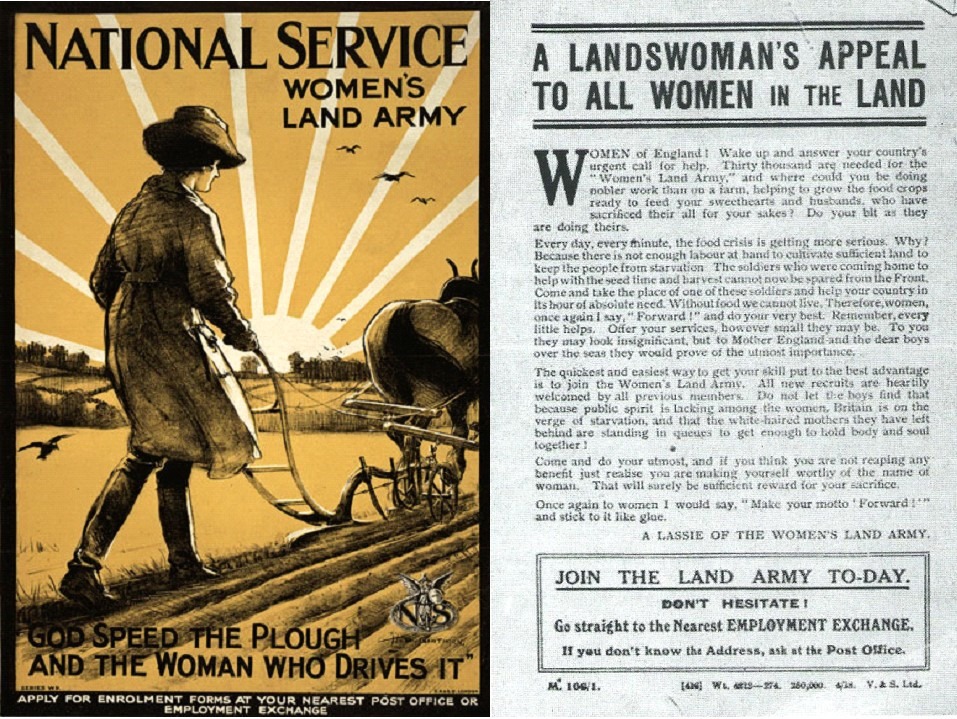
I don’t have the detailed historical knowledge to know how depopulated the farming areas of England were by the need for soldiers during WWI. From Edward Thomas’ poem from last month, Gone, Gone Again I get the idea that the absence of farming men was noticeable. And it was at least enough of an issue that England formalized an effort to recruit and train women as replacement farm labor.

Womens Land Army

Not just whispering to her boyfriend. “There’s not enough labour at hand to cultivate sufficient land to keep people from starvation.” Recruitment ads for the Women’s Land Army in England during World War I.


Well, I just like it that this is blurred. Do the final two lines give us any clues? Why does Hardy say that “War’s annals will cloud into night?” In early drafts, Hardy wrote “fade,” and “cloud” seems a more peculiar choice. In the context of the 2nd stanza weed-burning, I’m thinking he’s saying they will disappear in a cloud of smoke. Also in context of the 2nd stanza, this would make such war records in some future as valueless as weeds, but smoke/cloud again reiterates that there’s something unsubstantial about the couple.

“In the Time of the Breaking of Nations”  demonstrates a lot of what I like about short lyric poetry. T. S. Eliot could write a Modernist masterpiece like “The Wasteland”  extending to the farthest lengths of lyric expression, 15,000 words—but a poem like this can touch a lot in its 63 words.

It may not be apparent due to the instrumentation used, but I might have been subconsciously inspired by Bob Dylan’s repeating chord progression used for his masterful three-short-stanza song “All Along the Watchtower,”   which is very much in the same mode as Hardy’s poem.

Here is my performance of Hardy’s poem. Use the player below.


*Note too, Hardy’s pun on “harrowing.” For another discussion of boustrophedon plowing and time, see this earlier post. Near the end of his life, while visiting a farming museum, my father wanted me and his grandson to know that he’d walked behind a horse-drawn plow.

**Though the poem was published in 1916 when Hardy was asked for submissions of poems to support the war effort, one biographer says it may date back to 1870.

California City Landscape

I beg your indulgence, but once more I feature Carl Sandburg’s words in today’s piece. Variety is a goal here, so perhaps I need to take a personal no-Sandburg pledge for a decent interval. And, honestly, I wasn’t seeking another Sandburg piece when I read through a yearly anthology of American poetry from 1922 last week, looking for fresh public domain material. Reading it I came upon the interesting poem that is the basis for today’s piece.

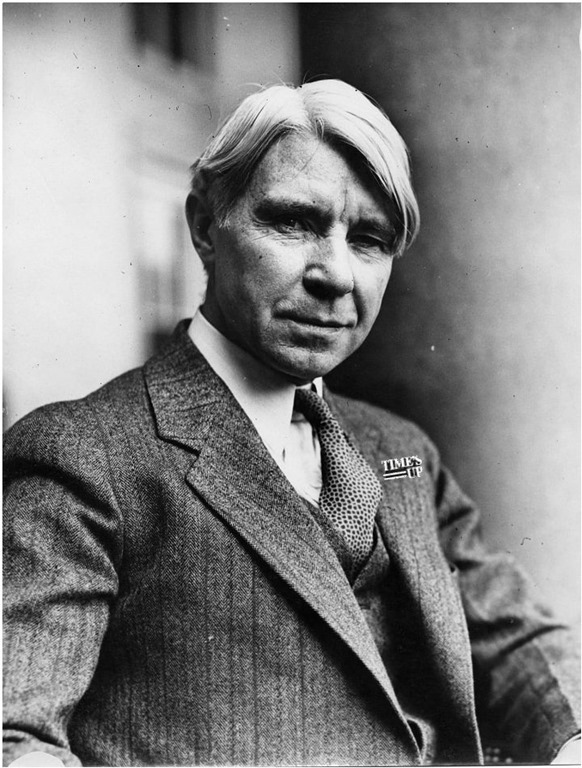
Carl Sandburg Times Up

The younger Carl Sandburg. Prophet?


Besides variety, I like to see connections, and “California City Landscape”  is rich in that. As a poem it may not be as sharp and condensed as Sandburg’s Imagist poems that I like to call attention to, but it does bring to the table Sandburg’s youthful journalism. “California City Landscape”  starts off like a feature story, and the story it tells is like ones written about gentrification in the 21st Century, even though it was written no later than 1922. The incumbent residents may be displaced. But like a poem, or a piece of carefully written prose, the reportage includes sentences which send a reader or listener off into entire dimensions of reality outside its moment in “the peace of the morning sun as it happened.” It was those things that arrested my attention as I read this in the midst of this old annual anthology.

It starts out with this anecdote about a second generation Irish-American goat farmer, connecting as it does to one of second-generation immigrant Sandburg’s great themes: American immigration. But how carefully barbed is the sentence Sandburg uses to sum up the changes this man has seen in California by 1922. He arrived in a covered wagon, and “shot grouse, buffalo, Indians, in a single year.”

If we were Tweeting: “OMG! He went there!”

But there it is in a sentence. An Irish-American, coming from a nation that is widely despised, colonially oppressed, and mired in poverty and starvation, travels in a generation across and ocean and a broad continent, and in the process shoots (and presumably kills) indigenous Americans, an act linked as if it was like hunting for food.

I’ll admit, at first moment I thought it offensive, but I’ve read enough Sandburg to know his toughmindedness, his instinct to not sugar-coat. That Sandburg wouldn’t have included this detail as a thoughtless, bloodless, “Oh, those good ol’ days, when men knew how to handle a rifle” comment.

His next anecdote: two Japanese families, truck gardening for the growing city of Los Angeles. And once again, the undertone: immigrants whose race and culture is understood barely enough to be widely disapproved of in their new country. We don’t need to credit Sandburg with the gift of prophecy, but historically we may know what will happen in 20 years: the Japanese Americans on the West Coast will be taken from their homes by legal fiat and detained in makeshift rural camps.

So, a 95-year-old poem about a problem we might write about today (if our poetry would be politically engaged and socially observant): gentrification. And in talking about it, Sandburg brings in racism, and immigration from those, ah, um—what’s the Presidential term—oh, yes, less desirable countries.

And then the third anecdote: the McMansion of the Hollywood director, with the “whore-house interiors.” Here I’m not completely sure about Sandburg’s prophetic dimension. The epithet of whore-house décor remained even into my time in the second half of the 20th Century as a charge on nouveau riche ostentation, a term used without a direct linkage to sexual oppression.

That Sandburg the poet goes on to add “ransacked clothes,” an odd adjective choice that he could have intended as a knock against Hollywood costumers knocking off “real” European couture—but that sounds more snobbish than Sandburg could ever be—and he next adds the “In the combats of ‘male against female” line. From the era we know the director is male, and Sandburg associates this anecdote specifically with a struggle of “male against female.”

Maybe I’m missing an obvious alternative, but is Sandburg predicting a 95 year #timesup statement?

Finally, I love the last line, echoing a common Sandburg trope about modernity and timelessness: “How long it might last, how young it might be.”


And now for something completely different: Sandburg in his 80s. “Ernest Hemmingway?”


Musically, I’ve been a little short of time. I wanted to do something reminiscent of the mid-20th Century word-jazz bag, but the typical beat poet reading to jazz backing in a small club used piano, and my piano skills are entirely rudimentary. Frequent Parlando Project keyboardist Dave Moore is currently fighting a right hand issue, so I couldn’t go that route, so I used by love of jazz guitarist Jim Hall and my audacious tendency to fake styles beyond my abilities to create this jazz trio with drums, bass, and electric guitar for my reading of Sandburg’s “California City Landscape.” Hear it using the player below.