Long time readers here will know I’ve referred several times to an observation by former US Poet Laureate Donald Hall that I’ve called Donald Hall’s Law. Here’s how I’ve recorded what Hall wrote:
The majority of poets who receive prizes, notice and ample publication in their time, will be unread 20 years after their death.
If they are unread at 20 years post-mortem, their fate beyond that rarely changes, save by scattered efforts like this weird Project and its versatile readers and listeners. So, today’s piece is by one such awarded and forgotten poet, Margaret Widdemer. I can’t really claim that Widdemer is a great talent awaiting rediscovery. I fear some antiquated elements in her poetry make reading her in large doses more of an academic exercise. As an indifferent scholar with many other tasks in this project, I can only say I’ve skimmed her work. Yet, per Hall’s Law, she was a prolific oft-published prize winner. Widdemer was first published as a novelist in 1915, and in the silent film era several of her novels were adapted into movies. Her poetry has several modes and subjects, and she wrote selections dealing with social issues, including child labor and women’s suffrage. Perhaps the height of her prize-winning resume came fairly early, when she tied Carl Sandburg in the voting for the 1919 Pulitzer Prize for poetry, becoming the co-winner that year. Anyone who knows me knows I maintain that Sandburg is due for a reappraisal — but if Sandburg’s undervalued, he at least has a current value. If Widdemer was his peer in 1919, her stock has long ago dropped off the literary stock exchange.
Widdemer’s Pulitzer Prize winning poetry collection was The Old Road to Paradise, and it contained a representative mix of what I’ve seen while skimming her poetry. She writes rhymed verse, and her poems often seem to have music implied in their structure and prosody — you could class many of them as literary ballads or songs. Despite this structure, I’m unaware that she’s been commonly set to music by composers.*
At least to me, the most interesting of Widdemer’s work combines that “just asking for a musical setting” structure with strong fantasy elements.** Given that fantasy literature retains cultural interest in the present day, these Widdemer poems are the ones that might have revival interest. Today’s selection “The Dark Cavalier,” included in her Pulitzer book, is one such poem. Furthermore, if it was written more recently and set to music, we’d easily see it genre-wise as Goth. It certainly risks being disturbing, the poem being spoken by a seductive Death who wishes to lure the weary or troubled listener to settle for his stable and grave-set romance. The poem’s outlook is such that one could feel that reprints should have footnotes about the 988 number established for those dealing with suicidal thoughts. Yet it seems to be one of the relatively-known of her nearly-unknown works, and it was selected in 1958 as the title for a late selected poems collection.
I didn’t know Widdemer married a cellist when I composed this, but this setting is acoustic guitar with a simple string quartet accompaniment.
.
In musical performance I tried to undercut the poem’s speaker’s luring spiel, to bring out a little of the subsumed caddishness in a suitor who offers an everlasting relationship, when we know, that even for prize-winning poets, their attention will quickly fade.
You can hear my performance of the musical setting I did for Margaret Widdemer’s “The Dark Cavalier” with the audio player gadget you may see below. No player to be seen? Some ways of reading this blog will suppress that player, so I offer this highlighted link that will open a new tab with its own audio player.
.
*Widdemer married the year she received the Pulitzer. Her husband was also a prolific author, but it’s also said he was a proficient cellist who wrote book-length biographies of composers.
**One recent reader noted that she wrote a poem about a “Gray Magician” in “Middle Earth” before Tolkien, which indicates that Widdemer may have had some knowledge like JRRT did of Old English. I also suspect that she must have been aware of the revival of interest in older British Isles folk-music by Cecil Sharp, Francis James Child, et al.
Nine days ago I started this Halloween Series with my sung adaptation of a graveyard poem by Robert Frost. Now we’re nearing the end of the series, and today I’m going to present another graveyard poem that sits with my sense of Halloween, Ethna McKiernan’s “Stones.”
I also promised in the beginning of the series that I would say why I’ve decided to make an extra effort to note Halloween. Decades ago, I met a young man (we were both young then) who had many interests, John Brower. The immediate bond: we both loved unusual music, not just strange or adventurous Rock that one could find in many a large record store back then, but harder to find Modernist orchestral music, and the even harder to find musics from other cultures around the globe. John also had a strong interest, much stronger than mine, in fantasy and horror genre fiction and film. What links those two groupings? For one thing, they were outsider-ish things then. If you want direct evidence of this mysterious connection you only need to investigate the trope of using the musics of the first of John’s interests with the movies and TV shows within his second one. The first signals the second: dread, tension, and the unknown. Scary movie, unknown planet, unsettled minds, eldritch times and places, it was a good chance that the less tonal string sections, the theremins and early electronica, the gongs or tuned percussion, the swooping vibratos and strange timbres of otherwise unheard avant-garde or exotic musics would emerge in the soundtrack. In the obverse, can anyone think of a well-known happy or loving scene similarly soundtracked with odd music? I can’t.*
But that doesn’t explain John. He gathered about him an eclectic mix of folks interested in these things, many of whom would be loners by inclination or classification. And every Halloween he would take them into the dark autumn north woods to his family’s cabin for a celebration of the holiday of the things less -heard than feared, we all in this group lit by the light of frightening movies until deep into the night.**
John grew up, continued to be engaged in many things, keeping those core interests and working to foster them. Then he died suddenly, while still young by the way I’d measure lifetimes from my current age.
There so much more to his story, and I’m sure parts I don’t really know, but within the briefness I prefer for these posts I want to say that I learned things from John and his enthusiasms, and in the scattered pre-Internet age he was a rare ear interested in some of the things that I spent my time thinking about and seeking out. Two decades after his death, I still will hear a piece of music, see a movie referred to, or encounter a piece of dark fantasy, and I’ll think of John, remembering some of what he thought of it, or I’ll be occasioned to consider what he might say about it today,
John had this spirit of Halloween, the old spirit of the things we repress and shush-up the rest of the year. Now, long after his death, and the death of others who so graciously tolerated and helped inform my interests in music and poetry, I have this personal graveyard in my head that I’m tending. As the Blues Poet Bo Diddley sang, I find “I’ve got a tombstone hand and a graveyard mind…”
One of the most striking and effecting poems in my Halloween Series, Ethna McKiernan’s Stones. If you want more, and I’m thinking some of you will, buy her book, linked below.
..
Which brings me to today’s poem I set to music. Regular readers may recall Ethna McKiernan from earlier posts. She was part of a small poet’s group alternate Parlando voice Dave Moore and I were part of — and unlike Dave or I, she published her poetry regularly both locally and via her connection with Ireland.*** She died nearly two years ago now, but in my head she has a mind’s gravestone like my late wife, like John Brower, like Ethna’s friend and poet compatriot Kevin FitzPatrick.
Poets, musicians — we play in our heads all the time. We look back at inscribed dates inside there, and compose in that dark using beats and sounds strung over time. Those beats come to rests, those sounds fade to silence. When I set Ethna’s poem “Stones” to music I chose to refrain a line from her beautiful poem so that it won’t end before you pay attention to it: “I am watching over all of you.” In Ethna’s poem that line is hauntingly unclear by design. We the living are charged with watching over our personal graveyards. We hope, transparently and by wisps of sight, that their residents are also watching over us.
Happy, yes, Happy Halloween that we knew them. The audio player to hear me trying to do justice to Ethna McKiernan’s poem “Stones” with my own music and performance is below. No player on your screen? This highlighted link will open a new tab which will supply you with an audio player.
.
*While the avant-garde or the exotic was only used for terror and unrest, for some reason the foundational composer of western classical music, Johan Sebastian Bach was the other go-to music for frightening undercurrents. Why? As young children, did filmmakers sit under towering pipe organ tubes fearing that wolves would appear out of that forest, or that teetering from low notes, that they would fall over and crush them?
**John was one of the first folks I knew with a home VCR, and even as video rental stores started to emerge he proudly purchased movies he admired, just has he collected esoteric avant-garde records, and small-press books. Neither of these things were inexpensive to his income level then, but he considered this his form of patronage of artists and their art.
Continuing our Halloween Series featuring some of our listener’s favorite fantasy and supernatural pieces from the seven years of the Parlando Project we get to today’s short Emily Brontë poem “Spellbound.” Once more we have an eerie situation with withheld information that adds to the mystery while paradoxically compelling our attention.
Before beginning the Parlando Project I was only aware that Emily Brontë had written poetry, holding that fact as having no other consequence. I’m not even sure what drew me into her poetry — memory fades — but it may have been finding out that another Emily, Emily Dickinson, read it. Brontë’s poetry, which preceded her famous novel Wuthering Heights, was at least partially extracted from a series of writings she and her young siblings created within a set of fantasy worlds — and though this short discussion of Emily and Anne Brontë’s imagined world of Gondal doesn’t list this poem as being part of that universe, “Spellbound’s” setting doesn’t sound out of place from the northern, winter island in their Gondal.
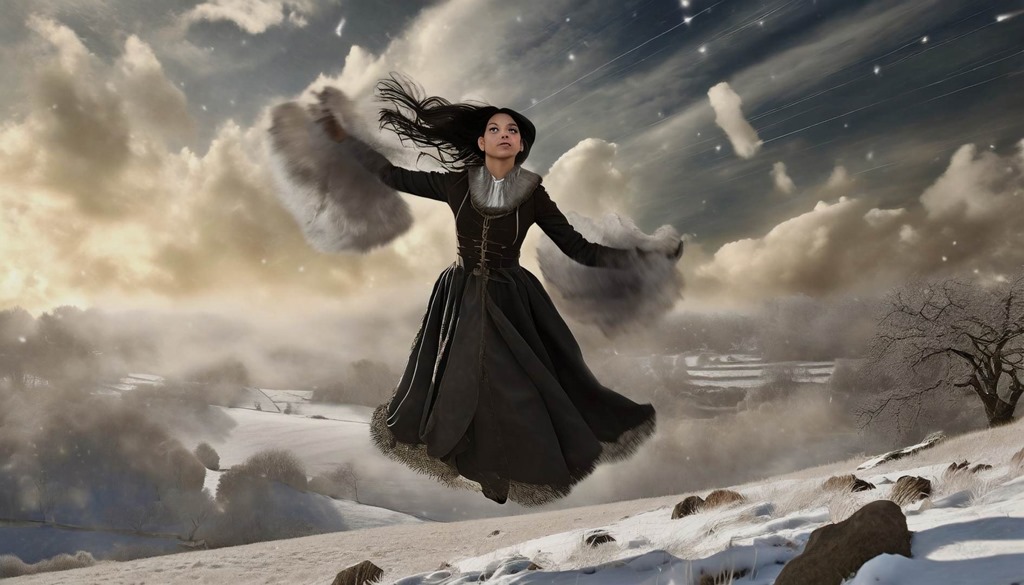
Nor out of place in the northern U.S. where I live, where the wind and weather is casting us to cold with predictions of snow and ice within the next 24 hours. When I first presented this poem three years ago,* I was intrigued by the prepositional position that the poem’s speaker seems to be in. In the poem they say that clouds are above them and the wintery wastes are below. It could be that Brontë was only envisioning a highlands or hillside perspective, but my mind’s eye had the spellbound speaker suspended, frozen in mid-air. Perhaps again, my imagination overtook me in that detail, but then I’m glad for Brontë’s imagination which created this chilling and enchanting poem that let me picture that.
Another illustration created by enchanting Adobe’s Firefly with an incantation. Firefly claims that it doesn’t use uncompensated artists work in its AI model.
.
I rather like the music I came up with for this one. Maybe you will too. An audio player is below for many of you so you can hear the performance of it, but some ways of reading this blog will suppress that page element, and so I also offer this alternative: a highlighted link that will open its own audio player gadget.
.
*If you follow this link to my original presentation of “Spellbound” you can see the lyrics as part of a chord sheet in case you would like to perform this song yourself.
Judging from the numbers of its inclusions in Internet lists of spooky poems, Walter de la Mare’s “The Listeners” comes to mind to more than just me when people are asked to think of Halloween poems. Yet it has no monsters, no sudden scares, no wicked battles, no fully-described supernatural events.
It creates its strange effect in this strange way: it gives us lots of details which may seem inessential, and next to nothing of its central situation. The plot is simple: a man travels to a building on horseback. He knocks at the building’s door. No one answers. He leaves. As an elevator pitch summary, it has little to call us in or disturb us. Why does it leave us with a wondering chill? It’s those details. Here’s a link to the poem.
First off, there’s a supporting character in the poem which seems to have only one for sure, the Traveller. That character: his horse. We meet the horse right at the start, noticing that it is unconcerned and grazing as the Traveller opens with his door-knocking announcement of arrival.
We’re also told it’s night. Only slightly unusual, in that one generally doesn’t schedule appointments at night. The Traveller knocks again. We’re told the building has a turret. Castle or fortress, or just a decorated Victorian era house? We know by this it’s not a small hut or cabin. The listeners that are spoken of soon are something of some means.
Our two characters: the Traveller, and the horse he rode in on. One thinks it’s very important to be there, the other couldn’t care less.
.
We’re told the Traveller has grey eyes. What an odd detail! We’re not filling out his driver’s license after all. Grey is a quite rare eye color in de la Mare’s Great Britain or Western Europe. Does the poem mean to suggest the Traveller is coming from a far distance?
Is there anyone inside the house? The poem mentions “phantom listeners” and these listeners are in the title. “Phantom” says they aren’t in the house at present in the way the Traveller and the horse are outside the door. We learn that the house has a hall, reinforcing by detail that the building isn’t small. The Traveller senses these whatevers, their “strangeness.” How are they strange? Nothing is said — but our second character, the horse, remains only interested in grazing.
The Traveller is insistent, pounding louder, shouting the intriguing line “Tell them I came…that I kept my word.” This is the plot’s climax, we don’t know what duty brought the Traveller there, perhaps from a long way off. Of course, we wonder what the bargain is, what the promise was. Is our wonder stirred by not knowing? Mine always is.
Another detail: we’re told the Traveller is “the one man left awake.” How are we to take that statement? That the “phantom listeners” are asleep and can’t be awakened? Or should we take it more catastrophically: that the “phantom listeners” aren’t human, never were, and that the Traveller is the last man at all, anywhere, awake? I never considered this latter reading until typing this tonight —perhaps I’m over-reading — but if so, is the Traveller coming to ask them to lift that spell, the only man still with agency to plead?
I love the final quatrain of this poem. Our horse returns, and the listeners, we’re told, can hear the creak of the leather from its saddle stirrup — a lovely detail, and a quieter sound compared to the pounding and shouting that has preceded it. Finally this sound: the evocation of the horseshoes ringing on hard stone inside a world of otherwise silence. The horse may be unconcerned by the silence, perhaps even the lack of any other awake people is not of any matter to it.
My music for this features the electric 12-string guitar, an instrument that I love. You can hear me perform Walter de la Mare’s “The Listeners” with the audio player below. If you can’t see that player, no need to knock louder, use this highlighted link which will open a new tab with its own audio player. Thank you for being The Listeners for this Project!
Today’s piece in our Halloween Series is clearly fantasy. What value has fantasy?
Well, it’s often fun; it exercises the imagination by giving it an unlimited field. This potential has a natural limit however — humans are uncomfortable with the unlimited. We are animals quite tied to limits, to the actual, the particular. Even fantasy not intended as allegory must reference those things inside the everyday limits of our world, of our time. The SF of the past is often quaint with those make-dos, specifics that seem anachronistic to the stories unknown time. Watching a Sixties Star Trek TV show we see the family on the Enterprise bridge, the patriarch in an easy chair, the subsidiaries at kid’s-height tables, mom at the Radar Range — and all are watching one screen in front of them. Their haircuts are all in style for our now past mid-century. The warfare tactics: broadsides and boarding parties, already obsolete when freshly filmed. Watching it now, the other side — our present-day watcher’s side of the screen — we are farther into the future than these characters are.
I don’t believe poet A. E. Housman retains the readership in the U.S. that he retains in Britain. His best-known poetry collection A Shropshire Lad is as series of poems considering rural adolescence and youth in the 19th century. UK readers might likely find that place in cultural memory more easily than Americans — but Houseman was not just local color. He was a classical translator and scholar of achievement. He knew how to put classical restraint, objectivity, and concision to work in poetry, like in this fantasy poem I set to music a few years ago, and will present today: “Her Strong Enchantments Failing.”
I like to include these chord sheets here from time to time. It’s my hope that better singers will improve on my own performances. Lot of suspended chords here, as this song’s moment is suspended.
.
The poem is set in a timeless place, though time still has days and death. There’s magic and spells there, laid out in a sharply chiseled first verse. I love the cinematic zoom from falling castle towers, to empty potions, to a knife at the titular her’s neck. And as page-poetry it’s eminently singable; and for a performer, the compelling force of the storytelling is what every singer would want in a lyric.
The situation violently balanced in the final two verses may just be plot for the author. The Queen’s slayer is about to process his knife’s edge. The queen, who’s emptied her spells and potions knows that they will work in magical or biochemical time by the next day. I have no idea if Houseman had any intended allegory to a situation here, something that might have been clear and present to his contemporary readers. When I performed this in 2020, it was then a fine fantasy poem, so well-drawn and easy to sing. Today, I can look at this autumn’s news and find easy parallels to current events.
You can hear my performance of A. E. Housman’s “Her Strong Enchantments Failing” with the audio player gadget below. Can’t see a player? Not a spell, just the limits of some ways to read this blog. Here’s a backup highlighted link that will open its own audio player.
I asked the teenager if they had any ideas for a poem I could use for May Day, the international workers day. She thought for a minute and then said, “Well there’s one, but it’s from a video game.”
Have I intrigued you? Perhaps only the unusual folks who follow this project might be. May Day. Video game? Poem? Maybe even: teenager? Every one of those things are keywords that might drop readers. Add that your author is an old guy, one not very hip to video games, and I don’t know how many are still reading by this paragraph.
Still here. Good — because the poem is excellent, and we’ll get to it in a moment. First, a short summary of the context it came from. The video game is titled Night in the Woods.It’s now around 5 years old, and it seems to this outsider to have an unusual premise: it revolves around teenagers and their peer relationships in a declining industrial town of Possum Springs. There’s a mystery to be solved, at least after a fashion, but the richness of the characters and their milieu makes it more a novelistic experience than a puzzle escape room or series of mini to macro baddies to battle. Oh, and did I mention that the characters are anthropomorphic animals?
Sound cute? Well, here we go with opposites again. Mental illness and violence are part of the world. Nancy Drew Case-Of… or PBS Kids style animal parables this isn’t. Our main characters are teenagers, and yet the weight of this world is on them — and the world, despite the fantastic elements, is our world, set in the declining rural America inhabited not by animated animal-faced kids but by a gig economy and our new-fangled robber barons.
The poem is spoken in the game by a minor character — in the nomenclature of game mechanics, a non-playable character — a spear-carrier in this small-town opera. I’m told she appears in various episodes as the game proceeds, speaking funny little poems while the foreground, playable characters, deal with weightier things. As she starts to read this, it’s not clear from the opening words that this poem isn’t just another little sideways humorous piece of verse.
It’s not. Yes, the people in it, the working class this May Day is ostensibly for, are counted as small, but the poem builds in its litany of smallness increasing, of inequality compounding. At the end the poet-character finishes stating her dream of justice. In that night dream, she’s alone, and that’s why it’s a dream — and will always be a dream on those terms. A century ago when the Wobbly songwriter Alfred Hayes dreamed he saw the dead Joe Hill, Joe Hill tells him to organize. When Martin Luther King said “I have a dream” he was standing in front of thousands who’d say it with him. That’s why we have a May Day.
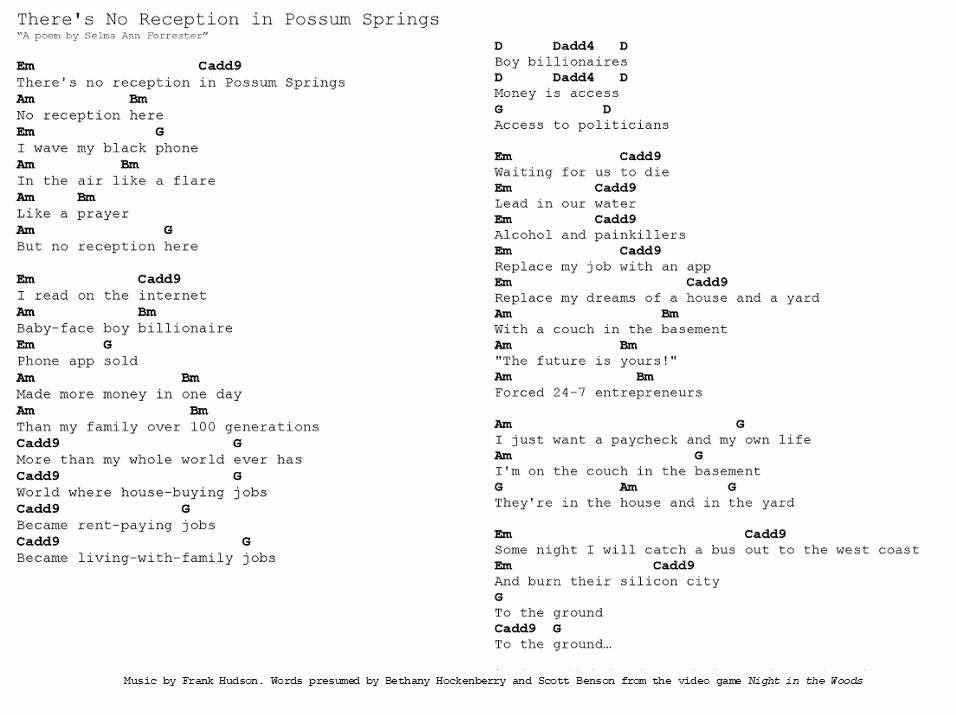
Here’s the poem presented as the chord sheet that I performed it from today, credited to the fictional character in the game. Best as we can figure, the actual authors of the game’s dialog and therefore this poem are Bethany Hockenberry and Scott Benson.* The chords listed show the chords I was fingering on guitar, but I had a capo on the first fret in this recording, so they sound a half-step higher. The main reason I’ve been presenting these chord sheets is that while I do my best in my rapid production schedule on these pieces, I figure others out there might do a better job with this. One person singing a song is a performance. The second is a cover version. More than that, and it might be a folk song!
.
To hear my performance there’s an audio player below. Player not there? Then this highlighted hyperlink will open a new tab with its own audio player.
.
*They have no connection with this performance, other than the eloquence of the words impressing my daughter and then myself. Apologies in that I hurried to do this for May Day and haven’t contacted them.
While looking for material to combine with music and perform for the Project this week I came upon a specific but little-known connection between two great early 20th century poets. I’ll go into the details of that in a bit, but before I write about that, let me set the scene by mentioning something about one of those poets, Robert Frost.
In the past mid-century, when I was growing up, Robert Frost was a poetic institution. He’d won four Pulitzer prizes, his work was as well known as any living American poet, ordinary readers might have familiarity with some of his best-known poems, and a few phrases from those poems had entered general usage. It was not uncommon for the schoolbook poetry anthologies that I’d encounter back then to end with Robert Frost. If he wasn’t the end of poetry, he was as good a symbol as any of the end of poetry as it was consumed up until that mid-century time, where literary poets wrote verse that was assumed to have a chance at general readership and could have evident value to them. He wasn’t Tennyson or Longfellow exactly (Frost’s sound was more like common American speech) but you could see him as a proprietor in the same trade as the 19th century giants.
He was enough of an institution that schoolboy-me was having as little to do with him as I could. Sure, he was living, but that was no help, because he was old. Many dead poets left young corpses, paintings, engravings, or photographs of dashing writers, heads cocked with their thumbs and index fingers up against their visionary brains. Keats or William Blake, now there were my comrades, not Frost. I plead youthful ignorance and concerns, and Frost’s poetry stuck around to eventually inform me in my foolishness.
So, it surprised me to eventually learn that for nearly half his life Robert Frost couldn’t get arrested as a poet in America, and he wasn’t doing all that well in finishing college or finding a steady day gig. Frost may have been trying, but he wasn’t trying very long in any one place — inevitably either they or he wasn’t for having him stick around. Nearing 40 years old, Robert Frost did something next in his unstable life: he went to England. What was this guy, that by my time was the quintessential American-scene poet, thinking?
I’m not enough of a scholar to know for sure, though reading a few Frost bios would probably inform me. One good theory: nature poetry and poetry about rural subjects was having something of a bloomlet in England. If England had led the way in industrialization and empire building, an in-reaction interest for literature about the countryside and country living was arising.
Within a couple of years of arrival Frost connected in England as he’d never been able to do in New England. He published his first two collections of poetry. He formed a close friendship with British critic Edward Thomas (and in return convinced Thomas to write poetry). He ran into another American ex-pat, Ezra Pound, and the younger Pound trumpeted the now 40-year-old Frost’s poetry back to America as part of the coming new thing.
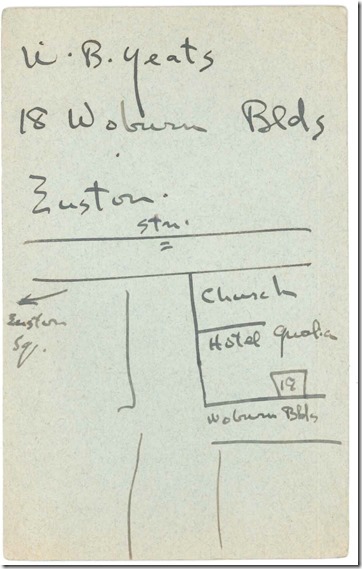
Imagism in action Ezra Pound, acting as a Georgian-era GPS, drew this map to show Frost how to get to Yeats place in London.
.
And there may have been another factor, a hoped-for connection with another poet: William Butler Yeats. Yeats wrote of the rural Irish countryside of course, and I had never associated Frost with the Celtic revival at all. Just in preparing for this post today, I took note for the first time that Frost’s mother was a Scottish immigrant. Why did I start to look into that kind of connection?
I started re-reading Frosts first English-published collection, A Boy’s Will, where I came upon this poem with a generalized title: “Love and a Question.” That poem stood out at first glance because I could easily see how it could be fit to a folk-ballad style musical accompaniment. It even included a close variation of a floating verse line used in several folk songs “Her heart in a case of gold/and pinned with a silver pin.” But then there’s a second line too: the woman by a country hearth with thoughts of “the heart’s desire.” Here’s a link to the full text of Frost’s poem.
That second line would have been unremarkable except for the accident of performing a Yeats poem from an early verse play of his The Land of Heart’s Desire this past winter. I link to my post on this if you are new or have forgotten, but this play sets up a nearly identical situation to Frost’s “Love and a Question.” A newly married couple are in a remote cottage on a stormy night. A knock at the door, and we are introduced to a stranger who asks for some comfort — but who is, it’s inferred, a fairy who wishes to enchant the new bride.
How well did Frost know this piece by Yeats? In research this week I found out that while in one of his short-lived teaching jobs before leaving for England he’d directed Yeats play with a company of his students. Cites I can find online mention him putting on this play,* but nothing I found mentions that he also wrote this poem rather directly dealing with the play’s same story.
What does Frost bring to Yeats’ material? While his poem is understandably more condensed than even a one-act play, Frost obscured the situation considerably over Yeats well-told fantasy tale. The few attempts to write about Frost’s poem I found online catch nothing of the fantasy element because Frost makes that so unclear. Yeats’ stranger at the door is portrayed as odd and troubling soon after the character’s arrival, yet other than the continued borrowings from Yeats plot, the only thing in Frost’s text that suggests that the stranger is not a mortal is the peculiar detail of the stranger carrying a ”green-white stick” which if read in the context of Yeats’ tale may be interpreted as a wand or wizard’s staff. The stranger in Yeats is an active character, throwing themselves into the newlyweds’ relationship rapidly. Frost’s stranger is but spoken to and doesn’t act or speak other than the knocking entrance. The bride in Yeats has some action and agency in her own thoughts. The bride in Frost is a single tableau by the fire. The fears of the bridegroom are expressed in both the verse play and the poem, but in Frost’s poem he seems to be talking almost to himself. Endings? Spoiler alert: in Yeats’ play the bride dies, and it may be guessed that her soul-spirit has been taken by the fairy-stranger. Frost’s ending is vaguer. The bridegroom seems to say he understands the protocols of regular alms-seeking, but he can’t understand why someone would be so rude as to interrupt a new wedded couple on their honeymoon. Yeats’ bridegroom is anxious, but wary as he tries to win the occult battle, even though he fails. Frost’s bridegroom seems, well, puzzled.** Is Frost satirizing Yeats tragic Irish tale, suggesting that a real rural bridegroom wouldn’t figure out what was going on? I might be missing something, but does the poem feel like a satire? For the bridegroom to be a fool wouldn’t surprise a Frost reader. Many kinds of human foolishness, misunderstandings and limitations are portrayed in Frost poems.
This brings up another factor. This early Frost poem isn’t very Frostian. The story, such as it is, isn’t clearly laid out, and the language and prosody — this seems impolite to say about this master — is awkward. I thought this poem would be easy to sing. It wasn’t, and I think that goes beyond my limitations and the brief time I could obtain to work on recording this. The poem strains natural, clear syntax and order at times to make the rhyme, and it doesn’t show well Frost’s famed use of metered verse that sounds like natural 20th century American speech. I don’t know if being so confusing adds to the weird tale, though as an aficionado of handed-down folk music there are times when the stuff that falls out through worm-holes or is forgotten in the folk process does add power by mystery. No one really knows for sure what “Smokestack lightning” is, or what it has to do with the rest of what Howlin’ Wolf sang about, and most don’t know what the hell a cambric shirt is either. We know only that something strange is going on. The listener here may be like Frost’s bridegroom: with some passion though puzzled.
So now you know that Robert Frost wrote a poem after a verse-play by Yeats, and you can hear me work to bring that Frost poem to music with the graphic player below. If that player doesn’t show up at your door, wave your magic pointer and strike this highlighted link to open an alternative audio player.
.
*Introduction to a Frost anthology The Road Not Taken by L. U. (I’m thinking, Louis Untermeyer), Yeats and American Poetry by Terence Diggory, and Robert Frost: A Life by Jay Parini. The latter quotes Frost writing that Yeats was able to “make the sense of beauty ache.”
**The ballad tradition includes tales of ordinary folks who by luck, pluck, or guile beat the occult challenger. I don’t know how well Frost knew his Child ballads, but he did know the golden heart box with a silver pin. Still, I can’t think of one offhand where the mortal wins just by being a bit dense about what is going on.
A person I know as a poet told me at a reading that he was playing with his Jazz combo on Sunday, assuming (rightly) that there would be some interest on my part. I told him I wasn’t sure if I could attend, since I live in a household with two distressed persons. They nodded as if they understood.
If you’ve noticed that this Project has been more intermittent, that’s much of the reason. The typical post here starts with looking for interesting texts, researching a bit about their context, composing, playing and recording the music, and then finally these blog entries about my encounters with the poems and the process of presenting them. The order of these events isn’t set in stone, occasionally there are gaps between steps, but it’s also common for each step to take an open-ended block of concentration. My desires to support those I love, their needs for quiet, and frankly, my unease held in common with theirs, has made that kind of focus rare for several months, wearing down what storehouse of steps I have for new pieces of work.
In place of that, I’ve taken up two things that more easily fill the odd-lots moments of time that come to me. I’ve increased Twitter promotion of the over 650 pieces in our Parlando Project archives found here.* I’m doing that enough that I’m probably seen by some as an ignorable nag by now, and the results so far in drawing traffic are only slightly better than my attempts on Twitter made during last National Poetry Month. Still this substitute effort to promote the various ways that music and words can combine makes me feel like I’m not abandoning this Project’s goals.
The other activity is reading, which of course has always been part of the Project, but I speak of reading that isn’t directly tied to finding a new piece or understanding its contexts. I’m mostly reading books about musicians, music, or poets for pleasure and as a reset from life stress.
But enough about me and troubles that aren’t yours. This post is getting tardy in getting to today’s work by William Butler Yeats. His “A Fairy Song” comes from a fairy story told in a verse play from early in Yeats career. Most recently we’ve presented a later Yeats poem “A Coat”in which Yeats is looking askance at this sort of earlier work and at those who chose to copy his early style. “A Fairy Song” is very pretty, and you could enjoy it just as fantasy word-music — decoration not declaration or anything much. I enjoyed the poem from first reading on that basis. In times of trouble, why not some dancing fantasy?
Easy chords & simple arrangement, and like many of my Parlando Project pieces, offered here in case other singers want to sing it.
.
However, after waking in the middle of the night last night I read the play The Land of Hearts Desire that this poem appears in twice, introduced inside the play by a fairy child. Let me quickly summarize the plot: a young bride is beguiled to take in a beautiful child who comes upon their rural poor Irish cottage at night. She gives the child food and warmth, and in return the child reminds her that her loving marriage means bondage to grinding tasks of life and family duties that will have no release until death — but if the young bride comes away with the beautiful child to the otherland of the faery, they will have nothing but carefree joy.
It’s a commonplace that fairy stories have psychological depth, and so to my mind in the middle of my night, I was ready to take this one in beyond idle fantasy. I hold for the loving marriage. I hold for duty. Ever the freedom and fate for breakage, ever the poverty or wealth of what we can give and bring — beside and knowing that — I’m for that above music and magic. And readers, I love music and poetry a great deal.
That poet who plays saxophone in his jazz combo? I waited until an hour before the show started, things were clear, I went off and saw them play. I was worried: jazz plus poetry is a formula that might each reduce the additive audience, but an appreciative 50 or so showed up scattered about the theater. A stranger a couple of seats over thought the keyboard player sang like Chet Baker — and yes he did. The playing was fine, and at my age I might have danced, but the fixed theater seat aisles would have kept a dancing ring from forming.
The next day I had what turned out to be a bit over an hour to find music from “The wind that blows out the gates of the day.”** I did so and quickly recorded this simple setting with acoustic guitar of Yeats’ “A Fairy Song.” You can hear it with the player gadget below. No gadget seen? This highlighted link will play it too.
.
*If you’re following the Elon-Musk-takes-Twitter farce of Internet doors opening and closing amid much bumbling, you may be curious about my take on this. No time today. There are some interesting people there, including a small poetry community — that size like all poetry communities. Twitter’s design, which long predates Musk, is conducive to folks like me with unknown blocks of time from a few minutes to sleepless doomscrolling hours. I personally find it impossible to keep up with WordPress on my phone, even though I treasure the blogs I follow when I can find time at a larger computer screen.
**If you’re interested in a deep dive into the Irish faery mythology that Yeats was using in his play and poem, this web page will give you quite a bit to go on.
Where’s the gore? Where’s the grisly fright? My Halloween series has been featuring atmospheric fantasy poems so far, a mode I personally like, but I suspect there are some in my audience that want things more corpse than incorporeal ghosts.
Well, I’ve been saving this one up for you, wanting to work out a full folk-rock arrangement. Given that I play all the parts, it’s taken awhile to complete, but the stars aligned and it’s ready for you to hear. Who’s the poet and word-supplier this time? Robert E. Howard.
“That Robert E. Howard?” a few of you may be asking. Yup. Conan etc. No, not the red-haired antic Harvard-educated TV comic. The other one. The character who helped put the sword to sword and sorcery. And today’s poem didn’t appear in The Dial, Poetry, Others, The Criterion, or other early 20th century magazine of emergent literary art. “Dead Man’s Hate” first saw print in the pulp Weird Tales.
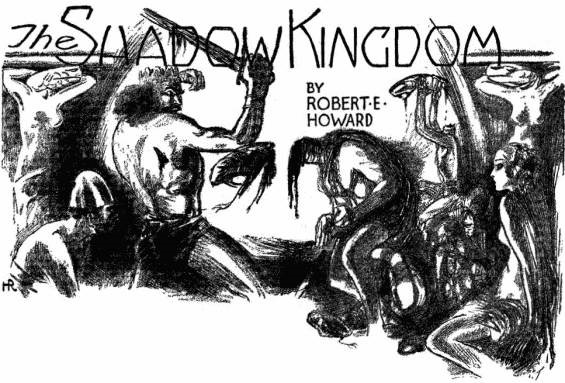
No, not the charmingly mysterious Bob Dylan short musical film, this is Howard’s own 1929 sword and sorcery story as illustrated in Weird Tales. Besides the putative Dylan connection, note that freshly severed head. Our hero’s kingdom is beset by many evil things that aren’t what they seem, including the now familiar shape-shifting snake-headed lizard people trope.
.
To the small degree I know Howard’s work, it is through a late friend of mine who appreciated the literature of H. P. Lovecraft and his circle which included Howard. That friend was always careful to frame Lovecraft, Howard, et al by noting their racist and racialist elements. He could have gone on to note that they weren’t consistent literary craftsmen either. Given their needs to sell by the word to late-paying pulps, they perhaps couldn’t afford literary polish — but that their stories can still have power for some readers, despite all that, says something too. Howard’s “Dead Man’s Hate” has no problematic racialist elements* and I think it has the on-rushing narrative power of a Child or broadside ballad in telling its gruesome story of a hanging.
As I said in opening, the music took a bit of work, and perhaps in coincidental honor to Howard’s pre-WWII Texas upbringing, I used twin violins as the lead instruments — but this unconventional folk-rock style song isn’t really Texas Swing. Besides a twanging Telecaster, electric bass, and drums, there’s a pump organ and some vox-humana-like notes in there too. You can hear my performance of “Dead Man’s Hate” with the player gadget below. No player visible? This highlighted link is an alternative way to open an audio player to hear it. Looking for those less gritty Halloween pieces? Check out our last six Parlando Project posts for a range of other ghosts and gothics.
.
*Well, there is this: the man being hanged has a distinguishable Irish surname, and the one celebrating this event has the WASPey name of Adam Brand. Hangings in American westerns often read to me as conscious or unconscious wrangling with the history of American lynchings of Afro-Americans and other outsider groups. As to racism in Howard’s pre-WWII Texas, my father spent part of his childhood there, and it was pretty much baked-in according to his recollections. Poor Howard, dead and gone, left me here to sing his song — and Howard might not have lived long enough to see what he was indurated with. I’ve come to believe the Muses, a useful name for the unlimited forces that inspire art, are capable of bringing in viewpoints and power that their human receivers would have difficulty expressing.
English poet Walter de la Mare does a very particular kind of fantasy or horror poem. If one is looking for body horror or jump-scare monsters, de la Mare is not your guy. His spooks and slitherers are usually off-camera — instead, he describes discretely the atmosphere and effect of a haunting, visitation, or some binding spell. As our Halloween series continues, I have a performance today of a de la Mare poem called “Song of Shadows.” It starts out commanding a musician, so it’s a natural for the Parlando Project, but besides the ghost story, I think it invokes something else I considered this week.
Here’s a link to the poem as de la Mare wrote it. I made a slight change to the concluding line of each stanza as I like how that change works in performance.
I learned a weird fact about de la Mare this month: as a writer he struggled for income, but for reasons I don’t yet know he was given a bequest in golden-boy and WWI casualty Rupert Brooke’s will that provided for his career.
.
“Song of Shadows” is not definitely set, though some elements of the scene indicate it might be somewhere antique. Fires and tapered candles wouldn’t be totally obsolete to a 19th century-born man like de la Mare, but the opening command to a musician sounds like a court or titled lord of the manor kind of thing to me. And the poems report of an extant — not necessarily metaphorical — hourglass with sinking sands really sets this outside of the early 20th century when it was written.
One could stretch and draw a class-conscious reading between the commander of the poem, the musician, and the eventual appearance of some ghosts or spirits. Who are the ghosts to the commander? To the musician? De la Mare leaves that open, but the different roles of those three characters offer an opportunity for speculation. To the commander: old friends, old enemies, subjects, servants, or serfs rebellious? And within the range of feelings the spirits may carry, we may note the poem’s commander asks to risk summoning them.
But I mentioned the poem set off another line of thought beyond its subtle fantasy intent. The poem concludes the shadows have been summoned by the musician’s song, “Dreaming, home once more.” So rather than thinking of the commander or the ghosts, I thought of the musician. While I operate musical instruments to realize the Parlando compositions, I’m likely more competent as a poet than as a musician, but singer is often an honorary title for any poet. For those who read this who are poets: is this not a part of our job?
The thought intensified when I read a string of Twitter posts by Lao poet Brian Thao Worra this week. Thao Worra was taking stock of his career in that post, and throughout it he seemed charged with a mission toward the Laotian diaspora as a Laotian-born poet and artist living in America. I’m no expert on Laos (nor anything else really, but less so on Laos), but it struck me that so many poets I read and resonate with are part of, and speak of, large diasporas: Irish poets, Afro-American poets, Jewish poets. Even the echt classical Chinese poets Du Fu and Li Bai were banished to far provinces of China. Why do I resonate to these poetries? It then occurred to me: many, perhaps most, poets are in some kind of diaspora, be it geographic or otherwise. We have emigrated from the country of Poetry, or we have been exiled or taken away from there. And there we are, like the musician who sweeps faint strings in de la Mare’s poem — singing, waiting for countrymen* to hear our song. Will they hear, and if so, will it be in the plane of dreaming, in the plane of ghosts and spirits — and so then will it be that we are all, home, once more?
I didn’t sweep the strings of an old, cheap 12-string guitar very faintly for this performance of Walter de la Mare’s “Song of Shadows.” And I kind of hollered the vocals. Ghosts, make of that what you want. You can hear it with an audio player gadget below, but if you don’t see that player, this highlighted link is an alternative that will open a player gadget.
.
*I can’t think of a gender-neutral word that has the same flavor and power to me as that word “countrymen.” Why that is must be complex, or just some failure on my part, but I just wanted to say I used it because I couldn’t do better.




 Frank Hudson