Robbing an Orchard

Halloween is a multi-valent holiday. There’s the cluster of religious and spiritual holidays of prayer and remembrance for the dead, the holiday of horror and monsters, the children’s festival of costumes and small candy-bars, and so on. I went looking for some supernatural poems that might be fun to present this week, and I came upon this short poem by British Romantic-era figure Leigh Hunt that was begging to be sung – after all, the full title of his poem was written down as Song of the Fairies Robbing an Orchard.”  It’s light fantasy, but then the news has stolen all the horrors.

Was I thinking of a particular orchard as I worked on this piece? There were two apple trees just to the side of the house I grew up in, but they were past their prime by my time. I remember they bore small and not very appetizing fruit, and sometime around when I left home they were cut down. I recall my sisters and I climbing in the low and scraggly branches when barely more than toddlers – but it wasn’t exactly that pair of trees. I was probably thinking more of an orchard I have never seen: the apple trees that are part of the homestead “kitchen garden” that blogger Paul Deaton often writes about.  I also probably visualized Deaton’s apple trees and his stories of work with them when I performed Robert Frost’s great harvest-time poem “After Apple Picking”  a few years back. Deaton’s a regular reader of this Project’s blog – so Paul, if you read this, and when you next check you are missing some of your apples, you’ll know who tipped off the fay. Well, the more they take, the fewer you need to harvest and put up.

Leigh_Hunt

An engraved drawing of Leigh Hunt by J. Hayter

.

Leigh Hunt is one of those Zelig or Forrest Gump like characters of the 19th century British Romantic-era. He knew and worked with all the big three Romantics: Byron, Shelley, and Keats. Hunt was key in launching Keats poetic career, was there for Shelley’s death by drowning, and had a tempestuous relationship (I suspect the most common kind) with Byron. As a poet himself, he’s decidedly minor, but this opus’ mischievous whimsy charmed me. I love the characterization tidbits in it: the fairies peeping in at pious humans worshiping in chapels, and their admission that they don’t even care that much for apples, but are in it more for the challenge of stealing them.

The 12 string guitar as played by Leadbelly 800

Come to think of it, Julius Lester probably has as least as high a Zelig/Forest Gump score as Leigh Hunt

.

For music to sing Hunt’s poem, I used a 12-string acoustic guitar. Last week while commenting on a poem I’d read online, its author asked if I’d read Julius Lester. An old man, my steel-trap memory has corrosion problems, but the name rang a rusty bell. I remember seeing Lester’s byline in the Village Voice back in the Seventies, and I had some vague recall of him working on radio. But poetry? No, I had no idea he wrote any poetry. I hit a quick web search, and Julius Lester as it turns out was a multi-hyphenate: author of many books in several fields, social activist, college professor, photographer, critic, broadcasting host, and folk-scare-era folk singer. Reading about him I realized that I had owned one of his books: the early Sixties instruction manual “The 12-String Guitar as played by Leadbelly.”   I’ve long been interested in this 12-string variation of the great folk instrument of my country: the steel-string, flattop acoustic guitar. Leadbelly was a pioneering performer on that instrument.*  I can’t say that today’s piece is fully in his style, but it’s the work of someone who’s heard Leadbelly and some of his more apt descendants. You can hear the short song I call “Robbing an Orchard”  with the audio player gadget below. What, have the fairies run off with the audio player too? Naughty fairies! I give you this alternative enchantment then: a highlighted link that will open a new tab with its own audio player.

.

*I heard a counselor at a kids summer camp play a 12-string in the early part of The Sixties around the time that the 12-string-featuring song “Walk Right In”  made it to #1 on the Billboard Hot 100.  I note in the linked wiki article on that song, that in 1962 12-string guitars were so scarce that when they decided to use two 12-strings playing together for an even more powerful sound, they had to wait for a second one to be made by the Gibson guitar company. Lester’s book, co-authored with no-less-than Pete Seeger, was a rare publication on how to play this instrument.

Minnesota’s Twin Cities was something of a hotbed of 12-string players in the 20th century, and shortly after I moved there, I bought my first 12-string, a cheap one sold as a sideline in a Musicland record store.
The Three Friends: an audio play adaptation of a Walter de la Mare short story

I indicated last time that I had another piece I wanted to present before Halloween by Walter de la Mare, that British master of the subtle supernatural. It took a bunch of concentrated effort to produce something of a realization of it, but it’s as ready as I can make it in time. How’d it come about, and why was I not sure I could promise it?

I use the Internet Archive often as part of this “not just non-profit — it’s non-revenue” Project. One of the things the IA has is a large library of scanned public domain literary works,* which affords me a handy way to look through “many a quaint and curious volume of forgotten lore.” In the run up to Halloween I made a note to see if there was some Walter de la Mare work I could use for my Parlando Project purposes.

This Project lets me not only explore the well-known writer’s and musical composer’s habit of procrastination, but also the reader’s and researcher’s branch of that foible too. I put that book search in my I’ll-do-that-tomorrow bin for about a week. “I’ll get around to it” I told myself.

And then in mid-October some numbskulls hacked the Internet Archive causing it to go largely offline for more than a week. When the scanned book section returned to availability, I was already into making other new work for this year’s Halloween series, but a few days ago I was finally able to access some additional collections of de la Mare’s work from the IA. In looking through those, I found that Walter de la Mare wasn’t only a poet. He also wrote short stories, which like his poetry, exhibit his dry sense of the strange. “The Three Friends”  is one of his shortest published stories — short enough to work into one of my short-format audio pieces.

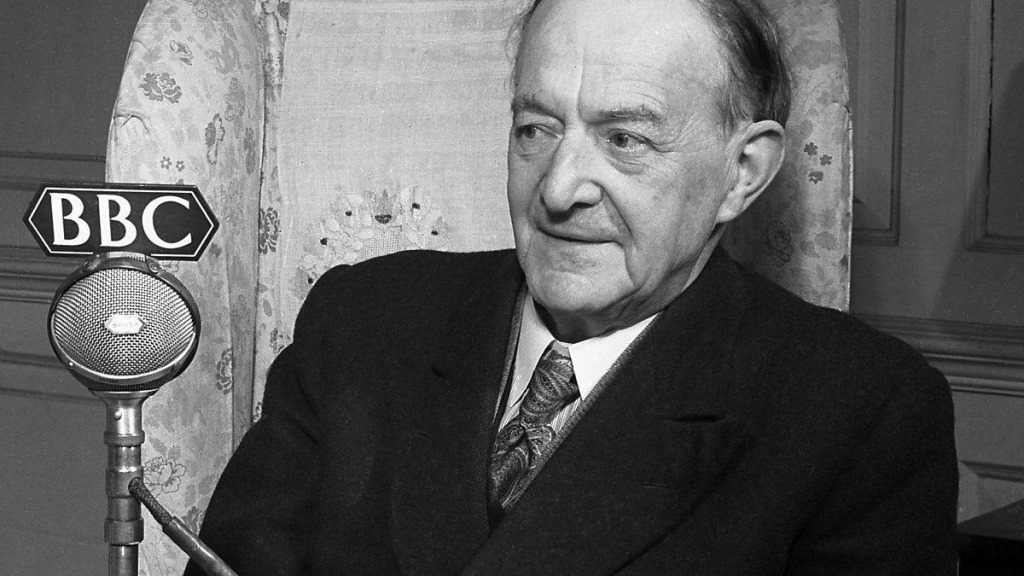
Walter de la Mare in front of a microphone

When Walter de la Mare worked the mic, he had a whole radio network to support him.

.

“The Three Friends”  is dialog-centric, and in less than a day I was able to jury-rig up a three-person play out of it — but who’d be my voice-acting ensemble? It was less than 72 hours until Halloween. I’d have loved to have used Dave Moore’s voice, but my production schedule is catch-as-catch-can, and I didn’t know if I could corral him in time. My wife agreed to play the part of Lacey, the tavern keeper member of the three friends, assuming she wasn’t completely worn-out from her work and the rest of her life. Last night she stepped up to the mic and recorded that part in a quick pass. I made a logistical compromise and recorded the other two parts with my own voice, also working quickly.**  By about 9 PM last night I had the dialog recorded.

Between then and about 3 PM this afternoon I worked on the audio production of the recordings, selecting a bit of instrumental music (from my last-weekend exploration of a new audio software feature) to serve as a plausible theme music for “The Parlando Project Theatre of the Air.” The 19 hours from first opening up the microphones to an audio play ready to upload weren’t all Project work: I did go to sleep after midnight, I got up at dawn and did a bicycle ride to breakfast, and early this afternoon I made another bike trip to the grocery store — but there was a lot of production work trying to meet the needs of this format that isn’t what the Project normally does. “Radio play” music production isn’t the same as recording and mixing a 3-minute song, and I had to learn how to apply my computer audio tools in a slightly different way. If you haven’t done audio production, it’s a heap of tasks even to get a half-way polished result: finding environmental sound effects, balancing levels, fixing the most egregious dialog glitches, deciding if any pauses are too long or too short, and so on. The result of this experiment is good enough to present, though I note things that I would have liked to do better.

So, what’s the story our actors are presenting for your ears today? Two friends are casually talking about a problem bedeviling one of them. That troubled man, Eaves, has been having reoccurring dreams or visions. His friend Sully tries to make light of it, but in the course of their evening they meet up with the third friend who works in a tavern, Miss Lacey. They talk over Eaves’ problem: you see Eaves thinks he has pierced the Samhain veil. Has Eaves seen, will he tell of, “the undiscovered country from whose bourn no traveler returns?”

Well, it’s de la Mare. Most writers would break out the purple pen to write such visions, de la Mare wants to make a more subtle (and human) observation. The orchestra (well, the piano trio) has started to sound. Take your seats and listen to the short, 10-minute world-premiere performance of the audio play “The Three Friends”  by using the audio player below. What, has someone tall with a large hat sat in front of your audio player gadget? I provide this alternative, a highlighted link that will open a new tab with its own audio player.

.

*The Internet Archive has also taken an aggressive stance to works that are not clearly in the Public Domain. That activity is controversial and has had some legal judgements handed down for rights-holders. I won’t take your time to go into all that, but its scanned PD literary archive is a treasure for readers and researchers.

**Oh, if only I was one of those skilled voice actors who can call up entirely different vocal timbres to create distinctive sounding character voices! I tried to mitigate the lack of distinction between Eaves’ and Sully’s voices both being portrayed by mine by using stereo separation on today’s audio

The Song of Finis

Last time in our Halloween series I reported that Edgar Allan Poe had movies made from some of his poems — well, sort of.  Today’s poet Walter de la Mare’s poetry, in title and under his name, wouldn’t have served for such, because so much of what de la Mare does is understated and inferred. He’s one of those poets that when read casually seems to not be doing as much as he’s actually doing. There may be no fireworks going off when you read a de la Mare poem of the supernatural— until after reading it once and remembering the poem later, you may sense the flash-bang-backs of what’s there and evoked.

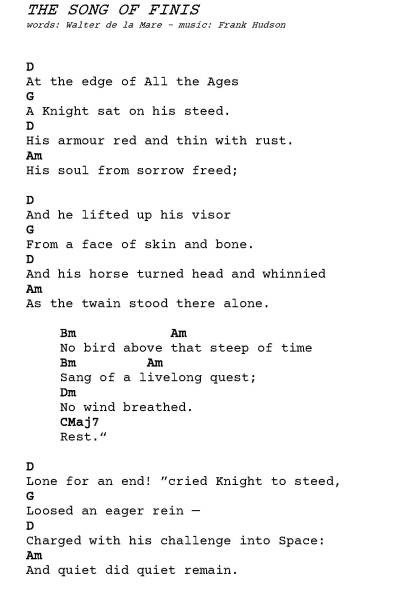
Today’s Walter de la Mare piece “The Song of Finis”  is an example. It seems simple enough to be children’s poetry, and indeed his publisher bound selections of de la Mare’s more whimsical short poems to market them as children’s books. “The Song of Finis”  presents an eerie short scene and situation, supplying only the barest of details still rich in specificity, and wraps it all in some fine word-music that urged me to make a song of this proclaimed song.

The Song of Finis

I present these chord sheets so that you can sing these songs yourself.

.

We have a knight, but one out of his time, yet still errant. The once shining armor is rusted.*  When he lifts his helmet visor, we see yet “skin and bone,” a choice that lets us imagine a gaunt face suggesting the skull beneath. He’s alone somewhere warm and windless (warm enough to summon the tea-time image of steeping).

There are but two lonely sounds of dialog recorded. His horse whinnies knowing something’s up, and the knight calls out “Lone for an end!” The latter is a bit poetic-dictiony, but I’ll allow it to depict the out-of-time knight, and I suspect de la Mare wants us to hear “lone” as double-sounding for “long.”

What happens in the poem’s conclusion? Does the knight and horse charge off some cliff to end his anachronism? Or is he challenging that empty place he finds himself in with that single cry that has no answer? My thought, it’s sort of both, the song of “Finis” is about endless endings, and the desire for one last adventure.

knight with angels 600

In de la Mare’s poem there are no angels

.

You can hear my song setting of Walter de la Mare’s “The Song of Finis”  with the audio player gadget below. It’s not finis is you can’t see that audio player, as I supply this highlighted link that will open a new tab with its own audio player. Not finis for me either this year, for my plans are to return soon with at least one more de la Mare fantasy piece before this Halloween charges into memory.

*As a fan of the 20th century Rock group Procul Harum, I wondered if the band’s lyricist Keith Reid read de la Mare’s poem once and remembered it in his song “Conquistador.”

Poe’s The Haunted Palace

Let’s continue our series of fantasy and supernatural poems with a musical performance of a poem by Edgar Allan Poe — a poet that might be expected to appear in any such series. Before we go to that poem and my performance, let me take a quick jaunt back to my mid-century youth.

Poe sat in a unusual place in literature back then (and probably still does now). His writing, including his poetry, remained in circulation. Unlike Longfellow, it wasn’t likely because it was deemed worthy lessons for young people — Poe’s writing kept its place for its gothic sensation into the 20th century. Without Poe or his sensibility, would there have been then a Vampira, EC horror comics, pedantic pulp detectives, Lovecraftian horror, a great deal of Heavy Metal lyrical content, or a post mid-life movie career for Vincent Price? And that’s not even broaching the topic of Poe’s influence on the French Symbolists, who took elements of his strange and abnormal on an emigration journey from the asylum to the academy.

For a year or so around middle school age, I went on a Poe jag, reading a great many of his stories in collections that also included his poetry. It was a short-lived enthusiasm, and I’m not sure what remains of it. Did I start there with my love for an unreliable narrator? Was the on-the-spectrum “Aha” moment attractive to me neurologically anyway before this reading? Since I can’t say, let’s get on with an example of Poe being the inevitable poet that a Halloween series calls forth when the boundary-line between the dead and the living becomes permeable.

The scenery about the ghosts in “The Haunted Palace”  is something of a poetic trope. Poetry loves a ruin, and poets being the unacknowledged back-benchers in the world of political power, there’s a draw to poems about the death of kings — and so we have poets writing “Ozymandias”  or “Jade Flower Palace.”

Poe though is drawn almost entirely to the sensuousness of the decay here. There’s no lesson about unwise or tyrannical rulers in the poem. There’s no tragedy — if we can even guess the kingdom’s tragic flaw it might be that it was all too beautiful.*  On one hand I find the poem a hallow poem of hollowness — but intended by the author or not, that hollowness is a statement about great kingdoms and their lovely riches. And the ending’s invocation of always escaping — and therefore not escaping — unsmiling ghosts of hideous laughter completes the poem with a powerful rhetorical burst.


Take a sideways jump to the genius of SCTV

.

Perhaps because of the simple harmonic structure of my musical setting, I worked some hours unproductively this week on additional musical decoration. I made two attempts at twin bowed-string lead lines for this, and abandoned both those ruins to our mutual benefit. After that wrong turn, I decided that the piece’s feature is more its swaying, understated groove which I left to stand for its value. Mid-century ghosts visiting this music are welcome to do The Frug or The Jerk while listening, but those on any side of the Samhain borders can visit “The Haunted Palace” with the audio player gadget below. Has such a gadget disappeared within a fetid mist? Oh, no matter, you can hear it with this highlighted link then, as that will open a pale-doored new tab with its own audio player.

.

*Poe wrote that the death of beauty was the ultimate poetic theme — the gothic manifesto in short. I’d note in that an undercurrent there that many (most) artists feel: that they create all their beauties, only for them to become abandoned ruins with rare and uncommon audiences. As Frank O’Hara’s fraternal twin brother Count Floyd said: Pretty scary, huh, boys and girls!

The Puca

As our Halloween series continues, let me advocate today for an element of the fantastical: the goblin. Some fantasy creatures are, by definition, not fully alive: your vampires, zombies, golem, all animated undead meat; your ghosts “spirited” in some way, but incorporeal. The goblin, like all the variations in the fairy realm, seems akin to the human, but not in the beautified, glammed-up way that many fairies are depicted; and also, like the human, goblins seem subject to motivations and whims, not driven by some designed in need.

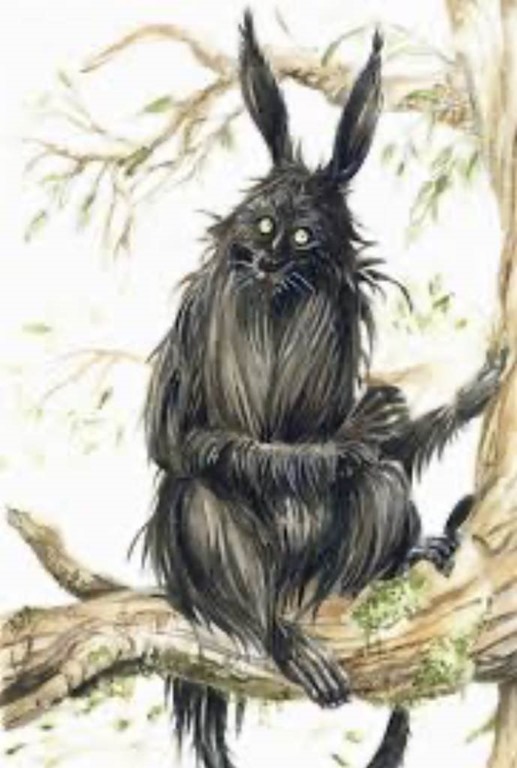
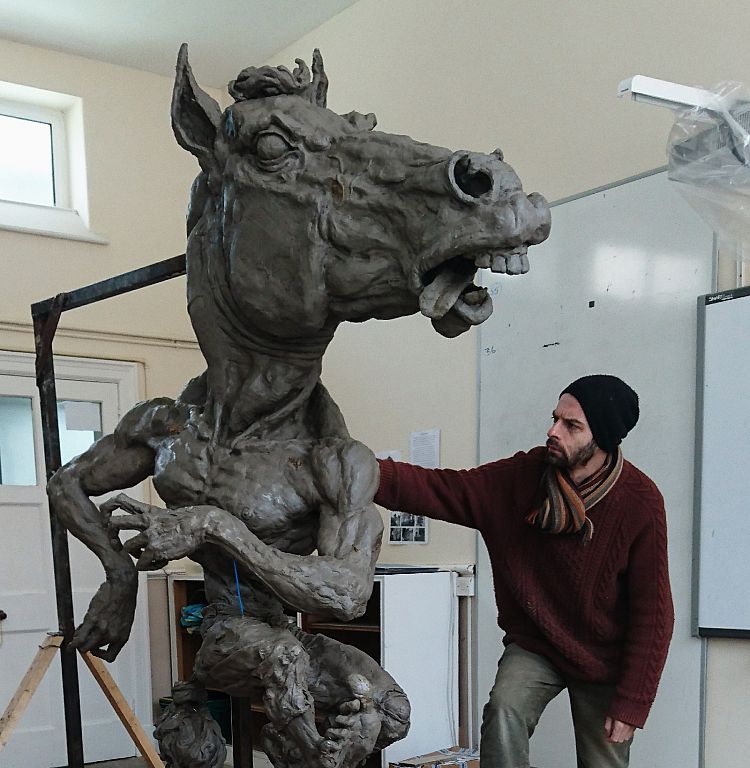
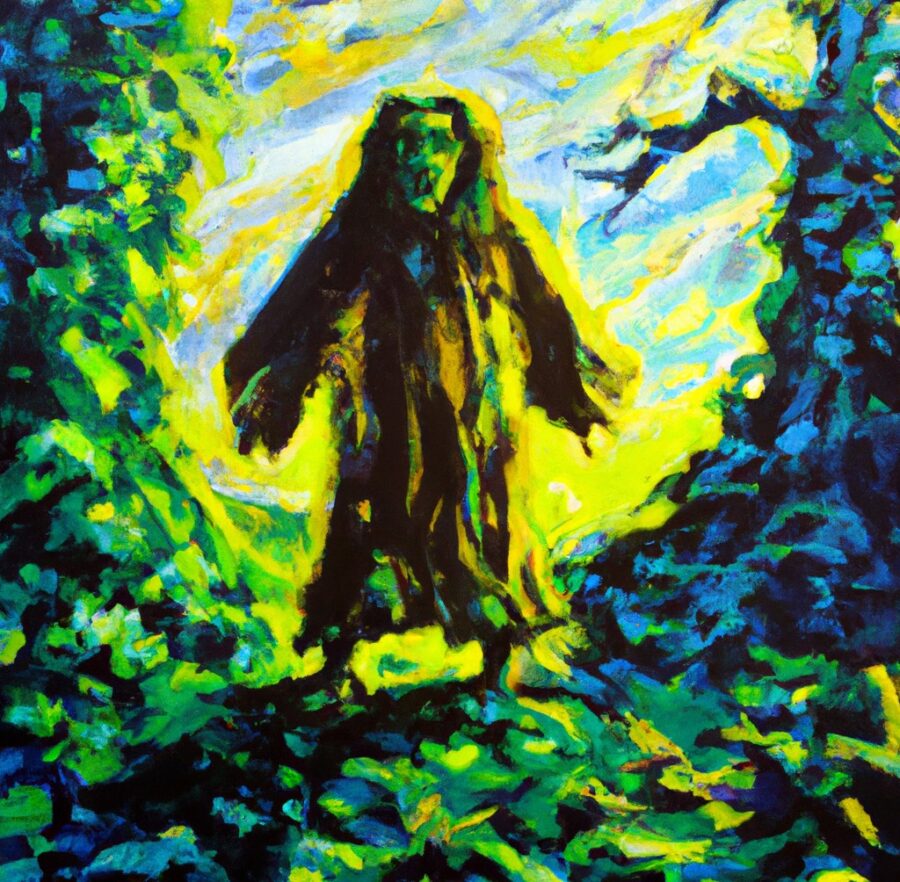
Puca is a goblin name of uncertain etymology, and specifics of their appearance and nature are like the word’s origin, broad-ranging. That non-specific appearance is baked into many accounts: they are shapeshifters. Some accounts link them to taking on animal forms: rabbits, red-eyed horses, and so on.*  Today’s puca is related in a poem by Irish poet Joseph Campbell.**  While Campbell is attuned to shapeshifters, his puca doesn’t change species or form in his poem: he starts and remains a hairy creature of the forest, human-enough to mirror human behavior, which becomes the signal incident in the poem.

Puca drawing

Shapes of pucas. I don’t know the artists for the two on the sides, but the sculptor in the middle is Aidian Harte and his mid-transformation depiction caused a commotion in the Irish town it was to be displayed in.

.

If goblins are unpredictable, portrayed as helpful and troublesome, this puca does in a way transform. In my reading of the poem, I sensed it describes something of a turn-about: rather than a human encountering a magical creature and then by elfin spell or trickery the human is changed, Campbell describes the opposite: a shy creature emerges, is observed laughing, dancing, poetry on his lips. And then a stanza later, his mood is sad, distressed, bitter. What causes this change?

The poem doesn’t say, but another creature, the poem’s voice is observing the puca. Let us assume he’s human, even that he may be the poet himself. The unhappy puca is said to have become “the double of distress.” Does “double” just mean equal to the happiness of the second stanza? Or does it mean the puca has taken on, mirrored, the human who has revealed that he envies the puca’s “sunny mood” in the happy verse before?

The poem ends by telling us this human/goblin encounter has caused the puca to retreat back into its cave, hiding itself. The puca may have been enchanted by the human’s sadness, and thus fled from the human’s thrall.

Unsaid in the poem, but I’ll ask: is the human changed by this encounter? While the puca instinctively flees the dissatisfied human, it’s the poet that’s telling us this story, and I think they’ve concisely explained that their bitterness has an effect, causing the happy fantastic to leave. Did the poet learn something from this?

I’ll add this biographic note on the author: Campbell’s involvement with the Irish Civil War that followed independence broke him. He was imprisoned, faced at least some danger of execution — and once released, he fled the Ireland whose culture had fed his art. His literary efforts tailed off sharply and the “gall and bitterness” that the puca demonstrates was Campbell’s lot in the last part of his life.

But this is a poem of Campbell’s early career, first published in 1913. Mute on the page, it set out a spell for me to set it to music. I think “The Puca” shows one of Campbell’s strengths: concision. A great many literary balladeers want to write epics. While I admire those that can vivify a 10-minute ballad in performance, I also observe that that endurance is beyond me — and Campbell, fresh from rubbing shoulders with the concise Imagists, has packed a charged moment in time into four stanzas — and if my reading is valid, more is evoked in the incident described than might be explicated in extra verses.

I tried for the eerie in the music I composed and recorded here: a certain wildness in the keyboard line’s contour and oddness in their timbre. You can hear my performance with the graphical audio player below. What? Such player has crept away into a cave or twilight glen?  This highlighted link is an alternative, as it will open a new tab with its own audio player.

.

*Articles on the puca I read this month relate this creature to the Easter Bunny and the invisible friend in Harvey,  generally benign creatures — but then, the red-eyed horse is said to offer rides home to the inebriated, the acceptance of which will lead to a wild, bucking, bramble-scratched ride, ending with the rider being bucked off in a field far from home. Unmentioned in the pieces I read would be the animated cartoon character of Bugs Bunny, the gender-fluid trickster that I’d see as in this tradition too.

**Obligatory footnote every time I bring Joseph Campbell up — no, not the Power of Myth guy. This Campbell is a deserving-of-more-interest writer of the turn of the century Irish cultural revival. Like many others of his generation, he was caught up in the Irish independence struggle, used Celtic folklore material, and dabbled in writing for performance (plays and song-lyrics) — but he was also connected with the Imagists and early English language poetic Modernism that emerged in London before WWI.

The House of Ghosts

It’s been a busy week at the Parlando Project studio as I record more Halloween-themed songs freshly made by combining other people’s words (usually literary poetry in the public domain) with original music in differing styles. Let us go to the lab and see what’s on the slab.

Last dark-and-stormy-night-time we had a poem that started with someone at a household’s door asking to be let in. Waif or wraith? Therein lies that tale. Today we again have a piece that starts at a doorway — but the tale-teller here lets themselves in. What do they find there? Well, that’s the song.

The words I used today originated with a poem by early 20th century American writer Margaret Widdemer. While Widdemer is little remembered now, she was a successful presence in the literature of her day. And while the Parlando Project does the everlasting Greatest Hits of Poetry sometimes, I also like digging through old poetry collections and anthologies looking for overlooked poems and poets. Such “many a quaint and curious volume of forgotten lore” reading let me find Widdemer, and one thing that drew me to her was that she seemed to have absorbed some stuff from the folk-music collectors of her time — for example, this eerie poem of hers that builds on the “Lyke Wake Dirge”  presented here six years ago.

One thing that folk-music tradition teaches us: the singer is free to change and adapt the song that was handed down to them. Entirely new words or new music may be applied. Verse order, much less exact wording is not sacrosanct. Instead, a good fit for the singer and the audience (these being the folk in folk-music) is the guiding force. Most composers who work in the Art-Song form are compelled to keep the text unaltered, and while I’m not of that tradition, I most often present the poet’s words as they published them for the silent page. But, for today’s piece I substantially altered Widdemer’s poem to make what I hope is a more effective song.

House of Ghosts

Widdemer’s poem is linked here if you’d like to see the “before” to my substantial revision.

.

I started with a simple change: I created a refrain based on the initial verse of Widdemer’s original text when I found it ineffective for audience grabbing. In other revisions and additions, I sought to sharpen the “build” of the story’s details, and I excised antique words and diction that added no charm.

Musically I recorded a late-night laid-back Rock combo of two electric guitars, electric piano, bass, and drums for my resulting song. Here’s the chord sheet in case you’d like to play your own rendition. That’s also the in the folk-music tradition: the song shouldn’t belong to only one voice.

To hear the way I played and sang it you can use the audio player below. What? Has no audio player gadget materialized on your screen?  This highlighted link will open a new tab with its own audio player then.

I plan to be back soon with an entirely different, more orchestral ensemble for the next piece in our 2024 Halloween series. Should I act like a YouTubber or Substack author and urge you to subscribe for this upcoming content?*

No, I’ll leave you as a free agent on that decision. This Project goes beyond non-profit — it is by design no-profit. I just love diverse music and poetry and get a kick out of exploring what’s possible. I have nothing to sell and would avoid anything that is paid by the click, because I have no makeup to be a small-businessman.** But my self-regard (or desire to promote a range of poetry) likes seeing viewers and listeners. Sharing this stuff on social media, or just telling a friend, will help keep this going.

.

*The Parlando Project started as a short-form podcast, one sans the usual blather, paid-for-promotions, and between-host jocularity — presenting instead our typically 2-5 minute musical pieces unadorned. It turns out that podcast audiences prefer one-to-two hours of gab — but if you want a break between the talkers in your podcast app, you can still subscribe to the Parlando Project on Apple Podcasts or most other popular ways to get podcasts.

I don’t believe I misunderstand those who appreciate the typical podcast format. I sometimes listen to podcasts while cleaning or fixing something with my hands. Alas, as a person who spends much of their time reading, composing, playing, recording, and mixing music, my own ears are usually occupied, and so I lack time to partake.

**I admire small-business people in general — and yes, I appreciate how hard it is for musicians, composers, and writers to make even a meagre living these days. While I work at this Project like someone with a small-business enterprise, I’m just not suited to bookkeeping, form-filling, and tax-law lane-keeping.

The Witch

I’m starting a Halloween series again this year, so musical pieces using public domain poems that have fantasy or supernatural elements are something I’ve been gathering, and this one popped up in a couple of lists. It’s by Mary Elizabeth Coleridge, an English early 20th century poet I did not know.

Yes, she’s distantly related to Samuel Taylor Coleridge, the “Kubla Khan”  and “Ancient Mariner”  guy, but this poem reminds me (in a good way) of Christina Rossetti. Here’s a link to the text of her poem “The Witch.”

My search for Halloween material and reading those early 20th century children’s poetry anthologies for this year’s National Poetry Month shows that supernatural creatures were a cultural thing in this era, and were presented in a range of contexts from folk-tale weirdness, to gothic, to pleasant guises. I’m hesitant to say without enough scholarship, but unlike ghosts or fairy folk and the like, witches were almost always depicted as evil.*

Here’s an excuse for me to trot out my favorite construct, the how-old was-X-thing-when-this-was-written calculation. Witch trials and witch executions were around 200 years past when “The Witch”  was written, perhaps long enough to be considered expired history to be toyed with for literary uses, but the general roots and results of that deadly hysteria lingered. Fear of the outsider, the strange one, their unknown and supposed beliefs and motivations never left the world. I can see it in current disgusting news stories recycling old libels.

If Halloween is a holiday that has broadened its scope from an origin of remembering the dead and their spirits into a celebration of the things we fear as much as death — and to the spice of experiencing those fears in a transitory way — then this poem is an example we might want to interrogate.

The plot of “The Witch”  is simple enough,** but Coleridge does a great job of structuring the tale. The first two of the poem’s three stanzas are a vivid present-tense monolog from what sounds like a refugee or wanderer who’s outside someone’s homesite door begging to come in from the cold. The outside voice describes herself as “a maiden still.” An interesting claim — what with the “still” — and my imagination as I read this says that she is claiming this because she doesn’t necessarily look like a young woman.

The poem’s final stanza is swift and concisely indirect in a way that pleases me. The viewpoint changes to someone else, the home’s resident on the inside of the door recounting (now in past-tense) what happens. The outsider is invited, indeed carried, in past the threshold, there’s a movement intensified by a repeating “she came,” and the poem’s standout enjambment ends a line with “the quivering flame” continuing on the next line’s “sunk and died in the fire.” It doesn’t say this, but my imagination filled this line break with the outsider changing shape into something less solid and smothering the home’s hearth-fire. The poem ends with the inside-the-home’s voice telling us the fire can now not be relit. This conclusion is ambiguous. It might be that the outsider has killed the home’s resident who would have tended the fire, just as it has killed the fire. Or it might be (and I prefer this option) that the insider is doomed to be as cold and lost as the outsider was in the poem’s opening, and now is cast in the same curse. This is a well-told tale, so easily set to music — I couldn’t resist letting it over my threshold.

But as I worked on it, it wasn’t the supernatural element that was giving me chills. Is this the wrong poem to make into song in my time and place when fear of the outsider is being whipped up for purposes? Is this poem a parable supporting that?

Yes and no — but I’m going with the no. To me, it’s also a story about deceit, those lies that we invite inside ourselves, which is why I fell to and promote the reading that in the end the insider becomes the same creature as the outsider: cold, in despair, now likely self-serving and lying to be invited in though the door.

The Witches Kitchen - Frans Francken the younger

Documentary oil-painting evidence that all witches are not dogmatically against fire.

.

I don’t know if I’ll find any good witches to sing about this month, but I do plan, in whatever Halloween series I can complete, to examine our fears and the why and where they take us.

You can hear my song performance of Mary Coleridge’s “The Witch”  with the audio player below. Is your way of reading this ghosting that audio player gadget?  This highlighted link is a spell to open a new tab with its own audio player.

.

*Well, L. Frank Baum’s Oz  has a good witch, but even there Margaret Hamilton and her flying monkeys are what’s tattooed on our dreams. Modern NeoPagans and so forth wish to rehabilitate the idea of witchcraft as empowerment with a sideboard of herbal remedies.

**The premise of a supernatural pretense to gain invited entrance to a warm homestead reminds me of a fantasy verse play and excerpted poem by Yeats.  Yeats wasn’t necessarily anti-magical beings — after all, he had his own sideline as an esoteric mage. Robert Frost directed Yeats trickster-fairy play for student actors, and later wrote this gently satiric “answer poem” to Yeats’ work. In Frost’s poem the wizard powers of New England skepticism is cast to defeat supernatural treachery.

The Mote: a 19th century SciFi prose poem

So, what else did our two young late-19th century North Americans Bliss Carman and Richard Hovey put in their 1894 Songs from Vagabondia  book? How about this one: a SF prose poem adrift in wine and the universe?

I’ve already mentioned that Hovey’s poetry is easy to link to the French language poets* that were a strong influence on English language Modernism that was just over the horizon in 1894, but perhaps pioneering Canadian poet Carman had obtained a copy of Rimbaud’s Illuminations  when it was issued just a few years before the pair’s Vagabondia book. The form of the prose poem was still fairly novel, but this experiment in that form adds another, fantastic, element too.

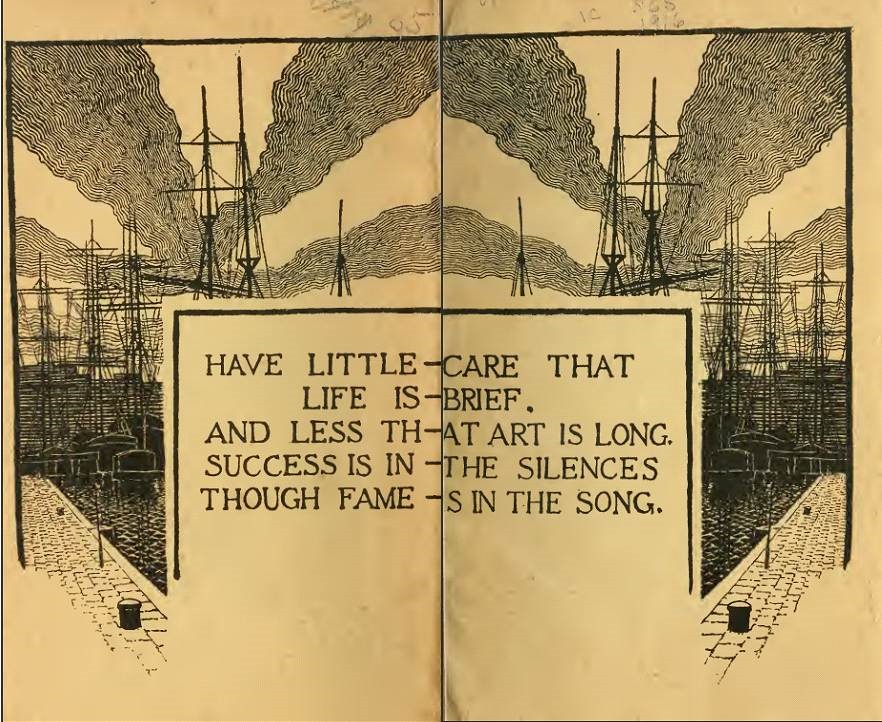
Vagabondia Front Piece

The front piece in Carman & Hovey’s “Songs from Vagabondia.” Here’s a link to the text of “The Mote” included in it.

.

The first time I read “The Mote”  I thought it the story of a short slightly tipsy conversation between two young men in a bar. For young men with loosened tongues to talk of the universe, its unfathomable scope and mysterious connections, is a comic commonplace after all.

As the mote flies into the wine cup of one of the young tavern drinkers and the conversation starts, it’s easy to overlook the way Carman set the scene: the pair entering the tavern are of “august bearing, seraph tall.” Are Rudy Gobert and Karl Anthony-Towns having a post-game libation? “Seraph” isn’t the most common form of an esoteric word, “seraphim,” but it’s a name for the highest order of angels.

If one reads it again, taking that seraph literally rather than figuratively, then the mote which is called “Earth” isn’t a parable, but the plaything of two indolent angels! This ambiguity seems cleverly designed-in by Carman.

You can hear me perform Bliss Carman’s “The Mote”  with the audio player below. The guitar part was played with my Squier Jazzmaster, an affordable rendition of a once unsuccessful Fender electric guitar design. One of the knocks against the Jazzmaster was that it had too much open string-length between the tailpiece and the bridge, a fault that could generate extraneous noises when one uses the vibrato bar. Some modern players see this and figure: “Feature, not a bug!” So, in that manner, some of what I recorded here has me intentionally playing the outside noises that a Jazzmaster can make.

If you don’t see the audio player gadget, I provide this highlighted link that will open a new tab with its own audio player.

.

*Here’s an odd thing: the 19th century French poets that were stretching the subject matter, outlook, and prosody in advance of their contemporaries in England took influences from American poets like Whitman and Poe. Carman and Hovey wouldn’t have needed to go across the ocean to France to read those Americans — but still, there’s a field of echoes going on in this pre-Modernist era. There’s another cosmic joke here too: Brits may have needed to hear some American-originated poetic ideas spoken in French before they could recognize their value!

The Fairies Have Never a Penny to Spend

We’re coming to the end of my month-long look at a pair of poetry anthologies for children: 1922’s The Girls Book of Verse  and the follow-up 1923 Boys Book of Verse.   I’ve had a little fun with the decision to make two volumes, asking you to guess which poems the editors chose for each gender. So, before we get to a poem from them and its corresponding musical piece, let me do a quick final summary of how they divvied poetry up by gender audience.

The boys book has four sections: Outdoor Poems, Poems of Peace and War, Story Poems, Songs of Life. The first three are self-explanatory, the fourth consists of poems meant to teach stalwart virtues and honorable life. I’d hoped to include at least one poem from this section to demonstrate that flavor — a leading candidate was William Henley’s “Invictus” — but I maxed out my capacity to produce increased posts this National Poetry Month and it didn’t make the cut.

The girls book has four sections too: Melody, The Pipes of Pan, Enchantment, and Stories. Melody is more-or-less a poetic catchall, with a slight preference for poems explicitly invoking song or music. The Pipes of Pan is the girls version of the boys Outdoor Poems. Stories obviously corresponds to the narrative Story Poems in the other volume. Enchantment? It’s fairy poetry.

So, here’s our divergence: boys get war and stern life-coaching. Girls get fairies.*  Most of these are fairy whimsey, only a few touch on anything truly mysterious or an outland** where humans have no dominion.

Today’s piece is made from one of the whimsical fairy poems, written by Rose Fyleman. Fyleman was making book on fairies in the run up to these American children’s verse anthologies. During WWI she submitted a fairy poem to England’s Punch  magazine and it was so well liked that a number of books of fairy poems for children authored by Fyleman followed. I know no further details, but two things stand out from this career story: Fyleman was 40, a somewhat late start for a writer, and she was the daughter of an immigrant from Germany, a nation that England was at war with as she was submitting her poetry of the “Oh, nothing — just fairies pretending not to be imaginary” kind. Given the war losses in Britain then, the market for light fantasy might have been a desirable diversion.

The child next door has a wreath on her hat

A frontpiece from the book-length collection that included today’s poem, Fairies and Chimneys. The illustration is for another poem in Fyleman’s book that starts “The child next door has a wreath on her hat./Her afternoon frock sticks out like that,/ All soft and frilly;/She doesn’t believe in fairies at all /(She told me over the garden wall)—/She thinks they’re silly.”

.

“The Fairies Have Never a Penny to Spend”  isn’t “La Belle Dame Sans Merci”  or “Tam Lin,”  but it is  fun, and after the sober Arnold, a darkly satiric Browning, and a month of much work to bring these pieces to you, we can enjoy a little of that. The music is a rock’n’roll trio, so go to the graphical audio player below and bop to the fairy beat. What? The fairies have stolen your graphical audio player?  This highlighted link is a backup that will open a new tab with its own player.

.

*Consider this gendered choice in the context of later years when Tolkien and all the extensions of his imagined worlds and demi-humans became a considerable sub-culture among boys and young men. While Fyleman was writing her fairy poetry, Tolkien was stuck in the battle of the Somme.

**There is another Walter De La Mare fairy poem that I planned to perform — and it might still sneak in some following day because it’s too good not to present. And this girls book section included Yeats’  “Faries Song,”  a similar case to “Pippa Passes”  from a couple of days ago. Both seem innocuous as stand-alone poems, but each was part of a play which provides dread context. You can read about Yeats’ play and hear my performance of the song from it here.

The Wraithie’s Message

Is there anyone reading this far in these posts today mumbling to themselves “It’s Black History Month — and instead of the eclectic variety I expect from the Parlando Project, Frank is giving us this little-known early-20th century Black Chicago poet, this Fenton Johnson guy (who, huh)?”

Let’s keep you here, because Johnson is bringing the variety again today, with a piece that could pass for early William Butler Yeats, or someone else from the Celtic Revival that was happening contemporarily with Johnson’s first poetry collection A Little Dreaming  of 1913. And if our last piece of Johnson’s that had the Roman underworld didn’t warn you, this one is further into the dark fantasy/horror poetry genre as well.

Wraiths and wights, two names given to the wicked messenger in today’s poem have been popularized by later, fantasy books — Tolkien and Rowling et al. But Yeats and others in the Celtic Revival touched on various kinds of supernatural spirits around the time of Fenton Johnson. The non-human beings in these dealings were often at least chaotic or untrustworthy — and as a class, wraiths tended to be even more so. Though named as fairies, not wraiths, I’ve recently presented two linked fairy poems by Yeats and Robert Frost for example where the fairy is seeking to trick a human couple so that they can abduct one of them to fairyland.

Fiery Mask 800

Don’t stay up late reading blogs, for a wraithie might visit you

.

In Johnson’s “The Wraithie’s Message”  the poem’s initial speaker beholds a marvelous creature made of “living flame” at his window. The creature tells our mortal, who the wraith addresses as “dreamer” that there is a lovely sea-side woman, the dreamer’s soul’s desire, who he has beguiled with “burning song” so that this woman is now dreaming of, desirous of, our dreamer.

The dreamer at the window is all in on this. He sees not an untrustworthy wraith in this apparition of living flame, but a “good elf” who might be of service to humans. And besides, as the poem ends, he explains that this dreamer is tired of his  dreams — ones that have not been realized. What really awaits? In my understanding of this poem, the wraithie is a siren by proxy. The promised maiden may be by “the deathless sea,” but that may be in the sense that the enthralled or the dead have no more dying to do.

Should it surprise us that a young Black Chicagoan is writing this poem? Perhaps a little, but it shouldn’t be a lot. I come from the Midwestern city of Prince Rogers Nelson after all. Versatility with many styles has been demonstrated by Black Americans over and over. In regard to Afro-American musicians, I lost my constrained surprise decades ago when I learned that Fenton Johnson’s early 20th century contemporaries, Blues musicians —who I prized for their distinctive “authentic” recorded music — had a wider repertoire and spread of influences than I had guessed, and that they were often capable of essaying a variety of white ethnic styles with aplomb.*

But the choice of this Celtic Revival flavor by Johnson may not have been entirely random. Remember that last time Johnson was trying on the title of “bard,” and a bard for a generation of Black Americans who were trying to propagate an Afro-American culture of achievement and distinction — not just out of some parochial ethnic pride, but out of a very serious need to establish their humanity in a country that still retained nearly its full measure of white supremacy. The Celtic Revival of Johnson’s time was similarly seeking to present themselves as full human beings by displaying a rich culture, and it’s not unlikely that Johnson was seeing what he could appreciate and adopt from that.

With a Celtic myth via an Afro-American, there is after all a story here of a despairing dreamer and an untrustworthy power willing to trick them to their doom.

The Wraithe's Message

Simple guitar chords, but my recorded version will sound different because I used a CGDGBE tuning

.

I had planned to do this Fenton Johnson piece this month, but as I’ve mentioned before, I’m nearly always unsure of what time and focus I will have to do these pieces now. I had written a sketch of the music already (that helps) and in the middle of the day today I was able to try it out. It came together so quickly I was able to complete a basic track before attending a Canadian Zoom salon featuring friend of this blog Robert Okaji reading new poems. Then later tonight I finished mixing it, leaving it simple enough, though I hope it’s effective. This is another piece that may depend a great deal on my vocal abilities “of a subjective quality” — but that’s up to you the listener. You can hear my musical setting of “The Wraithie’s Message”  with the audio gadget below. No player? A substitute can be summoned with this highlighted link which will open a new tab with its own audio player.

.

*Some might be wondering if Fenton Johnson utilized or valued Afro-American music and modes. Yes indeed — he was early and effective in that, a decade before those in the Harlem Renaissance did similar things. I’ve got a couple of pieces planned demonstrating that yet this month.