Inside Whales and Lofts, Part 1

Let me momentarily make this place act like a regular blog and remark on a few things I’ve run across trying to do — or avoid doing — new work. Warning: these are not necessarily mainstream things of interest to most people, even people who read blogs about various poetry combined with a variety of original music.

While not sleeping one night this week I ran into an essay masquerading as a book review written by George Orwell at the end of the 1930s: Inside the Whale.  As per the dangers of doomscrolling, it was not the right piece to run into while trying to fall back to sleep. It’s long, covers a bunch of ground, and since it is Orwell it contains a lot of pithy observations and things that incite one to consider not merely what Orwell believes, but what you, yourself believe.

It starts off reviewing a book by the American writer Henry Miller that was already several years old. Or rather, it makes motions like it’s going to take on that task. Orwell tells you little specifically about what’s in Miller’s book, and he speaks of it and it’s outlook in alternatively dismissive and “it’s better than some” statements. Orwell concludes that, whatever the book’s failures and omissions, that Miller’s novel has stuck with him, and that its subjective effects on a reader might be worthwhile.

Then a full-fledged essay breaks out: a meditation on the changes he observes in the literary scene from the 20s to the 30s of his 20th century. In doing so, Orwell also is quite subjective, compressing the wide range of these two important decades with broad characterizations, summations that have the virtue of vigor. Orwell’s overall judgement is the 20s were an explosion of free expression and expansion of subject matter, and then the following 30s had taken a wrong turn into political statements and advocacy. Orwell’s historical summary is one that others have made as well, and as with all such “spirit of the age” high-level views, it can be contradicted by considerable examples of those who didn’t follow the big titles over their decades.

In my middle of the night reading, I found this wrong-turn judgment odd. Writers who avoided political stances or opinions? Orwell would never have been on such a list! He’s remembered specifically as a life-long critic writing on political ideas and operations. This verging-on-hypocrisy stance, similar to pundits and any odd people with Internet access criticizing actors, artists, and writers for expressing political opinions,* can be made rational if one extracts from his argument the more distinct point he’s making: that the expressed political stances and opinions opposed are wrong and based on falsity. But within this essay that point seems less clear, it’s more about the demonstrated failure of that art-for-political-change effort in the 30s leading Orwell to suggest that it’s likely/arguably the better of limited choices to simply write about ordinary life in a way that avoids any evidence of political thinking.**

I’m around twice Orwell’s age when he wrote this essay, and to the glowing 21st century screen I was reading him on, I talked back to him that he had just discovered a universal truth I’ve written here several times: All Artists Fail. Betting odds calculated from a past performance tout-sheet are not a singular reason to not attempt something in art — the odds are always against success in art, that’s partly why we revere it.

Two small things in Orwell’s long essay remain for me to note. There’s an anecdote of Miller meeting Orwell as Orwell was about to embark on his sojourn into the Spanish Civil War. Miller, Orwell says, told him he was crazy to put himself in harm’s way, and then gives Orwell a warmer jacket better than the meager suitcoat he was wearing. That act, that tiny scene, is Orwell demonstrating his point that ordinary life closely observed may illuminate more than many grander political statements. And the other, more poetry related, has Orwell go on this short aside about the American poet Walt Whitman:

It is not certain that if Whitman himself were alive at this moment he would write anything in the least degree resembling Leaves of Grass.  For what he is saying, after all, is ‘I accept,’ and there is a radical difference between acceptance now and acceptance then. Whitman was writing in a time of unexampled prosperity, but more than that, he was writing in a country where freedom was something more than a word. The democracy, equality and comradeship that he is always talking about are not remote ideals, but something that existed in front of his eyes. In mid-nineteenth-century America men felt themselves free and equal, were  free and equal, so far as that is possible outside a society of pure communism. There was poverty and there were even class-distinctions, but except for the negros there was no permanently submerged class.”

Taken in — as we might well in our age — as statement to be evaluated from a woke (or waking) political outlook, this has so many howlers and hold-my-artisanal-higher-hops-content beverage potential Tweet-takes! Start with the “Leaves of Grass  are always greener on the other side” view of America in general. Thanks, I guess, for the “negros” exception that is altogether too large and horrible for a sub-clause. No mention of the state-side colonialism regarding indigenous peoples. And, wait a minute, women! Orwell’s “America men” freedom isn’t just accidental language-convention-gendering in historical context. I could go on, with anti-immigrant prejudices galore, and….

But. What Orwell is demonstrating here, intentionally or not, is that Whitman painted a plausible reality, containing vivid details of ordinary, mundane reality, of an America that supplanted those things, where open desire, freedom, and comradeship existed in plus and overplus. Did Whitman fool the wily Orwell into thinking that was actually, abundantly so in the years before and during an American bloodbath, or is Orwell suggesting, however inadvertently, what art can try to do, and while failing and retrying, help to accomplish?
e2cjqnp
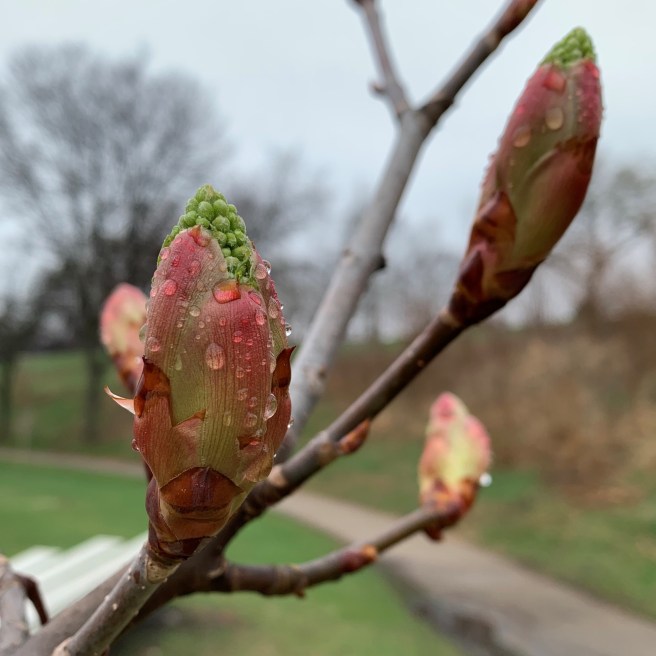
I sometimes misread the “darling buds of May” as the “daring buds of May.”  These seem so strange, so alien, as they emerge.

.

This is enough for a Part 1, but rest, and only later think about this: can your art spur on change — or rather, not just urge it on with the spur and the whip, but with the portrayal of where we must go in a hurry?

As to music, here’s another audio piece you may have missed, using a 1920 poem by German Anarchist writer Erich Mühsam that I translated into English. This post from last July tells what I learned about Mühsam’s life and that of his mentor who first published the poem, Gustav Landauer. In the post, there’s a Whitman connection. Player gadget below for some of you, or if you don’t see that, this highlighted hyperlinkwill play the audio piece.

.

*The hypocrisy of that is: the pundits most often have no more skin in the game in these matters than some artists; and that the ordinary Internet people, who often wish to self-proclaim their ordinariness, may have by definition no more expertise than another person whose job it is to observe and extract transmittable reality.

**Small, dear, peripheral, and personal aside here. Anaïs Nin was the writer specifically noted as existing inside the titular whale, Jonah-like, in the essay — and so, in Orwell’s judgement, then beneficially cut-off and protected from politically-charged writing. My late wife was once writing an article for a national “woman’s publication” on the cultural phenomenon of journaling, circa 1979. In a phone call discussing her sources for the article, her editor suggested she could setup an interview with Anaïs Nin. When the call ended, she and I had the writers vs. editors conspiratorial laugh over that unintentionally Ouija-level suggestion, as Nin was then two-years dead.

At the Beginning

Before I present today’s audio piece, once more a story, one that has kept me up reading and thinking about it for the past week. Like many of the stories I’ll tell here, the events may seem at first to be far off and unrelated to you, as much a “who cares” as poetry is to many people. But the story behind the poem affected me, now, in our current age, just as poetry written long before I was born might.

In 1878, a man was born in Germany named Erich Mühsam. When he reached the proper age he was sent off to a fine boarding school where young Mühsam recognized two things: he didn’t much care for the school’s rigorous discipline (“corporal punishment,” the polite word for instructional beatings, was the order of the day) and that he wanted to become a writer, a poet. So, the teenaged Erich wrote an article for the local Socialist newspaper about the school’s abuses. For good or bad, that was his ticket out of there. He was expelled.

As the new 20th century began he returned to his home city of Berlin and fell in with some young folks who were running what in my day would have been called a commune: “Neue Gemeinschaft” (New Society). It’s there that Mühsam met Gustav Landauer, who though only eight years older, became a sort of guru to the young Mühsam. Landauer was a theorist, a charismatic one at that, for a type of Anarchism that believed that the most effective direct action was to begin living the theory rather than seeking (and likely waiting) for some revolution to give Anarchists that opportunity. He encouraged Mühsam to develop as a poet, and poetry was part of Landauer’s world-view. Landauer’s wife was also a poet and a German translator of works of Wilde, Poe, Rabindranath Tagore, and Walt Whitman.

Mühsam absorbed much from Landauer, and you can see that in the text for today’s piece, a poem Mühsam wrote in 1909—but Mühsam was a more active revolutionary, though much of it was through literary efforts: poetry, plays, cabaret works, essays, and editorship of his own anarcho-communist journal Kain. The Left in this period was (as it often is) splintered—sometimes most sure that those with beliefs most adjacent to a segment’s own were as dangerous to the cause as overt opponents. Mühsam was non-violent but open to alliances with those that weren’t. Landauer and Mühsam sometimes found themselves on opposing sides, but their relationship was never severed. Landauer was accused of being to professorial and uninvolved in active struggle. Mühsam was thought by some as too provocative. *

Muhsam-Landauer-Buber
Mühsam, Gustav Landauer, Martin Buber. How does that last guy fit in? Read on. Is it just me or does Mühsam have a little Marc Maron thing going on?


How many of you find this Anarchist theology boring? Well, here comes WWI. Boring also to some, but also deadly and existential.

The war stifled critics of the Imperial German government, at least at first. Even the activist Mühsam had a hot take where defending his country and citizens seemed an imperative.** Write anything critical of the government and you might be arrested and jailed. Support strikes by war-workers? Go directly to jail. So, eventually Mühsam was jailed.

By late 1918 the dam broke. Beside the mountains of deaths on all sides, unimaginable before this first full-scale mass-production European war, Germany was losing, and no amount of government propaganda could convince many that this was not so. Sacrifice for winning can be cast as heroic. Sacrifice for losing is a harder sell.

And if you were waiting for it, here it comes: revolution!

In November 1918 the Kaiser abdicates as WWI ends. In the Bavarian regional capitol, Munich, the Independent Socialist Party declared the “People’s State of Bavaria.” A guy named Kurt Eisner was named its President. Seeking alliances with others on the left, Mühsam and Landauer are offered positions in the new government. They don’t take them up on this, but during this time the two old friends are now in Munich.

Eisner’s Socialists were democratic, republican (small case, they believed in elections). In the midst of this chaos, with even basic social functions in turmoil and the new Socialist alliance unable to prove any of its theories, they held elections in January 1919. They lost. Eisner went to parliament to present his resignation, true to his beliefs. An assassin shot and killed him on the street before he arrived. Now a new government is proclaimed “The Bavarian Soviet Republic.”***  And now Mühsam and Landauer join up.

Ah, so now the story of sleek agitators and thoroughbred theorists pressed into harness as government draft-horse functionaries? If only my story could stay so boring. This government lasted six days. I’ve had left-over pizza that lasted longer than that! And Wikipedia says that during this less than a week time a “mentally ill Foreign Affairs deputy” declared war on Switzerland. How could they go up against all those multifunction knives and prevail? Oh! Such comedy, dark as it is!

Trust that dark. That’s where we’re going.

Now yet another government is declared in Munich, this time led by Communists and a guy that his contemporaries said “Wanted to be Lenin. He thought  he was  Lenin!” Mühsam is arrested by this new government and thrown back in jail. Given that he was so provocative, one doesn’t have to imagine him stretching his talents far to piss them off. Lucky him. The more mild-mannered Landauer has suffered in this winter the death of his talented literary wife (a victim of the 1918-19 flu pandemic) and the dashing of his hopes for wider realization of his theories. He sticks around, out of power. Is he frozen by grief that winter? Spring comes. There’s a revolution one can count on…

…but not just flowers are coming. The Freikorps, a right-wing militia, goes into Munich to put down the revolution. This they do, hundreds die. Who can tell Landauer’s mind, but Landauer had refused advice to leave in that spring. He’s rounded up, imprisoned. The day after May Day, the guards take him to a room. They beat and abuse him. They shoot him. They beat him some more. They shoot him again, finally killing him, and toss him into a common grave.

Mühsam escaped this because he had been imprisoned by the last revolutionary government. But in the aftermath, he’s still a notorious revolutionary, so he’s put in a new prison as an enemy of the new central German Republic government.

While he’s imprisoned, in 1920, a collection of his poems titled Brennende Erde (Burning Earth) is published, and this month I got a pdf scan copy and did a rough machine translation in order to peruse it. Why did I go looking for this obscure collection? I’d read a passing reference to him as a poet and activist, and something drew me to look, in this time when I’m questioning the arts and poetry and the seeming necessity of activism that I feel unequipped to take on.

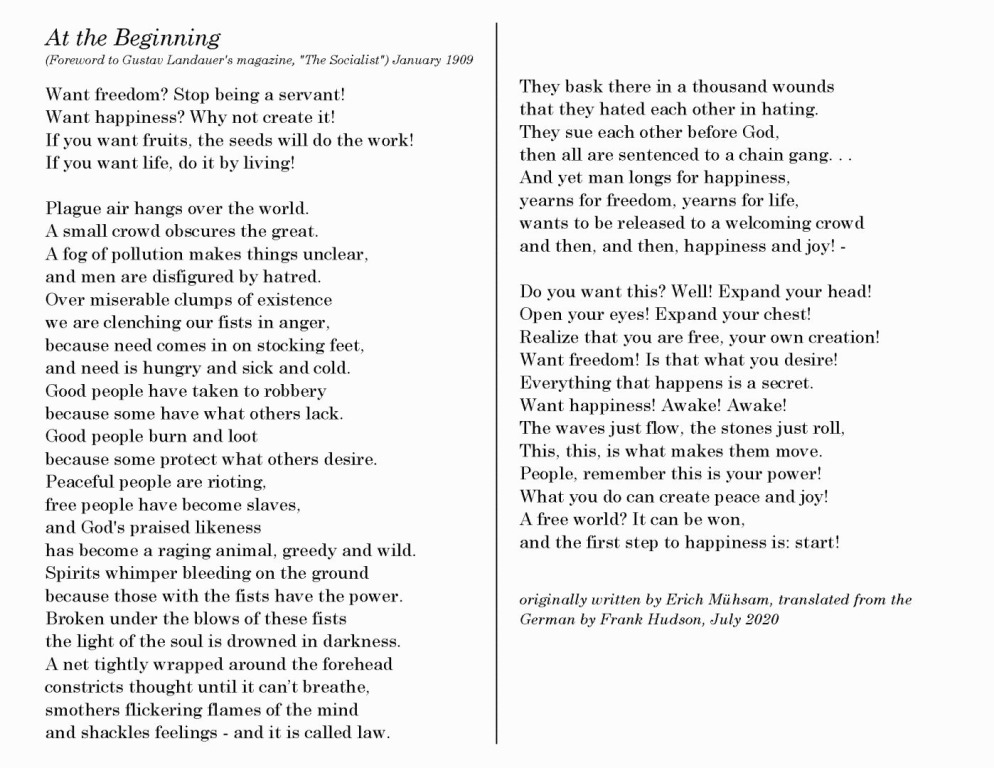
I did a more careful, human, translation of the first poem in that collection, “Zum Beginn “ (“At the Beginning.”)  It carries a subheading there telling that “At the Beginning”  was first published in Gustav Landauer’s magazine, and given the importance of Landauer to Mühsam and the short interval between the publication date for the collection and Landauer’s death, it’s easy to read it as a comment on what Mühsam learned from his teacher. Here’s my English translation, the one I perform today:

At the Beginning


Can one read things in it that seem to speak to today? I believe one can. I wonder if whoever was putting together the collection before publication thought it spoke to 1919 too. That line written in 1909: “Plague air hangs over the world” could be read in 1919 as a comment on the great influenza pandemic, not as a mere metaphor, just as you might read it now in Covid-19 times. The closing litany of people awakening to the power of realization, that too could be more than a dusty relic as folks marched this summer under a growing common understanding of oppression and “nets tightly wrapped around the forehead…until it can’t breathe.”

So, what happened to this young poet who turned activist/poet? In 1924 there was an amnesty declared for political prisoners and he was released. Lucky him! Another lucky man released by that amnesty had tried to declare a new government from Munich too, this time in 1923: a painter turned activist named Adolph Hitler. You probably haven’t heard much of his paintings.

Just as his 1909 poem foretold, Mühsam arrived by train in Berlin after release from prison and was met by a crowd of admirers, cheering and lifting him onto their shoulders. Someone thought things got out of hand, and soon the edges of the crowd were being attacked and beaten, though Mühsam was carried to safety that day. More than a decade after he wrote his poem, those with the fists still had the power—or some of it.

Mühsam took part in the artistic and political ferment in Berlin for almost ten years. Shortly after that pardoned painter/activist succeeded in getting power in Germany, someone burnt down the Reichstag, and it was time to round up those that had ticked off Hitler and his supporters. Mühsam was one of the first taken in. You know the quote attributed to the conservative German Lutheran pastor Martin Niemöller? The one that starts “First they came for…?” Jews, Gays, Leftists, avant garde artists? Was there any group Mühsam didn’t qualify for? Lucky man, head of the line.

He was sent to a concentration camp. There he was beaten and abused. In short order he was taken into a room and abused and beaten until he was dead. The guards hung his body and said he committed suicide.

There are martyrs we remember and martyrs we forget. Phil Ochs wrote a song “Too Many Martyrs”  and we might slag him off for stating the obvious rather than the artful—but the obvious is likely the truth here. At least in the United States we have next to no remembrance of Mühsam or Landauer. As far as I can tell from a brief search, Mühsam’s poetry has not attracted interest from English translators, with one site that did feature some English translations (and tantalizingly, some set to music) now defunct—and the domain name takes you to a place with bogus antivirus pop-ups flashing all over your screen. Both do have some interest to Anarchists as political figures. That’s a bit odd. Isn’t one of the romantic knocks against artists turning activists: ars longa, (and their political concerns), vita brevis? Countering that is what I call Donald Hall’s Law: that poet’s statement that almost all poets, even prize-winning poets, are largely unread 20 years after their death. I fight that here, but Hall may be right.

History had a few more things to offer me as I read this sad and affecting tale of these two men.

Mühsam wasn’t the only one who had their life impacted by Landauer and his idea of practicing egalitarian Anarchism right now in a communal and immediate relationship. His most famous pupil was probably Martin Buber, whose influence on humanism in the mid-20th century was considerable.

Remember Landauer and his wife, and his belief in the monad of domestic life as a model for change? Well that talented writer and translator and that theorist of humanist Anarchism had a child. And that child, Brigitte, survived her parents and married a doctor in Berlin. In 1931 they had a child, Mikhail—and later that decade they got out of Dodge before the painter/activist/ Führer got around to those not first on every part of his list.

They settled in America and adopted an easier to spell-and-say name, so their grade-school-aged son Mikhail Igor Peschkowsky became Mike Nichols. He became a radio folk-music DJ, an influential pioneer in popularizing improv comedy with Elaine May, and then on to a significant career as a stage and movie director.

Strange, the undernotes of history. I’ll likely never listen to a Nichols and May routine or watch a Nichols-directed movie like The Graduate  again without thinking of that grandfather, that heartbroken, widowed man being abused to death after watching the revolution, one he didn’t want to wait for, fail. I’ll still laugh. The laughs are just darker.

Today’s music is more in the “bash it out fast” manner, no pretty string quartets, no subtle sound design, just two electric guitars, bass, drums and my effort to speak the words. The player gadget is below if you read this in a browser. Apple WordPress Reader users, use the Reader’s gadget to open this in Safari to see the player.


*Among Mühsam’s early 20th century beliefs were “free love” and gay rights/acceptance. The communard Landauer believed that a loving and equalitarian family unit was a small-scale model for society.

**He took that back, and wrote anti-violence and war poetry during the war. Can one imagine Twitter in 1914? The telegraph lines would have melted.

***OK, if you stayed with me so far, with “Socialist” and “Communist” being thrown around in addition to the “aren’t they the guys who throw little black round bombs” “Anarchists,” “Soviet” might be the final straw  that chokes your metaphoric dolphin or turtle or other benevolent creature. “Soviet” means in this context, a worker’s council as a source of authority. As far as Anarchists were concerned, that’s a good thing. Anarchists are often against violence, and particularly state violence, torture, and oppression—but they are very much for long boring meetings, which have a special dispensation from being defined as torture or oppression.