Today is the anniversary of Emily Dickinson’s birthday. Let’s open a small present.
Her poem cataloged by its first line “A face devoid of love or grace” transmits clearly on first reading. I hear it as describing a widespread human feeling: the disgust one might feel looking at a confidently self-satisfied face. So, a simple poem?
Simpler than some of Dickinson’s work, even though we should always consider that she can cloak unique thoughts in cottage-core embroidered-sampler language. The thing I think described is a bit of an odd emotion though. Why can we feel such disgust at sensing resolve and rest on the face of someone we dislike? Is it just our hate transferring to some visage a hate we’re sure we find behind the surfaces? Not if our judgements of the person behind the visage are valid — if what drives us to fury are the actions we know the expression covers.
That’s an F Major 7, mixed in with all those minor chords. That’s been a favorite chord of mine for more than 40 years.
.
This week’s news includes the overthrow of a dictator, an event that brings obligatory photos of newly mutilated portraits of the disposed tyrant, and videos of the toppling of statues — enthusiasts performing the pre-requisite of “Ozymandias.” While in my country, many see the calm, regularized-in-demeanor news-slug faces of our upcoming national administration while reading alongside them their announced motives and plans which horrify — the “sneer of cold command.” There’s a disconnect there that many feel. “He looks so righteous, while your face is so changed” as yet another writer put it. So, the self-absorbed bureaucrats of disorder and disregard look unconcerned behind their hard successful faces.
In Dickinson’s verse I note a choice: she could have described the unconcerned face that stands for someone that disgusts her in a variety of ways. The one she chose, stone-like, brings along with it that idea of heroic statuary. And there’s an unexpected double-twist from her pencil at the end: that face and its metaphoric linkage with stone. Stone is rhymed* with “thrown.” It’s like stone, and like the stone that the angered would want to throw, rock against rock. And then too, something I didn’t notice until I was singing this, a possible intended pun: thrown/throne.
Am I dissecting a bog-simple nobody-frog of this short poem here? Could be. But even if this is a short birthday gift, it’s the thought that counts.
You can hear my musical performance of Dickinson’s “A face devoid of love or grace” with the audio player below. It’ll only take 90 seconds of your time, about as much time as it takes to sing “Happy Birthday.” No audio player to be seen? It hasn’t been blown-out and removed with frosting-feet, it’s just that some ways of viewing these posts won’t display it. This highlighted link will open a new tab with its own audio player.
.
*Speaking of rhyme: I love the off-rhyme of “ease” and “acquaintances” in this poem.
Someone on social media this week suggested this conversational opener: “Remember when talking about the weather was just small talk?”
I was thinking about this as I worked to finish today’s musical piece that I’d started a week ago. Since then, American news has been filled with accounts of one major hurricane’s aftermath and the approach of another one. The kind of fun I have meshing poetry with a variety of music I compose and realize is hard to set beside disasters of this scope. I think: here I am privileged to explore unusual connections when other citizens are dealing with hardship and immense losses. In the end I saw the Dickinson poem speaking to those differing situations, and I’ll finish by talking about making this musical piece and the style of its playing which also lets two strong differences coexist.
“The Wind Began to Rock” presents as a narrative, with well observed descriptions of the storm’s arrival and then deluge, but Dickinson chooses the odd conclusion. You can read the text of her poem here. We don’t get a tale of devastation. We don’t get the following suffering. We’ve had the fury — and then what? The incongruity of that ending — if it isn’t a mistake, what is it? I think we should be convinced of Dickinson’s genius enough to make our default assumption it’s written with intent. I’m already risking insensitivity, could I add humor to this and say that with the anti-climactic ending of the narrative arc here, I could have appended a subtitle “Started early, took my shaggy dog.”
I’ll just briefly note that Dickinson could be writing from experience. During the 1861 hurricane season, her hometown of Amherst got the inland tail-end of two storms. But I’ll note another metaphoric storm too at the same time: America’s Civil War. That this huge storm occurs, and the Dickinson household damage reported at the end is only “quartering a tree” may be her point. Some are losing more, up to their lives. The question of enslavement’s onerous human property and the continued existence of the nation that her father served in the Congress of are at risk.
Even the seemingly inconsequential summary of “quartering a tree” is an odd choice that bears consideration. Is this a reference to the particularly cruel execution practice of “drawing and quartering?”
The storm has not made her house divided and not standing, but the tree may say her privileged situation has a crucifix of more complete suffering in view. Questions may arise to us, if we are privileged to not be in the direct path of hurricanes or oppression, looking out on our own storm season and the drifting path to an election this Autumn. All those thoughts arose after I’d completed the recording of today’s musical piece. My earlier performance was innocent of them, but let me present the music anyway.
As I mentioned last time, Emily Dickinson’s wide-ranging poetic spirit had possessed me with this charge: “I wanna rock!” I have no idea how rocking Dickinson’s own parlor-piano music-making was, but her poetry often indicates to me a mood of loud slyness that could front a rock band.
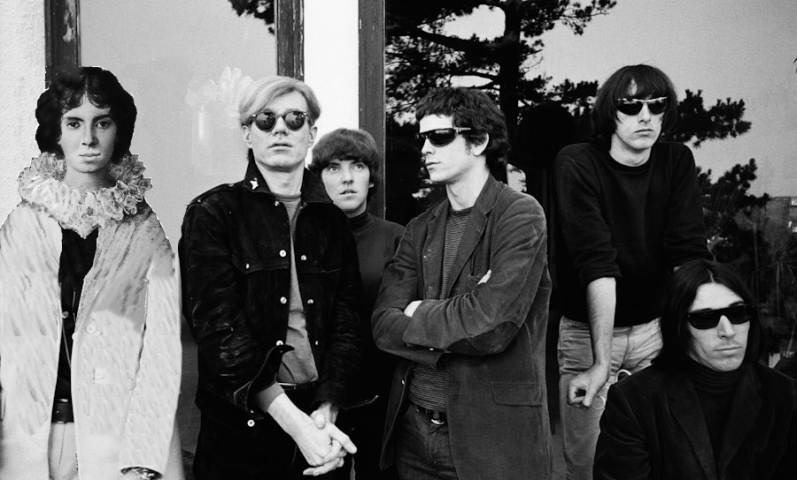
Rock music famously doesn’t require a lot of compositional undergirding, and the harmonic framework of the music here was minimal: two chords (B and A), their roots a full-step apart. Yet, it really doesn’t correspond with typical chordal cadences in Blues or Rock — it’s a tactic I associate with the Velvet Underground, a smart people in a rock band collective whose formative association once traded under the name “The Primitives.”
Today’s musical piece doesn’t sound much like this band, but “All Tomorrow’s Hurricanes” was a cut on the first Velvet Underground and Emily Dickinson album. Andy Warhol’s cover had a picture of a peelable ghost flower.
.
As much as I was working with piano, bowed strings, and acoustic guitar lately, I was itching to get back to loud electric guitar — but my situation in this era of my life makes two poles of music making more difficult to schedule. My quiet stuff has to be recorded when outside noise won’t scrape and bark into sensitive microphones, and the loud Rock that asks for interaction between the electric guitars and amplifiers pushing rude airwaves into a room risks disturbing others. Sometimes the situation, that I can’t whisper in an otherwise silent room, only makes me want to turn up the electric guitars all the more.
As you’ll hear if you venture to the audio player below, I was able to turn the guitar amps up for this, though I had a limited window to shatter.
The kind of guitar playing that steps out to the lead in the ensemble today is a style I worked with quite a bit back at the turn of the century. Like the chord progression, it’s not Rock-band-conventional. The framework is two lead guitars each free to explore melodic lines without strictly alternating (e.g. obligatory “call and response,” “trading fours,” or the like) or playing pre-composed harmonic intervals between their melody notes. It’s still Rock-music-like in that the two lead instruments reference the Rock beat, but this kind of simultaneous, spontaneous lead playing happens only rarely in the Rock genre. You can hear something like it in some folk musics, in early Jazz, and much later in Free Jazz — but for all its “let’s make a racket” ethos, Rock music generally avoids this.
Anyway, if you want to listen to this as it’s intended to be heard, don’t use ear buds or quiet levels. Use a set of stereo speakers and turn up the volume level. You can dance if you want to.
Audio player washed out on your way to reading this? This highlighted link is an alternative that will open a new tab with its own audio player.
I thought I was done with my Emily Dickinson series. I had started to think of what poets would be next, and….
Emily came back. Not the mystical psychedelic Dickinson. Not the weird indie-folk Dickinson. Oh, still mysterious, still a trickster — but she asked not for unusual harmonies or strange timbres this time. She wanted to Rock!
Well, if you’ve been in a mode lately of working with acoustic guitar, and you want to transition to Rock, then there’s no better way to start than Blues. I grabbed my bottleneck slide and my resonator guitar* and it was time to get down with some rough ‘n’ ready Delta Blues — at least the way I play them.
I didn’t learn how to play slide from some Papa Legba at the crossroads, nor by grizzled tutelage from an in-the-tradition player. I was an Iowa teenager when a white college kid from Minnesota pulled out a severed wine bottle top from his jean-jacket pocket and proceeded to show the results of the guitar lessons he’d had in Minneapolis.** I recall his technique was not pristine, but the sound including the incidental noises of the slide grinding into the strings and occasionally slapping onto the fretboard entranced me.*** Five years later I finally decided to try to figure out how to play guitar, by myself, living in a little rented travel trailer, and unable to afford any lessons.
We know Emily Dickinson played piano. Did she have lessons her family could have afforded her? Did a family member teach her? I don’t know if we know what kind of music she played, but it may have been hymns and popular parlor pieces that were sold as sheet music. Did the Celtic immigrants in Amherst leak any of their music to her? Was Black American music in her ken, and if so what variety? All mysteries, but it’s unlikely she had any idea of Blues music, because as best as can be determined, it didn’t exist yet. Sometime around the time her poetic writing was tailing off, it seems that Black Americans began mixing the musics they heard around them in North America with the music that survived the slave ships, and lullabies, and work-a-day chants of work-gangs or field laborers. Most were newly freed from enslavement. Commercial entertainment was a newly opened field for them as musicians and as audiences. In this new situation they had a new story to tell.
Extracted as musicological theory, Blues can be expressed in a lot of ways, but my appreciation says it’s an attitude as much or more than a scale, timbre, or harmonic framework. What attitude? The Blues isn’t “the Blues” as Western European derived Americans knew it. It’s not melancholia or simply depression. It’s not elevated Romantic despair. Sad, bad, and difficult things happen in a Blues song, but that’s not the main point: the main points are that the singer is still here, can tell you about it, and has maybe figured out something about what has led to this situation that they’ll share with you.
So, here’s what Emily Dickinson did that was Blues-like. Like the Blues, Dickinson is going to use humor and incongruity to describe her experience. If death is a fact of human existence, she’s going to write its Yelp review telling you about it. She’s going to tell her tales using coded language at times, so as to not rile up those who think she shouldn’t have the thoughts she has — and besides, coded language gives one the paradoxical freedom to choose the strongest, sharpest words.
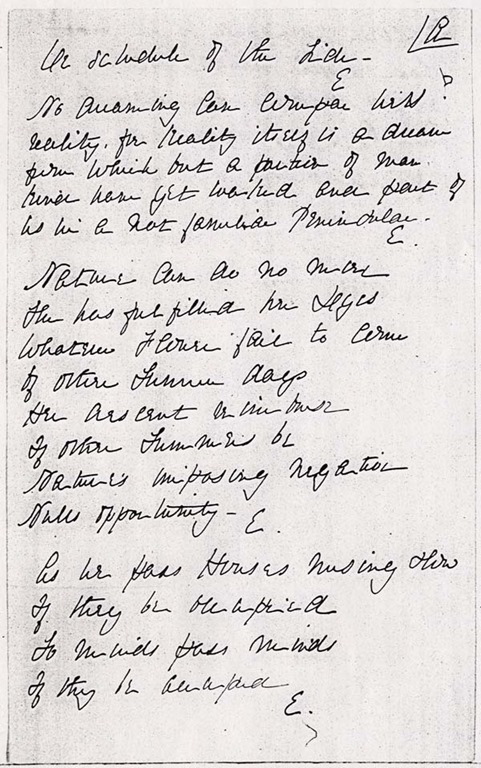
Now the poem I took today is from late in Dickinson’s life, and it’s more puzzling than many of her often puzzling poems. “Nature can do no more” strikes me as an Autumn poem. Here’s all it is, as she wrote it down:
Nature can do no more
She has fulfilled her Dyes
Whatever Flower fail to come
Of other Summer days
Her crescent reimburse
If other Summers be
Nature’s imposing negative
Nulls opportunity —
Dickinson’s “Nature can do no more” in manuscript. Above the poem she wrote: No dreaming can compare with reality, for reality itself is a dream from which but a portion of mankind have yet worked and part of us in a not familiar Peninsula.“
This poem expresses itself strangely. “Fulfilled her Dyes?” Floral blooming colors? Autumn leaves? Punning “dies?” The transcribers think she scribed “crescent” but it might be “descent” — but what’s accounts receivable here? “Negative Nulls opportunity?” As the Pythagorean math-lyricist Billy Preston put it “Nothing from nothing leaves nothing.” Or it just clearing the field for new growth? I saw a short presentation on Dickinson poetry this week where the presenter compared Dickinson to Joyce’s tangled Modernist word-play mode. This poem would be an exhibit for that.
But this struck me as Blues-like too. You see, following up on my mid-century, Upper Mississippi white-blues-kid introduction to this old acoustic Blues style, I wanted to hear more of this music performed by its originators, and you did that listening to LPs re-recorded off of worn, made-cheap, second-hand-store shellac 78s, cut fast in any handy room with a single approximated microphone. It’s a powerful sound, but it’s not a pristine and clear sound. And the singers, even if I was in the room — maybe because I was in the room, a white guy like almost all the recordists — aren’t always going to speak out. They’re asking to be heard by other Afro-American listeners perhaps, so their patois and accents aren’t lightened or toned down.
To this day, after years of listening, after much more study of Afro-American history and language, after generations of audio restoration advancements, there aren’t 100% agreed upon transcriptions of lyrics sung and said on all those early 20th century records (and their meaningful context) — “crescent” or “descent” isn’t the half of it.
I might have performed Dickinson’s exact words for this piece, but I wanted them to fit into a common Blues music form, and so I was already prepared to modify them. I decided to make words that were more my extrapolation of what I feel she might be saying as she views the null of winter coming on with the knowledge of the cyclical phase of the seasons meaning another summer follows. I tried to mumble the words a bit as I sang them to give it the air of those old slide-guitar Blues records. Here’s what I sang:
Nature can do no more, she has fulfilled her Dyes
Nature can do no more, she has fulfilled her Dyes
Flowers that failed to bloom left for other summer days
The crescent moon decrees, other Summers yet to be
The crescent moon decrees, other Summers yet to be
Colors’ slow cremation — nulls for opportunity
Yes, there’s a spoken aside in the middle of the song. I’m not printing that, because the spirit of the old 78s says you have to try to figure it out. You can hear my performance of this “after a poem by Emily Dickinson” song with the audio player you should see below. No player seen? You don’t have to jump the Katy looking for it, you can use this highlighted link that will open a new tab with its own audio player.
.
*The, neck and the body’s outline shape is like a regular acoustic guitar, but the top and interior are replaced with a 10-inch metal speaker cone. This cone is driven to vibrate by the bridge holding the guitar’s strings producing a louder piercing tone that has a directness and can’t-ignore-it volume that Blues players liked.
**The kid’s name was Don Williams, an all-to-common name. If he’s still alive he’d be in his 70s. I’d love to meet him again if only to tell him that for all his pretentions and mine he imprinted my approach to the guitar.
***This is not how everyone plays slide guitar, even Blues slide. Precise touch and technique can produce music with tight intonation that avoids all these artifacts. I just like hearing those artifacts. I love recording piano with key or pedal noise or even a bit of a squeaking bench too.
****I often fear I’m too long-winded when a feeling starts me up. But I’m nothing like what recordings like Geeshie Wiley’s can do to folks whom the muse has touched. Here’s two of them (warning: long form writing) Daphne A. Brooks. John Jeremiah Sullivan.
This Emily Dickinson poem tracks like many others of hers: a vivid set of images, so unexpected in its choices and details finished with a gnomic conclusion that puzzles as well as tantalizes. Last time we had her famous “My Life had stood — a Loaded Gun.” Today’s lesser-known poem is just as weaponized. I find it as strong as “Loaded Gun” — Dickinson, powerful enough as a writer to bring the proverbial knife to a gun fight. Here’s a link to the poem “She dealt her pretty words like Blades” in case you’d like to follow along.
I maintained last time that in “Loaded Gun” Dickinson created a tragic character out of an inanimate object. Today she’s describing some other personage who uses “words like blades.” I didn’t think she was the gun in the last poem, only its playwright. Is the blade-wielder here Dickinson? I can’t say for sure. Is she “othering” herself to examine something she does with her verse? Poets will do this, but at first I was unconvinced. Dickinson has elements of satire and calling out foolishness in her poetry, sure, but I’ve never seen her as the kind of devastating wit that boldly impales the subjects and pins them to the bloody page. Did she think she could do that, or that some thin-skinned reader thought she did that? Possible, but we must consider the theory is that she may be writing of another writer.
Who? I don’t know. Our knife-wielder is gendered female, and in Dickinson’s 19th century circle that doesn’t leave us with many candidates. The woman-poets we know she read: Elizabeth Barrett Browning, Emily Brontë, or her classmate Helen Hunt Jackson don’t immediately jump out, saber in hand. Of the three, Brontë with her Gondal fantasy world poems is the strongest “could be” here. If we stretch it, I could add to the suspect line-up the “terrible swift sword” Julia Ward Howe of “Battle Hymn of the Republic” fame. These are all wild guesses, so let’s leave that off, posit it doesn’t really matter to the poem, and return to read it again.
Rereading the poem, I began to sense less of a swashbuckler and more of a butcher’s tale here. Aha! Now we see something that I can associate with Dickinson’s life. In the household domestic tasks the two Dickinson daughters had to carry out, Emily took to the cooking and the gardening from all accounts. Did she butcher meat, or prepare cooking cuts from carcasses? The wantoned, without concern for the former life of the meat, carving to the bone is in that work. She does say the blade is being used on “Creatures” in her images too. If we want to return and take this poem’s “she” as Emily Dickinson, then here we may have the dissecting poet* we read in her work metaphorically describing something of her process!
This striking image shows an installation by artist Kim Simonsson at the American Swedish Institute some years ago.
.
I can’t give you a clear reading of the poems final four lines either, I only see the images, not where they are to lead us. Pain, human pain, is indeed not polite. The film upon the eye is the dead eye on the carcass. What though is the locking up in the last line? That we abstract (lock out) ourselves from the former living creature now the meat? Did she butcher for cold storage in a meat locker? These biographic details — again, perhaps beside the point. In experiencing the poem, those things are dispensable. Is this a household butcher or a fearless ninja-writer? She wants the effect of both for the listener, and perhaps Dickinson is happy that the final part’s summary is just as mysterious as a blade-wielder leaping out from her packet of poems.
I’m always amenable to mystery in the music I present here. Here I used my 12-string acoustic guitar and a viola with the undercurrent of the South Asian tanpura beneath them. What’s the tanpura doing there with these occidental instruments? Oh, it just mysteriously appeared, drawn to the drone of the lowest strings on the guitar You can hear my performance of “She dealt her pretty words like Blades” with the audio player gadget below. No player to be seen? Maybe one will appear like that tanpura within a new tab called up by this highlighted link.
.
*It quite possible that she dissected animals as part of her schooling. Another biographic theory.
The achievement of Emily Dickinson’s poetry is unusual, but the poem I set to music and perform today stands out even amid the rest of her work. This uniqueness has led to varied interpretations of what the poem is getting at: sometimes esoteric readings of the poem’s matter, written by folks plausibly smarter and more knowledgeable about Dickinson than I.
And so, if I was stopped before approaching this poem to make a song from it, I would have replied with a vague recall of what I’ve read: that it’s about something singularly, perhaps secretly, important about Dickinson herself — a striking, summary image of a rage or force she felt. Well, maybe it is. I’m not proposing that I have any authority to change any charge this poem has given you. I’ve often found myself ignorant or obtuse. Still, I found a rather different poem than I expected as I tried to arrange how I’d express the poem while singing it.
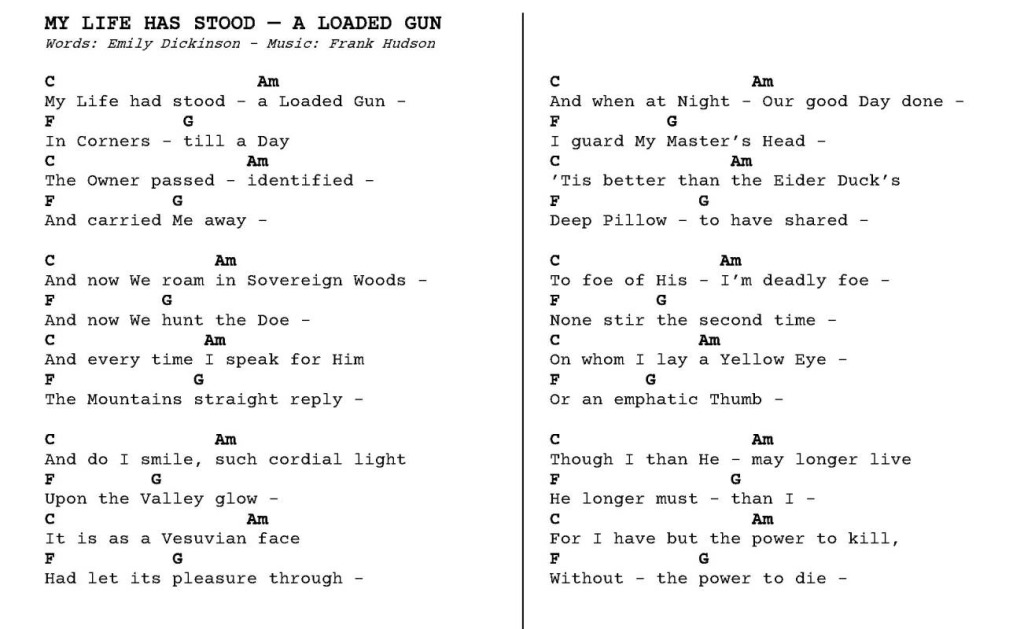
Here’s a chord sheet for today’s song. One intent in providing this is a hope others will sing it, perhaps better than I can.
.
The poem I read anew had Dickinson’s poetic voice playing a dramatic role, and the play is a tragedy whose protagonist is a sentient non-animal object, a gun. The gun’s relationship to humans, or particularly to its owner, is subservient and not rage-filled. It self-portrays itself as if it was a loyal dog: happy that it’s been selected like a pup from the pound, happy with a woodland walk in the company of its owner, proud of its sharp echoing bark. The stanza-scene where the gun is snozzled up to its owner’s pillow in bed, as if a sleeping pet, would make the most ardent gun-enthusiast contentedly smile.
Some readings have over-weighed the “stood” in the first line, as a Chekhovian gun frozen in the first act — all unrealized potential violence, a symbol of a quiet hurt or rage.
But then the turn, the volta. In the penultimate stanza the gun’s self-portrayal takes on another aspect: it’s like a gangland capo here, a deadly enforcer. Is it proud of its efficacy and efficiency in killing that it recounts? There’s no clear moralizing, but there is a contrast between that stanza and the sleeping master and gun. They will stir, and awake, while any foe the gun has shot will not “stir the second time.” The final stanza will tip our speaker-gun’s judgement on this.
Am I not diving deep enough into the wreck here? Am I stuck on the surface symbolism and not cognizant of the deeper meaning of what is being symbolized about Emily Dickinson, the middle-class, likely non-violent, non-weapon-toting woman? Could be, but as a singer of subjective quality, as a poor strutting player in this tragedy of the loyal gun, I might be able to convey that deeper stuff by playing the images well.
What was Dickinson’s self-knowledge of what she’s doing here? Was she the gun any more than Shakespeare was Macbeth or that Bob Dylan secretly sees himself as an Early Roman King? Deception and hidden meanings are a Dickinsonian trope, and the final verse clearly intends to be a hermetic riddle. I solve the riddle by thinking that the gun muses that as a non-living durable object it could outlive its human owner — but that in a better, wished-for world, the master would destroy it.
You can hear my performance of “My Life has stood — a Loaded Gun” with the graphical audio player below. No player seen? There’s one more bullet in your chamber — this highlighted link will open a new tab with its own audio player.
Is there a name for a poetic form made of two quatrains? Emily Dickinson wrote a good number of these 8-liners — brief, but a bit longer than one-stanza forms such as the haiku or the cinquain. One advantage of short forms is that they are easy to hold in memory, allowing them to be shaped and revised while one’s hands are busy with other daily tasks. We know Dickinson sometimes jotted down short pieces on household paper scraps, but maybe even those had earlier drafts before she could grab a pencil.
What can she put in such a container?
This one implies a short narrative. Someone (we’ll just say Dickinson for simplicity’s sake) is waiting at her house for something to arrive. She’s ready to tie on her bonnet (her outdoor hat) and on the waited arrival she’ll be going outside her home. In the second quatrain she says she’s awaiting “his…step.” The something is revealed as a male someone. Where are they going? Dickinson writes of a “journey to the Day.” Is this an odd way to say she expects a day-long journey? Perhaps, but she did capitalize “Day” as if it’s a particular concept rather than a 24-hour interval, and the poem ends with mention of a similarly capitalized “Dark.” Dickinson was fond of circular intervals standing for a lifetime, with a day’s sunset or nightfall standing for death. I suspect that’s what she’s getting at here.
I was captured by this poem, given my musical interests, by its citing of singing in each stanza. Examined carefully, the first line says something distinctive. “I sing to use the Waiting.” What a striking statement to a musician — or to music’s sister art poetry and poets. Life is time, that’s its waiting. What counts its meter and shapes the air in-between? I think of composer Frank Zappa’s quote “Without music to decorate it, time is just a bunch of boring production deadlines or dates by which bills must be paid.” Poets and musicians sing to use that waiting.
In the ending sentence Dickinson says both she and the awaited are singing to “Keep the Dark away.” Does music — does poetry — hold off, or prevent, death? Well, it may not be that death=dark exactly. Dark may be the unknowable aspect of death, the frightening nature of the threshold we cannot see beyond.
A thought occurred to me as I was living with this poem over the past couple of days: it would seem to pair well with — as a prequel of sorts — to one of Emily Dickinson’s most famous poems: “Because I could not stop for Death.” In “I sing to use the Waiting” she’s awaiting that other poem’s he, Death, to bring around a carriage for her. If that’s so, we might expect that on the ensuing carriage ride the two, Death and Emily, are singing as they ride past the playground and the cemetery toward eternity.
I’m OK with all the night-time transparent carriage traffic, but I wish they’d stop singing so loud. Still from The Phantom Carriage (1921)
.
I had immediate ideas for the musical sounds for today’s Dickinson poem setting, which helped me get a rapid start of the process of composing and tracking it. I was aiming for mysterious, but when I went to mix the various tracks it began to sound odder than I had thought it would be. I explored different options at that point, but in the end I decided there was no going back from strange. I should more often remind listeners here that I go exploring a lot of different musical ideas, so don’t take any one piece you hear here as representative of what you might hear in the next piece, or the one after that.
You can hear my musical performance of Dickinson’s “I sing to use the Waiting” with the audio player gadget below. Awaiting a gadget that never shows up? This highlighted link is an alternative.
The great American poet Emily Dickinson writes about death a lot, so maybe I should pause for a moment to mention how inescapable the living’s experience of death was in her time and place, what with disease, injury, a deadly Civil War, graveyards within the city limits, and approaching death happening often at home.
Because I lived across the street from death? When a child, Emily Dickinson’s family did not live in the Dickinson Homestead (now the Dickinson Museum), but at another house, located across the road from the town cemetery where she would later be buried. A child is born, plays, grows up, and crosses the fence.
.
The poem I’ll sing below today speaks to that. If you’d like to follow along, here’s a link to the text of “As far from pity, as complaint.” This poem is more than its message —most good poems are — but let me write down here a sentence to summarize what I read this poem as saying: rather than pity, dread, or anger toward death, a result we cannot change, we should emulate the dead themselves who demonstrate that life is not everlasting — but the predicament of dying, and the predicament of living, are everlasting.
That’s a worthwhile thought, and poems in Dickinson’s time and place were often expected to deliver a lesson. But why is this a poem, why is this an Emily Dickinson poem? An essay, a sermon, a sympathy card, a letter, a conversation all could deliver this message as well or better as 12 lines not even pentameter-long and broken with the skeleton spaces of the pervasive Dickinson dashes (as if her “trade was bone.”)
Because it sings this situation, even silently on the page. There’s a dancer’s force, a singer’s force, an instrument’s augmented force in this way of telling. If death is inevitable — as is also meter, repetition, rhyme, the flow of sound into shapes — might we be comforted by these shapes? We live. We die. The shape of life continues. Quod Erat Demonstrandum, thus it is demonstrated.
When encountering this poem earlier this summer I sensed an intra-poem image-rhyme in this poems 7th and 8th lines. A better-known Dickinson poem which attracts us with what seems like mundane charm, “I’ll tell you how the Sun rose,*” has summer children playing from dawn — and at the end, disappearing over the horizon’s fence-line at sunset. That’s the continuing shape of our lives.
You can hear my musical performance of “As far from pity, as complaint” with the audio player below. If your way of reading this blog is numb to that revelation, don’t complain, I offer this highlighted link as a way to open a new tab that will have its own audio player so you can hear it.
Here’s another example of a short Emily Dickinson poem that seems in some facets simple, and yet when examined more closely still shows her uniqueness. On first reading it reminded me of a saying attributed to Benjamin Franklin* “Nothing concentrates the mind like the prospect of being hanged at dawn.”
One might read this poem from the start as a restatement of that Franklin quote — except, Dickinson may be saying this isn’t someone’s last day, she wants to set down the situation someone’s next-to-last day. In the first stanza, it is sunrise, and the poem says that the doomed person has delight. Why? Because there is one more day before their death at the dawn.
Chord sheet in case you’d like to sing this one yourself.
.
This idea is clearer in the second stanza, where again, death is clearly due — but tomorrow. There the doomed man is listening for the bird that will likely sing at the next dawn. Perhaps he’s listening to the Meadow bird in the day-before dawn more intently, knowing the next time he hears that song it will be his execution, and this is his last day to hear it in the more generally hopeful context of introducing a day, not an execution. He might choose this — after all, if he knows he’s to die tomorrow, he can be somewhat assured he will not die in that present day as the bird sings the day to begin.
The final stanza may be the oddest, but indicates that this is so. It twice tells us the mood is joyful, which would indicate that the condemned does feel assured of, and is in love with, this day — the full day before. There’s a somewhat ambiguous word-choice in the last line: “ought.” The word can be a stand-in for zero, for nothing, but it’s primary meaning is more at obligated. If we take the zero/ought meaning, or the obligated meaning, Dickinson’s poem is saying the poems doomed subject is joyful though the next-to-last morning Meadow bird has a duty to sing nothing but elegy, because the poem’s subject will accept the day with joy.
So, this is goth-mode Emily with death certain, but this is also certainly the day before the last day.
Musically I had to throw this one together quickly, but it came out OK. Though in a minor key it’s somewhat jaunty. You can hear it with the graphical player below, or if the Meadow bird’s audio player isn’t visible, you can use this highlighted link that will open a new tab with its own audio player.
.
*There’s a similar quote attributed to Samuel Johnson, and there’s this later extension authored by Terry Pratchett “They say that the prospect of being hanged in the morning concentrates a man’s mind wonderfully; unfortunately, what the mind inevitably concentrates on is that, in the morning, it will be in a body that is going to be hanged.”
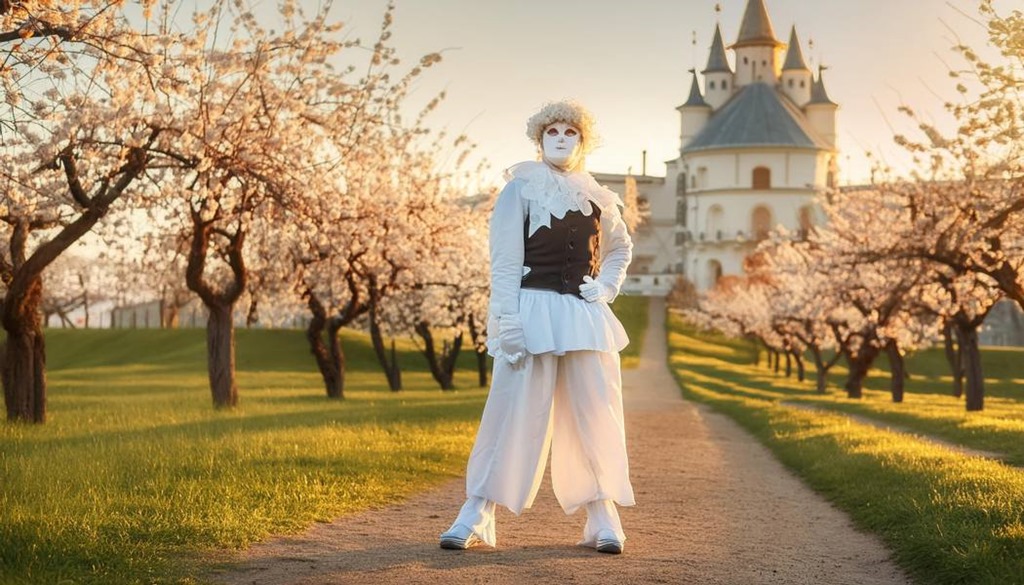
Today’s musical piece uses another very short Spring poem by Emily Dickinson “A little Madness in the Spring.” I was reminded of this poem when I attended the May Midstream Poetry Reading Series this month where Thomas R. Smith opened a set of his own poems by reading this one of Dickinson’s. If you’d like to follow along, here’s a link to the text of that poem. Spring madness is not an unique poetic subject, but there’s an odd character we meet in this 6-line poem: a clown. Smith told us that “Clown” in his mind is best illuminated by understanding that the word emerged from a character that would have been understood as a country bumpkin. Checking on this, I confirmed that. The silent, white-makeup, big-shoed, red-nosed presentation that likely arises in your mind when you read “Clown” has not yet come into its full form when Dickinson wrote her poem, but the rural clod stock character reached back through commedia dell’arte to the works of Latin and Greek comedic playwrights.
I can’t say how Dickinson visualized clowns in her mid-19th century. I don’t know her access to whatever comic drama or the opera bouffe, but she might have run into clown characters in books or periodical reviews too. One thing that occurs to me: an American form that uses stock buffoons that was popular in Dickinson’s time and place was the minstrel show. Minstrelsy is infamous for using largely white actors playing black slaves acting foolishly, a context which cannot be disengaged from the larger social evils of slavery and white supremacy. It’s not to excuse our parochial evils to note that these character tropes existed outside of the peculiarities of America and white blackface.
When I had seen “A little Madness in the Spring” with its “Madness,” “King” and “Clown” before I heard Smith read it, I casually thought the poem referenced Shakespeare’s King Lear. Looking at that today, I can’t find evidence for it. The Fool in Lear is always The Fool, the word clown is never used. Nor is Springtime evoked in the play.
“As if it were his own…”
.
So, I think Dickinson may have a generic King and Clown in her little poem. The meaning I’d extract is: It’s fine to be irrational in Spring, even if one has powerful responsibilities, but even more so we should note the foolish notion of the innocent peasant or farmer clown who observes all this new growth of spring, the “whole Experiment of Green” and believes it is their property. One fine point I’ll put onto that last part: even an unschooled farmer — and avid gardener Dickinson too — would know the work and craft that goes into starting a garden, crop field, or orchard. A King might puff himself up and portray that husbandry as “his own,” but the man or woman dealing with the exact logistics and labor knows well their part, regardless of who owns the crop or the field.
Is Dickinson winking at that difference in her comparison of the King and Clown? But neither labor nor legal papers and titles make the Earth and Springtime fully our own. We sing it, but the music comes from elsewhere.
You can hear my musical performance of Dickinson’s “A little Madness in the Spring” with the audio player gadget below. No gadget? This highlighted link will open a new tab with its own audio player.
For a cluster of reasons, it’s been increasingly difficult to create new audio pieces for this Project. For one thing, having done over 750 of these pieces during the past 8 years, a lot of musical ideas, poets, and poems have been explored already. For another, my increasing age and high-mileage body have decreased my stores of reliable energy and dexterity. But one other reason is that I no longer have a predictable and luxurious access to times when I can record something that involves a microphone. Oh, I still get such time — but I don’t always know when it’s coming — and so an opportunity may arise, and I’m committed to something else, or it comes about and I’m weary and spend it napping or resting my aching old frame, or it opens up, and I have nothing prepared to record.
This frustrates me even as I realize that what I do have to bring to the Parlando Project in terms of resources and time is something to be grateful for.
Yesterday I had foreknowledge of one of those recording times coming. I collected two things I wanted to do something with: a well-known poem by Emily Dickinson and another musical piece that I wanted to record just for my own personal enjoyment. As I sat down in my studio space to record my musical performance of the better-known Dickinson poem, I noticed on my music stand a chord sheet for a lesser-known Dickinson poem I had done the music for early this spring: “Sexton! My Master’s sleeping here. ” “Sexton!” hadn’t been recorded, even though it was ready — I didn’t have the time in early Spring as I rushed to do all the pieces on the children’s verse theme I had chosen for National Poetry Month.
Dickinson’s “Sexton!” is an early Spring poem, a season that arrives at different times in different climes, but I figured that I needed to record it right away if I was going to keep it at all timely. I grabbed a dreadnaught guitar (a larger, more powerful sounding guitar than my usual instrument) and quickly refreshed myself on how I had intended to perform “Sexton!”
I was so eager to record on this occasion when the restrictions to making a sound had fallen away that I ripped into the piece at a reckless tempo. A choice or a mood? Moot point, I had to get on with it. Thinking about that tempo today I also wondered if my teenager’s hardcore punk listening had seeped into my mental metronome. But then “Sexton!” does start with an exclamation point, and the whole poem is that: an exclamation of Spring.
Of course this is Goth Emily — so even if her poem and performance are as short as a cut by the so-rapid punk bards of San Pedro The Minutemen, there’s context crammed into 90 seconds. Here’s a link to Dickinson’s poem if you want to follow along. What do we find in those words?
This is what you come to the Parlando Project for: stuff that’s stuck on each other like cockleburs.
.
A sexton* takes care of church grounds, typically including a graveyard. The sleeping Master’s bed chamber is therefore likely a grave. Spring has come with flowers and birds expecting new life.**
Spring isn’t stopping to reflect on this, like the tempo of the song it’s got work to do. Dickinson is in a churchyard, but it’s full of death departed and life arriving, not dogma. What replaces that dogma, sermon, homily? Bird-troubadours, secular Spring-song: its shortness, its insistence. You can hear my performance of Emily Dickinson’s “Sexton!” with the graphical audio gadget you should see below. No gadget? This highlighted link is a backup that will open a new tab with its own audio player.
.
*By anachronistic coincidence, the poem’s sexton made me think of Anne Sexton, a 20th century American poet. Poetry is like a cocklebur: its tropes and metaphors will stick to anything.
**More coincidental connections: in considering Dickinson’s poem in the context of a song I thought of this Earl Sykes song, best-known from a Ralph Stanley bluegrass version, called “A Robin Built a Nest on Daddy’s Grave.” I wonder if Sykes knew Dickinson’s poem, or if there’s some third source that both the poet and the songwriter tapped for this springtime combination. My Dickinson poem-now-song would make a good medley with Sykes’ song —and good bluegrass high vocals and harmony would certainly spruce up my rough-hewn singing performance.




 Frank Hudson