I’ve told some folks that I’m working on Emily Dickinson’s “No Kings” piece this week. Now, that’s hardly true. There is a king in this poem and he doesn’t come off so well in its telling; but there’s a naïve maiden too, and Emily’s going to paint her as much a fool as the pompous potentate.
If much has been made about the use of hymn meter in Dickinson’s verse and connections there to her skeptical view of conventional religion, plot-wise this poem takes its tale from an extremely common folk and folk-broadside trope: the foolish maiden. In countless variations some man of high-degree dallies with a young woman of the common folk, and it usually doesn’t turn out well for the girl.* In the best of it, he’s a cad and leaves her; in the worst, there’s murder most foul in the offing. Many folk songs, including those in this grouping, open with it being a Spring morning. Springtime promises, it seems, aren’t to be trusted the voice of folk music says.
I’m not scholar enough to tell how many such songs Emily Dickinson knew, but they were highly common in her time, and I suspect she was using that folk-music plot here to make her point about what life promises us, and about trusting kings.
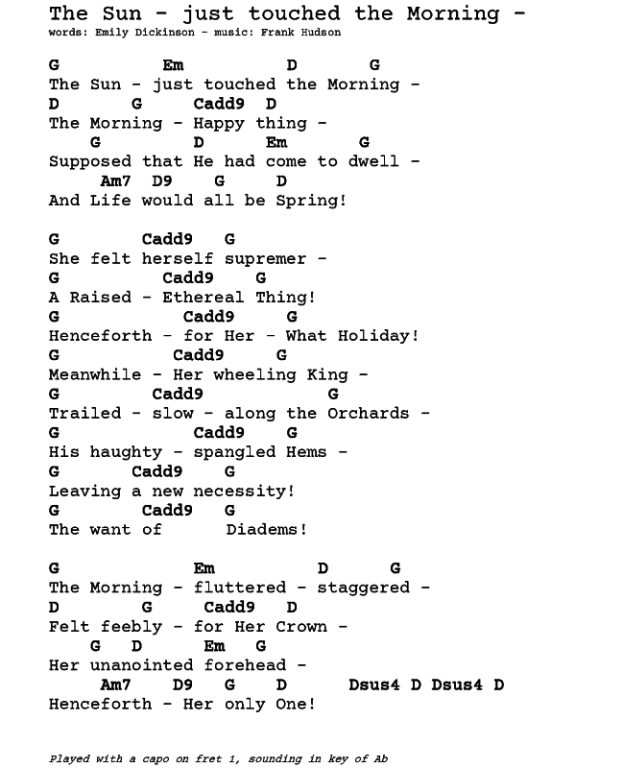
Here’s a chord sheet to assist if you’d like to sing this in your parlor. I like the sound of 9th chords, but they were chosen here to ease my fingering on guitar and can likely be simplified if that suits other players.
.
In “The Sun – just touched the Morning” we have the morning herself playing the foolish maiden and the sun is the sun king who likely believes that when you’re a king they just let you grab it. The sun, as we might guess, soon has to be moving on doing important stuff like making dew into a passing mock-up of glittering jewels, but Morning thinks she is to be his queen. Dickinson reports Morning trying to act like the imperial Sun, crowned with a dew-drop diadem: “She felt herself supremer – A Raised – Ethereal Thing!”
Dickinson knows how this comes out: there’s no crown on offer, no coronation. Some divine right will not tell us who is right, honorable, reciprocal, or trustworthy – that will be up to our “unanointed foreheads.”
So it is: hymns generally tell us how to live right, how to praise a beyond-human perspective, while folk songs take on the task of telling us not to be a fool.
As I composed this, I tried to use a 19th century popular song kind of feel, but ended up being enticed by rock quartet instrumentation with a chiming electric guitar element. If I was to do another version, I might lean more into parlor instruments – but this’ll have to do for now, for we have present business with kings we refuse to allow.
You can hear this song version of Emily Dickinson’s “The Sun – just touched the Morning” with the audio player below. What? Has the king refused to fund any such audio player? No, it’s just that some ways of reading this blog won’t show the player, and I offer this highlighted link which will open a new tab with its own audio player so you can hear it.
Here’s a poem by Emily Dickinson that I made into a little song. There’s an audio player below to hear it.* I intended the music I made for this piece to be jaunty – not only because I worry that too many of the Parlando Project pieces are slow to mid-tempo, but because it fits the language of Dickinson’s poem. Just 8 lines, but its “what’s in the box” description includes: a sunset, a morning, cottages, and a USB C charging cable.
No – error – sorry. No charging cable. I looked at the catalog listing:
OK. I’m funning with you. After living with the poem for awhile as I set it to music and recorded my performance of the result, I instead believe this poem is an example of the genre my wife calls “Cozy Gothic.” How come? I think the poem’s cottages are graves.
Here’s how I understand Dickinson’s poem. There’s a pretty sunset, an eternally repeated and universal, broad-sky-set thing. The sunset must appear where ED’s poem sees it, but after its moment it’ll be “Gone Westerly,” for today. Gone westerly is likely a similar idiom to “gone south,” a euphemism for death. The sun has not fled out of dereliction of duty –“treason” – but because a day, like a human life has its limits. The poem’s second stanza reminds us of the circadian day too: that morning and a sunrise was, and will be, there – but that’s no matter to the dwellers in the cottage/grave “swellings in the ground” who can’t see the “supercilious Sun.”
Here a chords sheet, and what’d be more Cottage-Core than playing this Cozy Gothic song in your own cottage? That G chord form I played is just the B & E strings fretted at the effective 3rd fret along with the open D and G strings.
.
I asked my wife again this morning about “Cozy Gothic” as I prepared to write this. I reminded her that the young Emily Dickinson did not grow up in the grand house that’s now the Emily Dickinson Museum, but in another place where the Dickinson family lived in her youth after her grandfather got the family finances mired in debts until her generation extracted them from that and were able to move back to the grander house we associate with her poetry. The grand Dickinson manse was across the road from a crop field, and had room for gardens of fruit, food, and flowers; and it was beside a main road for travelers in and out of town. The place that her family had to relocate to was smaller, and across the street was a graveyard. Mix those two homes ED knew in her lifetime, and you have some pretty good poetic loam. I asked my wife, a known PK,** “Did you ever live next to a graveyard?”
Yes, when we lived in a parsonage. The town was taken aback when I sunbathed in the graveyard. I didn’t know what the big deal was about that – it just seemed like a nice, peaceful, place.”
That’s my wife. Nature nymph and likely a better writer than I am – and for all the mixture that made up her childhood, she got to live the spirit of this Dickinson poem directly – Cozy Gothic.
Here’s that audio player gadget. What, has any such audio player “Gone Westerly?” You can take hope in the resurrection, but it’s likely because some ways of viewing this blog suppress displaying the audio player gadget, just like they mute the angels that would write better, more concise blog posts. I make do by providing this highlighted link that will open a new tab with its own audio player though. Playing the bass track for this one – without making a point to think of it, but still thinking of it – I was thinking of the great British bassist, Danny Thompson, who died this autumn. Thompson’s playing could be quite free and capable of quick, large, leaps in register, but while doing that he could follow complicated or chaotic other players ad lib and help make musical sense out of them. I loved his playing, and of course mine is more a tribute than the work of a peer in skills or dedication to the instrument.
.
*I find it puzzling as this Project enters its 10th year that the number of people who take the time to listen to the (almost always) short musical pieces here remains essentially flat from 3 years in the Project on forward, while the number of readers of the blog posts continues to grow. Less than 10% of readers click the audio player or link, assuming that the stats I get are accurate.
I have guesses. My rough-hewn voice will never make me America’s sweetheart. My naïve compositional skills may fall between the sawhorses of pop ready-mades and art-song sophistication. The variety of my musical approaches may put a stop to continued listening, as I’m near certain to attempt a style someone doesn’t like (and so my failure or limited success in evoking those styles could be beside the point).
**”PK” = “Preacher’s Kid.” Not just my wife, then Dave Moore, my long-time musical partner sometimes heard here, is a PK too. I’m sort of one, though my father left the Protestant ministry, except for fill-in roles, in my childhood – but that history and those fill-in pulpit appearances likely helped shape me.
The sequela of being a PK vary. Some become rebel angels, some follow into the “family business,” some suffer from having had childhood expectations of goodness and polity, others take the close-hand connections with music, ethics, or philosophy and use that in some other field. For myself, I think the main thing I took from it (and my father deciding not to take to it) is the concept of “a calling.”
Emily Dickinson poems are easy to set to music, but they can be more difficult for the performer. Having absorbed Protestant hymn books and folk songs in my youth, the common meter/ballad meter stanza Dickinson easily falls into makes it especially easy for me to find music for them. But then the composer me turns things over to the necessary performer me – and in that role I’m left with the question: what is she on about in this poem? What’s the attitude to the material she’s presenting: is she playful, joking, earnestly existential, or some hard to assay mixture of those approaches?
Here’s an example of how this dichotomy works out. In August I completed a setting and performance of a Dickinson poem, “Tis whiter than an Indian Pipe,” inspired, as I was with the recent D. H. Lawrence “Bavarian Gentians” poem, by a flower that my wife had seen and photographed on one of her nature walks. Working rapidly on that song setting I went with a casual judgement that this is a playful poem, a little portrait or riddle around the entirely pale white Indian Pipe plant. It has no green chlorophyll at all – doesn’t need it, it doesn’t use photosynthesis to get its nutrition, instead feeding parasitically off deep soil fungi. Dickinson may have been especially drawn to the plant (she had an avid horticultural interest throughout her life) because it’s, well, so weird. As the poem proceeds, my quick understanding was Dickinson commenting on its oddities. That would be consistent with other short nature portraits-in-verse that she wrote.
If they are symbol of the afterlife, they aren’t immortal. The Indian Pipe/Ghost Pipe flowers are short-lived, and this one, near the end of its life, has lost its pipe-bowl shape.
.
Now in September, I looked again at the poem, and I can see the primary mistake I made leading me to understand this poem too soon. The poem begins “Tis whiter than an Indian Pipe.” Duh! While the things she writes in the rest of the poem could be characteristics of an impressionistic plant description, she’s declaring right off that the poem isn’t about this unusual plant, though it will make use of the comparable flower as a symbol. Here’s a link to see the text of the poem and a scan of the handwritten manuscript including alternative words Dickenson considered.
What is the thing she’s sort of riddling us to guess is her subject? Some kind of immortal soul, some extension of being or consciousness past death. Oblivious to this at first, in this new understanding Dickinson’s poem is a good pairing with Lawrence’s “Bavarian Gentians” – each poem is examining the prospects of that “undiscovered country” past death, illuminated by a late-summer/autumn flower. This poem’s speaker (likely Dickinson herself) is unsure of such a thing: it’s colorless in the shade, makes no sound, is not something all can see. Belief in it might well be romantically exaggerated, “hyperbole.” This pale uncertainty continues, an ongoing “drama” about the possibility of an ongoing plot for our souls, instead of a tragedy’s concluding act.*
The original music and performance I created was lighthearted. In this new understanding, Dickinson is still playing, balancing thoughts about immortality, riddling with mysteries without solution. My new music would have a stronger “drone” center to depict on the necessarily faith or grounding in the unanswered question here. The core instrument in this recorded performance is my old Seagull Folk acoustic guitar, a smaller-bodied cedar-topped instrument, brown and worn as the leaf-beds the Indian Pipe might sprout from. For the drone grounds I played a tanpura, an Indian of a more correct than Columbian geography instrument. For drums, I stayed with the emerging South Asian sounds and played tablas with only the simplified technique I have for them.**
I liked how the new version came out. You can hear it with the audio player below. No player to be seen? Well, “not any voice denotes it here” – some ways of viewing the blog suppress the audio player gadget – but it be not tragedy, I supply this highlighted link that will open a new tab with its own audio player.
.
*Oddly, for all her oft-expressed gothic touches, she doesn’t use one of the symbolic plant’s other common names which include “Ghost Pipe,” and “Corpse Flower.” Perhaps the name she used was entirely predominate in her time and place? A supposition is that the plant’s long stem topped with a bowl-shaped flower is reminiscent of a ceremonial native American smoking pipe. By 1879, First Nations people were largely absent from Amherst (see also this extraordinarily brutal Robert Frost poem) – and to call this haunting plant “Indian” may have had a cultural or specific undercurrent for Dickinson.
1879 – I note this is a late Dickinson poem. Dickinson was very prolific in the early 1860s, but by this time in her life the number of poems we have of hers tails off. She’d gone through the death of her father, and her mother’s crippling stroke, and all the national casualties of the American Civil War – all occasions for considering if death was really the end. She wouldn’t have known this, but the 49-year-old poet would be dead herself in 7 years, but with the ghostly flowers we have within her poetry I can make customs of the air by singing them.
**Just to be clear – my studio space is cluttered enough – I used virtual instruments (computer databases of all the sampled notes and articulations of the actual instruments) to allow my MIDI guitar and little plastic piano keyboard to play those sounds.
Welcome back to our regular fare after a spate of summer diversions. And what is it that you’d expect to see here? We take various words, mostly literary poetry, and combine them with original music in differing styles. I’ve done this Project for over nine years, and within the archives here you can wander through nearly 850 of these combinations. Since poetry can be described as words that want to burst into song, such combinations might seem an obvious task – sometimes they are – but I enjoy looking for unusual connections, conversations between tendrils and mycelium deeper in the soil, not just the majestic and visible branches everyone sees.
One frequent supplier of words to be recast in sound here is the seminal American 19th century poet Emily Dickinson. Dickinson’s mind is Shakespearean in its scope, and while her modes of expression vary to meet those needs, much of her poetry sits in a rich intersection between short epigramic verse that superficially seems like it could be stitched as some crewel homily, and unconventional, rebellious, independence of thought.
For example, this lesser-known Dickinson poem: “The spider holds a Silver Ball.” I’ll link the full text of it here. The opening four lines are praise to a spider’s industriousness, with the arachnid – unusually for this poet – standing in here for the highly common Dickinson totem, the bee. Dickinson, the avid gardener with a science-focused education, knows well the necessity of pollinating and honey-keeping bees. In this rarer appearance in her work, the spider is no such creature, for their work is occult or predatory. She praises its web-work none-the-less, that work’s imperial provisioning for prey goes unmentioned. This praise continues in the next stanza. The web is anchored or arises from “Nought” she says. The spider makes its spider silk from a secreted process, its attachment points may be a dimly lit corner unespied, its constructions do not exist until the spider’s efforts create them. But “Nought to Nought” is an omen too for all this effort as the final stanza will tell. Note too, Dickinson genders the spider: “His.” Spiders of either sex spin webs, but this action is male.
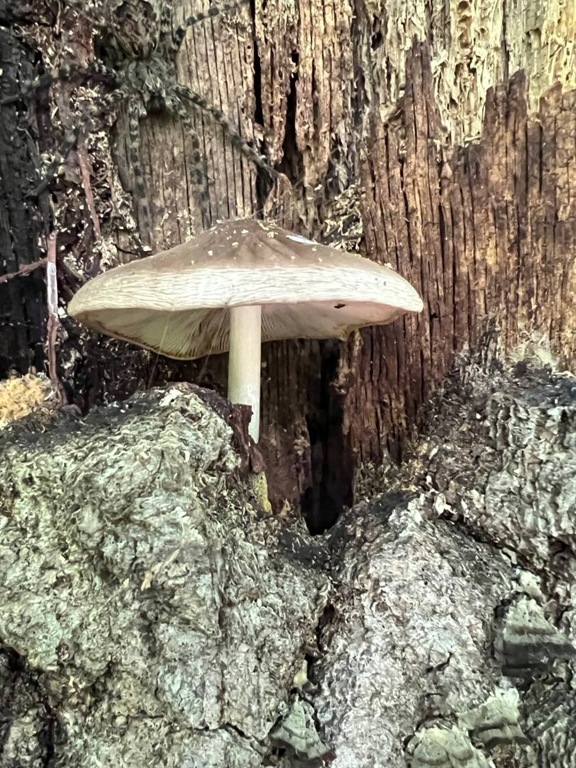
A mélange of moss and mushroom. Can you spot the spider’s unperceived hands in the picture? (click to enlarge)
.
I’ll make a leap here: Dickinson, the prolific weaver of 1,789 poems, identifies with this spider. One accounting has this as poem 513, so there are hundreds of poems behind her as she makes this one, and more than a thousand yet to go. The bees in Dickinson’s poems are usually cast as joyfully playing, the spider here is more obsessive. Even the dourest Puritan in her era would know the worth of the bee’s work: flowers, food, unspoiled sweetness. In the final stanza, the spider’s work is destroyed by what Dickinson genders as woman’s work, by housework – as endless as this spider’s spinning. Another leap: I wondered if Dickinson might have composed this poem while busy with housework, secretly engaged in the (gendered by her) masculine work of inessential gossamer creation – no matter if “Nought to Nought” is that work’s fate.
I combined Dickinson’s words with music that partakes of the sound of the 1960s psychedelic genre.* The joy of that kind of expression is the freedom granted to instruments to take novel roles and reconstituted timbres. To a loping 6/8 time, the bass is allowed to rise to sing, the electric piano has been having an episode, the guitars wander onto new paths, an organ breathes, the drums fibrillate. Over this I sing wildly, unconcerned to be overheard. You can hear this performance with the audio player gadget below. What, has that audio player seemingly come to nought? Some ways of viewing this post will suppress the gadget, so I offer this highlighted link which will spin a new tab that has its own audio player so you can listen.
.
*I don’t find this a strained pairing at all. The 19th century American New Thought and Transcendentalist strain was still alive in the Beat and later counter-culture outlooks that arose a century later. Dickinson’s recasting of language and syntax in many of her poems is like to the sonic experiments of psychedelic music, which I’m attracted to for their adventuresomeness rather than their drugs. What is novel about my application of this to Dickinson is that this element of her poetry is under-observed, while it’s more common to view William Blake as “A ‘head’ before his time.”
It’s known that Emily Dickinson played piano, but my scattershot scholarship doesn’t inform me if she played any other instrument, or exactly what kind of music she played or appreciated. Many of her poems use hymn or ballad meter, and I was still a young person when I first was told that you can sing many a Dickinson poem to the tune of “Amazing Grace,”“The Yellow Rose of Texas,” or “The Theme to Gilligan’s Island.”
That factoid tells us that her metrical musical inspiration is hard to pin down, for in her 19th century a great deal of music followed that form. By our time, ballad meter is heard as presenting a certain kind of old-timey folk-music vibe — in Dickinson’s 19th century a wide variety of more or less contemporary music used it.* Did she ever sing her poems, or perhaps noodle a tune on piano while composing poetry? I know of no accounts. Still, when I ran into this early Dickinson poem, written by her as a twenty-something before the bulk of her poems followed during her highly productive thirties, I couldn’t help but think of it as being made to be sung.
“I had a guinea golden” is a poem about loss of friends or lovers, and it’s not hard to think it a characteristic work of someone in their twenties. Dickinson grew up in a dynamic time, in a small college town. Her school-and-college-age friends would, as they likely would today, be due to scatter to occupational and romantic opportunities during that decade of life, and the biographic data on Emily Dickinson would give us a goodly number of separations from meaningful people in her life during this time. From memory, I can think of only one who was separated by death in this part of Dickinson’s life (Benjamin Franklin Newton) — and I mention that because it may be impossible to be certain about how seriously Dickinson took this poem’s lament at losses.
My suspicion is that “I had a guinea golden” is layered. That it catalogs more than one loss (the guinea coin, the singing robin, the bright star) and takes time to note that each of these losses are not generally the loss of wealth, bird song, or a starry firmament seems to say to me that these losses are less serious than they feel. In letters to those Dickinson longed to hear from, she often takes a stance that she feels betrayed or onerously deprived of contact from her separated friends. In the informality of friendly correspondence that reads as playful there, and so it could well be here in this poem too. As we reach the poem’s — now song’s — conclusion, I suspect this lawyer’s daughter (unlike our country’s mad king) well knows that unforgiveable treason is not actually indictable just because someone has traveled away from Amherst. But even if playful, the piece does speak to how these losses feel, and in performance I chose not to wink at the pain of the symbolic losses portrayed.
Back in 1775 this mad king was taxing and tariffing Americans out of spite, and sending government troops to “protect” American cities that wanted no part of his chaotic misrule. This was the gold guinea coin that might have paid those troops.
.
Well frankly, I was glad to be able to use the limited instrument of my voice once again to record anything. Since late June I have had some kind of flu or respiratory bug that had me greatly fatigued, coughing, and so brain-fogged I could read only superficially. I’m not sure that intentional irony has yet come back fully online, so I performed “I had a guinea golden” as a serious lament. I’ll let Dickinson’s words and the listener provide the layered context. You can hear my performance with the audio player gadget you should see below. No player visible? “Treason!” “Exile!” “Avicide!” No, it’s just that some ways of viewing this blog suppress the player, and so I offer this highlighted link that will open a new tab with its own audio player.
.
*Poets too, including ones we know Dickinson read, used the format for literary ballads not necessarily meant to be sung.
Another poem for April Poetry Month. Another Emily Dickinson poem. Once more, wildflowers. Once more they’re that early spring flower, daffodils. Once more the poet is looking back because something’s missing.
Chord sheet because someone else might sing this better than I can
.
Last time the voice in Dickinson’s poem was also alienated from Spring, but there was a taunting wit to that one. The mode in today’s Dickinson is more abstract, and the second, final, stanza is so gnomic here I can’t say I know fully what it’s conveying. Even the first stanza is tied in knots, tangled with those Dickinsonian dashes. Is “an April Day” the “Absent Place” — or is the April day, with present dancing-in-the-breeze daffodils, in contrast to the Absent Place? The stanza’s final line asking us to consider the viewpoint of “the Souls that snow” could be saying then the snow is more full of motion and drifting shapes than mere blossoms — or that April brings forth feelings that makes the Absent Place snow-Souls uncomfortable?
In intent or effect, it may be a shifting Tao — an all of the above in motion with each other?
But the final stanza? I assume “Drift” within is of the snow-Souls’, a self-impediment worse than snowed-in roads or walks, but the concluding two lines are harder to follow. Perhaps she’s saying that snow-Souls are the ”Him” in the last line, and their change and emotion is as strong as (“duplicate”) as the wind-moved daffodils? But “duplicate” is a strange word choice. Even within slant-rhyme it’s quite strained to rhyme with “without.” I even toyed with pronouncing the duplicate as the noun, not the verb, which would be a nice sound-pair with “but.” However, that’s syntactically sour and doesn’t follow the first stanzas ABAB rhyme scheme.
For awhile I engaged in a little fantasy extension of this brief poem while asking why daffodils, rather than another Spring flower. Poet Dickinson famously knew her plants — not just as an avid gardener — but as a woman with more education than most in her time and place (which included science, considered a presentable ladylike field). She was the maker of an impressive book of pressed flowers labeled with their scientific names. Did she know her Greek myths as well as the scientific name for the daffodil, Narcissus? The essential piece of the Greek myths of Narcissus is that the youth of that name dies because he becomes entranced by his reflection, his duplicate. Is the last line’s “Him” Narcissus or something like him?
Or is she taking another route into the roots of the word narcissus, related to narcosis, a drugged numbing? Does the final stanza mean to say that springtime joy can be as numbing as wintertime sadness?
It may be wise to consider my thoughts about the final stanza over-thinking. They’re surely speculative, but it still seems likely that the poem means to link the emotions extracted from Winter and Spring landscapes.
As April National Poetry Month winds down, I’ve fallen into a theme without designing it. Many of us are feeling crabby, dismayed, disgusted, frightened, but Spring doesn’t know that. The cold of Northern April is now behind us, and May lays out ahead with greening and warmth. Is it taunting us by being pleasant and hopeful?
For the music in the performance you can hear below, I fell into it too, as certain and mindless as Spring. The recording started with the chordal guitar part, which I played on my jangling Squier Jazzmaster instead of an acoustic guitar because I was telling myself I’ve been stuck on acoustic playing too much lately, and I hate to be predictable. In timbre and volume it was hardy enough to easily accept the drums and electric bass that I matched with it. The final part was the lead guitar line played largely on the B string of the guitar up and down the neck, in that “I’ve just heard a Ravi Shankar LP” way that was popular in The Sixties — the 1960s, not Emily’s 1860s. You can hear it with the audio player gadget below. No such gadget to be seen? The authorities haven’t shut down the psychedelic ballroom, it’s just that some ways of reading this blog suppress showing the audio player. This highlighted link is an alternative which will open its own tab with its own audio player inside.
The attention I’ve been calling forth this National Poetry Month has been divided up between “civic poetry” about the state of nations, and poet’s examination of Springtime. Today’s piece continues with the wildflowers and wildlife side of April, but because it’s by Emily Dickinson, it’s a complex statement.
Dickinson here uses the ballad meter as she often did, a form also used for many Protestant hymns. This form as common as the robin. Simple music, startling images, another disconnect.
.
This poem, approximately dated at 1862, can still startle the modern reader. Over a century and a half of poems have been written since then, yet the language, images, and play of thought within it still seem fresh and surprising. And there’s no wait for the surprise in this one, beginning with the idea that I used for a title for the resulting song I made of it. Dread of Robins? This common North American bird is anything but frightening. It’s not large, or fierce, no raptor or raven. In the context of the poem, the outstanding thing about the American Robin is that it’s a migratory bird whose arrival is a sign of Spring. Yet it causes pain somehow.
The next stanza seems to amplify sound. The song of the robin is not that loud, but the sound of wild birds in Spring taken together does have a choral aspect. In their territoriality and mate-seeking, there is a shout to their throats. Dickinson hears some music in it, but it’s not altogether pleasant. The Piano in the Woods image delights in sideways incongruity. The piano is Dickinson’s instrument, the one she played, but as an acoustic guitarist one thing I know about the piano is that it can be overpoweringly loud. And placing the piano with its wooden case in a woodland implies a metamorphosis. Perhaps ED hears a piano whose notes are bird calls? “Mangle” here is another characteristic unusual word choice by Dickinson. In her day she’d know the machine named with the verb: the wringer for squeezing water out of laundry. Spring is putting the speaker in the poem through the wringer.
Many of this April’s pieces have featured wildflowers, and specifically daffodils, but the colorful brightness of the flower here does not delight even after the dreary monochrome of a Massachusetts Winter.
Bees are everywhere in Dickinson’s poems, more than angels in Blake or Rilke. She often speaks fondly of their seeking sweetness, their industry, their pollinating agency in horticulture. Dickinson had by interest and education knowledge of these details, yet here the Spring bee too is unwelcome and she feels alienated from them.
In the penultimate stanza the creatures and flowers of Spring are present. She grandiloquently calls herself, “The Queen of Calvary,” suffering as if the crucified Jesus of Lenten Spring.
In the final stanza there’s a parade of sorts, with drums and salutes. “Plumes” here strikes me as an odd choice. It may be a bereaved funeral procession. Black ostrich plumes were apparently used for funeral decorations in the 19th century, so oddly we start with a modest small bird and end with the plumage of one of the largest. The poem’s speaker dreads the robin, yet seems accepting of the plucked raiment of the giant.
Is this a poem of disappointment and depression? Yes, that is there — but it’s majestic too. The poem is a catalog of Spring’s changes, all of which the poem’s speaker is unable to find pleasure in: dreaded little robins, pianos in forests, piercing yellow wildflowers, the energy of bees. There’s wit here, and like a Blues singer, there is a power of being able to sing knowing the score of a bad outcome!
I think this is a poem of a divided mind. I can relate. Spring remains wonderful, much as this Spring I’m experiencing this year, but my civic world has presented us with discordant changes, public cruelty, careless acts, all cloaked in self-serving bluster. Dickinson’s poem is dated to 1862 — the American Civil War, which for now still has a singular name, had started.*
I originally tracked my musical setting here with just my voice and acoustic guitar. I thought that spareness might contrast with the last two musical pieces here with full-on Rock ensembles. I had second thoughts though: this may be a poem about internal sensations, but it’s also about change in a fuller natural and national world. Eventually this arrangement, one that evolves throughout with high wind instruments and emerging synth seemed better suited. You can hear it with the audio player gadget below. No dreadful robin, I mean player, to be seen? You may be reading this blog in a way that suppresses the player, so here’s a highlighted link that will open a new tab with its own audio player.
.
*One reader of a Dickinson blog has a detailed theory of the personal particulars that might have faced ED when the poem was written. Deadly Civil War or mentors splitting for the coast would be matters of mismatched scale. Is the Spring of closely watched bees, and little birds and yellow wildflowers smaller or bigger than those things?
A friend of the blog noticed today I used a particular phrase when I wrote about late-night work on the musical piece you can hear below. I’ll try not to take too much of your time, but I thought I’d expand on my explanation to him, and at the bottom you’ll be able to hear a 2-minute song made from a poem by Alfred Kreymborg.
The early years of the Parlando Project benefited from several things that are not in as great a supply now: I had multiple days in each week when I could work on finding and making these musical pieces. I worked regular workday hours on this, beginning after my morning bicycle ride for breakfast. I was eight years younger then, and those days were filled with rewarding creative work as I learned more about musical composition and recording technology. Shortly after the public launch of the Parlando Project, we had a consequential election in America,* but that (if anything) increased the energy I found most weeks.
Those who happen upon early posts here might notice a tone that isn’t as common in recent years. Without announcement, I was writing back then with my child in mind as an audience. They were going to be entering the 6th grade, and I vividly recall from my own youth how a great vista of complex, connective, and evaluative thought opens up around that age. I wasn’t going to make it a point to them to read this — adolescents aren’t looking for that sort of thing from parents — but rather more, I thought others in their peer group might come upon this Project and find some interest in my promotion of discovery and enjoyment. Working from that aim, as my child grew, I gradually changed the age group I was aiming the blog writing here at — though I don’t know if I ever achieved an adolescent audience.
Then a few years ago my family went through a series of crises, and it was only after a period of distress that the wise and resourceful members of my little family met those issues and managed them. I tried to be supportive — I probably was, to my imperfect degree — but that work was largely their doing. I’ll say that in that year or so of the greatest distress, my time spent here was a tonic for me from the stress and worry. How much of that was (in the modern terminology) “self-care,” and how much was temporary flight from responsibility? I can’t say, my perspective is too close-in.
But now in the past year or so, the time I can devote to this Parlando Project is constrained by external and internal factors. By choices outside my control, days go by when I’m restricted from recording, and even the blocks of assured time to compose or research are harder to come by. At the same time my energy endurance is lower as I age. As grateful as I remain to have the opportunity to do this Project, I guilt and grumble as an old codger when an opportunity comes — time when I can play or record — and at that moment my body is saying: take a nap instead. If I could schedule creative time, if I was to ask for concessions to schedule it, I’d probably face complex outcomes and reactions when my old body can’t be assured the energy levels and ready fingers like my 70-something self could.
Let me be complexly-clear about that though: that frustration doesn’t outweigh the gratitude. To have the opportunity and resources to do this Project remains a blessing! I just have to work with this, that’s all.
Here’s one “how” of that: after everyone in the house has gone to sleep early, or is at work on an evening shift outside our home — I can do my work, as long as it’s in silence. Knowing this, I often get a “second-wind” after 8 or 9 PM or so. I might spend this time researching or writing early or final drafts of these posts. There’s even limited music-making that can be done without making noise. I can go over the things I have been able to record, evaluate if they are worth using, perhaps adding additional parts silently using my little plastic keyboard, and mix the results into something suitable for releasing to the public. So: the hours between 9 PM and 1 AM have increasingly become working hours for the Parlando Project.
I’ve come to call that time “burning the midnight lamp.” As I told my online friend this morning, that phrase is taken from two particular sources — ones you might not guess could be combined.
“Burning the Midnight Lamp” is a song, a lesser-known “deep cut,” by Jimi Hendrix. The song had a long gestation, Hendrix struggled to complete it. It was written early in his Jimi Hendrix Experience career, while living in London. Hendrix was a young man who previously had been in the care of a succession of childhood relatives, foster homes, and then a short Army barracks stint followed by couch-surfing until this point. For the first time he had his own place, shared with a woman in what sounds like an equality of love.** That Hendrix London flat has been restored to appear as it did then, and when I visited it some years back I thought of what a special place it must have seemed to him. I imagine his thoughts: my own place, paid for with my own money, living on my own recognition, work done under my own name. In anyone’s life (not just a “rock star”) the time when one has achieved that — that’s something.
Here’s an odd connection: when you visit the site it’s a joint institution. Hendrix’s apartment is upstairs, but the main floor is laid out to reflect another emigrant musician of another era: this address was also George Frideric Handel’s London home.
When Hendrix was searching for the extra sound needed to complete his “Burning the Midnight Lamp,” he found the recording studio he was in had an odd instrument present: a harpsichord. Comparing Hendrix’s guitarist skills to my own would be laughable, but things even out in naivete when at the musical keyboard. Today’s song uses piano, but I had to play separate right and left hand tracks to realize the simple part. Likewise, Hendrix hacked out a little harpsichord part for his song. Was Hendrix tipping his hat to his downstairs ghost with that harpsichord?
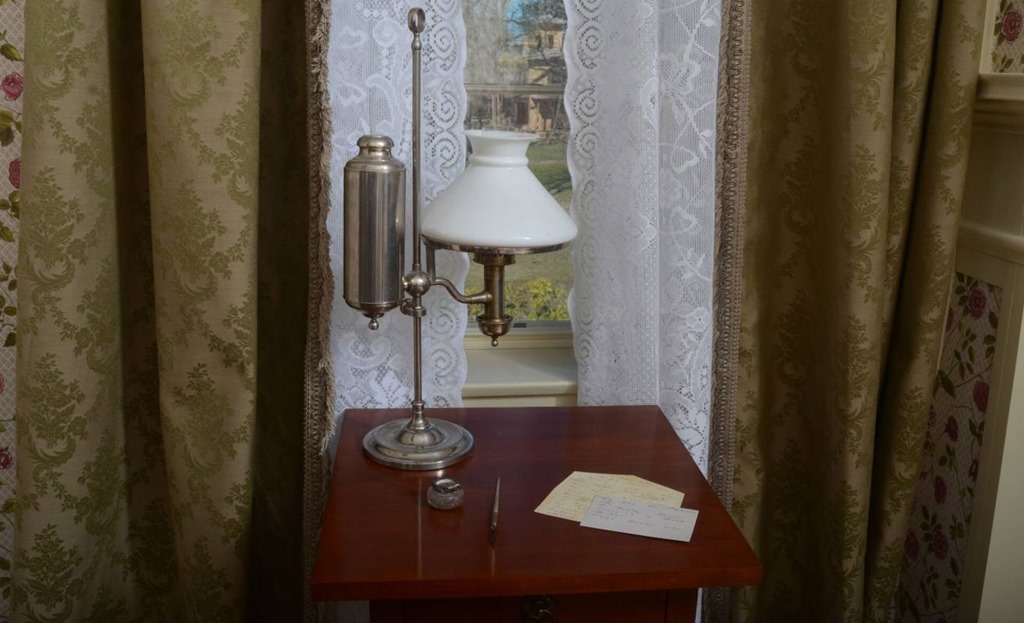
Why did Hendrix write his tune about working late within the endemic uncertainty of creatives using the image of a lamp? No guess. But another lamp, elsewhere, in another visit: something I recall when visiting Emily Dickinson’s bedroom was the little table that was her writing desk. On the small top of the table was a whale oil lamp. Dickinson, living with her family in a household, with household tasks and human needs that would take the daylight hours, had this little mid-19th Century, middle-class luxury of a warm effective light to work by after the busier-with-others’ hours.
“Ready for the same old explosion/Going through my mind…” A small writing table and lamp in Emily Dickinson’s bedroom (photo from the Emily Dickinson museum)
.
Looking at Dickinson’s lamp, I thought of the whole system that represented: the swimming mammals of the dark, cold sea, the diverse Moby Dick industry which captured, killed and deconstructed those massive bodies — and so, extra hours glowing with North Atlantic juice opened for a woman to scribble and sew little booklets. If I’d try to tell these thoughts and feelings when looking at the lamp to the average person, they’d sense a disproportion. Someone might even harrumph to me “It’s just a lamp — an unexceptional, domestic thing.” Readers here? You’re not that sort of person — and on her part, Dickinson too, she had further thoughts.
And so I continue, to burn the midnight lamp. Alone.
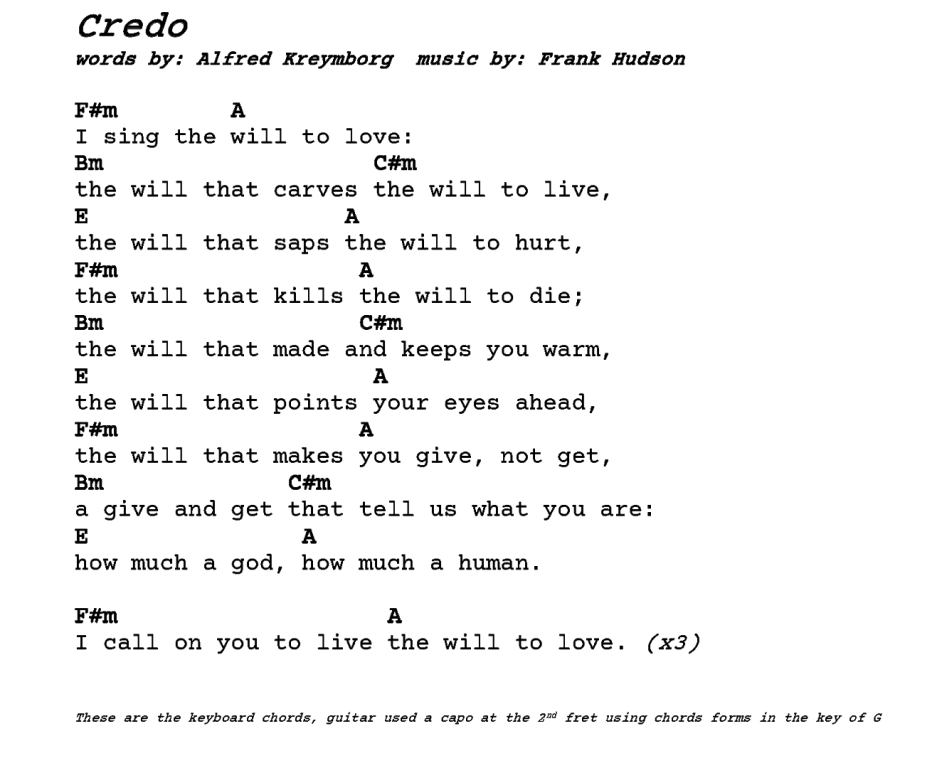
Today’s results came after a week of disappointing myself as I looked for some words to express what I was feeling, words that would ask me to sing them out even with my inexact and unprofessional voice. I was seeking words that would add something hopeful in a time of extraordinarily slipshod callousness carried out with motives of punishment as a virtue. It was this short poem by early American Modernist poet, editor, and publisher Alfred Kreymborg that captured me.
As I often say here under these chord sheets: someone out there can likely sing this song better than I can.
.
Last post here was a series of inspirational maxims carried by a Jazz musician. Maybe Kreymborg’s “Credo” seems a little too hopeful, too earnest for some of you. It’s probably not the sort of poem you’d first think of as an early text of American Modernist poetry from a colleague of William Carlos Williams, Man Ray, and Mina Loy. Little matter, I felt I needed to sing it. That’s enough for now.
You can hear my performance of “Credo” with the graphical audio player gadget below. No gadget? It’s not that you didn’t keep your lamplight trimmed and burning, it’s just that some ways of reading this suppress showing the player gadget. This highlighted link will open a new tab with its own audio player.
.
*Decades before, longtime Parlando contributor Dave Moore and I started the LYL Band just before Ronald Reagan’s election. Then too something that wasn’t very good for the country paradoxically encouraged creativity as contrast.
I suspect a majority of my readers are looking for something related to poetry when they visit here. Stats show continued high visit counts for older posts on some poems this winter, proof of Pound’s dictum that “Poetry is news that stays news.” I remain a little puzzled by the trailing interest in the audio pieces that accompany nearly all the blog posts. The analyst in me assigns that to the fleeting visits of many internet users who sometimes can’t politely play audio, or who don’t care to expend the 2 to 5 minutes most of my musical pieces would take. Maybe some think the audio player gadget will launch an all-to-typical one-hour-plus podcast with an inefficient, in-joking set of hosts rattling each-other’s funny bones? Or it could be musical tastes that diverge, including expectations of better or different musicianship and a more attractive and commercial voice than mine? If so, fair enough.
I doubt any but a few are here for politics. And this week, more so.
I had a political life, I retain an interest in politics in old age, yet even I am on a political news diet this winter.* If it looks like I’ve been writing thinly veiled political posts lately, I’ll claim my intent is more to expiate my own emotions — and to, with whatever value, to succor those that William Carlos Williams portrayed last time as “huddled together brooding our fate.”
One of my early poetic heroes, Carl Sandburg, had both a political and literary life. I recall a story that as his early Modernist poetry was breaking out into publication, he was challenged on controversial political elements in his poems. He claimed (earnestly, or with care for his emergent career, I don’t know) that any such was incidental — that he, the author couldn’t fully compartmentalize himself. I have no career. My primary interests here are to promote other people’s poetry and to learn and enjoy myself while doing that, and so I’ll make a similar claim.
Which brings me back, as this Project often does, to Emily Dickinson. There are some things exceedingly modern about this mid-19th century American poet: the compression of her language, her freedom from lockstep prosody or conventional syntax, the explicit use of the mind’s interior as a landscape, her abrupt linkage of the prosaic ordinary and the most high-flown concepts. With all that stuff that still seems modern, folks looking to more deeply comprehend her work may need to be reminded that she is, for all her genius, a citizen of a particular place and era.
I remember a short session I had while at the Dickinson Homestead Museum some years back, when a tour docent made a comment that Dickinson wrote a good deal about the Civil War.
“Huh?” I said to myself. I could recall no such poems. In my ignorance then I assumed Dickinson was largely insulated from that, being in small-town New England, privileged, white, and female. I’ve learned a lot since then, and that’s been one of the joys of this Project.
Today’s musical piece is her poem “Inconceivably Solemn.” In its abrupt/oblique language, landscaped with the blank horizons of those em-dashes, I can’t catch a definitive picture of what she’s observing. Metaphoric or actual, it seems to be a parade or celebration. What’s the occasion? An Independence Day? A group of newly mustered troops for that Civil War? An election? I lean to the latter two, and remind those who aren’t steeped in mid-19th century American history that those two things were linked as chattel slavery was a huge and sundering political issue for decades before breaking into war. I first thought the poem was troops going off to war from her town, and it still may be. The 1861-65 war overlapped Dickinson’s most productive years as a poet, and her Amherst sent troops which quite likely enlisted and marched out from the town.
If you’re tired of politics, poet Emily Dickinson seems skeptical of the celebration here.
.
On the other hand, the poem also seems at times to place the celebration/parade as being far away. Is she imagining the soldiers marching into battles at the battlefields that weren’t near her town? Or reacting to battlefield reports in publications perhaps with “mute” engravings of the troops? The poem starts and ends with clear oxymorons, with that first line’s “inconceivably solemn” that is used as the title stand-in. That “solemn” is soon “gay.” And the penultimate line has “wincing with delight.” So then: portraying great causes, assumed honor and bravery, but also suffering and death.
Allow me one moment of my pedantry, and some very uncertain speculation on my part, regarding something that only occurred to me today after working with the poem earlier this winter to prepare the music you can hear below. You see, there’s this odd line “Pierce — by the vary Press.” Dickinson is no stranger to choosing an unusual word, and that may be all “Pierce” is meant to do here.
But one of my youthful enthusiasms was history, and just today I thought, “Is she punning on Franklin Pierce?” OK, I know I’m defeating audience expectations here to ask you to be interested in poetry and vaguely-indie-folk-rock in one Project — and now there’s a history pop quiz? You see, Franklin Pierce was one of America’s worst and least-successful Presidents. He was a Democrat, though in an era where political alignments under that party differed greatly from today. He was elected President in 1852. Dickinson would have been just in her majority, though as a woman, unable to vote — but her father, Edward, was politically involved.** In the 1830s and 40s Edward served six years in various offices as a state legislator and elsewhere with the state Governor. In 1852, the same year that Pierce was elected, Edward Dickinson was elected to the national House of Representatives. Edward Dickinson was a staunch Whig party man. Once more I’ll skip the complex details of the political alignments of this time —but during the 1850s and the run up to the Civil War the Whig party disintegrated. And Pierce? By the midterm elections of 1854 Pierce’s Democratic party was reeling as well. In 1856 Pierce became the first American President to seek and be denied the nomination for a second term — but as ineffective as he was a President, his victory in 1852 coincided with the steep decline of the Whig party of Dickinson’s father.
So from that plausible wordplay connection,*** and the absence of any armaments or uniforms in this poem — only flags, drums, and pageantry — I’m open to the thought that it’s one of those raucous political parades that were a big part of 19th century American politicking that’s being depicted. Improbable gay solemnity could describe such a civic event, and the poem’s side-eye to all the noise and celebration would be all the more appropriate if the Dickinson family’s party might have been on the loosing end of the campaign hurly-burly. If written with hindsight after the Civil War has broken out following the failures of Pierce and his successor, the similarly one term and terrible President Buchanan — then the final “Drums” is reminding us in conclusion that the martial drums of a Civil War were “too near.”
OK, here’s that short musical piece. Perhaps thinking of Colin Mansfield reminding me of the early Woody Allen gag about the cellist in the marching band, I didn’t do a brass band for this, but acoustic guitar, organ, violin, and yes, cello in this song of a parade. There’s a graphical audio player below, but if you don’t see it’s mute pomp and pleading pageantry, I supply this highlighted link that will open its own tab with an audio player.
.
*And Parlando contributor Dave Moore has, at least as of the time being, dropped his monthly comic published elsewhere, which often commented on political issues. He and his partner should be allowed to tell their own story, but he told me recently that he couldn’t bear to do the same comics over again as the country enters its Restoration era.
**I’ve written often here about a theory I have, that Emily picked up information, terminology, and concepts from the family business, lawyering, practiced by her grandfather, father, brother, and maybe even her later-life flame Judge Lord. I’m sure there has been, or should be, some scholar who’ll do a graduate thesis on the use of the Law in her verse. And why not the same regarding the closely allied field of politics?
***Wikipedia says that the Democrats needled the Whigs by campaigning in Pierce’s 1852 race with the slogan “We Polked (successful Presidential campaigner James Polk) in forty-four. We’ll Pierce in fifty-two.”
However similar if amorphous shapes, everyone’s ghosts are private spirits, and I have a new musical piece with words by Emily Dickinson testifying to that — but let me slide over to a couple of personal things first, as if I was a regular blogger externalizing their internal story.
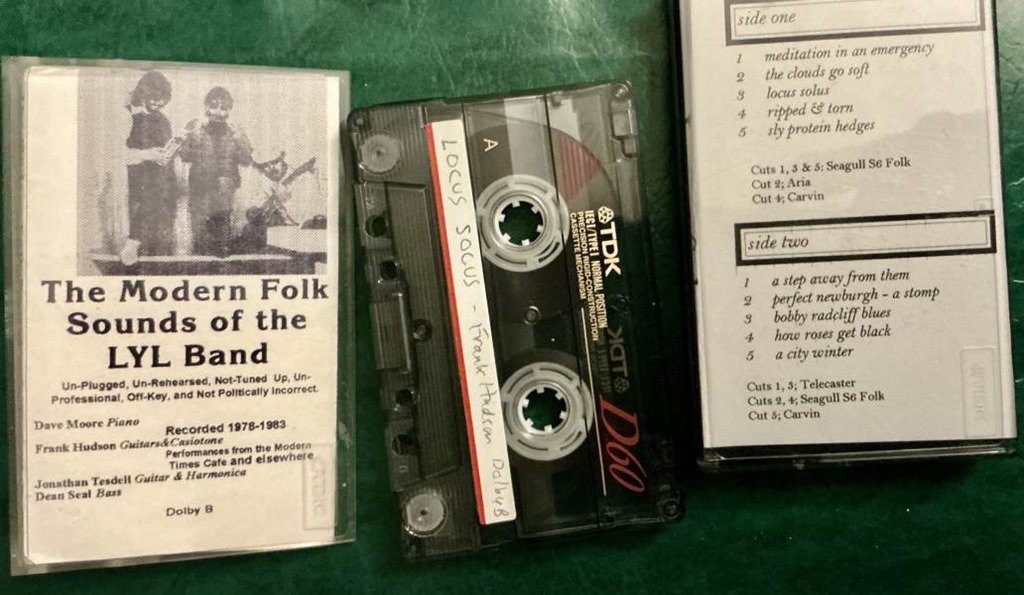
I’ve had a couple of weeks when I’ve needed to come back to the Parlando Project stuff from other things. I had a colonoscopy with unremarkable results. Huzzah. That’s some prime blogger internal dialog! But before that, I searched around my crowded little bedroom/office to find old cassette tapes. The oldest are from The Sixties when I had one of those small battery powered monaural cassette recorders with a slide-out chrome handle, a single speaker on the top, and a chorded plastic microphone with a start-stop slider button on its side. Others were from the 1970’s-2000 era when I recorded musical things, first on the stereo tape decks of the late 20th century home hi-fi era until I was able to afford one of the legendary Portastudio models designed for musicians, using the same humble cassette tapes, but able to record 4 distinct tracks. My task: to make digital copies that I can store in no appreciable physical space and are independent of an obsolete format.* More than 30 years of this stuff, much of it of only private interest, though you may hear some of it eventually.
Some of the cassette tapes.
.
The ubiquitousness of inexpensive video is fairly recent, but assuming no catastrophic events, many born in the past 15-20 years will likely have color video with sound of their childhoods and young adulthood that could follow them the rest of their lives.** Is that a good thing, something they welcome? I don’t know. Before this some folks had diaries and journals, or kept letters, so some level of self-documentation is not entirely novel. Still, for me, a person whose Project lives in music and sound, whose favored form of literature began in sound before writing was invented — retaining an element of the sound of the words, and their sequence, and echoes — my particular audio time-capsules have a special tang. And fears.
Most of the tapes are not just me, in a few I’m just the man holding the microphone, though I’m there as the shadow that chose to start the recorder. They hold our imperfections: things before we knew, before we learned — and then too the persistent faux pas that we still commit: there, and committed to a recording. Given that most can record now anytime with the tap of screen, how many will simply erase to save future embarrassment?
So back to Emily Dickinson and this poem about ourselves and what we think we fear — which may not be what we actually fear, or should fear. “One need not be a chamber — to be haunted” is a poem about that self we either can’t lose or can’t consider. In five stanzas Dickinson lays out some conventional gothic scenery (some of which she herself will erect in other poems) haunted houses, undead ghosts, church graveyards, and finally an assassin laying in wait for us.*** Dickinson points out that the self may be making or amplifying those fears, and perhaps that self, making scary movies in our imaginations, may be doing it to displace us from seeing the real fear source, our mind’s-self. “Ourself — behind Ourself — Concealed — Should startle — most” Dickinson’s poem concludes. You can read the text of Dickinson’s poem at this link. And yes, you might note I sang “alley” by mistake instead of “abbey” messing up Dickinson’s graveyard implication.
So, is that our choice? To ignore ourselves, out of fear of what we’ll find, or to disappear into a copious kingdom of solitary solipsistic self, many of us with the digital equivalent of Krapp’s Last Tape clanking and dangling from them like Marley’s ghost? Socrates decried the unexamined life. Memoir can be an honorable genre. Despite my taking the time this month with the old tapes, I think of this Scylla and Charybdis, and in the end there’s ultimately no keeping of this life and self, though sometimes there is sharing.
Today’s musical ensemble is a Rock-band of some kind: drums, bass, piano, 12-string acoustic guitar, and two electric guitars, one of which is run through enough effects to mask its guitaristic nature. No need to rewind, you can hear it with the audio player below. No player? No need to untangle that with a pencil in the reel-hole — this highlighted link will open a new tab with its own audio player.
.
*Many years ago, I was on a committee working on the technical design for a radio network’s archives (most of which were still on audio tape then) which involved long-term storage and public accessibility elements. The online “New Media” folks had their ideas about what formats to use for listeners to stream over the Internet, the audio engineers had concerns about what would give the longest life and best fidelity, and the computer IT folks had thoughts about what media would have the capacity to hold something that might climb into the then hard to imagine “terabytes” of digital storage. The three groups weren’t always in agreement, and a grizzled consultant from some outside large, already in existence, archive was brought in to meet with us. Should we use digital tape, hard drives, optical disks? What file-system format on which? What audio file format should be used on that media? Is some of this going to die from “bit rot” on the media in how many years? We had lots of questions and wanted the wizard to arbitrate our concerns. He listened for a while as we cross-talked.
Then he answered. “It doesn’t make much difference what you choose. You’re going to have to convert to other media, file-systems, and audio formats in the future, and every few years going forward. Plan for that.”
**Many of my mid-century generation have photos from their youth. I had a “baby book” that lasts into my grade-school years in black and white. A few families had movie cameras (though no one I knew did) but many of those shot silent film. The cost of film and developing that film constrained the amount of pictures and home movies made. Lots of birthday parties, weddings, holidays. Parts of life yes, but selected shorts.
***I was working on this in the wake of the news of a planned, lay-in-wait killing of an insurance company CEO, which will be followed in the American drama by the killing of a teacher and a teenage student in a school reported by a 2nd grader who called 911. The first was caught on ubiquitous digital video, and the emergency call of the second perhaps made on one of those smaller than a fat postal-letter things we call phones even when we aren’t making phone calls. More than social embarrassment may haunt our digital archives as we live going forward.
I also note that final stanza of this poem’s “revolver” is another example to go with “My life has stood — a loaded gun” of Dickinson poetry citing a firearm being held as the high card in some kind of deadly personal dispute.





 Frank Hudson