Inconceivably Solemn

I suspect a majority of my readers are looking for something related to poetry when they visit here. Stats show continued high visit counts for older posts on some poems this winter, proof of Pound’s dictum that “Poetry is news that stays news.” I remain a little puzzled by the trailing interest in the audio pieces that accompany nearly all the blog posts. The analyst in me assigns that to the fleeting visits of many internet users who sometimes can’t politely play audio, or who don’t care to expend the 2 to 5 minutes most of my musical pieces would take. Maybe some think the audio player gadget will launch an all-to-typical one-hour-plus podcast with an inefficient, in-joking set of hosts rattling each-other’s funny bones? Or it could be musical tastes that diverge, including expectations of better or different musicianship and a more attractive and commercial voice than mine? If so, fair enough.

I doubt any but a few are here for politics. And this week, more so.

I had a political life, I retain an interest in politics in old age, yet even I am on a political news diet this winter.*  If it looks like I’ve been writing thinly veiled political posts lately, I’ll claim my intent is more to expiate my own emotions — and to, with whatever value, to succor those that William Carlos Williams portrayed last time as “huddled together brooding our fate.”

One of my early poetic heroes, Carl Sandburg, had both a political and literary life. I recall a story that as his early Modernist poetry was breaking out into publication, he was challenged on controversial political elements in his poems. He claimed (earnestly, or with care for his emergent career, I don’t know) that any such was incidental — that he, the author couldn’t fully compartmentalize himself. I have no career. My primary interests here are to promote other people’s poetry and to learn and enjoy myself while doing that, and so I’ll make a similar claim.

Which brings me back, as this Project often does, to Emily Dickinson. There are some things exceedingly modern about this mid-19th century American poet: the compression of her language, her freedom from lockstep prosody or conventional syntax, the explicit use of the mind’s interior as a landscape, her abrupt linkage of the prosaic ordinary and the most high-flown concepts. With all that stuff that still seems modern, folks looking to more deeply comprehend her work may need to be reminded that she is, for all her genius, a citizen of a particular place and era.

I remember a short session I had while at the Dickinson Homestead Museum some years back, when a tour docent made a comment that Dickinson wrote a good deal about the Civil War.

“Huh?” I said to myself. I could recall no such poems. In my ignorance then I assumed Dickinson was largely insulated from that, being in small-town New England, privileged, white, and female. I’ve learned a lot since then, and that’s been one of the joys of this Project.

Today’s musical piece is her poem “Inconceivably Solemn.”   In its abrupt/oblique language, landscaped with the blank horizons of those em-dashes, I can’t catch a definitive picture of what she’s observing. Metaphoric or actual, it seems to be a parade or celebration. What’s the occasion? An Independence Day? A group of newly mustered troops for that Civil War? An election? I lean to the latter two, and remind those who aren’t steeped in mid-19th century American history that those two things were linked as chattel slavery was a huge and sundering political issue for decades before breaking into war. I first thought the poem was troops going off to war from her town, and it still may be. The 1861-65 war overlapped Dickinson’s most productive years as a poet, and her Amherst sent troops which quite likely enlisted and marched out from the town.

Inconceivably Solemn

If you’re tired of politics, poet Emily Dickinson seems skeptical of the celebration here.

.

On the other hand, the poem also seems at times to place the celebration/parade as being far away. Is she imagining the soldiers marching into battles at the battlefields that weren’t near her town? Or reacting to battlefield reports in publications perhaps with “mute” engravings of the troops? The poem starts and ends with clear oxymorons, with that first line’s “inconceivably solemn” that is used as the title stand-in. That “solemn” is soon “gay.” And the penultimate line has “wincing with delight.” So then: portraying great causes, assumed honor and bravery, but also suffering and death.

Allow me one moment of my pedantry, and some very uncertain speculation on my part, regarding something that only occurred to me today after working with the poem earlier this winter to prepare the music you can hear below. You see, there’s this odd line “Pierce — by the vary Press.” Dickinson is no stranger to choosing an unusual word, and that may be all “Pierce” is meant to do here.

But one of my youthful enthusiasms was history, and just today I thought, “Is she punning on Franklin Pierce?” OK, I know I’m defeating audience expectations here to ask you to be interested in poetry and vaguely-indie-folk-rock in one Project — and now there’s a history pop quiz? You see, Franklin Pierce was one of America’s worst and least-successful Presidents. He was a Democrat, though in an era where political alignments under that party differed greatly from today. He was elected President in 1852. Dickinson would have been just in her majority, though as a woman, unable to vote — but her father, Edward, was politically involved.**   In the 1830s and 40s Edward served six years in various offices as a state legislator and elsewhere with the state Governor. In 1852, the same year that Pierce was elected, Edward Dickinson was elected to the national House of Representatives. Edward Dickinson was a staunch Whig party man. Once more I’ll skip the complex details of the political alignments of this time —but during the 1850s and the run up to the Civil War the Whig party disintegrated. And Pierce? By the midterm elections of 1854 Pierce’s Democratic party was reeling as well. In 1856 Pierce became the first American President to seek and be denied the nomination for a second term — but as ineffective as he was a President, his victory in 1852 coincided with the steep decline of the Whig party of Dickinson’s father.

So from that plausible wordplay connection,*** and the absence of any armaments or uniforms in this poem — only flags, drums, and pageantry — I’m open to the thought that it’s one of those raucous political parades that were a big part of 19th century American politicking that’s being depicted. Improbable gay solemnity could describe such a civic event, and the poem’s side-eye to all the noise and celebration would be all the more appropriate if the Dickinson family’s party might have been on the loosing end of the campaign hurly-burly. If written with hindsight after the Civil War has broken out following the failures of Pierce and his successor, the similarly one term and terrible President Buchanan — then  the final “Drums” is reminding us in conclusion that the martial drums of a Civil War were “too near.”

OK, here’s that short musical piece. Perhaps thinking of Colin Mansfield reminding me of the early Woody Allen gag about the cellist in the marching band, I didn’t do a brass band for this, but acoustic guitar, organ, violin, and yes, cello in this song of a parade. There’s a graphical audio player below, but if you don’t see it’s mute pomp and pleading pageantry, I supply this highlighted link that will open its own tab with an audio player.

.

*And Parlando contributor Dave Moore has, at least as of the time being, dropped his monthly comic published elsewhere, which often commented on political issues. He and his partner should be allowed to tell their own story, but he told me recently that he couldn’t bear to do the same comics over again as the country enters its Restoration era.

**I’ve written often here about a theory I have, that Emily picked up information, terminology, and concepts from the family business, lawyering, practiced by her grandfather, father, brother, and maybe even her later-life flame Judge Lord. I’m sure there has been, or should be, some scholar who’ll do a graduate thesis on the use of the Law in her verse. And why not the same regarding the closely allied field of politics?

***Wikipedia says that the Democrats needled the Whigs by campaigning in Pierce’s 1852 race with the slogan “We Polked (successful Presidential campaigner James Polk) in forty-four. We’ll Pierce in fifty-two.”
The Lamp burns sure

What did Emily Dickinson think about the American Civil War, that great national trauma that occurred during her most productive time as a poet? And what did she think about the great national sin that was the cause of that war, slavery?

Emily Dickinson often writes puzzling poems, compressed like a set of speaker’s reminder notes on an index card. Despite occasional antique words and references to obsolete technology, Dickinson’s poems don’t really seem to dwell in a particular time or have any anchors in a time’s signature events. Instead we are left with the multiple capitalized idealized concepts that in the hands of most poets would doom a poem to vapid incorporeality—but the speed and brio of a Dickinson poem seems like the rush of thoughts, and that and they carry us along. All of this lets us see a remarkable mind thinking, but it doesn’t necessarily tell us the conclusions, only the methods by which it tries to reach them.

With many other American poets of her day we can tell what they thought of the Civil War and where they stood on the issues of slavery. Of course, we no longer read most of them, and we continue to read Dickinson. Even though my curiosity about these matters is personal, and in the end it doesn’t significantly change the originality and attraction of Dickinson’s work, I’ve still looked to see what I could find.

Dickinson’s father, Edward, was a politician, a member of the short-lived Whig party, and so there are political stands associated with him. The American Whig party, particularly for northern Whigs, was a “free soil” party. This meant that they did not stand for the abolition of existing slavery but wished to limit any expansion of the practice. Southern slaveholder interests were not content with that as a compromise. In an era when new territories and states were being added to the Union, they feared that they would eventually be too small a minority in a growing United States. In the 19th century before the Civil War, time and again these interests would come into conflict, and it was generally the Whigs who worked out some compromise that put off the Civil War. Edward Dickinson seems to have been an orthodox Whig, he supported those compromises, including voting for one of the last and most fateful of them, the Compromise of 1850 that gave the slave holders a Federal Fugitive Slave Act, giving license for bounty hunters of dubious ethics to haul escaped slaves back to the South (and financial rewards if they over-reached and just grabbed a free black person “by mistake”) and requiring local state authorities to assist in their efforts.

The injustices of the Fugitive Slave Act enraged Afro-Americans and energized abolitionist sentiments. And in the slave states who would secede at the start of the Civil War one of their chief complaints was that the Federal Government wasn’t doing enough to enforce this Fugitive Slave law against individual states that were hampering rather than aiding these “slave catcher” bounty hunters.

The Whig parties balancing act fell off the high wire shortly after that. It essentially split into two parties, the new Republican Party which was more adamant about free soil with no compromises, and eventually became the “party of Lincoln” and slavery’s abolition. The other part was the Constitutional Unionist Party which wanted to continue the Whig-style balancing act. Edward Dickinson seems to have aligned with the Constitutional Unionist faction, which completed the rapidly increasing progression to irrelevance for the Whigs.

On the other hand, both Edward and Emily Dickinson were on friendly terms with those who went the Republican route and even the more radical abolitionist bent. If yesterday’s story of Angeline Palmer might lead you to see a 19th century Massachusetts casting of To Kill a Mockingbird  with Edward as Atticus Finch and the young Emily as Scout, the reality of the Dickinsons is much more ambiguous.

I’ve found various critics and commentators who have sought to answer my questions about what Emily Dickinson thought on these things. Some point to Dickinson poems and have suggested readings of them, but these are most often unconvincing to me. She does have poems mentioning warrior courage, duty and loss, but none of them seem to say anything about the causes or necessity of the pressing war in her time. Even more rare are references to slavery or people of color in the poems.

The Lamp burns sure

Mysterious and burning. Dickinson’s mind by lamplight

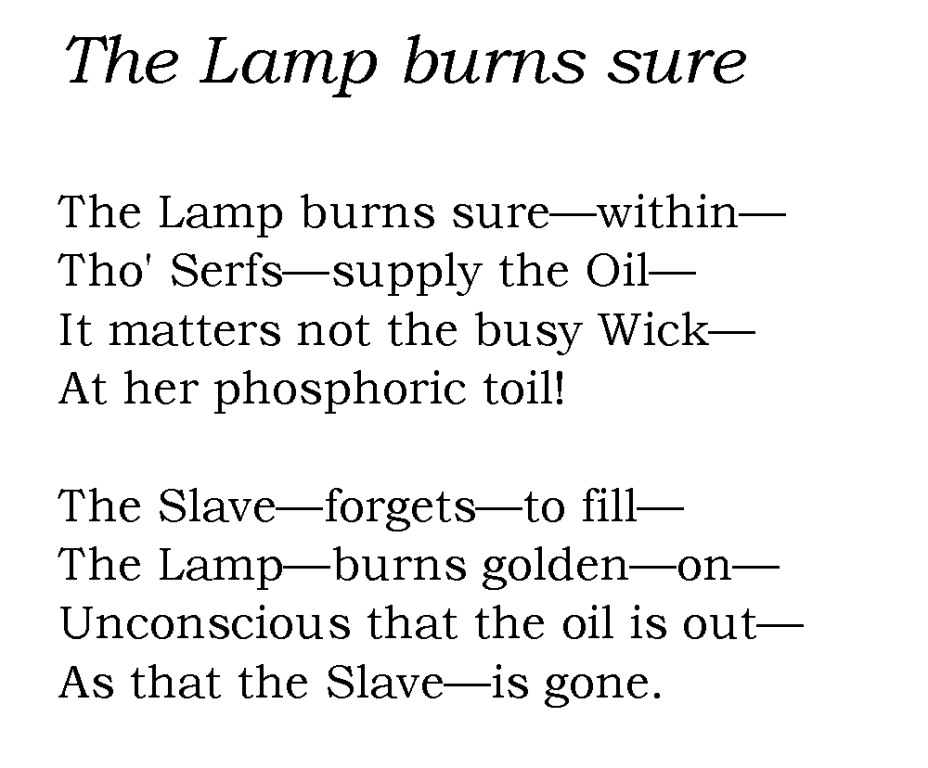
The poem I use for today’s piece is one of those rare ones. “The Lamp burns sure”  is Dickinson at her most compressed and ambiguous. The poem’s plot is clear enough, an oil lamp whose oil is supplied by slaves or serfs (the poem says both at first, muddying the waters if it’s talking about slavery) runs out of oil because they have stopped filling the reservoir. The lamp’s wick is so busy burning that it doesn’t notice that it’s out of fuel and would in the normal course of events burn itself out shortly. The poem does not proceed to that end however. It leaves us only with the wick’s obliviousness, and then breaking the tie between the oil bringer’s role as being a serf or a slave, leaves us with the final statement that the busily burning wick is also unaware that the oil is out because “the Slave —  is gone.” We don’t get to find out if the lamp is some Hanukkah mystery that will go on burning longer miraculously.

So, what does it mean, if it indeed means one thing? Some read it as a parable of creativity, that we’ll work ourselves past our resources in our passion. A key word there would be “within” indicating some imaginary inner lamp and the slave is just our body and emotional resources.

Some read it as a comment on the base labors that support a civilization that in turn supports arts, science or spiritual pursuits, and in that reading it’s an acknowledgment of the necessity of those labors—take them away, no light! The confusion of serf and slaves is a necessary confusion as it’s talking generally about civilizations.

And then some think, since this is a poem written in 1861 as the Civil War has broken out, and all the slave labor that has supported a large portion of the agricultural economy of the nation is now in question along with that nation itself, that this is not a generalized metaphor. The slave who’s gone, is an American slave, the light is an American light that will burn golden on.

Emily Dickinson's desk

Emily Dickinson’s desk with a whale oil lamp, a little luxury that could extend her writing hours

That last one would make it the closest to an Emily Dickinson statement on slavery and the Civil War. As I burn my own midnight oil tonight and I think of Emily Dickinson who wrote at night by the light of an oil lamp, I lean to the first reading. But some other day I might see something else and read it another way. I’d like to be surprised and to find out that Emily Dickinson’s keen and questioning mind could see what only some in her time could see about people of color and slavery, but that might not be the case. But here’s what I do find when I go to the music of that mind: a mind unafraid to be original and like Frederick Douglass in Robert Hayden’s poem, to believe freedom thought to be as needful as a heartbeat. Even if she didn’t free anyone from slavery like Lewis Frazier and his fellow servants in our last post, or agitate and orate like Douglass, I find there’s liberation there that burns sure.

Here’s my performance of Emily Dickinson’s “The Lamp burns sure.”  You can use the player below to hear it if you can see one. No player? Then use this highlighted hyperlink.

Angeline Palmer

Here’s a story. You can decide for yourself if it’s a sad or happy one.

It was a spring day in 1840 in a town in rural Massachusetts named Belchertown. For children you might expect that would be a fine day for play, but that’s not what this story is about, though it is about a child, one with a beautiful name: Angeline Palmer.

Angeline was a poor orphan and ten years old. Playtime was not on her mind. About a year back, the town poorhouse in which she’d lived since she was two years old had bonded her out as a servant to a prominent family in Belchertown. The town’s council ran the poorhouse, and Angeline was their ward legally, but such arrangements reduced the cost of running the almshouse.

I can’t be sure what work a nine or ten-year-old servant performed in those days in that place, but of course there were no appliances, and in rural towns there were not even stores stocked with things we might buy to save a household from having to make them. Households then were very labor intensive, so there must have been work for Angeline.

A servant like Angeline might dream of a better life on a spring day. Some would learn trades in household service that would allow them to start their own businesses. Or they might marry and start households of their own, where even if their lot would be the same sort of household work, they’d be servants of their own.

But Angeline wasn’t dreaming of a better life that day. Instead the future looked ominous. The man who owned the house was now staying in Georgia, looking for new business ventures. He had sent his wife all the way to Massachusetts to check on things at his house in Belchertown, and while she was there, a letter arrived. The letter had instructions for raising some money for his new business: ship Angeline Palmer down to Georgia. The letter figured she’d be worth $600 cash sold as a slave there. That’s about $17,000 today.

You see, Angeline Palmer was Afro-American. She was an orphan, poor, a servant—all things that limited her life, but she was free.

Servants in the house heard this letter being discussed, and quickly sent news of it back to the town where Angeline had been born. She had a half-brother there, Lewis Frazier, barely more than a teenager himself, he arranged a delegation to the town’s council, the men who were by law Angeline’s effective parents. The council wouldn’t take action.

Angeline was allowed to return to Amherst to say goodbye before the trip to Georgia and slavery. Her Grandmother was a servant at the home of the town’s postmaster. She asked him what could be done. Alas, the postmaster was the brother-in-law of the wife who’d been sent the letter. Instead of stopping this, he warned the Belchertown people that someone might be trying to stop the shipment of Angeline.

The postmaster worried someone might try to interrupt Angeline’s trip back to Belchertown by the scheduled stagecoach. Figuring they’d try something on the open road, he hired a liveryman to take her back by special wagon over a different route.

The postmaster was right. Angeline’s half-brother and a friend did flag down that stage, and of course Angeline was not on it. Slowly the pair walked back to town, sure that they’d failed.

But the liveryman had a servant too, and he knew the slower roundabout route the liveryman was taking back to Belchertown with Angeline. The town’s butcher loaned the liveryman’s servant a wagon and the now trio of rescuers sped off to Belchertown.

Despite the liveryman’s slow route, Angeline was already there, back in the house where she’d been a servant and from where she’d soon be shipped off to slavery. There was no time to waste, no one left to appeal to. Leaving the other two in the wagon, Lewis Frazier rushed into the house and found Angeline. Those in the house quickly reacted, and locked Angeline and her would-be rescuer in a room.

The other two men who’d raced from Amherst then left the safety of the buggy, ran up the stairs, pushed aside those trying to stop them, opened the door and took Angeline and her half-brother back down the stairs to their borrowed buggy. A crowd was beginning to form. Angeline and the three men didn’t wait to see what they might do, whipping back out of town as fast as their team could pull.

Angeline was secreted out of Amherst to an underground railroad safe house. Lewis Frazier and his two accomplices were arrested and charged. Though they’d stopped the fraudulent theft of a human being who would have been turned into property, who would have been owned along with her offspring, and bought and sold like livestock, the trio was charged with assault and kidnapping. The evil scheme of the man in Georgia was beyond the local court’s jurisdiction, and besides the three men had prevented that crime.

I don’t know how Belchertown looked upon this matter, but some in Amherst seemed to support the rescuers. Amherst’s most prestigious lawyer defended the trio of Afro-American men at the trial. That lawyer’s name was Edward Dickinson. Dickinson had a red-headed daughter, only a year older than Angeline Palmer, and her name was Emily Dickinson, who later would become known as a poet. Despite Dickinson’s efforts, the trio were convicted. They were given a sentence of 3 months, but it would be stayed if they would reveal where Angeline was hiding.

The dutiful trio didn’t take that deal, but the jailer seemed to be another who sympathized with them. While they slept in the jail at night during their sentence, he granted them liberty each day, and it’s said that townsfolk brought them gifts of extra food. The three men gave up some of their liberty for a short time but prevented a life of slavery.

So, what happened to Angeline Palmer? After a decade had passed, she returned to Amherst and married a relative of one of the men who had rescued her. She died, likely in childbirth, a few years after that. That may sound sad, but that was also the ordinary risk of a free woman living a married life in that time. They’d tried to steal her away and make her a slave, but a network of servants and three African-American men who cared for her risked all to prevent it. So, is that a sad story or a happy one?

For today’s audio piece, here’s my reading of Robert Hayden’s poem “Frederick Douglass”  about a man who stole his own freedom. Thanks again to the publisher for permission to perform this. “Frederick Douglass”  is Copyright © 1966 by Robert Hayden. From COLLECTED POEMS OF ROBERT HAYDEN by Robert Hayden edited by Frederick Glaysher. Used by permission of Liveright Publishing Company.

My chief source for the story of Angeline Palmer is this blog post by Cliff McCarthy of Belchertown. The web site that includes that post has  other stories about Afro-Americans in Emily Dickinson’s time and region.

The player gadget for my reading of “Frederick Douglass”  is below. The text of Hayden’s sonnet for those who wish to read along, is here.