Here’s a poem that I’ve turned into a song for my second post honoring two Irish-American poets who led a St. Patrick’s Day poetry reading in Minnesota for several years before their death. Of the two, Ethna McKiernan had more direct ties to Ireland, having spent some time living in Dublin, and then in Minnesota running an Irish book and music arts store in the Twin Cities for many years.
For a part of those years I was acquainted with Ethna through the Lake Street Writer’s Group,* where a small group of poets shared works in progress and discussed on the side our lives and outlooks. When I look back on those years, I miss those writers, but I also fear I was inappropriate in critiquing their work, particularly Ethna. My style in that sort of thing tended to be highly detailed (picky might be a word), and even if I would lengthen my responses to their work in progress with “you could consider this or that alternative” because I believed in an honest “test reader” response without claiming to having some reliable recipe for a successful poem, or authority to ask them to change anything. That claim, that belief, should have opened me up to considering “so why then bother them (or myself) with these suggestions or reactions?” I have no academic training in poetry (Ethna did) and in my late twenties I gave up working at submitting for publication. Ethna did publish. She and Kevin each had several book-length collections as well as the usual small-press acceptances. All this would testify that whatever I thought about poetry’s workings, those ideas were unlikely to be commercially helpful.
Well, you can’t apologize to the dead. They either know better or not at all. I meant well, and I could be amazed by Ethna’s best poems. So, here’s to letting you know about their work here, which I hope is a pleasure for you. And if you would like more of that pleasure, Ethna’s last book, a new and selected collection finished as she was in her final illness, is available here from her Irish publisher.
I think I heard Ethna read today’s poem selection, “The Day My Mother Gave Me Away to the Tinkers,” more than once, including at one of those annual St. Patrick’s Day public readings, where it’s an apt choice, what with its Dublin setting. Before reading it, Ethna would instruct the listeners that, just as with many people of our shared generation,** her mother had issued the threat inside the poem’s title in jest, at worst during momentary frustration; and that the subject of her poem was but her teenage mind thinking in response “Well, I’ll take her up and that, and then she’ll be sorry.”
What else do I want you to know before you hear my song performance of this poem? First, for practicalities sake, there’s a man singing this mother-daughter poem. That might be a detriment. Otherwise? I made a mistake singing the name of a baker mentioned in the poem, Johnston Mooney and O’Brien. I dropped the “Johnston,” but at first figured no one would care, that it must be just some immaterial tiny particular bakery – but it turns out that firm is a famous and long-standing Irish baking concern, Oh well. I hope you enjoy the song anyway.
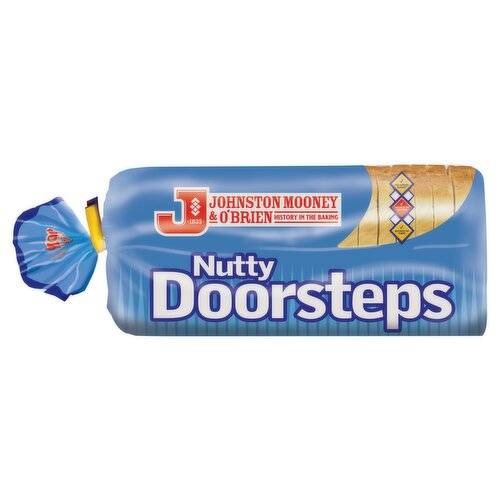
Forgot the “Johnston?” Never darken (or spread jam on) my doorsteps again!
.
You can hear it with the audio player gadget below. Has any such audio player disappeared? No, the gadget’s mother hasn’t given it away, it’s just that some ways of viewing the blog must want the audio player to not be seen (or heard) – and so I offer this highlighted link that’ll open a new tab with its own audio player.
.
*Alternative voice here Dave Moore, and our other St. Patrick’s Day poet Kevin FitzPatrick, were principals of the Lake Street Writers Group.
**My own mid-century mother had her variation of this “give you away” phrase, and but seven kids to test her patience.


 Frank Hudson