She Dreams of Sewing Machines

I wondered what I’d do for this April’s U.S. National Poetry Month. I’ve usually done something to observe it, though what I do may not be similar to other places. The audio pieces here almost always use literary poetry we combine with original music, so appreciation of poetry is business as usual there. What about writing poetry? I’m not a big fan of overt poetry prompts, instead working from a personal expectation that anything in life or art worth creating a poem over will let you know; and while I write sometimes about the process of creativity, I’m not a creative teacher. I’m also not promoting my own poetry — an honest, necessary task, just not one that I’ve chosen to do much of. Similarly, I’m by present resolution non-commercial with the music I create here. The current music business situation is difficult enough that the least troublesome and most assured way to make nothing from music is to start with, and keep to, the goal of doing exactly that!

So, what to do this April? I’d considered a close-focus theme, or the presentation of the work of a particular poet, but I’ve recently tested my appreciated readers a bit with a long series on the mystery of a musician’s scrapbook that came into my possession decades ago. Enough long- form for a while I think.

Online, I asked for requests, and got one: anti-fascist poetry. I’ve been bending somewhat away from my usual “you can get your complete diet of politics many other places” practice due to my nation’s current situation, which frankly disgusts me in the present and frightens me in its extrapolated expectations; but as a practical matter I almost always use older Public-Domain-status words for the poetry texts I combine with music here. Unlike our current Twenties, the last decade to be called The Twenties (where PD status generally ends) had yet to come upon that brand of authoritarian superiority.*

I found my solution by looking at the materials made by the organizers for this 2025 National Poetry Month. I saw that this year’s theme takes off from a line in a Naomi Shihab Nye poem “Gate A-4”  which offers me a suitable theme for the Parlando Project this April in this country in this year. That line is: “This is the world I want to live in. The shared world.” So, there will be some civic poetry on civic issues. There will also be poems of varied shared experiences. I haven’t completed any translations from other languages recently, but if I don’t get to that this month (and it’s usually a very busy month) I may feature some of my favorite not-originally-in-English poems from my past decade’s work.
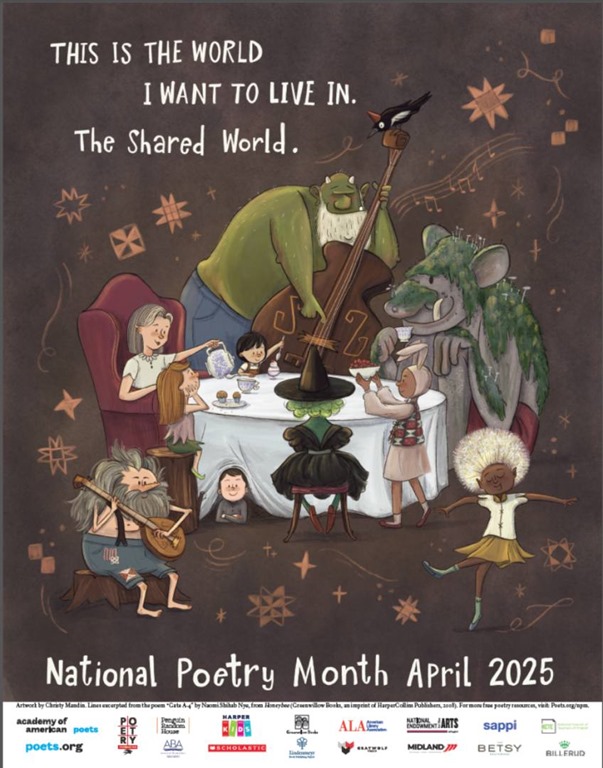
2025 National Poetry Month Poster 1080

This year’s poster by Christy Mandin.

.

To start off #NPM2025 I’m going to do something that’s not representative of what this Project normally does: from the start we’ve focused here on other poets’ poetry, even though Dave or myself could’ve supplied a great number of song lyrics and poetry to be recast as such. That decade-long primary practice is not followed in today’s audio piece — instead, it’s a sonnet from the Memory Care Series I’ve been writing for several years — some of which have been performed here in draft form. Though I wrote these words, it doesn’t really violate this Project’s maxim: “Other People’s Stories,” because it’s the tale of a daughter with a mother descending deeper into dementia, and of the connections and slow-motion mourning the course of this disease assesses.

Earlier this month I performed Alice Dunbar Nelson’s “I Sit and Sew”  a civic poem about a woman who wished to help the war-distressed and injured. Sewing was a bitter consolation in that poem — but in today’s sonnet, sewing is an image of a different, though still bittersweet, connection. You can hear my performance of “She Dreams of Sewing Machines”  with the audio player gadget below. If you don’t see any such gadget, it’s likely because you’re viewing this blog through a reader that suppresses showing it, and so I offer this highlighted link as an alternative.  It will open a new tab with its own audio player.

Return here throughout April to see what other, varied poetry, music, and performance styles I can complete and add to our shared world, or just use the blog follow feature.

.

*Arrogant ignorance, prejudice, persecution, vain greed for glory and gelt — that all existed before the name fascism, and that may still provide some PD poems. The pieces that I have nearer to completion are more about the human experiences that we all share, and by telling of them we by implication speak against callous disregard.
Arcadian Ewes (Ca’ the Yowes to the Knowes)

Today is Robert Burns’ birthday, which I hear is much celebrated in Scotland. While this Project has done over 800 audio pieces over the years, none of them (before today) have used Burns words. Why not? It’s a personal limitation of mine: his poetry uses a lot of Scottish words and dialect, and I have a hard time doing that.*

But, at last, I’ve finally snuck in a bit of Burns. And while it’s not as novel, I’m also using a set of words I wrote for the bulk of today’s performance, though the Parlando Project remains overwhelmingly about experiencing other people’s words. The second part of “Arcadian Ewes”  is a draft version from a work in progress: The Memory Care Sonnets.  Drafts of other poems in the series have appeared here before, but for those new to this, they tell the story of a daughter visiting and caring for a mother with increasing dementia.

While hearing the original account of a daughter and the daughter’s friend going for a weekly singing session at the memory care facility last fall, I was somehow struck at the time with the story’s Arcadian sensibility. That’s a place I know from this Project. Poetry and folk-song is rich in Arcadia: there are shepherds, flocks, meadows, love, peril, loneliness, peace, gifts, songs, a sense of time ever-present without fences, taking place over the hills and away from our actual daily lives. Here, in the sonnet, the shepherdesses go to the place, gather their flock of singers. What songs will they sing?

Even as I was writing the poem the refrain of Burns’ song that now begins the recorded performance was in my mind. I can’t quite account for why, other than the song for some reason often brings me to tears — and I can’t fully explain that either.

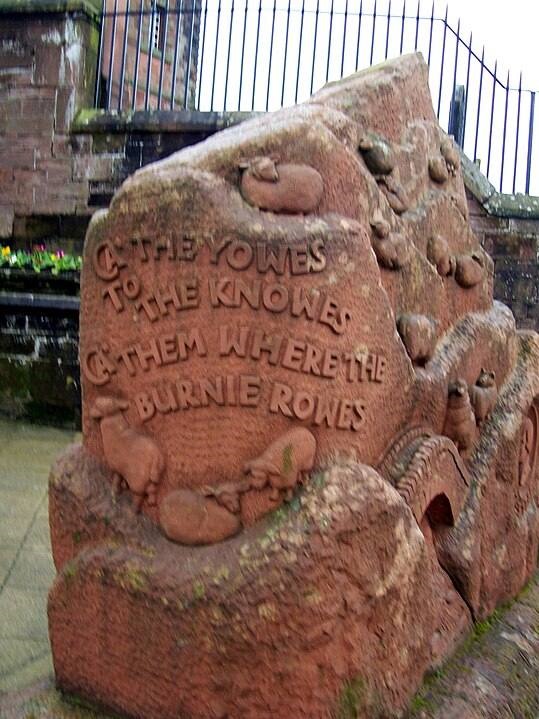
Ca the Yowes status Dunfries Scotland

Today’s musical piece begins with part of a Robert Burns’ song  displayed on this monument in Dumfries Scotland
(photo by: summonedbyfells via Wikipedia)

.

“Ca’ the Yowes to the Knowes”  was collected and reshaped by Robert Burns in the late 18th century.  He published at least two versions, and the folk process has given us other variations, including differences in how much of the Scottish accent and wordage is retained. As a text though, it generally isn’t a sad song. The song’s shepherdess, taking her ewes among the hills seems happy enough in her labor, but happier yet to find a swain in her Arcadia who promises her unending devotion and care. That story isn’t sad now, is it — unless one dotes on how love’s promises aren’t always faithful, that human lives are not unending. But as I said above, poetic Arcadian time doesn’t end, and maybe that contrast with human time is the essential sadness. Perhaps it is those elemental parts of Burns’ story, of the care for the carer, is what linked it to my resulting poem of the daughter taking care of the mother.

However inexplicably, I believe it’s the music that makes me cry when I hear that song’s tune. Music, that same powerful class of thing that is the balm that restores a connection to the mother on one of her “bad days” of deeper withdrawal in the sonnet. The music for the performance you can hear below doesn’t hew exactly to the old song’s tune, for I don’t know if I could have stayed with the reading if it did. You can hear my performance with the audio player gadget below. Has your audio player strayed away over the hills? No, just some ways of reading this blog suppress displaying it, so I also offer this highlighted link which will open a new tab with its own audio player.

.

*That lack of the ability to hear and then repeat back sounds bedevils me several ways: it’s often relied on in musical endeavors, and it’s long frustrated me in my desire to speak other languages, or even pronounce some names correctly. I suspect it’s a neurological quirk of my brain.

The Fade, a Rock song about aging and loss

So here it is, our 800th officially released audio piece from the Parlando Project. Perhaps it’s not representative: it’s not by a dead poet, and unlike almost everything else we do it may not have been written for the page without thought of it being sung. “The Fade”  was written and sung by the leading alternate voice of the Project and all-around inspiration Dave Moore. Dave and I go back to when we were leaving our teenage years. I met him then when he read two pieces in a church: one was his own poem, a cheeky number that mixed eros and agape, and the other was a reading (as if it was page poetry) of Bob Dylan’s “With God on Our Side.”   A decade later we started doing music together as the LYL Band, and some of what we were doing has become melded into what became the Parlando Project.

So, as I think again — is there any way to have a representative Parlando Project piece? Maybe not, and if so, by design. Variety and seeking something unexpected are founding goals.

Dave’s writing here, and our common efforts in making it the song you can hear below, strikes me as something too little done. Rock, whether it’s Rock’n’Roll, punk-rock, Alt-Rock, Indie-Rock, has tended to speak from a youthful perspective. Even the Classic-Rock acts that are still treading the boards at Dave’s or my age hew to topics that would interest those younger than they are. “The Fade”  is far from those common tropes: it’s about the diminishment of aging and particularly about the fogging and loss of memory.

Early this morning I watched an old documentary, a British South Bank Show done in the mid-1980s about the Velvet Underground, a band that was more than a decade defunct at that point, but all the principals (several dead now) were alive then, only entering into middle-age in the 80s, and of a mind to answer questions about the band’s influential work. The topic most covered as they spoke about their former joint project was what made the songs the original lineup put out of lasting importance when the idea of 20-year-old Rock songs having currency seemed novel.

Chief songwriter Lou Reed had it that he wrote about the things he saw around him rather than using the regular subjects of pop songs. True enough, but he chose subjects decidedly less ordinary in song in the times when he wrote them. He specifically wrote about things that frightened people enough that they left them out of the songs they wished to listen to: drug dependency, gay and gender issues, less-vanilla sexuality, and mental variations. And then several others, including the band’s PhD, Sterling Morrison, took pains to note that Reed presented those stories without editorial comment or stance, without sentimentality.

I’ll note now, that later in his career, past the times of that now 40-year-old documentary, Reed wrote one of the few Rock albums about aging and its disabilities: Magic and Loss.  It still stands pretty much alone. It’s also unlikely that even the adventurous readers and listeners that this Project has have heard it.

Dave and I recorded “The Fade”  this past spring. When I talked to Dave this morning we exchanged info on folks we know, folks our age or even a bit younger, who are moving into assisted living or who are suffering from dementia. I don’t know, there are probably a few songs about how sad Alzheimer’s and the like are, probably some songs that try to mitigate it with a chorus that mixes in the memories the sufferer no longer maintains. Dave’s song isn’t like those songs — if they exist — and I’m glad I helped make his song exist, and that I get to share it with you today.

The Fade

This is the sheet Dave handed me with brief scribbled chord notes on the day we recorded this. As you listen to the performance you may see that he did a masterful job of revising his typed words. I think the song gained power from the verses he left out.

.

You can hear that recording of “The Fade”  with the audio player below. I think Dave gets a bit of the VU-ara John Cale sound with the keyboards in it. I’m using feedback in it too, but not quite as the Velvet’s did. What? No player visible? No, you didn’t forget it along with where your keys are or what you came into the room for, it’s just not shown in some ways of reading this blog.  You can use this highlighted link as an alternative.

.

Smells

Traffic for the blog has picked up again a bit after its summer slump, but I’m still going to be presenting a few more of my own poems before returning to our usual presentation of other authors’ words. One thing that this does is allow me direct access to the poet’s intent, so today let me pull back the curtain and discuss what choices I made and what I was trying to convey in this sonnet that is part of a series I’ve done this year about a family dealing with one of their members with Alzheimer’s disease. The main characters so far are the older woman with dementia and her middle-aged daughter. The mother has transitioned to a Memory Care Unit as her dementia has increased.

Here’s the text of today’s poem, “Smells,”  so that we can follow along line by line as I discuss what I was trying to do and how I chose to do it. For today, for length reasons, I won’t talk as much about sound-music choices. Maybe another time for that.

Smells

The August after-rain smelled of rot and growth
where it dropped drought leaves on the lawn.
And by the garage door a bug had left its
solar-boat sarcophagus molt on the door frame,
implacable as any statue. Then down the block
the young dog walker looks at their phone
while the dog sniffs longingly at the weeds
tufting a stop sign. On to the MCU.

It smells today of urine just in the door;
and the mother asks again if she can leave —
which they do only for a walk. They pass
a bee garden, which has a sign “bee safe.”

The mother laughs. The daughter smiles.
She can still recognize a pun — its
accident.

Even though the poem follows the consciousness of the daughter character, the first three images of the poem were taken from things I observed myself on August mornings this summer. It can be chancy imbuing personal thoughts on a character when the character may jump across gender, age, or other boundaries from the author — but the alternative of not making that leap and to attempt to invent outside of the body and consciousness the author lives in risks as much if not more.

The first two lines discuss a dichotomy or dialectic: in this summer’s drought, when we had a short rain, it actually stripped the just hanging-on leaves off of some trees rather than greening their canopies up. Oddly, there was an autumn/spring smell from this, that, as the poem says, included a bit of decay and a bit of fertility in the air. The poet here hopes the reader can feel this moment of loss and change from these images, and as the poem develops remember how they may reflect on the other events.

Cicada Molt 1024

It’s remarkable how the winged cicada can emerge and yet leave this detailed casing behind so intact and empty.

.

Lines 3-5 include the second image, another dichotomy, an inert and lifeless thing left from an insect’s life-cycle and change. I sort of piled on here with the Egyptian allusions in line 4, and I questioned that. First off, not everyone has any interest and knowledge of those historical myths, and I’m calling them in without deep expertise in that. My hope here is that neither does the reader need more than superficial knowledge. As an inconsistently educated American I see these leftover bug shells, so lifelike and yet empty, and marvel as they often call to mind the Egyptian use of insects in their iconography. Once more this is nature’s change, even growth, though with evidence of loss intentionally invoked. I think too that subconsciously I was referring to the Jewish tradition of mezuzah devices on doorposts. The traditional mezuzah contains verses from Deuteronomy invoking the supremacy of the godhead, meant to remind all that pass through doors that we may come and go, but that something else is eternal.

As an author I often find that images like these present themselves to me as images first, and I need to ask myself what they mean or potentially mean. I collect the image, and the poem to use them in follows. My expectation here is that such images are richer than ones simply ginned up to decorate or explain by simile something in a poem, but the risk here is that they may not seem similarly meaningful to a reader. How many notice something as odd as leaves falling in August instead of later Autumn, or intact cicada shells except empty of their insect, or recalls particulars of old Egyptian or Hebrew iconography?

A casual, quick reader will just see these things as time-wasters, dawdling until the poem says something. I’m putting some trust in my readers here.

The final image of the sonnet’s octet is perhaps more universal. I could see it as a New Yorker cartoon or cover, and it’s common enough that I suspect that someone has drawn a cartoon meant to make us smile at this combination: a dog smelling for scent markings left by other dogs’ urine while the human at the other end of the leash is checking something else for connections to others of their species. The opening two images are ambiguous, growth and loss. I’m hoping the reader smiles a bit at the third, assuming they pause a bit to consider this combination of the dog and human.

The octet ends with the information that the daughter is seeing this while getting into her car and then driving to the MCU, the Memory Care Unit. I worried that by itself the abbreviation will be puzzling but saw no way out inside the structure of this sonnet. In the series,* the MCU acronym should become familiar.

At line 9 we link from the comic scene before it to a more concerning one regarding the message that the MCU smells of incontinent folks further along in their dementia. Line 10 introduces what will be a re-occurring motif in the sonnet collection: the mother wants to leave the MCU, but her increasing confusion while still being active and mobile makes it necessary that she be in a constantly supervised, structured, place for her safety. The daughter and mother get a walk and make yet another nature observation: a garden intentionally meant to attract pollinators with a whimsical sign. When the mother laughs, the daughter is reassured that at least for now, the mother still understands the concept of a pun, and once more the tension of the situation is sweetened with humor.

Just as I was making the version of the sonnet shown above I decided to leave the poem’s final word on an indented line continuation. My intent here was to make the reader stop and consider why the poem ends with “accident.”

What does this poem mean by that or mean in its entirety? I occasionally get asked that and I’m embarrassed to find myself tongue-tied, unable to do anything more but burble something inane. I am somewhat aware and can articulate (as I did above) what each image or event in the poem is intending to convey, but the whole thing? Ah, err, well, a….

A confident artist would say that if I could convey the combined intent of a poem, even a short poem —perhaps even more so with a short poem — what the combination of words and their sounds and sequence means with a prose paragraph or three, that I wouldn’t have written it as a poem. I’m not being coy or secretive when I say that — it’s just that a poems indirection and sound music undercurrent means differently than a prose explication means. The foreshadowing nature images here should mesh with the events of the last six lines, and the juxtaposition allow each to illuminate each other and the reader.

“Accident” is the end word to make us consider that just as a pun makes us laugh at the coincidental double meaning of a word-sound, that the infliction of the indignity of Alzheimer’s and our accommodations as sufferers or caretakers to deal with it are not punishments or acts of evil.

My performance of my sonnet “Smells”   is available with a player gadget below, or if you don’t see that, with this highlighted hyperlink that will open a new tab window to play it.

.

*Another sonnet in this sequence was presented earlier this summer in this post here.

The Story of Dave Moore and Love Songs

Don’t worry, we’re only taking a break from our regularly scheduled mix of various words (mostly poetry) with original music to tell the history of the Parlando Project’s alternate voice Dave Moore. So far in our story, he’s gone from poet to pioneering Twin Cities indie band lyricist to full-fledged songwriter to singer-songwriter-keyboardist for a two-person band of poets with instruments in about two years. If you’ve been following along, I’m the other poet.

How did this turn out?

Returning to 1980 after the release of the Lose Your Lunch Band’s Driving the Porcelain Bus  recording, the two-man-poet-band thing seemed to be a problem. Around this time a handful of Twin Cities indie rock bands had eked out a local circuit of venues that would book them. This was all very tentative, and only sufficient to give bands the initial toe-hold on a career, and it wasn’t really open to something as sparse and loose as we were. Could we possibly have tried to push that square peg, a “hardly rock band,” into that circuit?

Perhaps. We started looking to fill out the band, with the drummer being the biggest problem. I had started to dabble with electric bass, and Dave’s Farfisa combo organ had left-hand gray keys which could be dedicated to keyboard bass duties in the Ray Manzarek mode. The first third was Jonathan Tesdell, a guitarist who had a set of congas, and who was drafted out of a commune down the street. Jonathan practiced and played with us for a few gigs on electric guitar, but I can’t recall us ever even trying the congas as a replacement for a more rockist drum set live. But after a few months, Jonathan left town, traveling light. I once heard that his Gibson Firebird electric guitar that he sold before packing for travel was bought by The Replacements’ Bob Stinson.

Next up was a very talented guy who I believe was working then in the live comedy and theater scene,* Dean Seal. Dave somehow recruited him**, and Dean played drums and bass. Of course, not at the same time, a limitation we overlooked because he was willing to play with us. Dean could write great songs as idiosyncratic as Dave’s, and he had a good singing voice (later recordings with Mr. Elk and Mr. Seal demonstrate his cabaret-ready performance chops***). Dean later went on to a long and unique career, leading the Minnesota Fringe Festival for several years, and in this century becoming a UCC minister who combined his theater and comedy experience with religion.****

A fully operational LYL Band

Performing “Magnetized,” the rarely seen, full LYL Band live in the ‘80s. L to R: unknown drummer (see below) Dean Seal, Dave Moore, and Frank Hudson


Alas, Dave and I had sort of lost the fire to play out around the time Dean joined up. I’m not even sure if Dean could have been the singing drummer (harder than it looks) and songwriting voice that could have given Dave a rock-club ready band. With us, Dean played mostly electric bass, and he took a liking to a cheap Japanese copy of a Gibson EB0 bass that I had found in a second-hand store. We traded basses, mine for his similarly low-quality Made In Japan bad-translation-of-a-Fender bass. That instrument sits next to me as I type this, and I still play it often on pieces you hear here. Somewhere in the later ‘80s the LYL Band went, as press-releases still say these days, “on hiatus.”

Why? When I asked Dave today he said he hadn’t thought of that, but as we chewed it over I think it was the matter of both of us, in committed relationships and needing to pay the rent and bills at the lower edges of the economy, gradually converting the concept of the public band to a private joy.

But as that was, almost imperceptibly to us, happening, Dave’s songwriting took one more turn. The goth and gothic Fine Art lyrics and the agitprop and Dada characters of the early LYL songs were joined by unconventional and sincere love songs.

It’s more than 30 years ago, but I can still remember the first time I heard Dave sing this song, as I have heard Dave sing many songs before or since, stone cold fresh. We didn’t often discuss songs before playing them. Unless specifically working out a live set, we didn’t work out arrangements, run through the changes or discuss accompaniment. We just let it happen for fun or failure.

So, there we are in the 1980s. Dave’s standing at the Montgomery Wards electric piano, I’m no doubt sitting with my Cortez 12-string acoustic guitar with a DeArmond soundhole pickup. I’ve programmed a simple three-drum beat on a Mattel Synsonics electronic drums toy. I hit record on the cassette recorder. Dave hammers out some chords and I figure out the key and some kind of pattern as quick as I can. He begins to sing—and I suddenly realize this is, surprisingly, a love song, a damn fine love song, though still uniquely Dave. What do I think next? Well, that I had better not screw this up. Playing lead/melody lines on a 12-string has a catch: the two highest string courses are tuned in unison, but move to the G string and lower, and they jump up to courses tuned an octave apart. Listening to this now, I can still feel how I kept that in mind as I played. If music be the food of love, don’t lose your lunch.

I have some later, better-recorded versions of “(I Think I’ve Lost My) Total Recall.”  The lyrics Dave wrote as a younger 30-something were good then, but when I perform or listen to this song now, thoughts of memory loss mixing with love are real as well as art representing the impact of love. As songs occasionally do, it’s gone from heartfelt to heartbreaking—but this is the moment I first heard it, and so, excuse the archival audio quality and listen.


As a bonus, although also low-fi, here’s what a putative ‘80s LYL Band as a fully realized rock band would sound like. We’d planned this gig at a Native American center with Dean Seal playing drums or bass on alternate numbers. We’d setup and sound-checked ourselves, and then left our instruments sitting on stands at the end of the building’s gym. As we left for the rest of the event before we played, four guys, unknown to us, went over to our instruments, and began to play them. They were pretty good as I recall, sort of blues-rock. We figured there was no reason to stop the better, volunteer musicians. They played a short set, maybe two or three songs or so. Later that night, the drummer asked if he could sit in for our set on Dean’s drums. Trusting in chance, that’s what happened. The song “Magnetized”  is a Dave Moore lyric, another love song, but I think I wrote the music and sang it here. Once more it’s a cassette recording, taken from the vocal PA that night. You can hear me slightly off-mic trying to let the band know when I’m going to the bridge and walking over to let the rhythm section know that it’s time to end the tune.


*Someone should write a book on that circa ‘80s Twin Cities comedy scene, and yet oddly enough no one has. Louie Anderson, Liz Winstead, Joel Hodgson, Kevin Kling, Jeff Cesario—and I could go on—were all starting out in the Twin Cities in this era.

**Dave remembers he was working as a record store clerk for a time at the Wax Museum on Lake Street, and his manager there, knew Dean, and probably introduced them. Dave doesn’t recall knowing anything about Dean’s theater and comedy work then, only that he played bass.

***One story is that when Mr. Elk and Mr. Seal recorded an album at Prince’s Paisley Park they did it so quickly that it was the least expensive recording ever made there. Here’s some of their work.

****Here’s an article that touches on Dean’s 21st century take on Christianity.