Before the Snow

Long time readers know that the Parlando Project is largely about our encounters with other people’s words – usually their literary poetry. Poetry, even impersonal or hermetic poetry, is a rich way to transfer experience between consciousnesses. Poetry’s strengths in this transference over memoir, blog post, or informal conversation are largely the strengths of focused beauty – that thing that attracts us even before knowledge, expressed as sound or by novel connections.

Still, these beautiful elements of poetry come with costs, which is why many, most of the time, prefer other modes. Yet, I think the shortness and the compressed incidents of lyric poetry offer a possible compromise. We’re asked to share a little burden, a few minutes of reading or listening, subconsciously absorbing the word-music and linkages, which may in leisure or with mood be extended by re-reading and re-thinking such a small number of lines.

One of the things that caused me to begin this Parlando Project was thinking that a short musical accompaniment might add pleasures to possible serial re-encounters with the words. Is this so? I’m not sure, though I persist in doing this.*

That preamble out of the way, I’m going to look like I’m violating the “Other People’s Stories” maxim that is a principle of this Project, because I’m presenting today words I wrote to go with the music I compose and record – but hold on, I’m going to tell you this is still about a poetic transference across a gap.

Here’s why: once again I’ve been running into things from decades ago as I do my “death cleaning” reduction in things stored away or unlikely to be of foreseeable use. Just last week I moved aside a drum set that had been played by Dean Seal when he was in the LYL Band,** and found under the bass drum a plastic carryall tub with things hurriedly packed up after some gig: a Radio Shack battery-powered mixer, cables, a guitar strap, a cassette recorder, and a few tambourines we’d hand out for audience participation. And more spiral, college-ruled notebooks have come to light. Glancing through one I found a page with 9, untitled, lines – the start of a poem. From the style of the poetry in the fragment I think it’s from the 1990s, but it might be earlier or later. It caught my attention because it seemed to be talking about November in Minnesota in that interval right before the first snows come.

I remember nothing about writing this poem, or what prompted it, but it had some nice word-music and was roughly pentameter. That pentameter made me think I was writing a sonnet, and for some reason left off at this incomplete draft. That night, before bed, with my aching muscles and joints from twisting, bending, and hauling I decided to complete a full 14-line draft.
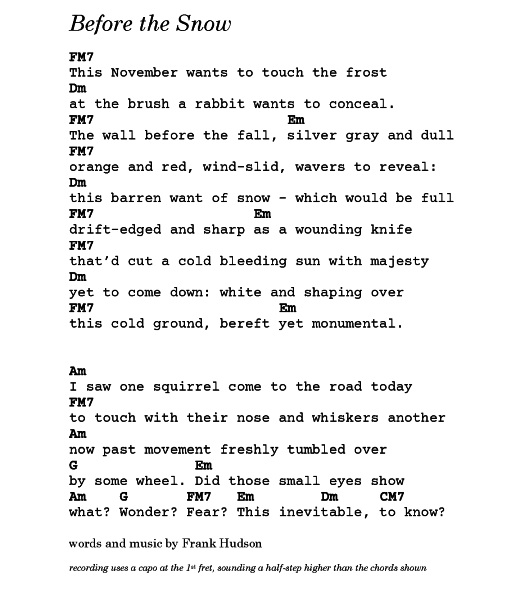
Before the Snow

More musical perversity: the difficulty in finding times to record acoustic guitar with sensitive mics in the past year or so has increased the number pieces I’ve done with that instrument.

.

For the final 5 lines I used an incident from a recent bike ride. Rolling down to a favorite breakfast destination at the borders of my wooded city I’m usually met with a rewarding bit of wildlife (outside of deep winter): constant squirrels, rabbits, small rodents, birds, including waterfowl by a pond and creek I pass, insistent crows, and so forth. If Keats wrote his “Ode to Autumn”  on Hampstead Heath in the Highgate section of the city of London, these near-daily rides of mine with this contrasting nature in the midst of modest single-family houses and parkland is my equivalent. What I saw this day was a little epiphany – a squirrel had been quite recently struck down crossing the road. Not smack dab run over, for it was not squashed, and there was only a little blood – yet it was clearly not moving or breathing, and even from the height of my bicycle its eyes could be seen fixed and dead. And then, as I was approaching, carelessly another squirrel scampered out onto the road and up to the corpse. Though I was riding onward, and only slowed a bit moving to the side, this squirrel bent down right to the head of the dead one, close enough to touch it barely with whiskers, clearly looking closely at it, for a moment regardless of my vehicular approach.

And then, just as I was beside them, it scattered off, missing by accident or close design, my slowed, but rolling, bike wheels. What was that squirrel after, what was it thinking in those few seconds with the dead one? This  was the matter to finish the poem that had started years ago with a rabbit finding scarcely-leaved autumn bush and brush to hide in. And I too had had my customary Parlando encounter without firm context, working with the part of the poem written by someone I hadn’t seen for decades: though in this case, it was my younger self. Not really that different from the usual encounters here with Frost, Dickinson, Sandburg, Millay, Stevens, Hardy, et al.

I originally gave the resulting sonnet the title “Before the Rapture of Snow,”  because I thought that tied-in the rabbit’s anxious waiting and the dead squirrel. I drew back from that thinking it too grand a reach, and because the theological implications of “rapture” would repel, puzzle, or draw in too-determinant reactions.

I was lucky enough to have a Monday to record this, finishing what felt like a good take of the vocals and acoustic guitar just before I had to leave my studio space. I added piano yesterday and mixed the tracks. As a non-pianist I’ve fallen into using that instrument simplistically as I do here, and I’ve grown fond of how these pounded single notes mesh with the timbre of acoustic guitar. You can hear “Before the Snow”  with the audio player below. Has the player been raptured up to heaven? No, it’s just that some ways of reading this blog suppress displaying such a thing, so I provide this highlighted link that will open a new tab with its own audio player.

.

*Besides my lack of talents for promotion, I sometimes feel what I do with this Project presents a number of detriments to gathering an Internet-scale audience. Poetry, as I write above, is not something sought out by modern Americans in great numbers. And then the music I make suffers from these things that reduce audience interest: I’m not a singer with a beautiful voice, nor do I think of myself as a performer with charisma or erotic appeal, and the music I make despite that is both too varied and too limited.

Many potential listeners or readers, presented with an infinite library of options in our modern age, will avoid things that have but one of those strikes against it – and to add another one or two against the Parlando work wouldn’t be rare either.

All this isn’t breast-beating or humble-brag, and I’m even hesitant to waste your time writing this. I am proud of much of the work I’ve done over the last decade here. While my audience is Internet-small, I believe it’s not all that small by poetry standards, and increasingly, not completely outsized by the audience for much non-Pop Indie music. Thanks to my hardy listeners!

**Dean was working elsewhere in comedy, and with at least one other partner in music, when he played in the LYL Band in the 1980s. He was talented and creative, we were looking for a drummer or bass player, and we perversely came upon him as both – unconcerned with the challenges of one person filling both roles! He may have grown to think of us as less professional or ambitious than he was, I don’t know, or events of his life may have intervened, but for reasons unknown to me we just stopped playing together – but this happened without him picking up the small drum set he played with us, and stored at my place. While working on my cleanout this fall I briefly tried to find contact info for Dean to see about the drums, but the trail ran cold after finding articles about him being part of the pastoral lineup at a church that no longer listed him on staff.

Exhumation

I’ve already mentioned that I’ve been dispensing with a lot of stuff, the kind of winnowing that I like to refer to as “Death Cleaning.”* This has included going through a series of stored-away boxes and plastic bins which dated back to moving into my present house in the 1980s. While somewhat illogical, this isn’t, I think, unusual. When we move, we’re moving forward, and there’s a tendency to liberally bundle and box up those things we think we might still want – and then in the new place, present time takes over and one never gets to unboxing things one doesn’t need right away.

Things of mine I found in these dusty bins? Music tutorial books, and books on French poetry and language. The former because this was the height of the LYL Band’s live performance era and I was hoping to increase my skills and knowledge, the latter because I was interested in translating Symbolist and Modernist French poetry.** More than 40 years have passed. I now know that I know just a bit more about music: mostly what I’ve found out about in order to create the over 850 Parlando Project pieces composed this century. That’s what became my tutorial: doing. I never got around to translating as much French poetry as I planned, though you will still see that interest playing out here sometimes. Back then, I thought French poetry was the key to English-language Modernism, and while that’s not entirely untrue, I now know the American influences some of the French poets took note of.

One night in this clean-out task, working in a small room with shelving that I think had once been the coal or oil bin for our Edwardian house’s early furnace, I pulled open one of the stacked boxes there.

It was likely the contents of a desk or file cabinet drawer packed away by my late wife in the 1980s. Inside the larger cardboard one, there was a metal box, the kind one might keep important papers in – but this one was filled mostly with things she had written. Looking through the pages, there were a few things that might have dated back to high school, and a selection of poems and short-stories, some for college classwork,*** some for her just post-college time when she submitted and had published poetry. A couple looked like work for articles she had published in Seventeen, then a glossy magazine for the teenage girl market. Also in the cardboard box were the contents of many a desk in that era: sheets of typing paper, the chalky white strips that one could carefully pinch just above the belettered hammer of a typewriter to blank out a mistyped character, and a few miscellaneous things from a job she’d had with Control Data.

I was steeled for the job of getting rid of things that had an adjudged expiration date of meaning or usefulness. I could easily chuck the general detritus of this typewriter wielding ghost, but I couldn’t throw out the manuscripts. How many poems were in the stack? Might I be able to perform some of them here? Maybe. “Death cleaning” sternly says you won’t get around to it. The Parlando Project whispers otherwise.

Renee's Metal Box

In this case, Public Image Ltd was not involved: Renee’s metal box and folder of youthful creative writing work.

.

So, the metal box went into the to be saved pile – but of course there is no real keeping. I’ve survived my late wife for 24 years, and I’ve been with my living wife for almost exactly as long as I was with my wife who died all too young at 43 years old. Actuary tables say I will die before any more such multidecade interval. Death cleaning has its solid argument: the writings of a young woman, or those of myself, the young man she partnered up with, will not have any enduring memorial. It’s a near certainty that is so too of all the poets I’ve known. We write words like the immortals do, with the same goals, to the best of our craft – but there are only so many niches in the pantheon.

Today’s musical piece is a poem I wrote condensing that experience. I can imagine the readers I used to have in my small group of poets wondering at an imperfection of the poem’s ending. “Why end this personal poem with such a mundane little observation about – what? – a business you don’t even name? Needs another draft.”

And I confess to you here, that’s the thing I’m trying to say. The most practical and commercial things we do in life come to an end, are forgotten – all that stuff we’re told we should be doing instead of writing poems, making music, or creating art. So then, forgive us our arts.

You can hear my musical performance of the poem I call “Exhumation” with the audio player below. I wanted this to have rough edges, and so the guitar recording tries to capture and leave in pick and fretboard noises that you’d usually not hear by intent. What if the intended audio player gadget is not where I say it will be? No worries, some ways of reading this blog toss it out, but I supply this highlighted link that will open a new tab with its own audio player.

.

*I think when I first heard the term it was “Swedish Death Cleaning” and the process was imbued with practical Scandinavian modesty. The florid sentimentalist of objects within me has to listen to the memento mori enlightened elder in me: these are simply artifacts of one person’s life that are meaningless once that life ends. Somewhere in the corner, there’s a Modernist, smoking unfiltered cigarettes, in an Existentialist infested coffee shop, who exhales in blue and says to no one in particular, “Well, it’s all meaningless, save for what you compose it to be.”

**Mixed in were some faded to brown music papers from the Seventies and Eighties: Punk, New York Rocker, Sounds. I had them in the to-the-trash pile, but my kid wondered if they could digitize them and upload the scans to the Internet Archive. I doubt they will ever get around to that, but they’re young and should enjoy those provisional ideas.

***The little college she attended allowed her classes with Howard Mohr and Phillip Dacey.

Dorothy Parker’s “Portrait of the Artist”

Is Dorothy Parker a humorist or a poet? If choosing one, do we diminish the other? Wikipedia leads with the latter – which surprises me a little, because if you’d asked me in the midst of my literary engagements decades ago, I’d have replied the former. The poetic literary cannon doesn’t mind wit, but it downrates those suspected of making humor the main point of their work. And there’s the matter of how it was presented: Parker published in general periodicals (though at a time when they were still engaged more than now with literary poetry). Her collections are filled with short verses sharply focused on catching the busy glossy page-turner a century ago. Are they the poetry equivalent of a New Yorker cartoon – some insidery cultural memeability, yes – but not meant to be judged alongside fine art with substantial complexity?

What if we were to read her in translation, and she was a writer from a culture and times we were substantially distanced from? Imagine a poem like the one I’ll perform today not as a 1920’s American work by a writer whose lifetime overlapped my own, but as a fragment of Sappho or a poem taken from the pen-work of Li Po? Might we see something else?*

Here are some things I see looking at today’s poem this way as I worked to set it to music and perform it. The first is some awkward syntax, some of which could be “poetese,” that mangling of normal word order that is reaching for a sense that this is “special” speech cast in some archaic or fancified manner. In humorous verse this is often used as part of the joke: you were expecting some grand edifice of beauty and truth – dressed in this artificial, inflated manner – and instead you get a pratfall? Ha ha! This still works as a humor tactic, though its sharpness is dulled by the relative absence of literary poetry in our culture. Needing to reach the rhyme is part of the humorous charm of light verse – forced or outlandish rhymes are laugh points. Parker doesn’t go Ogden-Nash-hard on this here, but I smiled when the “rankles” and “ankles” chime goes off in the first verse.

An allied tactic is the use of some unusual words, another high-falutin stance that aims to make the pratfall funnier. I actually had to fix my recording of this. Having recently worked on Yeats famous apocalypse “The Second Coming,”  I actually sang “And gyre my wrists and ankles.” “Gyve” is to bind or tie, “gyre” is to move in a circle or spiral. I don’t know, maybe I was visualizing RFK Jr’s falcons besetting the poem’s speaker with fetters in their beaks and claws.**

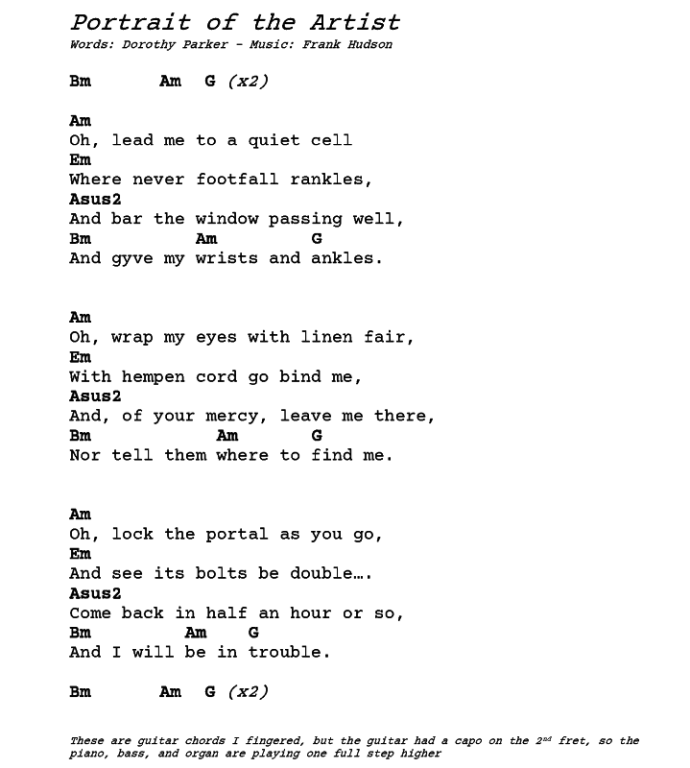
Portrait of the Artist

Here’s a chord sheet for the song I made of Parker’s poem

.

Also noted when dealing with this poem: the situation set out in the poem is extreme, and taken literally it’s a portrait of bondage, exile, or imprisonment. If parts of this survived as a Sappho fragment, I can see this being decoded erotically. Scholarship and kink cross-over more often these days – and the poem’s imagery is specifically sensual – but don’t put that in your scholarly paper until you do further research.

And here’s the last, most important thing I noticed: I’ve been living this poem recently. First off, a sidelight on the manner in which I found Parker’s poem: I have been going through books and disposing of most of them. My wife is distressed by the number of books and recordings I’ve accumulated over my life. Little difference most sit shelved at the edges of rooms, they are clutter,  and she believes that the space could be used otherwise. At this point in my life, I can see this issue another way: I’m of an age that there’s no world enough and time to imagine going back and rereading or reading the majority of them. Books that I once treasured as reference materials are likely obsoleted by the Internet. For example, I’m torn about keeping my thick hardbound French to English dictionary which was a companion when I started translating French poetry years ago. I’m keeping most of my books of poetry, and some on music, as I intend to keep doing this Project. Novels and general non-fiction? To be carried away.***  Is it clutter? Among my small segment of humanity, I’m not alone in being comforted by books and music surrounding me, and the irrationality of there being more than I can consume in whatever time I have left as an aged person doesn’t change this, but having accumulated an overwhelming amount submerges some books. Going through my books I was surprised to find a 1930’s printing of Parker’s collected poems. I don’t remember buying it, though I did spend time and a dollar or two in any used bookstore that had a hardbound poetry section during my youth.

Last week I read through the first segment of Parker’s book, work that is now in the public domain, and it’s there I found “Portrait of the Artist.”  I’ve mentioned recently that my opportunities to create new work here has become constrained. I’ll spare you the logistical details, but in the early years of this Project I had the five workdays of the workweek to research, compose, and record. The hundreds of pieces I produced in the first half of the Parlando Project’s run say I used that time productively – but if I was to be honest, I’d report that there were days I just blew off, knowing that the next day would be just as good to start or complete some Parlando work.

Now? I can’t tell for certain when I can record, I just know there will be fewer hours available. My energy level as I age is lower, and my old body no longer finds itself able to sit in an upright office chair for hours at a time. I do more of my research and reading on a tablet, which however marvelous, is a poorer environment for complex work with its constrained single smaller screen. I’m still able to play my instruments when I can use my studio space, though I need more time there practicing or simply blowing off the stress of life with a plugged-in electric guitar moving air around me. There are some mornings when my wife, being helpful, will tell me I’ll be able to work on recording for a few hours that day. I’ll think: I don’t have any new poem-texts selected, or the basis of a musical setting ready to be realized, and my energy is low. What can I do (anything?) with that time? And if I can’t do anything, when will the next chance come?

Whine. Whine. What else is the Internet for – complaint and its opposite, the carefully curated presentation of one’s perfectly actualized life to be envied. In Apollonian distance I can clearly see that to have the opportunity and the wonderous technology to do creative work, is a historical exception of the first order.

But then artists, many of whom are toward the introverted side, are often like the one in Parker’s poem: always swearing they wish they had the solitude and freedom from the distractions of life. And then the poet faces the blank page, the composer the silence in the room, their muse taunts them “What’ya got?” and the artist mumbles “That’s your job,” knowing that there’s really no one else in the room, just as they wanted.

There are lots of things in life that are temptations for self-pity or abuse. Sometimes the de profundis answer is “Ha ha.” That doesn’t mean it isn’t serious. The consequences for this troubled encounter with the chance to be creative, and perhaps to come up dry, have killed and crippled.

Simeon the Stylite 600

Simeon the Stylite has figured out how to get some work done without Robert Benchley, FPA, George S. Kaufman, Alexander Woollcott, et al.

.

All this feeds into the choices I made in the musical performance of Parker’s poem. I treated it no differently than I would have a “serious” literary poem by Parker’s contemporaries Elinor Wylie or Sara Teasdale, though I believe there are a couple of times I’m subtly winking as the singer seeks the situation of a desert-steeple mendicant. The fool is funny – still is when the situation is serious. This is often the lonely place of business for creativity: weighted on commercial and logical scales, it’s absurd that we do it – even, or especially, alone in that room with silences and tabla rasa.

You can hear this performance of Dorothy Parker’s “Portrait of the Artist”  with the audio player gadget below. What, is any such gadget gyved up somewhere? Well then, I provide this highlighted link that will open a new tab with its own audio player.

.

*We can prosecute mootings on more recent American authors too. I’ve recently written here on the difficulties in deciding how often Emily Dickinson means to make a humorous/satiric point in her poems vs. how often she’s an earnest transported romantic. A mixture? Likely, but what are the proportions? What are we missing if we miss the joke?

**Ah, the powers of overdubbing. I fixed that word-mistake ex-post-facto.

***I’m fond of the term “Death Cleaning” for this process. Time’s winged chariot is heading for Goodwill. While I’m blessed to be healthy for my age, I can no longer fool myself into thinking that someday I’ll get around to this, and that…and that, and that.