Let’s get one more Halloween appropriate piece in before the holiday.
We’ve featured a lot of words from Dave Moore this month, but not enough of his voice, so let’s get to that with a performance by Dave backed by the LYL Band. Dave’s a founding member of the LYL Band, singing and playing various keyboards with it. Beside his own band, Moore wrote lyrics for other bands back in the beginnings of the Twin Cities punk/new wave/indie rock scene. Around the same time, Dave worked with Kevin FitzPatrick on a well-loved literary magazine “The Lake Street Review.” Besides poetry and songs, Dave Moore has produced the comic “The Spirit of Phillips” for many years.
Besides Dave’s words, voice and keyboards that are often present here, you’ve also read me talking about Dave’s father, Les Moore (he of the Bauhaus name). That should be enough background from me.
Alan Moore didn’t share any birthday cake with Dave. “Isn’t the book enough?”
I found Moore’s “Did You Miss It” mysterious, in a good way, so let’s let him tell us how it came to be:
“I could have called this ‘3 Moores Stew,’ where the ‘philosophies’ of Dave, Alan and Les collided in my head around the issue of predestination. It’s also an attempt to celebrate first-and-only-take songs.
For my birthday last year (#67), I got (my hero) Alan Moore’s 1200-pg. novel Jerusalem. Wonderful, literally. Took a while to read such an intricate structure, and parts of it started to show up in my dreams.
Concurrently, I was editing my dad Les Moore’s sermons, typing over 50 transcripts. I’d class him as liberal Methodist, the admirable socially involved 60s Christian. I heard him speak every week till I went off to college & expected that many of his words would bang something up from my subconscious.
The lyric starts in Alan-psychogeography-zone, where one of his characters is choking to death for hundreds of pages as reality is explicated.
The joke of the chorus is also from Jerusalem, shared by Sir Thomas More with another shade. How could you miss the free will you didn’t have?
2nd verse (‘more hairy’) extrapolates Alan’s simultaneous beauty & death across time.
3rd verse (‘Belief’) is Les’s gift of Heavenly beauty despite death.
4th verse (‘Lights go on’) Dave points out you make your own beauty & might as well enjoy it. If it’s yours, you can get the joke.
Unlike most of my mistakes, those in the concluding instrumental are intentional. If everything’s pre-destined, who would bother pre-scripting this? Or could they?”
“Beef stew, I tell you there’s no beef stew…”
Dave points out the contrast we get from having LYL Band performances mixed with the more composed stuff here, where I play all the parts. “Did You Miss It” is one of those “first and only takes songs” that we’ve done, were the arrangement and parts are happening just as the recording light is lit. Trick or treat? Mostly treat here I think.
Yesterday, the songs I made from Dave Moore’s cycle of poems about Vampira had taken us up to her short run as the first “horror host” in the early days of television. As recounted in that post, by the time her little more than a year of broadcasting fame had wrapped up, the idea of a sardonic costumed character hosting late night showings of horror and SciFi films went nationwide, with dozens of local reflections of that concept. None of them were exactly like Vampira though, and oddly, all of them were male.
Vampira’s creator, Finish-American Maila Nurmi kept at a show business career following her TV host stint, including some Los Vegas work with Liberace, but as the 1950s started to conclude, she was getting farther and farther from the brass ring. Should there be any wonder that this would have been so? No, there were few models of self-defined female performers in the Fifties, and it was her character, Vampira, not herself, that held what fame remained. And that character, combining as it did fears of death with fears of female sexuality, both attracted and repelled where it was remembered.
It was in this context that Nurmi took a role in a micro-budgeted movie with an incoherent script and famously eccentric director: “Plan 9 From Outer Space.” When the movie was completed, if such a disaster could say to have completion, it hung around in obscurity even lower than Nurmi’s for more than a decade.
Like 80s video game packages, Plan 9’s poster has higher production values than the movie.
Vampira gestures, Tor Johnson arises from the grave, and Ed Wood’s chiropractor fakes it as Bela Lugosi
Nurmi pressed on with living, less and less known. There were a couple more bit parts, and her day gig sometimes was “handyman” work in the homes of the more affluent. Poet Kevin Fitzpatrick remarked after reading Dave Moore’s pieces on Nurmi’s resilience that she was showing “Sisu,” that untranslatable Finnish characteristic that says that determination will get you through any challenge.
And then something odd happened. The same generation of film scholars and fans that helped recognize the value in genre fare like pre-war horror movies, low-budget serials, or the foreign oddness of Japanese monster movies began to look around all the blind corners of obscure film. What made a film that met few of the criteria of good cinema still interesting? Could it be that watching a film fail to fulfill it’s duties had a fascination in itself? What would the worst possible movie be like?
In 1978 a couple of movie critics put together a book called “The Fifty Worst Films Of All Time.” Like many lists of superlatives, it generated plenty of response, but one response was to claim that they’d overlooked this now 20 year old film that was seen mostly on TV, late at night, when viewers just couldn’t believe the bad dream they were seeing. The authors, Michael and Harry Medved, figured there was another, better book about worser movies, and in 1980 they redid their lowerarchy with a follow up book that named “Plan 9 from Outer Space” the worst movie of all time, and it’s director, Ed Wood, the worst director of all time. And since then, nothing has challenged that assessment, it’s become the “Citizen Kane” of bad cinema, a movie seen by millions who are astounded by its, ah, quality.
Thus Vampira’s few minutes of (gratefully, given the script) silent footage in “Plan 9” communicated Nurmi’s visual concept to a new generation looking to stand back from their times. The Misfits recorded a tribute song around this time, and now this year, The Haxans illuminate that song with an excellent cover. But of course, you want to hear how Dave Moore and I conveyed this part of Maila Nurmi’s story in the song-cycle. In case you’re in a hurry to get to your Halloween party, here are the three preceding songs from the Vampira song-cycle, along with the LYL Band telling the story of how Vampira would have been forgotten “If Not For Ed.”
Maila Nurmi arrives in L.A., and as she considers what persona to take on she considers celebrity evangelist Amiee Semple.
Why might someone like Nurmi choose a gothic character
in the midst of the supposedly peaceful and satisfied Fifties?
Maila Nurmi performs on TV as the first “Horror Host.”
The last part of the tale, how “Plan 9” allowed Vampira to be seen by a new generation.
Once more we visit a song from the Dave Moore-written song-cycle looking at the innovative goth/horror persona created by Maila Nurmi in 1953-54. Today’s piece “Hollywood TV” continues Nurmi’s story as commerce finds a place for her Vampira character as it seeks to fill out the expanding television time slots.
In the 50s, the moving picture industry faced an existential crisis of its own: television was going to deliver its kind of entertainment right to people’s homes, no need to go to the theater, no need to pay admission, make your own popcorn, Philco Playhouse and chill.
One way the old entertainment empire sought to use the new TV medium was to sell rights to rebroadcast movies that had completed—sometimes, long-ago completed–their theatrical runs. One studio, Universal Pictures, wanted to monetize their classic horror pictures it had released back in the ‘20s, ‘30s, and ‘40s and so put together a package of these films for TV stations to buy and rebroadcast in 1956.
It’s hard to believe now, in an era when SciFi, Horror, and Fantasy are the dominant commercial film genres, that in the mid-50s these films were considered shoddy goods. They reflected back to 19th Century characters and tropes, even when they were made before WWII, and so they were not thought to be the stuff that a forward-looking post-war world was looking for.
But wait, we’re in 1953-54. Even this is still in the future.
Nurmi had created the Vampira costume for a Hollywood Halloween costume party in 1953, and the story goes this novel combination of sex and death was noticed there by an entertainment figure, through which she was eventually connected with a TV station looking to broadcast old movies. The TV execs thought such old-fashioned low-value fare needed something else to make it viable, a host to contextualize the old movies to be shown at night when such niche material could fill otherwise uncommercial air time.
So, in 1954, two years before the Universal “Shock Theater” package was offered, Vampira began hosting a show made up of old movies whose rights could be obtained on the cheap, with her character leavening the proceedings with quips and intentional perversity. This is an old show-business tactic, as even in vaudeville theater, a master of ceremonies might be called on to hype or explain the acts, or to fill time when a performer had dragged down the audience’s interest. And intentional perversity was decades old too, what with the Dada cabaret of the WWI years.
Even if this is recent history, in the lifetime of people still living, it’s hard to know how big the Vampira character’s impact was in her time. Her late-night show lasted about a year ending in 1955. A follow-up show with the character on another local station didn’t stick. During the years 1954-56, there was a substantial publicity push, a local Emmy nomination, a Life magazine profile, guest appearances in the Vampira persona on other TV shows; but there was the short run of the show, and a general tailing off of Nurmi’s celebrity and performance career afterward. How big were the waves in that ripple?
If we can’t see how big the first ripples are, we can see the waves that built off it, as they are substantial, and still rolling.
In 1956 came that Universal Pictures “Shock Theater” package, eventually followed by “Creature Features” and others. Over the next decade, most major local TV markets gained a horror/SciFi host. The pattern was unmistakable. Costume. Macabre humor. Campy name. Maybe a little dry-ice fog, screeches and screams, and a haunted house décor. All parts of the Vampira scheme. What wasn’t copied? The Thanatos remained, however distanced by humor, but the Eros was toned way, way down, and the follow-on horror hosts were invariably male.
It’s a boys club. Some of the horror hosts for “Shock Theater” around the USA
In pop music, the erotic and self-possessed element of Vampira saw a revival by the late ‘70s with Poison Ivy and the Cramps, and in the UK, bands like Siouxsie and the Banshees. Eventually a goth subculture and “look” developed often borrowing from first or second level influences of the Vampira character with various continental European influences.
Poison Ivy of the Cramps substituted midriff & pychobilly riffs for Vampira’s décolletage and goth ennui
It took a generation from the ‘50s before the female TV horror host was revived in 1981, back again in Los Angeles, with a character, Elvira, largely based on an updated Vampira. Nurmi had helped with the creation of the show, but had a falling out with the producers.
By the end of the 20th Century, the Vampira character was still being kept alive by a wordless cameo in a widely viewed “Worst Movie of All Time” “Plan 9 from Outer Space.” Irony wasn’t just a pose for the character, it was the way the character survived.
More irony: the mostly male ‘50s children who watched Vampira, Shock Theater, Creature Feature, and the other black and white movies rerun on TV at night past their bedtimes, had grown up and became the new Hollywood elite, making tens, and then hundreds of millions for a revived Hollywood, revising the tropes of the shoddy goods whose TV rights had been sold on the cheap.
If you take pre-Comics Code EC Comics attitude, the TV horror hosts, their old movies and modern descendants, add some bite-sized marketing from the candy merchants, and there you have modern American Halloween. If you walk by the rack of tacky vinyl and polyester costumes at the store, past the Star Wars characters in kid’s sizes, over to the adult-sized costumes, and there you see a “Sexy Vampire” hanging, black and low-cut, long, dark-haired wig included. A colored sheet suggests it worn by a thin young woman with red lipstick, white makeup and weaponized eyebrows. Think, then, of Maila Nurmi for Dave and me, won’t you.
Oh, there’s a song. Dave Moore wrote the words, I wrote the music and performed it. You can hear “Hollywood TV” using the player below. Click it. If You Dare!
Continuing our change of pace, temporarily stepping away from our usual spoken word and music combination, I’m going to dress-up once more for Halloween as a singer, which I fear is not a totally convincing costume. Today’s piece “Prevailing Winds” is the second cut from the song-cycle about ‘50s goth/horror innovator Vampira. Dave Moore, whose voice and words you may have heard here before, wrote the words for this piece, and I wrote the music and performed it. The first part, “Helen Heaven” was posted here Monday.
As I mentioned yesterday, the 1950s has, somewhat in retrospect, gained a reputation as a peaceful, relaxed, and satisfied time in the United States. When a political figure such as our current Presidential performer refers to “make America great again” it’s generally assumed that his clientele understands this as “like the 1950s” in hat-band shorthand.
But, as experienced, America in the 1950s was not so peaceful. The decade began with the Korean war, now commonly forgotten, but deadlier proportionately than the Vietnam war. Somewhat more so than the Vietnam war, and more like our current war on terror, the Korean War was viewed as only a small part of an open-ended global struggle against an evil multi-national enemy. And as the decade went on, there existed a widespread and increasing fear that the atomic weapons first unleashed just prior to the decade, and held in a rough but uncertain balance by the central powers of the enemies, would return again, but in multi-fold form threatening worldwide destruction, threatening human survival.
On either side of Los Angeles, where Maila Nurmi was formulating her Vampira persona, these human-survival threatening weapons were being tested in deserts and on Pacific islands, right in the open air. Radioactive isotopes were measured in milk as Nurmi fashioned the dropping white décolletage of her costume.
“I give epitaphs, not autographs” Maila Nurmi created the Vampira persona in 1953/54
As someone old enough to remember those times, I’m often puzzled at the ebb and flow of nuclear worry in American minds. There have been times when it almost disappears, and times when it is so omnipresent that the topic is nearly as unavoidable in social and party conversation as the weather or sports teams. As this is being written, Korea and nuclear worries are on an upswing, and I have no way of knowing if this level is proportionate to the threat or not—but I do believe it’s still less amplified now than it was in 1953-1954 when the Vampira persona was being created.
The human condition is mortality, this does not change. Poets have spoken of this since before the time they could write their songs down. But the human condition in that time, the 1950s, was the first to consider humanity itself as mortal.
To hear the Dave Moore/Frank Hudson song “Prevailing Winds” from the song-cycle “Vampira”, use the player below.
Let’s leave off those modernists of the era around WWI for a while, and move to a few songs about some midcentury mods. This is the time when popular culture mutated into something recognizable as ours, as it still is into this 21st Century.
Somewhere in this second decade of the 21st Century a new modernism is likely being born, but I do not know it yet. Back in the early 1950s people expected something new, perhaps as much or more than we expect change today in 2017. As it turns out, we may have not gotten all the change we thought we were due.
Today’s piece is the opening song in a song-cycle about one woman who had a moment in this moment of change in the early 1950s in Los Angeles/Hollywood. The woman was a second-generation Finnish-American, Malia Nurmi, who created a character that for a short time, just about a year, captivated TV audiences in Southern California with a strange take on sexuality and various horror tropes, blending in a beatnik/Dada critique of “normal” as a reaction to the unthinkable. The character was named “Vampira.”
Somewhere in the later 1960s it became a commonplace to view the 1950s as an era of calm, peace, satisfaction and complacency, and this characterization has only increased over time. But this was also the era just after a cataclysmic war ended with atom bombs, a horror that eventually moved from reality, to nightmares, to repressed acceptance, to forgetfulness and finally now again to present fears. This was the decade of a forgotten, brutal, war in Korea. This was an era when society tried to put back into the bottle the broadening social roles for women and Afro-Americans that WWII had allowed. This was the time that revealed the horrible efficiency of the extermination and slave labor camps, and the decade in which the utopian dream of Communism exposed its shames and shams. This was a deeply uneasy time when some feared everything “normal” was a dream and others saw clearly the waking hours outside the dream.
All of which makes this campy TV quipster host who created the makeup, costume and persona of Vampira seem inadequate to address this. Well, what is? As we move to celebrate Halloween, that strangest of holidays, where we make fun of our inability to escape fear, death, and too much candy, let’s reconsider her.
Media in black and white: Aimee Semple used religion, Maila Nurmi used Vampira
“Helen Heaven” has words written by Dave Moore, the alternate voice and writer/musician here at the Parlando Project, along with music written and performed by myself. This piece is the first song in the Vampira song-cycle, contrasting the LA-based white-dressed pop-religious phenomenon Aimee Semple McPherson with Nurmi/Vampira’s dark negative.
To hear “Helen Heaven” use the player you should see just below this.
It’s been too long since we featured one of the looser live performances of the LYL Band here at the Parlando Project, and with the interval, it’s also been too long since alternate voice Dave Moore has been featured. Given that we’re running up to Halloween, and that Dave has a long-standing interest in fantasy and scifi, it’s time to redress that.
Today’s piece is Dave’s adaptation of a short story by Anglo-Irish writer Lord Dunsay from Dunsay’s fantasy collection “The Book of Wonder”. The story is called “The Return of the Exiles.”
Yes, it’s Avebury, not Stonehenge. Poetic license applied for.
Lord Dunsay is one of those writers who had a long successful career during the first half of the 20th Century, but who now gets mentioned more as an inspiration than read as a writer. His Wikipedia entry has one of the longest lists of writers who’ve acknowledged him as an influence that I’ve run across. Everyone from Tolkien to Gaiman has tipped their hat to Dunsay.
Dunsay served in both World Wars and the Boer War.
Besides writing, Dunsay appears to have served in three wars. One hopes that future soldier-writers will be able to avoid reaching that achievement.
Dave adapted the short story to make it more musical, but his telling is generally faithful to the original. One detail retained, that I personally liked, is that our narrator is on a bicycle journey as the story begins.
To hear “The Return of the Exiles” use the player that should appear below.
It’s time to report the most popular audio pieces posted here over this increasingly busy summer. Before I get to this season’s Top 10 countdown, I want to thank everyone who has listened, followed, liked, or shared our posts and audio pieces on social media or on other blogs. I don’t have time (or perhaps the talents) to do all the promotion that some other blogs do, so it’s the kind words and enthusiastic work that you readers/listeners do that has spread the news about this combination of various words with various music.
Lots of changes from our last Top 10, so let’s get started. There should be a player gadget after each piece on the list, so you can easily hear the audio combining those words with music we create and perform as part of the Parlando Project.
10th place? Turns out it’s a three-way tie for 10, and since the three pieces demonstrate the variety I seek to present here, let’s just dispense with tie-breakers and list all three audio pieces that are tied at number 10..
“Sonnet 18” is, so far, our only Shakespeare selection. Shakespeare is, or course, inescapable, and setting Shakespeare’s sonnets to music isn’t a rare thing either, but one of the good things that comes from the Shakespeare phenomenon is that a listener can hear a lot of different takes on one text. I choose to bring out the brag in this one.
“A Summer’s Night” uses a poem by Paul Laurence Dunbar, the first widely published Afro-American poet who died tragically young in 1906. A lot of Dunbar’s success during his lifetime was with dialect pieces which he had ambiguous feelings about. He sometimes said that he wished to be known more for his poetic work in standard English, something that “A Summer’s Night” demonstrates.
“On the Troop Ship To Gallipoli” demonstrates a small bit of artistic courage on my part to pay tribute to the real-world courage of Rupert Brooke, who died in service to his country in WWI. The “Great War” redrew the world’s maps, overturned several empires, and it also drew a literary dividing line, as post-war poetry embraced Modernism which made the poetic stylings of Brooke seem decades old only a few years after he wrote them. Those who lived through that time often adapted to the new ideas of modern poetry, but Brooke never had that chance. So, in this piece I recast a late fragment of Brooke’s words as if it was an Imagist poem.
In 9th place, we have “Zalka Peetruza (who was christened Lucy Jane),” which uses a poem by journalist and poet Roy Dandridge, who coincidently like Dunbar, was another Ohio Afro-American. By evidence of this poem, Dandridge deserves to be better known than he is, as it’s a tart observation of the art of getting over while Black, in this case by passing one’s self off as exotic.
8th place goes to a bit of a surprise, my slightly Beefheartian musical setting of two sections of Gertrude Stein’s “Tender Buttons.” Don VanVliet (Capt. Beefheart) and Gertrude Stein were both uncompromising artists who hoed their own rows, so I viscerally made the connection in creating this piece.
7th is Sir Walter Raleigh’s damning litany “The Lie.” It’s a poem I’ve loved since my youth and I don’t think one has to add much musical vengeance to amplify Raleigh’s words. 400 years old, and still pissed off.
6th slot goes to one of my translations, Rainer Maria Rilke’s “The Dark Interval.” I did this translation a few years ago, and it was intended to be a somewhat freer variation. As I learn more, I think my assumptions on what the poem was getting at were wrong, but this looser version got 20 more listens that it’s more literal translation I also presented here this summer.
Halfway to number 1, at number 5, is Parlando Project alternative reader Dave Moore’s tale “I Was Not Yet Awake.” Dave also plays many of the keyboard parts you hear here, including the organ part on this. “I Was Not Yet Awake” is short for a story, but longer than many pieces we present here. Dave’s story is so well told that it still managed to pick up a lot of listens this summer.
At number 4, dropping down from two straight appearance as number 1, is “Frances,” a teenaged George Washington’s acrostic love poem. That’s still a marvel, as week after week I look at stats and see that it’s still getting listens, long after its appearance here last February.
Top 3 time! In position 3 is “The Death of Apollinaire,” my translation of Dada principal Tristian Tzara’s surprisingly sincere eulogy for the multi-national poet and critic Guillaume Apollinaire, who invented the term “Surrealism” and helped weave together many of the strands of European Modernism before he died from complications of wounds he suffered in WWI.
And in position #2, up one place from 3rd in the last Top 10, is Dave Moore enigmatic song “Love and Money.” It may offer an American answer to the question the Beatles once asked in “Can’t Buy Me Love.”
“The steam hissed. Someone cleared his throat. No one left and no one came…”
Position number 1 is another return, and an even higher rise in the chart due to the large number of listens over this summer: “Adlestrop,” British poet Edward Thomas’ famous moment on train platform on a hot June 24th 1914, were nothing much happens, but everything palpably is.
It’s a much-loved poem for many reasons. Some find extra resonance in the lines describing calmness in the tiny village train stop, the literal calm before the storm of WWI, and that’s a fine thought for those that hold it, but I believe the poem exists beyond those associations. “Adelstop’s” closing lines are sublime even without that particular war, that particular trauma to that specific nation, and as it was, to the ending of the life of its author Thomas, who became another of the poets killed in that war.
Here’s a piece with a short story written and read by Dave Moore.
Just as I have my bicycle ride poems, Dave has his morning dog walk poems and stories, and this one is one of my favorites. Dave tells me that he thinks he may have messed up the ending in this performance of “I Was Not Yet Awake ,” but I think it works just fine.
I’ll let the story unfold as you listen to it without a lot of commentary from me this time. “I Was Not Yet Awake” is a story about neighborhoods, neighbors, and trust, distrust and need.
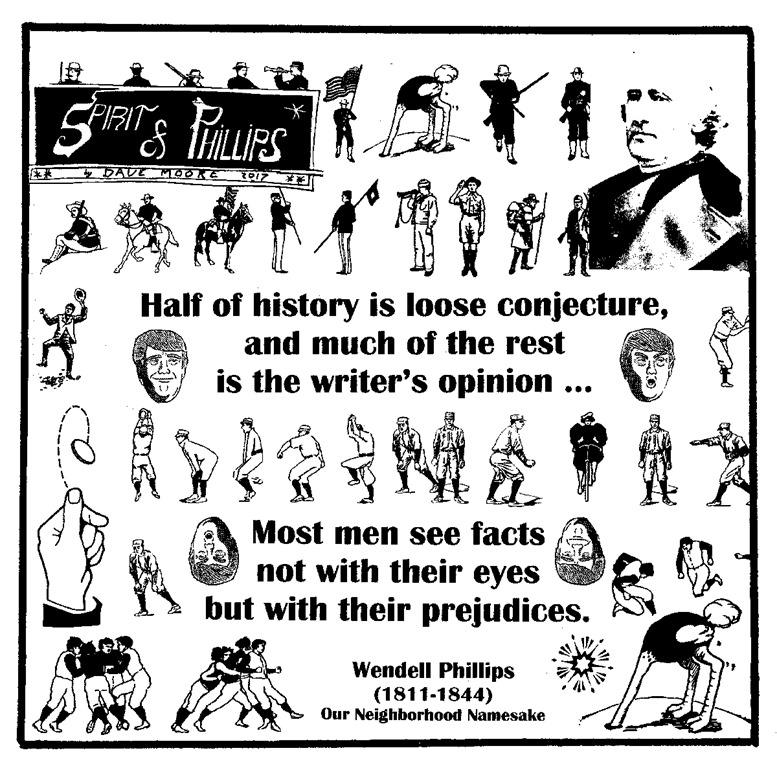
Dave Moore is also a cartoonist. His “Spirit of Phillips” reinvigorates the work of radical Abolitionist Wendell Phillips.
Dave is the alternative reader with the Parlando Project, and he also plays most of the keyboard parts you hear here on other pieces featuring the LYL Band. This story is much different from the last piece, where I tried to mash up Capt. Beefheart and Gertrude Stein, and it will also be different from the next episode. That variety in music and words is part of what we do. So go ahead and listen using the player you will find below.
Our audience growth in the past year has been largely as result of readers and listeners like you who have spread these audio pieces by sharing on social media or through their own blogs. Thanks to everyone who’s helped!
A couple of days back the Parlando Project passed its first birthday. It’s eating solid foods now, and is making efforts to walk. I thought it might be a good time for some posts to catch up a few things.
First off, some of you may be new to the Parlando Project and its presence here on this blog. What is the Parlando Project? We combine music (various kinds) with words (various kinds, but mostly poetry). I’m the Frank Hudson in this blog’s domain, and I’m the “editor” of this Project, but Dave Moore (whose voice you’ll be hearing again soon) is the alternative reader and vocalist here, and the project wouldn’t be the same without him.
I ask you to note the “various” used twice above. I’m one of those rare people, who when asked what their favorite type of music is, cannot answer. Yes, I have moods when I don’t want to hear one kind of musical expression, or when I strongly desire to hear or make another kind, but overall, I can’t say there is one type of music I want to be gone from forever, or another that I will never listen to or try to make.
So please do not take any single example of our music as representative of what you’ll hear next. I like noisy and chaotic music and sweet consonant sounds, I like solo acoustic guitar, I like modern day composers who refuse to die, I like artificial sounds created electronically, I like the natural sounds of strings vibrating in air, I like things simple and I like things complex.
The same somewhat applies to the words we use. I have a certain framework that we use at the Parlando Project. We favor shorter pieces for example. We both like a darkly comic touch. We generally don’t use our own words, even though Dave and I have written our own words since our youth, and we’ll use some of them here.
Rather than add another “I” speaking to the mesh of the Internet, I want to jointly experience with you some understanding of what others have written and spoken.
Why is that? The Internet is full of self-expression. I don’t want to put that down, but I feel the various mediums the Internet carries to your phone, tablet or computer are awash in it. Even our literature has become primarily memoir in one guise or another. Well, I consume some of that, you probably do to, but I’m currently not in the mood to create more of it. Rather than add another “I” speaking to the mesh of the Internet, I want to jointly experience with you some understanding of what others have written and spoken. That’s what I seek to do by performing the Parlando Project pieces, and writing about them here.
A poet who Dave and I have known for decades, Kevin FitzPatrick, was once reviewed as writing “poems that have other people in them.” Kevin’s other people are real characters, they have their own lives and wholeness, they are not hand puppets speaking only the words he mouths for them. They, like Kevin, are sometimes funny and sometimes subject to their own misconceptions and foibles.
This is one of Kevin’s four published collections of poetry
Stop and think for a moment now of how few poets do what Kevin does. Perhaps, if you write poetry, you too, fall into that larger grouping, writing from your innermost feelings, allowing other voices to speak only as you would have them. At the Parlando Project I use the idea, the rule, “Other People’s Voices” to remind me of this principle. I join with you, the listener and reader here, in trying to understand those other voices, by merging our performance of their words with the music we create as an audience to them.
It’s now a commonplace to note how divided the United States is politically. The way the story is told, there are now two tribes, each sure the other side is largely wrong. We are said to know this, even if we are less than sure about everything “our side” may say, even if we are skeptical, even critical, of some in our faction. You may not believe that this is true about you, but this is what is widely said, and you may say something like this about others, even if you do not believe it about yourself.
I’m about to simplify a story, condensing its humanity so that you will only see moments in several people’s lives. That means you are going to need to pay attention, because the things it may lead you think about are only going to be there for moment.
On a summer day, 177 years ago, a sheriff bearing a writ from a judge knocked on the door of a house on the banks of Lake Harriet, which was then on the outskirts of Minneapolis Minnesota. If you live in Minneapolis, perhaps you know this lake. It just so happens that I’ve spent many mornings this summer reading poetry beside it, as panting joggers and conversing walkers surround it like clockwork.
The judge’s writ commanded the appearance in court of a piece of evidence. As he knocked, that piece of evidence was being told by the people inside to run out the back door and hide. The evidence did not obey. The evidence’s name was Eliza Winston, a 30-year-old woman held as property by the family inside. By her home state of Mississippi’s laws, her mother would have been property too, and her children, if she would have any, would be property as well, the same as livestock on a farm.
How did she happen to be in Minnesota? The man that owned her had traveled up the Mississippi river with his family to escape the heat of the South’s summer, taking a steamboat as far north as the great river was navigable. For his and his family’s comfort, he had taken one of his slaves, Eliza Winston, with him. The laws of the state he traveled to explicitly forbade slavery, but three years earlier the national Supreme Court had ruled that a slave named Dred Scott remained property when he had been brought to Minnesota.
Living in Minnesota then were people allied with a faction that sought to end the practice of slavery. They were looking for people claimed as property to contest those claims. How did they view the slave owners? Of course, as evil you may think. Wouldn’t anybody? Somehow, Eliza Winston had made contact with these slavery opponents. One of them, William Babbitt, would swear out a complaint that her slavery on Minnesota soil violated Minnesota law.
Imagine if you could own something as useful as another human being as property, to have complete control over them. Wouldn’t that be useful; and as a business venture, potentially profitable? The faction that owned other people certainly felt that way. How did they view that other faction, the ones who sought to end that practice? They viewed them as wrong certainly, but they also saw them as annoying self-righteous busybodies that needed to be taught a lesson, a view that was sometimes shared even by those that weren’t sure that slavery was a good and necessary thing.
Since Eliza did not hide, she was taken to directly to a courtroom. Despite the rapidity of the actions, the courtroom was packed with those from both factions. Eliza’s owner was there with his lawyer, who pointed out Dred Scott. The lawyer for Babbitt had testimony from Eliza Winston that she was indeed a slave, that she’d been passed around like property between several owners, and the lawyer stipulated that Minnesota’s constitution clearly forbade slavery in the state.
The judge ruled, that based on Minnesota law, Eliza Winston was now free. As soon as he pronounced, a clergyman in the crowd jumped up and condemned the decision as “unrighteous,” pointing out that, regardless of the state or federal law, Christianity and its scriptures approved of slavery. I don’t know more of what he said, but he could have claimed that Babbitt and his faction were worse than thieves and rustlers, in that they not only stole, they were self-satisfied in their actions. The crowd stirred at this, and then there was moment of calm in the summer courtroom. Eliza Winston’s owner walked over to the woman that he had owned like a horse or a cow, and he calmly asked her if she wanted to come back with him and return to Mississippi. And Eliza, no longer property, answered that she wished to be free and remain in Minnesota. As Eliza Winston left the courtroom, the Minnesota clergyman was still orating on the wrong that had been done to the slave-owner.
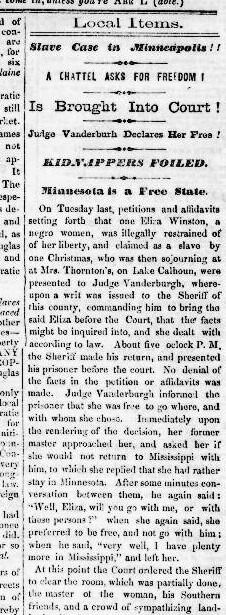
“A chattel asks for freedom”
That night, those angry at the decision went out around the town looking for Eliza Winston. What would they have done if they had found her? One can only guess. They surrounded Babbitt’s house and battered down the door seeking Winston or Babbitt, and crying for blood. They similarly broke into another house seeking Winston. Winston, however had been moved somewhere else, and may have fled as far as Canada. A year later the Civil War broke out, and Winston, no longer property, became as if a ghost. There are no pictures of her, no tales of great or even small things that she may have done. Some even say she went back to the south after the war. In Minneapolis there is an inconspicuous historical marker about her case, placed along the Mississippi river that brought her here, and not much else.
An inconspicuous historical plaque about Winston in Minneapolis
William Green has the most complete telling of the story I’ve seen. For a PDF click here.
Then last year Dave Moore was told a version of Eliza Winston’s story by a friend. The friend, or perhaps Dave, got a couple of the details wrong, and I have left a lot of details out of the story as well—that may not matter. Dave was struck, mixing Eliza’s story and the tale of his friend choosing to tell him this story together, and then forming this lovely, vulnerable song.
Here’s what I ask you, now that you’ve heard my telling of Eliza Winston’s story. If you ever find yourself in a world of factions, and you find yourself in one of those factions, perhaps not sure of what you think, but sure that the other side is clearly more wrong. Ask yourself what Eliza’s story, and the story of slavery tells you.
To hear Dave sing his Eliza Winston song with the LYL Band, use the player below:




 Frank Hudson