The Book of Lu T’ang Chu

Why bother with little-known poets of the early Modernist age? Well, it’s conceivable that we can better understand the context the better-known poets were operating in by looking at the field the greats stood out from. And frankly, I get a kick out of looking at the left-behinds and odd corners. Like a crate-picker at a used record store, I’m looking for those weird finds that you can’t quite believe exist or that reflect some transitory moment in the culture.

I’ve already mentioned Arthur Davison Ficke in an earlier post as one of the Davenport Group, a bunch of Iowans, who with their rural Illinois cross-river neighbors, made a bit of a splash in American culture in the first part of the 20th Century. Ficke is not as obscure a character as Muriel Strode from our last post, but the separating distances of fame and achievement shrink as time moves on, so you’re not going to run into either of them in any survey course or even specialist literary class in school.

Unlike Strode, I could find out about Ficke’s family background. He grew up in one of Davenport’s richest and most cultured families. His father was a prominent lawyer and had amassed a considerable oriental art collection. After education in Davenport, Ficke was sent to Harvard where he was a classmate of Franklin Roosevelt. After graduation he was granted one of those traditions of the well off, an overseas tour which included travel to Japan.

Throughout his school years, Ficke was drawn to the arts, and yet family expectation dictated that he was to practice law. A career as an art critic and poet therefore progressed alongside lawyering. During WWI, and while serving as a military Judge Advocate, he met Edna St. Vincent Millay and eventually a post-war love affair blossomed. You may see some similarity to Millay in today’s Ficke-written piece, a rhymed, metrical sonnet, a form Millay also worked in.
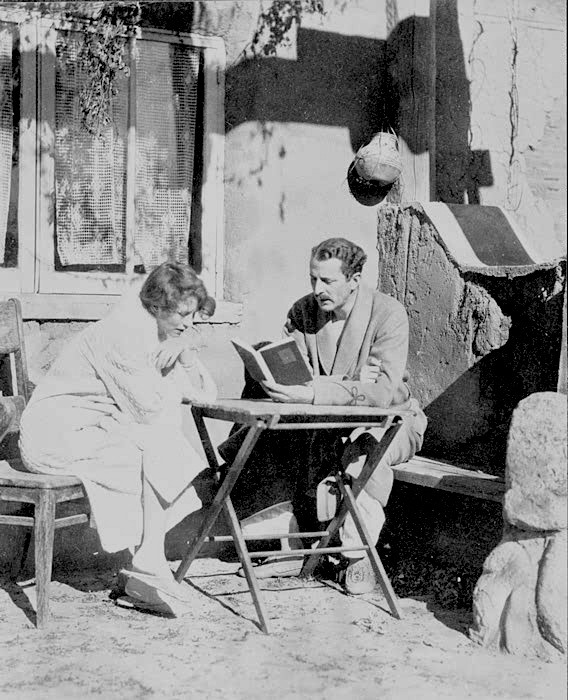
Arthur Davidson Ficke and Edna St Vincent Millay

Arthur Davison Ficke with Edna St. Vincent Millay.


Like Millay, Ficke mixed with the Modernists socially while not consistently writing in the new Modernist style. This ambiguity of Ficke’s toward Modernism played out in an event we’ll cover in a future post.

I don’t find Ficke’s poetry as musical as Millay’s, but his“The Book of Lu T’ang Chu”  still has its charms. The poem combines Ficke’s interest in the Orient with a subtle observation about art in the modern age. This poem’s ancient Chinese emperor and Ficke himself are now both dust in the wind, as we all will be—but we can still listen to his meditation, set to my new music and performed on acoustic guitar, piano, and an attempt at playing (via a MIDI controlled “virtual instrument”) the Chinese traditional zither that came to the fore during the Tang dynasty, the guzheng. Use the gadget below to hear this.

Morituri Salutamus

I suspect no poet in the past couple of centuries has suffered a greater decline in esteem as Henry Wadsworth Longfellow. This is not due to some scandal in his biography, for as far as I can tell he lived an admirable life, but artistically he’s been indicted for a number of crimes and misdemeanors. Before I go over those, let me briefly summarize the heights from which Longfellow has fallen.

He was the first self-sustaining professional American poet, the first to reach a considerable level of national and international success. By the middle of the 19th Century he was roughly as famous as Tennyson and Dickens, known and generally admired by his contemporary poets, and avidly read by a broad non-academic readership. He sustained this fame for several decades and further, past his death in 1882. His general readership survived into my grandfather’s generation, and then through my father’s, and to a degree, into mine. Somewhere in the middle of the 20th Century, this engine of fame and readership broke down, and by now they’ve torn up the tracks of the Longfellow Line, and ragged grass grows over the railbed.

I grew up reading Longfellow as the next generations might read Dr. Suess or Sandra Boyton in childhood. As I reached the age of ridicule, I could revel in Bullwinkle the moose in his parody poetry corner reciting Longfellow poems that I knew. Now Longfellow is probably not well enough known to satirize.

So, what are Longfellow’s poetic crimes? Meter and rhyme and a certain amount of antique diction—though we are able to somewhat forgive the English romantics of the generation before Longfellow those afflictions. Earnestness and popularity, two things that no ironic 20th Century Modernist would wish to be accused of—but Robert Frost survived the later, while being seen (mistakenly) as expressing the former. Longfellow’s contemporary, Walt Whitman, explicitly sought to commit the earnestness and popularity crimes—though, as the old dis goes, for many years, Whitman couldn’t get arrested for it.

Whitman-Longfellow

The good gray poet Whitman, and his doppelganger the forgotten famous writer Longfellow.

But Longfellow’s capital offense, the crime his reputation has been executed for, is simplicity and conventionality of thought. If I had to be Longfellow’s defense lawyer on this charge, perhaps I’d be reduced to throwing his case on the mercy of the court. Longfellow’s writing is often expressly didactic, and impersonal sentimental themes abound. Over and over again, he counsels perseverance and its seeming opposite, acceptance of impermanence. A more metaphysical poet would show his work and do more with incident to earn his conclusions. A more modern poet would make sure to make his life’s painful particulars his main subject.

Ironically, Longfellow’s life story is full of such material. Today we often think of poetry and art as an extension of memoir, and that writers earn their license to express things from their life stories. Longfellow would have had that license.

Some forms of Modernism believe that the best way to deal with complex emotion or great pain is to put it in the silences, in the blank spaces. These Modernists believed this would be more effective, because they are signaling with this constrained and minimalist expression that the thoughtful audience needs to seek for what is not said.

20th Century Modernists decorated their foreground with images, not antique forms of literary expression, and the complex message is encrypted in those images as if by steganography. Could Longfellow be doing something similar in the blank spaces between the lines of his hypnotic verse?

Today’s piece uses words from a late Longfellow poem “Morituri Salutamus,”  a Latin title taken from the famous gladiator phrase “Those who are about to die salute you.” The bulk of this poem, written for the occasion of his 50th college class reunion when Longfellow was 68, is taken up with matter that might appear in a commencement speech or the granting of an honorary diploma. Its purported mode is lightly elegiac, advice to the young is given; but as it proceeds, Longfellow transitions to a not over-worn thought. He prepares for the poem’s final stanza by cataloging some swan-songsters of literary history: Simonides, Chaucer, Sophocles. For compression, and for my preference for briefer work, this last stanza is what I used for today’s piece.

In that final stanza, with supple verse, Longfellow concisely implores his aging generation (and himself) to continue to labor to create, to create better. That’s not a complex thought. Does it need to be? Is it easier or tougher to do because it’s a simple thought?

To hear my performance of the conclusion to Longfellow’s “Morituri Salutamus,”  use the player below. Some of you will not see the player, but then this highlighted hyperlink can be used instead to play it.

We Grow Accustomed to the Dark

It’s hard to escape the pull of Emily Dickinson here in the Parlando Project, and I keep finding that her poems ask for that unheard music in them to be made audible. So much is remarkable about Dickinson. She’s so original in poetic expression, and yet she’s kept a substantial audience of readers from the time of her first posthumously published collection in the late 19th Century.

Here’s yet another striking fact about her: she wrote over a thousand poems, the majority of her poetic work, roughly around the time of the American Civil War, in a burst of creativity less than a decade long. Can one even imagine what that might have been like? For this means that, on average, over twice a week a new Emily Dickinson poem, a new and unprecedented type of poetry, emerged from her pen.

Emily Dickinson's desk

Where she created a new way to write American poetry over a thousand times


She shared them somewhat, some of them anyway, with family and friends. She informally bound many of them into little booklets. But did she know what she was accomplishing? What faith drove her creativity?

Today’s words are drawn from a Dickinson poem she wrote halfway into that burst. Unlike some Dickinson poems, the “plot” of the poem is easy enough to follow, and it concludes with a moral, like a conventional poem of moral uplift might. However, like a lot of good art, the experience and meaning of it changes as you bring your own time and times to it.

“We Grow Accustomed to the Dark”  starts off in that pre-electric outdoors that we last talked about with Frost’s Stopping by a Wood on a Snowy Evening.”  On a new moon or overcast night, that old dark is darker than any we routinely experience in modern urban America. Yet, then or now, eyes indeed adjust, and make better use of what weak light may be present. Dickinson next changes the scene and speaks of “Evenings of the Brain” where even moon and starlight are extinguished. Other than Dickinson’s near, but not quite, “slant rhymes,” this is a conventional poem up to this point. But wait there’s a small warning that she’s not going to develop this conventionally. Those evenings inside the brain are a larger thing than the whole of the outdoor night.

Her next metaphor is not Victorian sentiment, but outright slapstick farce. Moving forward in the dark earnestly, the nobly brave—smack!  Faceplant themselves into a tree trunk.

This brings ambiguity to her concluding moral. Is becoming accustomed to the dark a good thing? We think we’ve adjusted. We think we’ve steeled ourselves to “Brave”—or maybe we’ve just added that outer darkness to our brain, and we agree to pretend it’s normal. “Life steps almost straight” she concludes. Somehow, at least this week, as I watch our dark world, I don’t think Dickinson intends this as a consolation.

For today’s music I tried to underscore that from the first note. I wrote this orchestral piece based around an F minor to D progression that should leave the listener unsettled from the start. I chose to experiment with this cadence after reading Alex Ross’ short piece about pioneering Afro-American composer Florence Price earlier this month. If you’re new to the Parlando Project, let me remind you that our goal is to present the words with music as varied as I can make it. If you like one kind of music that works one way, we may puzzle you with what we do in any single piece. If so, try another. We are fast approaching 200 audio pieces in our archives, so take a listen around a few of them.

To hear my performance of Dickinson’s “We Grow Accustomed to the Dark”,  use the player below. Please remember that this Project continues because listeners and readers pass the word around about it.  Mentioning us, tweeting about us, linking to us, telling a friend about us, helps grow the audience and encourages our efforts.