Free to Fall

Allow me to be more internal than I usually am when presenting these pieces. Today’s piece uses my own words (we do that rarely here) and it’s here today for a peculiar reason — and peculiar is something I enjoy indulging in.

Early this autumn I was looking for a musical piece that represented the season, and I recalled this poem of mine that I had written music for. When? I probably wrote the poem early this century, and from a file I found, I was able to determine I wrote the music in 2007. Sometime after writing the music, I recorded what I recall was a pretty good version of it, likely with Dave Moore playing keys.

“Maybe I made this one of the early Parlando Project pieces” I thought. At the beginning of this Project as I was figuring out how to compose and record our combinations of original music with literary poetry, I had used several recordings of that vintage. Having some already completed pieces gave me time to get a handle on other tasks while getting this thing going.

But, what, I didn’t know? Well, I’ve put up over 700 publicly accessible pieces in this Project’s lifetime since 2016 — and that doesn’t count the ones that just didn’t work or didn’t fit the concept. One might like to think I keep my eye on every sparrow — but with that amount of catalog, it’s not fully accessible in my head. So, I looked. Here. For my own work.

Nope. I hadn’t presented it. It might not have made the cut because I wrote the words, and the Parlando Project is about other people’s words. Where else might it be? I looked in my somewhat disorganized collection of sessions and finished non-public pieces. Nope, not found there either.

My solution then was to re-record it. Recording time has been hard to come by lately, but I remembered this poem-which-became-song as being effective, so I tried to have it ready when I could open my microphone and record.

The piece is called “Free To Fall.”  As I wrote at the start of this inward story, I said I remembered it as being an interesting variation on the poetic perennial of autumn. In the first verse I already hit the falling leaves motif (can that one be escaped?) and I think the “every tree grows tall” was me referencing the British folk song “The Trees They Do Grow High.”   I continued to try to bring some longstanding tropes into this brief song: my own restatement of François Villon’s “Mais où sont les neiges d’antan*” starts off the second verse. I think the lines “Old men carry winters/in which the children play” are my own, but like my memory of where I put this song’s older recording, who knows if I just don’t recall some inspiration or reference.

The third verse’s reversion to summer memories and grief may be influenced by what I consider to be one of the great autumn songs, one found in every fakebook: Joseph Kosma/Jacques Prévert/Johnny Mercer’s “Autumn Leaves.**”  That song too begins with falling leaves, but references a summer lover now gone. Having lost my late wife in August might have made sure I made that step back in memory in the song.

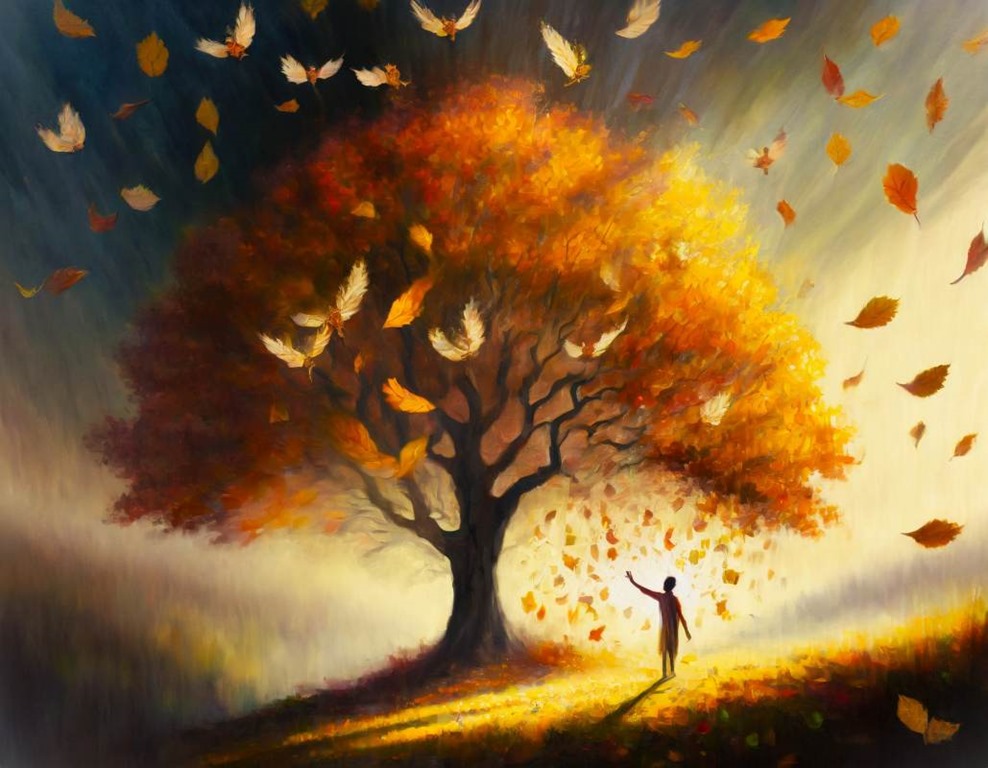
Free to Fall Illustration 800

“Everything is free to fall”

.

The originality of this compressed catalog of autumn thought comes in the refrained pair of lines “I grew up believing/everything was free to fall.” What was my intent there? I’m not sure if I’m articulate enough to do as brief a job as the poet me did in writing the poem. Yes, I knew many readers/listeners would think of things like free will and predestination, shibboleths of theology — but in the lines’ first statement I wanted the connotation that autumn’s falling leaves are freed from their work in photosynthesis and now can flutter and drift. The fourth verse refrain may (or may not) put this in a different context. Is this a compressed statement of “free will,” the doctrine that humankind has the choice of choosing good or evil, which also carries a connected thought that this is what makes good, good, not just an inherent trait? I was likely aware of that when I wrote it, but in performing it this fall I took another plausible memory: that there are those who believe in an afterlife, or a rising or rebirth of the souls of the dead, but that the song’s singer believes that however temporary or final autumn’s dying off is, that there’s a freeing element in it, like that leaf that has been loosed at the start. That’s a bittersweet freedom I wanted to convey.

Free to Fall

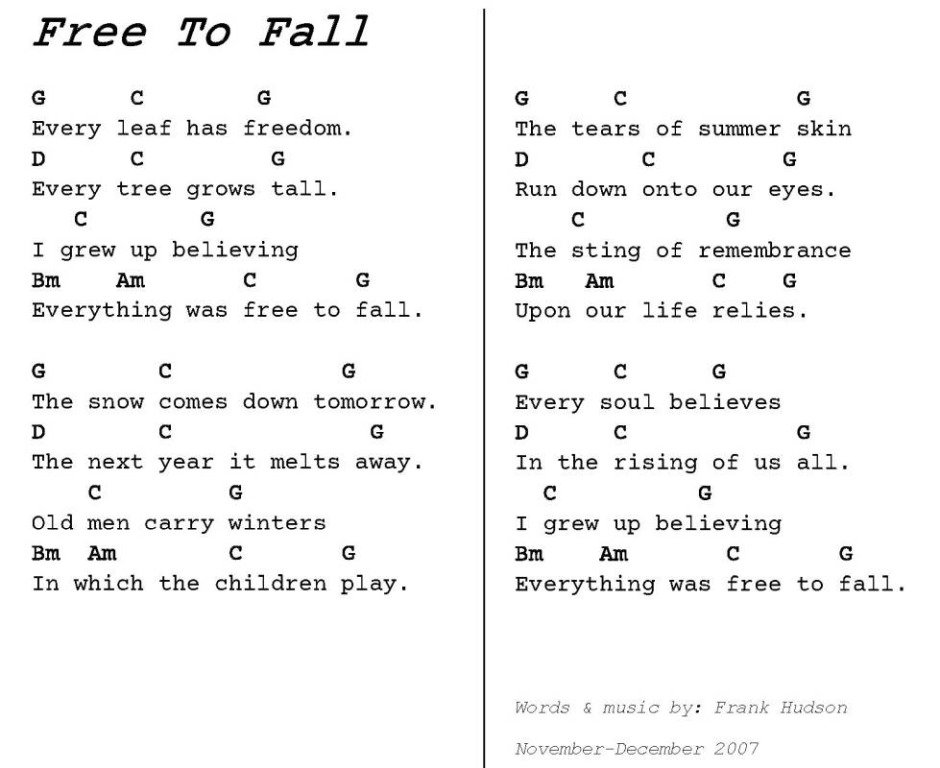
Here’s a chord sheet so that other singers can extend or improve my performance

.

This poem/song works for me. Maybe it has some worth to you. In summary, the way I think it works is from the ability of compressed verse and song to collect things in a small memorable chunk of words, a portable experience. I’m glad I remembered this 16-year-old song and that I was able to record a new version to share with you. You can hear it with the audio player gadget below if you see that. No gadget? Some ways of viewing this blog won’t show them, but this highlighted link will open a new tab with its own audio player.
.

*“Where are the snows of yesteryear” is the concluding line of his “Ballade des dames du temps jadis”  published in 1533. Yup, those snows are definitely gone.

**One of the abandoned Parlando Project songs you won’t hear came from my idea to do a fresh translation of Surrealist-associated poet/lyricist Prévert’s French “Autumn Leaves” lyrics. I got a hold of those lyrics in French, and found that Johnny Mercer’s English lyrics are a freer, looser sort of translation. Prévert’s lyric is longer and more miserable, while Mercer’s cuts right to the nub of the situation without wasted elaboration. I found there was nothing I could do with Prévert’s French that would even approach the recasting that Mercer had already done.

Wabasha and 5th, 1949

Tomorrow is Thanksgiving in the United States, a harvest festival with elements of a more general event for gratitude. Those who wish to emphasize the gratitude aspect will often decry that Thanksgiving has become too connected with the Christmas shopping season. Their criticism would be: how inappropriate that a day to count our blessings is the day to launch a month of acquisitions and striving for more to give or get.

Earlier in this frankly troubling week for my family, with losses, stresses, and dissatisfactions, I happened upon a photograph from Twitter user Gary Hornseth, who specializes in archived photos and scans from my region. As I glanced at it, I first noticed that it was a very nice urban nightscape shot. The photographer, either freelance or working on a newspaper’s staff, was able to get a long exposure and the right amount of what painters call chiaroscuro to make the high-vantage-point monochrome shot eye-catching. The archivist’s note didn’t tell us who the photographer was, but they say its source was the November 23rd 1949 edition of the St. Paul Pioneer Press newspaper.

Wabasha and 5th 1949

I don’t know who the photographer of this midcentury downtown St. Paul shot was. Fine work.

.

But then the next thing intrigued me. Hold it, I know that section of St. Paul Minnesota. I worked for 20 years just a couple of blocks away from that corner later in the 20th century. There — that must be the church spire next door to where my coworkers and I worked for a radio network. Back then, from the 4th floor or the roof of my workplace, nearly the same viewpoint on the night was on offer. The streetcar that runs down Wabasha in the old photo? That would be ancestral to the light rail that eventually ran down the street by my work. I looked closer to see what else I could find in the photo. Oh look, there are Christmas decorations spanning the street. Many cities and towns used to string them between light poles for the season, and there they were, like a Minnesota Bedford Falls, arrayed across Wabasha. I checked a calendar. Just as today’s 23rd of November, the day this photo appeared was the eve of Thanksgiving.

And finally, I saw the one thing that drew me furthest into that picture. At the left margin of the photo, silhouetted in a lit window on the 4th floor of an office building, is the single human figure in the shot. Not enough detail to say who they are, just their unmistakable human form. A cleaning person, night watchman, midnight-oil-burning worker, or business owner? Could it even be a writer such as myself? Because they are not so blurred in the photo’s long exposure, we know they were standing still, looking out for a good moment. To look out at the night on a settlement of people, especially from a high vantage point, is to have a thought, or the experience of something that may be more encompassing than an ordinary thought. Here then, as I would have seen decades later, are people and their creations, their government, their religions, their workplaces, their schools, their hospitals, their arts, their businesses. All of them have someplace to be or someplace to be lost from, something to celebrate or something that does not fit them. The gap in time from 1949 to now, is something like a lifetime of moving through those states, even on one corner in St. Paul Minnesota. To someone my age, that doesn’t seem that long.

In conclusion, that’s the real and balanced Thanksgiving, the one of all of us satisfied or unsatisfied, grieving or gathering, living in justice or injustice, may observe.

I wrote today’s piece you can listen to below after viewing that photo. It started somewhat prose-poem-like, which I revised more toward prose. It’s a couple minutes longer than most of our Parlando Project pieces and I didn’t have much time to put together a performance of it, so I decided to go word-jazz, working as spontaneously as a one-man band could do so. I quickly ran through the piano part, worked with percussion samples to get a drum track that worked (easily the longest task), and then played the fretless bass part. The spoken word story recording was one pass, not perfect, but close enough considering the time I could devote to this. You can hear it with the player gadget below, and where that gadget isn’t displayed, with this backup highlighted link.

.